Contents:
 Introduction
 Construction
 Working principle
 Comparison of rotor
 References
Kongunadu College of Engineering & Technology Synchronous Generator
SYNCHRONOUS GENERATOR
Introduction
Alternators (or) Synchronous generators  A Machine generating AC
e.m.f
Synchronous motors  A machine accepting i/p from AC supply to
produce mechanical output
Synchronous Speed:
Alternators has to be rotated at a particular speed to keep the frequency
of the generated e.m.f constant at required value
Ns = 120f / P
Ns  Synchronous speed
f frequency
P  No. of poles
Kongunadu College of Engineering & Technology Synchronous Generator
CONSTRUCTION
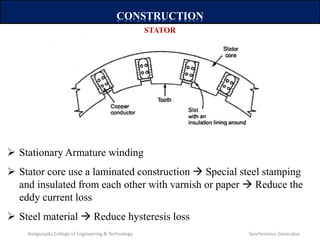
 Stationary Armature winding
 Stator core use a laminated construction  Special steel stamping
and insulated from each other with varnish or paper  Reduce the
eddy current loss
 Steel material  Reduce hysteresis loss
STATOR
Kongunadu College of Engineering & Technology Synchronous Generator
CONSTRUCTION
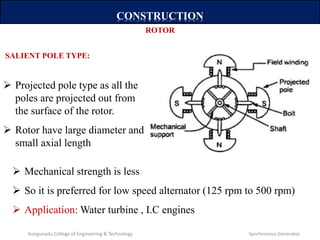
 Projected pole type as all the
poles are projected out from
the surface of the rotor.
 Rotor have large diameter and
small axial length
ROTOR
SALIENT POLE TYPE:
 Mechanical strength is less
 So it is preferred for low speed alternator (125 rpm to 500 rpm)
 Application: Water turbine , I.C engines
Kongunadu College of Engineering & Technology Synchronous Generator
CONSTRUCTION
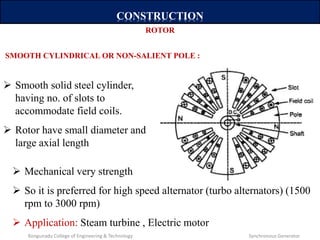
 Smooth solid steel cylinder,
having no. of slots to
accommodate field coils.
 Rotor have small diameter and
large axial length
ROTOR
SMOOTH CYLINDRICAL OR NON-SALIENT POLE :
 Mechanical very strength
 So it is preferred for high speed alternator (turbo alternators) (1500
rpm to 3000 rpm)
 Application: Steam turbine , Electric motor
Kongunadu College of Engineering & Technology Synchronous Generator
OPERATION
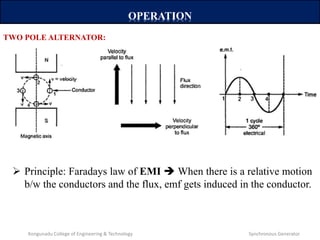
TWO POLE ALTERNATOR:
 Principle: Faradays law of EMI  When there is a relative motion
b/w the conductors and the flux, emf gets induced in the conductor.
Kongunadu College of Engineering & Technology Synchronous Generator
OPERATION
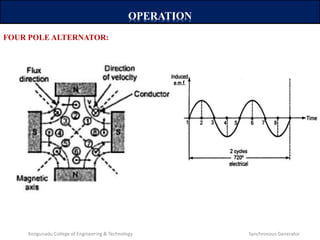
FOUR POLE ALTERNATOR:
Kongunadu College of Engineering & Technology Synchronous Generator
The rotor winding is energized from the d.c. exciter and
alternate N and S poles are developed on the rotor.
When the three phase supply is given to the stator, the stator
or armature conductors experience the force due to
electromagnetic induction.
Then the rotor starts to rotate. The speed of the motor is
given by;
N = 120f / P
Where N = speed of rotor in r.p.m. ,
P = number of rotor poles.
Kongunadu College of Engineering & Technology Synchronous Generator
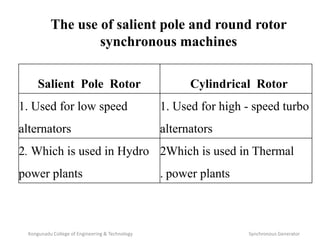
Salient Pole Rotor Cylindrical Rotor
1. Used for low speed
alternators
1. Used for high - speed turbo
alternators
2. Which is used in Hydro
power plants
2
.
Which is used in Thermal
power plants
The use of salient pole and round rotor
synchronous machines
Kongunadu College of Engineering & Technology Synchronous Generator
S.No Book s / Web Sources
1
A.E. Fitzgerald, Charles Kingsley, Stephen. D. Umans, ‘Electric Machinery’, Tata Mc Graw Hill publishing
Company Ltd, 2003.
2 D.P. Kothari and I.J. Nagrath, ‘Electric Machines’, Tata McGraw Hill Publishing Company Ltd, 2002.
3 P.S. Bhimbhra, ‘Electrical Machinery’, Khanna Publishers, 2003.
4 M.N.Bandyopadhyay, Electrical Machines Theory and Practice, PHI Learning PVT LTD., New Delhi, 2009.
5 K. Murugesh Kumar, ‘Electric Machines’, Vikas Publishing House Pvt. Ltd, 2002.
6
Syed A. Nasar, Electric Machines and Power Systems: Volume I, Mcgraw -Hill College; International ed Edition,
January 1995.
7 J. Ganavadivel, ‘Electrical Machines II’, Anuradha publications, Fourth edition, 2015.
8 U.A.Bakshi &M.V.Bakshi, ”Electrical Machines II,” Technical Publications, Second revised edition, 2016.
9 Google and Wikipedia
REFERENCES
Contents:
 Armature Reaction
 Parallel operation of Alternators
 Conditions for parallel operation
 Procedure for parallel operation
 Methods of Synchronization
 References
Armature reaction and Parallel Operation of Alternators
Kongunadu College of Engineering & Technology Armature Reaction and Parallel operation
Armature reaction
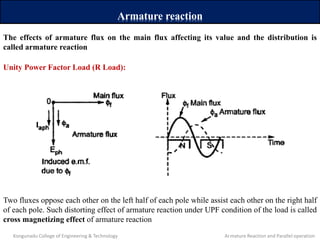
The effects of armature flux on the main flux affecting its value and the distribution is
called armature reaction
Unity Power Factor Load (R Load):
Two fluxes oppose each other on the left half of each pole while assist each other on the right half
of each pole. Such distorting effect of armature reaction under UPF condition of the load is called
cross magnetizing effect of armature reaction
Kongunadu College of Engineering & Technology Armature Reaction and Parallel operation
Armature reaction
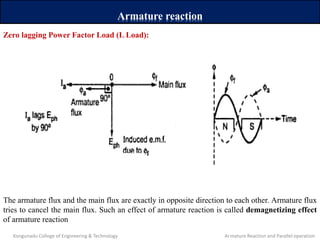
Zero lagging Power Factor Load (L Load):
The armature flux and the main flux are exactly in opposite direction to each other. Armature flux
tries to cancel the main flux. Such an effect of armature reaction is called demagnetizing effect
of armature reaction
Kongunadu College of Engineering & Technology Armature Reaction and Parallel operation
Armature reaction
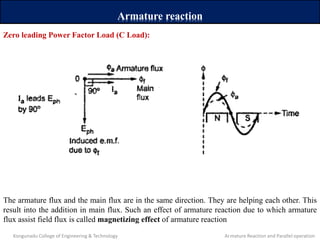
Zero leading Power Factor Load (C Load):
The armature flux and the main flux are in the same direction. They are helping each other. This
result into the addition in main flux. Such an effect of armature reaction due to which armature
flux assist field flux is called magnetizing effect of armature reaction
Kongunadu College of Engineering & Technology Armature Reaction and Parallel operation
Armature reaction
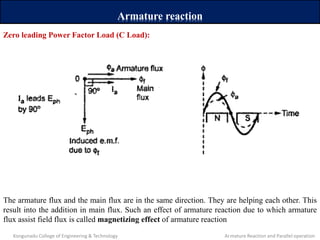
Zero leading Power Factor Load (C Load):
The armature flux and the main flux are in the same direction. They are helping each other. This
result into the addition in main flux. Such an effect of armature reaction due to which armature
flux assist field flux is called magnetizing effect of armature reaction
Kongunadu College of Engineering & Technology Armature Reaction and Parallel operation
Armature reaction
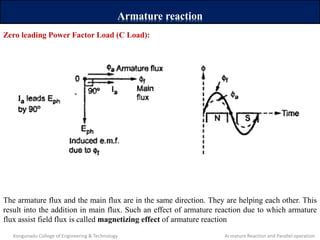
Zero leading Power Factor Load (C Load):
The armature flux and the main flux are in the same direction. They are helping each other. This
result into the addition in main flux. Such an effect of armature reaction due to which armature
flux assist field flux is called magnetizing effect of armature reaction
Kongunadu College of Engineering & Technology Armature Reaction and Parallel operation
Parallel Operation of Alternators
Most of synchronous generators are operating in parallel with other synchronous
generators to supply power to the same power system. Obvious advantages of this
arrangement are:
1. Several generators can supply a bigger load;
2. A failure of a single generator does not result in a total power loss to the load
increasing reliability of the power system;
3. Individual generators may be removed from the power system for maintenance
without shutting down the load;
4. A single generator not operating at near full load might be quite inefficient.
While having several generators in parallel, it is possible to turn off some of
them when operating the rest at near full-load condition.
Kongunadu College of Engineering & Technology Armature Reaction and Parallel operation
Conditions for Parallel Operation
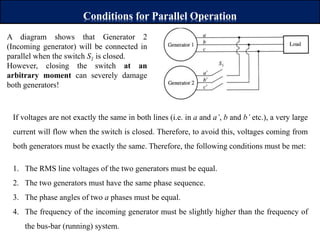
A diagram shows that Generator 2
(Incoming generator) will be connected in
parallel when the switch S1 is closed.
However, closing the switch at an
arbitrary moment can severely damage
both generators!
If voltages are not exactly the same in both lines (i.e. in a and a’, b and b’ etc.), a very large
current will flow when the switch is closed. Therefore, to avoid this, voltages coming from
both generators must be exactly the same. Therefore, the following conditions must be met:
1. The RMS line voltages of the two generators must be equal.
2. The two generators must have the same phase sequence.
3. The phase angles of two a phases must be equal.
4. The frequency of the incoming generator must be slightly higher than the frequency of
the bus-bar (running) system.
Conditions for Parallel Operation
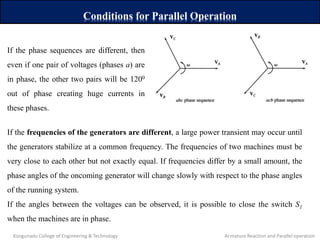
If the phase sequences are different, then
even if one pair of voltages (phases a) are
in phase, the other two pairs will be 1200
out of phase creating huge currents in
these phases.
If the frequencies of the generators are different, a large power transient may occur until
the generators stabilize at a common frequency. The frequencies of two machines must be
very close to each other but not exactly equal. If frequencies differ by a small amount, the
phase angles of the oncoming generator will change slowly with respect to the phase angles
of the running system.
If the angles between the voltages can be observed, it is possible to close the switch S1
when the machines are in phase.
Kongunadu College of Engineering & Technology Armature Reaction and Parallel operation
General procedure for paralleling generators
When connecting the generator G2 to the running system, the following steps should be
taken:
1. Adjust the field current of the oncoming generator to make its terminal voltage equal to
the line voltage of the system (use a voltmeter).
2. Compare the phase sequences of the oncoming generator and the running system. This
can be done by different ways:
1) Connect a small induction motor to the terminals of the oncoming generator and
then to the terminals of the running system. If the motor rotates in the same
direction, the phase sequence is the same;
2) Connect three light bulbs across the open terminals of the switch. As the phase
changes between the two generators, light bulbs get brighter (large phase difference)
or dimmer (small phase difference). If all three bulbs get bright and dark together,
both generators have the same phase sequences.
General procedure for paralleling generators
If phase sequences are different, two of the conductors on the oncoming
generator must be reversed.
3. The frequency of the oncoming generator is adjusted to be slightly higher than
the system’s frequency.
4. Turn on the switch connecting G2 to the system when phase angles are equal.
The simplest way to determine the moment when two generators are in phase is by observing the
same three light bulbs. When all three lights go out, the voltage across them is zero and,
therefore, machines are in phase.
A more accurate way is to use a synchroscope – a meter measuring the difference in phase angles
between two a phases. However, a synchroscope does not check the phase sequence since it only
measures the phase difference in one phase.
Kongunadu College of Engineering & Technology Armature Reaction and Parallel operation
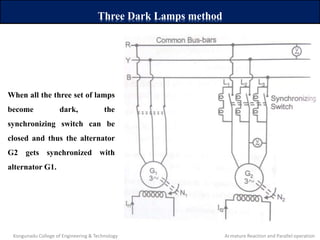
Three Dark Lamps method
When all the three set of lamps
become dark, the
synchronizing switch can be
closed and thus the alternator
G2 gets synchronized with
alternator G1.
Kongunadu College of Engineering & Technology Armature Reaction and Parallel operation
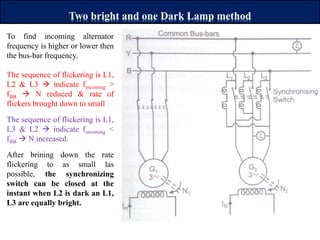
Two bright and one Dark Lamp method
To find incoming alternator
frequency is higher or lower then
the bus-bar frequency.
The sequence of flickering is L1,
L2 & L3  indicate fincoming >
fBB  N reduced & rate of
flickers brought down to small
The sequence of flickering is L1,
L3 & L2  indicate fincoming <
fBB  N increased.
After brining down the rate
flickering to as small las
possible, the synchronizing
switch can be closed at the
instant when L2 is dark an L1,
L3 are equally bright.
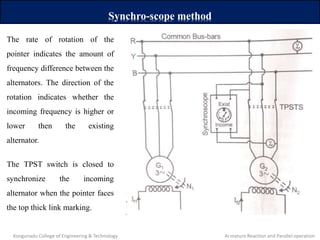
Synchro-scope method
The rate of rotation of the
pointer indicates the amount of
frequency difference between the
alternators. The direction of the
rotation indicates whether the
incoming frequency is higher or
lower then the existing
alternator.
The TPST switch is closed to
synchronize the incoming
alternator when the pointer faces
the top thick link marking.
Kongunadu College of Engineering & Technology Armature Reaction and Parallel operation
REFERENCES
S.No Book s / Web Sources
1
A.E. Fitzgerald, Charles Kingsley, Stephen. D. Umans, ‘Electric Machinery’, Tata Mc Graw Hill publishing
Company Ltd, 2003.
2 D.P. Kothari and I.J. Nagrath, ‘Electric Machines’, Tata McGraw Hill Publishing Company Ltd, 2002.
3 P.S. Bhimbhra, ‘Electrical Machinery’, Khanna Publishers, 2003.
4 M.N.Bandyopadhyay, Electrical Machines Theory and Practice, PHI Learning PVT LTD., New Delhi, 2009.
5 K. Murugesh Kumar, ‘Electric Machines’, Vikas Publishing House Pvt. Ltd, 2002.
6
Syed A. Nasar, Electric Machines and Power Systems: Volume I, Mcgraw -Hill College; International ed Edition,
January 1995.
7 J. Ganavadivel, ‘Electrical Machines II’, Anuradha publications, Fourth edition, 2015.
8 U.A.Bakshi &M.V.Bakshi, ”Electrical Machines II,” Technical Publications, Second revised edition, 2016.
9 Google and Wikipedia
Contents:
 Two reaction theory
 Phasor diagram
 Slip test
 Important cautions for slip test
 References
Two Reaction Theory and Slip test
Kongunadu College of Engineering & Technology Two reaction Theory & Slip Test
Two Reaction Theory
Introduction
Salient-pole generators, such as hydroelectric generators,
have armature inductances that are a function of rotor position,
making analysis one step more complicated.
The key to analysis of such machines is to separate mmf and
flux into two orthogonal components. The two components are
aligned with the direct axis and the quadrature axis of the
machine.
The direct axis is aligned with the field winding, while the
quadrature axis leads the direct by 90°.
Kongunadu College of Engineering & Technology Two reaction Theory & Slip Test
Two Reaction Theory
According to this theory the armature m.m.f can be divided
into two components as,
Component acting along the pole axis called direct
(Magnetizing/ demagnetizing) axis (d-axis: The R offered to
m.m.f wave is lowest when it is aligned wit field pole axis).
Component acting at right angle to the pole axis called
quadrature (cross magnetizing) axis (q axis: The R offered is
highest when the mmf wave oriented at 900 to the field pole
axis).
Kongunadu College of Engineering & Technology Two reaction Theory & Slip Test
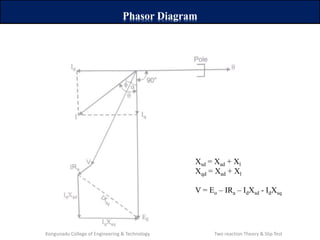
Phasor Diagram
Xsd = Xad + Xl
Xqd = Xad + Xl
V = Eo – IRa – IdXsd - IdXsq
Kongunadu College of Engineering & Technology Two reaction Theory & Slip Test
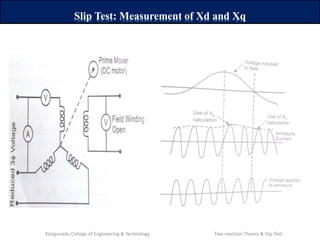
The d-axis and q-axis reactance can be measured by slip test.
When the peak of the armature m.m.f is in line with the field pole,
the reluctance offered by the magnitude circuit is minimum. The
ratio of armature terminal voltage per phase to armature phase
current gives Xd.
After one quarter of slip cycle, the peak of armature m.m.f is in
line with q-axis and the reluctance offered by the magnetic circuit is
maximum. The ratio of armature terminal voltage per phase to
armature phase current gives Xq.
Slip Test: Measurement of Xd and Xq
Kongunadu College of Engineering & Technology Two reaction Theory & Slip Test
Slip Test: Measurement of Xd and Xq
Kongunadu College of Engineering & Technology Two reaction Theory & Slip Test
1) Slip should be extremely low during experimentation. In case of
high slip (more than about 5%) following effects may be observed:-
(a) Current induced in the damper winding of alternator will
produce an appreciable error.
(b) Induced voltage in the open circuit field may r
each dangerous values.
2) It should be assured that the induced voltage in
the open circuit is less than the rating of
the voltmeter connected in the circuit.
Important cautions for slip test
Kongunadu College of Engineering & Technology Two reaction Theory & Slip Test
References :
Kongunadu College of Engineering & Technology Two reaction Theory & Slip Test
S.No Book s / Web Sources
1
A.E. Fitzgerald, Charles Kingsley, Stephen. D. Umans, ‘Electric Machinery’, Tata Mc Graw Hill publishing
Company Ltd, 2003.
2 D.P. Kothari and I.J. Nagrath, ‘Electric Machines’, Tata McGraw Hill Publishing Company Ltd, 2002.
3 P.S. Bhimbhra, ‘Electrical Machinery’, Khanna Publishers, 2003.
4 M.N.Bandyopadhyay, Electrical Machines Theory and Practice, PHI Learning PVT LTD., New Delhi, 2009.
5 K. Murugesh Kumar, ‘Electric Machines’, Vikas Publishing House Pvt. Ltd, 2002.
6
Syed A. Nasar, Electric Machines and Power Systems: Volume I, Mcgraw -Hill College; International ed Edition,
January 1995.
7 J. Ganavadivel, ‘Electrical Machines II’, Anuradha publications, Fourth edition, 2015.
8 U.A.Bakshi &M.V.Bakshi, ”Electrical Machines II,” Technical Publications, Second revised edition, 2016.
9 Google and Wikipedia
Synchronous Motor
• Synchronous Motor-Introduction
• Synchronous Motor-principle
• Changing the Load
• Starting Torque
• Improvement of starting torque
• Synchronous Machine Construction
• Summary
Kongunadu College of Engineering & Technology Synchronous Motor
Synchronous Motor- Introduction
 The synchronous motor rotates at the synchronous
speed i.e. the speed of the RMF.
 Stator is similar in construction to that of an
induction motor, so same principle is applied to the
synchronous motor rotor.
 Field excitation is provided on the rotor by either
permanent or electromagnets with number of poles
equal to the poles of the RMF caused by stator
Kongunadu College of Engineering & Technology Synchronous Motor
Synchronous Motor-Principle
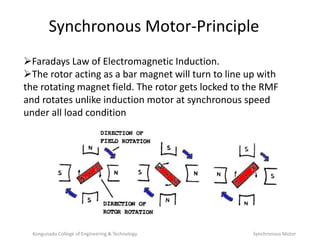
Faradays Law of Electromagnetic Induction.
The rotor acting as a bar magnet will turn to line up with
the rotating magnet field. The rotor gets locked to the RMF
and rotates unlike induction motor at synchronous speed
under all load condition
Kongunadu College of Engineering & Technology Synchronous Motor
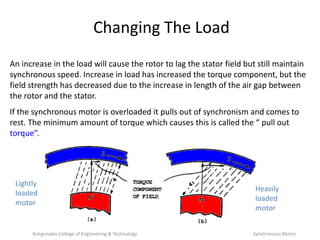
An increase in the load will cause the rotor to lag the stator field but still maintain
synchronous speed. Increase in load has increased the torque component, but the
field strength has decreased due to the increase in length of the air gap between
the rotor and the stator.
If the synchronous motor is overloaded it pulls out of synchronism and comes to
rest. The minimum amount of torque which causes this is called the “ pull out
torque”.
Lightly
loaded
motor
Heavily
loaded
motor
Changing The Load
Kongunadu College of Engineering & Technology Synchronous Motor
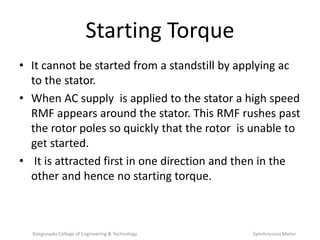
Starting Torque
• It cannot be started from a standstill by applying ac
to the stator.
• When AC supply is applied to the stator a high speed
RMF appears around the stator. This RMF rushes past
the rotor poles so quickly that the rotor is unable to
get started.
• It is attracted first in one direction and then in the
other and hence no starting torque.
Kongunadu College of Engineering & Technology Synchronous Motor
Improvement of starting torque
• It is started by using a squirrel cage within a
rotor construction and therefore starts as an
induction motor.
• At synchronous speed the squirrel cage has no
part to play.
Kongunadu College of Engineering & Technology Synchronous Motor
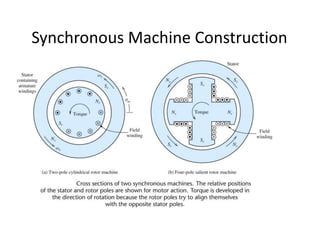
Synchronous Machine Construction
Construction
Stator:
 Stationary Armature winding
 Stator core use a laminated construction  Special
steel stamping and insulated from each other with
varnish or paper  Reduce the eddy current loss
 Steel material  Reduce hysteresis loss
Kongunadu College of Engineering & Technology Synchronous Motor
Rotor:
 Projected pole type as all the poles are projected out
from the surface of the rotor.
 Rotor have large diameter and small axial length
 The poles have damper winding.
 The damper windings are used to reduce the
‘Hunting’
Kongunadu College of Engineering & Technology Synchronous Motor
Summary
 The synchronous motor requires to be started by an external
prime mover.
 Runs only at synchronous speed, this is an advantage where
continuous speed is required but a disadvantage where a
variable speed is required.
 Can be used to adjust the power factor of a system at the
same time it is driving a mechanical load.
Kongunadu College of Engineering & Technology Synchronous Motor
References
Kongunadu College of Engineering & Technology Synchronous Motor
S.No Book s / Web Sources
1
A.E. Fitzgerald, Charles Kingsley, Stephen. D. Umans, ‘Electric Machinery’, Tata Mc Graw Hill publishing
Company Ltd, 2003.
2 D.P. Kothari and I.J. Nagrath, ‘Electric Machines’, Tata McGraw Hill Publishing Company Ltd, 2002.
3 P.S. Bhimbhra, ‘Electrical Machinery’, Khanna Publishers, 2003.
4 M.N.Bandyopadhyay, Electrical Machines Theory and Practice, PHI Learning PVT LTD., New Delhi, 2009.
5 K. Murugesh Kumar, ‘Electric Machines’, Vikas Publishing House Pvt. Ltd, 2002.
6
Syed A. Nasar, Electric Machines and Power Systems: Volume I, Mcgraw -Hill College; International ed Edition,
January 1995.
7 J. Ganavadivel, ‘Electrical Machines II’, Anuradha publications, Fourth edition, 2015.
8 U.A.Bakshi &M.V.Bakshi, ”Electrical Machines II,” Technical Publications, Second revised edition, 2016.
9 Google and Wikipedia
Vector diagram and Phasor diagram of Synchronous Motor
Contents:
 Vector diagram
 Phasor diagram
 Synchronous condenser
 Applications of Synchronous motor
 References
Kongunadu College of Engineering & Technology Synchronous Motor vector and phasor diagram
Vector Diagram and Phasor diagram of
Synchronous Motor
• The equivalent circuit of a synchronous motor is exactly same as the equivalent
circuit of a synchronous generator, except that the reference direction of IA is
reversed.
• The basic difference between motor and generator operation in synchronous
machines can be seen either in the magnetic field diagram or in the phasor diagram.
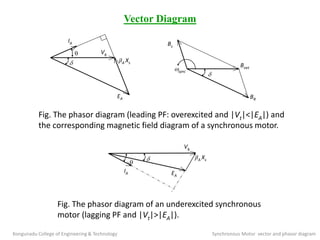
• In a generator, EA lies ahead of Vf, and BR lies ahead of Bnet. In a motor, EA lies
behind Vf, and BR lies behind Bnet.
• In a motor the induced torque is in the direction of motion, and in a generator the
induced torque is a countertorque opposing the direction of motion.
Kongunadu College of Engineering & Technology Synchronous Motor vector and phasor diagram
Vector Diagram
d
IA
Vf
EA
jIA Xs
d
IA
Vf
EA
jIA Xs
d
Bs
Bnet
BR
wsync
Fig. The phasor diagram (leading PF: overexcited and |Vt|<|EA|) and
the corresponding magnetic field diagram of a synchronous motor.
Fig. The phasor diagram of an underexcited synchronous
motor (lagging PF and |Vt|>|EA|).
Kongunadu College of Engineering & Technology Synchronous Motor vector and phasor diagram
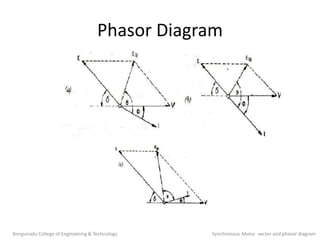
Phasor Diagram
• (a) Unity power factor
• In this unity power factor, the excitation of the synchronous
motor is 100% or in normal excitation.
• (b) Lagging power factor
• In this unity power factor, the excitation of the synchronous
motor is less than 100%.
• (c) Leading power factor
• In this unity power factor, the excitation of the synchronous
motor is greater than 100%.
Kongunadu College of Engineering & Technology Synchronous Motor vector and phasor diagram
Phasor Diagram
Kongunadu College of Engineering & Technology Synchronous Motor vector and phasor diagram
Synchronous motor can be used as synchronous
condenser
• An over excited synchronous motor running on no load is known as
synchronous capacitor or synchronous condenser.
• A synchronous motor takes a leading current when over excited and
therefore, behaves as a capacitor.
• As compared with a synchronous motor with equal armature voltage
and current rating a synchronous capacitor requires more copper in the
field winding to carry large field current.
• The synchronous capacitor does not require so large shaft and bearings
as the synchronous motor because no shaft torque is required.
Kongunadu College of Engineering & Technology Synchronous Motor vector and phasor diagram
Applications of Synchronous Motor
Synchronous motors are usually used in large sizes because in small sizes
they are costlier as compared with induction machines. The principal
advantages of using synchronous machine are as follows:
– Power factor of synchronous machine can be controlled very easily
by controlling the field current.
– It has very high operating efficiency and constant speed.
– For operating speed less than about 500 rpm and for high-power
requirements (above 600KW) synchronous motor is cheaper than
induction motor.
In view of these advantages, synchronous motors are preferred for driving
the loads requiring high power at low speed; e.g; reciprocating pumps and
compressor, crushers, rolling mills, pulp grinders etc.
Kongunadu College of Engineering & Technology Synchronous Motor vector and phasor diagram
References :
Kongunadu College of Engineering & Technology Synchronous Motor vector and phasor diagram
S.No Book s / Web Sources
1
A.E. Fitzgerald, Charles Kingsley, Stephen. D. Umans, ‘Electric Machinery’, Tata Mc Graw Hill publishing
Company Ltd, 2003.
2 D.P. Kothari and I.J. Nagrath, ‘Electric Machines’, Tata McGraw Hill Publishing Company Ltd, 2002.
3 P.S. Bhimbhra, ‘Electrical Machinery’, Khanna Publishers, 2003.
4 M.N.Bandyopadhyay, Electrical Machines Theory and Practice, PHI Learning PVT LTD., New Delhi, 2009.
5 K. Murugesh Kumar, ‘Electric Machines’, Vikas Publishing House Pvt. Ltd, 2002.
6
Syed A. Nasar, Electric Machines and Power Systems: Volume I, Mcgraw -Hill College; International ed Edition,
January 1995.
7 J. Ganavadivel, ‘Electrical Machines II’, Anuradha publications, Fourth edition, 2015.
8 U.A.Bakshi &M.V.Bakshi, ”Electrical Machines II,” Technical Publications, Second revised edition, 2016.
9 Google and Wikipedia
V and Inverted V Curves of
Synchronous Motor
Explanation.
Circuit Diagram
V curve and Inverted V curve
Kongunadu College of Engineering & Technology V and Inverted V curves of Synchronous Motor
Explanation
• When the excitation of a three phase synchronous
motor taking constant power P from constant voltage
supply main is varied, the power factor of the motor
changes.
• The power drawn by a 3 phase synchronous motor is
given by, P=VIcosφ.
• Since input power P and supply voltage V are
constant, decrease in power factor causes increase in
armature current and vice-versa.
Kongunadu College of Engineering & Technology V and Inverted V curves of Synchronous Motor
Circuit diagram
Kongunadu College of Engineering & Technology V and Inverted V curves of Synchronous Motor
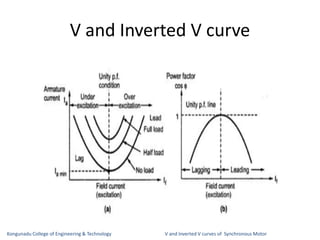
 Hence variation in excitation or in field current causes the
variation in armature current and curves drawn between armature
current and field current for different power inputs are known as
“V – curves”.
 On the other hand ,if the power factor (cosφ) is plotted against the
field current, the graph looks like an inverted V.
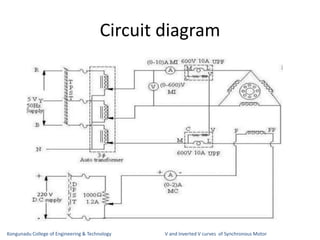
 The following figures shows the experimental setup to obtain V
curves. The three phase supply is given to stator.
 The two wattmeter method is used to measure the input power.
 Here the rheostat is used in the field circuit to adjust the excitation
to operate the motor under variable excitation.
Kongunadu College of Engineering & Technology V and Inverted V curves of Synchronous Motor
V and Inverted V curve
Kongunadu College of Engineering & Technology V and Inverted V curves of Synchronous Motor
conclusion
V curve
V curve is the graph showing the relation of armature current
as a function of field current in synchronous machines keeping the
load constant. The purpose of the curve is to show the variation in
the magnitude of the armature current as the excitation voltage of
the machine is varied.
Inverted V curve
The Inverted V Curve is a graph showing the relation of power factor as a
function of field current
Kongunadu College of Engineering & Technology V and Inverted V curves Synchronous Motor
references
Kongunadu College of Engineering & Technology V and Inverted V curves Synchronous Motor
S.No Book s / Web Sources
1
A.E. Fitzgerald, Charles Kingsley, Stephen. D. Umans, ‘Electric Machinery’, Tata Mc Graw Hill publishing
Company Ltd, 2003.
2 D.P. Kothari and I.J. Nagrath, ‘Electric Machines’, Tata McGraw Hill Publishing Company Ltd, 2002.
3 P.S. Bhimbhra, ‘Electrical Machinery’, Khanna Publishers, 2003.
4 M.N.Bandyopadhyay, Electrical Machines Theory and Practice, PHI Learning PVT LTD., New Delhi, 2009.
5 K. Murugesh Kumar, ‘Electric Machines’, Vikas Publishing House Pvt. Ltd, 2002.
6
Syed A. Nasar, Electric Machines and Power Systems: Volume I, Mcgraw -Hill College; International ed Edition,
January 1995.
7 J. Ganavadivel, ‘Electrical Machines II’, Anuradha publications, Fourth edition, 2015.
8 U.A.Bakshi &M.V.Bakshi, ”Electrical Machines II,” Technical Publications, Second revised edition, 2016.
9 Google and Wikipedia
Three Phase Induction Motors
Contents :
Frequency of Rotor
Rotor EMF
Rotor Current and Power Factor
Related Problems
Kongunadu college of Engineering & Technology Three phase Induction – Frequency, Rotor EMF, Current and Power factor related Problems
Frequency of Rotor
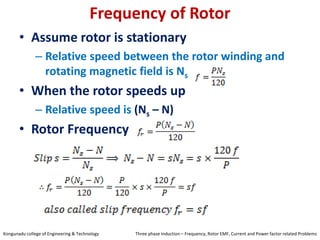
• Assume rotor is stationary
– Relative speed between the rotor winding and
rotating magnetic field is Ns
• When the rotor speeds up
– Relative speed is (Ns – N)
• Rotor Frequency
Kongunadu college of Engineering & Technology Three phase Induction – Frequency, Rotor EMF, Current and Power factor related Problems
Rotor EMF
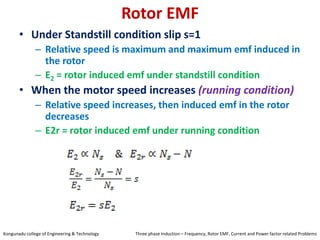
• Under Standstill condition slip s=1
– Relative speed is maximum and maximum emf induced in
the rotor
– E2 = rotor induced emf under standstill condition
• When the motor speed increases (running condition)
– Relative speed increases, then induced emf in the rotor
decreases
– E2r = rotor induced emf under running condition
Kongunadu college of Engineering & Technology Three phase Induction – Frequency, Rotor EMF, Current and Power factor related Problems
Rotor Current and Power Factor
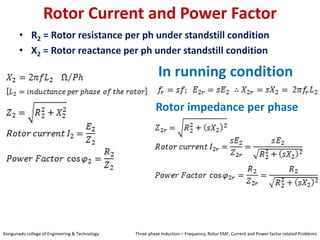
• R2 = Rotor resistance per ph under standstill condition
• X2 = Rotor reactance per ph under standstill condition
In running condition
Rotor impedance per phase
Kongunadu college of Engineering & Technology Three phase Induction – Frequency, Rotor EMF, Current and Power factor related Problems
Problem - 1
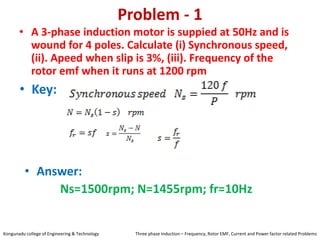
• A 3-phase induction motor is suppied at 50Hz and is
wound for 4 poles. Calculate (i) Synchronous speed,
(ii). Apeed when slip is 3%, (iii). Frequency of the
rotor emf when it runs at 1200 rpm
• Key:
• Answer:
Ns=1500rpm; N=1455rpm; fr=10Hz
Kongunadu college of Engineering & Technology Three phase Induction – Frequency, Rotor EMF, Current and Power factor related Problems
Problem - 2
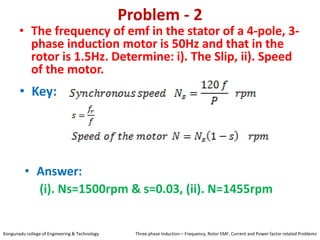
• The frequency of emf in the stator of a 4-pole, 3-
phase induction motor is 50Hz and that in the
rotor is 1.5Hz. Determine: i). The Slip, ii). Speed
of the motor.
• Key:
• Answer:
(i). Ns=1500rpm & s=0.03, (ii). N=1455rpm
Kongunadu college of Engineering & Technology Three phase Induction – Frequency, Rotor EMF, Current and Power factor related Problems
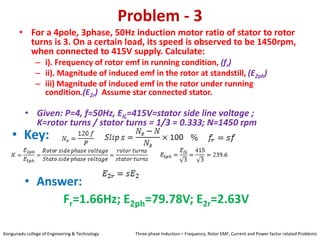
Problem - 3
• For a 4pole, 3phase, 50Hz induction motor ratio of stator to rotor
turns is 3. On a certain load, its speed is observed to be 1450rpm,
when connected to 415V supply. Calculate:
– i). Frequency of rotor emf in running condition, (fr)
– ii). Magnitude of induced emf in the rotor at standstill, (E2ph)
– iii) Magnitude of induced emf in the rotor under running
condition.(E2r) Assume star connected stator.
• Key:
• Answer:
Fr=1.66Hz; E2ph=79.78V; E2r=2.63V
• Given: P=4, f=50Hz, EIL=415V=stator side line voltage ;
K=rotor turns / stator turns = 1/3 = 0.333; N=1450 rpm
Kongunadu college of Engineering & Technology Three phase Induction – Frequency, Rotor EMF, Current and Power factor related Problems
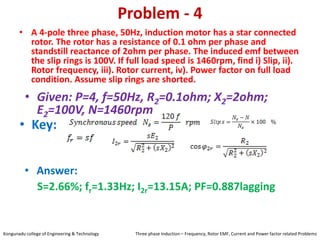
Problem - 4
• A 4-pole three phase, 50Hz, induction motor has a star connected
rotor. The rotor has a resistance of 0.1 ohm per phase and
standstill reactance of 2ohm per phase. The induced emf between
the slip rings is 100V. If full load speed is 1460rpm, find i) Slip, ii).
Rotor frequency, iii). Rotor current, iv). Power factor on full load
condition. Assume slip rings are shorted.
• Key:
• Answer:
S=2.66%; fr=1.33Hz; I2r=13.15A; PF=0.887lagging
• Given: P=4, f=50Hz, R2=0.1ohm; X2=2ohm;
E2=100V, N=1460rpm
Kongunadu college of Engineering & Technology Three phase Induction – Frequency, Rotor EMF, Current and Power factor related Problems
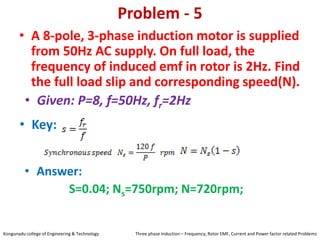
Problem - 5
• A 8-pole, 3-phase induction motor is supplied
from 50Hz AC supply. On full load, the
frequency of induced emf in rotor is 2Hz. Find
the full load slip and corresponding speed(N).
• Key:
• Answer:
S=0.04; Ns=750rpm; N=720rpm;
• Given: P=8, f=50Hz, fr=2Hz
Kongunadu college of Engineering & Technology Three phase Induction – Frequency, Rotor EMF, Current and Power factor related Problems
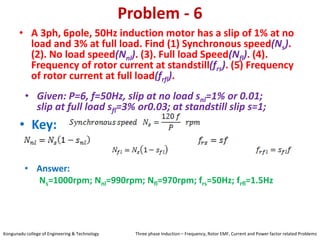
Problem - 6
• A 3ph, 6pole, 50Hz induction motor has a slip of 1% at no
load and 3% at full load. Find (1) Synchronous speed(Ns).
(2). No load speed(Nnl). (3). Full load Speed(Nfl). (4).
Frequency of rotor current at standstill(frs). (5) Frequency
of rotor current at full load(frfl).
• Key:
• Answer:
Ns=1000rpm; Nnl=990rpm; Nfl=970rpm; frs=50Hz; frfl=1.5Hz
• Given: P=6, f=50Hz, slip at no load snl=1% or 0.01;
slip at full load sfl=3% or0.03; at standstill slip s=1;
Kongunadu college of Engineering & Technology Three phase Induction – Frequency, Rotor EMF, Current and Power factor related Problems
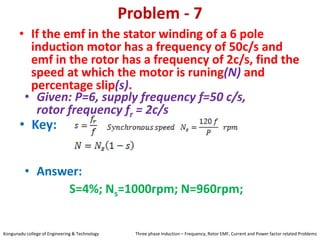
Problem - 7
• If the emf in the stator winding of a 6 pole
induction motor has a frequency of 50c/s and
emf in the rotor has a frequency of 2c/s, find the
speed at which the motor is runing(N) and
percentage slip(s).
• Key:
• Answer:
S=4%; Ns=1000rpm; N=960rpm;
• Given: P=6, supply frequency f=50 c/s,
rotor frequency fr = 2c/s
Kongunadu college of Engineering & Technology Three phase Induction – Frequency, Rotor EMF, Current and Power factor related Problems
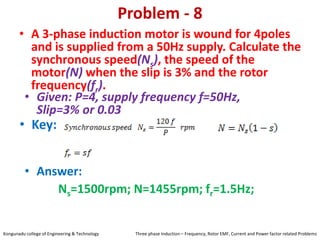
Problem - 8
• A 3-phase induction motor is wound for 4poles
and is supplied from a 50Hz supply. Calculate the
synchronous speed(Ns), the speed of the
motor(N) when the slip is 3% and the rotor
frequency(fr).
• Key:
• Answer:
Ns=1500rpm; N=1455rpm; fr=1.5Hz;
• Given: P=4, supply frequency f=50Hz,
Slip=3% or 0.03
Kongunadu college of Engineering & Technology Three phase Induction – Frequency, Rotor EMF, Current and Power factor related Problems
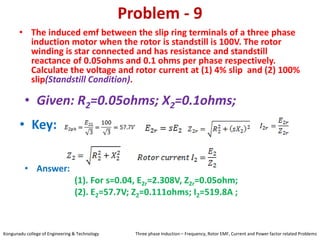
Problem - 9
• The induced emf between the slip ring terminals of a three phase
induction motor when the rotor is standstill is 100V. The rotor
winding is star connected and has resistance and standstill
reactance of 0.05ohms and 0.1 ohms per phase respectively.
Calculate the voltage and rotor current at (1) 4% slip and (2) 100%
slip(Standstill Condition).
• Key:
• Answer:
(1). For s=0.04, E2r=2.308V, Z2r=0.05ohm;
(2). E2=57.7V; Z2=0.111ohms; I2=519.8A ;
• Given: R2=0.05ohms; X2=0.1ohms;
Kongunadu college of Engineering & Technology Three phase Induction – Frequency, Rotor EMF, Current and Power factor related Problems
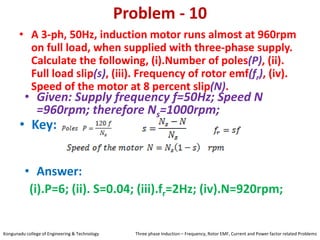
Problem - 10
• A 3-ph, 50Hz, induction motor runs almost at 960rpm
on full load, when supplied with three-phase supply.
Calculate the following, (i).Number of poles(P), (ii).
Full load slip(s), (iii). Frequency of rotor emf(fr), (iv).
Speed of the motor at 8 percent slip(N).
• Key:
• Answer:
(i).P=6; (ii). S=0.04; (iii).fr=2Hz; (iv).N=920rpm;
• Given: Supply frequency f=50Hz; Speed N
=960rpm; therefore Ns=1000rpm;
Kongunadu college of Engineering & Technology Three phase Induction – Frequency, Rotor EMF, Current and Power factor related Problems
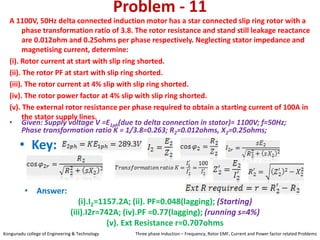
Problem - 11
A 1100V, 50Hz delta connected induction motor has a star connected slip ring rotor with a
phase transformation ratio of 3.8. The rotor resistance and stand still leakage reactance
are 0.012ohm and 0.25ohms per phase respectively. Neglecting stator impedance and
magnetising current, determine:
(i). Rotor current at start with slip ring shorted.
(ii). The rotor PF at start with slip ring shorted.
(iii). The rotor current at 4% slip with slip ring shorted.
(iv). The rotor power factor at 4% slip with slip ring shorted.
(v). The external rotor resistance per phase required to obtain a starting current of 100A in
the stator supply lines.
• Key:
• Answer:
(i).I2=1157.2A; (ii). PF=0.048(lagging); (Starting)
(iii).I2r=742A; (iv).PF =0.77(lagging); (running s=4%)
(v). Ext Resistance r=0.707ohms
• Given: Supply voltage V =E1ph(due to delta connection in stator)= 1100V; f=50Hz;
Phase transformation ratio K = 1/3.8=0.263; R2=0.012ohms, X2=0.25ohms;
Kongunadu college of Engineering & Technology Three phase Induction – Frequency, Rotor EMF, Current and Power factor related Problems
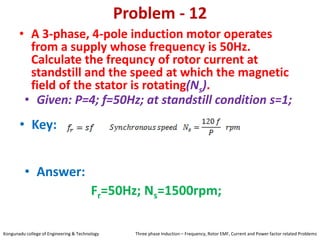
Problem - 12
• A 3-phase, 4-pole induction motor operates
from a supply whose frequency is 50Hz.
Calculate the frequncy of rotor current at
standstill and the speed at which the magnetic
field of the stator is rotating(Ns).
• Key:
• Answer:
Fr=50Hz; Ns=1500rpm;
• Given: P=4; f=50Hz; at standstill condition s=1;
Kongunadu college of Engineering & Technology Three phase Induction – Frequency, Rotor EMF, Current and Power factor related Problems
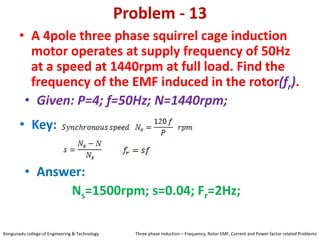
Problem - 13
• A 4pole three phase squirrel cage induction
motor operates at supply frequency of 50Hz
at a speed at 1440rpm at full load. Find the
frequency of the EMF induced in the rotor(fr).
• Key:
• Answer:
Ns=1500rpm; s=0.04; Fr=2Hz;
• Given: P=4; f=50Hz; N=1440rpm;
Kongunadu college of Engineering & Technology Three phase Induction – Frequency, Rotor EMF, Current and Power factor related Problems
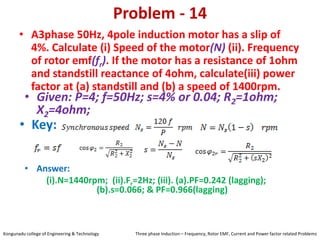
Problem - 14
• A3phase 50Hz, 4pole induction motor has a slip of
4%. Calculate (i) Speed of the motor(N) (ii). Frequency
of rotor emf(fr). If the motor has a resistance of 1ohm
and standstill reactance of 4ohm, calculate(iii) power
factor at (a) standstill and (b) a speed of 1400rpm.
• Key:
• Answer:
(i).N=1440rpm; (ii).Fr=2Hz; (iii). (a).PF=0.242 (lagging);
(b).s=0.066; & PF=0.966(lagging)
• Given: P=4; f=50Hz; s=4% or 0.04; R2=1ohm;
X2=4ohm;
Kongunadu college of Engineering & Technology Three phase Induction – Frequency, Rotor EMF, Current and Power factor related Problems
S.No Book s / Web Sources
1
A.E. Fitzgerald, Charles Kingsley, Stephen. D. Umans, ‘Electric Machinery’, Tata Mc Graw Hill publishing
Company Ltd, 2003.
2 D.P. Kothari and I.J. Nagrath, ‘Electric Machines’, Tata McGraw Hill Publishing Company Ltd, 2002.
3 P.S. Bhimbhra, ‘Electrical Machinery’, Khanna Publishers, 2003.
4 M.N.Bandyopadhyay, Electrical Machines Theory and Practice, PHI Learning PVT LTD., New Delhi, 2009.
5 K. Murugesh Kumar, ‘Electric Machines’, Vikas Publishing House Pvt. Ltd, 2002.
6
Syed A. Nasar, Electric Machines and Power Systems: Volume I, Mcgraw -Hill College; International ed Edition,
January 1995.
7 J. Ganavadivel, ‘Electrical Machines II’, Anuradha publications, Fourth edition, 2015.
8 U.A.Bakshi &M.V.Bakshi, ”Electrical Machines II,” Technical Publications, Second revised edition, 2016.
9 Google and Wikipedia
REFERENCES
Kongunadu college of Engineering & Technology Three phase Induction – Frequency, Rotor EMF, Current and Power factor related Problems
Three Phase Induction Motors – Torque-Slip
Characteristics
& Related Problems
Kongunadu college of Engineering & Technology Three phase Induction Motor – Torque slip characteristics
Contents :
Torque slip characteristics
Power flow diagram
Relationship between rotor power and
losses
Related Problems
Torque-Slip Characteristics
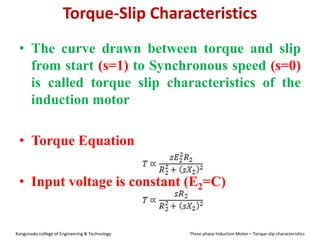
• The curve drawn between torque and slip
from start (s=1) to Synchronous speed (s=0)
is called torque slip characteristics of the
induction motor
• Torque Equation
• Input voltage is constant (E2=C)
Kongunadu college of Engineering & Technology Three phase Induction Motor – Torque slip characteristics
Torque-Slip Characteristics
Kongunadu college of Engineering & Technology Three phase Induction Motor – Torque slip characteristics
Torque-Slip Characteristics
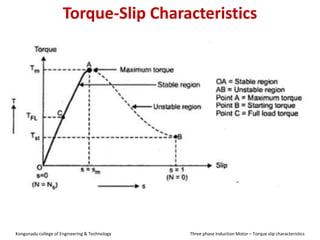
• Three Regions:
– Stable operating region
– Unstable operating region
– Normal operating region
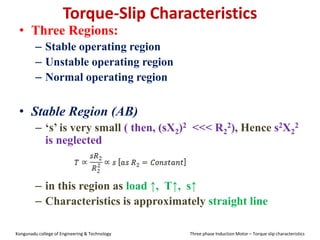
• Stable Region (AB)
– ‘s’ is very small ( then, (sX2)2 <<< R2
2), Hence s2X2
2
is neglected
– in this region as load ↑, T↑, s↑
– Characteristics is approximately straight line
Kongunadu college of Engineering & Technology Three phase Induction Motor – Torque slip characteristics
Torque-Slip Characteristics
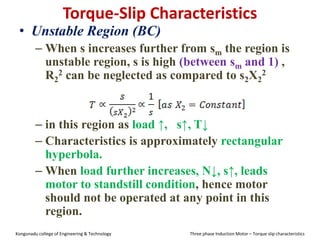
• Unstable Region (BC)
– When s increases further from sm the region is
unstable region, s is high (between sm and 1) ,
R2
2 can be neglected as compared to s2X2
2
– in this region as load ↑, s↑, T↓
– Characteristics is approximately rectangular
hyperbola.
– When load further increases, N↓, s↑, leads
motor to standstill condition, hence motor
should not be operated at any point in this
region.
Kongunadu college of Engineering & Technology Three phase Induction Motor – Torque slip characteristics
Torque-Slip Characteristics
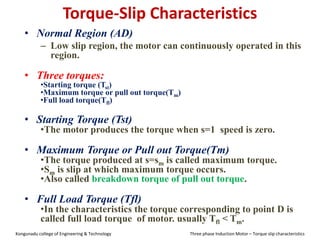
• Normal Region (AD)
– Low slip region, the motor can continuously operated in this
region.
• Three torques:
•Starting torque (Tst)
•Maximum torque or pull out torque(Tm)
•Full load torque(Tfl)
• Starting Torque (Tst)
•The motor produces the torque when s=1 speed is zero.
• Maximum Torque or Pull out Torque(Tm)
•The torque produced at s=sm is called maximum torque.
•Sm is slip at which maximum torque occurs.
•Also called breakdown torque of pull out torque.
• Full Load Torque (Tfl)
•In the characteristics the torque corresponding to point D is
called full load torque of motor. usually Tfl < Tm.
Kongunadu college of Engineering & Technology Three phase Induction Motor – Torque slip characteristics
Torque-Slip Characteristics
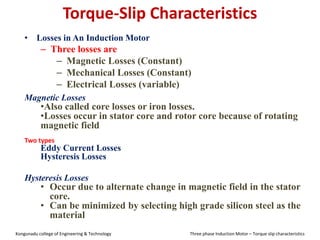
• Losses in An Induction Motor
– Three losses are
– Magnetic Losses (Constant)
– Mechanical Losses (Constant)
– Electrical Losses (variable)
Magnetic Losses
•Also called core losses or iron losses.
•Losses occur in stator core and rotor core because of rotating
magnetic field
Two types
Eddy Current Losses
Hysteresis Losses
Hysteresis Losses
• Occur due to alternate change in magnetic field in the stator
core.
• Can be minimized by selecting high grade silicon steel as the
material
Kongunadu college of Engineering & Technology Three phase Induction Motor – Torque slip characteristics
Torque-Slip Characteristics
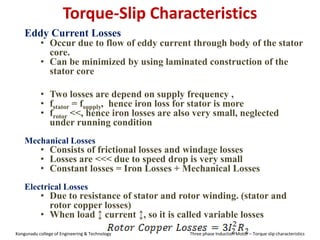
Eddy Current Losses
• Occur due to flow of eddy current through body of the stator
core.
• Can be minimized by using laminated construction of the
stator core
• Two losses are depend on supply frequency ,
• fstator = fsupply, hence iron loss for stator is more
• frotor <<, hence iron losses are also very small, neglected
under running condition
Mechanical Losses
• Consists of frictional losses and windage losses
• Losses are <<< due to speed drop is very small
• Constant losses = Iron Losses + Mechanical Losses
Electrical Losses
• Due to resistance of stator and rotor winding. (stator and
rotor copper losses)
• When load ↕ current ↕, so it is called variable losses
Kongunadu college of Engineering & Technology Three phase Induction Motor – Torque slip characteristics
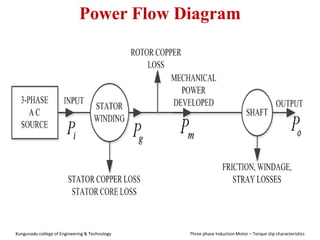
Power Flow Diagram
Kongunadu college of Engineering & Technology Three phase Induction Motor – Torque slip characteristics
Power Flow Diagram
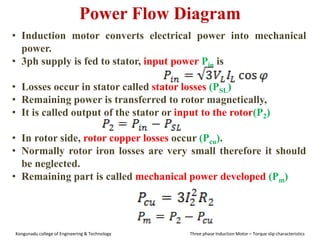
• Induction motor converts electrical power into mechanical
power.
• 3ph supply is fed to stator, input power Pin is
• Losses occur in stator called stator losses (PSL)
• Remaining power is transferred to rotor magnetically,
• It is called output of the stator or input to the rotor(P2)
• In rotor side, rotor copper losses occur (Pcu).
• Normally rotor iron losses are very small therefore it should
be neglected.
• Remaining part is called mechanical power developed (Pm)
Kongunadu college of Engineering & Technology Three phase Induction Motor – Torque slip characteristics
Power Flow Diagram
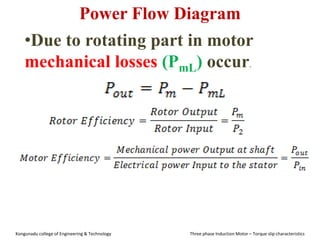
•Due to rotating part in motor
mechanical losses (PmL) occur.
Kongunadu college of Engineering & Technology Three phase Induction Motor – Torque slip characteristics
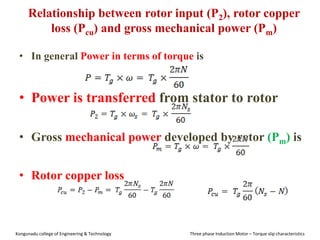
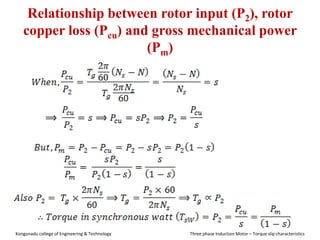
Relationship between rotor input (P2), rotor copper
loss (Pcu) and gross mechanical power (Pm)
• In general Power in terms of torque is
• Power is transferred from stator to rotor
• Gross mechanical power developed by rotor (Pm) is
• Rotor copper loss
Kongunadu college of Engineering & Technology Three phase Induction Motor – Torque slip characteristics
Relationship between rotor input (P2), rotor
copper loss (Pcu) and gross mechanical power
(Pm)
Kongunadu college of Engineering & Technology Three phase Induction Motor – Torque slip characteristics
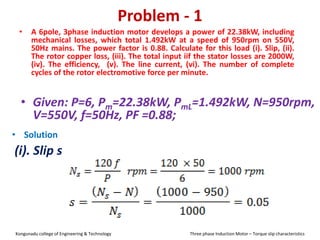
Problem - 1
• A 6pole, 3phase induction motor develops a power of 22.38kW, including
mechanical losses, which total 1.492kW at a speed of 950rpm on 550V,
50Hz mains. The power factor is 0.88. Calculate for this load (i). Slip, (ii).
The rotor copper loss, (iii). The total input iif the stator losses are 2000W,
(iv). The efficiency, (v). The line current, (vi). The number of complete
cycles of the rotor electromotive force per minute.
• Solution
(i). Slip s
• Given: P=6, Pm=22.38kW, PmL=1.492kW, N=950rpm,
V=550V, f=50Hz, PF =0.88;
Kongunadu college of Engineering & Technology Three phase Induction Motor – Torque slip characteristics
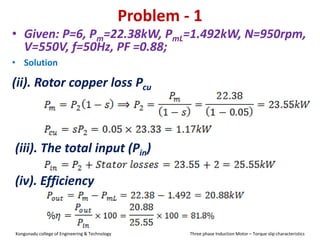
Problem - 1
• Solution
(ii). Rotor copper loss Pcu
• Given: P=6, Pm=22.38kW, PmL=1.492kW, N=950rpm,
V=550V, f=50Hz, PF =0.88;
(iii). The total input (Pin)
(iv). Efficiency
Kongunadu college of Engineering & Technology Three phase Induction Motor – Torque slip characteristics
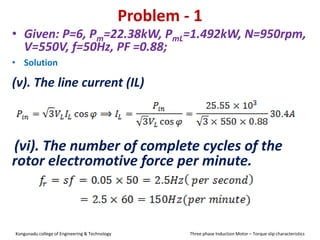
Problem - 1
• Solution
(v). The line current (IL)
• Given: P=6, Pm=22.38kW, PmL=1.492kW, N=950rpm,
V=550V, f=50Hz, PF =0.88;
(vi). The number of complete cycles of the
rotor electromotive force per minute.
Kongunadu college of Engineering & Technology Three phase Induction Motor – Torque slip characteristics
Problem - 2
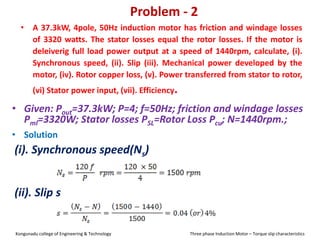
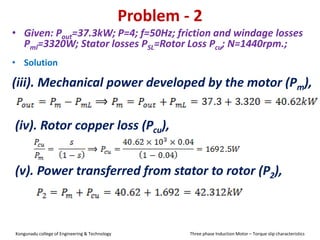
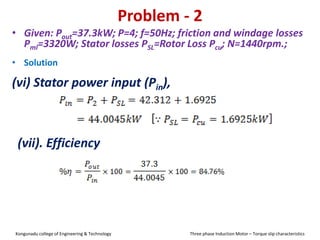
• A 37.3kW, 4pole, 50Hz induction motor has friction and windage losses
of 3320 watts. The stator losses equal the rotor losses. If the motor is
deleiverig full load power output at a speed of 1440rpm, calculate, (i).
Synchronous speed, (ii). Slip (iii). Mechanical power developed by the
motor, (iv). Rotor copper loss, (v). Power transferred from stator to rotor,
(vi) Stator power input, (vii). Efficiency.
• Solution
(i). Synchronous speed(Ns)
• Given: Pout=37.3kW; P=4; f=50Hz; friction and windage losses
Pml=3320W; Stator losses PSL=Rotor Loss Pcu; N=1440rpm.;
(ii). Slip s
Kongunadu college of Engineering & Technology Three phase Induction Motor – Torque slip characteristics
Problem - 2
• Solution
(iii). Mechanical power developed by the motor (Pm),
• Given: Pout=37.3kW; P=4; f=50Hz; friction and windage losses
Pml=3320W; Stator losses PSL=Rotor Loss Pcu; N=1440rpm.;
(iv). Rotor copper loss (Pcu),
(v). Power transferred from stator to rotor (P2),
Kongunadu college of Engineering & Technology Three phase Induction Motor – Torque slip characteristics
Problem - 2
• Solution
(vi) Stator power input (Pin),
• Given: Pout=37.3kW; P=4; f=50Hz; friction and windage losses
Pml=3320W; Stator losses PSL=Rotor Loss Pcu; N=1440rpm.;
(vii). Efficiency
Kongunadu college of Engineering & Technology Three phase Induction Motor – Torque slip characteristics
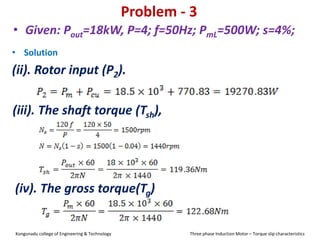
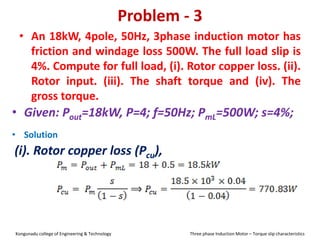
Problem - 3
• An 18kW, 4pole, 50Hz, 3phase induction motor has
friction and windage loss 500W. The full load slip is
4%. Compute for full load, (i). Rotor copper loss. (ii).
Rotor input. (iii). The shaft torque and (iv). The
gross torque.
• Solution
(i). Rotor copper loss (Pcu),
• Given: Pout=18kW, P=4; f=50Hz; PmL=500W; s=4%;
Kongunadu college of Engineering & Technology Three phase Induction Motor – Torque slip characteristics
Problem - 3
• Solution
(ii). Rotor input (P2).
• Given: Pout=18kW, P=4; f=50Hz; PmL=500W; s=4%;
(iii). The shaft torque (Tsh),
(iv). The gross torque(Tg)
Kongunadu college of Engineering & Technology Three phase Induction Motor – Torque slip characteristics
S.No Book s / Web Sources
1
A.E. Fitzgerald, Charles Kingsley, Stephen. D. Umans, ‘Electric Machinery’, Tata Mc Graw Hill publishing
Company Ltd, 2003.
2 D.P. Kothari and I.J. Nagrath, ‘Electric Machines’, Tata McGraw Hill Publishing Company Ltd, 2002.
3 P.S. Bhimbhra, ‘Electrical Machinery’, Khanna Publishers, 2003.
4 M.N.Bandyopadhyay, Electrical Machines Theory and Practice, PHI Learning PVT LTD., New Delhi, 2009.
5 K. Murugesh Kumar, ‘Electric Machines’, Vikas Publishing House Pvt. Ltd, 2002.
6
Syed A. Nasar, Electric Machines and Power Systems: Volume I, Mcgraw -Hill College; International ed Edition,
January 1995.
7 J. Ganavadivel, ‘Electrical Machines II’, Anuradha publications, Fourth edition, 2015.
8 U.A.Bakshi &M.V.Bakshi, ”Electrical Machines II,” Technical Publications, Second revised edition, 2016.
9 Google and Wikipedia
REFERENCES
SINGLE-PHASE INDUCTION MOTOR
Kongunadu college of Engineering & Technology Single phase Induction Motor
Contents:
Introduction
Construction
Double field revolving theory
Cross field theory
Starting of Single phase induction motor
Split phase methods
References
INTRODUCTION
• A single-phase induction motor is structurally
similar to a three-phase induction motor; the
difference is only in the stator winding
arrangements.
• The stator windings of a single-phase
induction motor are distributed, pitched and
skewed to produce a sinusoidal m.m.f. in
space.
Kongunadu college of Engineering & Technology Single phase Induction Motor
CONSTRUCTION
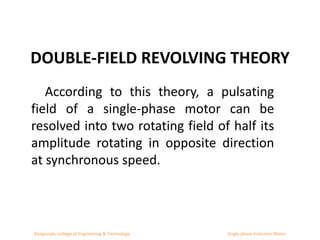
• The construction of a single-phase induction motor is
similar to that of a three-phase induction motor.
• The single-phase motor stator has a laminated iron
core with two windings arranged perpendicularly – one
is the main and the other is the auxiliary winding or
starting winding.
• The motor uses a squirrel-cage rotor, which has a
laminated iron core with slots in it. Single-phase
induction motor is not self-starting and requires some
mechanism to assist it in the starting process.
Kongunadu college of Engineering & Technology Single phase Induction Motor
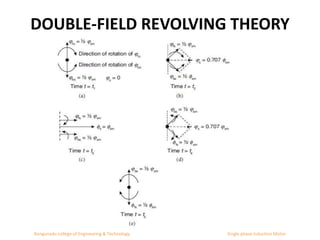
DOUBLE-FIELD REVOLVING THEORY
According to this theory, a pulsating
field of a single-phase motor can be
resolved into two rotating field of half its
amplitude rotating in opposite direction
at synchronous speed.
Kongunadu college of Engineering & Technology Single phase Induction Motor
DOUBLE-FIELD REVOLVING THEORY
Kongunadu college of Engineering & Technology Single phase Induction Motor
DOUBLE-FIELD REVOLVING THEORY
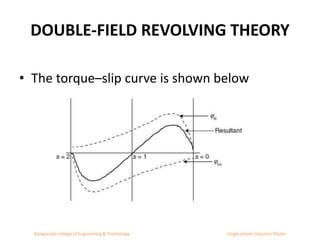
• The torque–slip curve is shown below
Kongunadu college of Engineering & Technology Single phase Induction Motor
CROSS FIELD THEORY
• When a single-phase supply is given to
the stator of a single-phase induction
motor, an alternating flux is produced in
the stator.
• This alternating flux will produce an
induced e.m.f. in the rotor windings,
which is initially at standstill.
• No torque will be produced in the rotor
Kongunadu college of Engineering & Technology Single phase Induction Motor
CROSS FIELD THEORY
If the rotor is rotated by giving some
external force, an e.m.f. will be induced
in the rotor and thus a current will flow
through the rotor. This current will be
displaced by 90 degree (electrical) from
the stator axis.
Kongunadu college of Engineering & Technology Single phase Induction Motor
STARTING OF SINGLE-PHASE
INDUCTION MOTOR
Some of the starting methods are,
i) Split-phase method
ii) Shaded-pole method
iii) Reluctance-start method
Kongunadu college of Engineering & Technology Single phase Induction Motor
Split Phase Method
The different split-phase techniques are:
i) Split-phase resistance-start motor.
ii) Split-phase capacitor-start motor.
iii) Capacitor-start – capacitor-run induction
motor
iv) Permanent single capacitor induction motor.
Kongunadu college of Engineering & Technology Single phase Induction Motor
S.No Book s / Web Sources
1
A.E. Fitzgerald, Charles Kingsley, Stephen. D. Umans, ‘Electric Machinery’, Tata Mc Graw Hill publishing
Company Ltd, 2003.
2 D.P. Kothari and I.J. Nagrath, ‘Electric Machines’, Tata McGraw Hill Publishing Company Ltd, 2002.
3 P.S. Bhimbhra, ‘Electrical Machinery’, Khanna Publishers, 2003.
4 M.N.Bandyopadhyay, Electrical Machines Theory and Practice, PHI Learning PVT LTD., New Delhi, 2009.
5 K. Murugesh Kumar, ‘Electric Machines’, Vikas Publishing House Pvt. Ltd, 2002.
6
Syed A. Nasar, Electric Machines and Power Systems: Volume I, Mcgraw -Hill College; International ed
Edition, January 1995.
7 J. Ganavadivel, ‘Electrical Machines II’, Anuradha publications, Fourth edition, 2015.
8 U.A.Bakshi &M.V.Bakshi, ”Electrical Machines II,” Technical Publications, Second revised edition, 2016.
9 Google and Wikipedia
REFERENCES
Kongunadu college of Engineering & Technology Single phase Induction Motor
TYPES OF SINGLE-PHASE INDUCTION MOTOR AND
EQUIVALENT CIRCUIT
Kongunadu college of Engineering & Technology Types Single phase Induction Motor & Equivalent Circuit
Contents:
Split phase resistance start motor
Split phase capacitor start motor
Capacitor start – capacitor run motor
Shaded pole method
Equivalent circuit of single phase induction motor
No load and Blocked rotor test
Comparison of single phase induction motor Vs Three
phase induction motor
References
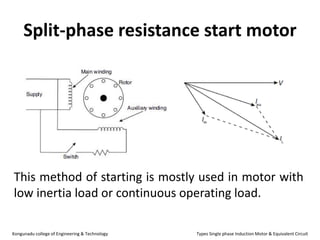
Split-phase resistance start motor
This method of starting is mostly used in motor with
low inertia load or continuous operating load.
Kongunadu college of Engineering & Technology Types Single phase Induction Motor & Equivalent Circuit
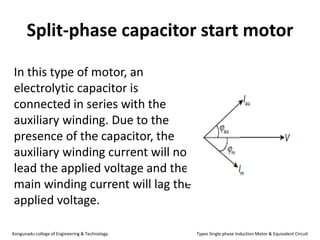
Split-phase capacitor start motor
In this type of motor, an
electrolytic capacitor is
connected in series with the
auxiliary winding. Due to the
presence of the capacitor, the
auxiliary winding current will now
lead the applied voltage and the
main winding current will lag the
applied voltage.
Kongunadu college of Engineering & Technology Types Single phase Induction Motor & Equivalent Circuit
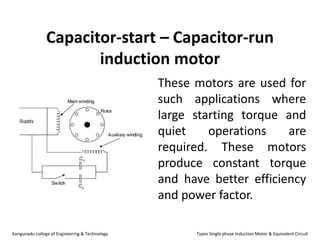
Capacitor-start – Capacitor-run
induction motor
These motors are used for
such applications where
large starting torque and
quiet operations are
required. These motors
produce constant torque
and have better efficiency
and power factor.
Kongunadu college of Engineering & Technology Types Single phase Induction Motor & Equivalent Circuit
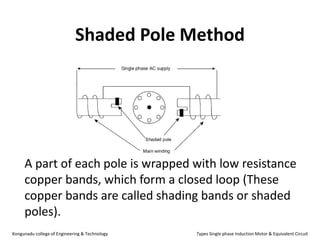
Shaded Pole Method
A part of each pole is wrapped with low resistance
copper bands, which form a closed loop (These
copper bands are called shading bands or shaded
poles).
Kongunadu college of Engineering & Technology Types Single phase Induction Motor & Equivalent Circuit
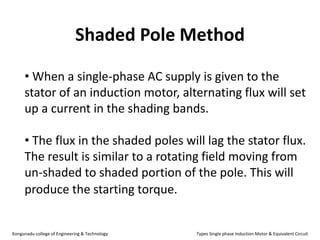
Shaded Pole Method
• When a single-phase AC supply is given to the
stator of an induction motor, alternating flux will set
up a current in the shading bands.
• The flux in the shaded poles will lag the stator flux.
The result is similar to a rotating field moving from
un-shaded to shaded portion of the pole. This will
produce the starting torque.
Kongunadu college of Engineering & Technology Types Single phase Induction Motor & Equivalent Circuit
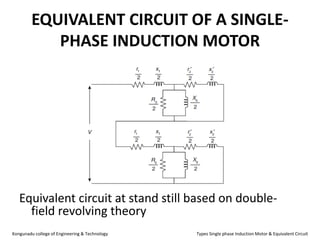
EQUIVALENT CIRCUIT OF A SINGLE-
PHASE INDUCTION MOTOR
Equivalent circuit at stand still based on double-
field revolving theory
Kongunadu college of Engineering & Technology Types Single phase Induction Motor & Equivalent Circuit
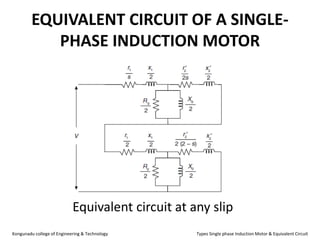
EQUIVALENT CIRCUIT OF A SINGLE-
PHASE INDUCTION MOTOR
Equivalent circuit at any slip
Kongunadu college of Engineering & Technology Types Single phase Induction Motor & Equivalent Circuit
Block Rotor Test
• Blocked rotor test is conducted on an induction motor.
It is also known as short circuit test or locked rotor test
or stalled torque test.
• From this test short-circuit current at normal
voltage, power factor on short-circuit, total leakage
reactance, starting torque of the motor can be found.
• The test is conducted at low voltage because if the
applied voltage was normal voltage then the current
flowing through the stator windings were high enough
to over heat the winding and damage them.
Kongunadu college of Engineering & Technology Types Single phase Induction Motor & Equivalent Circuit
No-load Test
• In this test, the rotor is made to rotate freely
without any load.
• Under this condition, the slip due to forward
rotating field will reach zero and the slip due
to backward rotating field will be 2.
COMPARISON OF SINGLE-PHASE AND THREE-PHASE
INDUCTION MOTOR
• Single-phase induction motors are simple in
construction, reliable and economical for small power
rating as compared to three-phase induction motors.
• The electrical power factor of single-phase induction
motors is low as compared to three-phase induction
motors.
• For the same size, single-phase induction motors
develop about 50% of the output as that of three-phase
induction motors.
• The starting torque is low for asynchronous motors.
• The efficiency of single-phase induction motors is less as
compared to that of three-phase induction motors.
Kongunadu college of Engineering & Technology Types Single phase Induction Motor & Equivalent Circuit
REFERENCES
S.No Book s / Web Sources
1
A.E. Fitzgerald, Charles Kingsley, Stephen. D. Umans, ‘Electric Machinery’, Tata Mc Graw Hill publishing
Company Ltd, 2003.
2 D.P. Kothari and I.J. Nagrath, ‘Electric Machines’, Tata McGraw Hill Publishing Company Ltd, 2002.
3 P.S. Bhimbhra, ‘Electrical Machinery’, Khanna Publishers, 2003.
4 M.N.Bandyopadhyay, Electrical Machines Theory and Practice, PHI Learning PVT LTD., New Delhi, 2009.
5 K. Murugesh Kumar, ‘Electric Machines’, Vikas Publishing House Pvt. Ltd, 2002.
6
Syed A. Nasar, Electric Machines and Power Systems: Volume I, Mcgraw -Hill College; International ed
Edition, January 1995.
7 J. Ganavadivel, ‘Electrical Machines II’, Anuradha publications, Fourth edition, 2015.
8 U.A.Bakshi &M.V.Bakshi, ”Electrical Machines II,” Technical Publications, Second revised edition, 2016.
9 Google and Wikipedia
Kongunadu college of Engineering & Technology Types Single phase Induction Motor & Equivalent Circuit

Electrical Machines - II

  • 1.
    Contents:  Introduction  Construction Working principle  Comparison of rotor  References Kongunadu College of Engineering & Technology Synchronous Generator SYNCHRONOUS GENERATOR
  • 2.
    Introduction Alternators (or) Synchronousgenerators  A Machine generating AC e.m.f Synchronous motors  A machine accepting i/p from AC supply to produce mechanical output Synchronous Speed: Alternators has to be rotated at a particular speed to keep the frequency of the generated e.m.f constant at required value Ns = 120f / P Ns  Synchronous speed f frequency P  No. of poles Kongunadu College of Engineering & Technology Synchronous Generator
  • 3.
    CONSTRUCTION  Stationary Armaturewinding  Stator core use a laminated construction  Special steel stamping and insulated from each other with varnish or paper  Reduce the eddy current loss  Steel material  Reduce hysteresis loss STATOR Kongunadu College of Engineering & Technology Synchronous Generator
  • 4.
    CONSTRUCTION  Projected poletype as all the poles are projected out from the surface of the rotor.  Rotor have large diameter and small axial length ROTOR SALIENT POLE TYPE:  Mechanical strength is less  So it is preferred for low speed alternator (125 rpm to 500 rpm)  Application: Water turbine , I.C engines Kongunadu College of Engineering & Technology Synchronous Generator
  • 5.
    CONSTRUCTION  Smooth solidsteel cylinder, having no. of slots to accommodate field coils.  Rotor have small diameter and large axial length ROTOR SMOOTH CYLINDRICAL OR NON-SALIENT POLE :  Mechanical very strength  So it is preferred for high speed alternator (turbo alternators) (1500 rpm to 3000 rpm)  Application: Steam turbine , Electric motor Kongunadu College of Engineering & Technology Synchronous Generator
  • 6.
    OPERATION TWO POLE ALTERNATOR: Principle: Faradays law of EMI  When there is a relative motion b/w the conductors and the flux, emf gets induced in the conductor. Kongunadu College of Engineering & Technology Synchronous Generator
  • 7.
    OPERATION FOUR POLE ALTERNATOR: KongunaduCollege of Engineering & Technology Synchronous Generator
  • 8.
    The rotor windingis energized from the d.c. exciter and alternate N and S poles are developed on the rotor. When the three phase supply is given to the stator, the stator or armature conductors experience the force due to electromagnetic induction. Then the rotor starts to rotate. The speed of the motor is given by; N = 120f / P Where N = speed of rotor in r.p.m. , P = number of rotor poles. Kongunadu College of Engineering & Technology Synchronous Generator
  • 9.
    Salient Pole RotorCylindrical Rotor 1. Used for low speed alternators 1. Used for high - speed turbo alternators 2. Which is used in Hydro power plants 2 . Which is used in Thermal power plants The use of salient pole and round rotor synchronous machines Kongunadu College of Engineering & Technology Synchronous Generator
  • 10.
    Kongunadu College ofEngineering & Technology Synchronous Generator S.No Book s / Web Sources 1 A.E. Fitzgerald, Charles Kingsley, Stephen. D. Umans, ‘Electric Machinery’, Tata Mc Graw Hill publishing Company Ltd, 2003. 2 D.P. Kothari and I.J. Nagrath, ‘Electric Machines’, Tata McGraw Hill Publishing Company Ltd, 2002. 3 P.S. Bhimbhra, ‘Electrical Machinery’, Khanna Publishers, 2003. 4 M.N.Bandyopadhyay, Electrical Machines Theory and Practice, PHI Learning PVT LTD., New Delhi, 2009. 5 K. Murugesh Kumar, ‘Electric Machines’, Vikas Publishing House Pvt. Ltd, 2002. 6 Syed A. Nasar, Electric Machines and Power Systems: Volume I, Mcgraw -Hill College; International ed Edition, January 1995. 7 J. Ganavadivel, ‘Electrical Machines II’, Anuradha publications, Fourth edition, 2015. 8 U.A.Bakshi &M.V.Bakshi, ”Electrical Machines II,” Technical Publications, Second revised edition, 2016. 9 Google and Wikipedia REFERENCES
  • 11.
    Contents:  Armature Reaction Parallel operation of Alternators  Conditions for parallel operation  Procedure for parallel operation  Methods of Synchronization  References Armature reaction and Parallel Operation of Alternators Kongunadu College of Engineering & Technology Armature Reaction and Parallel operation
  • 12.
    Armature reaction The effectsof armature flux on the main flux affecting its value and the distribution is called armature reaction Unity Power Factor Load (R Load): Two fluxes oppose each other on the left half of each pole while assist each other on the right half of each pole. Such distorting effect of armature reaction under UPF condition of the load is called cross magnetizing effect of armature reaction Kongunadu College of Engineering & Technology Armature Reaction and Parallel operation
  • 13.
    Armature reaction Zero laggingPower Factor Load (L Load): The armature flux and the main flux are exactly in opposite direction to each other. Armature flux tries to cancel the main flux. Such an effect of armature reaction is called demagnetizing effect of armature reaction Kongunadu College of Engineering & Technology Armature Reaction and Parallel operation
  • 14.
    Armature reaction Zero leadingPower Factor Load (C Load): The armature flux and the main flux are in the same direction. They are helping each other. This result into the addition in main flux. Such an effect of armature reaction due to which armature flux assist field flux is called magnetizing effect of armature reaction Kongunadu College of Engineering & Technology Armature Reaction and Parallel operation
  • 15.
    Armature reaction Zero leadingPower Factor Load (C Load): The armature flux and the main flux are in the same direction. They are helping each other. This result into the addition in main flux. Such an effect of armature reaction due to which armature flux assist field flux is called magnetizing effect of armature reaction Kongunadu College of Engineering & Technology Armature Reaction and Parallel operation
  • 16.
    Armature reaction Zero leadingPower Factor Load (C Load): The armature flux and the main flux are in the same direction. They are helping each other. This result into the addition in main flux. Such an effect of armature reaction due to which armature flux assist field flux is called magnetizing effect of armature reaction Kongunadu College of Engineering & Technology Armature Reaction and Parallel operation
  • 17.
    Parallel Operation ofAlternators Most of synchronous generators are operating in parallel with other synchronous generators to supply power to the same power system. Obvious advantages of this arrangement are: 1. Several generators can supply a bigger load; 2. A failure of a single generator does not result in a total power loss to the load increasing reliability of the power system; 3. Individual generators may be removed from the power system for maintenance without shutting down the load; 4. A single generator not operating at near full load might be quite inefficient. While having several generators in parallel, it is possible to turn off some of them when operating the rest at near full-load condition. Kongunadu College of Engineering & Technology Armature Reaction and Parallel operation
  • 18.
    Conditions for ParallelOperation A diagram shows that Generator 2 (Incoming generator) will be connected in parallel when the switch S1 is closed. However, closing the switch at an arbitrary moment can severely damage both generators! If voltages are not exactly the same in both lines (i.e. in a and a’, b and b’ etc.), a very large current will flow when the switch is closed. Therefore, to avoid this, voltages coming from both generators must be exactly the same. Therefore, the following conditions must be met: 1. The RMS line voltages of the two generators must be equal. 2. The two generators must have the same phase sequence. 3. The phase angles of two a phases must be equal. 4. The frequency of the incoming generator must be slightly higher than the frequency of the bus-bar (running) system.
  • 19.
    Conditions for ParallelOperation If the phase sequences are different, then even if one pair of voltages (phases a) are in phase, the other two pairs will be 1200 out of phase creating huge currents in these phases. If the frequencies of the generators are different, a large power transient may occur until the generators stabilize at a common frequency. The frequencies of two machines must be very close to each other but not exactly equal. If frequencies differ by a small amount, the phase angles of the oncoming generator will change slowly with respect to the phase angles of the running system. If the angles between the voltages can be observed, it is possible to close the switch S1 when the machines are in phase. Kongunadu College of Engineering & Technology Armature Reaction and Parallel operation
  • 20.
    General procedure forparalleling generators When connecting the generator G2 to the running system, the following steps should be taken: 1. Adjust the field current of the oncoming generator to make its terminal voltage equal to the line voltage of the system (use a voltmeter). 2. Compare the phase sequences of the oncoming generator and the running system. This can be done by different ways: 1) Connect a small induction motor to the terminals of the oncoming generator and then to the terminals of the running system. If the motor rotates in the same direction, the phase sequence is the same; 2) Connect three light bulbs across the open terminals of the switch. As the phase changes between the two generators, light bulbs get brighter (large phase difference) or dimmer (small phase difference). If all three bulbs get bright and dark together, both generators have the same phase sequences.
  • 21.
    General procedure forparalleling generators If phase sequences are different, two of the conductors on the oncoming generator must be reversed. 3. The frequency of the oncoming generator is adjusted to be slightly higher than the system’s frequency. 4. Turn on the switch connecting G2 to the system when phase angles are equal. The simplest way to determine the moment when two generators are in phase is by observing the same three light bulbs. When all three lights go out, the voltage across them is zero and, therefore, machines are in phase. A more accurate way is to use a synchroscope – a meter measuring the difference in phase angles between two a phases. However, a synchroscope does not check the phase sequence since it only measures the phase difference in one phase. Kongunadu College of Engineering & Technology Armature Reaction and Parallel operation
  • 22.
    Three Dark Lampsmethod When all the three set of lamps become dark, the synchronizing switch can be closed and thus the alternator G2 gets synchronized with alternator G1. Kongunadu College of Engineering & Technology Armature Reaction and Parallel operation
  • 23.
    Two bright andone Dark Lamp method To find incoming alternator frequency is higher or lower then the bus-bar frequency. The sequence of flickering is L1, L2 & L3  indicate fincoming > fBB  N reduced & rate of flickers brought down to small The sequence of flickering is L1, L3 & L2  indicate fincoming < fBB  N increased. After brining down the rate flickering to as small las possible, the synchronizing switch can be closed at the instant when L2 is dark an L1, L3 are equally bright.
  • 24.
    Synchro-scope method The rateof rotation of the pointer indicates the amount of frequency difference between the alternators. The direction of the rotation indicates whether the incoming frequency is higher or lower then the existing alternator. The TPST switch is closed to synchronize the incoming alternator when the pointer faces the top thick link marking. Kongunadu College of Engineering & Technology Armature Reaction and Parallel operation
  • 25.
    REFERENCES S.No Book s/ Web Sources 1 A.E. Fitzgerald, Charles Kingsley, Stephen. D. Umans, ‘Electric Machinery’, Tata Mc Graw Hill publishing Company Ltd, 2003. 2 D.P. Kothari and I.J. Nagrath, ‘Electric Machines’, Tata McGraw Hill Publishing Company Ltd, 2002. 3 P.S. Bhimbhra, ‘Electrical Machinery’, Khanna Publishers, 2003. 4 M.N.Bandyopadhyay, Electrical Machines Theory and Practice, PHI Learning PVT LTD., New Delhi, 2009. 5 K. Murugesh Kumar, ‘Electric Machines’, Vikas Publishing House Pvt. Ltd, 2002. 6 Syed A. Nasar, Electric Machines and Power Systems: Volume I, Mcgraw -Hill College; International ed Edition, January 1995. 7 J. Ganavadivel, ‘Electrical Machines II’, Anuradha publications, Fourth edition, 2015. 8 U.A.Bakshi &M.V.Bakshi, ”Electrical Machines II,” Technical Publications, Second revised edition, 2016. 9 Google and Wikipedia
  • 26.
    Contents:  Two reactiontheory  Phasor diagram  Slip test  Important cautions for slip test  References Two Reaction Theory and Slip test Kongunadu College of Engineering & Technology Two reaction Theory & Slip Test
  • 27.
    Two Reaction Theory Introduction Salient-polegenerators, such as hydroelectric generators, have armature inductances that are a function of rotor position, making analysis one step more complicated. The key to analysis of such machines is to separate mmf and flux into two orthogonal components. The two components are aligned with the direct axis and the quadrature axis of the machine. The direct axis is aligned with the field winding, while the quadrature axis leads the direct by 90°. Kongunadu College of Engineering & Technology Two reaction Theory & Slip Test
  • 28.
    Two Reaction Theory Accordingto this theory the armature m.m.f can be divided into two components as, Component acting along the pole axis called direct (Magnetizing/ demagnetizing) axis (d-axis: The R offered to m.m.f wave is lowest when it is aligned wit field pole axis). Component acting at right angle to the pole axis called quadrature (cross magnetizing) axis (q axis: The R offered is highest when the mmf wave oriented at 900 to the field pole axis). Kongunadu College of Engineering & Technology Two reaction Theory & Slip Test
  • 29.
    Phasor Diagram Xsd =Xad + Xl Xqd = Xad + Xl V = Eo – IRa – IdXsd - IdXsq Kongunadu College of Engineering & Technology Two reaction Theory & Slip Test
  • 30.
    The d-axis andq-axis reactance can be measured by slip test. When the peak of the armature m.m.f is in line with the field pole, the reluctance offered by the magnitude circuit is minimum. The ratio of armature terminal voltage per phase to armature phase current gives Xd. After one quarter of slip cycle, the peak of armature m.m.f is in line with q-axis and the reluctance offered by the magnetic circuit is maximum. The ratio of armature terminal voltage per phase to armature phase current gives Xq. Slip Test: Measurement of Xd and Xq Kongunadu College of Engineering & Technology Two reaction Theory & Slip Test
  • 31.
    Slip Test: Measurementof Xd and Xq Kongunadu College of Engineering & Technology Two reaction Theory & Slip Test
  • 32.
    1) Slip shouldbe extremely low during experimentation. In case of high slip (more than about 5%) following effects may be observed:- (a) Current induced in the damper winding of alternator will produce an appreciable error. (b) Induced voltage in the open circuit field may r each dangerous values. 2) It should be assured that the induced voltage in the open circuit is less than the rating of the voltmeter connected in the circuit. Important cautions for slip test Kongunadu College of Engineering & Technology Two reaction Theory & Slip Test
  • 33.
    References : Kongunadu Collegeof Engineering & Technology Two reaction Theory & Slip Test S.No Book s / Web Sources 1 A.E. Fitzgerald, Charles Kingsley, Stephen. D. Umans, ‘Electric Machinery’, Tata Mc Graw Hill publishing Company Ltd, 2003. 2 D.P. Kothari and I.J. Nagrath, ‘Electric Machines’, Tata McGraw Hill Publishing Company Ltd, 2002. 3 P.S. Bhimbhra, ‘Electrical Machinery’, Khanna Publishers, 2003. 4 M.N.Bandyopadhyay, Electrical Machines Theory and Practice, PHI Learning PVT LTD., New Delhi, 2009. 5 K. Murugesh Kumar, ‘Electric Machines’, Vikas Publishing House Pvt. Ltd, 2002. 6 Syed A. Nasar, Electric Machines and Power Systems: Volume I, Mcgraw -Hill College; International ed Edition, January 1995. 7 J. Ganavadivel, ‘Electrical Machines II’, Anuradha publications, Fourth edition, 2015. 8 U.A.Bakshi &M.V.Bakshi, ”Electrical Machines II,” Technical Publications, Second revised edition, 2016. 9 Google and Wikipedia
  • 34.
    Synchronous Motor • SynchronousMotor-Introduction • Synchronous Motor-principle • Changing the Load • Starting Torque • Improvement of starting torque • Synchronous Machine Construction • Summary Kongunadu College of Engineering & Technology Synchronous Motor
  • 35.
    Synchronous Motor- Introduction The synchronous motor rotates at the synchronous speed i.e. the speed of the RMF.  Stator is similar in construction to that of an induction motor, so same principle is applied to the synchronous motor rotor.  Field excitation is provided on the rotor by either permanent or electromagnets with number of poles equal to the poles of the RMF caused by stator Kongunadu College of Engineering & Technology Synchronous Motor
  • 36.
    Synchronous Motor-Principle Faradays Lawof Electromagnetic Induction. The rotor acting as a bar magnet will turn to line up with the rotating magnet field. The rotor gets locked to the RMF and rotates unlike induction motor at synchronous speed under all load condition Kongunadu College of Engineering & Technology Synchronous Motor
  • 37.
    An increase inthe load will cause the rotor to lag the stator field but still maintain synchronous speed. Increase in load has increased the torque component, but the field strength has decreased due to the increase in length of the air gap between the rotor and the stator. If the synchronous motor is overloaded it pulls out of synchronism and comes to rest. The minimum amount of torque which causes this is called the “ pull out torque”. Lightly loaded motor Heavily loaded motor Changing The Load Kongunadu College of Engineering & Technology Synchronous Motor
  • 38.
    Starting Torque • Itcannot be started from a standstill by applying ac to the stator. • When AC supply is applied to the stator a high speed RMF appears around the stator. This RMF rushes past the rotor poles so quickly that the rotor is unable to get started. • It is attracted first in one direction and then in the other and hence no starting torque. Kongunadu College of Engineering & Technology Synchronous Motor
  • 39.
    Improvement of startingtorque • It is started by using a squirrel cage within a rotor construction and therefore starts as an induction motor. • At synchronous speed the squirrel cage has no part to play. Kongunadu College of Engineering & Technology Synchronous Motor
  • 40.
  • 41.
    Construction Stator:  Stationary Armaturewinding  Stator core use a laminated construction  Special steel stamping and insulated from each other with varnish or paper  Reduce the eddy current loss  Steel material  Reduce hysteresis loss Kongunadu College of Engineering & Technology Synchronous Motor
  • 42.
    Rotor:  Projected poletype as all the poles are projected out from the surface of the rotor.  Rotor have large diameter and small axial length  The poles have damper winding.  The damper windings are used to reduce the ‘Hunting’ Kongunadu College of Engineering & Technology Synchronous Motor
  • 43.
    Summary  The synchronousmotor requires to be started by an external prime mover.  Runs only at synchronous speed, this is an advantage where continuous speed is required but a disadvantage where a variable speed is required.  Can be used to adjust the power factor of a system at the same time it is driving a mechanical load. Kongunadu College of Engineering & Technology Synchronous Motor
  • 44.
    References Kongunadu College ofEngineering & Technology Synchronous Motor S.No Book s / Web Sources 1 A.E. Fitzgerald, Charles Kingsley, Stephen. D. Umans, ‘Electric Machinery’, Tata Mc Graw Hill publishing Company Ltd, 2003. 2 D.P. Kothari and I.J. Nagrath, ‘Electric Machines’, Tata McGraw Hill Publishing Company Ltd, 2002. 3 P.S. Bhimbhra, ‘Electrical Machinery’, Khanna Publishers, 2003. 4 M.N.Bandyopadhyay, Electrical Machines Theory and Practice, PHI Learning PVT LTD., New Delhi, 2009. 5 K. Murugesh Kumar, ‘Electric Machines’, Vikas Publishing House Pvt. Ltd, 2002. 6 Syed A. Nasar, Electric Machines and Power Systems: Volume I, Mcgraw -Hill College; International ed Edition, January 1995. 7 J. Ganavadivel, ‘Electrical Machines II’, Anuradha publications, Fourth edition, 2015. 8 U.A.Bakshi &M.V.Bakshi, ”Electrical Machines II,” Technical Publications, Second revised edition, 2016. 9 Google and Wikipedia
  • 45.
    Vector diagram andPhasor diagram of Synchronous Motor Contents:  Vector diagram  Phasor diagram  Synchronous condenser  Applications of Synchronous motor  References Kongunadu College of Engineering & Technology Synchronous Motor vector and phasor diagram
  • 46.
    Vector Diagram andPhasor diagram of Synchronous Motor • The equivalent circuit of a synchronous motor is exactly same as the equivalent circuit of a synchronous generator, except that the reference direction of IA is reversed. • The basic difference between motor and generator operation in synchronous machines can be seen either in the magnetic field diagram or in the phasor diagram. • In a generator, EA lies ahead of Vf, and BR lies ahead of Bnet. In a motor, EA lies behind Vf, and BR lies behind Bnet. • In a motor the induced torque is in the direction of motion, and in a generator the induced torque is a countertorque opposing the direction of motion. Kongunadu College of Engineering & Technology Synchronous Motor vector and phasor diagram
  • 47.
    Vector Diagram d IA Vf EA jIA Xs d IA Vf EA jIAXs d Bs Bnet BR wsync Fig. The phasor diagram (leading PF: overexcited and |Vt|<|EA|) and the corresponding magnetic field diagram of a synchronous motor. Fig. The phasor diagram of an underexcited synchronous motor (lagging PF and |Vt|>|EA|). Kongunadu College of Engineering & Technology Synchronous Motor vector and phasor diagram
  • 48.
    Phasor Diagram • (a)Unity power factor • In this unity power factor, the excitation of the synchronous motor is 100% or in normal excitation. • (b) Lagging power factor • In this unity power factor, the excitation of the synchronous motor is less than 100%. • (c) Leading power factor • In this unity power factor, the excitation of the synchronous motor is greater than 100%. Kongunadu College of Engineering & Technology Synchronous Motor vector and phasor diagram
  • 49.
    Phasor Diagram Kongunadu Collegeof Engineering & Technology Synchronous Motor vector and phasor diagram
  • 50.
    Synchronous motor canbe used as synchronous condenser • An over excited synchronous motor running on no load is known as synchronous capacitor or synchronous condenser. • A synchronous motor takes a leading current when over excited and therefore, behaves as a capacitor. • As compared with a synchronous motor with equal armature voltage and current rating a synchronous capacitor requires more copper in the field winding to carry large field current. • The synchronous capacitor does not require so large shaft and bearings as the synchronous motor because no shaft torque is required. Kongunadu College of Engineering & Technology Synchronous Motor vector and phasor diagram
  • 51.
    Applications of SynchronousMotor Synchronous motors are usually used in large sizes because in small sizes they are costlier as compared with induction machines. The principal advantages of using synchronous machine are as follows: – Power factor of synchronous machine can be controlled very easily by controlling the field current. – It has very high operating efficiency and constant speed. – For operating speed less than about 500 rpm and for high-power requirements (above 600KW) synchronous motor is cheaper than induction motor. In view of these advantages, synchronous motors are preferred for driving the loads requiring high power at low speed; e.g; reciprocating pumps and compressor, crushers, rolling mills, pulp grinders etc. Kongunadu College of Engineering & Technology Synchronous Motor vector and phasor diagram
  • 52.
    References : Kongunadu Collegeof Engineering & Technology Synchronous Motor vector and phasor diagram S.No Book s / Web Sources 1 A.E. Fitzgerald, Charles Kingsley, Stephen. D. Umans, ‘Electric Machinery’, Tata Mc Graw Hill publishing Company Ltd, 2003. 2 D.P. Kothari and I.J. Nagrath, ‘Electric Machines’, Tata McGraw Hill Publishing Company Ltd, 2002. 3 P.S. Bhimbhra, ‘Electrical Machinery’, Khanna Publishers, 2003. 4 M.N.Bandyopadhyay, Electrical Machines Theory and Practice, PHI Learning PVT LTD., New Delhi, 2009. 5 K. Murugesh Kumar, ‘Electric Machines’, Vikas Publishing House Pvt. Ltd, 2002. 6 Syed A. Nasar, Electric Machines and Power Systems: Volume I, Mcgraw -Hill College; International ed Edition, January 1995. 7 J. Ganavadivel, ‘Electrical Machines II’, Anuradha publications, Fourth edition, 2015. 8 U.A.Bakshi &M.V.Bakshi, ”Electrical Machines II,” Technical Publications, Second revised edition, 2016. 9 Google and Wikipedia
  • 53.
    V and InvertedV Curves of Synchronous Motor Explanation. Circuit Diagram V curve and Inverted V curve Kongunadu College of Engineering & Technology V and Inverted V curves of Synchronous Motor
  • 54.
    Explanation • When theexcitation of a three phase synchronous motor taking constant power P from constant voltage supply main is varied, the power factor of the motor changes. • The power drawn by a 3 phase synchronous motor is given by, P=VIcosφ. • Since input power P and supply voltage V are constant, decrease in power factor causes increase in armature current and vice-versa. Kongunadu College of Engineering & Technology V and Inverted V curves of Synchronous Motor
  • 55.
    Circuit diagram Kongunadu Collegeof Engineering & Technology V and Inverted V curves of Synchronous Motor
  • 56.
     Hence variationin excitation or in field current causes the variation in armature current and curves drawn between armature current and field current for different power inputs are known as “V – curves”.  On the other hand ,if the power factor (cosφ) is plotted against the field current, the graph looks like an inverted V.  The following figures shows the experimental setup to obtain V curves. The three phase supply is given to stator.  The two wattmeter method is used to measure the input power.  Here the rheostat is used in the field circuit to adjust the excitation to operate the motor under variable excitation. Kongunadu College of Engineering & Technology V and Inverted V curves of Synchronous Motor
  • 57.
    V and InvertedV curve Kongunadu College of Engineering & Technology V and Inverted V curves of Synchronous Motor
  • 58.
    conclusion V curve V curveis the graph showing the relation of armature current as a function of field current in synchronous machines keeping the load constant. The purpose of the curve is to show the variation in the magnitude of the armature current as the excitation voltage of the machine is varied. Inverted V curve The Inverted V Curve is a graph showing the relation of power factor as a function of field current Kongunadu College of Engineering & Technology V and Inverted V curves Synchronous Motor
  • 59.
    references Kongunadu College ofEngineering & Technology V and Inverted V curves Synchronous Motor S.No Book s / Web Sources 1 A.E. Fitzgerald, Charles Kingsley, Stephen. D. Umans, ‘Electric Machinery’, Tata Mc Graw Hill publishing Company Ltd, 2003. 2 D.P. Kothari and I.J. Nagrath, ‘Electric Machines’, Tata McGraw Hill Publishing Company Ltd, 2002. 3 P.S. Bhimbhra, ‘Electrical Machinery’, Khanna Publishers, 2003. 4 M.N.Bandyopadhyay, Electrical Machines Theory and Practice, PHI Learning PVT LTD., New Delhi, 2009. 5 K. Murugesh Kumar, ‘Electric Machines’, Vikas Publishing House Pvt. Ltd, 2002. 6 Syed A. Nasar, Electric Machines and Power Systems: Volume I, Mcgraw -Hill College; International ed Edition, January 1995. 7 J. Ganavadivel, ‘Electrical Machines II’, Anuradha publications, Fourth edition, 2015. 8 U.A.Bakshi &M.V.Bakshi, ”Electrical Machines II,” Technical Publications, Second revised edition, 2016. 9 Google and Wikipedia
  • 60.
    Three Phase InductionMotors Contents : Frequency of Rotor Rotor EMF Rotor Current and Power Factor Related Problems Kongunadu college of Engineering & Technology Three phase Induction – Frequency, Rotor EMF, Current and Power factor related Problems
  • 61.
    Frequency of Rotor •Assume rotor is stationary – Relative speed between the rotor winding and rotating magnetic field is Ns • When the rotor speeds up – Relative speed is (Ns – N) • Rotor Frequency Kongunadu college of Engineering & Technology Three phase Induction – Frequency, Rotor EMF, Current and Power factor related Problems
  • 62.
    Rotor EMF • UnderStandstill condition slip s=1 – Relative speed is maximum and maximum emf induced in the rotor – E2 = rotor induced emf under standstill condition • When the motor speed increases (running condition) – Relative speed increases, then induced emf in the rotor decreases – E2r = rotor induced emf under running condition Kongunadu college of Engineering & Technology Three phase Induction – Frequency, Rotor EMF, Current and Power factor related Problems
  • 63.
    Rotor Current andPower Factor • R2 = Rotor resistance per ph under standstill condition • X2 = Rotor reactance per ph under standstill condition In running condition Rotor impedance per phase Kongunadu college of Engineering & Technology Three phase Induction – Frequency, Rotor EMF, Current and Power factor related Problems
  • 64.
    Problem - 1 •A 3-phase induction motor is suppied at 50Hz and is wound for 4 poles. Calculate (i) Synchronous speed, (ii). Apeed when slip is 3%, (iii). Frequency of the rotor emf when it runs at 1200 rpm • Key: • Answer: Ns=1500rpm; N=1455rpm; fr=10Hz Kongunadu college of Engineering & Technology Three phase Induction – Frequency, Rotor EMF, Current and Power factor related Problems
  • 65.
    Problem - 2 •The frequency of emf in the stator of a 4-pole, 3- phase induction motor is 50Hz and that in the rotor is 1.5Hz. Determine: i). The Slip, ii). Speed of the motor. • Key: • Answer: (i). Ns=1500rpm & s=0.03, (ii). N=1455rpm Kongunadu college of Engineering & Technology Three phase Induction – Frequency, Rotor EMF, Current and Power factor related Problems
  • 66.
    Problem - 3 •For a 4pole, 3phase, 50Hz induction motor ratio of stator to rotor turns is 3. On a certain load, its speed is observed to be 1450rpm, when connected to 415V supply. Calculate: – i). Frequency of rotor emf in running condition, (fr) – ii). Magnitude of induced emf in the rotor at standstill, (E2ph) – iii) Magnitude of induced emf in the rotor under running condition.(E2r) Assume star connected stator. • Key: • Answer: Fr=1.66Hz; E2ph=79.78V; E2r=2.63V • Given: P=4, f=50Hz, EIL=415V=stator side line voltage ; K=rotor turns / stator turns = 1/3 = 0.333; N=1450 rpm Kongunadu college of Engineering & Technology Three phase Induction – Frequency, Rotor EMF, Current and Power factor related Problems
  • 67.
    Problem - 4 •A 4-pole three phase, 50Hz, induction motor has a star connected rotor. The rotor has a resistance of 0.1 ohm per phase and standstill reactance of 2ohm per phase. The induced emf between the slip rings is 100V. If full load speed is 1460rpm, find i) Slip, ii). Rotor frequency, iii). Rotor current, iv). Power factor on full load condition. Assume slip rings are shorted. • Key: • Answer: S=2.66%; fr=1.33Hz; I2r=13.15A; PF=0.887lagging • Given: P=4, f=50Hz, R2=0.1ohm; X2=2ohm; E2=100V, N=1460rpm Kongunadu college of Engineering & Technology Three phase Induction – Frequency, Rotor EMF, Current and Power factor related Problems
  • 68.
    Problem - 5 •A 8-pole, 3-phase induction motor is supplied from 50Hz AC supply. On full load, the frequency of induced emf in rotor is 2Hz. Find the full load slip and corresponding speed(N). • Key: • Answer: S=0.04; Ns=750rpm; N=720rpm; • Given: P=8, f=50Hz, fr=2Hz Kongunadu college of Engineering & Technology Three phase Induction – Frequency, Rotor EMF, Current and Power factor related Problems
  • 69.
    Problem - 6 •A 3ph, 6pole, 50Hz induction motor has a slip of 1% at no load and 3% at full load. Find (1) Synchronous speed(Ns). (2). No load speed(Nnl). (3). Full load Speed(Nfl). (4). Frequency of rotor current at standstill(frs). (5) Frequency of rotor current at full load(frfl). • Key: • Answer: Ns=1000rpm; Nnl=990rpm; Nfl=970rpm; frs=50Hz; frfl=1.5Hz • Given: P=6, f=50Hz, slip at no load snl=1% or 0.01; slip at full load sfl=3% or0.03; at standstill slip s=1; Kongunadu college of Engineering & Technology Three phase Induction – Frequency, Rotor EMF, Current and Power factor related Problems
  • 70.
    Problem - 7 •If the emf in the stator winding of a 6 pole induction motor has a frequency of 50c/s and emf in the rotor has a frequency of 2c/s, find the speed at which the motor is runing(N) and percentage slip(s). • Key: • Answer: S=4%; Ns=1000rpm; N=960rpm; • Given: P=6, supply frequency f=50 c/s, rotor frequency fr = 2c/s Kongunadu college of Engineering & Technology Three phase Induction – Frequency, Rotor EMF, Current and Power factor related Problems
  • 71.
    Problem - 8 •A 3-phase induction motor is wound for 4poles and is supplied from a 50Hz supply. Calculate the synchronous speed(Ns), the speed of the motor(N) when the slip is 3% and the rotor frequency(fr). • Key: • Answer: Ns=1500rpm; N=1455rpm; fr=1.5Hz; • Given: P=4, supply frequency f=50Hz, Slip=3% or 0.03 Kongunadu college of Engineering & Technology Three phase Induction – Frequency, Rotor EMF, Current and Power factor related Problems
  • 72.
    Problem - 9 •The induced emf between the slip ring terminals of a three phase induction motor when the rotor is standstill is 100V. The rotor winding is star connected and has resistance and standstill reactance of 0.05ohms and 0.1 ohms per phase respectively. Calculate the voltage and rotor current at (1) 4% slip and (2) 100% slip(Standstill Condition). • Key: • Answer: (1). For s=0.04, E2r=2.308V, Z2r=0.05ohm; (2). E2=57.7V; Z2=0.111ohms; I2=519.8A ; • Given: R2=0.05ohms; X2=0.1ohms; Kongunadu college of Engineering & Technology Three phase Induction – Frequency, Rotor EMF, Current and Power factor related Problems
  • 73.
    Problem - 10 •A 3-ph, 50Hz, induction motor runs almost at 960rpm on full load, when supplied with three-phase supply. Calculate the following, (i).Number of poles(P), (ii). Full load slip(s), (iii). Frequency of rotor emf(fr), (iv). Speed of the motor at 8 percent slip(N). • Key: • Answer: (i).P=6; (ii). S=0.04; (iii).fr=2Hz; (iv).N=920rpm; • Given: Supply frequency f=50Hz; Speed N =960rpm; therefore Ns=1000rpm; Kongunadu college of Engineering & Technology Three phase Induction – Frequency, Rotor EMF, Current and Power factor related Problems
  • 74.
    Problem - 11 A1100V, 50Hz delta connected induction motor has a star connected slip ring rotor with a phase transformation ratio of 3.8. The rotor resistance and stand still leakage reactance are 0.012ohm and 0.25ohms per phase respectively. Neglecting stator impedance and magnetising current, determine: (i). Rotor current at start with slip ring shorted. (ii). The rotor PF at start with slip ring shorted. (iii). The rotor current at 4% slip with slip ring shorted. (iv). The rotor power factor at 4% slip with slip ring shorted. (v). The external rotor resistance per phase required to obtain a starting current of 100A in the stator supply lines. • Key: • Answer: (i).I2=1157.2A; (ii). PF=0.048(lagging); (Starting) (iii).I2r=742A; (iv).PF =0.77(lagging); (running s=4%) (v). Ext Resistance r=0.707ohms • Given: Supply voltage V =E1ph(due to delta connection in stator)= 1100V; f=50Hz; Phase transformation ratio K = 1/3.8=0.263; R2=0.012ohms, X2=0.25ohms; Kongunadu college of Engineering & Technology Three phase Induction – Frequency, Rotor EMF, Current and Power factor related Problems
  • 75.
    Problem - 12 •A 3-phase, 4-pole induction motor operates from a supply whose frequency is 50Hz. Calculate the frequncy of rotor current at standstill and the speed at which the magnetic field of the stator is rotating(Ns). • Key: • Answer: Fr=50Hz; Ns=1500rpm; • Given: P=4; f=50Hz; at standstill condition s=1; Kongunadu college of Engineering & Technology Three phase Induction – Frequency, Rotor EMF, Current and Power factor related Problems
  • 76.
    Problem - 13 •A 4pole three phase squirrel cage induction motor operates at supply frequency of 50Hz at a speed at 1440rpm at full load. Find the frequency of the EMF induced in the rotor(fr). • Key: • Answer: Ns=1500rpm; s=0.04; Fr=2Hz; • Given: P=4; f=50Hz; N=1440rpm; Kongunadu college of Engineering & Technology Three phase Induction – Frequency, Rotor EMF, Current and Power factor related Problems
  • 77.
    Problem - 14 •A3phase 50Hz, 4pole induction motor has a slip of 4%. Calculate (i) Speed of the motor(N) (ii). Frequency of rotor emf(fr). If the motor has a resistance of 1ohm and standstill reactance of 4ohm, calculate(iii) power factor at (a) standstill and (b) a speed of 1400rpm. • Key: • Answer: (i).N=1440rpm; (ii).Fr=2Hz; (iii). (a).PF=0.242 (lagging); (b).s=0.066; & PF=0.966(lagging) • Given: P=4; f=50Hz; s=4% or 0.04; R2=1ohm; X2=4ohm; Kongunadu college of Engineering & Technology Three phase Induction – Frequency, Rotor EMF, Current and Power factor related Problems
  • 78.
    S.No Book s/ Web Sources 1 A.E. Fitzgerald, Charles Kingsley, Stephen. D. Umans, ‘Electric Machinery’, Tata Mc Graw Hill publishing Company Ltd, 2003. 2 D.P. Kothari and I.J. Nagrath, ‘Electric Machines’, Tata McGraw Hill Publishing Company Ltd, 2002. 3 P.S. Bhimbhra, ‘Electrical Machinery’, Khanna Publishers, 2003. 4 M.N.Bandyopadhyay, Electrical Machines Theory and Practice, PHI Learning PVT LTD., New Delhi, 2009. 5 K. Murugesh Kumar, ‘Electric Machines’, Vikas Publishing House Pvt. Ltd, 2002. 6 Syed A. Nasar, Electric Machines and Power Systems: Volume I, Mcgraw -Hill College; International ed Edition, January 1995. 7 J. Ganavadivel, ‘Electrical Machines II’, Anuradha publications, Fourth edition, 2015. 8 U.A.Bakshi &M.V.Bakshi, ”Electrical Machines II,” Technical Publications, Second revised edition, 2016. 9 Google and Wikipedia REFERENCES Kongunadu college of Engineering & Technology Three phase Induction – Frequency, Rotor EMF, Current and Power factor related Problems
  • 79.
    Three Phase InductionMotors – Torque-Slip Characteristics & Related Problems Kongunadu college of Engineering & Technology Three phase Induction Motor – Torque slip characteristics Contents : Torque slip characteristics Power flow diagram Relationship between rotor power and losses Related Problems
  • 80.
    Torque-Slip Characteristics • Thecurve drawn between torque and slip from start (s=1) to Synchronous speed (s=0) is called torque slip characteristics of the induction motor • Torque Equation • Input voltage is constant (E2=C) Kongunadu college of Engineering & Technology Three phase Induction Motor – Torque slip characteristics
  • 81.
    Torque-Slip Characteristics Kongunadu collegeof Engineering & Technology Three phase Induction Motor – Torque slip characteristics
  • 82.
    Torque-Slip Characteristics • ThreeRegions: – Stable operating region – Unstable operating region – Normal operating region • Stable Region (AB) – ‘s’ is very small ( then, (sX2)2 <<< R2 2), Hence s2X2 2 is neglected – in this region as load ↑, T↑, s↑ – Characteristics is approximately straight line Kongunadu college of Engineering & Technology Three phase Induction Motor – Torque slip characteristics
  • 83.
    Torque-Slip Characteristics • UnstableRegion (BC) – When s increases further from sm the region is unstable region, s is high (between sm and 1) , R2 2 can be neglected as compared to s2X2 2 – in this region as load ↑, s↑, T↓ – Characteristics is approximately rectangular hyperbola. – When load further increases, N↓, s↑, leads motor to standstill condition, hence motor should not be operated at any point in this region. Kongunadu college of Engineering & Technology Three phase Induction Motor – Torque slip characteristics
  • 84.
    Torque-Slip Characteristics • NormalRegion (AD) – Low slip region, the motor can continuously operated in this region. • Three torques: •Starting torque (Tst) •Maximum torque or pull out torque(Tm) •Full load torque(Tfl) • Starting Torque (Tst) •The motor produces the torque when s=1 speed is zero. • Maximum Torque or Pull out Torque(Tm) •The torque produced at s=sm is called maximum torque. •Sm is slip at which maximum torque occurs. •Also called breakdown torque of pull out torque. • Full Load Torque (Tfl) •In the characteristics the torque corresponding to point D is called full load torque of motor. usually Tfl < Tm. Kongunadu college of Engineering & Technology Three phase Induction Motor – Torque slip characteristics
  • 85.
    Torque-Slip Characteristics • Lossesin An Induction Motor – Three losses are – Magnetic Losses (Constant) – Mechanical Losses (Constant) – Electrical Losses (variable) Magnetic Losses •Also called core losses or iron losses. •Losses occur in stator core and rotor core because of rotating magnetic field Two types Eddy Current Losses Hysteresis Losses Hysteresis Losses • Occur due to alternate change in magnetic field in the stator core. • Can be minimized by selecting high grade silicon steel as the material Kongunadu college of Engineering & Technology Three phase Induction Motor – Torque slip characteristics
  • 86.
    Torque-Slip Characteristics Eddy CurrentLosses • Occur due to flow of eddy current through body of the stator core. • Can be minimized by using laminated construction of the stator core • Two losses are depend on supply frequency , • fstator = fsupply, hence iron loss for stator is more • frotor <<, hence iron losses are also very small, neglected under running condition Mechanical Losses • Consists of frictional losses and windage losses • Losses are <<< due to speed drop is very small • Constant losses = Iron Losses + Mechanical Losses Electrical Losses • Due to resistance of stator and rotor winding. (stator and rotor copper losses) • When load ↕ current ↕, so it is called variable losses Kongunadu college of Engineering & Technology Three phase Induction Motor – Torque slip characteristics
  • 87.
    Power Flow Diagram Kongunaducollege of Engineering & Technology Three phase Induction Motor – Torque slip characteristics
  • 88.
    Power Flow Diagram •Induction motor converts electrical power into mechanical power. • 3ph supply is fed to stator, input power Pin is • Losses occur in stator called stator losses (PSL) • Remaining power is transferred to rotor magnetically, • It is called output of the stator or input to the rotor(P2) • In rotor side, rotor copper losses occur (Pcu). • Normally rotor iron losses are very small therefore it should be neglected. • Remaining part is called mechanical power developed (Pm) Kongunadu college of Engineering & Technology Three phase Induction Motor – Torque slip characteristics
  • 89.
    Power Flow Diagram •Dueto rotating part in motor mechanical losses (PmL) occur. Kongunadu college of Engineering & Technology Three phase Induction Motor – Torque slip characteristics
  • 90.
    Relationship between rotorinput (P2), rotor copper loss (Pcu) and gross mechanical power (Pm) • In general Power in terms of torque is • Power is transferred from stator to rotor • Gross mechanical power developed by rotor (Pm) is • Rotor copper loss Kongunadu college of Engineering & Technology Three phase Induction Motor – Torque slip characteristics
  • 91.
    Relationship between rotorinput (P2), rotor copper loss (Pcu) and gross mechanical power (Pm) Kongunadu college of Engineering & Technology Three phase Induction Motor – Torque slip characteristics
  • 92.
    Problem - 1 •A 6pole, 3phase induction motor develops a power of 22.38kW, including mechanical losses, which total 1.492kW at a speed of 950rpm on 550V, 50Hz mains. The power factor is 0.88. Calculate for this load (i). Slip, (ii). The rotor copper loss, (iii). The total input iif the stator losses are 2000W, (iv). The efficiency, (v). The line current, (vi). The number of complete cycles of the rotor electromotive force per minute. • Solution (i). Slip s • Given: P=6, Pm=22.38kW, PmL=1.492kW, N=950rpm, V=550V, f=50Hz, PF =0.88; Kongunadu college of Engineering & Technology Three phase Induction Motor – Torque slip characteristics
  • 93.
    Problem - 1 •Solution (ii). Rotor copper loss Pcu • Given: P=6, Pm=22.38kW, PmL=1.492kW, N=950rpm, V=550V, f=50Hz, PF =0.88; (iii). The total input (Pin) (iv). Efficiency Kongunadu college of Engineering & Technology Three phase Induction Motor – Torque slip characteristics
  • 94.
    Problem - 1 •Solution (v). The line current (IL) • Given: P=6, Pm=22.38kW, PmL=1.492kW, N=950rpm, V=550V, f=50Hz, PF =0.88; (vi). The number of complete cycles of the rotor electromotive force per minute. Kongunadu college of Engineering & Technology Three phase Induction Motor – Torque slip characteristics
  • 95.
    Problem - 2 •A 37.3kW, 4pole, 50Hz induction motor has friction and windage losses of 3320 watts. The stator losses equal the rotor losses. If the motor is deleiverig full load power output at a speed of 1440rpm, calculate, (i). Synchronous speed, (ii). Slip (iii). Mechanical power developed by the motor, (iv). Rotor copper loss, (v). Power transferred from stator to rotor, (vi) Stator power input, (vii). Efficiency. • Solution (i). Synchronous speed(Ns) • Given: Pout=37.3kW; P=4; f=50Hz; friction and windage losses Pml=3320W; Stator losses PSL=Rotor Loss Pcu; N=1440rpm.; (ii). Slip s Kongunadu college of Engineering & Technology Three phase Induction Motor – Torque slip characteristics
  • 96.
    Problem - 2 •Solution (iii). Mechanical power developed by the motor (Pm), • Given: Pout=37.3kW; P=4; f=50Hz; friction and windage losses Pml=3320W; Stator losses PSL=Rotor Loss Pcu; N=1440rpm.; (iv). Rotor copper loss (Pcu), (v). Power transferred from stator to rotor (P2), Kongunadu college of Engineering & Technology Three phase Induction Motor – Torque slip characteristics
  • 97.
    Problem - 2 •Solution (vi) Stator power input (Pin), • Given: Pout=37.3kW; P=4; f=50Hz; friction and windage losses Pml=3320W; Stator losses PSL=Rotor Loss Pcu; N=1440rpm.; (vii). Efficiency Kongunadu college of Engineering & Technology Three phase Induction Motor – Torque slip characteristics
  • 98.
    Problem - 3 •An 18kW, 4pole, 50Hz, 3phase induction motor has friction and windage loss 500W. The full load slip is 4%. Compute for full load, (i). Rotor copper loss. (ii). Rotor input. (iii). The shaft torque and (iv). The gross torque. • Solution (i). Rotor copper loss (Pcu), • Given: Pout=18kW, P=4; f=50Hz; PmL=500W; s=4%; Kongunadu college of Engineering & Technology Three phase Induction Motor – Torque slip characteristics
  • 99.
    Problem - 3 •Solution (ii). Rotor input (P2). • Given: Pout=18kW, P=4; f=50Hz; PmL=500W; s=4%; (iii). The shaft torque (Tsh), (iv). The gross torque(Tg) Kongunadu college of Engineering & Technology Three phase Induction Motor – Torque slip characteristics
  • 100.
    S.No Book s/ Web Sources 1 A.E. Fitzgerald, Charles Kingsley, Stephen. D. Umans, ‘Electric Machinery’, Tata Mc Graw Hill publishing Company Ltd, 2003. 2 D.P. Kothari and I.J. Nagrath, ‘Electric Machines’, Tata McGraw Hill Publishing Company Ltd, 2002. 3 P.S. Bhimbhra, ‘Electrical Machinery’, Khanna Publishers, 2003. 4 M.N.Bandyopadhyay, Electrical Machines Theory and Practice, PHI Learning PVT LTD., New Delhi, 2009. 5 K. Murugesh Kumar, ‘Electric Machines’, Vikas Publishing House Pvt. Ltd, 2002. 6 Syed A. Nasar, Electric Machines and Power Systems: Volume I, Mcgraw -Hill College; International ed Edition, January 1995. 7 J. Ganavadivel, ‘Electrical Machines II’, Anuradha publications, Fourth edition, 2015. 8 U.A.Bakshi &M.V.Bakshi, ”Electrical Machines II,” Technical Publications, Second revised edition, 2016. 9 Google and Wikipedia REFERENCES
  • 101.
    SINGLE-PHASE INDUCTION MOTOR Kongunaducollege of Engineering & Technology Single phase Induction Motor Contents: Introduction Construction Double field revolving theory Cross field theory Starting of Single phase induction motor Split phase methods References
  • 102.
    INTRODUCTION • A single-phaseinduction motor is structurally similar to a three-phase induction motor; the difference is only in the stator winding arrangements. • The stator windings of a single-phase induction motor are distributed, pitched and skewed to produce a sinusoidal m.m.f. in space. Kongunadu college of Engineering & Technology Single phase Induction Motor
  • 103.
    CONSTRUCTION • The constructionof a single-phase induction motor is similar to that of a three-phase induction motor. • The single-phase motor stator has a laminated iron core with two windings arranged perpendicularly – one is the main and the other is the auxiliary winding or starting winding. • The motor uses a squirrel-cage rotor, which has a laminated iron core with slots in it. Single-phase induction motor is not self-starting and requires some mechanism to assist it in the starting process. Kongunadu college of Engineering & Technology Single phase Induction Motor
  • 104.
    DOUBLE-FIELD REVOLVING THEORY Accordingto this theory, a pulsating field of a single-phase motor can be resolved into two rotating field of half its amplitude rotating in opposite direction at synchronous speed. Kongunadu college of Engineering & Technology Single phase Induction Motor
  • 105.
    DOUBLE-FIELD REVOLVING THEORY Kongunaducollege of Engineering & Technology Single phase Induction Motor
  • 106.
    DOUBLE-FIELD REVOLVING THEORY •The torque–slip curve is shown below Kongunadu college of Engineering & Technology Single phase Induction Motor
  • 107.
    CROSS FIELD THEORY •When a single-phase supply is given to the stator of a single-phase induction motor, an alternating flux is produced in the stator. • This alternating flux will produce an induced e.m.f. in the rotor windings, which is initially at standstill. • No torque will be produced in the rotor Kongunadu college of Engineering & Technology Single phase Induction Motor
  • 108.
    CROSS FIELD THEORY Ifthe rotor is rotated by giving some external force, an e.m.f. will be induced in the rotor and thus a current will flow through the rotor. This current will be displaced by 90 degree (electrical) from the stator axis. Kongunadu college of Engineering & Technology Single phase Induction Motor
  • 109.
    STARTING OF SINGLE-PHASE INDUCTIONMOTOR Some of the starting methods are, i) Split-phase method ii) Shaded-pole method iii) Reluctance-start method Kongunadu college of Engineering & Technology Single phase Induction Motor
  • 110.
    Split Phase Method Thedifferent split-phase techniques are: i) Split-phase resistance-start motor. ii) Split-phase capacitor-start motor. iii) Capacitor-start – capacitor-run induction motor iv) Permanent single capacitor induction motor. Kongunadu college of Engineering & Technology Single phase Induction Motor
  • 111.
    S.No Book s/ Web Sources 1 A.E. Fitzgerald, Charles Kingsley, Stephen. D. Umans, ‘Electric Machinery’, Tata Mc Graw Hill publishing Company Ltd, 2003. 2 D.P. Kothari and I.J. Nagrath, ‘Electric Machines’, Tata McGraw Hill Publishing Company Ltd, 2002. 3 P.S. Bhimbhra, ‘Electrical Machinery’, Khanna Publishers, 2003. 4 M.N.Bandyopadhyay, Electrical Machines Theory and Practice, PHI Learning PVT LTD., New Delhi, 2009. 5 K. Murugesh Kumar, ‘Electric Machines’, Vikas Publishing House Pvt. Ltd, 2002. 6 Syed A. Nasar, Electric Machines and Power Systems: Volume I, Mcgraw -Hill College; International ed Edition, January 1995. 7 J. Ganavadivel, ‘Electrical Machines II’, Anuradha publications, Fourth edition, 2015. 8 U.A.Bakshi &M.V.Bakshi, ”Electrical Machines II,” Technical Publications, Second revised edition, 2016. 9 Google and Wikipedia REFERENCES Kongunadu college of Engineering & Technology Single phase Induction Motor
  • 112.
    TYPES OF SINGLE-PHASEINDUCTION MOTOR AND EQUIVALENT CIRCUIT Kongunadu college of Engineering & Technology Types Single phase Induction Motor & Equivalent Circuit Contents: Split phase resistance start motor Split phase capacitor start motor Capacitor start – capacitor run motor Shaded pole method Equivalent circuit of single phase induction motor No load and Blocked rotor test Comparison of single phase induction motor Vs Three phase induction motor References
  • 113.
    Split-phase resistance startmotor This method of starting is mostly used in motor with low inertia load or continuous operating load. Kongunadu college of Engineering & Technology Types Single phase Induction Motor & Equivalent Circuit
  • 114.
    Split-phase capacitor startmotor In this type of motor, an electrolytic capacitor is connected in series with the auxiliary winding. Due to the presence of the capacitor, the auxiliary winding current will now lead the applied voltage and the main winding current will lag the applied voltage. Kongunadu college of Engineering & Technology Types Single phase Induction Motor & Equivalent Circuit
  • 115.
    Capacitor-start – Capacitor-run inductionmotor These motors are used for such applications where large starting torque and quiet operations are required. These motors produce constant torque and have better efficiency and power factor. Kongunadu college of Engineering & Technology Types Single phase Induction Motor & Equivalent Circuit
  • 116.
    Shaded Pole Method Apart of each pole is wrapped with low resistance copper bands, which form a closed loop (These copper bands are called shading bands or shaded poles). Kongunadu college of Engineering & Technology Types Single phase Induction Motor & Equivalent Circuit
  • 117.
    Shaded Pole Method •When a single-phase AC supply is given to the stator of an induction motor, alternating flux will set up a current in the shading bands. • The flux in the shaded poles will lag the stator flux. The result is similar to a rotating field moving from un-shaded to shaded portion of the pole. This will produce the starting torque. Kongunadu college of Engineering & Technology Types Single phase Induction Motor & Equivalent Circuit
  • 118.
    EQUIVALENT CIRCUIT OFA SINGLE- PHASE INDUCTION MOTOR Equivalent circuit at stand still based on double- field revolving theory Kongunadu college of Engineering & Technology Types Single phase Induction Motor & Equivalent Circuit
  • 119.
    EQUIVALENT CIRCUIT OFA SINGLE- PHASE INDUCTION MOTOR Equivalent circuit at any slip Kongunadu college of Engineering & Technology Types Single phase Induction Motor & Equivalent Circuit
  • 120.
    Block Rotor Test •Blocked rotor test is conducted on an induction motor. It is also known as short circuit test or locked rotor test or stalled torque test. • From this test short-circuit current at normal voltage, power factor on short-circuit, total leakage reactance, starting torque of the motor can be found. • The test is conducted at low voltage because if the applied voltage was normal voltage then the current flowing through the stator windings were high enough to over heat the winding and damage them. Kongunadu college of Engineering & Technology Types Single phase Induction Motor & Equivalent Circuit
  • 121.
    No-load Test • Inthis test, the rotor is made to rotate freely without any load. • Under this condition, the slip due to forward rotating field will reach zero and the slip due to backward rotating field will be 2.
  • 122.
    COMPARISON OF SINGLE-PHASEAND THREE-PHASE INDUCTION MOTOR • Single-phase induction motors are simple in construction, reliable and economical for small power rating as compared to three-phase induction motors. • The electrical power factor of single-phase induction motors is low as compared to three-phase induction motors. • For the same size, single-phase induction motors develop about 50% of the output as that of three-phase induction motors. • The starting torque is low for asynchronous motors. • The efficiency of single-phase induction motors is less as compared to that of three-phase induction motors. Kongunadu college of Engineering & Technology Types Single phase Induction Motor & Equivalent Circuit
  • 123.
    REFERENCES S.No Book s/ Web Sources 1 A.E. Fitzgerald, Charles Kingsley, Stephen. D. Umans, ‘Electric Machinery’, Tata Mc Graw Hill publishing Company Ltd, 2003. 2 D.P. Kothari and I.J. Nagrath, ‘Electric Machines’, Tata McGraw Hill Publishing Company Ltd, 2002. 3 P.S. Bhimbhra, ‘Electrical Machinery’, Khanna Publishers, 2003. 4 M.N.Bandyopadhyay, Electrical Machines Theory and Practice, PHI Learning PVT LTD., New Delhi, 2009. 5 K. Murugesh Kumar, ‘Electric Machines’, Vikas Publishing House Pvt. Ltd, 2002. 6 Syed A. Nasar, Electric Machines and Power Systems: Volume I, Mcgraw -Hill College; International ed Edition, January 1995. 7 J. Ganavadivel, ‘Electrical Machines II’, Anuradha publications, Fourth edition, 2015. 8 U.A.Bakshi &M.V.Bakshi, ”Electrical Machines II,” Technical Publications, Second revised edition, 2016. 9 Google and Wikipedia Kongunadu college of Engineering & Technology Types Single phase Induction Motor & Equivalent Circuit