Dr. Mostafa Elgamala
PMP-ITIL-IBDL-LDP8
RHCE-MCSA-CCNA/CCAI-CSCU
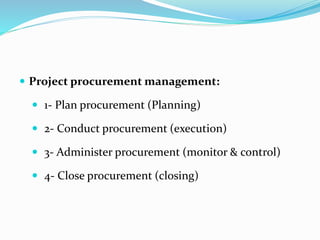
 Project procurement management:
 1- Plan procurement (Planning)
 2- Conduct procurement (execution)
 3- Administer procurement (monitor & control)
 4- Close procurement (closing)
Plan procurement
 Process of documenting project purchasing decisions,
and identifying sellers selection criteria.
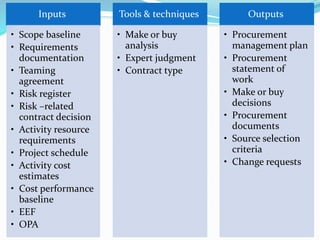
Inputs
• Scope baseline
• Requirements
documentation
• Teaming
agreement
• Risk register
• Risk –related
contract decision
• Activity resource
requirements
• Project schedule
• Activity cost
estimates
• Cost performance
baseline
• EEF
• OPA
Tools & techniques
• Make or buy
analysis
• Expert judgment
• Contract type
Outputs
• Procurement
management plan
• Procurement
statement of
work
• Make or buy
decisions
• Procurement
documents
• Source selection
criteria
• Change requests
Input
 Project management plan: Scope baseline
 Requirements documentation
 Risk register
 Activity resource requirements: contain
information on specific needs such as people,
equipment, or location
 Project schedule: contains information on required
timelines or mandated deliverable dates.
 Activity cost estimates: used to evaluate the
reasonableness of the bids or proposals received from
potential sellers.
 Stakeholder register
 EEF
 OPA
legal contractual relationships:
 Fixed-price contracts: fixed total price for a defined
product, service, may incorporate financial incentives
for achieving or exceeding selected project objectives.
buyers need to precisely specify the product or
services. (seller risk)
 Firm Fixed Price Contracts (FFP).
 Fixed Price Incentive Fee Contracts (FPIF)
 Cost-reimbursable contracts: Involves payments to
the seller for all legitimate actual costs incurred for
completed work, plus a fee representing seller profit.
 Scope of work cannot be precisely defined at the start
and needs to be altered, or when high risks may exist
in the effort. (buyer risk)
 Cost Plus Fixed Fee Contracts (CPFF)
 Cost Plus Incentive Fee Contracts (CPIF)
 Time and Material Contracts (T&M): often used for
staff augmentation, acquisition of experts, and any
outside support.
FP
 Buyer less management ,he know the total price
 More expensive more than CR, more work to specify
SoW
CR
 Simpler SoW, lower cost than FP
 Require auditing the seller’s invoices, more work to
manage, the seller has moderate incentive to control
cost.
Tools & techniques
 Make-or-Buy Analysis
120 is daily lease cost
1000 is investment cost with 20 daily cost
120 D = 1000 + 20 D
D=10
 Expert Judgment
 Market Research: includes examination of industry and
specific vendor capabilities
 Meetings
Output
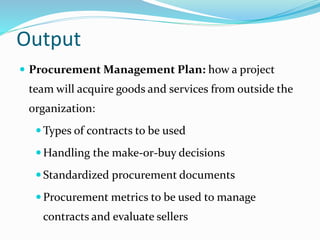
 Procurement Management Plan: how a project
team will acquire goods and services from outside the
organization:
Types of contracts to be used
Handling the make-or-buy decisions
Standardized procurement documents
Procurement metrics to be used to manage
contracts and evaluate sellers
 Procurement Statement of Work:
 defines only that portion of the project scope that is to be
included within the related contract, include:
 Specifications
 Quantity desired & quality levels
 Period of performance
 Work location
 Other requirements.
 Procurement Documents: request for information (RFI),
request for proposal (RFP), invitation for bid (IFB), request
for quotation (RFQ), invitation for negotiation (IFN).
 Source Selection Criteria:
 Overall or life-cycle cost
 Technical capability
 Risk
 Warranty
 Past performance of sellers
 Make-or-Buy Decisions
 Change Requests
 Project Documents Updates: risk register,
Requirements documentation…
Conduct procurement:
 Process of obtaining sellers responses, selecting a
seller and awarding a contract.
Inputs
• Project
management plan
• Procurement
documents
• Source selection
criteria
• Qualified seller
list
• Seller proposals
• Project
documents make
or buy decisions
• Teaming
agreement.
• OPA
Tools & techniques
• Bidder conference
• Proposal
evaluation
techniques
• Expert judgment
• Advertising
• Internet search
• Procurement
negotiations
Outputs
• Selected sellers
• Procurement
contract award
• Resource
calendars
• Change requests
• Project
management plan
updates
• Procurement
documents
updates
Tools & techniques
 Bidder conference
 Sellers have a clear and common understanding of the
procurement requirements.
 Proposal evaluation techniques:
 formal evaluation review process will be defined by the
buyer’s procurement policies
 Independent Estimates:
 have an estimate of costs prepared by an outside
professional estimator, to serve as a benchmark on
proposed responses
 Expert Judgment
 Advertising
 Analytical Techniques: identify the readiness of a
vendor to provide the desired end state, and avoid cost
overruns due to change.
 Procurement Negotiations
 Contract contents: usually most of contracts contains
the following :
Statement or work/ deliverables
Schedule baseline
Project period
Pricing
Payment terms
Warranty
Penatlies
Incentives
Insurance arrangements
Change request criteria
Acceptance criteria
Claims handling.
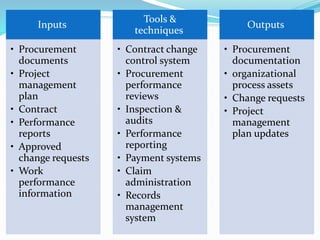
Administer procurement
 Process of managing procurement relationships,
monitoring contract performance, and making
changes and corrections as needed.
Inputs
• Procurement
documents
• Project
management
plan
• Contract
• Performance
reports
• Approved
change requests
• Work
performance
information
Tools &
techniques
• Contract change
control system
• Procurement
performance
reviews
• Inspection &
audits
• Performance
reporting
• Payment systems
• Claim
administration
• Records
management
system
Outputs
• Procurement
documentation
• organizational
process assets
• Change requests
• Project
management
plan updates
Tools & techniques
 Contract Change Control System: defines the
process by which the procurement can be modified. It
includes the paperwork, tracking systems, dispute
resolution procedures
 Procurement Performance Reviews: review of the
seller’s progress to deliver project scope and quality,
within cost and on schedule, as compared to the
contract
 Inspections and Audits: to verify compliance in the
seller’s work processes
 Performance Reporting
 Payment Systems:
 Claims Administration: If the parties themselves do
not resolve a claim, it may have to be handled in
accordance with alternative dispute resolution (ADR)
(mediation, arbitration, courts)
 Records Management System: The system contains
a retrievable archive of contract documents and
correspondence
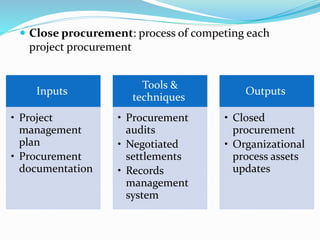
 Close procurement: process of competing each
project procurement
Inputs
• Project
management
plan
• Procurement
documentation
Tools &
techniques
• Procurement
audits
• Negotiated
settlements
• Records
management
system
Outputs
• Closed
procurement
• Organizational
process assets
updates
Thanks

Procurement management

  • 1.
  • 2.
     Project procurementmanagement:  1- Plan procurement (Planning)  2- Conduct procurement (execution)  3- Administer procurement (monitor & control)  4- Close procurement (closing)
  • 3.
    Plan procurement  Processof documenting project purchasing decisions, and identifying sellers selection criteria.
  • 4.
    Inputs • Scope baseline •Requirements documentation • Teaming agreement • Risk register • Risk –related contract decision • Activity resource requirements • Project schedule • Activity cost estimates • Cost performance baseline • EEF • OPA Tools & techniques • Make or buy analysis • Expert judgment • Contract type Outputs • Procurement management plan • Procurement statement of work • Make or buy decisions • Procurement documents • Source selection criteria • Change requests
  • 5.
    Input  Project managementplan: Scope baseline  Requirements documentation  Risk register  Activity resource requirements: contain information on specific needs such as people, equipment, or location  Project schedule: contains information on required timelines or mandated deliverable dates.
  • 6.
     Activity costestimates: used to evaluate the reasonableness of the bids or proposals received from potential sellers.  Stakeholder register  EEF  OPA
  • 7.
    legal contractual relationships: Fixed-price contracts: fixed total price for a defined product, service, may incorporate financial incentives for achieving or exceeding selected project objectives. buyers need to precisely specify the product or services. (seller risk)  Firm Fixed Price Contracts (FFP).  Fixed Price Incentive Fee Contracts (FPIF)
  • 8.
     Cost-reimbursable contracts:Involves payments to the seller for all legitimate actual costs incurred for completed work, plus a fee representing seller profit.  Scope of work cannot be precisely defined at the start and needs to be altered, or when high risks may exist in the effort. (buyer risk)  Cost Plus Fixed Fee Contracts (CPFF)  Cost Plus Incentive Fee Contracts (CPIF)
  • 9.
     Time andMaterial Contracts (T&M): often used for staff augmentation, acquisition of experts, and any outside support.
  • 10.
    FP  Buyer lessmanagement ,he know the total price  More expensive more than CR, more work to specify SoW
  • 11.
    CR  Simpler SoW,lower cost than FP  Require auditing the seller’s invoices, more work to manage, the seller has moderate incentive to control cost.
  • 12.
    Tools & techniques Make-or-Buy Analysis 120 is daily lease cost 1000 is investment cost with 20 daily cost 120 D = 1000 + 20 D D=10  Expert Judgment  Market Research: includes examination of industry and specific vendor capabilities  Meetings
  • 13.
    Output  Procurement ManagementPlan: how a project team will acquire goods and services from outside the organization: Types of contracts to be used Handling the make-or-buy decisions Standardized procurement documents Procurement metrics to be used to manage contracts and evaluate sellers
  • 14.
     Procurement Statementof Work:  defines only that portion of the project scope that is to be included within the related contract, include:  Specifications  Quantity desired & quality levels  Period of performance  Work location  Other requirements.
  • 15.
     Procurement Documents:request for information (RFI), request for proposal (RFP), invitation for bid (IFB), request for quotation (RFQ), invitation for negotiation (IFN).  Source Selection Criteria:  Overall or life-cycle cost  Technical capability  Risk  Warranty  Past performance of sellers
  • 16.
     Make-or-Buy Decisions Change Requests  Project Documents Updates: risk register, Requirements documentation…
  • 17.
    Conduct procurement:  Processof obtaining sellers responses, selecting a seller and awarding a contract.
  • 18.
    Inputs • Project management plan •Procurement documents • Source selection criteria • Qualified seller list • Seller proposals • Project documents make or buy decisions • Teaming agreement. • OPA Tools & techniques • Bidder conference • Proposal evaluation techniques • Expert judgment • Advertising • Internet search • Procurement negotiations Outputs • Selected sellers • Procurement contract award • Resource calendars • Change requests • Project management plan updates • Procurement documents updates
  • 19.
    Tools & techniques Bidder conference  Sellers have a clear and common understanding of the procurement requirements.  Proposal evaluation techniques:  formal evaluation review process will be defined by the buyer’s procurement policies  Independent Estimates:  have an estimate of costs prepared by an outside professional estimator, to serve as a benchmark on proposed responses
  • 20.
     Expert Judgment Advertising  Analytical Techniques: identify the readiness of a vendor to provide the desired end state, and avoid cost overruns due to change.  Procurement Negotiations
  • 21.
     Contract contents:usually most of contracts contains the following : Statement or work/ deliverables Schedule baseline Project period Pricing Payment terms Warranty Penatlies Incentives Insurance arrangements Change request criteria Acceptance criteria Claims handling.
  • 22.
    Administer procurement  Processof managing procurement relationships, monitoring contract performance, and making changes and corrections as needed.
  • 23.
    Inputs • Procurement documents • Project management plan •Contract • Performance reports • Approved change requests • Work performance information Tools & techniques • Contract change control system • Procurement performance reviews • Inspection & audits • Performance reporting • Payment systems • Claim administration • Records management system Outputs • Procurement documentation • organizational process assets • Change requests • Project management plan updates
  • 24.
    Tools & techniques Contract Change Control System: defines the process by which the procurement can be modified. It includes the paperwork, tracking systems, dispute resolution procedures  Procurement Performance Reviews: review of the seller’s progress to deliver project scope and quality, within cost and on schedule, as compared to the contract  Inspections and Audits: to verify compliance in the seller’s work processes
  • 25.
     Performance Reporting Payment Systems:  Claims Administration: If the parties themselves do not resolve a claim, it may have to be handled in accordance with alternative dispute resolution (ADR) (mediation, arbitration, courts)  Records Management System: The system contains a retrievable archive of contract documents and correspondence
  • 26.
     Close procurement:process of competing each project procurement Inputs • Project management plan • Procurement documentation Tools & techniques • Procurement audits • Negotiated settlements • Records management system Outputs • Closed procurement • Organizational process assets updates
  • 27.