Created by ejlp12@gmail.com, June 20107 - Project Cost ManagementProject Management Training
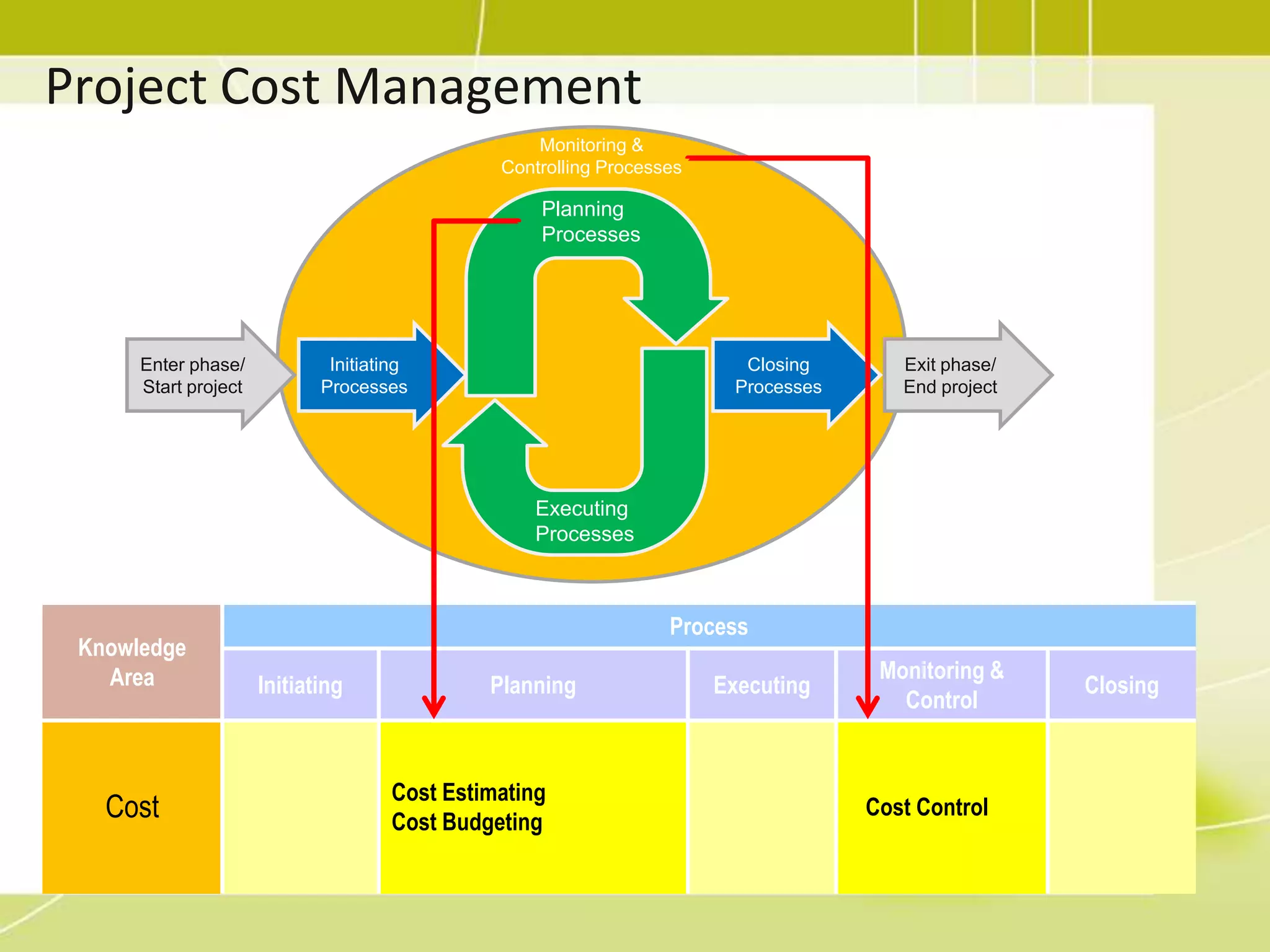
Project Cost ManagementMonitoring &Controlling ProcessesPlanningProcessesEnter phase/Start projectExit phase/End projectInitiatingProcessesClosingProcessesExecutingProcesses
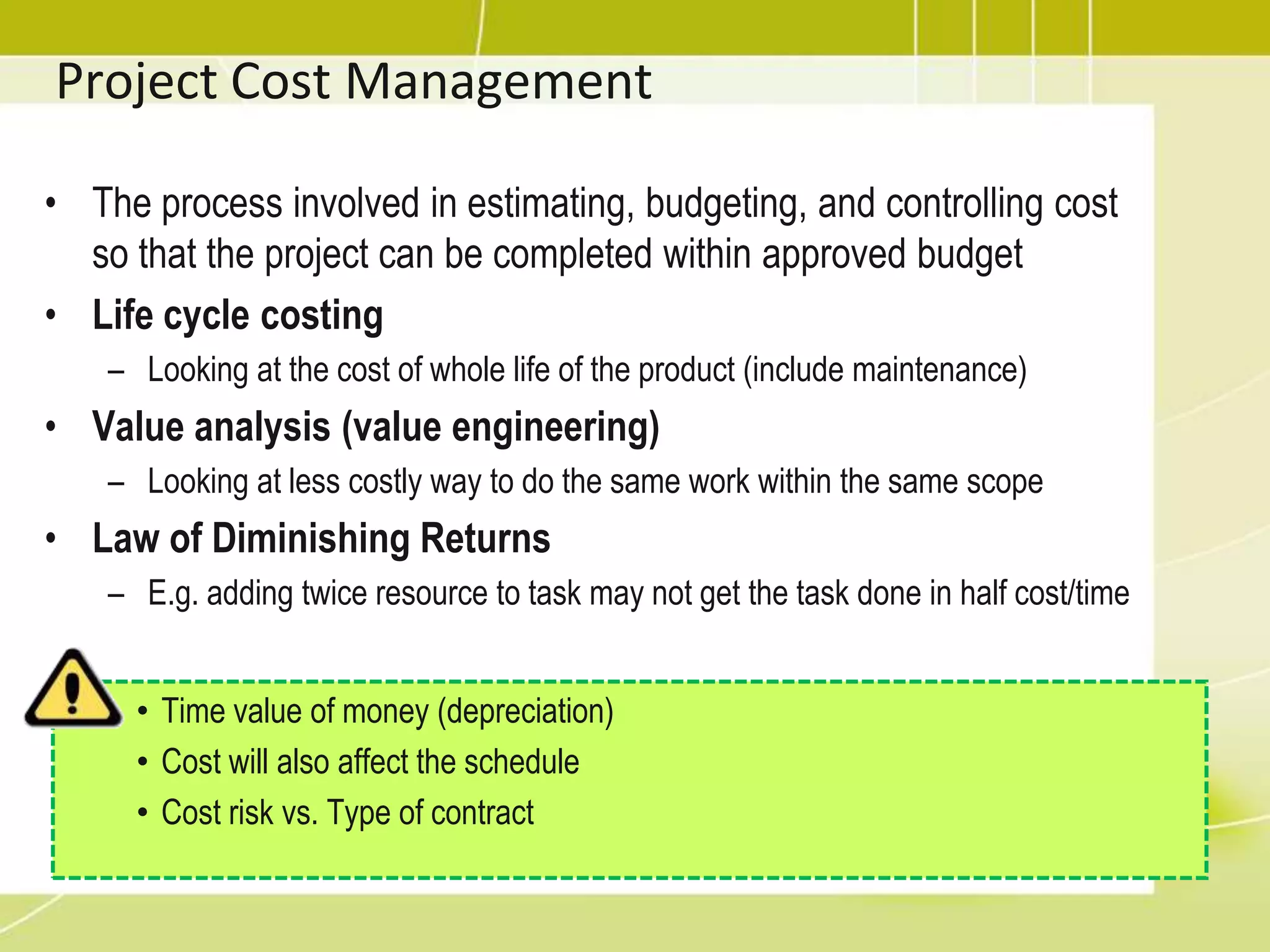
Project Cost ManagementThe process involved in estimating, budgeting, and controlling cost so that the project can be completed within approved budgetLife cycle costingLooking at the cost of whole life of the product (include maintenance)Value analysis (value engineering)Looking at less costly way to do the same work within the same scopeLaw of Diminishing ReturnsE.g. adding twice resource to task may not get the task done in half cost/timeTime value of money (depreciation)
Cost will also affect the schedule
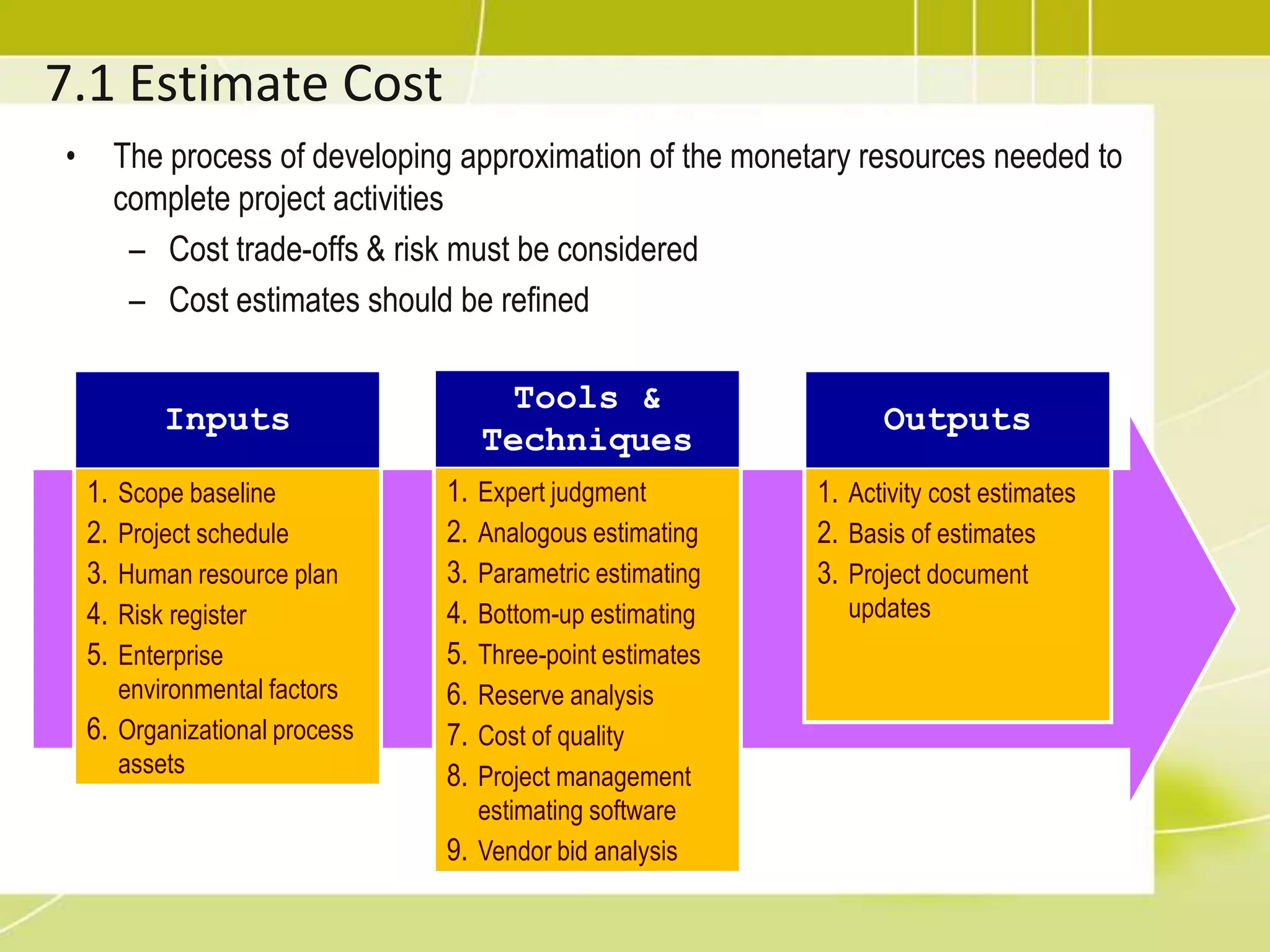
Cost risk vs. Type of contract7.1 Estimate CostThe process of developing approximation of the monetary resources needed to complete project activitiesCost trade-offs & risk must be consideredCost estimates should be refined
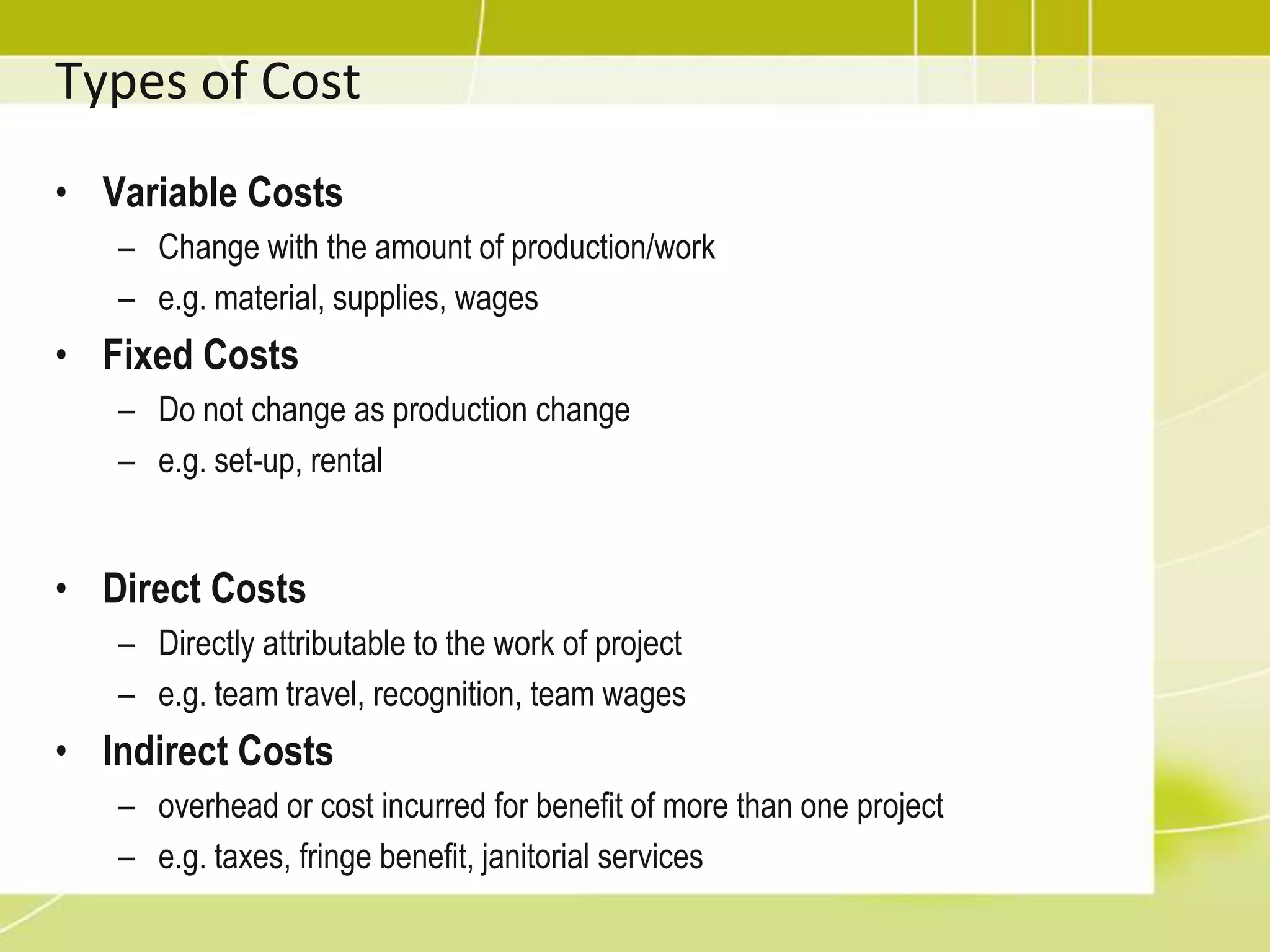
Types of CostVariable CostsChange with the amount of production/work e.g. material, supplies, wagesFixed CostsDo not change as production changee.g. set-up, rentalDirect CostsDirectly attributable to the work of projecte.g. team travel, recognition, team wagesIndirect Costsoverhead or cost incurred for benefit of more than one projecte.g. taxes, fringe benefit, janitorial services
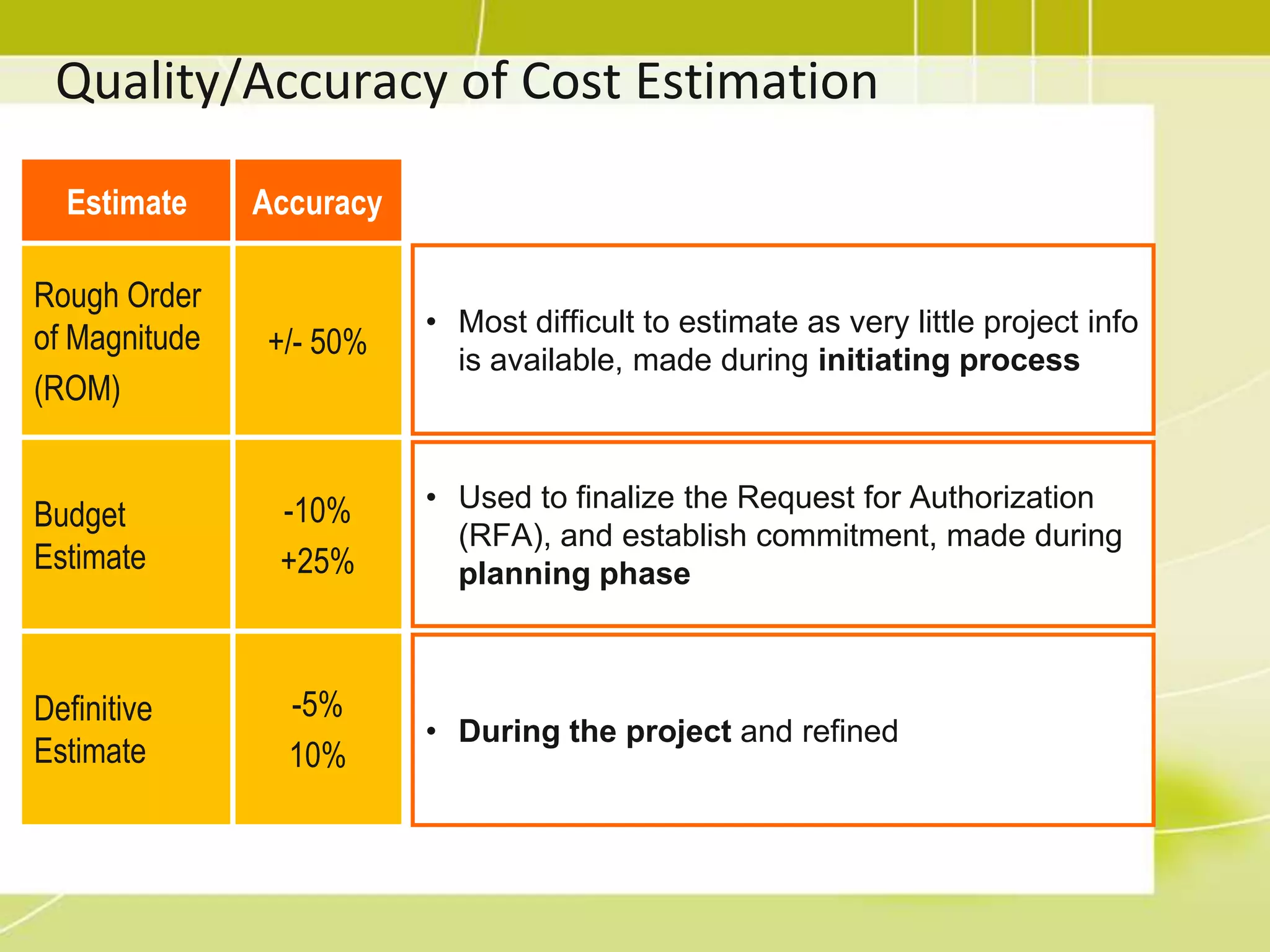
Quality/Accuracy of Cost EstimationMost difficult to estimate as very little project info is available, made during initiating process
Used to finalize the Request for Authorization (RFA), and establish commitment, made during planning phase
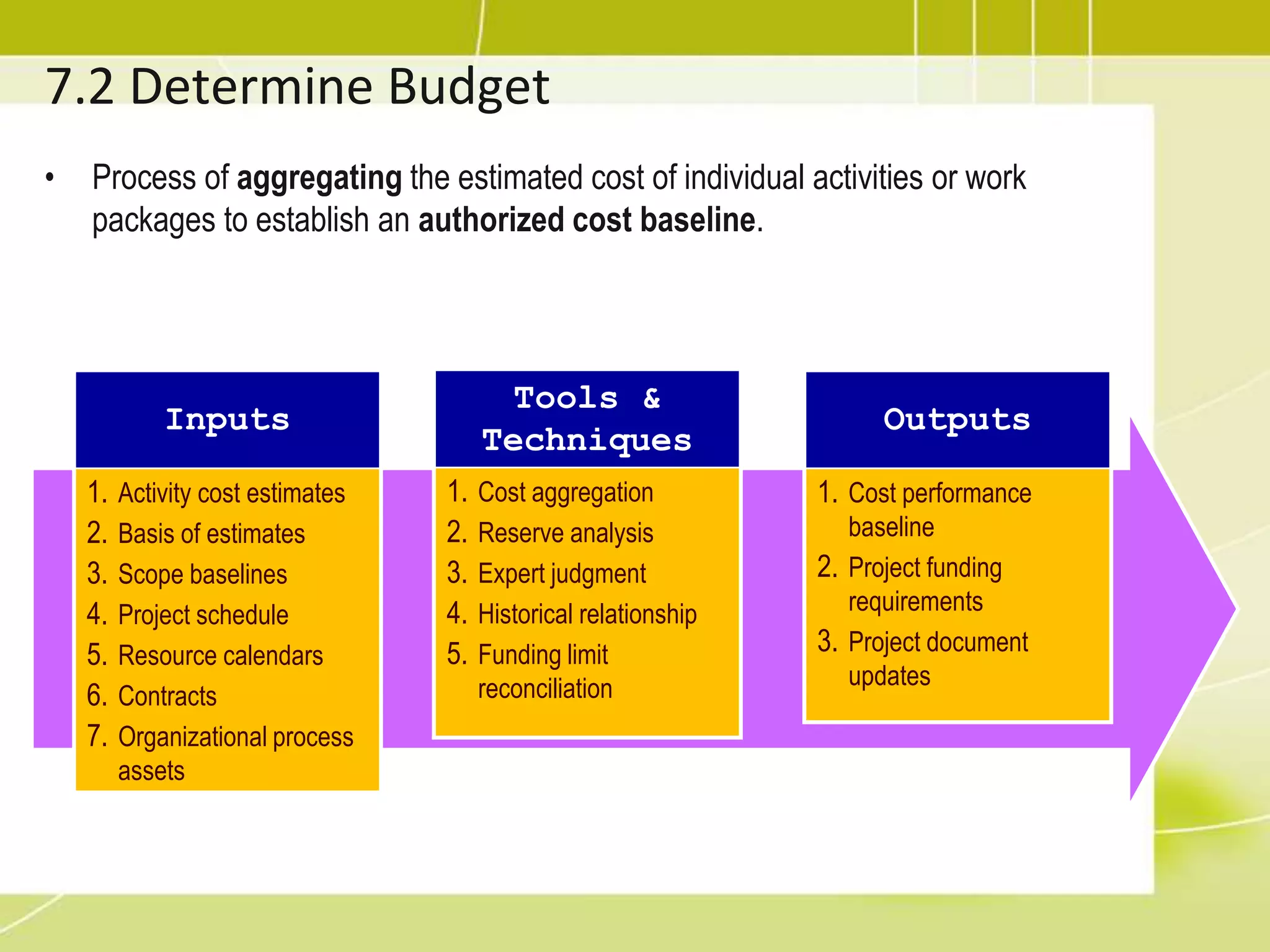
During the project and refined7.2 Determine BudgetProcess of aggregating the estimated cost of individual activities or work packages to establish an authorized cost baseline.
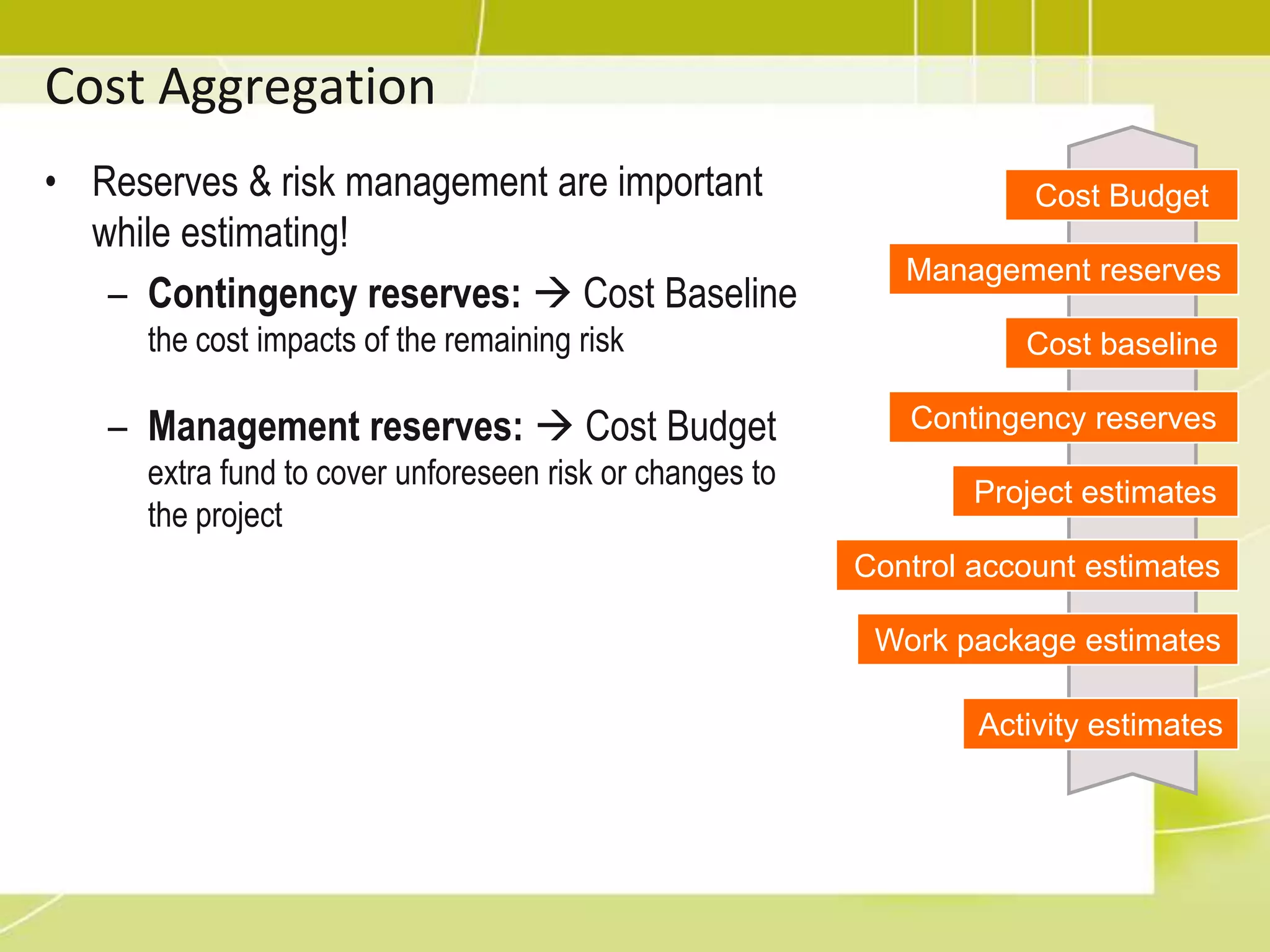
Cost AggregationReserves & risk management are important  while estimating!Contingency reserves:  Cost Baseline the cost impacts of the remaining riskManagement reserves:  Cost Budgetextra fund to cover unforeseen risk or changes to the projectCost BudgetManagement reservesCost baselineContingency reservesProject estimatesControl account estimatesWork package estimatesActivity estimates
Determines Budget: Other considerationsHigh level parametric estimate as a rule of thumbE.g. testing cost 50% of development costFunding limit reconciliation = checking cash flowWhen the money will be available? Reconciliation needed before proposed cost baseline and cost budget become finalSuch reconciliation is part of integration management
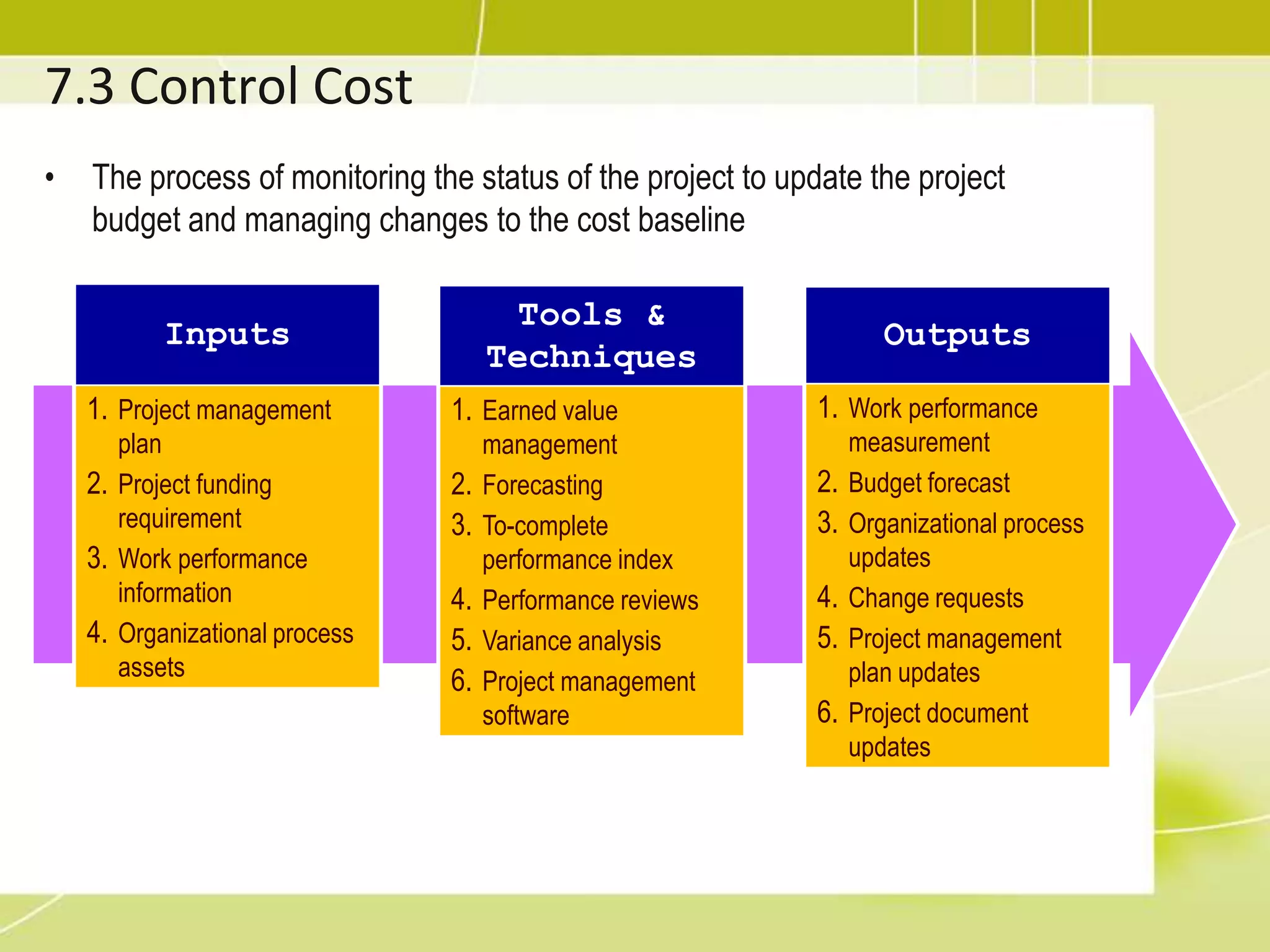
7.3 Control CostThe process of monitoring the status of the project to update the project budget and managing changes to the cost baseline
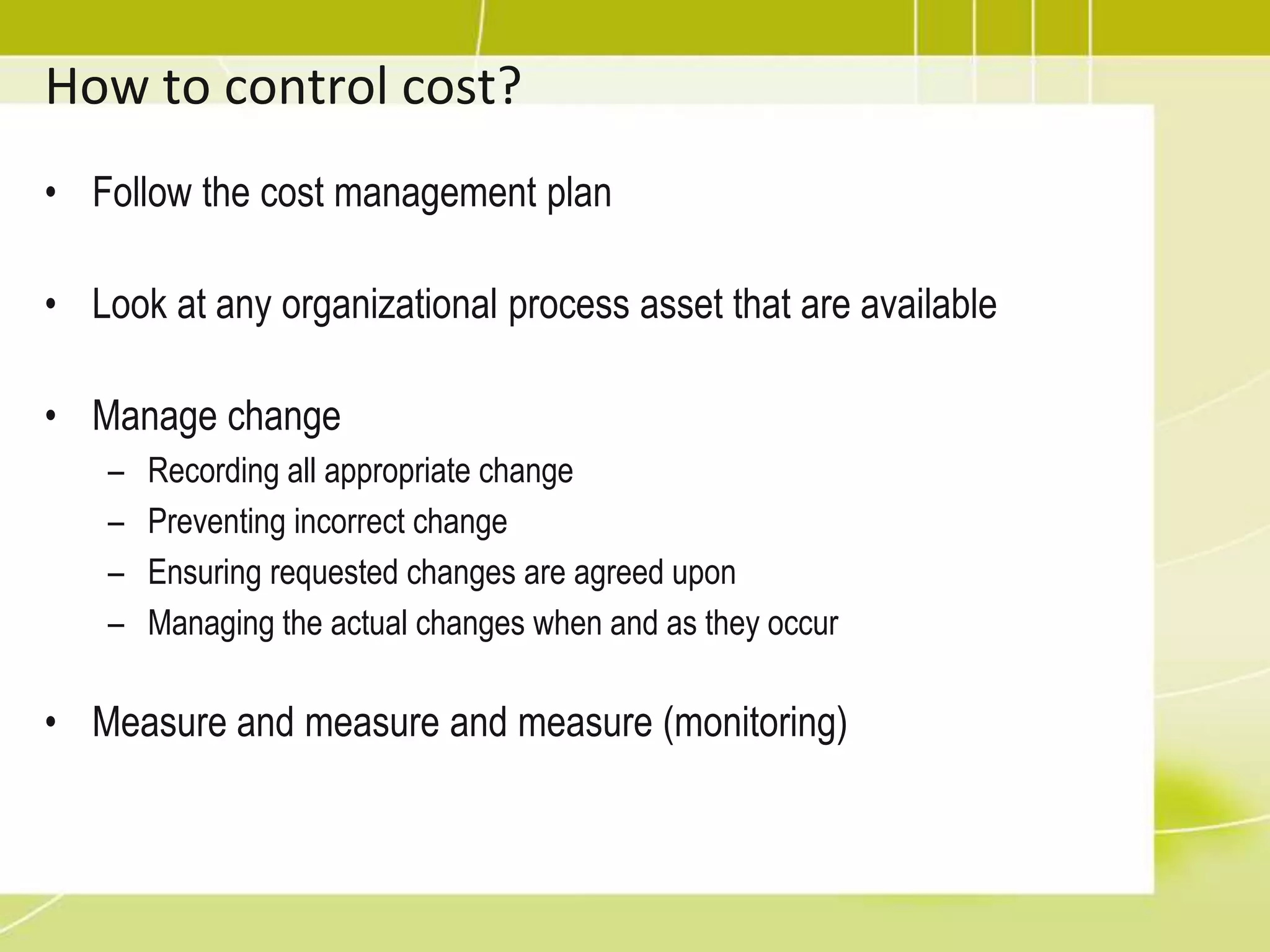
How to control cost?Follow the cost management planLook at any organizational process asset that are availableManage changeRecording all appropriate changePreventing incorrect changeEnsuring requested changes are agreed uponManaging the actual changes when and as they occurMeasure and measure and measure (monitoring)
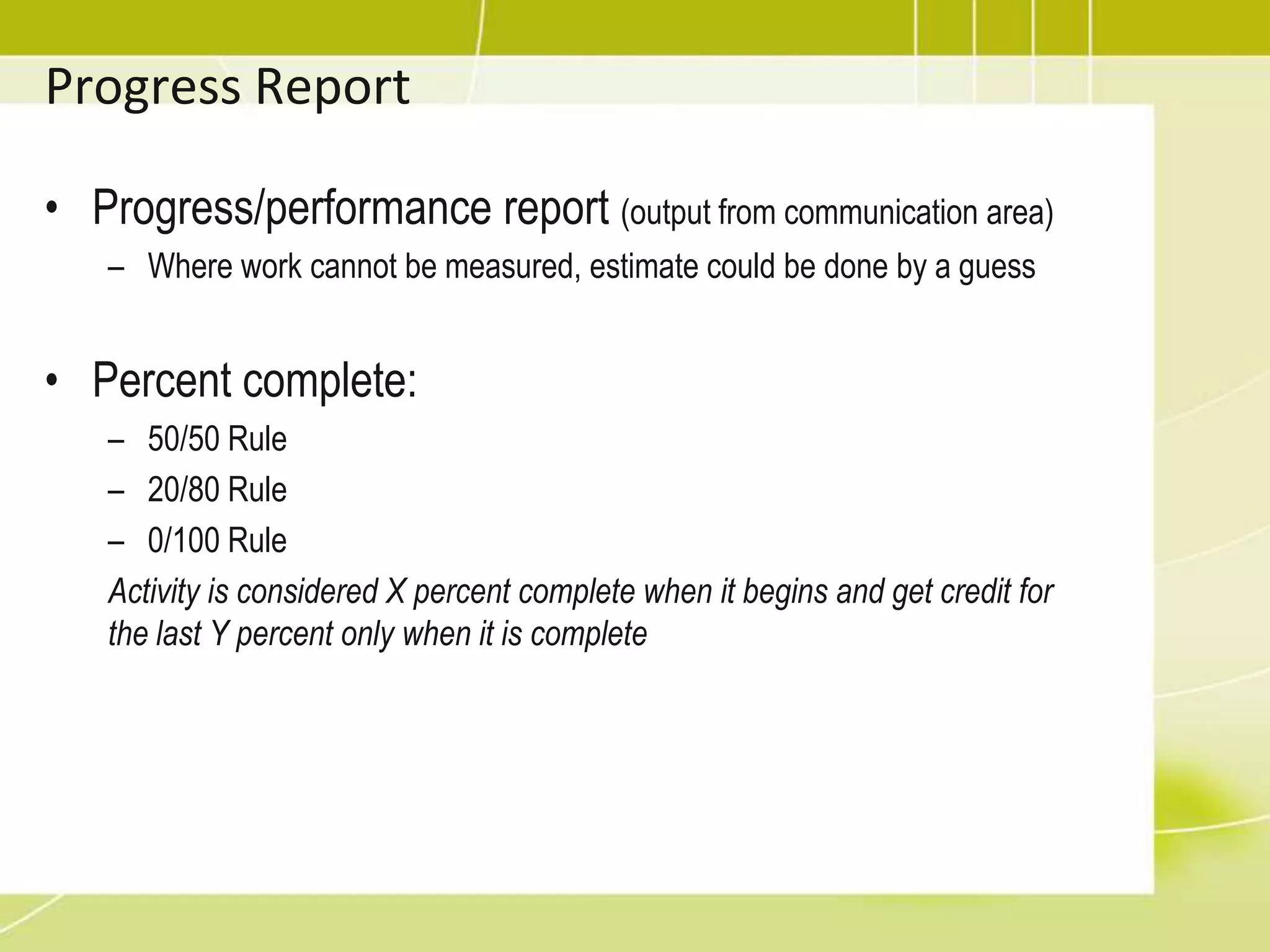
Progress ReportProgress/performance report (output from communication area)Where work cannot be measured, estimate could be done by a guessPercent complete:50/50 Rule20/80 Rule0/100 RuleActivity is considered X percent complete when it begins and get credit for the last Y percent only when it is complete
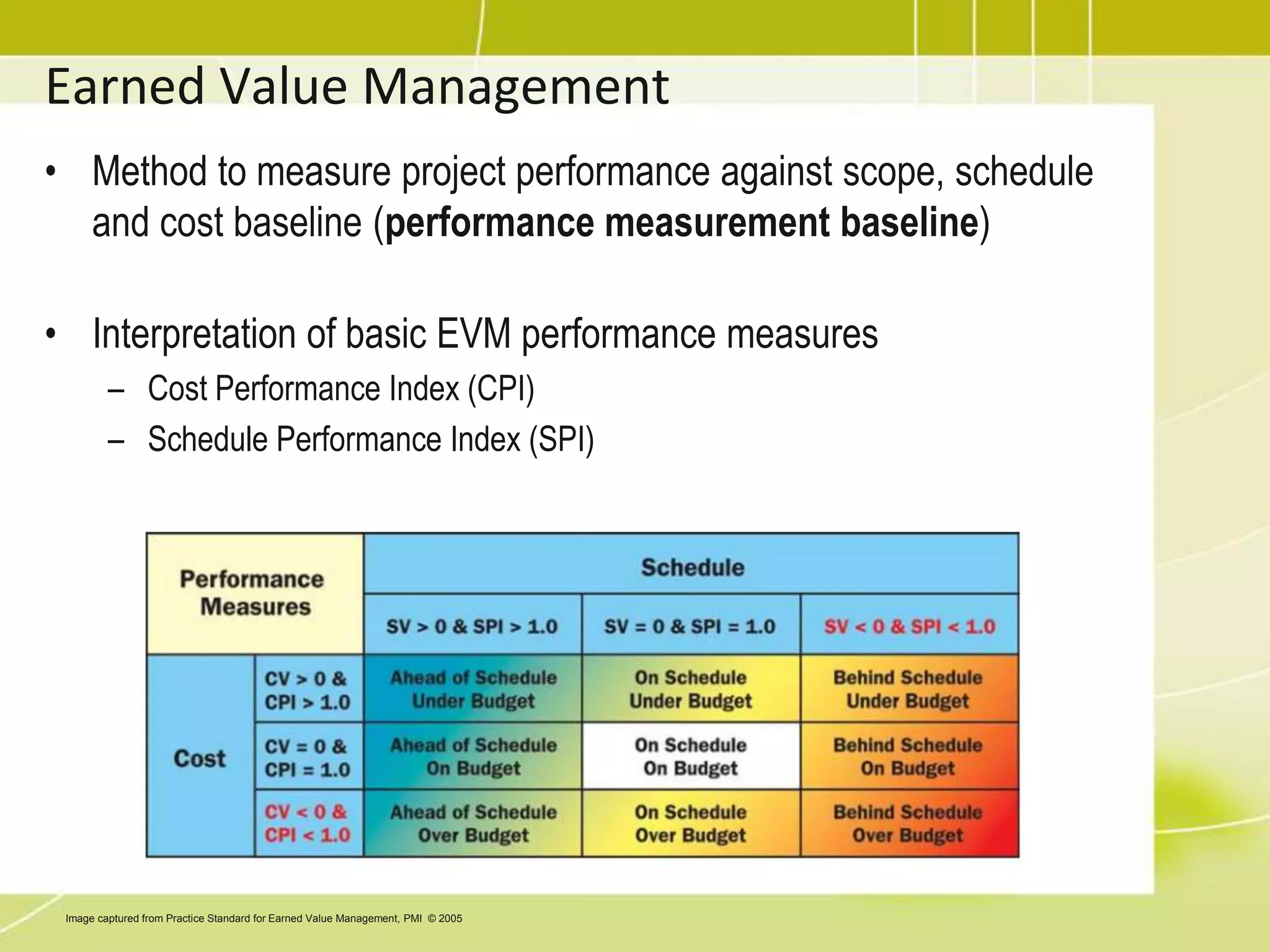
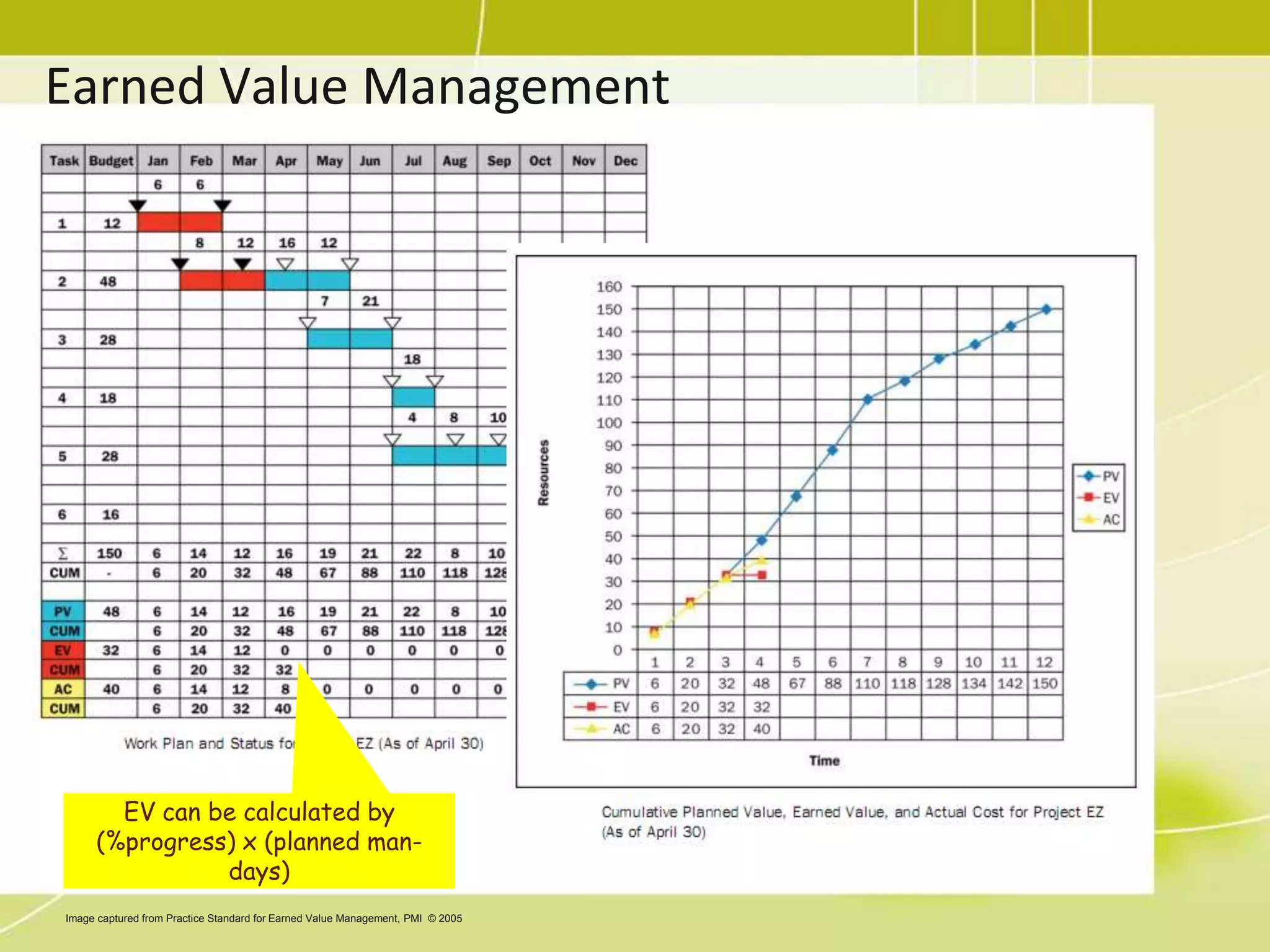
Earned Value ManagementMethod to measure project performance against scope, schedule and cost baseline (performance measurement baseline)Interpretation of basic EVM performance measuresCost Performance Index (CPI)Schedule Performance Index (SPI)Image captured from Practice Standard for Earned Value Management, PMI  © 2005
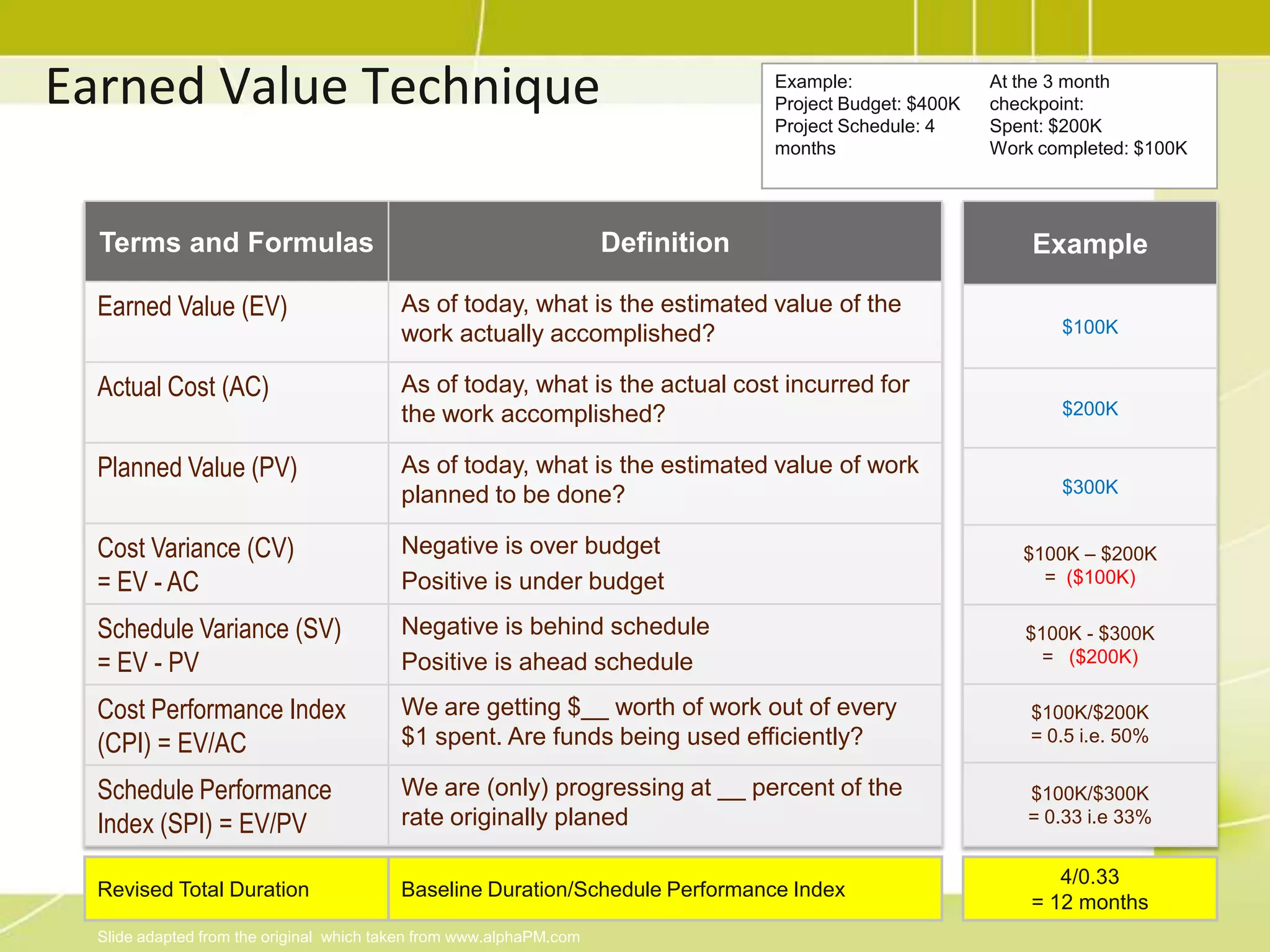
Earned Value TechniqueExample:Project Budget: $400KProject Schedule: 4 monthsAt the 3 month checkpoint:Spent: $200KWork completed: $100KRevised Total Duration Baseline Duration/Schedule Performance Index4/0.33= 12 monthsSlide adapted from the original  which taken from www.alphaPM.com
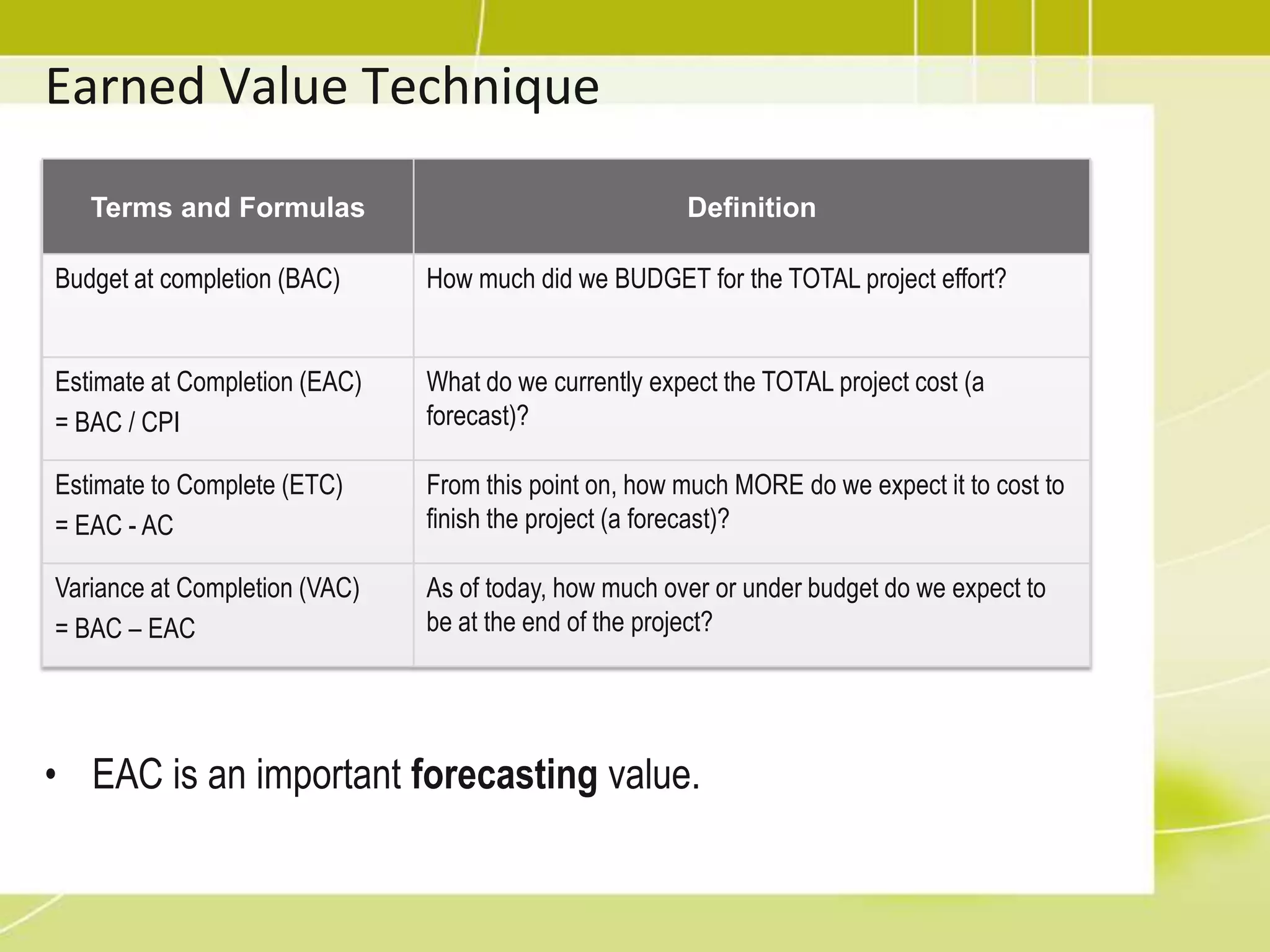
Earned Value TechniqueEAC is an important forecasting value.
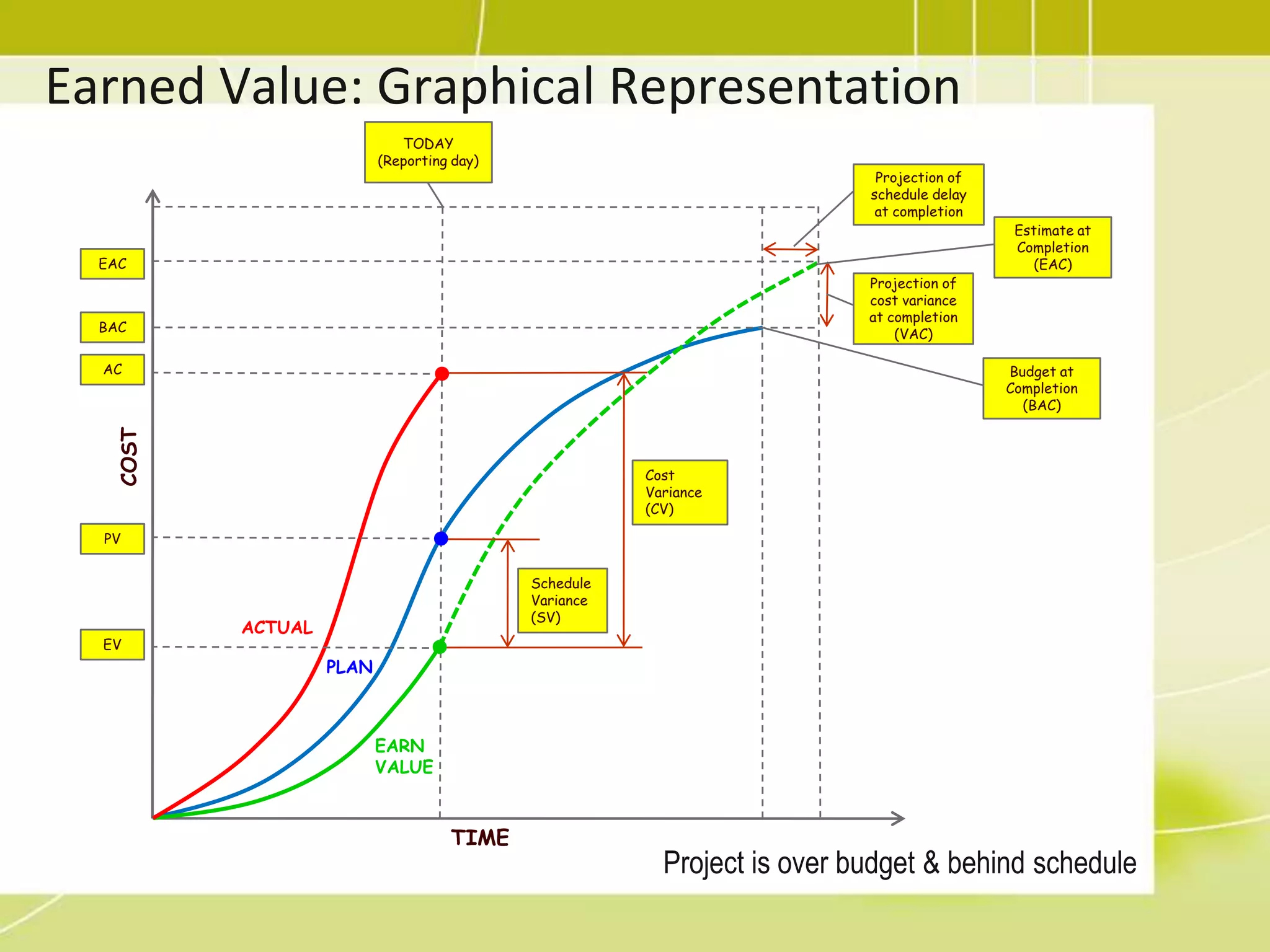
Earned Value: Graphical RepresentationTODAY(Reporting day)Projection of schedule delay at completionEstimate at Completion(EAC)EACProjection of cost variance at completion(VAC) BACACBudget at Completion(BAC)COSTCostVariance(CV)PVScheduleVariance (SV)ACTUALEVPLANEARNVALUETIMEProject is over budget & behind schedule
Earned Value ManagementEV can be calculated by (%progress) x (planned man-days)Image captured from Practice Standard for Earned Value Management, PMI  © 2005
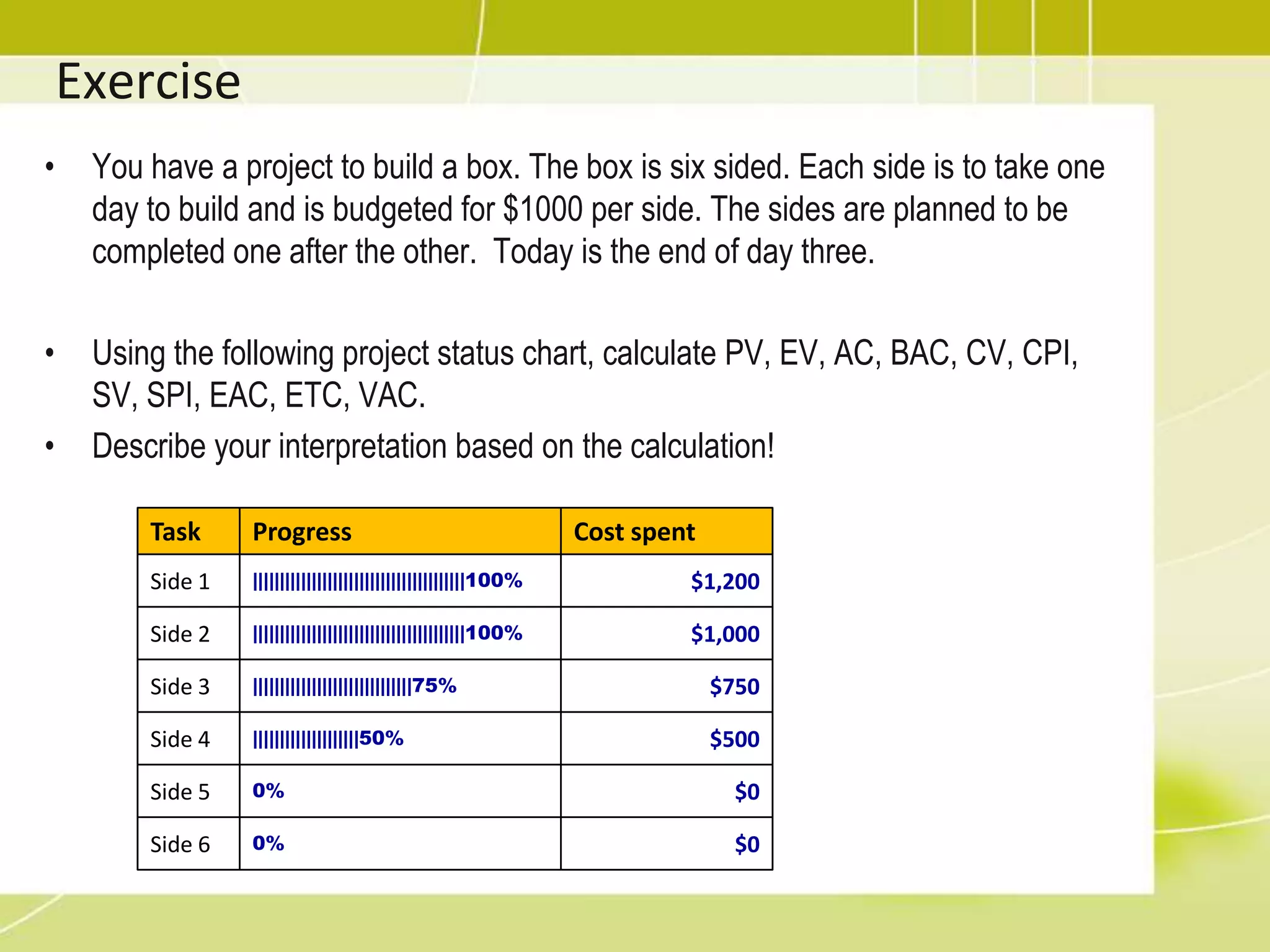
ExerciseYou have a project to build a box. The box is six sided. Each side is to take one day to build and is budgeted for $1000 per side. The sides are planned to be completed one after the other.  Today is the end of day three.
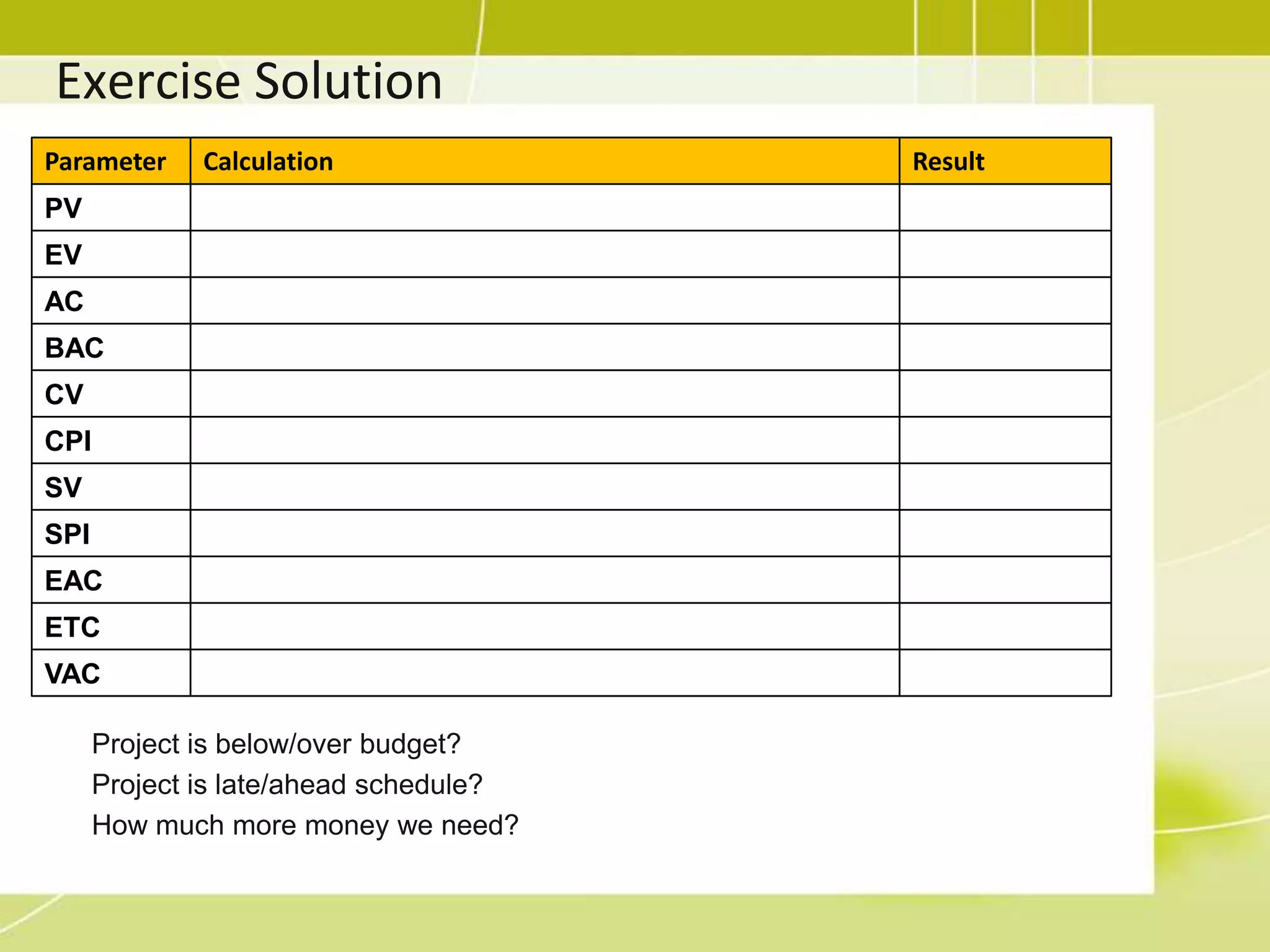
Using the following project status chart, calculate PV, EV, AC, BAC, CV, CPI, SV, SPI, EAC, ETC, VAC.
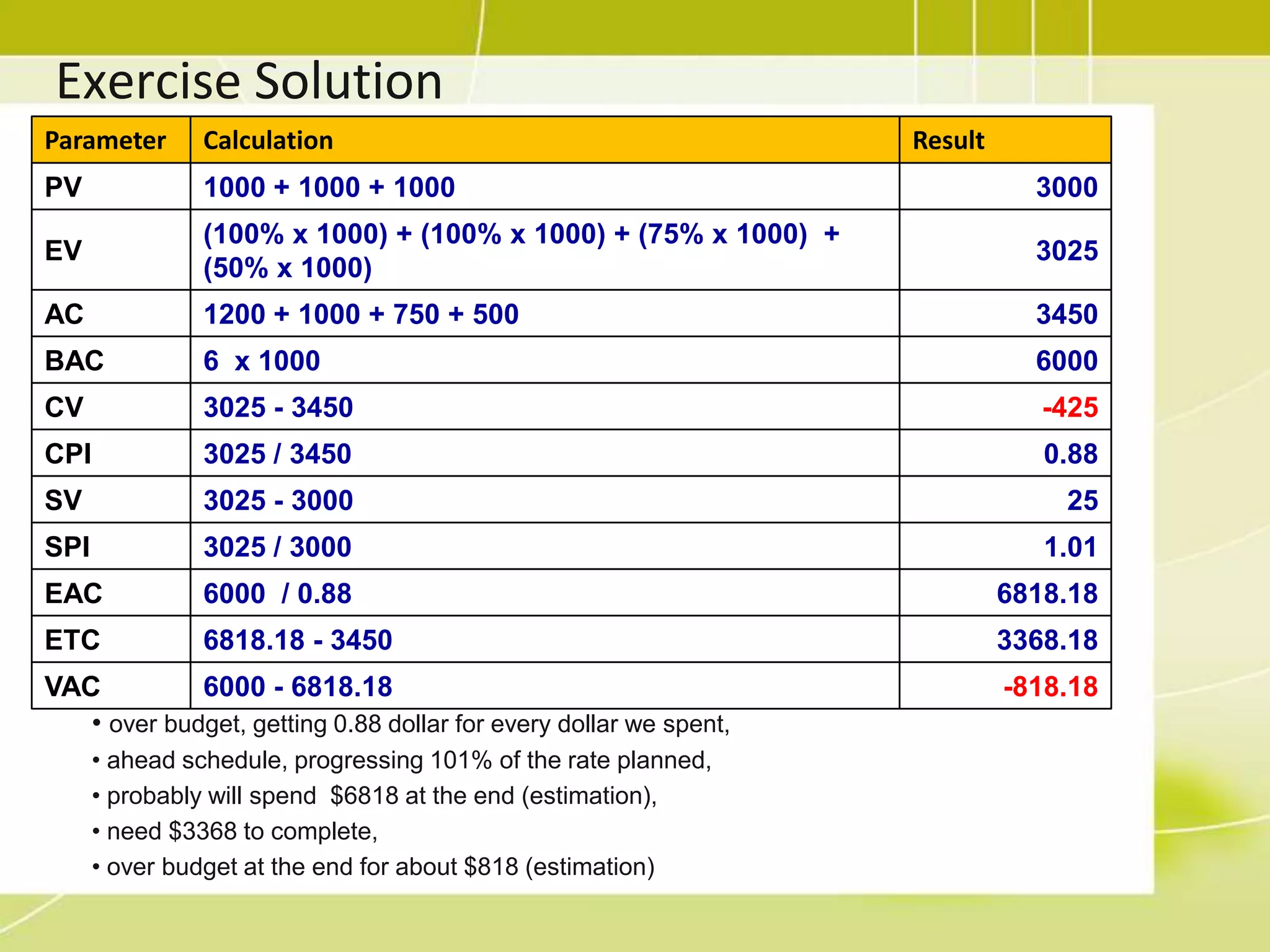
Describe your interpretation based on the calculation!Exercise SolutionProjectis below/over budget?Project is late/ahead schedule?How much more money we need?
Exercise Solutionover budget, getting 0.88 dollar for every dollar we spent,
 ahead schedule, progressing 101% of the rate planned,
probably will spend  $6818 at the end (estimation),
 need $3368 to complete,
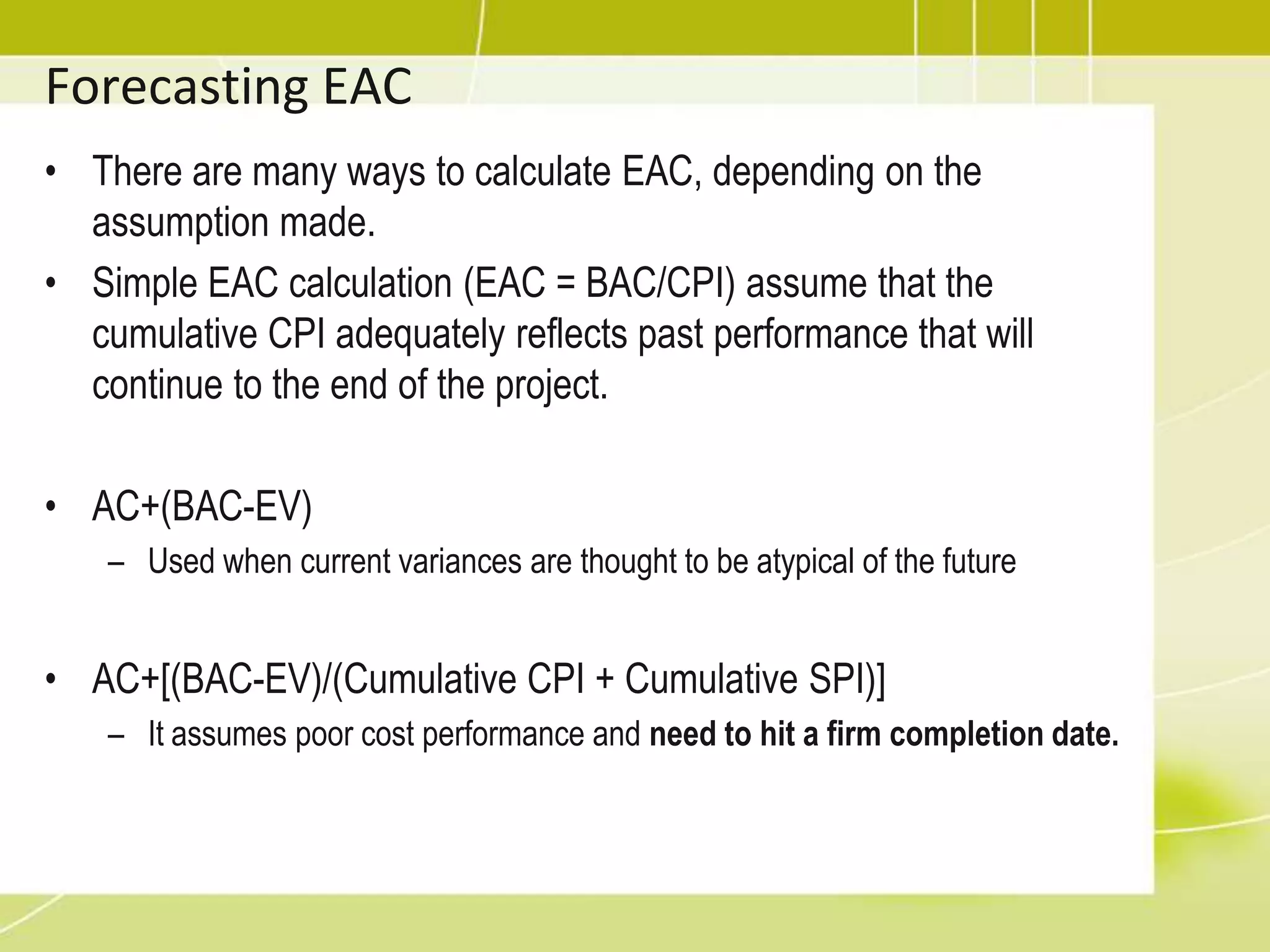
 over budget at the end for about $818 (estimation)Forecasting EACThere are many ways to calculate EAC, depending on the assumption made.Simple EAC calculation (EAC = BAC/CPI) assume that the cumulative CPI adequately reflects past performance that will continue to the end of the project. AC+(BAC-EV)Used when current variances are thought to be atypical of the futureAC+[(BAC-EV)/(Cumulative CPI + Cumulative SPI)]It assumes poor cost performance and need to hit a firm completion date.

PMP Training - 07 project cost management

  • 1.
    Created by ejlp12@gmail.com,June 20107 - Project Cost ManagementProject Management Training
  • 2.
    Project Cost ManagementMonitoring&Controlling ProcessesPlanningProcessesEnter phase/Start projectExit phase/End projectInitiatingProcessesClosingProcessesExecutingProcesses
  • 3.
    Project Cost ManagementTheprocess involved in estimating, budgeting, and controlling cost so that the project can be completed within approved budgetLife cycle costingLooking at the cost of whole life of the product (include maintenance)Value analysis (value engineering)Looking at less costly way to do the same work within the same scopeLaw of Diminishing ReturnsE.g. adding twice resource to task may not get the task done in half cost/timeTime value of money (depreciation)
  • 4.
    Cost will alsoaffect the schedule
  • 5.
    Cost risk vs.Type of contract7.1 Estimate CostThe process of developing approximation of the monetary resources needed to complete project activitiesCost trade-offs & risk must be consideredCost estimates should be refined
  • 6.
    Types of CostVariableCostsChange with the amount of production/work e.g. material, supplies, wagesFixed CostsDo not change as production changee.g. set-up, rentalDirect CostsDirectly attributable to the work of projecte.g. team travel, recognition, team wagesIndirect Costsoverhead or cost incurred for benefit of more than one projecte.g. taxes, fringe benefit, janitorial services
  • 7.
    Quality/Accuracy of CostEstimationMost difficult to estimate as very little project info is available, made during initiating process
  • 8.
    Used to finalizethe Request for Authorization (RFA), and establish commitment, made during planning phase
  • 9.
    During the projectand refined7.2 Determine BudgetProcess of aggregating the estimated cost of individual activities or work packages to establish an authorized cost baseline.
  • 10.
    Cost AggregationReserves &risk management are important while estimating!Contingency reserves:  Cost Baseline the cost impacts of the remaining riskManagement reserves:  Cost Budgetextra fund to cover unforeseen risk or changes to the projectCost BudgetManagement reservesCost baselineContingency reservesProject estimatesControl account estimatesWork package estimatesActivity estimates
  • 11.
    Determines Budget: OtherconsiderationsHigh level parametric estimate as a rule of thumbE.g. testing cost 50% of development costFunding limit reconciliation = checking cash flowWhen the money will be available? Reconciliation needed before proposed cost baseline and cost budget become finalSuch reconciliation is part of integration management
  • 12.
    7.3 Control CostTheprocess of monitoring the status of the project to update the project budget and managing changes to the cost baseline
  • 13.
    How to controlcost?Follow the cost management planLook at any organizational process asset that are availableManage changeRecording all appropriate changePreventing incorrect changeEnsuring requested changes are agreed uponManaging the actual changes when and as they occurMeasure and measure and measure (monitoring)
  • 14.
    Progress ReportProgress/performance report(output from communication area)Where work cannot be measured, estimate could be done by a guessPercent complete:50/50 Rule20/80 Rule0/100 RuleActivity is considered X percent complete when it begins and get credit for the last Y percent only when it is complete
  • 15.
    Earned Value ManagementMethodto measure project performance against scope, schedule and cost baseline (performance measurement baseline)Interpretation of basic EVM performance measuresCost Performance Index (CPI)Schedule Performance Index (SPI)Image captured from Practice Standard for Earned Value Management, PMI © 2005
  • 16.
    Earned Value TechniqueExample:ProjectBudget: $400KProject Schedule: 4 monthsAt the 3 month checkpoint:Spent: $200KWork completed: $100KRevised Total Duration Baseline Duration/Schedule Performance Index4/0.33= 12 monthsSlide adapted from the original which taken from www.alphaPM.com
  • 17.
    Earned Value TechniqueEACis an important forecasting value.
  • 18.
    Earned Value: GraphicalRepresentationTODAY(Reporting day)Projection of schedule delay at completionEstimate at Completion(EAC)EACProjection of cost variance at completion(VAC) BACACBudget at Completion(BAC)COSTCostVariance(CV)PVScheduleVariance (SV)ACTUALEVPLANEARNVALUETIMEProject is over budget & behind schedule
  • 19.
    Earned Value ManagementEVcan be calculated by (%progress) x (planned man-days)Image captured from Practice Standard for Earned Value Management, PMI © 2005
  • 20.
    ExerciseYou have aproject to build a box. The box is six sided. Each side is to take one day to build and is budgeted for $1000 per side. The sides are planned to be completed one after the other. Today is the end of day three.
  • 21.
    Using the followingproject status chart, calculate PV, EV, AC, BAC, CV, CPI, SV, SPI, EAC, ETC, VAC.
  • 22.
    Describe your interpretationbased on the calculation!Exercise SolutionProjectis below/over budget?Project is late/ahead schedule?How much more money we need?
  • 23.
    Exercise Solutionover budget,getting 0.88 dollar for every dollar we spent,
  • 24.
    ahead schedule,progressing 101% of the rate planned,
  • 25.
    probably will spend $6818 at the end (estimation),
  • 26.
    need $3368to complete,
  • 27.
    over budgetat the end for about $818 (estimation)Forecasting EACThere are many ways to calculate EAC, depending on the assumption made.Simple EAC calculation (EAC = BAC/CPI) assume that the cumulative CPI adequately reflects past performance that will continue to the end of the project. AC+(BAC-EV)Used when current variances are thought to be atypical of the futureAC+[(BAC-EV)/(Cumulative CPI + Cumulative SPI)]It assumes poor cost performance and need to hit a firm completion date.
  • 28.
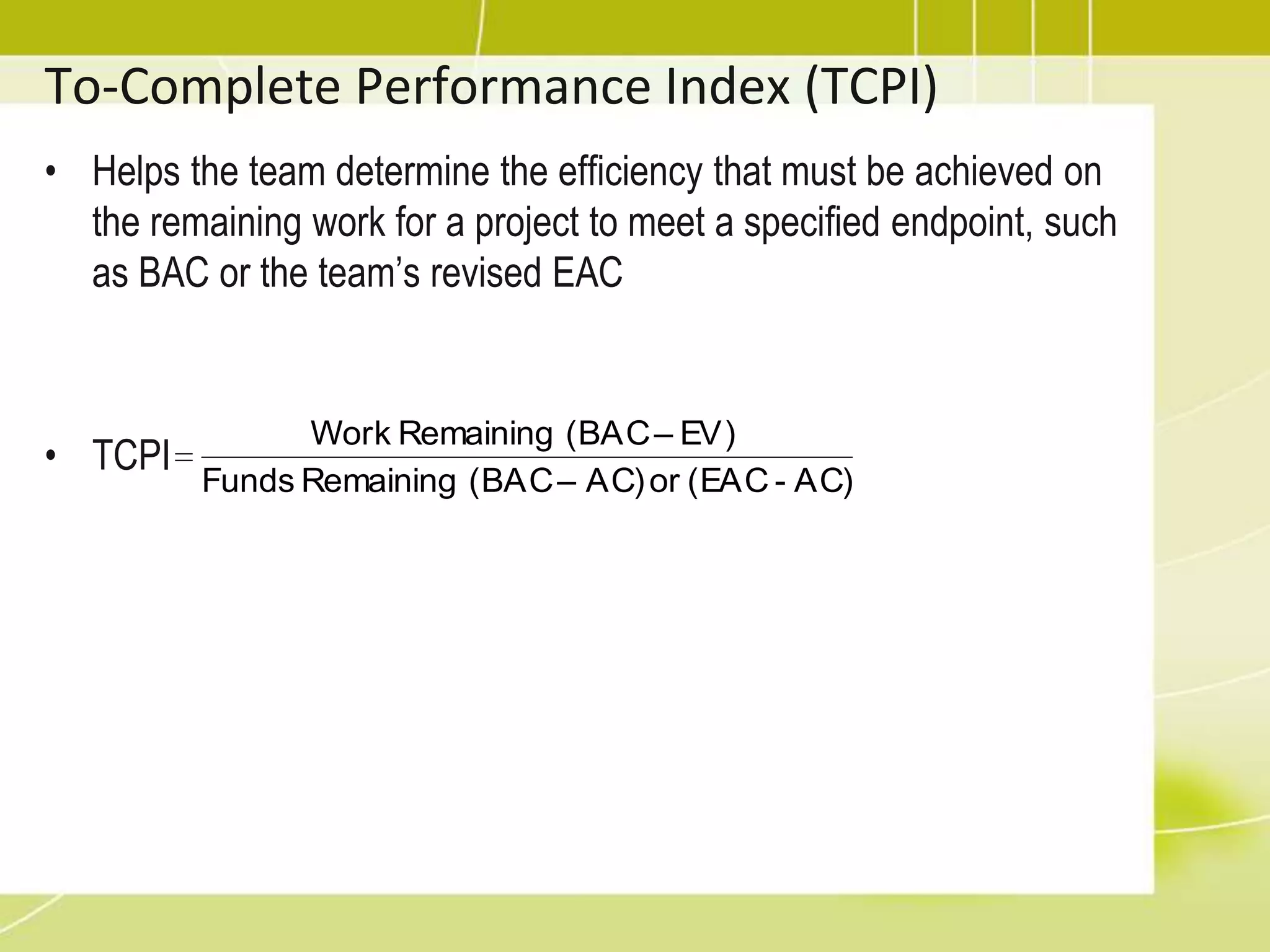
    To-Complete Performance Index(TCPI)Helps the team determine the efficiency that must be achieved on the remaining work for a project to meet a specified endpoint, such as BAC or the team’s revised EACTCPI
  • 29.
  • 30.
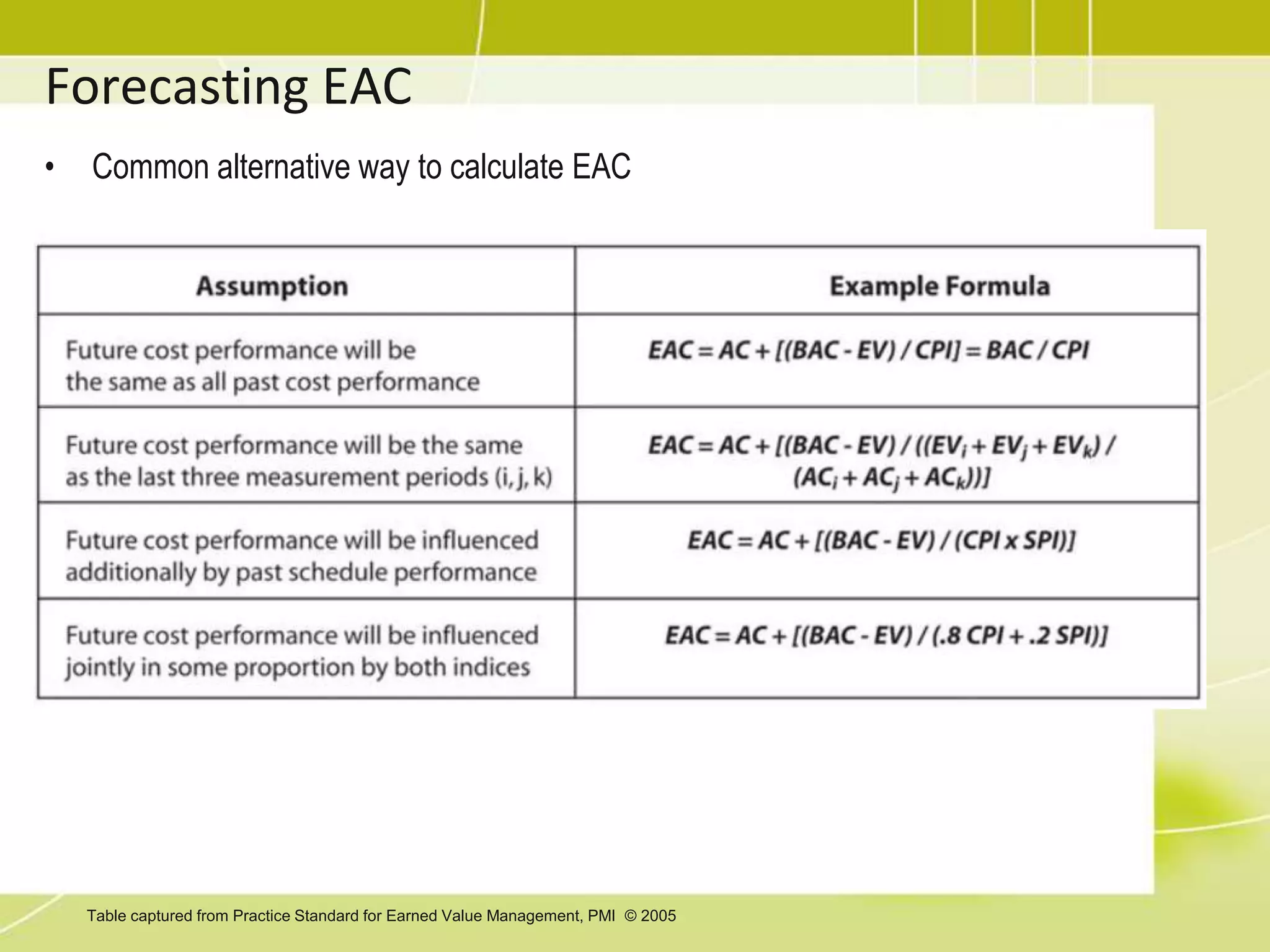
    Forecasting EACCommon alternativeway to calculate EACTable captured from Practice Standard for Earned Value Management, PMI © 2005
  • 31.
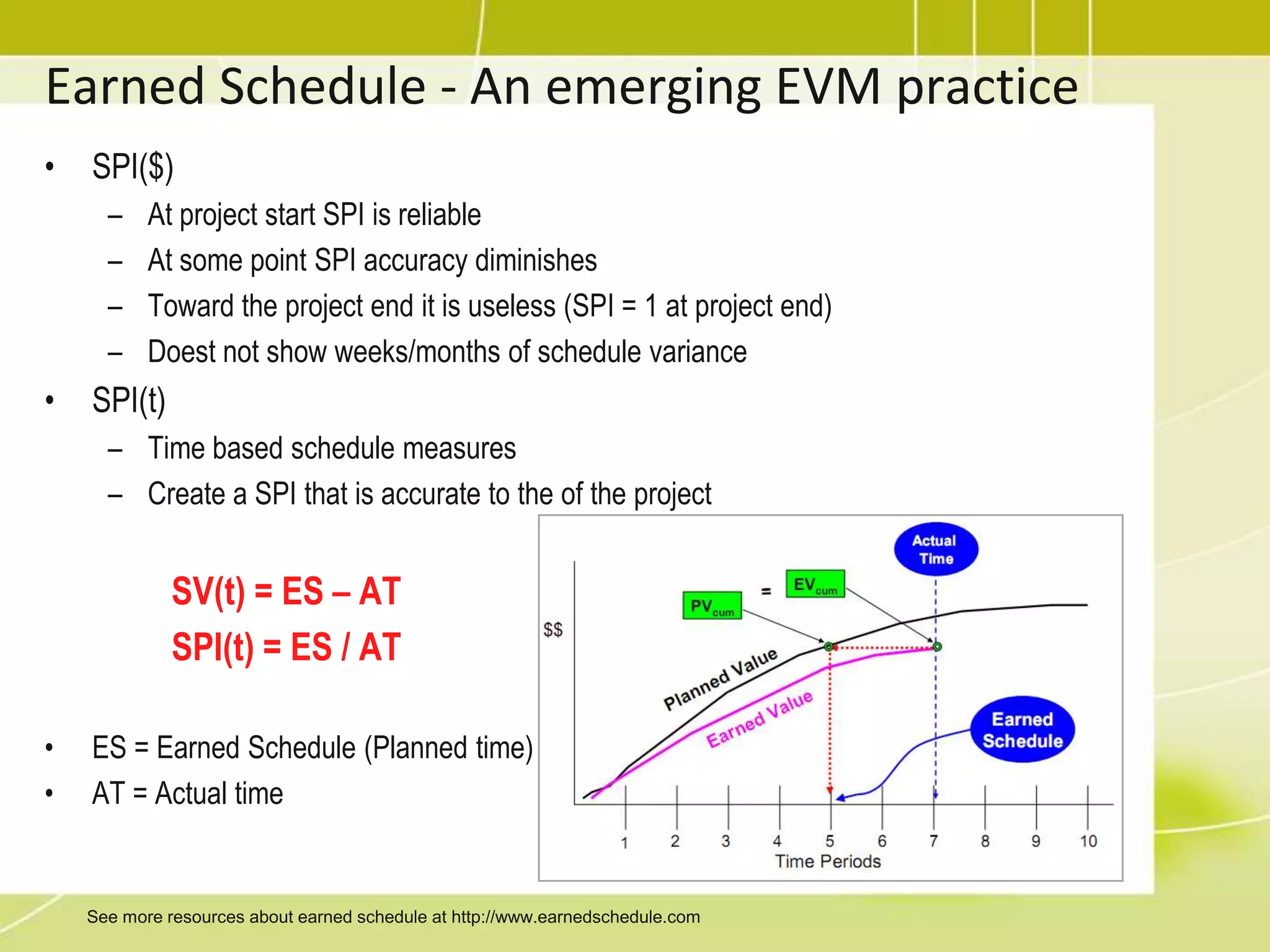
    Earned Schedule -An emerging EVM practiceSPI($) At project start SPI is reliableAt some point SPI accuracy diminishesToward the project end it is useless (SPI = 1 at project end)Doest not show weeks/months of schedule varianceSPI(t)Time based schedule measuresCreate a SPI that is accurate to the of the projectSV(t) = ES – ATSPI(t) = ES / ATES = Earned Schedule (Planned time)AT = Actual timeSee more resources about earned schedule at http://www.earnedschedule.com
  • 32.
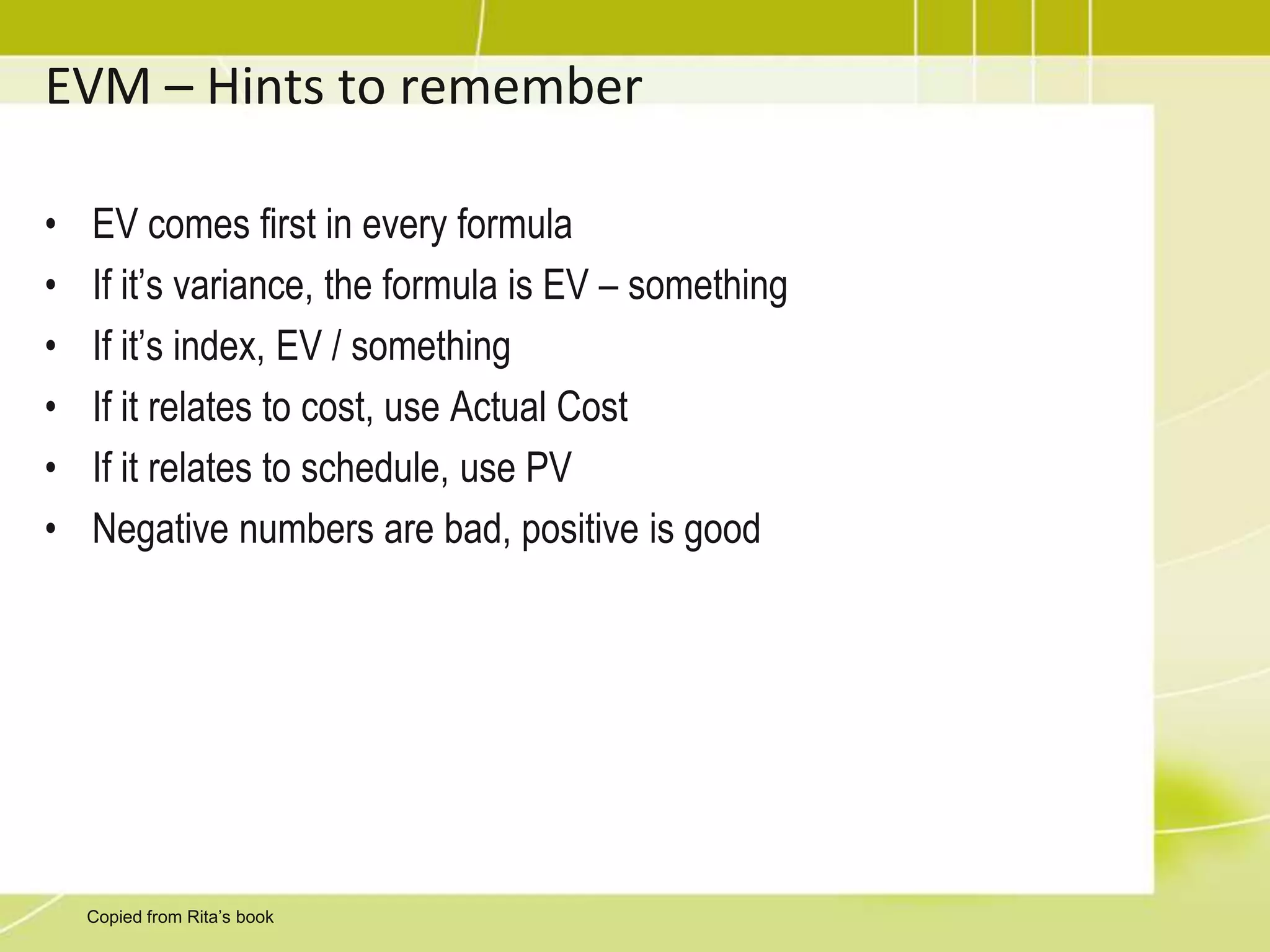
    EVM – Hintsto rememberEV comes first in every formulaIf it’s variance, the formula is EV – somethingIf it’s index, EV / somethingIf it relates to cost, use Actual CostIf it relates to schedule, use PVNegative numbers are bad, positive is goodCopied from Rita’s book
  • 33.
    Next topic: ProjectQuality ManagementThank You