Trainer: Anand Bobade
PMP
PMBOK 6th Edition, 2019, All rights reserved.
Chapter 12 –
Project Procurement Management
SIXTH EDITION
Plan Procurement
Management
Conduct
Procurement
Control
Procurement
PMBOK 6 - All rights reserved; By: Anand Bobade (nmbobade@gmail.com)
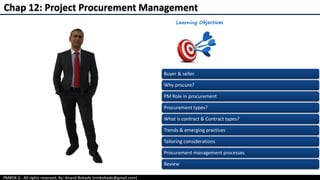
Chap 12: Project Procurement Management
Buyer & seller.
Why procure?
PM Role in procurement
Procurement types?
What is contract & Contract types?
Trends & emerging practices
Tailoring considerations
Procurement management processes
Review
PMBOK 6 - All rights reserved; By: Anand Bobade (nmbobade@gmail.com)
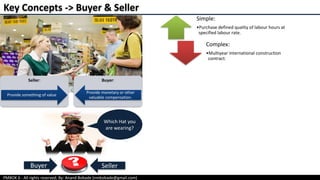
Simple:
•Purchase defined quality of labour hours at
specified labour rate.
Complex:
•Multiyear international construction
contract.
Key Concepts -> Buyer & Seller
Buyer Seller
Seller:
Provide something of value
Buyer:
Provide monetary or other
valuable compensation.
Which Hat you
are wearing?
PMBOK 6 - All rights reserved; By: Anand Bobade (nmbobade@gmail.com)
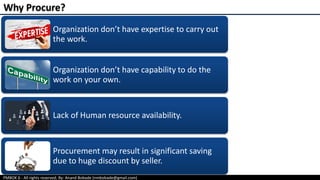
Organization don’t have expertise to carry out
the work.
Organization don’t have capability to do the
work on your own.
Lack of Human resource availability.
Procurement may result in significant saving
due to huge discount by seller.
Why Procure?
PMBOK 6 - All rights reserved; By: Anand Bobade (nmbobade@gmail.com)
Key Concepts -> Project Managers role
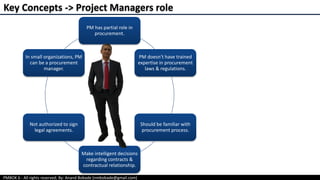
PM has partial role in
procurement.
PM doesn't have trained
expertise in procurement
laws & regulations.
Should be familiar with
procurement process.
Make intelligent decisions
regarding contracts &
contractual relationship.
Not authorized to sign
legal agreements.
In small organizations, PM
can be a procurement
manager.
PMBOK 6 - All rights reserved; By: Anand Bobade (nmbobade@gmail.com)
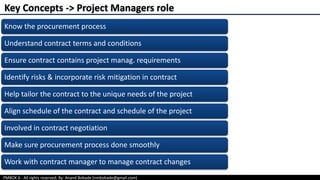
Know the procurement process
Understand contract terms and conditions
Ensure contract contains project manag. requirements
Identify risks & incorporate risk mitigation in contract
Help tailor the contract to the unique needs of the project
Align schedule of the contract and schedule of the project
Involved in contract negotiation
Make sure procurement process done smoothly
Work with contract manager to manage contract changes
Key Concepts -> Project Managers role
PMBOK 6 - All rights reserved; By: Anand Bobade (nmbobade@gmail.com)
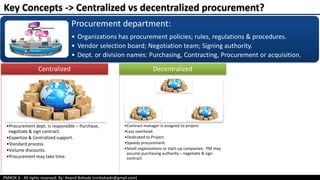
Procurement department:
• Organizations has procurement policies; rules, regulations & procedures.
• Vendor selection board; Negotiation team; Signing authority.
• Dept. or division names: Purchasing, Contracting, Procurement or acquisition.
•Procurement dept. is responsible – Purchase,
negotiate & sign contract.
•Expertize & Centralized support.
•Standard process.
•Volume discounts.
•Procurement may take time.
Centralized
•Contract manager is assigned to project.
•Less overhead.
•Dedicated to Project.
•Speedy procurement.
•Small organizations or start-up companies: PM may
assume purchasing authority – negotiate & sign
contract.
Decentralized
Key Concepts -> Centralized vs decentralized procurement?
PMBOK 6 - All rights reserved; By: Anand Bobade (nmbobade@gmail.com)
•Manage multiple contracts simultaneously or in sequence.
•Each contract life cycle may begin & end in any project
phase.
•Buyer seller relationship exists at many levels: at project level
or organization level.
Key Concepts -> Contracts in Complex projects
Seller:
•Contractor
•Vendor
•Service provider
•Supplier
•Start as bidder & then selected
source & finally vendor
Buyer:
•Owner of final product
•a Subcontractor
•Acquiring orgnization
•Service requester
•Purchasor
PMBOK 6 - All rights reserved; By: Anand Bobade (nmbobade@gmail.com)
Advances in tools
•Online tools for procurements.
•E.g., In construction, BIM (building information model) which is
now mandated in engineering to save time & money and to
reduce claims.
Advanced risk management
•Write contracts that’s accurately assign risks to different entities
most capable of managing them.
•Buyer will accept the risk. E.g., Changing corporate policies in the
buying organization.
Changing contracting process
•Megaprojects- involves international contract, multiple contracts
from many countries (more risky than local contractors)
•Contractors work closely with client to get discounts.
•Uses Internationally recognized standard forms to reduce claims.
Trends & emerging practices
PMBOK 6 - All rights reserved; By: Anand Bobade (nmbobade@gmail.com)
Logistics & supply chain management
• Time dependency based on industry.
• Long lead time items to be ordered in advance.
• Backup resources.
• Country laws - minimum purchase from local vendors
Technology & stakeholder relations
• Public funded projects are under Scrutiny.
• Technology like, webcams at sites showing progress,
storing of video data for claims are being used.
Trial engagements
• Engage several candidate sellers on paid basis initially.
• Evaluate before contract commitment, while making
progresses.
Trends & emerging practices
PMBOK 6 - All rights reserved; By: Anand Bobade (nmbobade@gmail.com)
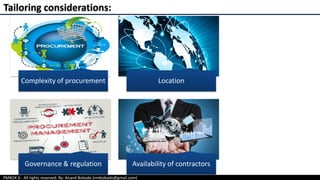
Complexity of procurement Location
Governance & regulation Availability of contractors
Tailoring considerations:
PMBOK 6 - All rights reserved; By: Anand Bobade (nmbobade@gmail.com)
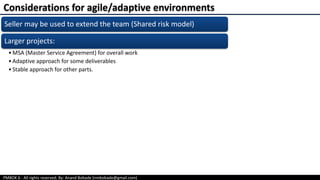
Seller may be used to extend the team (Shared risk model)
Larger projects:
•MSA (Master Service Agreement) for overall work
•Adaptive approach for some deliverables
•Stable approach for other parts.
Considerations for agile/adaptive environments
PMBOK 6 - All rights reserved; By: Anand Bobade (nmbobade@gmail.com)
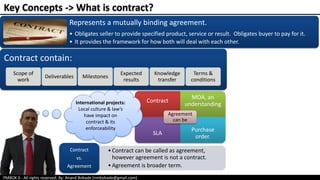
Represents a mutually binding agreement.
• Obligates seller to provide specified product, service or result. Obligates buyer to pay for it.
• It provides the framework for how both will deal with each other.
Contract contain:
Scope of
work
Deliverables Milestones
Expected
results
Knowledge
transfer
Terms &
conditions
Key Concepts -> What is contract?
Contract
MOA, an
understanding
SLA
Purchase
order.
Agreement
can be
•Contract can be called as agreement,
however agreement is not a contract.
•Agreement is broader term.
Contract
vs.
Agreement
International projects:
Local culture & law’s
have impact on
contract & its
enforceability
PMBOK 6 - All rights reserved; By: Anand Bobade (nmbobade@gmail.com)
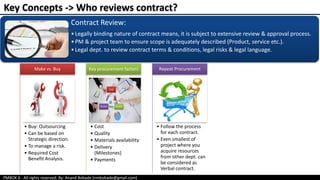
Contract Review:
•Legally binding nature of contract means, it is subject to extensive review & approval process.
•PM & project team to ensure scope is adequately described (Product, service etc.).
•Legal dept. to review contract terms & conditions, legal risks & legal language.
• Buy: Outsourcing
• Can be based on
Strategic direction.
• To manage a risk.
• Required Cost
Benefit Analysis.
Make vs. Buy
• Cost
• Quality
• Materials availability
• Delivery
(Milestones)
• Payments
Key procurement factors
• Follow the process
for each contract.
• Even smallest of
project where you
acquire resources
from other dept. can
be considered as
Verbal contract.
Repeat Procurement
Key Concepts -> Who reviews contract?
PMBOK 6 - All rights reserved; By: Anand Bobade (nmbobade@gmail.com)
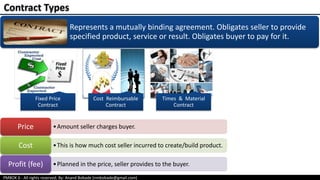
Represents a mutually binding agreement. Obligates seller to provide
specified product, service or result. Obligates buyer to pay for it.
Contract Types
Fixed Price
Contract
Cost Reimbursable
Contract
Times & Material
Contract
•Amount seller charges buyer.Price
•This is how much cost seller incurred to create/build product.Cost
•Planned in the price, seller provides to the buyer.Profit (fee)
PMBOK 6 - All rights reserved; By: Anand Bobade (nmbobade@gmail.com)
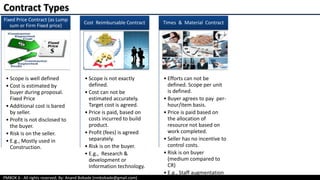
• Scope is well defined
• Cost is estimated by
buyer during proposal.
Fixed Price
• Additional cost is bared
by seller.
• Profit is not disclosed to
the buyer.
• Risk is on the seller.
• E.g., Mostly used in
Construction.
Fixed Price Contract (as Lump
sum or Firm Fixed price)
• Scope is not exactly
defined.
• Cost can not be
estimated accurately.
Target cost is agreed.
• Price is paid, based on
costs incurred to build
product.
• Profit (fees) is agreed
separately.
• Risk is on the buyer.
• E.g., Research &
development or
Information technology.
Cost Reimbursable Contract
• Efforts can not be
defined. Scope per unit
is defined.
• Buyer agrees to pay per-
hour/item basis.
• Price is paid based on
the allocation of
resource not based on
work completed.
• Seller has no incentive to
control costs.
• Risk is on buyer
(medium compared to
CR)
• E.g., Staff augmentation
Times & Material Contract
Contract Types
PMBOK 6 - All rights reserved; By: Anand Bobade (nmbobade@gmail.com)
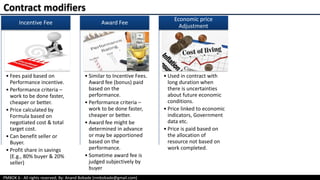
• Fees paid based on
Performance incentive.
• Performance criteria –
work to be done faster,
cheaper or better.
• Price calculated by
Formula based on
negotiated cost & total
target cost.
• Can benefit seller or
Buyer.
• Profit share in savings
(E.g., 80% buyer & 20%
seller)
Incentive Fee
• Similar to Incentive Fees.
Award fee (bonus) paid
based on the
performance.
• Performance criteria –
work to be done faster,
cheaper or better.
• Award fee might be
determined in advance
or may be apportioned
based on the
performance.
• Sometime award fee is
judged subjectively by
buyer
Award Fee
• Used in contract with
long duration when
there is uncertainties
about future economic
conditions.
• Price linked to economic
indicators, Government
data etc.
• Price is paid based on
the allocation of
resource not based on
work completed.
Economic price
Adjustment
Contract modifiers
PMBOK 6 - All rights reserved; By: Anand Bobade (nmbobade@gmail.com)
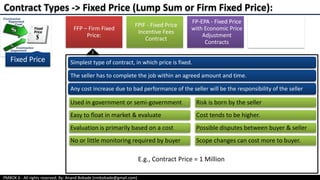
Fixed Price
FFP – Firm Fixed
Price:
FPIF - Fixed Price
Incentive Fees
Contract
FP-EPA - Fixed Price
with Economic Price
Adjustment
Contracts
PO (Purchase Order)
Contract Types -> Fixed Price (Lump Sum or Firm Fixed Price):
Simplest type of contract, in which price is fixed.
The seller has to complete the job within an agreed amount and time.
Any cost increase due to bad performance of the seller will be the responsibility of the seller
Used in government or semi-government
Easy to float in market & evaluate
Evaluation is primarily based on a cost
No or little monitoring required by buyer
Risk is born by the seller
Cost tends to be higher.
Possible disputes between buyer & seller
Scope changes can cost more to buyer.
E.g., Contract Price = 1 Million
1
PMBOK 6 - All rights reserved; By: Anand Bobade (nmbobade@gmail.com)
Fixed Price
Contract Types -> Fixed Price (Lump Sum or Firm Fixed Price):
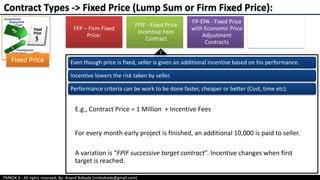
Even though price is fixed, seller is given an additional incentive based on his performance.
Incentive lowers the risk taken by seller.
Performance criteria can be work to be done faster, cheaper or better (Cost, time etc).
E.g., Contract Price = 1 Million + Incentive Fees
For every month early project is finished, an additional 10,000 is paid to seller.
A variation is “FPIF successive target contract”. Incentive changes when first
target is reached.
2
FFP – Firm Fixed
Price:
FPIF - Fixed Price
Incentive Fees
Contract
FP-EPA - Fixed Price
with Economic Price
Adjustment
Contracts
PO (Purchase Order)
PMBOK 6 - All rights reserved; By: Anand Bobade (nmbobade@gmail.com)
Fixed Price
Contract Types -> Fixed Price (Lump Sum or Firm Fixed Price):
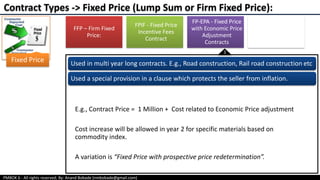
Used in multi year long contracts. E.g., Road construction, Rail road construction etc
Used a special provision in a clause which protects the seller from inflation.
E.g., Contract Price = 1 Million + Cost related to Economic Price adjustment
Cost increase will be allowed in year 2 for specific materials based on
commodity index.
A variation is “Fixed Price with prospective price redetermination”.
3
FFP – Firm Fixed
Price:
FPIF - Fixed Price
Incentive Fees
Contract
FP-EPA - Fixed Price
with Economic Price
Adjustment
Contracts
PO (Purchase Order)
PMBOK 6 - All rights reserved; By: Anand Bobade (nmbobade@gmail.com)
Cost Reimbursable
Contract
Contract Types-> Cost Reimbursable Contract:
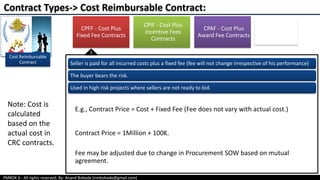
Seller is paid for all incurred costs plus a fixed fee (fee will not change irrespective of his performance)
The buyer bears the risk.
Used in high risk projects where sellers are not ready to bid.
E.g., Contract Price = Cost + Fixed Fee (Fee does not vary with actual cost.)
Contract Price = 1Million + 100K.
Fee may be adjusted due to change in Procurement SOW based on mutual
agreement.
1
Note: Cost is
calculated
based on the
actual cost in
CRC contracts.
CPFF - Cost Plus
Fixed Fee Contracts
CPIF - Cost Plus
Incentive Fees
Contracts
CPAF - Cost Plus
Award Fee Contracts
PMBOK 6 - All rights reserved; By: Anand Bobade (nmbobade@gmail.com)
Cost Reimbursable
Contract
Contract Types-> Cost Reimbursable Contract:
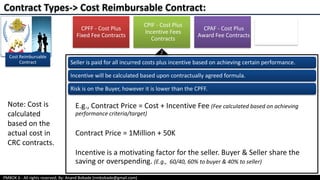
Seller is paid for all incurred costs plus incentive based on achieving certain performance.
Incentive will be calculated based upon contractually agreed formula.
Risk is on the Buyer, however it is lower than the CPFF.
E.g., Contract Price = Cost + Incentive Fee (Fee calculated based on achieving
performance criteria/target)
Contract Price = 1Million + 50K
Incentive is a motivating factor for the seller. Buyer & Seller share the
saving or overspending. (E.g., 60/40, 60% to buyer & 40% to seller)
2
Note: Cost is
calculated
based on the
actual cost in
CRC contracts.
CPFF - Cost Plus
Fixed Fee Contracts
CPIF - Cost Plus
Incentive Fees
Contracts
CPAF - Cost Plus
Award Fee Contracts
PMBOK 6 - All rights reserved; By: Anand Bobade (nmbobade@gmail.com)
Cost Reimbursable
Contract
Contract Types-> Cost Reimbursable Contract:
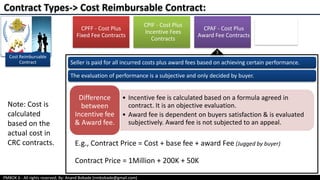
Seller is paid for all incurred costs plus award fees based on achieving certain performance.
The evaluation of performance is a subjective and only decided by buyer.
E.g., Contract Price = Cost + base fee + award Fee (Jugged by buyer)
Contract Price = 1Million + 200K + 50K
3
• Incentive fee is calculated based on a formula agreed in
contract. It is an objective evaluation.
• Award fee is dependent on buyers satisfaction & is evaluated
subjectively. Award fee is not subjected to an appeal.
Difference
between
Incentive fee
& Award fee.
Note: Cost is
calculated
based on the
actual cost in
CRC contracts.
CPFF - Cost Plus
Fixed Fee Contracts
CPIF - Cost Plus
Incentive Fees
Contracts
CPAF - Cost Plus
Award Fee Contracts
PMBOK 6 - All rights reserved; By: Anand Bobade (nmbobade@gmail.com)
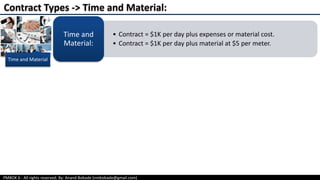
Time and Material
Contract Types -> Time and Material:
• Contract = $1K per day plus expenses or material cost.
• Contract = $1K per day plus material at $5 per meter.
Time and
Material:
PMBOK 6 - All rights reserved; By: Anand Bobade (nmbobade@gmail.com)
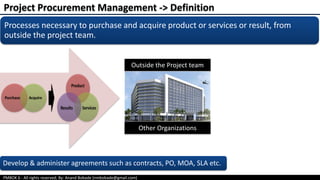
Processes necessary to purchase and acquire product or services or result, from
outside the project team.
Project Procurement Management -> Definition
Other Organizations
Outside the Project team
Develop & administer agreements such as contracts, PO, MOA, SLA etc.
PMBOK 6 - All rights reserved; By: Anand Bobade (nmbobade@gmail.com)
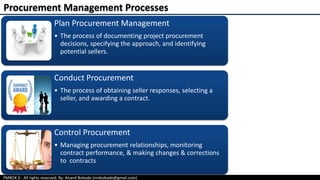
Plan Procurement Management
• The process of documenting project procurement
decisions, specifying the approach, and identifying
potential sellers.
Conduct Procurement
• The process of obtaining seller responses, selecting a
seller, and awarding a contract.
Control Procurement
• Managing procurement relationships, monitoring
contract performance, & making changes & corrections
to contracts
Procurement Management Processes
PMBOK 6 - All rights reserved; By: Anand Bobade (nmbobade@gmail.com)
Procurement Management -> Review
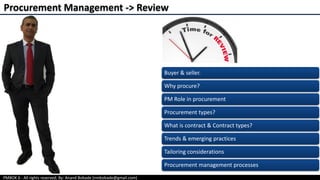
Buyer & seller.
Why procure?
PM Role in procurement
Procurement types?
What is contract & Contract types?
Trends & emerging practices
Tailoring considerations
Procurement management processes
PMBOK 6 - All rights reserved; By: Anand Bobade (nmbobade@gmail.com)

Chap 12.0 Procurement Management overview

  • 1.
    Trainer: Anand Bobade PMP PMBOK6th Edition, 2019, All rights reserved. Chapter 12 – Project Procurement Management SIXTH EDITION Plan Procurement Management Conduct Procurement Control Procurement
  • 2.
    PMBOK 6 -All rights reserved; By: Anand Bobade (nmbobade@gmail.com) Chap 12: Project Procurement Management Buyer & seller. Why procure? PM Role in procurement Procurement types? What is contract & Contract types? Trends & emerging practices Tailoring considerations Procurement management processes Review
  • 3.
    PMBOK 6 -All rights reserved; By: Anand Bobade (nmbobade@gmail.com) Simple: •Purchase defined quality of labour hours at specified labour rate. Complex: •Multiyear international construction contract. Key Concepts -> Buyer & Seller Buyer Seller Seller: Provide something of value Buyer: Provide monetary or other valuable compensation. Which Hat you are wearing?
  • 4.
    PMBOK 6 -All rights reserved; By: Anand Bobade (nmbobade@gmail.com) Organization don’t have expertise to carry out the work. Organization don’t have capability to do the work on your own. Lack of Human resource availability. Procurement may result in significant saving due to huge discount by seller. Why Procure?
  • 5.
    PMBOK 6 -All rights reserved; By: Anand Bobade (nmbobade@gmail.com) Key Concepts -> Project Managers role PM has partial role in procurement. PM doesn't have trained expertise in procurement laws & regulations. Should be familiar with procurement process. Make intelligent decisions regarding contracts & contractual relationship. Not authorized to sign legal agreements. In small organizations, PM can be a procurement manager.
  • 6.
    PMBOK 6 -All rights reserved; By: Anand Bobade (nmbobade@gmail.com) Know the procurement process Understand contract terms and conditions Ensure contract contains project manag. requirements Identify risks & incorporate risk mitigation in contract Help tailor the contract to the unique needs of the project Align schedule of the contract and schedule of the project Involved in contract negotiation Make sure procurement process done smoothly Work with contract manager to manage contract changes Key Concepts -> Project Managers role
  • 7.
    PMBOK 6 -All rights reserved; By: Anand Bobade (nmbobade@gmail.com) Procurement department: • Organizations has procurement policies; rules, regulations & procedures. • Vendor selection board; Negotiation team; Signing authority. • Dept. or division names: Purchasing, Contracting, Procurement or acquisition. •Procurement dept. is responsible – Purchase, negotiate & sign contract. •Expertize & Centralized support. •Standard process. •Volume discounts. •Procurement may take time. Centralized •Contract manager is assigned to project. •Less overhead. •Dedicated to Project. •Speedy procurement. •Small organizations or start-up companies: PM may assume purchasing authority – negotiate & sign contract. Decentralized Key Concepts -> Centralized vs decentralized procurement?
  • 8.
    PMBOK 6 -All rights reserved; By: Anand Bobade (nmbobade@gmail.com) •Manage multiple contracts simultaneously or in sequence. •Each contract life cycle may begin & end in any project phase. •Buyer seller relationship exists at many levels: at project level or organization level. Key Concepts -> Contracts in Complex projects Seller: •Contractor •Vendor •Service provider •Supplier •Start as bidder & then selected source & finally vendor Buyer: •Owner of final product •a Subcontractor •Acquiring orgnization •Service requester •Purchasor
  • 9.
    PMBOK 6 -All rights reserved; By: Anand Bobade (nmbobade@gmail.com) Advances in tools •Online tools for procurements. •E.g., In construction, BIM (building information model) which is now mandated in engineering to save time & money and to reduce claims. Advanced risk management •Write contracts that’s accurately assign risks to different entities most capable of managing them. •Buyer will accept the risk. E.g., Changing corporate policies in the buying organization. Changing contracting process •Megaprojects- involves international contract, multiple contracts from many countries (more risky than local contractors) •Contractors work closely with client to get discounts. •Uses Internationally recognized standard forms to reduce claims. Trends & emerging practices
  • 10.
    PMBOK 6 -All rights reserved; By: Anand Bobade (nmbobade@gmail.com) Logistics & supply chain management • Time dependency based on industry. • Long lead time items to be ordered in advance. • Backup resources. • Country laws - minimum purchase from local vendors Technology & stakeholder relations • Public funded projects are under Scrutiny. • Technology like, webcams at sites showing progress, storing of video data for claims are being used. Trial engagements • Engage several candidate sellers on paid basis initially. • Evaluate before contract commitment, while making progresses. Trends & emerging practices
  • 11.
    PMBOK 6 -All rights reserved; By: Anand Bobade (nmbobade@gmail.com) Complexity of procurement Location Governance & regulation Availability of contractors Tailoring considerations:
  • 12.
    PMBOK 6 -All rights reserved; By: Anand Bobade (nmbobade@gmail.com) Seller may be used to extend the team (Shared risk model) Larger projects: •MSA (Master Service Agreement) for overall work •Adaptive approach for some deliverables •Stable approach for other parts. Considerations for agile/adaptive environments
  • 13.
    PMBOK 6 -All rights reserved; By: Anand Bobade (nmbobade@gmail.com) Represents a mutually binding agreement. • Obligates seller to provide specified product, service or result. Obligates buyer to pay for it. • It provides the framework for how both will deal with each other. Contract contain: Scope of work Deliverables Milestones Expected results Knowledge transfer Terms & conditions Key Concepts -> What is contract? Contract MOA, an understanding SLA Purchase order. Agreement can be •Contract can be called as agreement, however agreement is not a contract. •Agreement is broader term. Contract vs. Agreement International projects: Local culture & law’s have impact on contract & its enforceability
  • 14.
    PMBOK 6 -All rights reserved; By: Anand Bobade (nmbobade@gmail.com) Contract Review: •Legally binding nature of contract means, it is subject to extensive review & approval process. •PM & project team to ensure scope is adequately described (Product, service etc.). •Legal dept. to review contract terms & conditions, legal risks & legal language. • Buy: Outsourcing • Can be based on Strategic direction. • To manage a risk. • Required Cost Benefit Analysis. Make vs. Buy • Cost • Quality • Materials availability • Delivery (Milestones) • Payments Key procurement factors • Follow the process for each contract. • Even smallest of project where you acquire resources from other dept. can be considered as Verbal contract. Repeat Procurement Key Concepts -> Who reviews contract?
  • 15.
    PMBOK 6 -All rights reserved; By: Anand Bobade (nmbobade@gmail.com) Represents a mutually binding agreement. Obligates seller to provide specified product, service or result. Obligates buyer to pay for it. Contract Types Fixed Price Contract Cost Reimbursable Contract Times & Material Contract •Amount seller charges buyer.Price •This is how much cost seller incurred to create/build product.Cost •Planned in the price, seller provides to the buyer.Profit (fee)
  • 16.
    PMBOK 6 -All rights reserved; By: Anand Bobade (nmbobade@gmail.com) • Scope is well defined • Cost is estimated by buyer during proposal. Fixed Price • Additional cost is bared by seller. • Profit is not disclosed to the buyer. • Risk is on the seller. • E.g., Mostly used in Construction. Fixed Price Contract (as Lump sum or Firm Fixed price) • Scope is not exactly defined. • Cost can not be estimated accurately. Target cost is agreed. • Price is paid, based on costs incurred to build product. • Profit (fees) is agreed separately. • Risk is on the buyer. • E.g., Research & development or Information technology. Cost Reimbursable Contract • Efforts can not be defined. Scope per unit is defined. • Buyer agrees to pay per- hour/item basis. • Price is paid based on the allocation of resource not based on work completed. • Seller has no incentive to control costs. • Risk is on buyer (medium compared to CR) • E.g., Staff augmentation Times & Material Contract Contract Types
  • 17.
    PMBOK 6 -All rights reserved; By: Anand Bobade (nmbobade@gmail.com) • Fees paid based on Performance incentive. • Performance criteria – work to be done faster, cheaper or better. • Price calculated by Formula based on negotiated cost & total target cost. • Can benefit seller or Buyer. • Profit share in savings (E.g., 80% buyer & 20% seller) Incentive Fee • Similar to Incentive Fees. Award fee (bonus) paid based on the performance. • Performance criteria – work to be done faster, cheaper or better. • Award fee might be determined in advance or may be apportioned based on the performance. • Sometime award fee is judged subjectively by buyer Award Fee • Used in contract with long duration when there is uncertainties about future economic conditions. • Price linked to economic indicators, Government data etc. • Price is paid based on the allocation of resource not based on work completed. Economic price Adjustment Contract modifiers
  • 18.
    PMBOK 6 -All rights reserved; By: Anand Bobade (nmbobade@gmail.com) Fixed Price FFP – Firm Fixed Price: FPIF - Fixed Price Incentive Fees Contract FP-EPA - Fixed Price with Economic Price Adjustment Contracts PO (Purchase Order) Contract Types -> Fixed Price (Lump Sum or Firm Fixed Price): Simplest type of contract, in which price is fixed. The seller has to complete the job within an agreed amount and time. Any cost increase due to bad performance of the seller will be the responsibility of the seller Used in government or semi-government Easy to float in market & evaluate Evaluation is primarily based on a cost No or little monitoring required by buyer Risk is born by the seller Cost tends to be higher. Possible disputes between buyer & seller Scope changes can cost more to buyer. E.g., Contract Price = 1 Million 1
  • 19.
    PMBOK 6 -All rights reserved; By: Anand Bobade (nmbobade@gmail.com) Fixed Price Contract Types -> Fixed Price (Lump Sum or Firm Fixed Price): Even though price is fixed, seller is given an additional incentive based on his performance. Incentive lowers the risk taken by seller. Performance criteria can be work to be done faster, cheaper or better (Cost, time etc). E.g., Contract Price = 1 Million + Incentive Fees For every month early project is finished, an additional 10,000 is paid to seller. A variation is “FPIF successive target contract”. Incentive changes when first target is reached. 2 FFP – Firm Fixed Price: FPIF - Fixed Price Incentive Fees Contract FP-EPA - Fixed Price with Economic Price Adjustment Contracts PO (Purchase Order)
  • 20.
    PMBOK 6 -All rights reserved; By: Anand Bobade (nmbobade@gmail.com) Fixed Price Contract Types -> Fixed Price (Lump Sum or Firm Fixed Price): Used in multi year long contracts. E.g., Road construction, Rail road construction etc Used a special provision in a clause which protects the seller from inflation. E.g., Contract Price = 1 Million + Cost related to Economic Price adjustment Cost increase will be allowed in year 2 for specific materials based on commodity index. A variation is “Fixed Price with prospective price redetermination”. 3 FFP – Firm Fixed Price: FPIF - Fixed Price Incentive Fees Contract FP-EPA - Fixed Price with Economic Price Adjustment Contracts PO (Purchase Order)
  • 21.
    PMBOK 6 -All rights reserved; By: Anand Bobade (nmbobade@gmail.com) Cost Reimbursable Contract Contract Types-> Cost Reimbursable Contract: Seller is paid for all incurred costs plus a fixed fee (fee will not change irrespective of his performance) The buyer bears the risk. Used in high risk projects where sellers are not ready to bid. E.g., Contract Price = Cost + Fixed Fee (Fee does not vary with actual cost.) Contract Price = 1Million + 100K. Fee may be adjusted due to change in Procurement SOW based on mutual agreement. 1 Note: Cost is calculated based on the actual cost in CRC contracts. CPFF - Cost Plus Fixed Fee Contracts CPIF - Cost Plus Incentive Fees Contracts CPAF - Cost Plus Award Fee Contracts
  • 22.
    PMBOK 6 -All rights reserved; By: Anand Bobade (nmbobade@gmail.com) Cost Reimbursable Contract Contract Types-> Cost Reimbursable Contract: Seller is paid for all incurred costs plus incentive based on achieving certain performance. Incentive will be calculated based upon contractually agreed formula. Risk is on the Buyer, however it is lower than the CPFF. E.g., Contract Price = Cost + Incentive Fee (Fee calculated based on achieving performance criteria/target) Contract Price = 1Million + 50K Incentive is a motivating factor for the seller. Buyer & Seller share the saving or overspending. (E.g., 60/40, 60% to buyer & 40% to seller) 2 Note: Cost is calculated based on the actual cost in CRC contracts. CPFF - Cost Plus Fixed Fee Contracts CPIF - Cost Plus Incentive Fees Contracts CPAF - Cost Plus Award Fee Contracts
  • 23.
    PMBOK 6 -All rights reserved; By: Anand Bobade (nmbobade@gmail.com) Cost Reimbursable Contract Contract Types-> Cost Reimbursable Contract: Seller is paid for all incurred costs plus award fees based on achieving certain performance. The evaluation of performance is a subjective and only decided by buyer. E.g., Contract Price = Cost + base fee + award Fee (Jugged by buyer) Contract Price = 1Million + 200K + 50K 3 • Incentive fee is calculated based on a formula agreed in contract. It is an objective evaluation. • Award fee is dependent on buyers satisfaction & is evaluated subjectively. Award fee is not subjected to an appeal. Difference between Incentive fee & Award fee. Note: Cost is calculated based on the actual cost in CRC contracts. CPFF - Cost Plus Fixed Fee Contracts CPIF - Cost Plus Incentive Fees Contracts CPAF - Cost Plus Award Fee Contracts
  • 24.
    PMBOK 6 -All rights reserved; By: Anand Bobade (nmbobade@gmail.com) Time and Material Contract Types -> Time and Material: • Contract = $1K per day plus expenses or material cost. • Contract = $1K per day plus material at $5 per meter. Time and Material:
  • 25.
    PMBOK 6 -All rights reserved; By: Anand Bobade (nmbobade@gmail.com) Processes necessary to purchase and acquire product or services or result, from outside the project team. Project Procurement Management -> Definition Other Organizations Outside the Project team Develop & administer agreements such as contracts, PO, MOA, SLA etc.
  • 26.
    PMBOK 6 -All rights reserved; By: Anand Bobade (nmbobade@gmail.com) Plan Procurement Management • The process of documenting project procurement decisions, specifying the approach, and identifying potential sellers. Conduct Procurement • The process of obtaining seller responses, selecting a seller, and awarding a contract. Control Procurement • Managing procurement relationships, monitoring contract performance, & making changes & corrections to contracts Procurement Management Processes
  • 27.
    PMBOK 6 -All rights reserved; By: Anand Bobade (nmbobade@gmail.com) Procurement Management -> Review Buyer & seller. Why procure? PM Role in procurement Procurement types? What is contract & Contract types? Trends & emerging practices Tailoring considerations Procurement management processes
  • 28.
    PMBOK 6 -All rights reserved; By: Anand Bobade (nmbobade@gmail.com)