Created by ejlp12@gmail.com, June 201010 - Project Human Resource ManagementProject Management Training
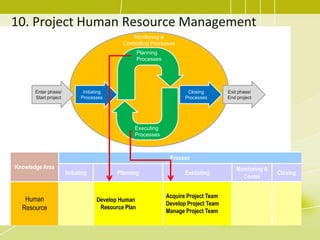
10. Project Human Resource ManagementMonitoring &Controlling ProcessesPlanningProcessesEnter phase/Start projectExit phase/End projectInitiatingProcessesClosingProcessesExecutingProcesses
Project Human Resource ManagementInclude the process that organize, manage, and lead the project team.Early involvement and participation of team members benefits:add their expertise during the planning process strengthens their commitmentTips: Understand clearly the role and responsibilities of Project Sponsor/Initiator, the team, stakeholders, functional manager, PM, portfolio manager, program manager
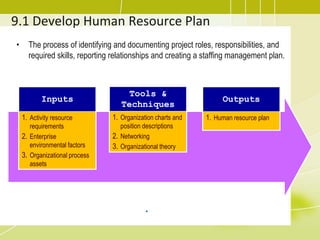
9.1 Develop Human Resource PlanThe process of identifying and documenting project roles, responsibilities, and required skills, reporting relationships and creating a staffing management plan..
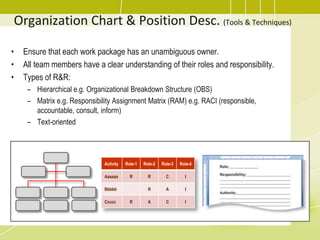
Organization Chart & Position Desc. (Tools & Techniques)Ensure that each work package has an unambiguous owner.All team members have a clear understanding of their roles and responsibility.Types of R&R:Hierarchical e.g. Organizational Breakdown Structure (OBS)Matrix e.g. Responsibility Assignment Matrix (RAM) e.g. RACI (responsible, accountable, consult, inform)Text-oriented
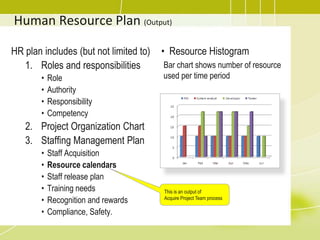
Human Resource Plan (Output)HR plan includes (but not limited to)Roles and responsibilities RoleAuthorityResponsibilityCompetencyProject Organization ChartStaffing Management Plan Staff AcquisitionResource calendarsStaff release plan Training needsRecognition and rewardsCompliance, Safety.Resource HistogramBar chart shows number of resource used per time periodThis is an output of Acquire Project Team process
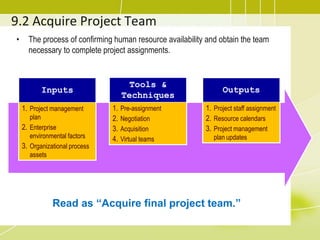
9.2 Acquire Project TeamThe process of confirming human resource availability and obtain the team necessary to complete project assignments.Read as “Acquire final project team.”
Acquire Project TeamPre-assignmentResources who are assigned in advanceNegotiationFor gaining resources within the organization or external vendors, suppliers, contractors, etc (in contract situation)AcquisitionAcquiring/hiring from outside resources (outsource)Virtual teamsThink the possibilities of having group of people even little or no time spent to meet face to face.
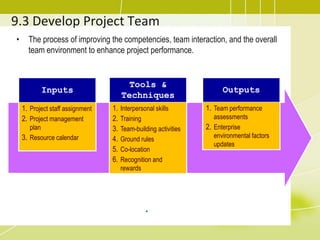
9.3 Develop Project TeamThe process of improving the competencies, team interaction, and the overall team environment to enhance project performance..
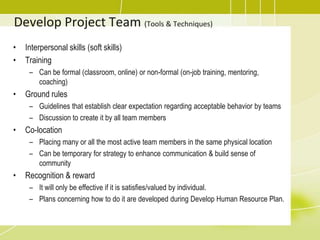
Develop Project Team (Tools & Techniques)Interpersonal skills (soft skills)TrainingCan be formal (classroom, online) or non-formal (on-job training, mentoring, coaching)Ground rules Guidelines that establish clear expectation regarding acceptable behavior by teamsDiscussion to create it by all team membersCo-locationPlacing many or all the most active team members in the same physical locationCan be temporary for strategy to enhance communication & build sense of communityRecognition & rewardIt will only be effective if it is satisfies/valued by individual.Plans concerning how to do it are developed during Develop Human Resource Plan.
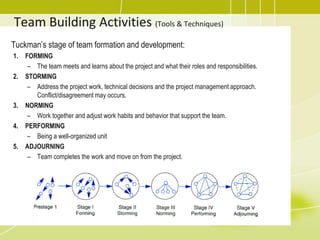
Team Building Activities (Tools & Techniques)Tuckman’s stage of team formation and development:FORMINGThe team meets and learns about the project and what their roles and responsibilities.STORMINGAddress the project work, technical decisions and the project management approach. Conflict/disagreement may occurs.NORMINGWork together and adjust work habits and behavior that support the team.PERFORMINGBeing a well-organized unitADJOURNINGTeam completes the work and move on from the project.Ground Rules..will establish clear expectation regarding acceptable behavior by project team members
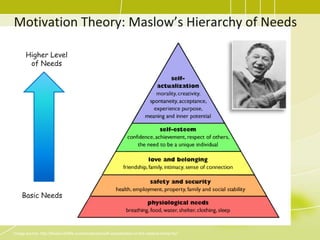
Motivation Theory: Maslow’s Hierarchy of NeedsHigher Level of NeedsBasic NeedsImage source: http://theskooloflife.com/wordpress/self-actualization-in-the-maslow-hierarchy/
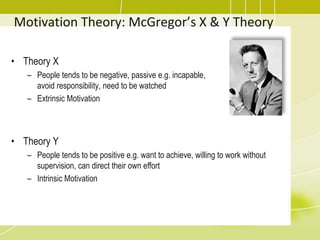
Motivation Theory: McGregor’s X & Y TheoryTheory XPeople tends to be negative, passive e.g. incapable, avoid responsibility, need to be watchedExtrinsic MotivationTheory Y
People tends to be positive e.g. want to achieve, willing to work without supervision, can direct their own effort
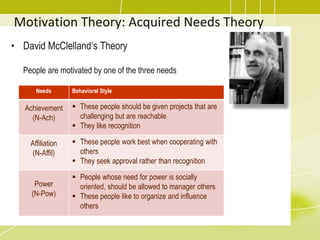
Intrinsic MotivationMotivation Theory: Acquired Needs TheoryDavid McClelland’s TheoryPeople are motivated by one of the three needs
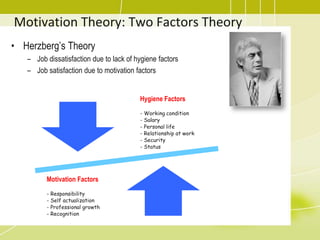
Motivation Theory: Two Factors TheoryHerzberg’s TheoryJob dissatisfaction due to lack of hygiene factorsJob satisfaction due to motivation factors
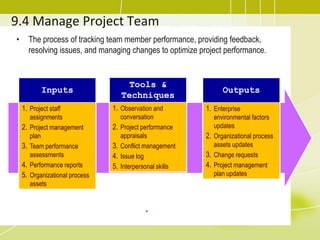
9.4 Manage Project TeamThe process of tracking team member performance, providing feedback, resolving issues, and managing changes to optimize project performance..
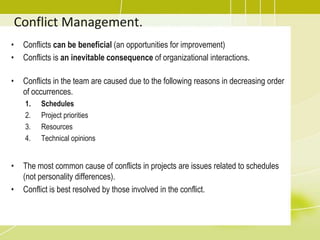
Conflict Management.Conflicts can be beneficial (an opportunities for improvement)Conflicts is an inevitable consequence of organizational interactions.Conflicts in the team are caused due to the following reasons in decreasing order of occurrences.SchedulesProject prioritiesResourcesTechnical opinionsThe most common cause of conflicts in projects are issues related to schedules (not personality differences).Conflict is best resolved by those involved in the conflict.
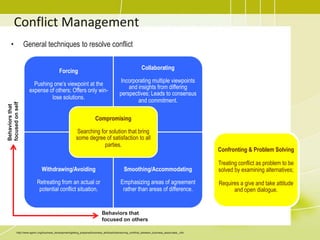
Conflict ManagementGeneral techniques to resolve conflictConfronting & Problem SolvingTreating conflict as problem to be solved by examining alternatives; Requires a give and take attitude and open dialogue.Behaviors that focused on selfBehaviors that focused on othershttp://www.agmrc.org/business_development/getting_prepared/business_skills/articles/solving_conflicts_between_business_associates_.cfm
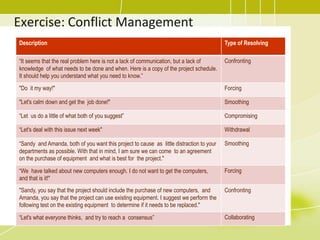
Exercise: Conflict Management
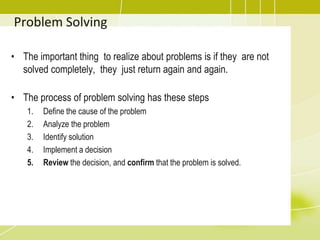
Problem SolvingThe important thing  to realize about problems is if they  are not solved completely,  they  just return again and again. The process of problem solving has these steps Define the cause of the problemAnalyze the problemIdentify solutionImplement a decisionReview the decision, and confirm that the problem is solved.
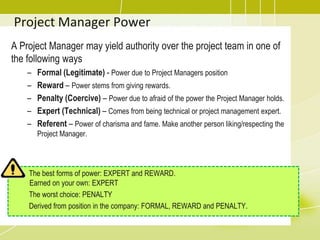
Project Manager PowerA Project Manager may yield authority over the project team in one of the following ways Formal (Legitimate) - Power due to Project Managers positionReward – Power stems from giving rewards.Penalty (Coercive) – Power due to afraid of the power the Project Manager holds.Expert (Technical) – Comes from being technical or project management expert.Referent – Power of charisma and fame. Make another person liking/respecting the Project Manager.The best forms of power: EXPERT and REWARD. Earned on your own: EXPERT The worst choice: PENALTYDerived from position in the company: FORMAL, REWARD and PENALTY.
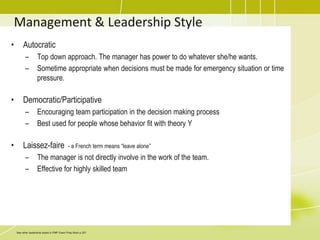
Management & Leadership StyleAutocraticTop down approach. The manager has power to do whatever she/he wants.Sometime appropriate when decisions must be made for emergency situation or time pressure.Democratic/ParticipativeEncouraging team participation in the decision making processBest used for people whose behavior fit with theory YLaissez-faire  - a French term means “leave alone”The manager is not directly involve in the work of the team.Effective for highly skilled teamSee other leadership styles in PMP Exam Prep Book p.327
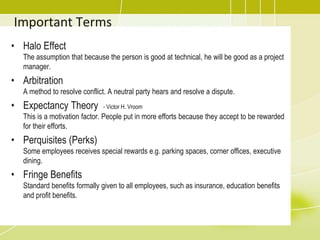
Important TermsHalo EffectThe assumption that because the person is good at technical, he will be good as a project manager.ArbitrationA method to resolve conflict. A neutral party hears and resolve a dispute.Expectancy Theory  - Victor H. Vroom This is a motivation factor. People put in more efforts because they accept to be rewarded for their efforts.Perquisites (Perks)Some employees receives special rewards e.g. parking spaces, corner offices, executive dining.Fringe BenefitsStandard benefits formally given to all employees, such as insurance, education benefits and profit benefits.
BaCKUP SLIDES
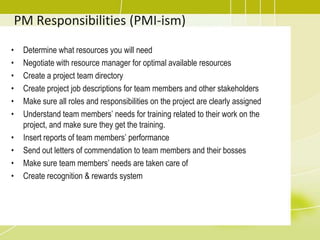
PM Responsibilities (PMI-ism)Determine what resources you will needNegotiate with resource manager for optimal available resourcesCreate a project team directoryCreate project job descriptions for team members and other stakeholdersMake sure all roles and responsibilities on the project are clearly assignedUnderstand team members’ needs for training related to their work on the project, and make sure they get the training.Insert reports of team members’ performanceSend out letters of commendation to team members and their bossesMake sure team members’ needs are taken care ofCreate recognition & rewards system
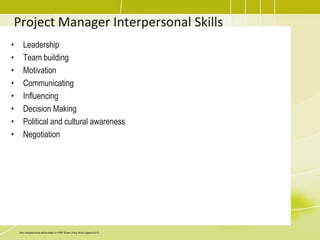
Project Manager Interpersonal SkillsLeadershipTeam buildingMotivationCommunicatingInfluencingDecision MakingPolitical and cultural awarenessNegotiationSee interpersonal skills detail in PMP Exam Prep Book Appendix-G

PMP Training - 09 project human resource management

  • 1.
    Created by ejlp12@gmail.com,June 201010 - Project Human Resource ManagementProject Management Training
  • 2.
    10. Project HumanResource ManagementMonitoring &Controlling ProcessesPlanningProcessesEnter phase/Start projectExit phase/End projectInitiatingProcessesClosingProcessesExecutingProcesses
  • 3.
    Project Human ResourceManagementInclude the process that organize, manage, and lead the project team.Early involvement and participation of team members benefits:add their expertise during the planning process strengthens their commitmentTips: Understand clearly the role and responsibilities of Project Sponsor/Initiator, the team, stakeholders, functional manager, PM, portfolio manager, program manager
  • 4.
    9.1 Develop HumanResource PlanThe process of identifying and documenting project roles, responsibilities, and required skills, reporting relationships and creating a staffing management plan..
  • 5.
    Organization Chart &Position Desc. (Tools & Techniques)Ensure that each work package has an unambiguous owner.All team members have a clear understanding of their roles and responsibility.Types of R&R:Hierarchical e.g. Organizational Breakdown Structure (OBS)Matrix e.g. Responsibility Assignment Matrix (RAM) e.g. RACI (responsible, accountable, consult, inform)Text-oriented
  • 6.
    Human Resource Plan(Output)HR plan includes (but not limited to)Roles and responsibilities RoleAuthorityResponsibilityCompetencyProject Organization ChartStaffing Management Plan Staff AcquisitionResource calendarsStaff release plan Training needsRecognition and rewardsCompliance, Safety.Resource HistogramBar chart shows number of resource used per time periodThis is an output of Acquire Project Team process
  • 7.
    9.2 Acquire ProjectTeamThe process of confirming human resource availability and obtain the team necessary to complete project assignments.Read as “Acquire final project team.”
  • 8.
    Acquire Project TeamPre-assignmentResourceswho are assigned in advanceNegotiationFor gaining resources within the organization or external vendors, suppliers, contractors, etc (in contract situation)AcquisitionAcquiring/hiring from outside resources (outsource)Virtual teamsThink the possibilities of having group of people even little or no time spent to meet face to face.
  • 9.
    9.3 Develop ProjectTeamThe process of improving the competencies, team interaction, and the overall team environment to enhance project performance..
  • 10.
    Develop Project Team(Tools & Techniques)Interpersonal skills (soft skills)TrainingCan be formal (classroom, online) or non-formal (on-job training, mentoring, coaching)Ground rules Guidelines that establish clear expectation regarding acceptable behavior by teamsDiscussion to create it by all team membersCo-locationPlacing many or all the most active team members in the same physical locationCan be temporary for strategy to enhance communication & build sense of communityRecognition & rewardIt will only be effective if it is satisfies/valued by individual.Plans concerning how to do it are developed during Develop Human Resource Plan.
  • 11.
    Team Building Activities(Tools & Techniques)Tuckman’s stage of team formation and development:FORMINGThe team meets and learns about the project and what their roles and responsibilities.STORMINGAddress the project work, technical decisions and the project management approach. Conflict/disagreement may occurs.NORMINGWork together and adjust work habits and behavior that support the team.PERFORMINGBeing a well-organized unitADJOURNINGTeam completes the work and move on from the project.Ground Rules..will establish clear expectation regarding acceptable behavior by project team members
  • 12.
    Motivation Theory: Maslow’sHierarchy of NeedsHigher Level of NeedsBasic NeedsImage source: http://theskooloflife.com/wordpress/self-actualization-in-the-maslow-hierarchy/
  • 13.
    Motivation Theory: McGregor’sX & Y TheoryTheory XPeople tends to be negative, passive e.g. incapable, avoid responsibility, need to be watchedExtrinsic MotivationTheory Y
  • 14.
    People tends tobe positive e.g. want to achieve, willing to work without supervision, can direct their own effort
  • 15.
    Intrinsic MotivationMotivation Theory:Acquired Needs TheoryDavid McClelland’s TheoryPeople are motivated by one of the three needs
  • 16.
    Motivation Theory: TwoFactors TheoryHerzberg’s TheoryJob dissatisfaction due to lack of hygiene factorsJob satisfaction due to motivation factors
  • 17.
    9.4 Manage ProjectTeamThe process of tracking team member performance, providing feedback, resolving issues, and managing changes to optimize project performance..
  • 18.
    Conflict Management.Conflicts canbe beneficial (an opportunities for improvement)Conflicts is an inevitable consequence of organizational interactions.Conflicts in the team are caused due to the following reasons in decreasing order of occurrences.SchedulesProject prioritiesResourcesTechnical opinionsThe most common cause of conflicts in projects are issues related to schedules (not personality differences).Conflict is best resolved by those involved in the conflict.
  • 19.
    Conflict ManagementGeneral techniquesto resolve conflictConfronting & Problem SolvingTreating conflict as problem to be solved by examining alternatives; Requires a give and take attitude and open dialogue.Behaviors that focused on selfBehaviors that focused on othershttp://www.agmrc.org/business_development/getting_prepared/business_skills/articles/solving_conflicts_between_business_associates_.cfm
  • 20.
  • 21.
    Problem SolvingThe importantthing to realize about problems is if they are not solved completely, they just return again and again. The process of problem solving has these steps Define the cause of the problemAnalyze the problemIdentify solutionImplement a decisionReview the decision, and confirm that the problem is solved.
  • 22.
    Project Manager PowerAProject Manager may yield authority over the project team in one of the following ways Formal (Legitimate) - Power due to Project Managers positionReward – Power stems from giving rewards.Penalty (Coercive) – Power due to afraid of the power the Project Manager holds.Expert (Technical) – Comes from being technical or project management expert.Referent – Power of charisma and fame. Make another person liking/respecting the Project Manager.The best forms of power: EXPERT and REWARD. Earned on your own: EXPERT The worst choice: PENALTYDerived from position in the company: FORMAL, REWARD and PENALTY.
  • 23.
    Management & LeadershipStyleAutocraticTop down approach. The manager has power to do whatever she/he wants.Sometime appropriate when decisions must be made for emergency situation or time pressure.Democratic/ParticipativeEncouraging team participation in the decision making processBest used for people whose behavior fit with theory YLaissez-faire - a French term means “leave alone”The manager is not directly involve in the work of the team.Effective for highly skilled teamSee other leadership styles in PMP Exam Prep Book p.327
  • 24.
    Important TermsHalo EffectTheassumption that because the person is good at technical, he will be good as a project manager.ArbitrationA method to resolve conflict. A neutral party hears and resolve a dispute.Expectancy Theory - Victor H. Vroom This is a motivation factor. People put in more efforts because they accept to be rewarded for their efforts.Perquisites (Perks)Some employees receives special rewards e.g. parking spaces, corner offices, executive dining.Fringe BenefitsStandard benefits formally given to all employees, such as insurance, education benefits and profit benefits.
  • 25.
  • 26.
    PM Responsibilities (PMI-ism)Determinewhat resources you will needNegotiate with resource manager for optimal available resourcesCreate a project team directoryCreate project job descriptions for team members and other stakeholdersMake sure all roles and responsibilities on the project are clearly assignedUnderstand team members’ needs for training related to their work on the project, and make sure they get the training.Insert reports of team members’ performanceSend out letters of commendation to team members and their bossesMake sure team members’ needs are taken care ofCreate recognition & rewards system
  • 27.
    Project Manager InterpersonalSkillsLeadershipTeam buildingMotivationCommunicatingInfluencingDecision MakingPolitical and cultural awarenessNegotiationSee interpersonal skills detail in PMP Exam Prep Book Appendix-G