Plasma MembranePlasma Membrane
Structure and FunctionStructure and Function
ByBy
Rizwan Abbas BahoRizwan Abbas Baho
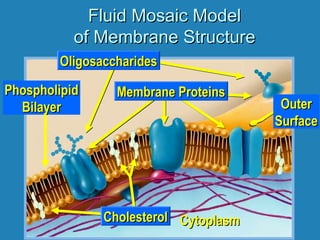
OligosaccharidesOligosaccharides
CytoplasmCytoplasm
Membrane ProteinsMembrane Proteins
CholesterolCholesterol
OuterOuter
SurfaceSurface
Fluid Mosaic ModelFluid Mosaic Model
of Membrane Structureof Membrane Structure
PhospholipidPhospholipid
BilayerBilayer
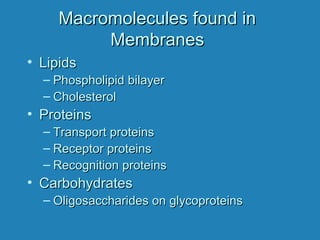
Macromolecules found inMacromolecules found in
MembranesMembranes
• LipidsLipids
– Phospholipid bilayerPhospholipid bilayer
– CholesterolCholesterol
• ProteinsProteins
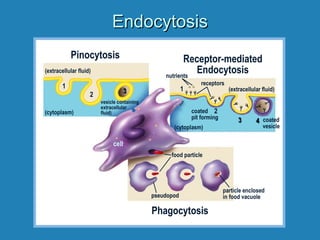
– Transport proteinsTransport proteins
– Receptor proteinsReceptor proteins
– Recognition proteinsRecognition proteins
• CarbohydratesCarbohydrates
– Oligosaccharides on glycoproteinsOligosaccharides on glycoproteins
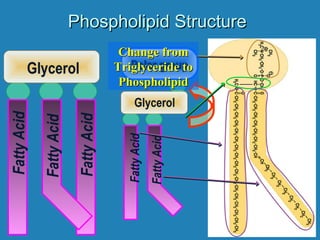
Phospholipid StructurePhospholipid Structure
FattyAcid
FattyAcid
Glycerol
Polar groupPolar groupGlycerol
FattyAcid
FattyAcid
FattyAcid
Change fromChange from
Triglyceride toTriglyceride to
PhospholipidPhospholipid
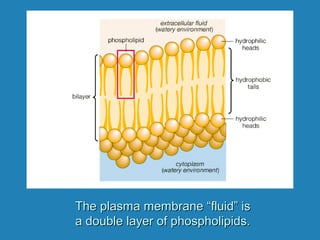
The plasma membrane “fluid” isThe plasma membrane “fluid” is
a double layer of phospholipids.a double layer of phospholipids.
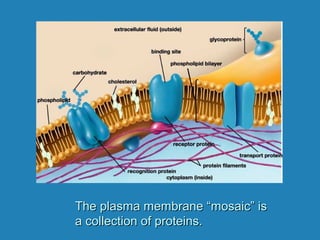
The plasma membrane “mosaic” isThe plasma membrane “mosaic” is
a collection of proteins.a collection of proteins.
Functions of MembraneFunctions of Membrane
MacromoleculesMacromolecules
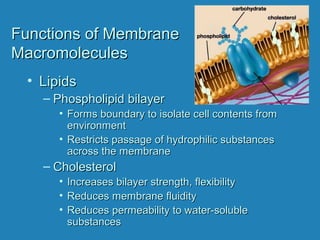
• LipidsLipids
– Phospholipid bilayerPhospholipid bilayer
• Forms boundary to isolate cell contents fromForms boundary to isolate cell contents from
environmentenvironment
• Restricts passage of hydrophilic substancesRestricts passage of hydrophilic substances
across the membraneacross the membrane
– CholesterolCholesterol
• Increases bilayer strength, flexibilityIncreases bilayer strength, flexibility
• Reduces membrane fluidityReduces membrane fluidity
• Reduces permeability to water-solubleReduces permeability to water-soluble
substancessubstances
Functions of MembraneFunctions of Membrane
MacromoleculesMacromolecules
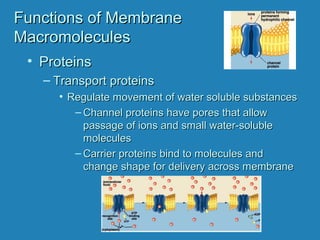
• ProteinsProteins
– Transport proteinsTransport proteins
• Regulate movement of water soluble substancesRegulate movement of water soluble substances
– Channel proteins have pores that allowChannel proteins have pores that allow
passage of ions and small water-solublepassage of ions and small water-soluble
moleculesmolecules
– Carrier proteins bind to molecules andCarrier proteins bind to molecules and
change shape for delivery across membranechange shape for delivery across membrane
Functions of MembraneFunctions of Membrane
MacromoleculesMacromolecules
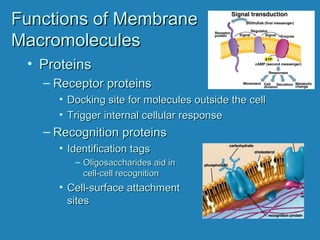
• ProteinsProteins
– Receptor proteinsReceptor proteins
• Docking site for molecules outside the cellDocking site for molecules outside the cell
• Trigger internal cellular responseTrigger internal cellular response
– Recognition proteinsRecognition proteins
• Identification tagsIdentification tags
– Oligosaccharides aid inOligosaccharides aid in
cell-cell recognitioncell-cell recognition
• Cell-surface attachmentCell-surface attachment
sitessites
Applying Your KnowledgeApplying Your Knowledge
A.A. Which component would have anWhich component would have an
oligosaccharide attached?oligosaccharide attached?
B.B. Which component regulates membraneWhich component regulates membrane
fluidity?fluidity?
C.C. Which component assists in movement ofWhich component assists in movement of
water-soluble substances across thewater-soluble substances across the
membrane?membrane?
1.1. CholesterolCholesterol
2.2. Receptor ProteinReceptor Protein
3.3. Phospholipid BilayerPhospholipid Bilayer
4.4. Transport ProteinTransport Protein
5.5. Recognition ProteinRecognition Protein
Transport ProcessesTransport Processes
• Movement of substances across theMovement of substances across the
cell membranecell membrane
• Passive transportPassive transport
– Substances move from [high]Substances move from [high][low][low]
– No energy input requiredNo energy input required
– Simple Diffusion, Facilitated Diffusion,Simple Diffusion, Facilitated Diffusion,
OsmosisOsmosis
• Active transportActive transport
– Substances move from [low]Substances move from [low][high][high]
– Requires energy inputRequires energy input
– Protein carriers, Endocytosis, ExocytosisProtein carriers, Endocytosis, Exocytosis
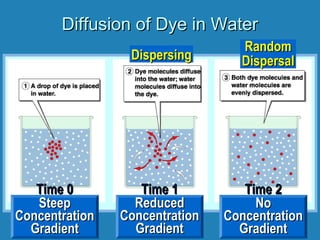
Diffusion of Dye in WaterDiffusion of Dye in Water
Time 0Time 0
SteepSteep
ConcentrationConcentration
GradientGradient
Time 1Time 1
ReducedReduced
ConcentrationConcentration
GradientGradient
DispersingDispersing
Time 2Time 2
NoNo
ConcentrationConcentration
GradientGradient
RandomRandom
DispersalDispersal
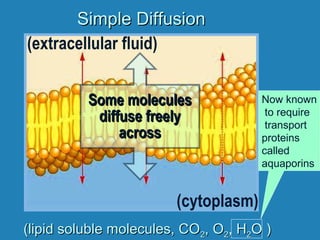
Simple DiffusionSimple Diffusion
(extracellular fluid)
(cytoplasm)
Some moleculesSome molecules
diffuse freelydiffuse freely
acrossacross
(lipid soluble molecules, CO(lipid soluble molecules, CO22, O, O22, H, H22O )O )
Now known
to require
transport
proteins
called
aquaporins
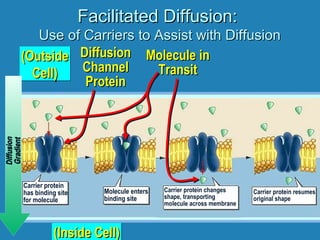
Facilitated Diffusion:Facilitated Diffusion:
Use of Carriers to Assist with DiffusionUse of Carriers to Assist with Diffusion
Carrier protein
has binding site
for molecule
Molecule enters
binding site
Carrier protein changes
shape, transporting
molecule across membrane
Carrier protein resumes
original shape
(Inside Cell)(Inside Cell)(Inside Cell)(Inside Cell)
(Outside(Outside
Cell)Cell)
(Outside(Outside
Cell)Cell)
DiffusionDiffusion
ChannelChannel
ProteinProtein
DiffusionDiffusion
GradientGradient
Molecule inMolecule in
TransitTransit
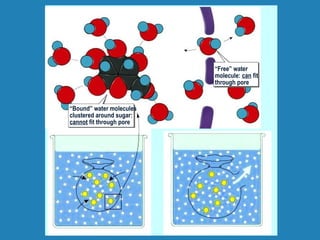
OsmosisOsmosis
• Diffusion of water across aDiffusion of water across a
differentially permeable membranedifferentially permeable membrane
• Water moves from [high]Water moves from [high]  [low][low]
“Bound” water molecules
clustered around sugar:
cannot fit through pore
“Free” water
molecule: can fit
through pore
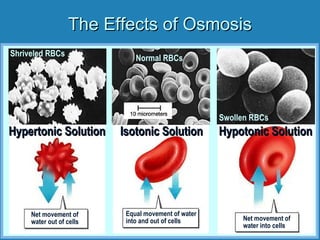
Normal RBCs
Isotonic SolutionIsotonic Solution
The Effects of OsmosisThe Effects of Osmosis
Equal movement of water
into and out of cells
Net movement of
water out of cells Net movement of
water into cells
Shriveled RBCs
Swollen RBCs
Hypertonic SolutionHypertonic Solution Hypotonic SolutionHypotonic Solution
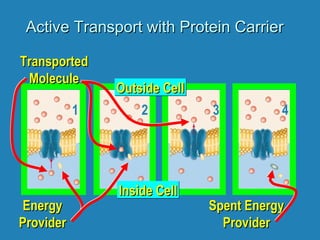
Active Transport with Protein CarrierActive Transport with Protein Carrier
Inside CellInside CellInside CellInside Cell
Outside CellOutside CellOutside CellOutside Cell
EnergyEnergy
ProviderProvider
Spent EnergySpent Energy
ProviderProvider
TransportedTransported
MoleculeMolecule
1 2 3 4
EndocytosisEndocytosis
(extracellular fluid)
Pinocytosis
vesicle containing
extracellular
fluid)(cytoplasm)
1
2 33
cell
(extracellular fluid)
(cytoplasm)
1
2
33 44
coated
pit forming
Receptor-mediated
Endocytosis
Phagocytosis
coated
vesicle
nutrients
receptors
food particle
pseudopod
particle enclosed
in food vacuole
EndocytosisEndocytosis
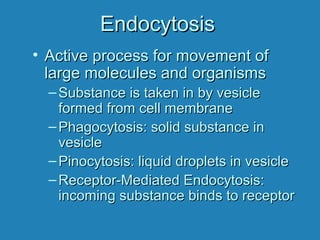
• Active process for movement ofActive process for movement of
large molecules and organismslarge molecules and organisms
– Substance is taken in by vesicleSubstance is taken in by vesicle
formed from cell membraneformed from cell membrane
– Phagocytosis: solid substance inPhagocytosis: solid substance in
vesiclevesicle
– Pinocytosis: liquid droplets in vesiclePinocytosis: liquid droplets in vesicle
– Receptor-Mediated Endocytosis:Receptor-Mediated Endocytosis:
incoming substance binds to receptorincoming substance binds to receptor
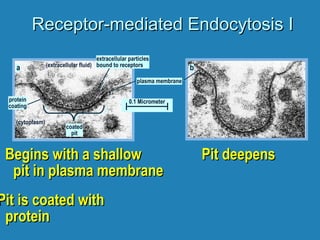
Receptor-mediated Endocytosis IReceptor-mediated Endocytosis I
Begins with a shallowBegins with a shallow
pit in plasma membranepit in plasma membrane
Pit is coated withPit is coated with
proteinprotein
(cytoplasm)
(extracellular fluid)
coated
pit
protein
coating
extracellular particles
bound to receptors
plasma membrane
Pit deepensPit deepens
aa bb
0.1 Micrometer
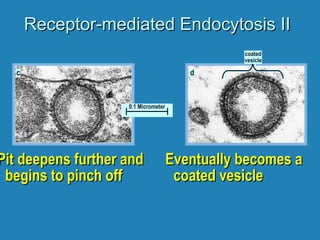
Receptor-mediated Endocytosis IIReceptor-mediated Endocytosis II
Pit deepens further andPit deepens further and
begins to pinch offbegins to pinch off
Eventually becomes aEventually becomes a
coated vesiclecoated vesicle
ddcc
0.1 Micrometer
coated
vesicle
ExocytosisExocytosis
• Substance is expelled after beingSubstance is expelled after being
enclosed in a vesicle within the cellenclosed in a vesicle within the cell
• Used to move large molecules outUsed to move large molecules out
of the cellof the cell
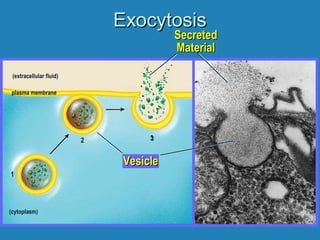
ExocytosisExocytosis
(cytoplasm)
1
VesicleVesicle
(extracellular fluid)
plasma membrane
2
SecretedSecreted
MaterialMaterial
33
Applying Your KnowledgeApplying Your Knowledge
A.A. Which methods allow movement intoWhich methods allow movement into
the cell?the cell?
B.B. Which methods involve movement ofWhich methods involve movement of
liquid?liquid?
C.C. Which methods involve movementWhich methods involve movement
from [low]from [low]  [high]?[high]?
1.1. Facilitated DiffusionFacilitated Diffusion
2.2. EndocytosisEndocytosis
3.3. OsmosisOsmosis
4.4. ExocytosisExocytosis
5.5. Active TransportActive Transport
6. Simple Diffusion6. Simple Diffusion
7. Pinocytosis7. Pinocytosis
8. Receptor-mediated8. Receptor-mediated
endocytosisendocytosis
9. Phagocytosis9. Phagocytosis
1, 2, 3, 5, 6, 7, 8, 91, 2, 3, 5, 6, 7, 8, 9
2, 3, 6, 72, 3, 6, 7
2, 4, 5, 7, 8, 92, 4, 5, 7, 8, 9
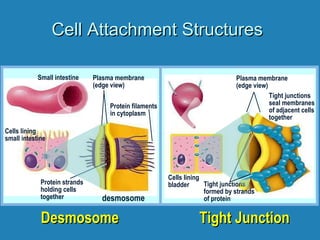
Cell Attachment StructuresCell Attachment Structures
DesmosomeDesmosome
desmosome
Protein strands
holding cells
together
Protein filaments
in cytoplasm
Small intestine Plasma membrane
(edge view)
Cells lining
small intestine
Tight JunctionTight Junction
Tight junctions
formed by strands
of protein
Plasma membrane
(edge view)
Cells lining
bladder
Tight junctions
seal membranes
of adjacent cells
together
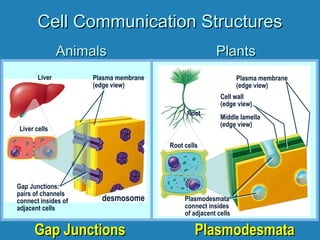
Cell Communication StructuresCell Communication Structures
Gap JunctionsGap Junctions
desmosome
Gap Junctions:
pairs of channels
connect insides of
adjacent cells
Liver Plasma membrane
(edge view)
Liver cells
PlasmodesmataPlasmodesmata
Plasmodesmata
connect insides
of adjacent cells
Plasma membrane
(edge view)
Root cells
Cell wall
(edge view)
Middle lamella
(edge view)
Root
AnimalsAnimals PlantsPlants

Plasma membrane, structure and function

  • 1.
    Plasma MembranePlasma Membrane Structureand FunctionStructure and Function ByBy Rizwan Abbas BahoRizwan Abbas Baho
  • 2.
    OligosaccharidesOligosaccharides CytoplasmCytoplasm Membrane ProteinsMembrane Proteins CholesterolCholesterol OuterOuter SurfaceSurface FluidMosaic ModelFluid Mosaic Model of Membrane Structureof Membrane Structure PhospholipidPhospholipid BilayerBilayer
  • 3.
    Macromolecules found inMacromoleculesfound in MembranesMembranes • LipidsLipids – Phospholipid bilayerPhospholipid bilayer – CholesterolCholesterol • ProteinsProteins – Transport proteinsTransport proteins – Receptor proteinsReceptor proteins – Recognition proteinsRecognition proteins • CarbohydratesCarbohydrates – Oligosaccharides on glycoproteinsOligosaccharides on glycoproteins
  • 4.
    Phospholipid StructurePhospholipid Structure FattyAcid FattyAcid Glycerol PolargroupPolar groupGlycerol FattyAcid FattyAcid FattyAcid Change fromChange from Triglyceride toTriglyceride to PhospholipidPhospholipid
  • 5.
    The plasma membrane“fluid” isThe plasma membrane “fluid” is a double layer of phospholipids.a double layer of phospholipids.
  • 6.
    The plasma membrane“mosaic” isThe plasma membrane “mosaic” is a collection of proteins.a collection of proteins.
  • 7.
    Functions of MembraneFunctionsof Membrane MacromoleculesMacromolecules • LipidsLipids – Phospholipid bilayerPhospholipid bilayer • Forms boundary to isolate cell contents fromForms boundary to isolate cell contents from environmentenvironment • Restricts passage of hydrophilic substancesRestricts passage of hydrophilic substances across the membraneacross the membrane – CholesterolCholesterol • Increases bilayer strength, flexibilityIncreases bilayer strength, flexibility • Reduces membrane fluidityReduces membrane fluidity • Reduces permeability to water-solubleReduces permeability to water-soluble substancessubstances
  • 8.
    Functions of MembraneFunctionsof Membrane MacromoleculesMacromolecules • ProteinsProteins – Transport proteinsTransport proteins • Regulate movement of water soluble substancesRegulate movement of water soluble substances – Channel proteins have pores that allowChannel proteins have pores that allow passage of ions and small water-solublepassage of ions and small water-soluble moleculesmolecules – Carrier proteins bind to molecules andCarrier proteins bind to molecules and change shape for delivery across membranechange shape for delivery across membrane
  • 9.
    Functions of MembraneFunctionsof Membrane MacromoleculesMacromolecules • ProteinsProteins – Receptor proteinsReceptor proteins • Docking site for molecules outside the cellDocking site for molecules outside the cell • Trigger internal cellular responseTrigger internal cellular response – Recognition proteinsRecognition proteins • Identification tagsIdentification tags – Oligosaccharides aid inOligosaccharides aid in cell-cell recognitioncell-cell recognition • Cell-surface attachmentCell-surface attachment sitessites
  • 10.
    Applying Your KnowledgeApplyingYour Knowledge A.A. Which component would have anWhich component would have an oligosaccharide attached?oligosaccharide attached? B.B. Which component regulates membraneWhich component regulates membrane fluidity?fluidity? C.C. Which component assists in movement ofWhich component assists in movement of water-soluble substances across thewater-soluble substances across the membrane?membrane? 1.1. CholesterolCholesterol 2.2. Receptor ProteinReceptor Protein 3.3. Phospholipid BilayerPhospholipid Bilayer 4.4. Transport ProteinTransport Protein 5.5. Recognition ProteinRecognition Protein
  • 11.
    Transport ProcessesTransport Processes •Movement of substances across theMovement of substances across the cell membranecell membrane • Passive transportPassive transport – Substances move from [high]Substances move from [high][low][low] – No energy input requiredNo energy input required – Simple Diffusion, Facilitated Diffusion,Simple Diffusion, Facilitated Diffusion, OsmosisOsmosis • Active transportActive transport – Substances move from [low]Substances move from [low][high][high] – Requires energy inputRequires energy input – Protein carriers, Endocytosis, ExocytosisProtein carriers, Endocytosis, Exocytosis
  • 12.
    Diffusion of Dyein WaterDiffusion of Dye in Water Time 0Time 0 SteepSteep ConcentrationConcentration GradientGradient Time 1Time 1 ReducedReduced ConcentrationConcentration GradientGradient DispersingDispersing Time 2Time 2 NoNo ConcentrationConcentration GradientGradient RandomRandom DispersalDispersal
  • 13.
    Simple DiffusionSimple Diffusion (extracellularfluid) (cytoplasm) Some moleculesSome molecules diffuse freelydiffuse freely acrossacross (lipid soluble molecules, CO(lipid soluble molecules, CO22, O, O22, H, H22O )O ) Now known to require transport proteins called aquaporins
  • 14.
    Facilitated Diffusion:Facilitated Diffusion: Useof Carriers to Assist with DiffusionUse of Carriers to Assist with Diffusion Carrier protein has binding site for molecule Molecule enters binding site Carrier protein changes shape, transporting molecule across membrane Carrier protein resumes original shape (Inside Cell)(Inside Cell)(Inside Cell)(Inside Cell) (Outside(Outside Cell)Cell) (Outside(Outside Cell)Cell) DiffusionDiffusion ChannelChannel ProteinProtein DiffusionDiffusion GradientGradient Molecule inMolecule in TransitTransit
  • 15.
    OsmosisOsmosis • Diffusion ofwater across aDiffusion of water across a differentially permeable membranedifferentially permeable membrane • Water moves from [high]Water moves from [high]  [low][low]
  • 16.
    “Bound” water molecules clusteredaround sugar: cannot fit through pore “Free” water molecule: can fit through pore
  • 17.
    Normal RBCs Isotonic SolutionIsotonicSolution The Effects of OsmosisThe Effects of Osmosis Equal movement of water into and out of cells Net movement of water out of cells Net movement of water into cells Shriveled RBCs Swollen RBCs Hypertonic SolutionHypertonic Solution Hypotonic SolutionHypotonic Solution
  • 18.
    Active Transport withProtein CarrierActive Transport with Protein Carrier Inside CellInside CellInside CellInside Cell Outside CellOutside CellOutside CellOutside Cell EnergyEnergy ProviderProvider Spent EnergySpent Energy ProviderProvider TransportedTransported MoleculeMolecule 1 2 3 4
  • 19.
    EndocytosisEndocytosis (extracellular fluid) Pinocytosis vesicle containing extracellular fluid)(cytoplasm) 1 233 cell (extracellular fluid) (cytoplasm) 1 2 33 44 coated pit forming Receptor-mediated Endocytosis Phagocytosis coated vesicle nutrients receptors food particle pseudopod particle enclosed in food vacuole
  • 20.
    EndocytosisEndocytosis • Active processfor movement ofActive process for movement of large molecules and organismslarge molecules and organisms – Substance is taken in by vesicleSubstance is taken in by vesicle formed from cell membraneformed from cell membrane – Phagocytosis: solid substance inPhagocytosis: solid substance in vesiclevesicle – Pinocytosis: liquid droplets in vesiclePinocytosis: liquid droplets in vesicle – Receptor-Mediated Endocytosis:Receptor-Mediated Endocytosis: incoming substance binds to receptorincoming substance binds to receptor
  • 21.
    Receptor-mediated Endocytosis IReceptor-mediatedEndocytosis I Begins with a shallowBegins with a shallow pit in plasma membranepit in plasma membrane Pit is coated withPit is coated with proteinprotein (cytoplasm) (extracellular fluid) coated pit protein coating extracellular particles bound to receptors plasma membrane Pit deepensPit deepens aa bb 0.1 Micrometer
  • 22.
    Receptor-mediated Endocytosis IIReceptor-mediatedEndocytosis II Pit deepens further andPit deepens further and begins to pinch offbegins to pinch off Eventually becomes aEventually becomes a coated vesiclecoated vesicle ddcc 0.1 Micrometer coated vesicle
  • 23.
    ExocytosisExocytosis • Substance isexpelled after beingSubstance is expelled after being enclosed in a vesicle within the cellenclosed in a vesicle within the cell • Used to move large molecules outUsed to move large molecules out of the cellof the cell
  • 24.
  • 25.
    Applying Your KnowledgeApplyingYour Knowledge A.A. Which methods allow movement intoWhich methods allow movement into the cell?the cell? B.B. Which methods involve movement ofWhich methods involve movement of liquid?liquid? C.C. Which methods involve movementWhich methods involve movement from [low]from [low]  [high]?[high]? 1.1. Facilitated DiffusionFacilitated Diffusion 2.2. EndocytosisEndocytosis 3.3. OsmosisOsmosis 4.4. ExocytosisExocytosis 5.5. Active TransportActive Transport 6. Simple Diffusion6. Simple Diffusion 7. Pinocytosis7. Pinocytosis 8. Receptor-mediated8. Receptor-mediated endocytosisendocytosis 9. Phagocytosis9. Phagocytosis 1, 2, 3, 5, 6, 7, 8, 91, 2, 3, 5, 6, 7, 8, 9 2, 3, 6, 72, 3, 6, 7 2, 4, 5, 7, 8, 92, 4, 5, 7, 8, 9
  • 26.
    Cell Attachment StructuresCellAttachment Structures DesmosomeDesmosome desmosome Protein strands holding cells together Protein filaments in cytoplasm Small intestine Plasma membrane (edge view) Cells lining small intestine Tight JunctionTight Junction Tight junctions formed by strands of protein Plasma membrane (edge view) Cells lining bladder Tight junctions seal membranes of adjacent cells together
  • 27.
    Cell Communication StructuresCellCommunication Structures Gap JunctionsGap Junctions desmosome Gap Junctions: pairs of channels connect insides of adjacent cells Liver Plasma membrane (edge view) Liver cells PlasmodesmataPlasmodesmata Plasmodesmata connect insides of adjacent cells Plasma membrane (edge view) Root cells Cell wall (edge view) Middle lamella (edge view) Root AnimalsAnimals PlantsPlants

Editor's Notes

  • #3 Many of these protein molecules (blue in this illustration) float around in the membrane like icebergs on the polar sea. The proteins serve several functions: Transport proteins: Regulate the movement of water-soluble molecules through the plasma membrane. Channel Proteins: Form pores that allow small molecules to pass. Carrier Proteins: Have binding sites that bind specifically to specific proteins and move the molecules through the membrane. Receptor Proteins: Trigger specific cellular responses when certain molecules bind to them. Recognition Proteins: Serve as ID tags and cell-surface attachment sites.
  • #5 A triglyceride is a glycerol molecule with three fatty acids attached (p42). Triglycerides are familiar fats and oils. The fatty acids may be of the same type or different types. Different fatty acids may have differing number of carbon atoms in their hydrocarbon chain. Some fatty acids have double bonds and are called unsaturated. Those with no double bonds are called saturated. Phosphoplipids are like triglycerides with one fatty acid swapped out and a polar group containing phosphorous swapped in its place. Phospholipids are abundant in biological membranes. They self assemble into lipid bilayers characteristic of the plasma membrane and organnelle membranes (fig 5-2).
  • #6 Eukaryotic Cell
  • #7 Eukaryotic Cell
  • #12 This refers to the types of processes used by cells to get materials in and out across the cell membrane. The membrane is said to be “semi-permeable.” This means that it will allow spontaneous passage of some materials but others must use special processes to get across. A concentration gradient is a difference in the number of molecules or ions of a given substance in two adjoining regions. Molecules constantly collide and tend to move according to existing concentration gradients. The net movement of like molecules down a concentration gradient (high to low) is simple diffusion. Gradients in temperature, electric charge, and pressure, can influence movements. Passive transport: Follows a concentration gradient Passive in the sense that the process does not require energy. It just happens naturally. Diffusion is passive transport. Due to the random movement of molecules in liquids & gases (Brownian motion). A concentrated material will tend to become more uniformly dispersed in the space made available to it. Water can diffuse across the cell membrane unassisted. Facilitated transport: Also follows a concentration gradient, but requires gateway to get through. In this case, the particular materials would not spontaneously cross the pure phospholipid membrane, even if encouraged by a concentration gradient. A facilitator molecule is produced in the membrane that serves as a gateway for the material. The material can now cross through the gateway spontaneously whenever a concentration gradient exists. Active transport: Flow up-hill against a concentration gradient; requires energy expenditure to keep going. The required energy is almost always provided directly by ATP. The ATP donates a phosphate to a specific gateway molecule which then “pumps” the desired molecule across the membrane, even if it goes against a concentration gradient. The ATP energy is used to drive the pump.
  • #13 Shows successive stages in the dispersal of red dye molecules after being dropped into water.
  • #15 Note that the molecules to be transported (little balls) are in higher concentration outside the cell than inside the cell. The molecules are of a type that cannot get to the inside of the cell by going directly through the membrane. The protein channel provides a passage way for the molecules to follow the concentration gradient.
  • #16 Osmosis is the passive movement of water across a differentially permeable membrane in response to solute concentration gradients, pressure gradients, or both. Special case of diffusion. Involves the diffusion of water across a membrane that has solutions of differing concentration on opposite sides of the membrane. The water moves more abundantly toward the side with the highest concentration of dissolved materials. The concentration of water is obviously lower on the side with the highest concentration of dissolved materials. So the water is simply diffusing from a higher concentration of water to a lower concentration of water. Example: Pure water on one side; sugar solution on other (ƒ5-5). Sugar molecules can’t cross, but crowd membrane pores on syrupy side. Water crosses faster toward sugar. Net movement of water ====> sugar solution There is a net increase in volume on the side that has the higher concentration of sugar. The side of the membrane with the lower concentration of sugar experiences a loss of volume. This persistent movement can result in a build up of pressure known as osmotic pressure.
  • #18 Note that molecules of water are constantly moving in BOTH directions across the cell membrane. Water will move faster FROM a low concentration of WATER than it moves AWAY from it. Though water is moving in both directions, there is a net gain of water on the side that starts out with less water (more stuff dissolved in the water).
  • #19 Note that the concentration of the molecules is higher outside the cell than inside, but that the molecules are moving out, against the gradient. This always requires energy, thus the term “active” transport.
  • #20 Here are some special adaptations of endocytosis. Pinocytosis is when a vesicle forms around and then surrounds and engulfs the liquid from outside the cell. Phagocytosis is when the vesicle forms around a solid particle like in slide 29. Receptor-mediated Endocytosis uses special receptor molecules that; Bind to specific molecules outside the cell Aggregate together as more and more of the receptors bind target molecules Cause the membrane to warp inwards where they aggregate Eventually pinch off to form a “coated” vesicle.
  • #25 This shows the steps in exocytosis. A vesicle on the inside of the cell contains a cell product destined for export. The membrane of the vesicle merges with the plasma membrane, and the contents of the vesicle are now outside the cell.