Chapter-8
CELL: THE UNIT OF LIFE
Presented by
B.Prabhakar
Principal
JNV. Panchmahal (Guj)
Membrane Structure andMembrane Structure and
FunctionFunction
Membrane FunctionMembrane Function
• Membranes organize the chemicalMembranes organize the chemical
activities of cells.activities of cells.
• The outer plasma membraneThe outer plasma membrane
– forms a boundary between a living cell and itsforms a boundary between a living cell and its
surroundingssurroundings
– Exhibits selective permeabilityExhibits selective permeability
• Controls traffic of molecules in and outControls traffic of molecules in and out
Membrane FunctionMembrane Function
• Internal membranes provide structuralInternal membranes provide structural
order for metabolismorder for metabolism
• Form the cell's organellesForm the cell's organelles
• Compartmentalize chemical reactionsCompartmentalize chemical reactions
Fluid Mosaic Model of the PMFluid Mosaic Model of the PM
• A membrane is a mosaicA membrane is a mosaic
– Proteins and other molecules are embeddedProteins and other molecules are embedded
in a framework of phospholipidsin a framework of phospholipids
• A membrane is fluidA membrane is fluid
– Most protein and phospholipid molecules canMost protein and phospholipid molecules can
move laterallymove laterally
Membrane StructureMembrane Structure
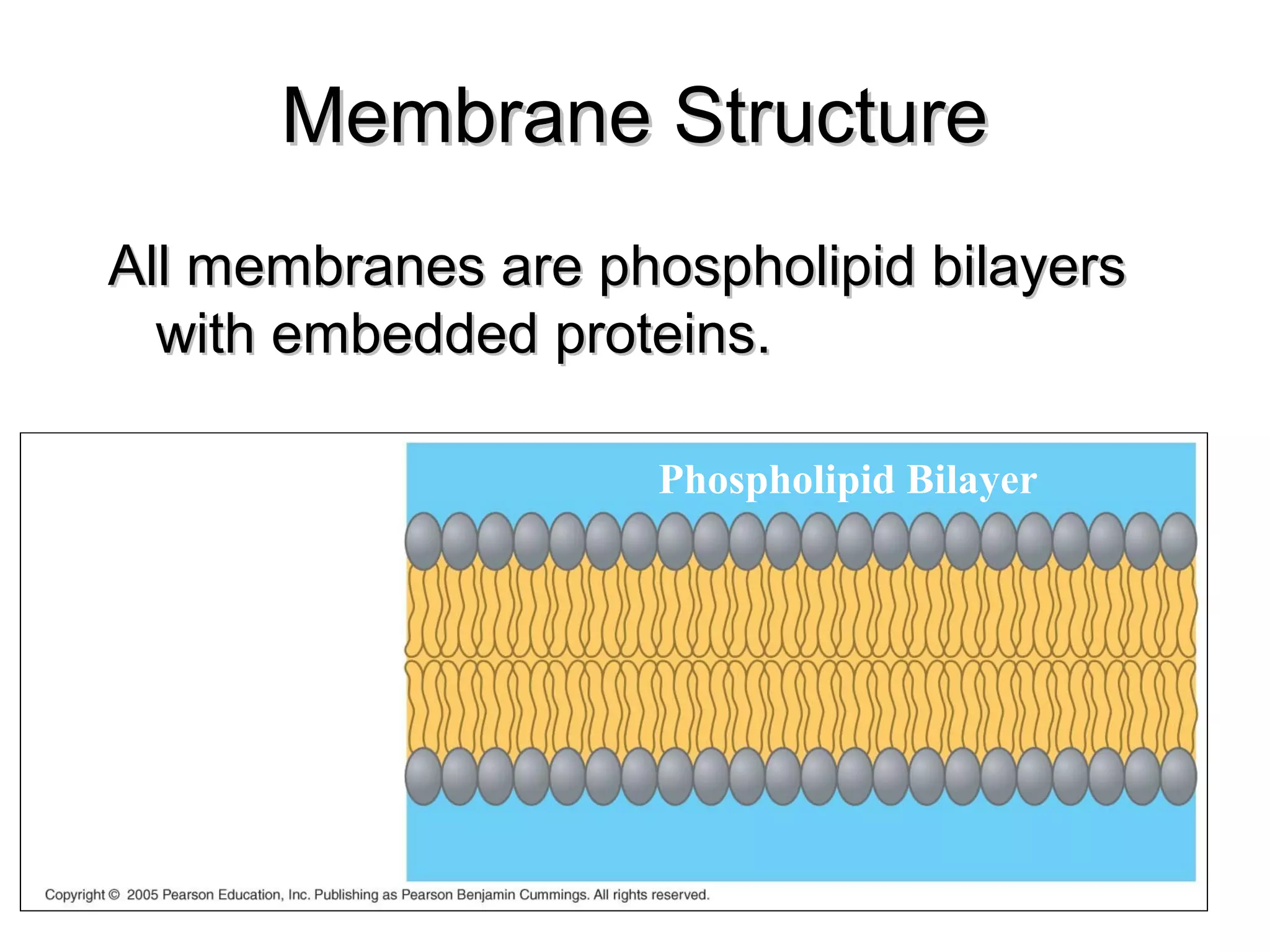
Phospholipids are
the major structural
component of
membranes.
Phospholipid
Membrane StructureMembrane Structure
All membranes are phospholipid bilayersAll membranes are phospholipid bilayers
with embedded proteins.with embedded proteins.
Label the:
Hydrophilic heads
Hydrophobic tails
Phospholipid Bilayer
• Embedded in the bilayer are proteinsEmbedded in the bilayer are proteins
– Most of the membrane’s functions areMost of the membrane’s functions are
accomplished by the embeddedaccomplished by the embedded
proteins.proteins.
• Integral proteinsIntegral proteins span the membranespan the membrane
• Peripheral proteinsPeripheral proteins are on one side or the other ofare on one side or the other of
the membranethe membrane
Plasma Membrane ComponentsPlasma Membrane Components
• GlycoproteinsGlycoproteins andand glycolipidsglycolipids areare
proteins/lipids with short chainproteins/lipids with short chain
carbohydrates attached on thecarbohydrates attached on the
extracellular side of the membrane.extracellular side of the membrane.
Fig. 5-1aFig. 5-1a
Cholesterol
Glycoprotein
Glycolipid
Carbohydrate of
glycoprotein
Phospholipid
Microfilaments
of cytoskeleton
Integrin
• Many membrane proteins areMany membrane proteins are enzymesenzymes
– This is especially important on theThis is especially important on the
membranes of organelles.membranes of organelles.
• Signal transduction (receptor) proteinsSignal transduction (receptor) proteins
bind hormones and other substances onbind hormones and other substances on
the outside of the cell.the outside of the cell.
– Binding triggers a change inside the cell.Binding triggers a change inside the cell.
• Called signal transductionCalled signal transduction
• Example: The binding of insulin to insulin receptorsExample: The binding of insulin to insulin receptors
causes the cell to put glucose transport proteinscauses the cell to put glucose transport proteins
into the membrane.into the membrane.
Fig. 5-1cFig. 5-1c
Messenger molecule
Activated
molecule
Receptor
Transport ProteinsTransport Proteins
• Passive Transport ProteinsPassive Transport Proteins
– allow water soluble substances (small polarallow water soluble substances (small polar
molecules and ions) to pass through themolecules and ions) to pass through the
membrane without any energy costmembrane without any energy cost
• Active Transport ProteinsActive Transport Proteins
– The cell expends energy to transport waterThe cell expends energy to transport water
soluble substancessoluble substances againstagainst theirtheir
concentration gradientconcentration gradient
Fig. 5-1dFig. 5-1d
Transport of Substances AcrossTransport of Substances Across
the Plasma Membrane (PM)the Plasma Membrane (PM)
1.1. Passive TransportPassive Transport
– (Simple) Diffusion (5.3)(Simple) Diffusion (5.3)
– Facilitated diffusion (5.6)Facilitated diffusion (5.6)
– Osmosis (5.4, 5.5)Osmosis (5.4, 5.5)
1.1. Active Transport (5.8)Active Transport (5.8)
2.2. Bulk Flow (5.9)Bulk Flow (5.9)
– EndocytosisEndocytosis
– ExocytosisExocytosis
Passive TransportPassive Transport
• InIn passive transportpassive transport substances crosssubstances cross
the membrane bythe membrane by diffusiondiffusion
– Diffusion - net movement of substances fromDiffusion - net movement of substances from
an area of high concentration to lowan area of high concentration to low
concentrationconcentration
• no energy requiredno energy required
Factors Affecting Diffusion RateFactors Affecting Diffusion Rate
• Steepness of concentration gradientSteepness of concentration gradient
– Steeper gradient, faster diffusionSteeper gradient, faster diffusion
• Molecular sizeMolecular size
– Smaller molecules, faster diffusionSmaller molecules, faster diffusion
• TemperatureTemperature
– Higher temperature, faster diffusionHigher temperature, faster diffusion
Simple DiffusionSimple Diffusion
• Nonpolar, hydrophobic moleculesNonpolar, hydrophobic molecules diffusediffuse
directly through the lipid bilayerdirectly through the lipid bilayer
– Simple diffusion does not require the use ofSimple diffusion does not require the use of
transport proteins.transport proteins.
– Examples: OExamples: O22, CO, CO22, steroids, steroids
• Polar, hydrophilic substancesPolar, hydrophilic substances cannotcannot passpass
directly through the lipid bilayerdirectly through the lipid bilayer
– Examples: water, ions, carbohydratesExamples: water, ions, carbohydrates
Simple DiffusionSimple Diffusion
small, nonpolar molecules
(ex. O2, CO2)
Polar molecules
(ex. Glucose, water)
ions
(ex. H+, Na+, K+)
LIPID-SOLUBLELIPID-SOLUBLE WATER-SOLUBLEWATER-SOLUBLE
LIPID-SOLUBLELIPID-SOLUBLE
Facilitated DiffusionFacilitated Diffusion
• In facilitated diffusion small polarIn facilitated diffusion small polar
molecules and ions diffuse throughmolecules and ions diffuse through
passive transport proteinspassive transport proteins..
– No energy neededNo energy needed
• Most passive transport proteins are soluteMost passive transport proteins are solute
specificspecific
• Example: glucose enter/leaves cellsExample: glucose enter/leaves cells
through facilitated diffusionthrough facilitated diffusion
Facilitated DiffusionFacilitated Diffusion
Passive transport
protein
Lower
concentration
Higher concentration of
OsmosisOsmosis
• Osmosis – diffusion of water across aOsmosis – diffusion of water across a
selectively permeable membraneselectively permeable membrane
• Water moves from an area of _______Water moves from an area of _______
water concentration to an area of _____water concentration to an area of _____
water conc.water conc.
– Is energy required ?Is energy required ?
• Water travels in/out of the cell throughWater travels in/out of the cell through
aquaporinsaquaporins
Osmosis TermsOsmosis Terms
Consider two solutions separatedConsider two solutions separated
by a plasma membrane.by a plasma membrane.
• HypertonicHypertonic
– solution with a relatively high concentration of solutesolution with a relatively high concentration of solute
• HypotonicHypotonic
– solution with a relatively low concentration of solutesolution with a relatively low concentration of solute
• IsotonicIsotonic
– solutions with the same solute concentrationsolutions with the same solute concentration
Water
molecule
Selectively
permeable
membrane
Solute
molecule
H2O
Lower
concentration
of solute
Higher
concentration
of solute
Equal
concentration
of solute
Solute molecule with
cluster of water molecules
Net flow of water
Osmosis and Animal CellsOsmosis and Animal Cells
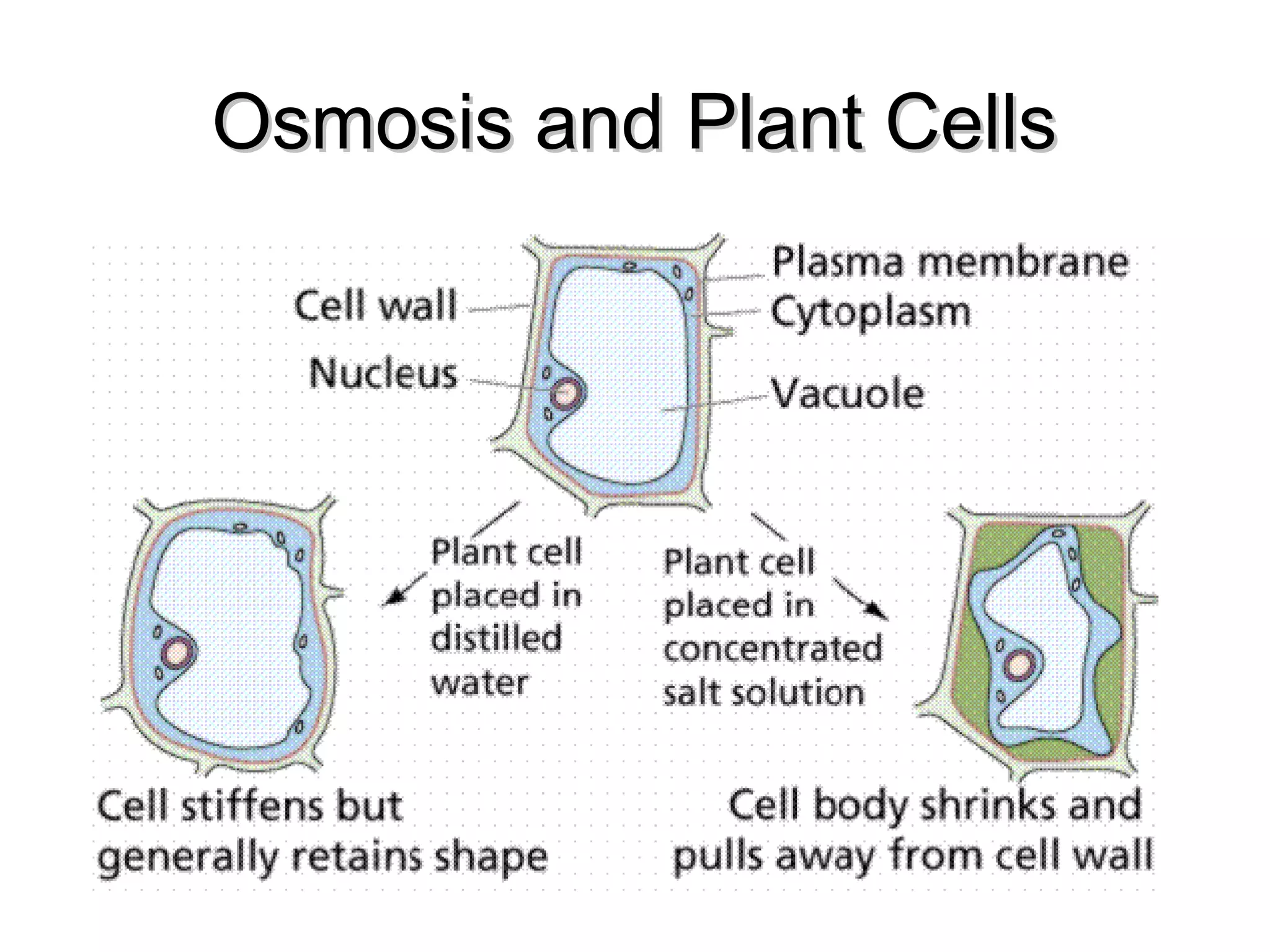
Osmosis and Plant CellsOsmosis and Plant Cells
OsmosisOsmosis
• When a Cell is Placed in a HypotonicWhen a Cell is Placed in a Hypotonic
SolutionSolution
– Water concentration is _________ the cell.Water concentration is _________ the cell.
– Water flows ___________ the cell.Water flows ___________ the cell.
OsmosisOsmosis
• When a Cell is Placed in a HypertonicWhen a Cell is Placed in a Hypertonic
SolutionSolution
– Water concentration is _________ the cell.Water concentration is _________ the cell.
– Water flows ___________ the cell.Water flows ___________ the cell.
Isotonic solution Hypotonic solution Hypertonic solution
H2O H2O
(1) Normal (2) Lysed
H2O
H2O H2O H2O
Animal
cell
Plant
cell
(4) Flaccid (5) Turgid (6) Shriveled
(plasmolyzed)
(3) Shriveled
Plasma
membrane
H2O
H2O
See page 83
Osmosis SummaryOsmosis Summary
•When a cell is placed in a Hypotonic solutionWhen a cell is placed in a Hypotonic solution::
– Cell gains water through osmosisCell gains water through osmosis
– Animal cell lyses; plant cell becomes turgid (firm)Animal cell lyses; plant cell becomes turgid (firm)
•When a cell is placed a Hypertonic solutionWhen a cell is placed a Hypertonic solution::
– Cell loses water through osmosisCell loses water through osmosis
– Animal cell shrivels; plant cell plasmolyzesAnimal cell shrivels; plant cell plasmolyzes
Active TransportActive Transport
• Active transport proteins move substancesActive transport proteins move substances
across the PMacross the PM againstagainst their concentrationtheir concentration
gradient.gradient.
– Requires energy (ATP)Requires energy (ATP)
– Active transport proteins are highly selectiveActive transport proteins are highly selective
– Active transport is needed for properActive transport is needed for proper
functioning of nerves and musclesfunctioning of nerves and muscles
Active Transport of “X”Active Transport of “X”
– Active transport proteins span theActive transport proteins span the
plasma membraneplasma membrane
– They have openings for “X” on only oneThey have openings for “X” on only one
side of the membraneside of the membrane
– ““X” enters the channel and binds toX” enters the channel and binds to
functional groups inside the transportfunctional groups inside the transport
protein.protein.
– Cytoplasmic ATP binds to theCytoplasmic ATP binds to the
transport proteintransport protein
Active Transport of “X”Active Transport of “X”
– A phosphate group is transferred fromA phosphate group is transferred from
ATP to the transport proteinATP to the transport protein
– protein is energized by the added –P.protein is energized by the added –P.
– The energized transport protein changesThe energized transport protein changes
shape and releases “X” on the other sideshape and releases “X” on the other side
of the cell.of the cell.
– The phosphate group is released fromThe phosphate group is released from
the transport protein and it resumes itsthe transport protein and it resumes its
original shape.original shape.
– Process repeats.Process repeats.
Fig. 5-8-1Fig. 5-8-1
Transport
protein
Solute
Solute binding1
Fig. 5-8-2Fig. 5-8-2
Transport
protein
Solute
Solute binding1 Phosphorylation2
Fig. 5-8-3Fig. 5-8-3
Transport
protein
Solute
Solute binding1 Phosphorylation2 Transport3
Protein
changes shape
Fig. 5-8-4Fig. 5-8-4
Transport
protein
Solute
Solute binding1 Phosphorylation2 Transport3
Protein
changes shape
Protein reversion4
Phosphate
detaches
Active TransportActive Transport
tell the story…tell the story…
ATPATP P
ADP
Bulk FlowBulk Flow
• Vesicles are used to transport largeVesicles are used to transport large
particles across the PM.particles across the PM.
– Requires energyRequires energy
• Types:Types:
– ExocytosisExocytosis
– EndocytosisEndocytosis
• Phagocytosis, pinocytosis, receptor-mediatedPhagocytosis, pinocytosis, receptor-mediated
Vesicle
Fluid outside cell
Protein
Cytoplasm
ExocytosisExocytosis
Bulk FlowBulk Flow
• ExocytosisExocytosis
– Cytoplasmic vesicle merges with the PMCytoplasmic vesicle merges with the PM
and releases its contentsand releases its contents
– Example:Example:
• Golgi body vesicles merge with the PM anGolgi body vesicles merge with the PM an
release their contentsrelease their contents
• How nerve cells release neurotransmittorsHow nerve cells release neurotransmittors
Vesicle forming
EndocytosisEndocytosis
Endocytosis can occur in three waysEndocytosis can occur in three ways
• Phagocytosis ("cell eating")Phagocytosis ("cell eating")
• Pinocytosis ("cell drinking")Pinocytosis ("cell drinking")
• Receptor-mediated endocytosisReceptor-mediated endocytosis
EndocytosisEndocytosis
• EndocytosisEndocytosis
– PM sinks inward, pinches off and forms aPM sinks inward, pinches off and forms a
vesiclevesicle
– Vesicle often merges with Golgi forVesicle often merges with Golgi for
processing and sorting of its contentsprocessing and sorting of its contents
Endocytosis - termsEndocytosis - terms
• PhagocytosisPhagocytosis – cell eating– cell eating
– Membrane sinks in and capturesMembrane sinks in and captures solidsolid
particlesparticles for transport into the cellfor transport into the cell
– Examples:Examples:
• Solid particles often include: bacteria, cellSolid particles often include: bacteria, cell
debris, or fooddebris, or food
• Pinocytosis – cell drinkingPinocytosis – cell drinking
– Cell brings in a liquidCell brings in a liquid
Endocytosis -Endocytosis - commentscomments
• Phagocytosis and pinocytosis are notPhagocytosis and pinocytosis are not
selectiveselective
– Membrane sinks inward and capturesMembrane sinks inward and captures
whatever particles/fluid present.whatever particles/fluid present.
– Vesicle forms and merges with the GolgiVesicle forms and merges with the Golgi
body…body…
Receptor Mediated EndocytosisReceptor Mediated Endocytosis
• Receptor Mediated EndocytosisReceptor Mediated Endocytosis is ais a
highly specific form of endocytosis.highly specific form of endocytosis.
– Receptor proteins on the outside of the cellReceptor proteins on the outside of the cell
bind specific substances and bring them intobind specific substances and bring them into
the cell by endocytosisthe cell by endocytosis
Receptor Mediated EndocytosisReceptor Mediated Endocytosis
1.1. Receptor proteins on PM bind specificReceptor proteins on PM bind specific
substancessubstances (vitamins, hormones..)(vitamins, hormones..)
2.2. Membrane sinks in and forms a pitMembrane sinks in and forms a pit
– Called a coated pitCalled a coated pit
2.2. Pit pinches closed to form a vesicle aroundPit pinches closed to form a vesicle around
bound substancesbound substances
• Cytoskeleton aids in pulling in the membrane andCytoskeleton aids in pulling in the membrane and
vesicle formationvesicle formation
Fig. 5-9cFig. 5-9c
Coated
vesicle
Coated
pit
Specific
molecule
Receptor-mediated endocytosis
Coat protein
Receptor
Coated
pit
Material bound
to receptor proteins
Plasma membrane
Fig. 5-9Fig. 5-9 Phagocytosis
EXTRACELLULAR
FLUID
Pseudopodium
CYTOPLASM
Food
vacuole
“Food” or
other particle
Pinocytosis
Plasma
membrane
Vesicle
Coated
vesicle
Coated
pit
Specific
molecule
Receptor-mediated endocytosis
Coat protein
Receptor
Coated
pit
Material bound
to receptor proteins
Plasma membrane
Food
being
ingested
8. Cell: The Unit of Life

8. Cell: The Unit of Life

  • 1.
    Chapter-8 CELL: THE UNITOF LIFE Presented by B.Prabhakar Principal JNV. Panchmahal (Guj)
  • 2.
    Membrane Structure andMembraneStructure and FunctionFunction
  • 9.
    Membrane FunctionMembrane Function •Membranes organize the chemicalMembranes organize the chemical activities of cells.activities of cells. • The outer plasma membraneThe outer plasma membrane – forms a boundary between a living cell and itsforms a boundary between a living cell and its surroundingssurroundings – Exhibits selective permeabilityExhibits selective permeability • Controls traffic of molecules in and outControls traffic of molecules in and out
  • 10.
    Membrane FunctionMembrane Function •Internal membranes provide structuralInternal membranes provide structural order for metabolismorder for metabolism • Form the cell's organellesForm the cell's organelles • Compartmentalize chemical reactionsCompartmentalize chemical reactions
  • 11.
    Fluid Mosaic Modelof the PMFluid Mosaic Model of the PM • A membrane is a mosaicA membrane is a mosaic – Proteins and other molecules are embeddedProteins and other molecules are embedded in a framework of phospholipidsin a framework of phospholipids • A membrane is fluidA membrane is fluid – Most protein and phospholipid molecules canMost protein and phospholipid molecules can move laterallymove laterally
  • 12.
    Membrane StructureMembrane Structure Phospholipidsare the major structural component of membranes. Phospholipid
  • 13.
    Membrane StructureMembrane Structure Allmembranes are phospholipid bilayersAll membranes are phospholipid bilayers with embedded proteins.with embedded proteins. Label the: Hydrophilic heads Hydrophobic tails Phospholipid Bilayer
  • 15.
    • Embedded inthe bilayer are proteinsEmbedded in the bilayer are proteins – Most of the membrane’s functions areMost of the membrane’s functions are accomplished by the embeddedaccomplished by the embedded proteins.proteins. • Integral proteinsIntegral proteins span the membranespan the membrane • Peripheral proteinsPeripheral proteins are on one side or the other ofare on one side or the other of the membranethe membrane
  • 16.
    Plasma Membrane ComponentsPlasmaMembrane Components • GlycoproteinsGlycoproteins andand glycolipidsglycolipids areare proteins/lipids with short chainproteins/lipids with short chain carbohydrates attached on thecarbohydrates attached on the extracellular side of the membrane.extracellular side of the membrane.
  • 17.
    Fig. 5-1aFig. 5-1a Cholesterol Glycoprotein Glycolipid Carbohydrateof glycoprotein Phospholipid Microfilaments of cytoskeleton Integrin
  • 19.
    • Many membraneproteins areMany membrane proteins are enzymesenzymes – This is especially important on theThis is especially important on the membranes of organelles.membranes of organelles.
  • 20.
    • Signal transduction(receptor) proteinsSignal transduction (receptor) proteins bind hormones and other substances onbind hormones and other substances on the outside of the cell.the outside of the cell. – Binding triggers a change inside the cell.Binding triggers a change inside the cell. • Called signal transductionCalled signal transduction • Example: The binding of insulin to insulin receptorsExample: The binding of insulin to insulin receptors causes the cell to put glucose transport proteinscauses the cell to put glucose transport proteins into the membrane.into the membrane.
  • 21.
    Fig. 5-1cFig. 5-1c Messengermolecule Activated molecule Receptor
  • 22.
    Transport ProteinsTransport Proteins •Passive Transport ProteinsPassive Transport Proteins – allow water soluble substances (small polarallow water soluble substances (small polar molecules and ions) to pass through themolecules and ions) to pass through the membrane without any energy costmembrane without any energy cost • Active Transport ProteinsActive Transport Proteins – The cell expends energy to transport waterThe cell expends energy to transport water soluble substancessoluble substances againstagainst theirtheir concentration gradientconcentration gradient
  • 23.
  • 24.
    Transport of SubstancesAcrossTransport of Substances Across the Plasma Membrane (PM)the Plasma Membrane (PM) 1.1. Passive TransportPassive Transport – (Simple) Diffusion (5.3)(Simple) Diffusion (5.3) – Facilitated diffusion (5.6)Facilitated diffusion (5.6) – Osmosis (5.4, 5.5)Osmosis (5.4, 5.5) 1.1. Active Transport (5.8)Active Transport (5.8) 2.2. Bulk Flow (5.9)Bulk Flow (5.9) – EndocytosisEndocytosis – ExocytosisExocytosis
  • 25.
    Passive TransportPassive Transport •InIn passive transportpassive transport substances crosssubstances cross the membrane bythe membrane by diffusiondiffusion – Diffusion - net movement of substances fromDiffusion - net movement of substances from an area of high concentration to lowan area of high concentration to low concentrationconcentration • no energy requiredno energy required
  • 26.
    Factors Affecting DiffusionRateFactors Affecting Diffusion Rate • Steepness of concentration gradientSteepness of concentration gradient – Steeper gradient, faster diffusionSteeper gradient, faster diffusion • Molecular sizeMolecular size – Smaller molecules, faster diffusionSmaller molecules, faster diffusion • TemperatureTemperature – Higher temperature, faster diffusionHigher temperature, faster diffusion
  • 27.
    Simple DiffusionSimple Diffusion •Nonpolar, hydrophobic moleculesNonpolar, hydrophobic molecules diffusediffuse directly through the lipid bilayerdirectly through the lipid bilayer – Simple diffusion does not require the use ofSimple diffusion does not require the use of transport proteins.transport proteins. – Examples: OExamples: O22, CO, CO22, steroids, steroids • Polar, hydrophilic substancesPolar, hydrophilic substances cannotcannot passpass directly through the lipid bilayerdirectly through the lipid bilayer – Examples: water, ions, carbohydratesExamples: water, ions, carbohydrates
  • 28.
    Simple DiffusionSimple Diffusion small,nonpolar molecules (ex. O2, CO2) Polar molecules (ex. Glucose, water) ions (ex. H+, Na+, K+) LIPID-SOLUBLELIPID-SOLUBLE WATER-SOLUBLEWATER-SOLUBLE LIPID-SOLUBLELIPID-SOLUBLE
  • 29.
    Facilitated DiffusionFacilitated Diffusion •In facilitated diffusion small polarIn facilitated diffusion small polar molecules and ions diffuse throughmolecules and ions diffuse through passive transport proteinspassive transport proteins.. – No energy neededNo energy needed • Most passive transport proteins are soluteMost passive transport proteins are solute specificspecific • Example: glucose enter/leaves cellsExample: glucose enter/leaves cells through facilitated diffusionthrough facilitated diffusion
  • 30.
    Facilitated DiffusionFacilitated Diffusion Passivetransport protein Lower concentration Higher concentration of
  • 31.
    OsmosisOsmosis • Osmosis –diffusion of water across aOsmosis – diffusion of water across a selectively permeable membraneselectively permeable membrane • Water moves from an area of _______Water moves from an area of _______ water concentration to an area of _____water concentration to an area of _____ water conc.water conc. – Is energy required ?Is energy required ? • Water travels in/out of the cell throughWater travels in/out of the cell through aquaporinsaquaporins
  • 32.
    Osmosis TermsOsmosis Terms Considertwo solutions separatedConsider two solutions separated by a plasma membrane.by a plasma membrane. • HypertonicHypertonic – solution with a relatively high concentration of solutesolution with a relatively high concentration of solute • HypotonicHypotonic – solution with a relatively low concentration of solutesolution with a relatively low concentration of solute • IsotonicIsotonic – solutions with the same solute concentrationsolutions with the same solute concentration
  • 33.
  • 34.
    Osmosis and AnimalCellsOsmosis and Animal Cells
  • 35.
    Osmosis and PlantCellsOsmosis and Plant Cells
  • 36.
    OsmosisOsmosis • When aCell is Placed in a HypotonicWhen a Cell is Placed in a Hypotonic SolutionSolution – Water concentration is _________ the cell.Water concentration is _________ the cell. – Water flows ___________ the cell.Water flows ___________ the cell.
  • 37.
    OsmosisOsmosis • When aCell is Placed in a HypertonicWhen a Cell is Placed in a Hypertonic SolutionSolution – Water concentration is _________ the cell.Water concentration is _________ the cell. – Water flows ___________ the cell.Water flows ___________ the cell.
  • 38.
    Isotonic solution Hypotonicsolution Hypertonic solution H2O H2O (1) Normal (2) Lysed H2O H2O H2O H2O Animal cell Plant cell (4) Flaccid (5) Turgid (6) Shriveled (plasmolyzed) (3) Shriveled Plasma membrane H2O H2O See page 83
  • 39.
    Osmosis SummaryOsmosis Summary •Whena cell is placed in a Hypotonic solutionWhen a cell is placed in a Hypotonic solution:: – Cell gains water through osmosisCell gains water through osmosis – Animal cell lyses; plant cell becomes turgid (firm)Animal cell lyses; plant cell becomes turgid (firm) •When a cell is placed a Hypertonic solutionWhen a cell is placed a Hypertonic solution:: – Cell loses water through osmosisCell loses water through osmosis – Animal cell shrivels; plant cell plasmolyzesAnimal cell shrivels; plant cell plasmolyzes
  • 40.
    Active TransportActive Transport •Active transport proteins move substancesActive transport proteins move substances across the PMacross the PM againstagainst their concentrationtheir concentration gradient.gradient. – Requires energy (ATP)Requires energy (ATP) – Active transport proteins are highly selectiveActive transport proteins are highly selective – Active transport is needed for properActive transport is needed for proper functioning of nerves and musclesfunctioning of nerves and muscles
  • 41.
    Active Transport of“X”Active Transport of “X” – Active transport proteins span theActive transport proteins span the plasma membraneplasma membrane – They have openings for “X” on only oneThey have openings for “X” on only one side of the membraneside of the membrane – ““X” enters the channel and binds toX” enters the channel and binds to functional groups inside the transportfunctional groups inside the transport protein.protein. – Cytoplasmic ATP binds to theCytoplasmic ATP binds to the transport proteintransport protein
  • 42.
    Active Transport of“X”Active Transport of “X” – A phosphate group is transferred fromA phosphate group is transferred from ATP to the transport proteinATP to the transport protein – protein is energized by the added –P.protein is energized by the added –P. – The energized transport protein changesThe energized transport protein changes shape and releases “X” on the other sideshape and releases “X” on the other side of the cell.of the cell. – The phosphate group is released fromThe phosphate group is released from the transport protein and it resumes itsthe transport protein and it resumes its original shape.original shape. – Process repeats.Process repeats.
  • 43.
  • 44.
  • 45.
    Fig. 5-8-3Fig. 5-8-3 Transport protein Solute Solutebinding1 Phosphorylation2 Transport3 Protein changes shape
  • 46.
    Fig. 5-8-4Fig. 5-8-4 Transport protein Solute Solutebinding1 Phosphorylation2 Transport3 Protein changes shape Protein reversion4 Phosphate detaches
  • 47.
    Active TransportActive Transport tellthe story…tell the story… ATPATP P ADP
  • 48.
    Bulk FlowBulk Flow •Vesicles are used to transport largeVesicles are used to transport large particles across the PM.particles across the PM. – Requires energyRequires energy • Types:Types: – ExocytosisExocytosis – EndocytosisEndocytosis • Phagocytosis, pinocytosis, receptor-mediatedPhagocytosis, pinocytosis, receptor-mediated
  • 49.
  • 50.
    Bulk FlowBulk Flow •ExocytosisExocytosis – Cytoplasmic vesicle merges with the PMCytoplasmic vesicle merges with the PM and releases its contentsand releases its contents – Example:Example: • Golgi body vesicles merge with the PM anGolgi body vesicles merge with the PM an release their contentsrelease their contents • How nerve cells release neurotransmittorsHow nerve cells release neurotransmittors
  • 51.
    Vesicle forming EndocytosisEndocytosis Endocytosis canoccur in three waysEndocytosis can occur in three ways • Phagocytosis ("cell eating")Phagocytosis ("cell eating") • Pinocytosis ("cell drinking")Pinocytosis ("cell drinking") • Receptor-mediated endocytosisReceptor-mediated endocytosis
  • 52.
    EndocytosisEndocytosis • EndocytosisEndocytosis – PMsinks inward, pinches off and forms aPM sinks inward, pinches off and forms a vesiclevesicle – Vesicle often merges with Golgi forVesicle often merges with Golgi for processing and sorting of its contentsprocessing and sorting of its contents
  • 53.
    Endocytosis - termsEndocytosis- terms • PhagocytosisPhagocytosis – cell eating– cell eating – Membrane sinks in and capturesMembrane sinks in and captures solidsolid particlesparticles for transport into the cellfor transport into the cell – Examples:Examples: • Solid particles often include: bacteria, cellSolid particles often include: bacteria, cell debris, or fooddebris, or food • Pinocytosis – cell drinkingPinocytosis – cell drinking – Cell brings in a liquidCell brings in a liquid
  • 54.
    Endocytosis -Endocytosis -commentscomments • Phagocytosis and pinocytosis are notPhagocytosis and pinocytosis are not selectiveselective – Membrane sinks inward and capturesMembrane sinks inward and captures whatever particles/fluid present.whatever particles/fluid present. – Vesicle forms and merges with the GolgiVesicle forms and merges with the Golgi body…body…
  • 55.
    Receptor Mediated EndocytosisReceptorMediated Endocytosis • Receptor Mediated EndocytosisReceptor Mediated Endocytosis is ais a highly specific form of endocytosis.highly specific form of endocytosis. – Receptor proteins on the outside of the cellReceptor proteins on the outside of the cell bind specific substances and bring them intobind specific substances and bring them into the cell by endocytosisthe cell by endocytosis
  • 56.
    Receptor Mediated EndocytosisReceptorMediated Endocytosis 1.1. Receptor proteins on PM bind specificReceptor proteins on PM bind specific substancessubstances (vitamins, hormones..)(vitamins, hormones..) 2.2. Membrane sinks in and forms a pitMembrane sinks in and forms a pit – Called a coated pitCalled a coated pit 2.2. Pit pinches closed to form a vesicle aroundPit pinches closed to form a vesicle around bound substancesbound substances • Cytoskeleton aids in pulling in the membrane andCytoskeleton aids in pulling in the membrane and vesicle formationvesicle formation
  • 57.
    Fig. 5-9cFig. 5-9c Coated vesicle Coated pit Specific molecule Receptor-mediatedendocytosis Coat protein Receptor Coated pit Material bound to receptor proteins Plasma membrane
  • 59.
    Fig. 5-9Fig. 5-9Phagocytosis EXTRACELLULAR FLUID Pseudopodium CYTOPLASM Food vacuole “Food” or other particle Pinocytosis Plasma membrane Vesicle Coated vesicle Coated pit Specific molecule Receptor-mediated endocytosis Coat protein Receptor Coated pit Material bound to receptor proteins Plasma membrane Food being ingested