By
KAUSHAL KUMAR SAHU
Assistant Professor (Ad Hoc)
Department of Biotechnology
Govt. Digvijay Autonomous P. G. College
Raj-Nandgaon ( C. G. )
SYNOPSIS
1) Introduction to cell
2) HistoricalAspects
3) Cell Diversity
4) Types Of Cell Diversity
 Cell Diversity In Origin
 Cell Diversity In size
 Cell Diversity In Shape
 Some OtherTypes
5) DifferentiationAnd Specialisation Of Cell Diversity
6) Conclusion
7) References
INTRODUCTIONTO CELL
The cell is the smallest structural and
functional unit of the all living organisms.
It comprises of the protoplasm limited by a
membrane and containing one or more nuclei at
some time in its life.
Also fundamental unit for reproduction and
function.
All cells physically defined by cell membrane
that controls movement of stuff in and out .
A living cell characterized by the fact that it
carries on chemical activity (metabolism) by
which it liberate energy for its life activities.
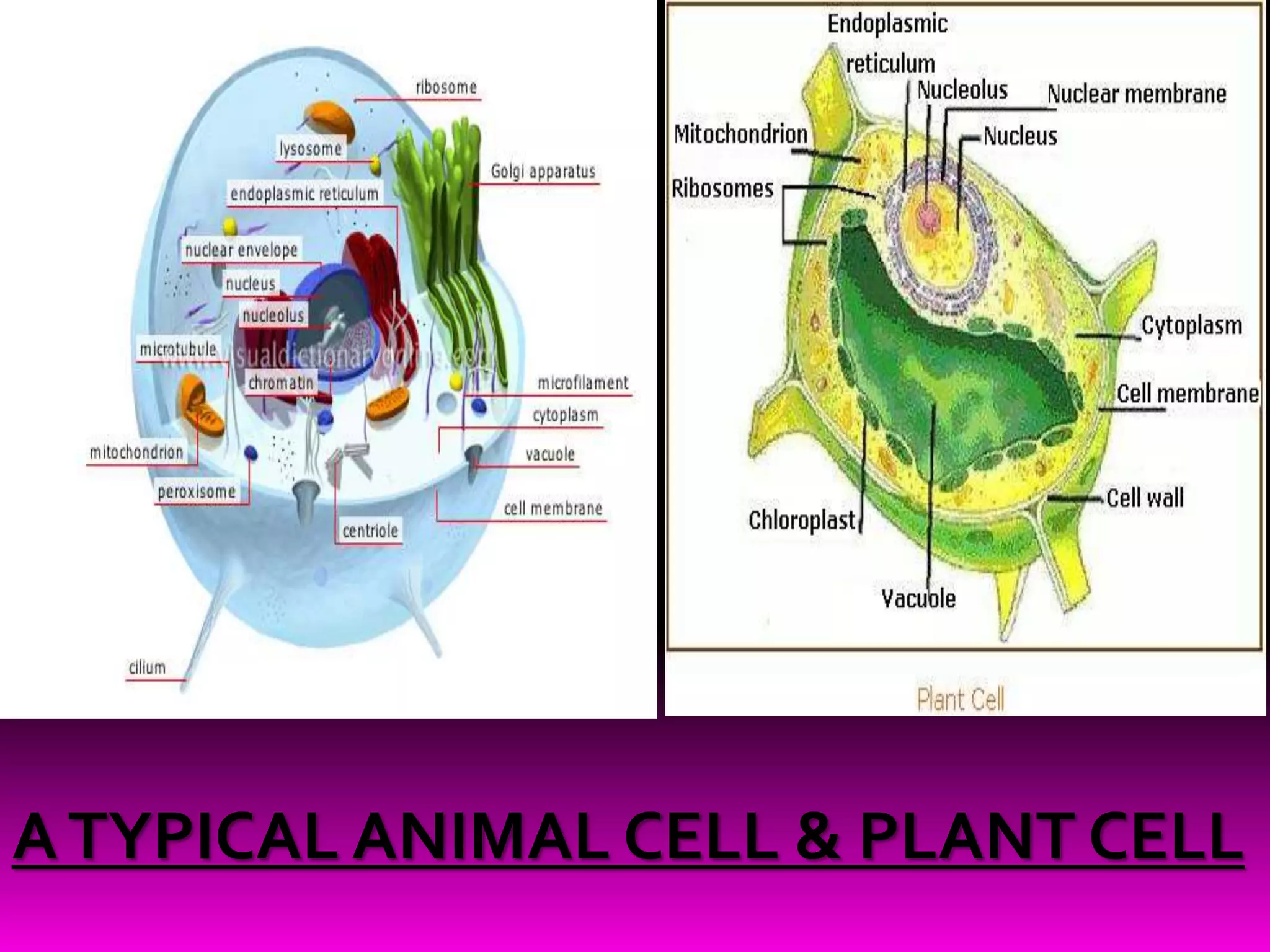
ATYPICAL ANIMAL CELL & PLANT CELL
HISTORICAL ASPECTS
In 1665, Robert Hook first time observed the cell. He observed a
thin slice of cork under his own microscope. Under microscope, he
observed a honey-comb like structure showing hallow empty
spaces or compartments surrounded by firm cell wall.To each
hallow space he called a ‘cell’. Actually what Robert Hook observed
was dead cell.
AntonyVan Leeuwenhoek (1632–1723) observed first time the
microorganisms (prokaryotic cell) under his compound microscope.
He observed tiny microbes in a drop of pond water which he called
‘animacules’.
In 1831, Robert Brown, first time observed a nucleus in the cell.
In 1855 Rudolph Virchow observed that new cells arise from
preexisting cells.
In 1938, M.J. Schleiden, a German botanist studied many plants
section under microscope and came to conclusion that, “all plants
are ultimately made up of cell”.
In 1938T.S. Schwann, a German Zoologist came to the similar
conclusion that, “all the animals are ultimately made up of cell”.
Later, Schleiden and Schwann both together put forth a theory
which is known as a CellTheory. According to this theory all the
organisms i.e. plants and animals are made up of cells.
CELL DIVERSITY
CELL DIVERSITY
Not all cells are alike.
Even cells within the same organism may show enormous
diversity in size, shape, and internal organization.
For example:- Our body contains at least 200 different cell types.
Cells may be of different types on the basis of their function.
For example:- Brain cells are different from Blood cells.
The diversity found in cells is greatly influenced by their
environment also.
The variety and diversity of cells are as many as their functions.
DIVERSITY OF CELLS IN OUR BODY
TYPES OF CELL
DIVERSITY
Cell Diversity In Origin
Cell Diversity In size
Cell Diversity In Shape
Some OtherTypes
Cell Diversity In Origin:-
Based upon its origin it is basically divided into two types:-
Prokaryotic Cell Diversity - Prokaryotic cells are primitive type of cells.These
cells lacks true nucleus and other cell organelle like mitochondria, chloroplasts,
endoplasmic reticulum, golgi complex, etc.The word prokaryotes is derived from
Greek word ‘pro’ means primitive or old and ‘karyotes’ means nucleus or main.
e.g. Cyanobacteria,
Bacteria.
Eukaryotic Cell Diversity - Eukaryotic cells have true nucleus and it also contains
cell organelles.The word eukaryotes is derived from Greek word ‘eu’ means true
and ‘karyotes’ means nucleus.
e.g. General green plants,
Starch containing amyloplasts,
TypicalAnimal Cells,
A live unicellular organism.
PROKARYOTIC & EUKARYOTIC CELL DIVERSITY
Cell Diversity In Size:-
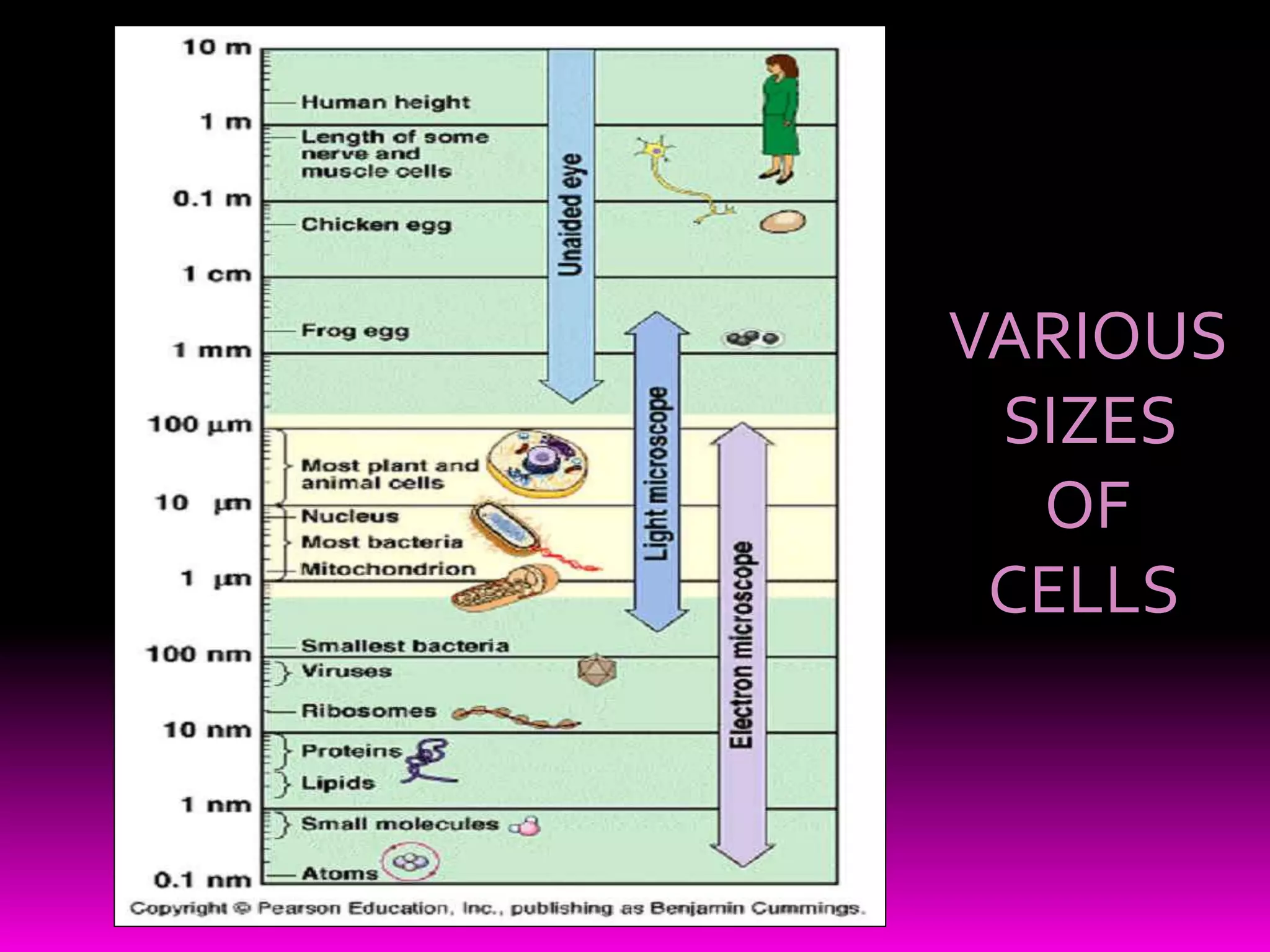
The size of cells in nature varies over an enormous range, with protists like
Amoeba proteus being many millions of times larger than the smallest
Mycoplasma.
A cell's size is a fundamental attribute that contributes to function in the
context of multicellular organisms and to fitness in the context of unicellular
organisms.
Size imposes constraints on cellular design. For instance, as cells grow larger,
passive diffusion may limit intracellular transport and the decreased surface area
to volume ratio may make nutrient uptake limiting for cell growth.
A few types of cells can be seen without the aid of a microscope (egg cells,
nerve cells in a giraffe – 2m long).
Most cells are visible only with a microscope.
Cells are limited in size by the ratio between their outer surface area and their
volume.
This means that if a cell keeps the same shape as it grows, its volume will
increase more rapidly than its surface area.At some point, its surface area
becomes too small to allow nutrients, oxygen, and other materials to enter the
cell quickly enough to meet the cell’s needs.
The cell size broadly ranges from 0.2 µm to 2 mm. But some cells are very large
like Giraffe Nerve cell is of 2 m., Ostrich Ovum is of about 100 mm in size.
S.
No
.
Cell Type Size(µm)
1.
2.
3.
4.
5.
6.
7.
8.
9.
10.
Mycoplasma (PPLO)
Bacteria
Small Lymphocytes
Erythrocytes
Amoeba Proteus
Liver Cells
Euglena
Human Oocyte
Ostrich Egg
Neurons (Length)
0.10
0.20-2.50
4.0
7.0-8.0
1000
20
100-500
250
75×103
2×10⁶
The following Table shows the Diversity in Cell size:-
VARIOUS
SIZES
OF
CELLS
Cell Diversity In Shape:-
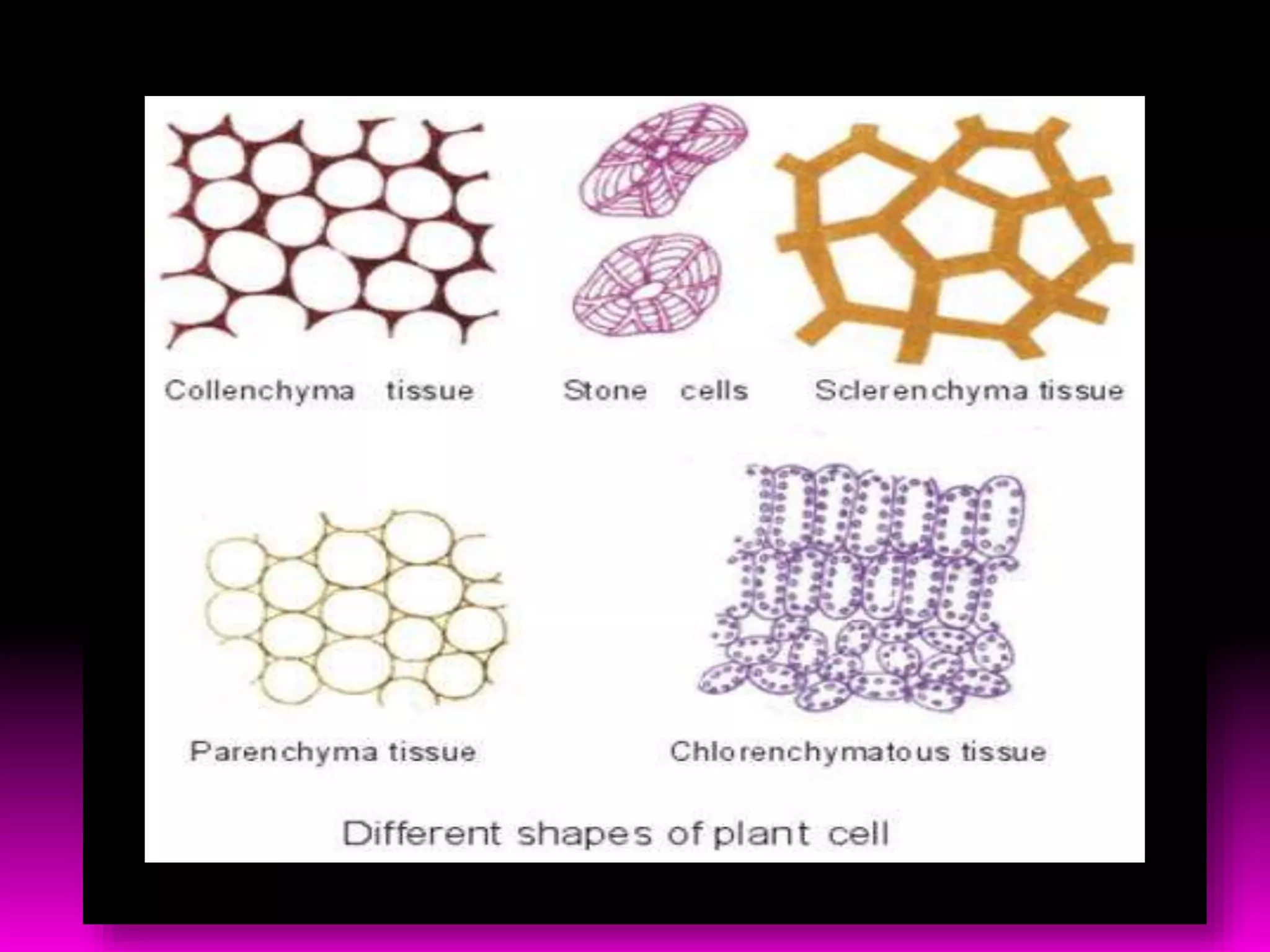
Cells come in a variety of shapes.
This diversity reflects a diversity of functions.
Skin cells are flat (cover the body’s surface).
White blood cells can change shape (leave the blood, enter the areas
surrounding blood vessels, so they can do their job---attack invaders like
bacteria).
Cell shape is controlled by certain physical, chemical and physiological
factors.
Majority of cells have characteristic fixed shape.
While certain cells have no fixed shape called variable cells, for e.g., amoeba
and leucocytes.
Cell shape Example
1. Variable cells Amoeba, Leucocytes, Myxomycetes.
2. Fixed cells
(i) Spherical cells eggs of many animals.
(ii) Flattened cells Squamous epithelium, endotheliums,
and upper layer of epidermis.
(iii) Cuboidal cells Thyroid gland follicles
(iv) Columner cells The cells lining the intestine.
(v) Discoidal cells Red Blood Cells Or Erythrocytes
(vi) Spindle shaped cells Smooth muscle fibres
(vii) Elongated cells Nerve cells or Neurons
(viii) Branched cells Chromatophores Or Pigment cells of
skin.
(ix) Polyhedral (with 8,12 or14 sides) Squamous Epithelium
Generally multicellular organisms are made up of different
shaped cells.Some major types are shown in the Table
below:-
SOME OTHER TYPES OF
CELL DIVERSITY:-
Single cell diversity
Functional Diversity
Molecular Cell Diversity
Ecological cell Diversity
Genomic cell Diversity
DIFFERENTIATION AND SPECIALIZATION OF
CELL DIVERSITY
Shape, structure and biochemistry often reflect
function.
Examples: red blood cell, nerve cells, rod cell, phloem and
xylem cells of plants.
Some cells are dead at maturity (e.g. xylem cells).
Red blood cells lose nucleus and important functions.
CONCLUSION
The cell is the smallest structural and functional unit of
the all living organisms.There is no generalisation in cell
size, shape and structure.They may be as small as an
erythrocyte (8 µm) or may be as bigger as giraffe nerve
cell (2 m). Diversity in Cell can be of many types on
several different basis. Even cells within the same
organism may show enormous diversity in size, shape,
and internal organization.
REFERENCES
 Cell & Molecular Biology – Gerald Karp, 4th Edition (2005)
 Cell Biology - E.J.Ambrose & Dorothy M. Easty, 2nd Edition (1977)
 Cell Biology - P.S. Verma & V.K. Agarwal, 1st Edition (Reprint 2007)
 Cell Biology – C.B. Powar, 3rd Edition (Reprint 2005)
 Websites:-
www.wikipedia.org
www.tutorvista.com
www.springerlink.com
www.current-biology.com

Diversity of cell size & shape By KK Sahu Sir

  • 1.
    By KAUSHAL KUMAR SAHU AssistantProfessor (Ad Hoc) Department of Biotechnology Govt. Digvijay Autonomous P. G. College Raj-Nandgaon ( C. G. )
  • 2.
    SYNOPSIS 1) Introduction tocell 2) HistoricalAspects 3) Cell Diversity 4) Types Of Cell Diversity  Cell Diversity In Origin  Cell Diversity In size  Cell Diversity In Shape  Some OtherTypes 5) DifferentiationAnd Specialisation Of Cell Diversity 6) Conclusion 7) References
  • 3.
    INTRODUCTIONTO CELL The cellis the smallest structural and functional unit of the all living organisms. It comprises of the protoplasm limited by a membrane and containing one or more nuclei at some time in its life. Also fundamental unit for reproduction and function. All cells physically defined by cell membrane that controls movement of stuff in and out . A living cell characterized by the fact that it carries on chemical activity (metabolism) by which it liberate energy for its life activities.
  • 4.
  • 5.
    HISTORICAL ASPECTS In 1665,Robert Hook first time observed the cell. He observed a thin slice of cork under his own microscope. Under microscope, he observed a honey-comb like structure showing hallow empty spaces or compartments surrounded by firm cell wall.To each hallow space he called a ‘cell’. Actually what Robert Hook observed was dead cell. AntonyVan Leeuwenhoek (1632–1723) observed first time the microorganisms (prokaryotic cell) under his compound microscope. He observed tiny microbes in a drop of pond water which he called ‘animacules’. In 1831, Robert Brown, first time observed a nucleus in the cell.
  • 6.
    In 1855 RudolphVirchow observed that new cells arise from preexisting cells. In 1938, M.J. Schleiden, a German botanist studied many plants section under microscope and came to conclusion that, “all plants are ultimately made up of cell”. In 1938T.S. Schwann, a German Zoologist came to the similar conclusion that, “all the animals are ultimately made up of cell”. Later, Schleiden and Schwann both together put forth a theory which is known as a CellTheory. According to this theory all the organisms i.e. plants and animals are made up of cells.
  • 7.
  • 8.
    CELL DIVERSITY Not allcells are alike. Even cells within the same organism may show enormous diversity in size, shape, and internal organization. For example:- Our body contains at least 200 different cell types. Cells may be of different types on the basis of their function. For example:- Brain cells are different from Blood cells. The diversity found in cells is greatly influenced by their environment also. The variety and diversity of cells are as many as their functions.
  • 9.
    DIVERSITY OF CELLSIN OUR BODY
  • 10.
    TYPES OF CELL DIVERSITY CellDiversity In Origin Cell Diversity In size Cell Diversity In Shape Some OtherTypes
  • 11.
    Cell Diversity InOrigin:- Based upon its origin it is basically divided into two types:- Prokaryotic Cell Diversity - Prokaryotic cells are primitive type of cells.These cells lacks true nucleus and other cell organelle like mitochondria, chloroplasts, endoplasmic reticulum, golgi complex, etc.The word prokaryotes is derived from Greek word ‘pro’ means primitive or old and ‘karyotes’ means nucleus or main. e.g. Cyanobacteria, Bacteria. Eukaryotic Cell Diversity - Eukaryotic cells have true nucleus and it also contains cell organelles.The word eukaryotes is derived from Greek word ‘eu’ means true and ‘karyotes’ means nucleus. e.g. General green plants, Starch containing amyloplasts, TypicalAnimal Cells, A live unicellular organism.
  • 12.
  • 13.
    Cell Diversity InSize:- The size of cells in nature varies over an enormous range, with protists like Amoeba proteus being many millions of times larger than the smallest Mycoplasma. A cell's size is a fundamental attribute that contributes to function in the context of multicellular organisms and to fitness in the context of unicellular organisms. Size imposes constraints on cellular design. For instance, as cells grow larger, passive diffusion may limit intracellular transport and the decreased surface area to volume ratio may make nutrient uptake limiting for cell growth. A few types of cells can be seen without the aid of a microscope (egg cells, nerve cells in a giraffe – 2m long). Most cells are visible only with a microscope.
  • 14.
    Cells are limitedin size by the ratio between their outer surface area and their volume. This means that if a cell keeps the same shape as it grows, its volume will increase more rapidly than its surface area.At some point, its surface area becomes too small to allow nutrients, oxygen, and other materials to enter the cell quickly enough to meet the cell’s needs. The cell size broadly ranges from 0.2 µm to 2 mm. But some cells are very large like Giraffe Nerve cell is of 2 m., Ostrich Ovum is of about 100 mm in size.
  • 15.
    S. No . Cell Type Size(µm) 1. 2. 3. 4. 5. 6. 7. 8. 9. 10. Mycoplasma(PPLO) Bacteria Small Lymphocytes Erythrocytes Amoeba Proteus Liver Cells Euglena Human Oocyte Ostrich Egg Neurons (Length) 0.10 0.20-2.50 4.0 7.0-8.0 1000 20 100-500 250 75×103 2×10⁶ The following Table shows the Diversity in Cell size:-
  • 16.
  • 17.
    Cell Diversity InShape:- Cells come in a variety of shapes. This diversity reflects a diversity of functions. Skin cells are flat (cover the body’s surface). White blood cells can change shape (leave the blood, enter the areas surrounding blood vessels, so they can do their job---attack invaders like bacteria). Cell shape is controlled by certain physical, chemical and physiological factors. Majority of cells have characteristic fixed shape. While certain cells have no fixed shape called variable cells, for e.g., amoeba and leucocytes.
  • 18.
    Cell shape Example 1.Variable cells Amoeba, Leucocytes, Myxomycetes. 2. Fixed cells (i) Spherical cells eggs of many animals. (ii) Flattened cells Squamous epithelium, endotheliums, and upper layer of epidermis. (iii) Cuboidal cells Thyroid gland follicles (iv) Columner cells The cells lining the intestine. (v) Discoidal cells Red Blood Cells Or Erythrocytes (vi) Spindle shaped cells Smooth muscle fibres (vii) Elongated cells Nerve cells or Neurons (viii) Branched cells Chromatophores Or Pigment cells of skin. (ix) Polyhedral (with 8,12 or14 sides) Squamous Epithelium Generally multicellular organisms are made up of different shaped cells.Some major types are shown in the Table below:-
  • 22.
    SOME OTHER TYPESOF CELL DIVERSITY:- Single cell diversity Functional Diversity Molecular Cell Diversity Ecological cell Diversity Genomic cell Diversity
  • 23.
    DIFFERENTIATION AND SPECIALIZATIONOF CELL DIVERSITY Shape, structure and biochemistry often reflect function. Examples: red blood cell, nerve cells, rod cell, phloem and xylem cells of plants. Some cells are dead at maturity (e.g. xylem cells). Red blood cells lose nucleus and important functions.
  • 24.
    CONCLUSION The cell isthe smallest structural and functional unit of the all living organisms.There is no generalisation in cell size, shape and structure.They may be as small as an erythrocyte (8 µm) or may be as bigger as giraffe nerve cell (2 m). Diversity in Cell can be of many types on several different basis. Even cells within the same organism may show enormous diversity in size, shape, and internal organization.
  • 25.
    REFERENCES  Cell &Molecular Biology – Gerald Karp, 4th Edition (2005)  Cell Biology - E.J.Ambrose & Dorothy M. Easty, 2nd Edition (1977)  Cell Biology - P.S. Verma & V.K. Agarwal, 1st Edition (Reprint 2007)  Cell Biology – C.B. Powar, 3rd Edition (Reprint 2005)  Websites:- www.wikipedia.org www.tutorvista.com www.springerlink.com www.current-biology.com