INTRODUCTION


Human Genome is thought to contain fewer than
105 genes, yet a human can make at least 1015
different types of antibodies in terms of Antigen
binding specificity.
GERM LINE THEORY
All Antibodies are coded by genes of Germ line cells.
Germ line proponents proposed that the genome
contributed by the germ cells contains a large
repertoire of Immunoglobulin genes. But they were
unable to explain the genetic mechanism to account
for Antibody diversity.
SOMATIC VARIATION THEORY

Genome of Somatic cells contains a relatively
small number of Immunoglobulin genes, from
which a large no of antibody specificities are
generated by Mutation or Recombination.
TONEGAWA’S IMMUNOGLOBULIN
        GENES REARRANGE
STRUCTURE OF IMMUNOGLOBULIN
HUMAN LIGHT CHAIN AND HEAVY                                            CHAIN
                GENES

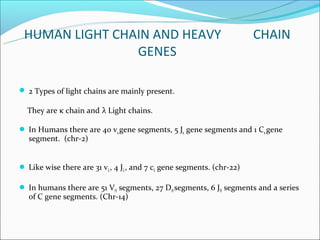
 2 Types of light chains are mainly present.

  They are κ chain and λ Light chains.

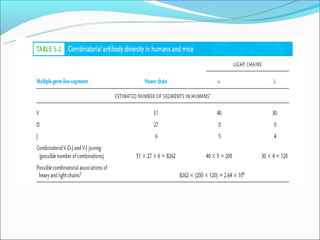
 In Humans there are 40 vκ gene segments, 5 Jκ gene segments and 1 Cκ gene
  segment. (chr-2)


 Like wise there are 31 vλ , 4 Jλ , and 7 cλ gene segments. (chr-22)

 In humans there are 51 VH segments, 27 DH segments, 6 JH segments and a series
  of C gene segments. (Chr-14)
RECOMBINATION OF LIGHT CHAIN GENES
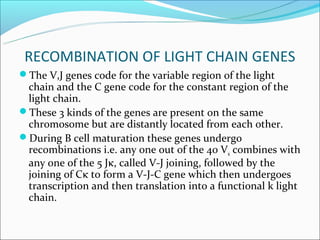
The V,J genes code for the variable region of the light
 chain and the C gene code for the constant region of the
 light chain.
These 3 kinds of the genes are present on the same
 chromosome but are distantly located from each other.
During B cell maturation these genes undergo
 recombinations i.e. any one out of the 40 Vκ combines with
 any one of the 5 Jκ, called V-J joining, followed by the
 joining of Cκ to form a V-J-C gene which then undergoes
 transcription and then translation into a functional k light
 chain.
HUMAN HEAVY CHAIN GENES
Heavy chains are also synthesized in an analogous
 manner but are encoded by 4 gene segments,
 V,J,D and C.
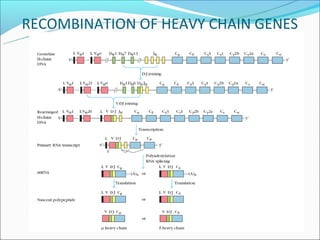
During B cell maturation D-J joining occurs first
 followed by joining of V gene to D-J gene segment
 to form V-D-J gene segment which then combines
 with any one of the c gene segment and
 undergoes transcription which then follows post
 transcriptional modifications and finally translate
 into a functional heavy chain.
RECOMBINATION OF HEAVY CHAIN GENES
RECOMBINATION SIGNAL SEQUENCES
MODEL DEPICTING RECOMBINATION OF
IMMUNOGLOBULIN GENES
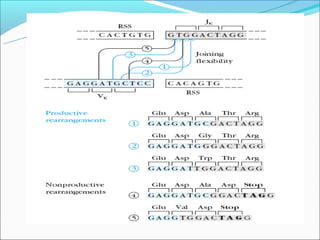
JUNCTIONAL DIVERSITY

The precise positions at which the genes for the V
 and J or the V,D, and J segments are fused
 together is not, and imprecise DNA
 recombination can lead to changes to amino acids
 at these junction sites, called Junctional diversity.
ALLELIC EXCLUSION
B cells like all somatic cells are diploid and
 contain both maternal and paternal
 chromosomes. Even though B cells are diploid it
 expresses rearranged heavy chain genes from only
 one chromosome and the rearranged light chain
 genes from only one chromosome, a process
 called allelic exclusion. This is of course essential
 for the Antigenic specificity of the B cell.
 Expression of both the alleles would render the B
 cell multi specific.
G.D YANCOPOULOS AND F.W.ALT MODEL
FOR ALLELIC EXCLUSION
SOMATIC HYPERMUTATION
Additional Antibody diversity is generated in
 rearranged variable region gene units by a process
 called Somatic Hyper mutation.
Somatic Hyper mutations occur at a frequency of
 10-3 per base pair per generation. This rate is at
 least a hundred thousand fold higher compared to
 spontaneous mutation rate i.e. 10-8/bp/generation.
P NUCLEOTIDE ADDITION AND N NUCLEOTIDE
ADDITION
N NUCLEOTIDE ADDITION
During the DJ and V to DJ joining process, a terminal
 deoxynucleotidyl transferase(TdT) catalyses addition
 of these N nucleotides at the coding joints. Up to 15
 nucleotides can be added to both the DH-JH and VH-DHJH
 joints. Thus, a complete heavy chain variable region is
 encoded by a VHNDHNJH unit.
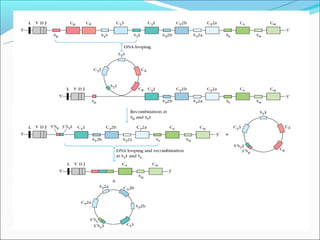
CLASS SWITCHING
 B cells makes antibody of just one single specificity that is fixed by the
  nature of VJ (light chain) and VDJ (heavy chain) rearrangements.
  These rearrangements occur in the absence of antigen the early stages
  of B cell maturation. During the life time of an individual cell,
  however, it can switch to make a different class of antibody, such as
  IgG, IgE, or IgA, while retaining the same antigenic specificity. The
  phenomenon is known as class switching and is dependent on
  Antigenic stimulation of the cell and the presence of factors released
  by T cells, known as cytokines.
 The CH gene selected in class switching is critically dependant on the
  cytokine present at the time of antigen activation of the B cell. Thus
  in the presence of the cytokine interferon –gamma, the B cell switch
  to IgG2 synthesis and in the presence of IL-4, B cell switches to IgG4
  or IgE.
 Thus a single B cell with a unique specificity is capable of making an
  antibody of all possible classes.
Antibody diversity
Antibody diversity

Antibody diversity

  • 2.
    INTRODUCTION Human Genome isthought to contain fewer than 105 genes, yet a human can make at least 1015 different types of antibodies in terms of Antigen binding specificity.
  • 3.
    GERM LINE THEORY AllAntibodies are coded by genes of Germ line cells. Germ line proponents proposed that the genome contributed by the germ cells contains a large repertoire of Immunoglobulin genes. But they were unable to explain the genetic mechanism to account for Antibody diversity.
  • 4.
    SOMATIC VARIATION THEORY Genomeof Somatic cells contains a relatively small number of Immunoglobulin genes, from which a large no of antibody specificities are generated by Mutation or Recombination.
  • 5.
  • 7.
  • 8.
    HUMAN LIGHT CHAINAND HEAVY CHAIN GENES  2 Types of light chains are mainly present. They are κ chain and λ Light chains.  In Humans there are 40 vκ gene segments, 5 Jκ gene segments and 1 Cκ gene segment. (chr-2)  Like wise there are 31 vλ , 4 Jλ , and 7 cλ gene segments. (chr-22)  In humans there are 51 VH segments, 27 DH segments, 6 JH segments and a series of C gene segments. (Chr-14)
  • 9.
    RECOMBINATION OF LIGHTCHAIN GENES The V,J genes code for the variable region of the light chain and the C gene code for the constant region of the light chain. These 3 kinds of the genes are present on the same chromosome but are distantly located from each other. During B cell maturation these genes undergo recombinations i.e. any one out of the 40 Vκ combines with any one of the 5 Jκ, called V-J joining, followed by the joining of Cκ to form a V-J-C gene which then undergoes transcription and then translation into a functional k light chain.
  • 11.
    HUMAN HEAVY CHAINGENES Heavy chains are also synthesized in an analogous manner but are encoded by 4 gene segments, V,J,D and C. During B cell maturation D-J joining occurs first followed by joining of V gene to D-J gene segment to form V-D-J gene segment which then combines with any one of the c gene segment and undergoes transcription which then follows post transcriptional modifications and finally translate into a functional heavy chain.
  • 12.
  • 13.
  • 14.
    MODEL DEPICTING RECOMBINATIONOF IMMUNOGLOBULIN GENES
  • 16.
    JUNCTIONAL DIVERSITY The precisepositions at which the genes for the V and J or the V,D, and J segments are fused together is not, and imprecise DNA recombination can lead to changes to amino acids at these junction sites, called Junctional diversity.
  • 18.
    ALLELIC EXCLUSION B cellslike all somatic cells are diploid and contain both maternal and paternal chromosomes. Even though B cells are diploid it expresses rearranged heavy chain genes from only one chromosome and the rearranged light chain genes from only one chromosome, a process called allelic exclusion. This is of course essential for the Antigenic specificity of the B cell. Expression of both the alleles would render the B cell multi specific.
  • 20.
    G.D YANCOPOULOS ANDF.W.ALT MODEL FOR ALLELIC EXCLUSION
  • 21.
    SOMATIC HYPERMUTATION Additional Antibodydiversity is generated in rearranged variable region gene units by a process called Somatic Hyper mutation. Somatic Hyper mutations occur at a frequency of 10-3 per base pair per generation. This rate is at least a hundred thousand fold higher compared to spontaneous mutation rate i.e. 10-8/bp/generation.
  • 22.
    P NUCLEOTIDE ADDITIONAND N NUCLEOTIDE ADDITION
  • 23.
    N NUCLEOTIDE ADDITION Duringthe DJ and V to DJ joining process, a terminal deoxynucleotidyl transferase(TdT) catalyses addition of these N nucleotides at the coding joints. Up to 15 nucleotides can be added to both the DH-JH and VH-DHJH joints. Thus, a complete heavy chain variable region is encoded by a VHNDHNJH unit.
  • 25.
    CLASS SWITCHING  Bcells makes antibody of just one single specificity that is fixed by the nature of VJ (light chain) and VDJ (heavy chain) rearrangements. These rearrangements occur in the absence of antigen the early stages of B cell maturation. During the life time of an individual cell, however, it can switch to make a different class of antibody, such as IgG, IgE, or IgA, while retaining the same antigenic specificity. The phenomenon is known as class switching and is dependent on Antigenic stimulation of the cell and the presence of factors released by T cells, known as cytokines.  The CH gene selected in class switching is critically dependant on the cytokine present at the time of antigen activation of the B cell. Thus in the presence of the cytokine interferon –gamma, the B cell switch to IgG2 synthesis and in the presence of IL-4, B cell switches to IgG4 or IgE.  Thus a single B cell with a unique specificity is capable of making an antibody of all possible classes.