SITE SPECIFIC RECOMBINATION
(SSR)
WHY SSR???
• Transformation through Agrobacterium & direct
DNA transfer leads to complex integration of
GOI.
• Complex integration is classified into,
 Single copy – multi locus integration
 Multi copy – single locus integration
• Complex integration leads to gene silencing.
• Ideal integration is single copy – single locus and
integration of GOI without intervening with
functional gene.
• The best way out of this issue is promoting the
development of system/technique that facilitates
site specific recombination.
• Two systems have been developed for
facilitating site specific recombination,
namely,
Cre/lox system
FLP/FRT system
Cre/lox system
• Derived from P1 bacteriophage.
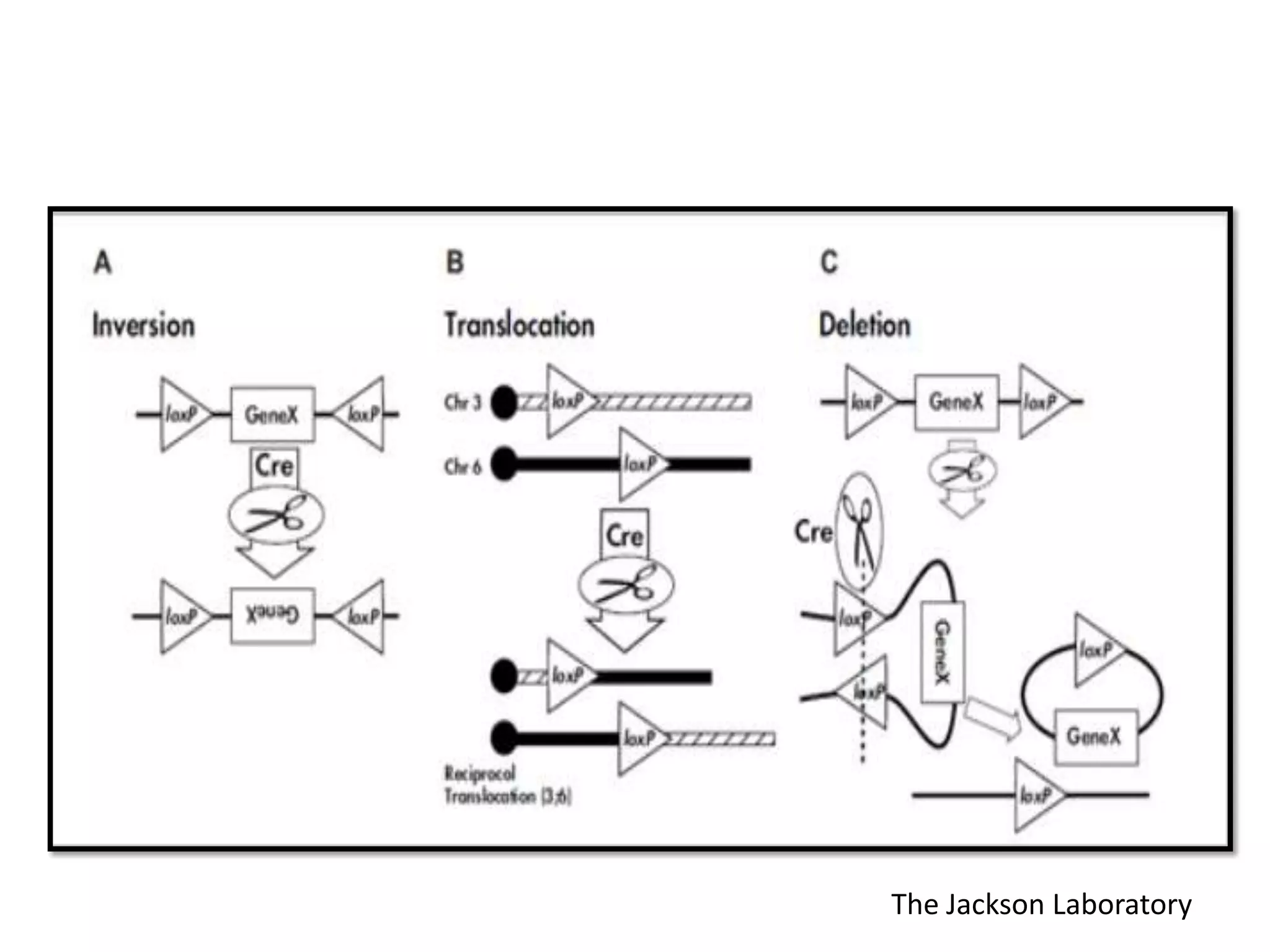
• Cre recombinase catalyses the recombination
between two loxP(site for recombination) sites.
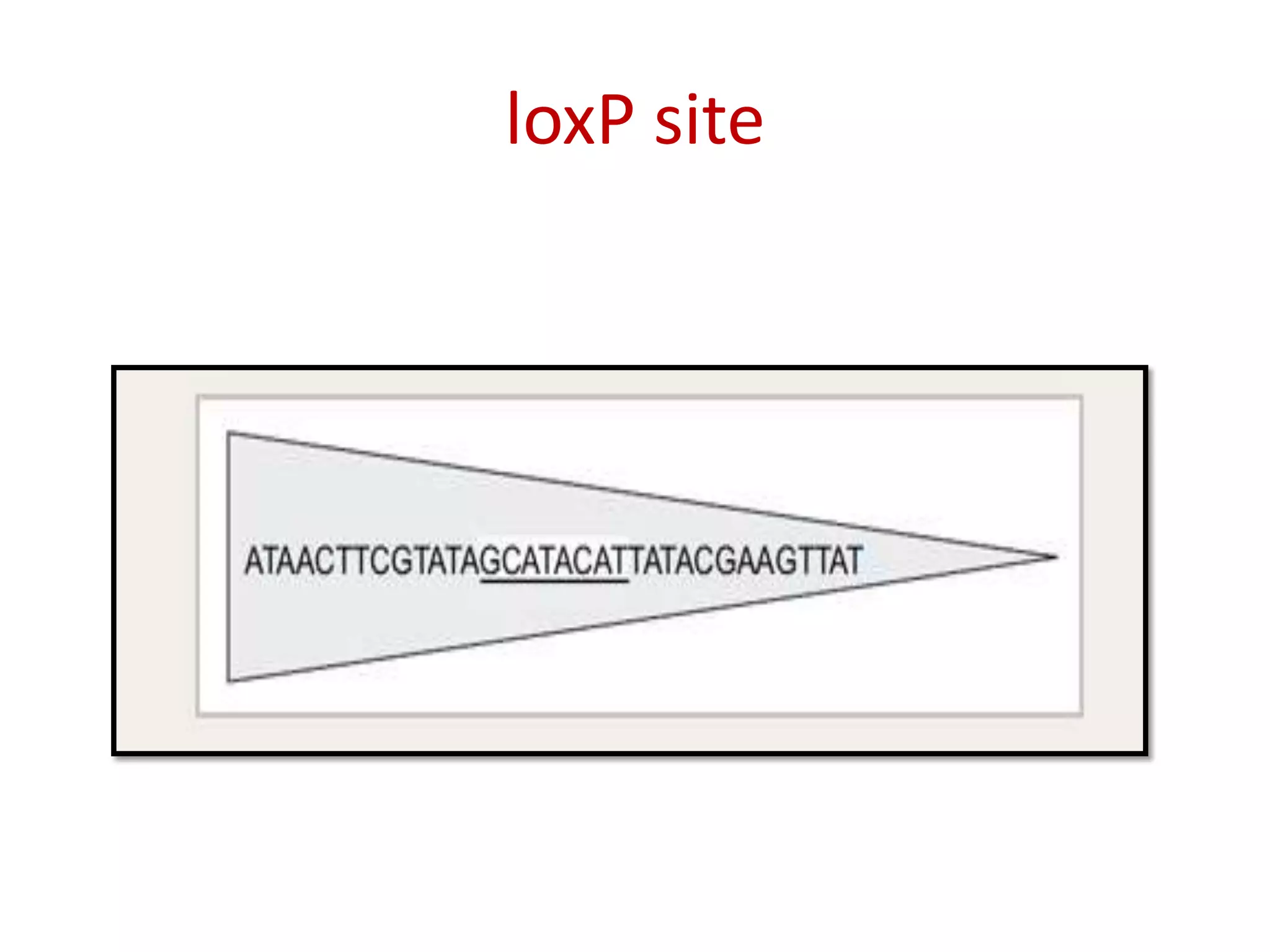
• loxP site consists of an 8-bp core sequence, where
recombination takes place, and two flanking 13-bp
inverted repeats.(In total 34-bp)
loxP site
The Jackson Laboratory
FLP/FRT system
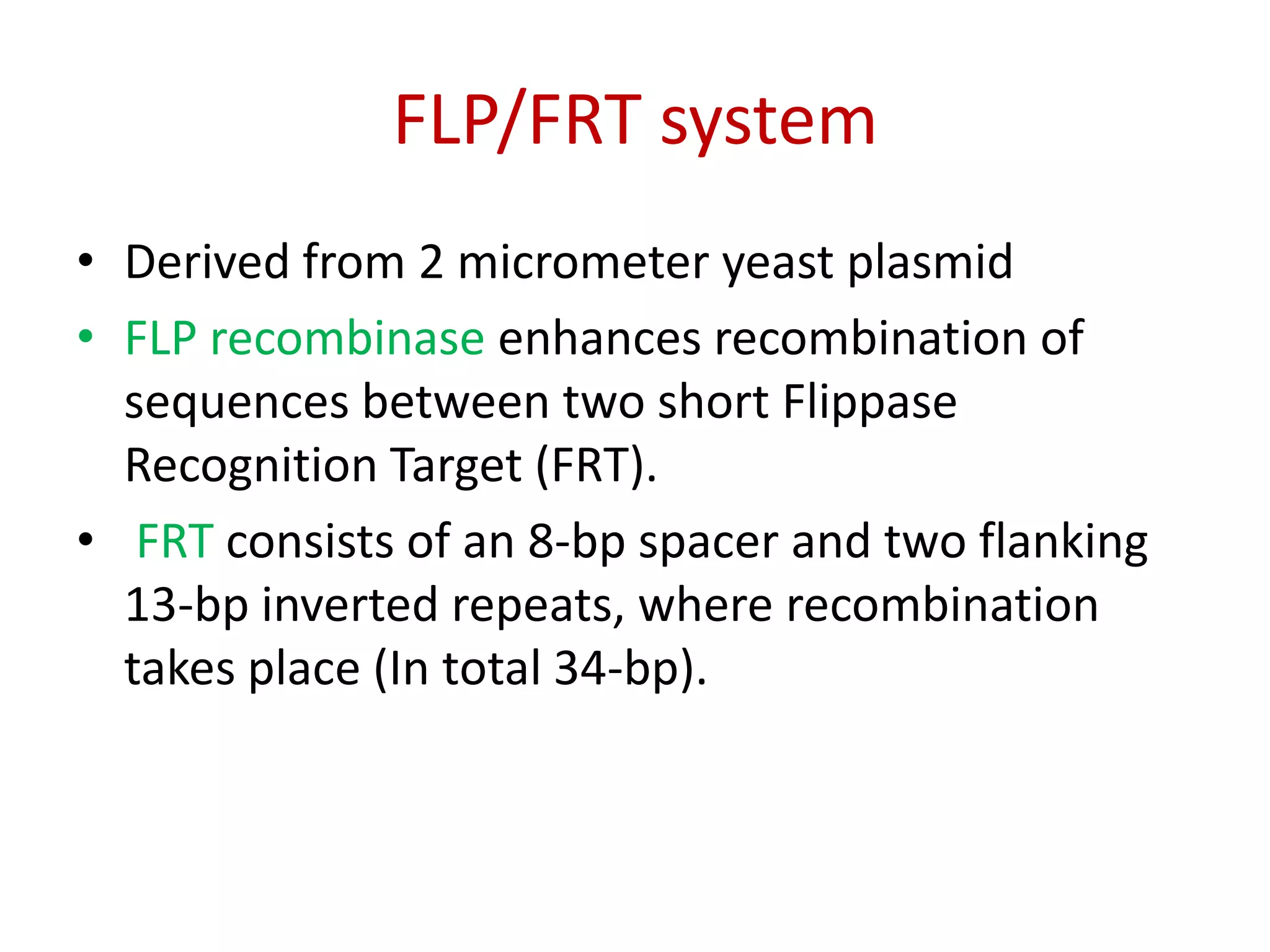
• Derived from 2 micrometer yeast plasmid
• FLP recombinase enhances recombination of
sequences between two short Flippase
Recognition Target (FRT).
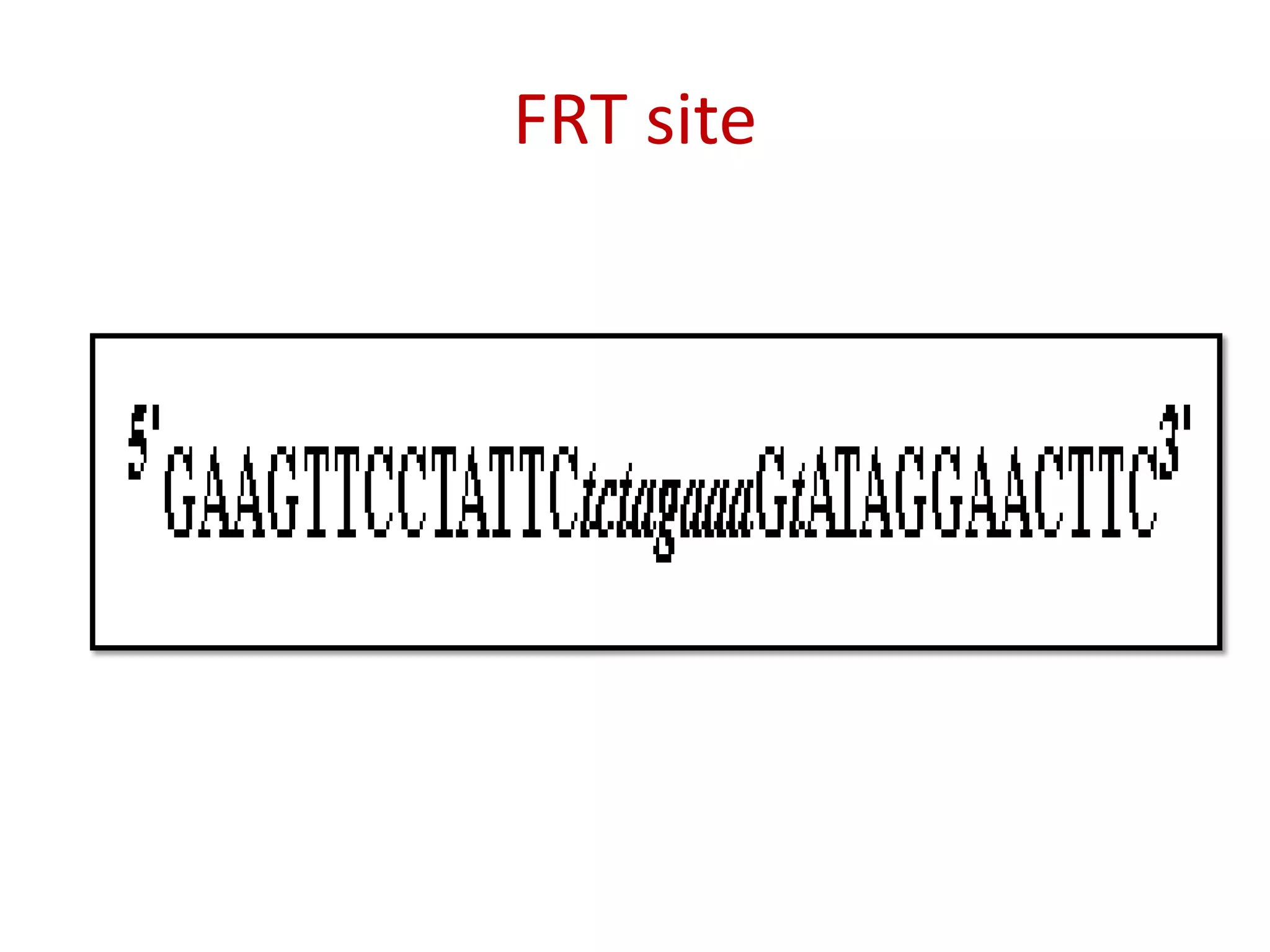
• FRT consists of an 8-bp spacer and two flanking
13-bp inverted repeats, where recombination
takes place (In total 34-bp).
FRT site
Classification based on nature of
Recombination
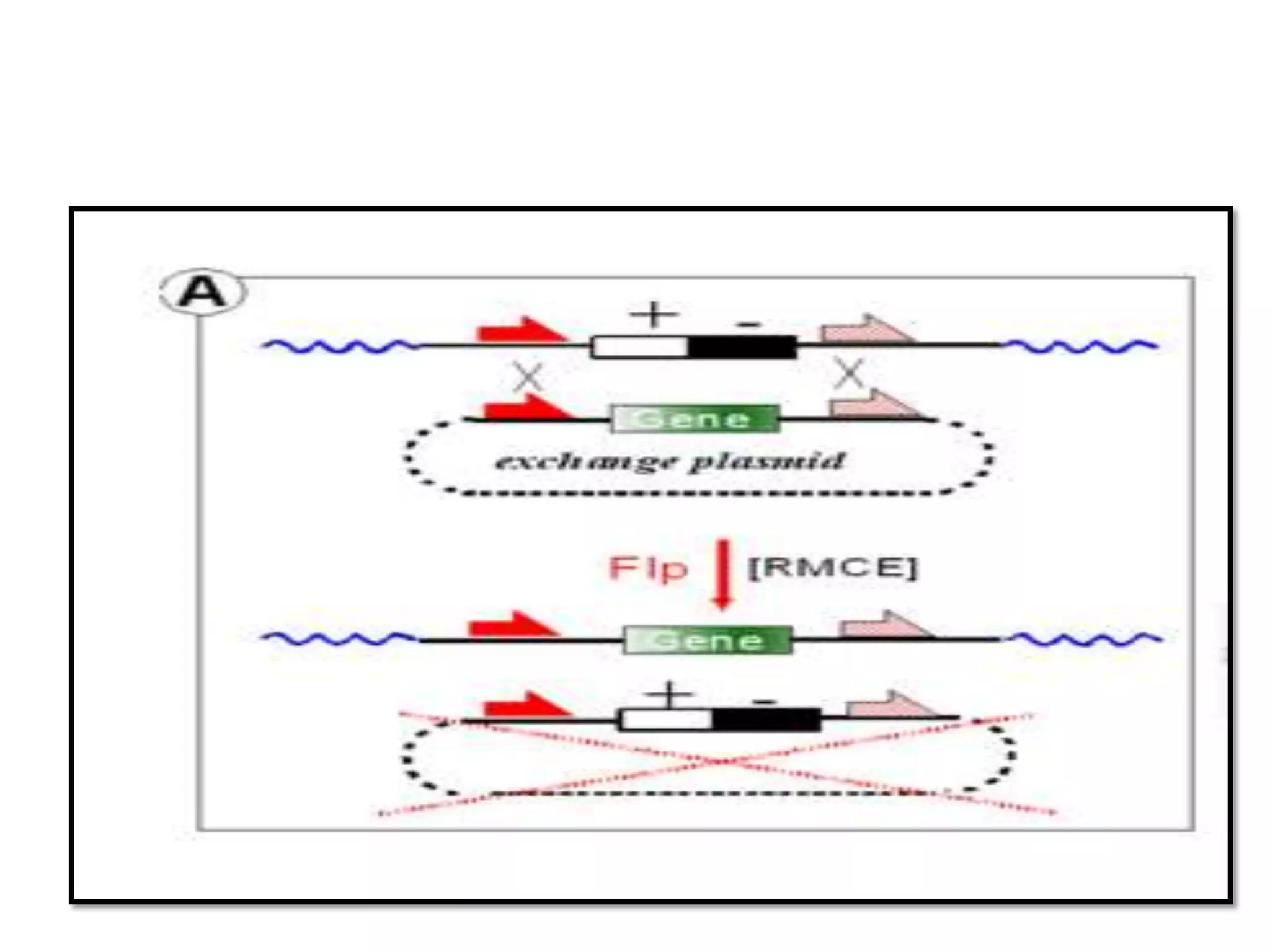
• Recombinase Mediated Cassette Exchange(RMCE)
strategy:
Based on dual recombination between a
pair of recombination sites resulting in
exchange of DNA cassettes between the
target locus and the donor DNA.
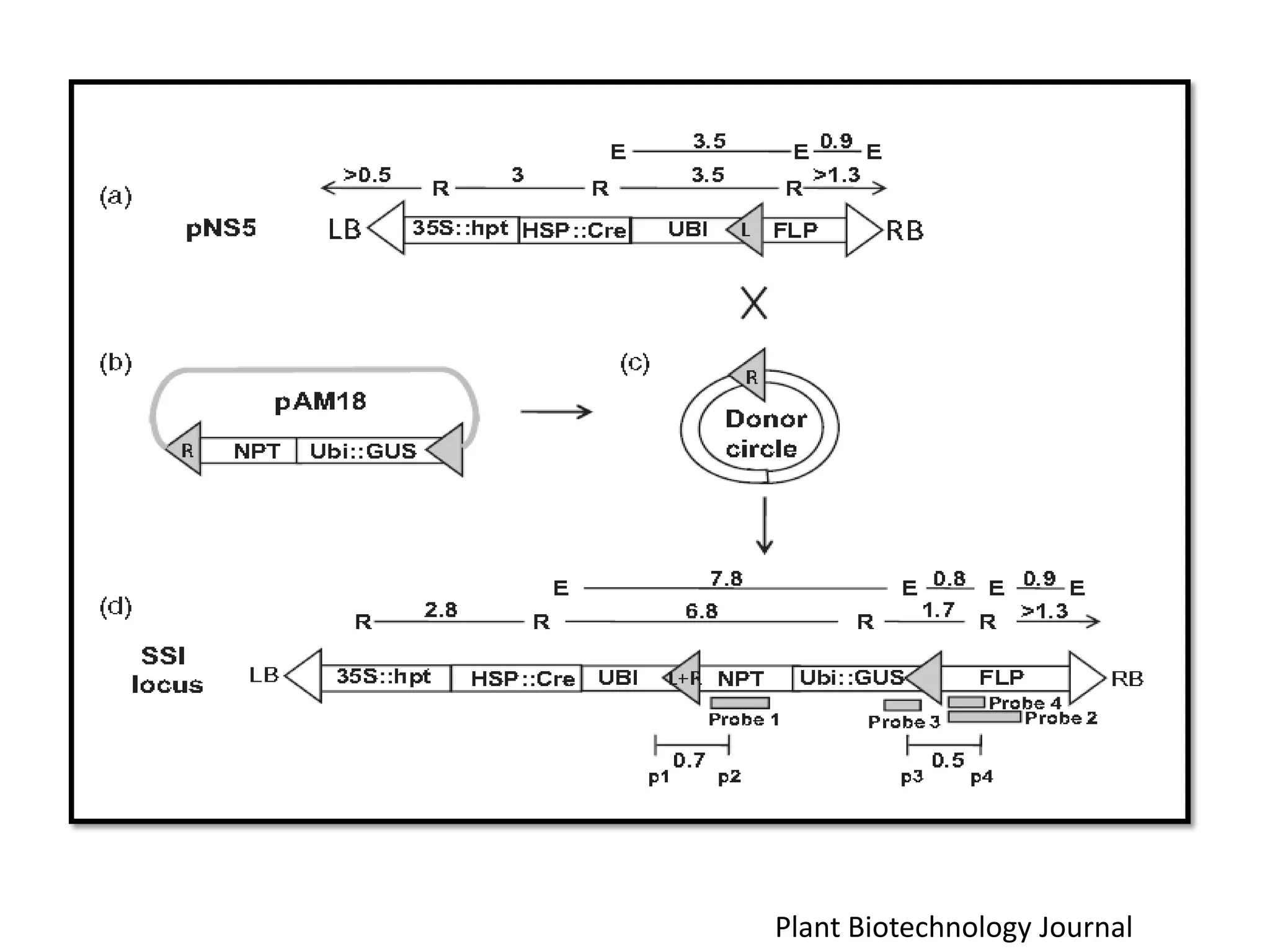
• Co-integration strategy:
In this method, single recombination
between two recombination sites occur,
resulting in integration of circular DNA
into the target site.
Plant Biotechnology Journal
• Site specific recombination – silver bullet for
enhancing ideal gene expression.
• Despite several advantages there are certain
limitations,
 Constitutive expression of Cre , FLP
protein is a problem- leads to undesired
genotypic changes.
Transfer of cre, flp gene to the progeny
lines is challenging.
The efficiency of these systems are not
up to the mark and they are not versatile.
CURRENT STATUS
• In order enhance the efficiency of site specific
recombination system(enzymes),
The current research focuses on the
alteration of the catalytic properties to
in turn modify the characters like
thermostability, recognition
sequences etc…
REFERENCES
 Site specific gene integration in rice genome mediated by
FLP-FRT recombination system. Soumen Nandy , Vibha
Srivastava , Plant Biotechnology Journal (2011) 9, pp. 713–
721
 Elimination of transgenic sequences in plants by cre gene
expression.
Book : Transgenic Plants-Advances & limitations,
Authors: Lilya Kopertekh and Joachim Schiemann
 FLP recombinase mediated site-specific recombination in
rice. Qian Hu , Halina Kononowicz-Hodges, Kimberly Nelson-
Vasilchik, David Viola, Peiyu Zeng, Haibo Liu, Albert P. Kausch ,
Joel M. Chandlee, Thomas K. Hodges and Hong Luo. Plant
Biotechnology Journal(2008)6, pp. 176–188
 An ultrasensitive site-specific DNA
recombination assay based on dual-color
fluorescence cross-correlation
spectroscopy.Michael Jahnz and Petra Schwille.
Nucleic Acids Research, 2005, Vol. 33, No. 6 e60
www.wikipedia.com

Site specific recombination

  • 1.
  • 2.
    WHY SSR??? • Transformationthrough Agrobacterium & direct DNA transfer leads to complex integration of GOI. • Complex integration is classified into,  Single copy – multi locus integration  Multi copy – single locus integration • Complex integration leads to gene silencing.
  • 3.
    • Ideal integrationis single copy – single locus and integration of GOI without intervening with functional gene. • The best way out of this issue is promoting the development of system/technique that facilitates site specific recombination.
  • 4.
    • Two systemshave been developed for facilitating site specific recombination, namely, Cre/lox system FLP/FRT system
  • 5.
    Cre/lox system • Derivedfrom P1 bacteriophage. • Cre recombinase catalyses the recombination between two loxP(site for recombination) sites. • loxP site consists of an 8-bp core sequence, where recombination takes place, and two flanking 13-bp inverted repeats.(In total 34-bp)
  • 6.
  • 7.
  • 8.
    FLP/FRT system • Derivedfrom 2 micrometer yeast plasmid • FLP recombinase enhances recombination of sequences between two short Flippase Recognition Target (FRT). • FRT consists of an 8-bp spacer and two flanking 13-bp inverted repeats, where recombination takes place (In total 34-bp).
  • 9.
  • 10.
    Classification based onnature of Recombination • Recombinase Mediated Cassette Exchange(RMCE) strategy: Based on dual recombination between a pair of recombination sites resulting in exchange of DNA cassettes between the target locus and the donor DNA.
  • 12.
    • Co-integration strategy: Inthis method, single recombination between two recombination sites occur, resulting in integration of circular DNA into the target site.
  • 13.
  • 14.
    • Site specificrecombination – silver bullet for enhancing ideal gene expression. • Despite several advantages there are certain limitations,  Constitutive expression of Cre , FLP protein is a problem- leads to undesired genotypic changes. Transfer of cre, flp gene to the progeny lines is challenging. The efficiency of these systems are not up to the mark and they are not versatile.
  • 15.
    CURRENT STATUS • Inorder enhance the efficiency of site specific recombination system(enzymes), The current research focuses on the alteration of the catalytic properties to in turn modify the characters like thermostability, recognition sequences etc…
  • 16.
    REFERENCES  Site specificgene integration in rice genome mediated by FLP-FRT recombination system. Soumen Nandy , Vibha Srivastava , Plant Biotechnology Journal (2011) 9, pp. 713– 721  Elimination of transgenic sequences in plants by cre gene expression. Book : Transgenic Plants-Advances & limitations, Authors: Lilya Kopertekh and Joachim Schiemann  FLP recombinase mediated site-specific recombination in rice. Qian Hu , Halina Kononowicz-Hodges, Kimberly Nelson- Vasilchik, David Viola, Peiyu Zeng, Haibo Liu, Albert P. Kausch , Joel M. Chandlee, Thomas K. Hodges and Hong Luo. Plant Biotechnology Journal(2008)6, pp. 176–188
  • 17.
     An ultrasensitivesite-specific DNA recombination assay based on dual-color fluorescence cross-correlation spectroscopy.Michael Jahnz and Petra Schwille. Nucleic Acids Research, 2005, Vol. 33, No. 6 e60 www.wikipedia.com