PLASMA MEMBRANE
STRUCTURE & FUNCTION
PRESENTED BY,
AKSHAYA ANIL
S 3 M Sc BIOCHEMISTRY
DEPT.OF BIOCHEMISTRY
KERALA UNIVERSITY 1
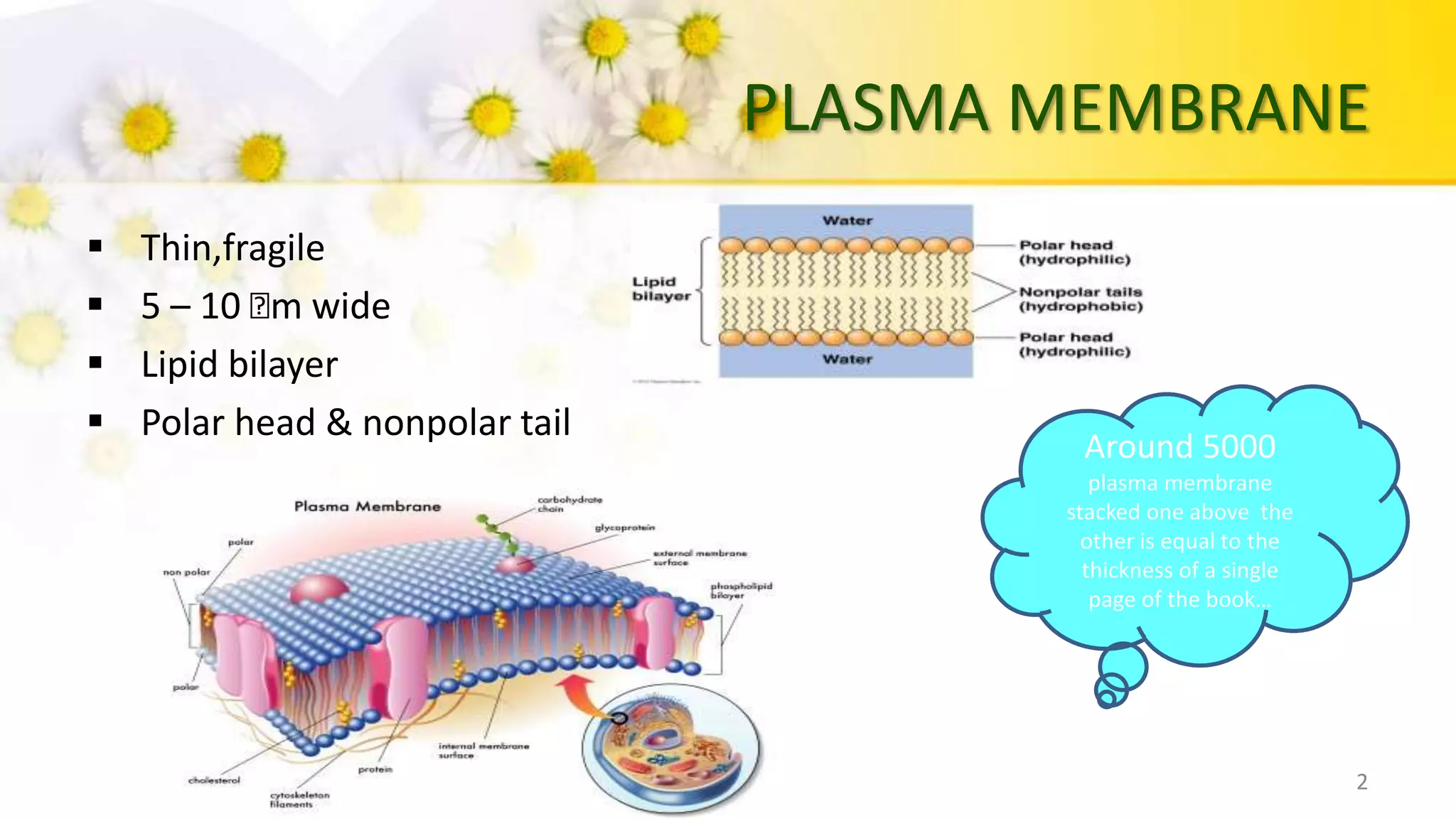
PLASMA MEMBRANE
 Thin,fragile
 5 – 10 ꞃm wide
 Lipid bilayer
 Polar head & nonpolar tail
2
Around 5000
plasma membrane
stacked one above the
other is equal to the
thickness of a single
page of the book…
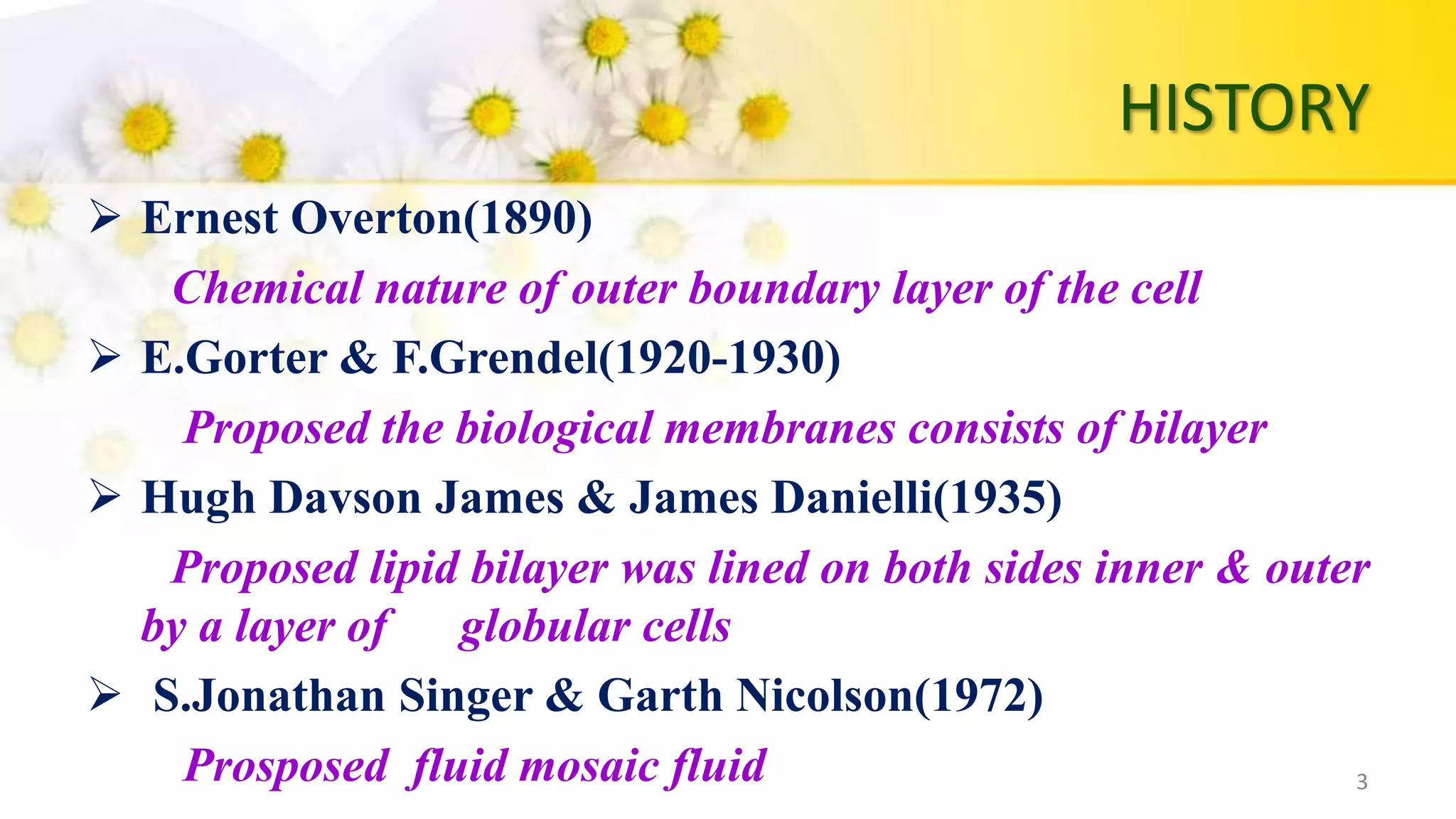
HISTORY
 Ernest Overton(1890)
Chemical nature of outer boundary layer of the cell
 E.Gorter & F.Grendel(1920-1930)
Proposed the biological membranes consists of bilayer
 Hugh Davson James & James Danielli(1935)
Proposed lipid bilayer was lined on both sides inner & outer
by a layer of globular cells
 S.Jonathan Singer & Garth Nicolson(1972)
Prosposed fluid mosaic fluid 3
• Central dogma of membrane biology
• The structure and arrangement of membrane proteins occurs as
a “mosaic” of discontinous particles that penetrate the lipid
sheet
• Protraits cell membranes as dynamic structures
4
• Membranes are lipid protein assemblies held together by non
covalent bonds
5
LIPIDS
•Phospholipids
Glycerophospholipids
Sphingolipids
•Sterol Cholesterol
CARBOHYDRATES
•Glycolipids
•Glycoproteins
PROTEINS
•Integral
•Peripheral
•Lipid anchored
6
• Core membrane consists of a sheet of lipids
arranged in a bimolecular layer
• Lipid bilayer,structural backbone provides
barrier that prevents random movement of
water-soluble materials into & out the cell
• Protein part perform the specialized functions
of the cell
• Contain a wide diversity of lipids
• Amphipathic
PHOSPHOLIPIDS
SPINGOLIPIDS
CHOLESTEROL
MEMBRANE LIPIDS
7
LIPID MOLE PERCENT
PHOSPHATIDYLCHOLINE 20
PHOSPHATIDYLETHANOLAMINE 11
PHOSPHATIDYLSERINE 4
PHOSPHATIDYLINOSITOL 2
CHOLESTEROL 49
SPINGOMYELIN 13
GLYCOLIPIDS 1
8
• Most membrane lipids contains a phosphate group which them
phospholipids
• Phospholipids are built on glycerol backbone,so called
phosphoglycerides
• Membrane glycerides are diglycerides,only two hydroxyl group are
esterified to fatty acid
• 3rd group is esterified to a hydrophilic phosphate group
9
• Additional groups attached with phosphoglycerides are
small & hydrophilic
• Together with the negatively charged phosphate group
to which it is attached forms a highly water soluble
domain called the head group
10
• Fatty acid chains are hydrophobic, unbranced
hydrocarbons ~16-22 carbons in length
Saturated
Monounsaturated
Polyunsaturated
Membrane fattyacids
11
• Less abundant class
• Derivative of sphingosine
• Sphingosine is a amino alcohol that contains a long
hydrocarbon chain attached by its amino group
12
• Animal cell constitute upto 50%lipid molecules in the
membranes
• Plant cells contains cholesterol like sterols
• Cholesterol molecules are oriented with their small
hydrophilic hydroxyl group towards the membrane surface &
the remainder of the molecule embedded in the lipid bilayer
• The hydrophobic rings of a cholesterol molecule are flat &
rigid & it interfere with the movements of fattyacid tails of
the phospholipids.
13
14
LIPID HUMAN RBC HUMAN MYELIN E.COLI
PHOSPHATIDIC ACID 1.5 0.5 0
PHOSPHATIDYLCHOLINE 19 10 0
PHOSPHATIDYLETHANOL
AMINE
18 20 65
PHOSPHATIDYLGLYCEROL 0 0 18
PHOSPHATIDYLSERINE 8.5 8.5 0
GLYCOLIPIDS 10 26 0
SPINGOMYELIN 17.5 8.5 0
CHOLESTEROL 25 26 0
• Depending upon species carbohydrate content ranges
between 2-10 %
• More than 90% of the membrane’s carbohydrate is
linked to proteins to form glycoproteins
• Remaining is covalently linked to lipids to form
glycolipid
15
• Present as short , branched hydrophilic oligosaccharides
• Oligosaccharides may attached to the amino acid by
• Play a major role in mediating the interactions of cell
• Involved in the sorting of membrane proteins to different
cellular compartments
• ABO blood grouping
16
N – glycosidic linkage
O- glycosidic linkage
• Depending on the cell type & the particular organelle within
that cell,a membrane may contain 100s of proteins
• Membrane proteins are grouped into 3
17
INTEGRAL PROTEINS
PERIPHERAL PROTEINS
LIPID ANCHORED PROTEIN
MEMBRANE
PROTEINS
• Penetrate the lipid bilayer
• Transmembrane proteins
• Have domains that protrude from both the extracellular &
cytoplasmic sides of the membrane
• Some have only one membrane spanning domain,some have
multispanning
• Constitute 25-30 % of all encoded proteins
• Roughly 60% are drug targets
18
• Located entirely outside the lipid bilayer
• Either the cytoplasmic or extracellular side
• Associated with the surface of the membrane by non covalent
bonds
• Provide mechanical support for the membrane
• Act as an anchor for the integral membrane proteins
• On the internal plasma membrane surface function as
enzymes,specialised coats,or factors that transmit
transmembrane signals
19
• Located outside the lipid bilayer
• Either on the extracellular or cytoplasmic surface
• Are covalently linked to a lipid molecule that is situated
within the lipid bilayer
• Peripheral membrane proteins linked to phosphoinositol
embedded in the outerleaflet of lipid bilayer by a
small,complex olidosaccharide are called GPI anchored
protein
20
COMPARTMENTALISATION
SCAFFOLD BIOCHEMICAL ACTIVITIES
PROVIDING A SELECTIVELY PERMEABLE MEMBRANE
TRANSPORTING SOLUTES
RESPONDING TO EXTERNAL STIMULI
INTERCELLULAR INTERACTIONS
ENERGY TRANSDUCTION
21
REFERENCES
• Cell Biology,Gerald Karp,7th edition
• The Cell,a molecular approach,Geoffrey M.Copper &
Robert e.Hausmann,7th edition
• Lehninger Principles of Biochemistry,David L.Nelson
& Michael M. Cox,7th edition
22

Plasma membrane

  • 1.
    PLASMA MEMBRANE STRUCTURE &FUNCTION PRESENTED BY, AKSHAYA ANIL S 3 M Sc BIOCHEMISTRY DEPT.OF BIOCHEMISTRY KERALA UNIVERSITY 1
  • 2.
    PLASMA MEMBRANE  Thin,fragile 5 – 10 ꞃm wide  Lipid bilayer  Polar head & nonpolar tail 2 Around 5000 plasma membrane stacked one above the other is equal to the thickness of a single page of the book…
  • 3.
    HISTORY  Ernest Overton(1890) Chemicalnature of outer boundary layer of the cell  E.Gorter & F.Grendel(1920-1930) Proposed the biological membranes consists of bilayer  Hugh Davson James & James Danielli(1935) Proposed lipid bilayer was lined on both sides inner & outer by a layer of globular cells  S.Jonathan Singer & Garth Nicolson(1972) Prosposed fluid mosaic fluid 3
  • 4.
    • Central dogmaof membrane biology • The structure and arrangement of membrane proteins occurs as a “mosaic” of discontinous particles that penetrate the lipid sheet • Protraits cell membranes as dynamic structures 4
  • 5.
    • Membranes arelipid protein assemblies held together by non covalent bonds 5 LIPIDS •Phospholipids Glycerophospholipids Sphingolipids •Sterol Cholesterol CARBOHYDRATES •Glycolipids •Glycoproteins PROTEINS •Integral •Peripheral •Lipid anchored
  • 6.
    6 • Core membraneconsists of a sheet of lipids arranged in a bimolecular layer • Lipid bilayer,structural backbone provides barrier that prevents random movement of water-soluble materials into & out the cell • Protein part perform the specialized functions of the cell
  • 7.
    • Contain awide diversity of lipids • Amphipathic PHOSPHOLIPIDS SPINGOLIPIDS CHOLESTEROL MEMBRANE LIPIDS 7
  • 8.
    LIPID MOLE PERCENT PHOSPHATIDYLCHOLINE20 PHOSPHATIDYLETHANOLAMINE 11 PHOSPHATIDYLSERINE 4 PHOSPHATIDYLINOSITOL 2 CHOLESTEROL 49 SPINGOMYELIN 13 GLYCOLIPIDS 1 8
  • 9.
    • Most membranelipids contains a phosphate group which them phospholipids • Phospholipids are built on glycerol backbone,so called phosphoglycerides • Membrane glycerides are diglycerides,only two hydroxyl group are esterified to fatty acid • 3rd group is esterified to a hydrophilic phosphate group 9
  • 10.
    • Additional groupsattached with phosphoglycerides are small & hydrophilic • Together with the negatively charged phosphate group to which it is attached forms a highly water soluble domain called the head group 10
  • 11.
    • Fatty acidchains are hydrophobic, unbranced hydrocarbons ~16-22 carbons in length Saturated Monounsaturated Polyunsaturated Membrane fattyacids 11
  • 12.
    • Less abundantclass • Derivative of sphingosine • Sphingosine is a amino alcohol that contains a long hydrocarbon chain attached by its amino group 12
  • 13.
    • Animal cellconstitute upto 50%lipid molecules in the membranes • Plant cells contains cholesterol like sterols • Cholesterol molecules are oriented with their small hydrophilic hydroxyl group towards the membrane surface & the remainder of the molecule embedded in the lipid bilayer • The hydrophobic rings of a cholesterol molecule are flat & rigid & it interfere with the movements of fattyacid tails of the phospholipids. 13
  • 14.
    14 LIPID HUMAN RBCHUMAN MYELIN E.COLI PHOSPHATIDIC ACID 1.5 0.5 0 PHOSPHATIDYLCHOLINE 19 10 0 PHOSPHATIDYLETHANOL AMINE 18 20 65 PHOSPHATIDYLGLYCEROL 0 0 18 PHOSPHATIDYLSERINE 8.5 8.5 0 GLYCOLIPIDS 10 26 0 SPINGOMYELIN 17.5 8.5 0 CHOLESTEROL 25 26 0
  • 15.
    • Depending uponspecies carbohydrate content ranges between 2-10 % • More than 90% of the membrane’s carbohydrate is linked to proteins to form glycoproteins • Remaining is covalently linked to lipids to form glycolipid 15
  • 16.
    • Present asshort , branched hydrophilic oligosaccharides • Oligosaccharides may attached to the amino acid by • Play a major role in mediating the interactions of cell • Involved in the sorting of membrane proteins to different cellular compartments • ABO blood grouping 16 N – glycosidic linkage O- glycosidic linkage
  • 17.
    • Depending onthe cell type & the particular organelle within that cell,a membrane may contain 100s of proteins • Membrane proteins are grouped into 3 17 INTEGRAL PROTEINS PERIPHERAL PROTEINS LIPID ANCHORED PROTEIN MEMBRANE PROTEINS
  • 18.
    • Penetrate thelipid bilayer • Transmembrane proteins • Have domains that protrude from both the extracellular & cytoplasmic sides of the membrane • Some have only one membrane spanning domain,some have multispanning • Constitute 25-30 % of all encoded proteins • Roughly 60% are drug targets 18
  • 19.
    • Located entirelyoutside the lipid bilayer • Either the cytoplasmic or extracellular side • Associated with the surface of the membrane by non covalent bonds • Provide mechanical support for the membrane • Act as an anchor for the integral membrane proteins • On the internal plasma membrane surface function as enzymes,specialised coats,or factors that transmit transmembrane signals 19
  • 20.
    • Located outsidethe lipid bilayer • Either on the extracellular or cytoplasmic surface • Are covalently linked to a lipid molecule that is situated within the lipid bilayer • Peripheral membrane proteins linked to phosphoinositol embedded in the outerleaflet of lipid bilayer by a small,complex olidosaccharide are called GPI anchored protein 20
  • 21.
    COMPARTMENTALISATION SCAFFOLD BIOCHEMICAL ACTIVITIES PROVIDINGA SELECTIVELY PERMEABLE MEMBRANE TRANSPORTING SOLUTES RESPONDING TO EXTERNAL STIMULI INTERCELLULAR INTERACTIONS ENERGY TRANSDUCTION 21
  • 22.
    REFERENCES • Cell Biology,GeraldKarp,7th edition • The Cell,a molecular approach,Geoffrey M.Copper & Robert e.Hausmann,7th edition • Lehninger Principles of Biochemistry,David L.Nelson & Michael M. Cox,7th edition 22