TOPIC: CELL MEMBRANE
SCHOOL OF CLINICAL SCIENCES – MAKENI
GROUP 5
Lecturer: DR. MASERAY
MODULE: BIOCHEMISTRY PRESENTATION
1. PETER S. SAMURA LEADER
2. ZAINAB KADIATU KAMARA
3. JOHN ET KALLON
4. NOAH JALLOH
5. SENNATU KOROMA
6. OSMAN CONTEH
GROUP MEMBERS
 DEFINATION OFCELL MENBRANE
 HISTORY OF CELL MEMBRANE
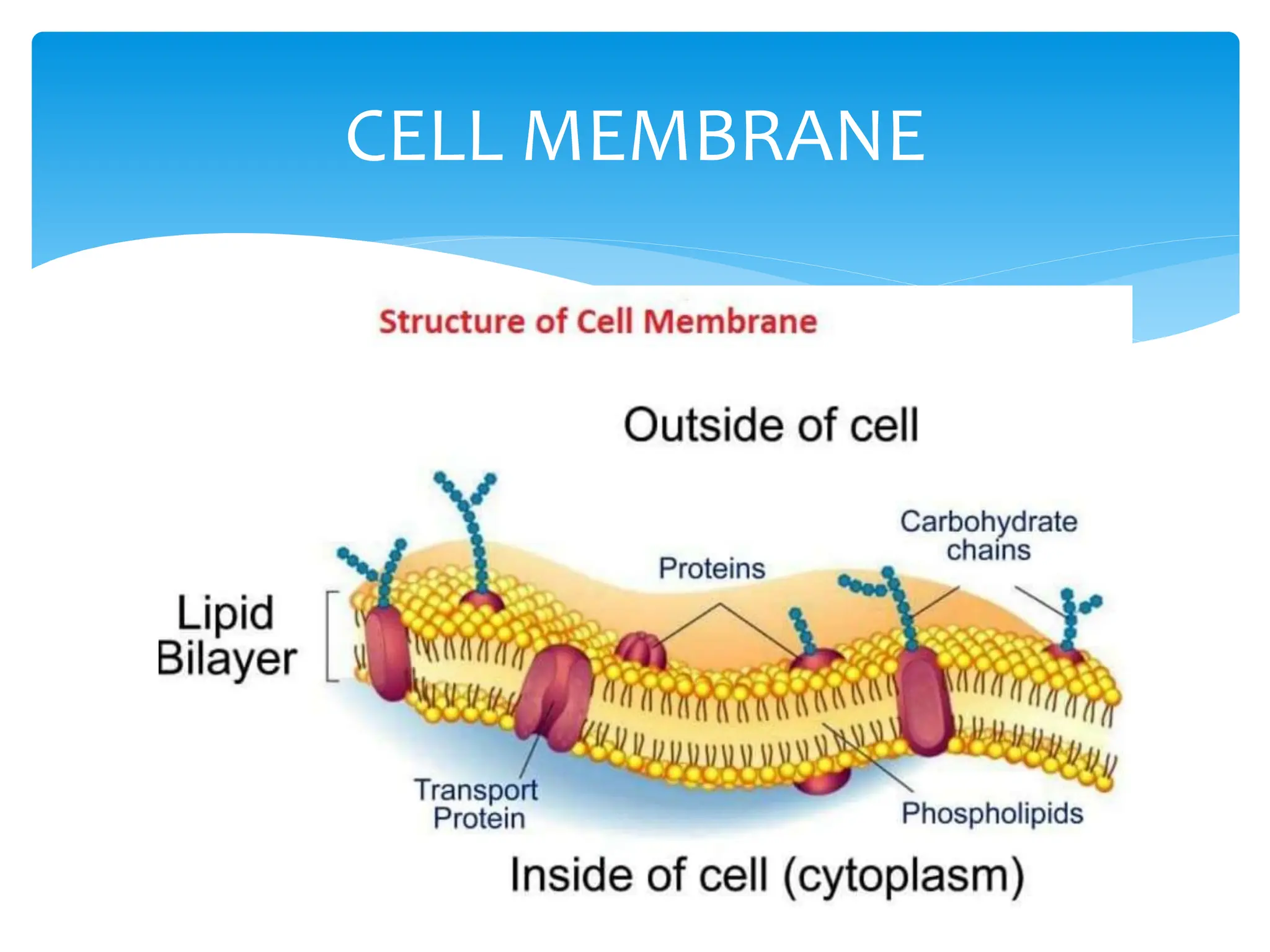
 STRUCTURE OF CELL MEMBRANE
 FUNCTION OF CELL MEMBRANE
 CHEMICAL COMPOSITION
 REACTION OF CELL MEMBRANE
OUTLINE
CELL MEMBRANE
Plasma/ cell membrane
The Plasma membrane or cell membrane is a thin,
biological membrane present in all eukaryotic and
prokaryotic cells that forms a boundary between the
cell and it’s environment and regulating the flow of
materials into and out of the cell.
Intro:……….
The first incite into chemical nature of the membrane was
obtained by Ernst Overtom in 1890s.
He knew that the non- polar solutes dissolved very easily in
the non-polar solvents then polar solvents and the polar
solvents has opposite solubility.
So he realised that the substances entering the cell has to be
dissolved in the outer boundary of cells is due to lipids.
Irvin Langmuir in 1970s doing his research in nature of oil
film, found that the membrane was made of mono layers of
lipids and they are arranged vertical with hydrocarbon chains
away from water and carboxyl groups in contact with the
surface of water.
This finding was a key in understanding the lipid bilayers and
cell membrane structure.
History
 the two Dutch scientists E’Gorter and F’Grendel in the 1925
were the first to find that the membrane was made of two
layers of lipids (lipid bilayer) with hydrophilic heads and
hydrophobic tails , but they could not explained about the
solute permeability or the surface tension.
In 1935 Hugh Davson and James Danielle proposed that the
membrane is made of lipids bilayers and on both outer
and inner surface there was a lining of globular proteins.
Cont:…………
 THE structure is made up of two micro molecules either lipids
and protein .
 The structure of the cell membrane is not fixed neither regal but
dynamic
 Cell membrane structure gives the cell a unique structure and
shape
 The cell membrane structure help to organize the cell in an
organized manners
 The cell membrane structure allows specifics substances to
enter from the environment selective permeable membrane
STRUCTURE OF CELL MEMBRANE
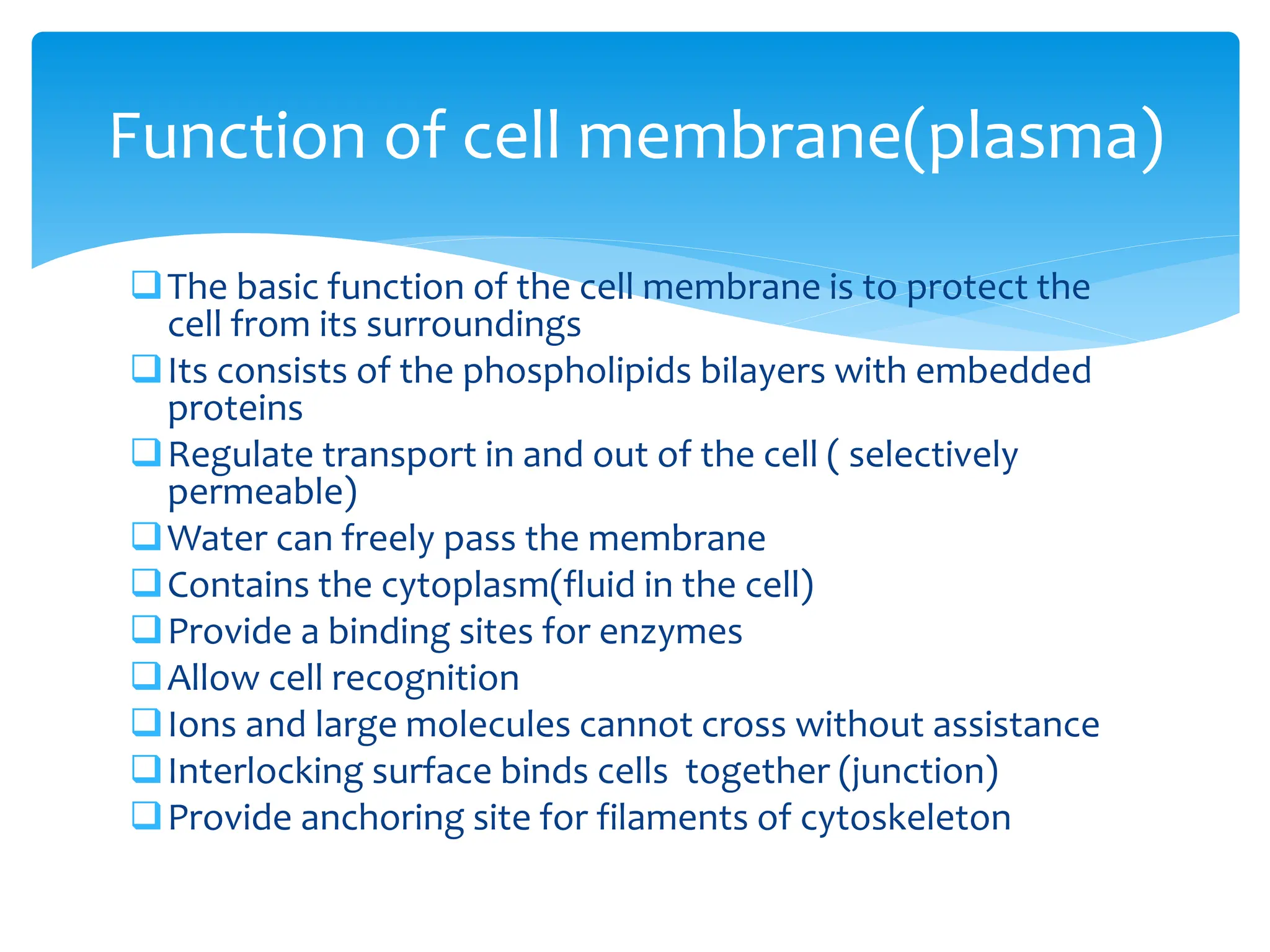
The basic function of the cell membrane is to protect the
cell from its surroundings
Its consists of the phospholipids bilayers with embedded
proteins
Regulate transport in and out of the cell ( selectively
permeable)
Water can freely pass the membrane
Contains the cytoplasm(fluid in the cell)
Provide a binding sites for enzymes
Allow cell recognition
Ions and large molecules cannot cross without assistance
Interlocking surface binds cells together (junction)
Provide anchoring site for filaments of cytoskeleton
Function of cell membrane(plasma)
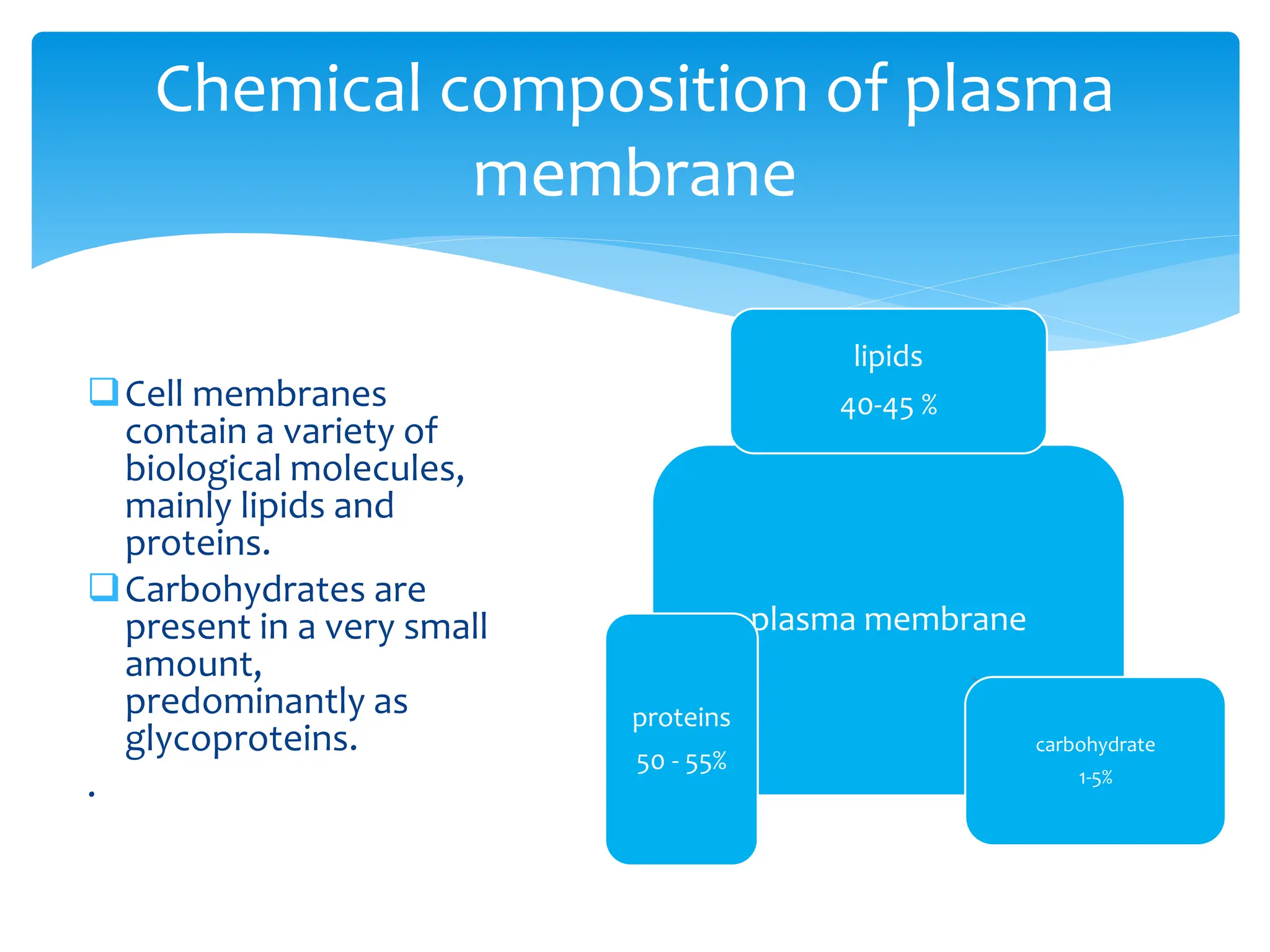
Cell membranes
contain a variety of
biological molecules,
mainly lipids and
proteins.
Carbohydrates are
present in a very small
amount,
predominantly as
glycoproteins.
.
Chemical composition of plasma
membrane
plasma membrane
lipids
40-45 %
carbohydrate
1-5%
proteins
50 - 55%
PHOSPHOLIPIDS > 55%
CHOLESTEROL =40-45%
GLYCOLIPID=2%
1. MEMBRANE LIPIDS
They are lipids that form bilayers of plasma
membrane.
It contains hydro phobic tail which face towards each
other and hydrophilic head facing the cytoplasm and
extracellular fluid.
The hydrocarbon chains forms hydrophobic tail while
the phosphate group and amino acids form
hydrophilic heads.
The lipid bilayer is semi permeable, allowing only
certain substances to diffuse through.
PHOSPHOLIPIDS
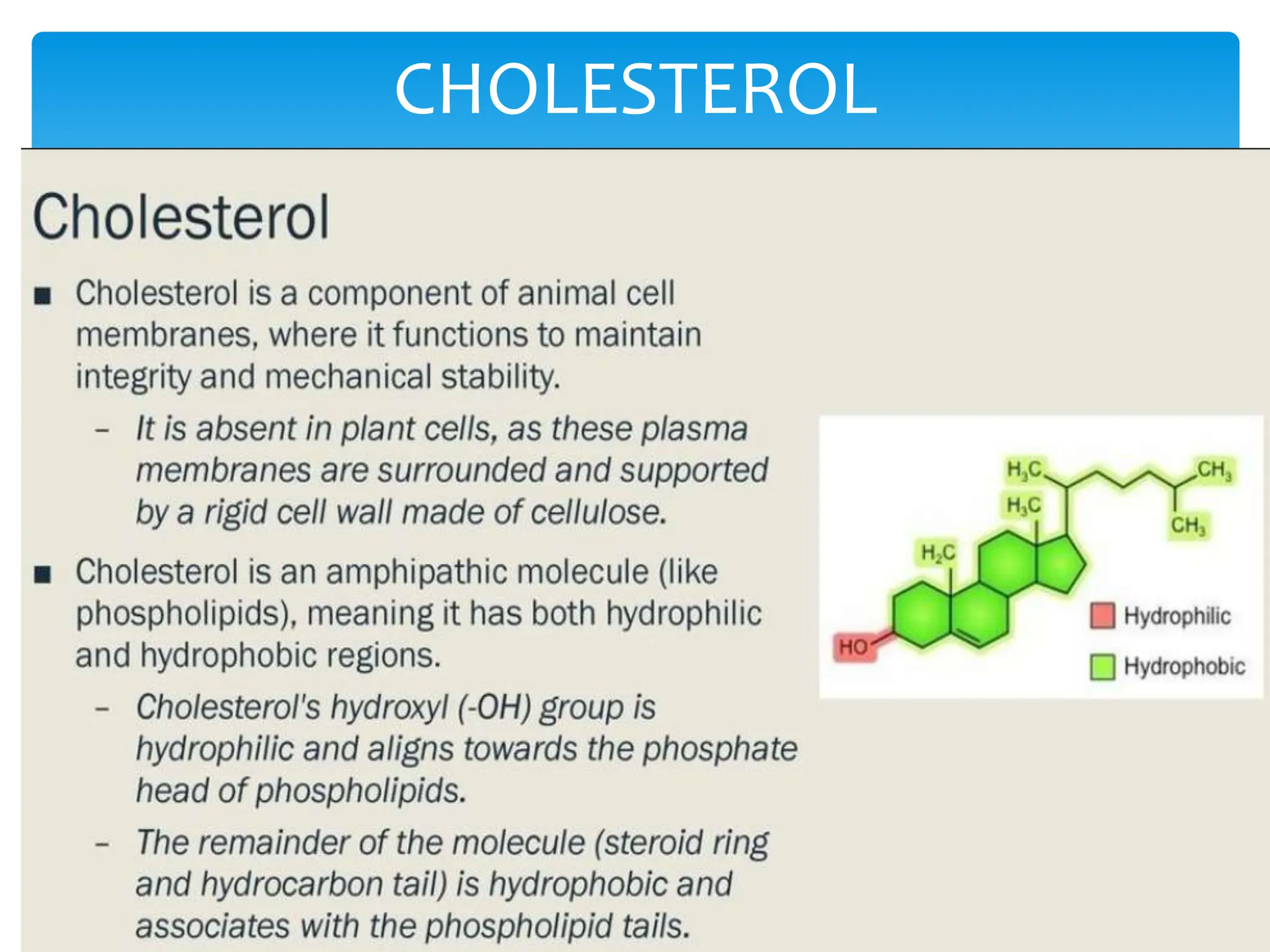
CHOLESTEROL
They are lipids
with a
carbohydrate
attached to it
It provides
energy and acts
as markers for
cellular
recognition.
GLYCOLIPIDS
Integral membrane proteins
Peripheral membrane proteins
Glycoproteins
2. MEMBRANE PROTEINS
These are proteins which are
embedded within the lipid bilayer
and it acts as channels through
which substances diffuse between
the extracellular and intracellular
fluid.
INTEGRAL MEMBRANE PROTEINS
It is attached to the inner surface
of the membrane and do not
penetrate the lipids bilayer.
They function as enzymes and
receptors.
PERIPHERAL PROTEINS
They are embedded in the cell
membrane.
Its is formed by attachment of
carbohydrate molecules to the protein.
It helps in cell – cell communication and
molecule transport across the
membrane.
GLYCOPROTEIN
Chemical reaction
Passive transport
In order to understand how substances move passively across a cell
membrane, it is necessary to understand concentration gradient and
diffusion.
A concentration gradient is the different in concentration of a substance
across a space.
Molecules(ion) will spread or diffuse from where they are more
concentrated to where they are less concentrated until they are equally
distributed in that space. (when molecules move in this way, they are said
to move down their concentration gradient.)
Three common type of passive transport includes
1. Simple diffusion
2. Osmoses diffusion
3. Facilitated diffusion
REACTION OF CELL MEMBRANE
It is the net movement of solvents from a area of high
concentration to a area of less concentration until the
concentration of solute reaches the state of equilibrium.
Due to lipids nature of the plasma membrane holding non-
polar molecules like oxygen, carbon dioxide and nitrogen
pass rapidly across the membrane according to their
concentration gradient.
It occurs because the molecules has free energy and they
are always in motion .
Simple diffusion
 When aver a substance exists in greater concentration on
one side of a semi permeable membrane, such as the
plasma membrane, any substance that move down it
concentration gradient across the membrane will do so .
Consider substance that can easily diffuse through the
lipids bilayer of the cell membrane, such as the gases,
oxygen (o2) and CO2.
 O2 generally diffuse into the cell membrane it is more
concentrated outside of them and CO2 typically diffused
out of the cells because it more concentrated inside of
them.
 Neither of these examples requires any energy on the part
of cell membrane and therefor they use passive transport
to move across the membrane.
Cont…….
 Osmosis is the diffusion of water through a semi
permeable membrane water can move freely across
the cell membrane of all cells either through protein
channels or by slipping between the lipids tails of the
membranes itself .
 However, it is concentration of solute within the
water that determine weather or not water will be
moving into the cell, out of the cell, or both.
Osmosis
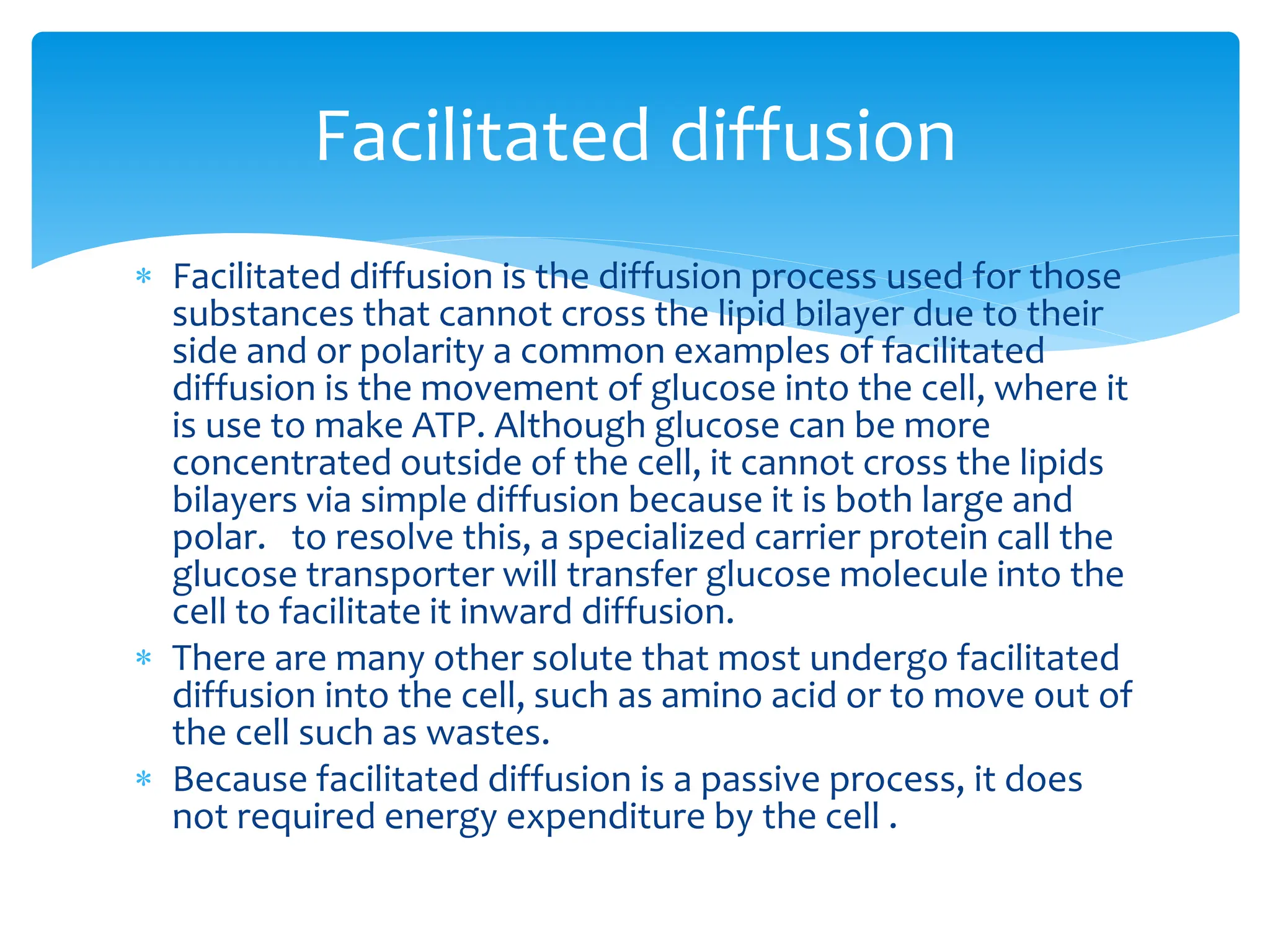
 Facilitated diffusion is the diffusion process used for those
substances that cannot cross the lipid bilayer due to their
side and or polarity a common examples of facilitated
diffusion is the movement of glucose into the cell, where it
is use to make ATP. Although glucose can be more
concentrated outside of the cell, it cannot cross the lipids
bilayers via simple diffusion because it is both large and
polar. to resolve this, a specialized carrier protein call the
glucose transporter will transfer glucose molecule into the
cell to facilitate it inward diffusion.
 There are many other solute that most undergo facilitated
diffusion into the cell, such as amino acid or to move out of
the cell such as wastes.
 Because facilitated diffusion is a passive process, it does
not required energy expenditure by the cell .
Facilitated diffusion
 it is the transport of molecules across the cell membrane
from an area of low concentration to and area of high
concentration using cellular energy .
Active transport occurs with the help of carrier proteins.
 There are two actives site in this carrier proteins.
One it receptors site which is recognizes the substances to
be carried and the other it that which releases the energy
in form of ATP. Example transportation of sodium out of
cell and potassium into the cell.
Active transport
There are two form of active
transport
1. Primary active transport
2. Secondary active transport
Form of active transport
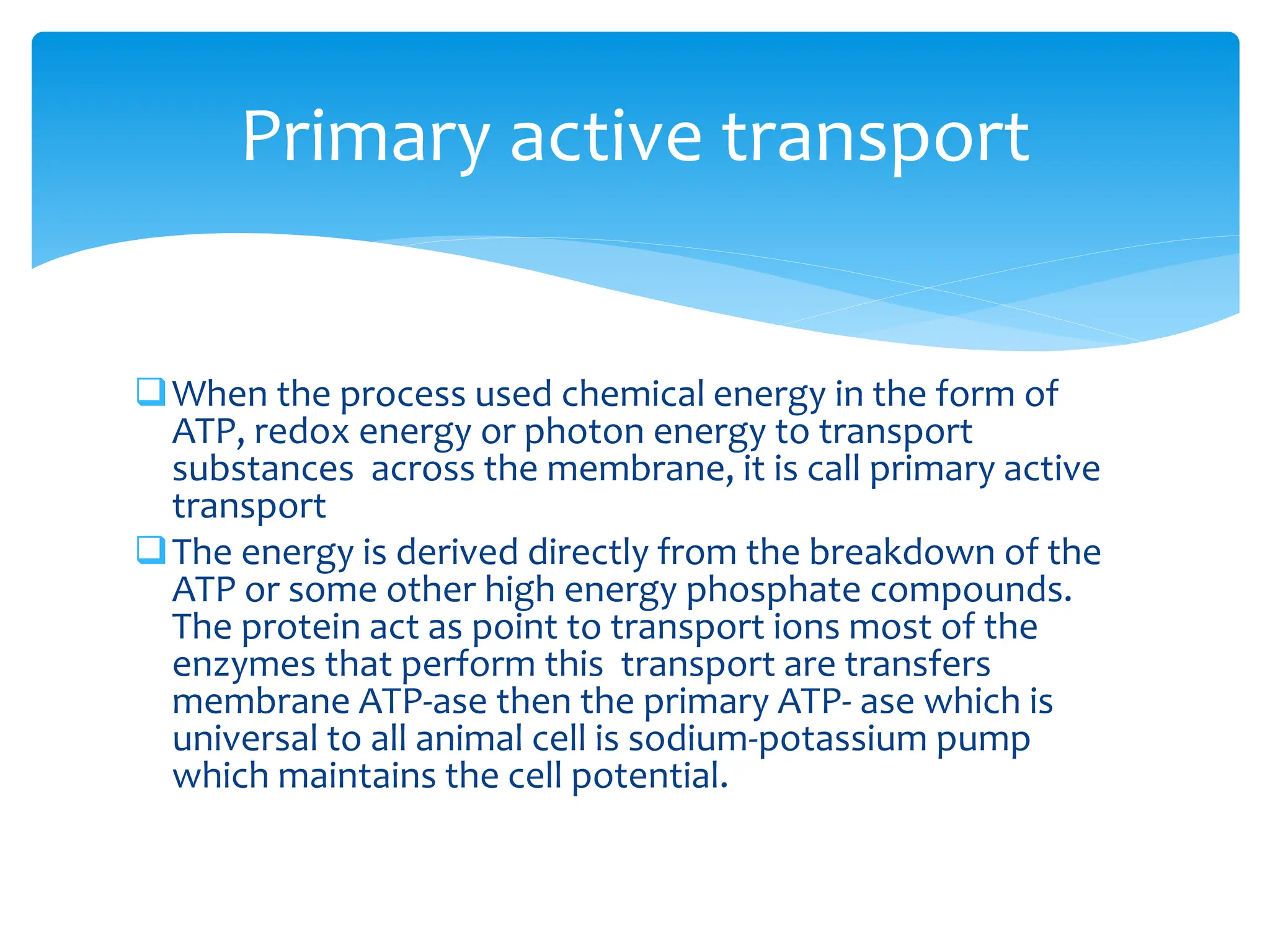
When the process used chemical energy in the form of
ATP, redox energy or photon energy to transport
substances across the membrane, it is call primary active
transport
The energy is derived directly from the breakdown of the
ATP or some other high energy phosphate compounds.
The protein act as point to transport ions most of the
enzymes that perform this transport are transfers
membrane ATP-ase then the primary ATP- ase which is
universal to all animal cell is sodium-potassium pump
which maintains the cell potential.
Primary active transport
When the process use electrochemical gradient to
transport substances it is called secondary active transport
 here the energy is derived secondarily from the energy
that has been stored in the form of ionic concentration
difference between the two site of the membrane, created
in the first place by primary active transport.
The pore forming proteins acts as channels across the cell
membrane for transporting substances the energy stored
in Na+ , H+ concentration gradient is used to transport
other solutes or ions.
Secondary active transport
 By Harshraj s shinde
 K.k. Wagh colledge of Agrculture Biotechnology
 Dr.Areeba Ghayas
Refrences
Thanks!!!
Any questions

Plasma membrane presentation22q222 .pptx

  • 1.
    TOPIC: CELL MEMBRANE SCHOOLOF CLINICAL SCIENCES – MAKENI GROUP 5 Lecturer: DR. MASERAY MODULE: BIOCHEMISTRY PRESENTATION
  • 2.
    1. PETER S.SAMURA LEADER 2. ZAINAB KADIATU KAMARA 3. JOHN ET KALLON 4. NOAH JALLOH 5. SENNATU KOROMA 6. OSMAN CONTEH GROUP MEMBERS
  • 3.
     DEFINATION OFCELLMENBRANE  HISTORY OF CELL MEMBRANE  STRUCTURE OF CELL MEMBRANE  FUNCTION OF CELL MEMBRANE  CHEMICAL COMPOSITION  REACTION OF CELL MEMBRANE OUTLINE
  • 4.
  • 5.
    Plasma/ cell membrane ThePlasma membrane or cell membrane is a thin, biological membrane present in all eukaryotic and prokaryotic cells that forms a boundary between the cell and it’s environment and regulating the flow of materials into and out of the cell. Intro:……….
  • 6.
    The first inciteinto chemical nature of the membrane was obtained by Ernst Overtom in 1890s. He knew that the non- polar solutes dissolved very easily in the non-polar solvents then polar solvents and the polar solvents has opposite solubility. So he realised that the substances entering the cell has to be dissolved in the outer boundary of cells is due to lipids. Irvin Langmuir in 1970s doing his research in nature of oil film, found that the membrane was made of mono layers of lipids and they are arranged vertical with hydrocarbon chains away from water and carboxyl groups in contact with the surface of water. This finding was a key in understanding the lipid bilayers and cell membrane structure. History
  • 7.
     the twoDutch scientists E’Gorter and F’Grendel in the 1925 were the first to find that the membrane was made of two layers of lipids (lipid bilayer) with hydrophilic heads and hydrophobic tails , but they could not explained about the solute permeability or the surface tension. In 1935 Hugh Davson and James Danielle proposed that the membrane is made of lipids bilayers and on both outer and inner surface there was a lining of globular proteins. Cont:…………
  • 8.
     THE structureis made up of two micro molecules either lipids and protein .  The structure of the cell membrane is not fixed neither regal but dynamic  Cell membrane structure gives the cell a unique structure and shape  The cell membrane structure help to organize the cell in an organized manners  The cell membrane structure allows specifics substances to enter from the environment selective permeable membrane STRUCTURE OF CELL MEMBRANE
  • 10.
    The basic functionof the cell membrane is to protect the cell from its surroundings Its consists of the phospholipids bilayers with embedded proteins Regulate transport in and out of the cell ( selectively permeable) Water can freely pass the membrane Contains the cytoplasm(fluid in the cell) Provide a binding sites for enzymes Allow cell recognition Ions and large molecules cannot cross without assistance Interlocking surface binds cells together (junction) Provide anchoring site for filaments of cytoskeleton Function of cell membrane(plasma)
  • 11.
    Cell membranes contain avariety of biological molecules, mainly lipids and proteins. Carbohydrates are present in a very small amount, predominantly as glycoproteins. . Chemical composition of plasma membrane plasma membrane lipids 40-45 % carbohydrate 1-5% proteins 50 - 55%
  • 12.
    PHOSPHOLIPIDS > 55% CHOLESTEROL=40-45% GLYCOLIPID=2% 1. MEMBRANE LIPIDS
  • 13.
    They are lipidsthat form bilayers of plasma membrane. It contains hydro phobic tail which face towards each other and hydrophilic head facing the cytoplasm and extracellular fluid. The hydrocarbon chains forms hydrophobic tail while the phosphate group and amino acids form hydrophilic heads. The lipid bilayer is semi permeable, allowing only certain substances to diffuse through. PHOSPHOLIPIDS
  • 15.
  • 17.
    They are lipids witha carbohydrate attached to it It provides energy and acts as markers for cellular recognition. GLYCOLIPIDS
  • 19.
    Integral membrane proteins Peripheralmembrane proteins Glycoproteins 2. MEMBRANE PROTEINS
  • 20.
    These are proteinswhich are embedded within the lipid bilayer and it acts as channels through which substances diffuse between the extracellular and intracellular fluid. INTEGRAL MEMBRANE PROTEINS
  • 21.
    It is attachedto the inner surface of the membrane and do not penetrate the lipids bilayer. They function as enzymes and receptors. PERIPHERAL PROTEINS
  • 22.
    They are embeddedin the cell membrane. Its is formed by attachment of carbohydrate molecules to the protein. It helps in cell – cell communication and molecule transport across the membrane. GLYCOPROTEIN
  • 23.
    Chemical reaction Passive transport Inorder to understand how substances move passively across a cell membrane, it is necessary to understand concentration gradient and diffusion. A concentration gradient is the different in concentration of a substance across a space. Molecules(ion) will spread or diffuse from where they are more concentrated to where they are less concentrated until they are equally distributed in that space. (when molecules move in this way, they are said to move down their concentration gradient.) Three common type of passive transport includes 1. Simple diffusion 2. Osmoses diffusion 3. Facilitated diffusion REACTION OF CELL MEMBRANE
  • 24.
    It is thenet movement of solvents from a area of high concentration to a area of less concentration until the concentration of solute reaches the state of equilibrium. Due to lipids nature of the plasma membrane holding non- polar molecules like oxygen, carbon dioxide and nitrogen pass rapidly across the membrane according to their concentration gradient. It occurs because the molecules has free energy and they are always in motion . Simple diffusion
  • 25.
     When avera substance exists in greater concentration on one side of a semi permeable membrane, such as the plasma membrane, any substance that move down it concentration gradient across the membrane will do so . Consider substance that can easily diffuse through the lipids bilayer of the cell membrane, such as the gases, oxygen (o2) and CO2.  O2 generally diffuse into the cell membrane it is more concentrated outside of them and CO2 typically diffused out of the cells because it more concentrated inside of them.  Neither of these examples requires any energy on the part of cell membrane and therefor they use passive transport to move across the membrane. Cont…….
  • 26.
     Osmosis isthe diffusion of water through a semi permeable membrane water can move freely across the cell membrane of all cells either through protein channels or by slipping between the lipids tails of the membranes itself .  However, it is concentration of solute within the water that determine weather or not water will be moving into the cell, out of the cell, or both. Osmosis
  • 27.
     Facilitated diffusionis the diffusion process used for those substances that cannot cross the lipid bilayer due to their side and or polarity a common examples of facilitated diffusion is the movement of glucose into the cell, where it is use to make ATP. Although glucose can be more concentrated outside of the cell, it cannot cross the lipids bilayers via simple diffusion because it is both large and polar. to resolve this, a specialized carrier protein call the glucose transporter will transfer glucose molecule into the cell to facilitate it inward diffusion.  There are many other solute that most undergo facilitated diffusion into the cell, such as amino acid or to move out of the cell such as wastes.  Because facilitated diffusion is a passive process, it does not required energy expenditure by the cell . Facilitated diffusion
  • 28.
     it isthe transport of molecules across the cell membrane from an area of low concentration to and area of high concentration using cellular energy . Active transport occurs with the help of carrier proteins.  There are two actives site in this carrier proteins. One it receptors site which is recognizes the substances to be carried and the other it that which releases the energy in form of ATP. Example transportation of sodium out of cell and potassium into the cell. Active transport
  • 29.
    There are twoform of active transport 1. Primary active transport 2. Secondary active transport Form of active transport
  • 30.
    When the processused chemical energy in the form of ATP, redox energy or photon energy to transport substances across the membrane, it is call primary active transport The energy is derived directly from the breakdown of the ATP or some other high energy phosphate compounds. The protein act as point to transport ions most of the enzymes that perform this transport are transfers membrane ATP-ase then the primary ATP- ase which is universal to all animal cell is sodium-potassium pump which maintains the cell potential. Primary active transport
  • 31.
    When the processuse electrochemical gradient to transport substances it is called secondary active transport  here the energy is derived secondarily from the energy that has been stored in the form of ionic concentration difference between the two site of the membrane, created in the first place by primary active transport. The pore forming proteins acts as channels across the cell membrane for transporting substances the energy stored in Na+ , H+ concentration gradient is used to transport other solutes or ions. Secondary active transport
  • 32.
     By Harshrajs shinde  K.k. Wagh colledge of Agrculture Biotechnology  Dr.Areeba Ghayas Refrences
  • 33.

Editor's Notes