Plasma Membrane
Presented By:
Shozab Seemab Khan
2016-mphil-1372
1
2
The Plasma Membrane -
Gateway to the Cell
3
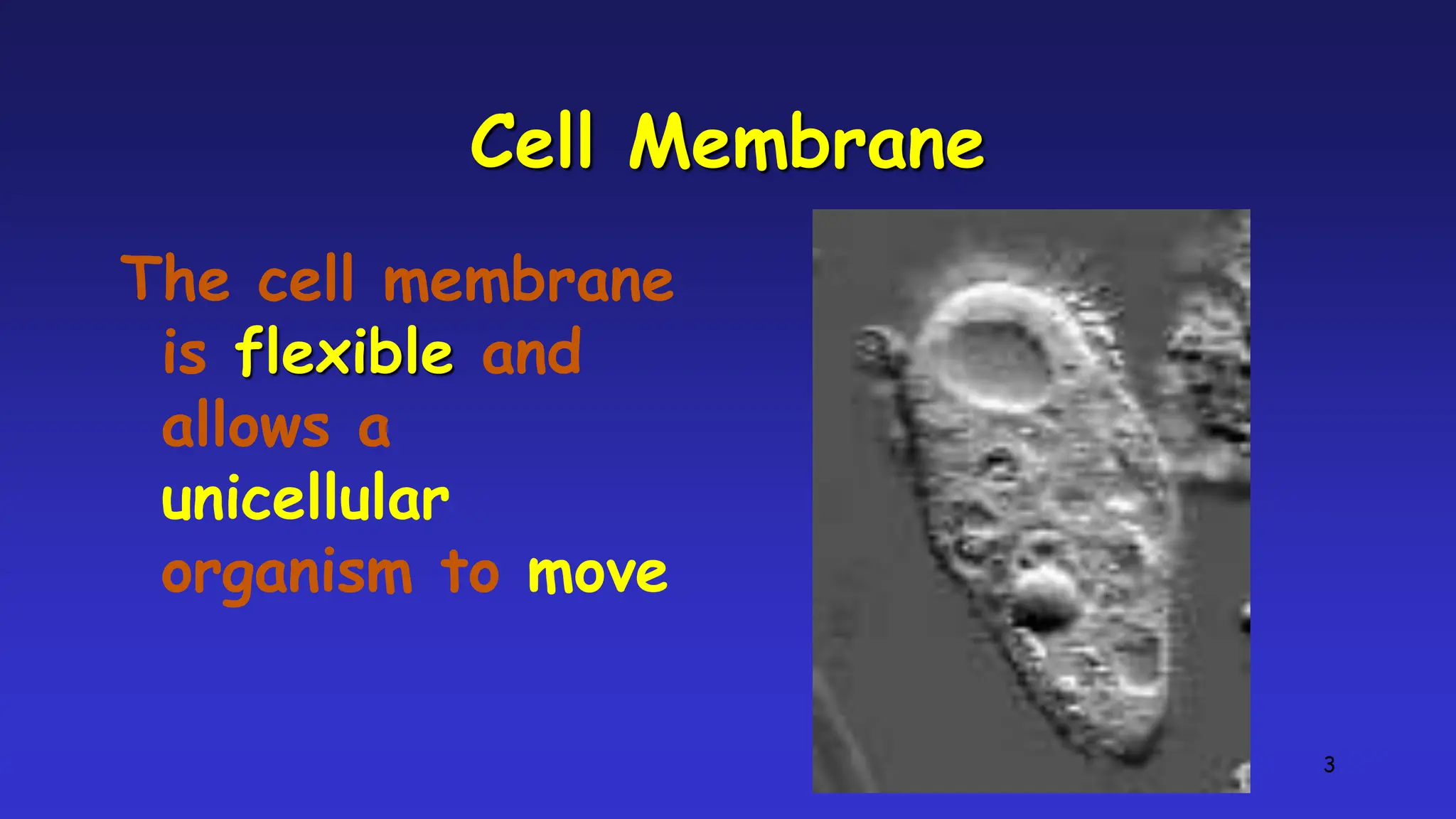
Cell Membrane
The cell membrane
is flexible and
allows a
unicellular
organism to move
4
Homeostasis
• Balanced internal condition of cells
• Also called equilibrium
• Maintained by plasma membrane
controlling what enters & leaves
the cell
5
Functions of Plasma Membrane
 Protective barrier
 Regulate transport in & out of cell
(selectively permeable)
 Allow cell recognition
 Provide anchoring sites for filaments
of cytoskeleton
6
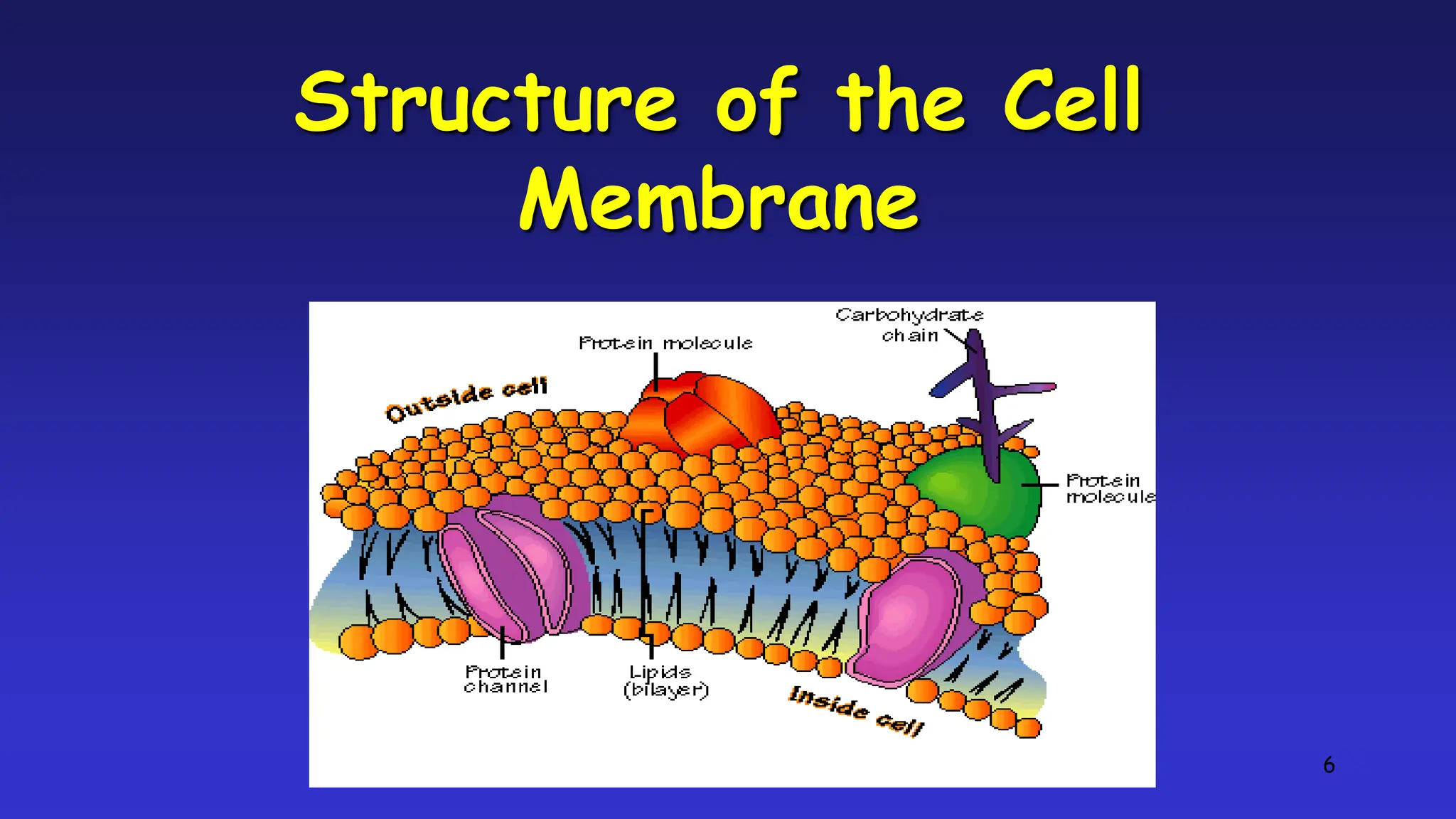
Structure of the Cell
Membrane
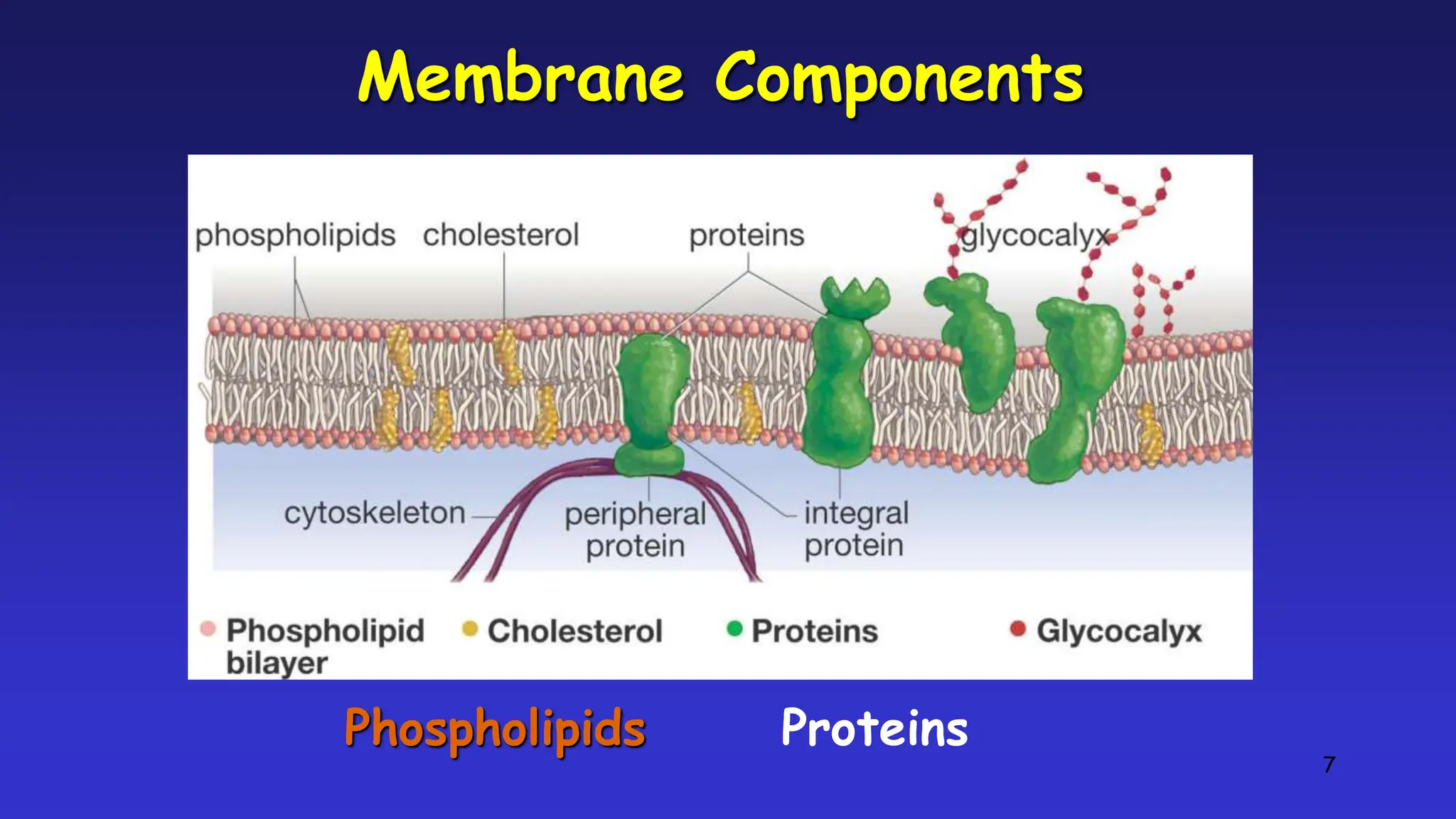
7
Phospholipids Proteins
Membrane Components
8
Phospholipids
Make up the cell
membrane
Contains 2 fatty
acid chains that
are nonpolar
Head is polar &
contains a
Phosphate group
9
10
FLUID- because individual phospholipids and
proteins can move around freely within the
layer, like it’s a liquid.
MOSAIC- because of the pattern produced by
the scattered protein molecules when the
membrane is viewed from above.
FLUID MOSAIC MODEL
11
12
13
Cell Membrane
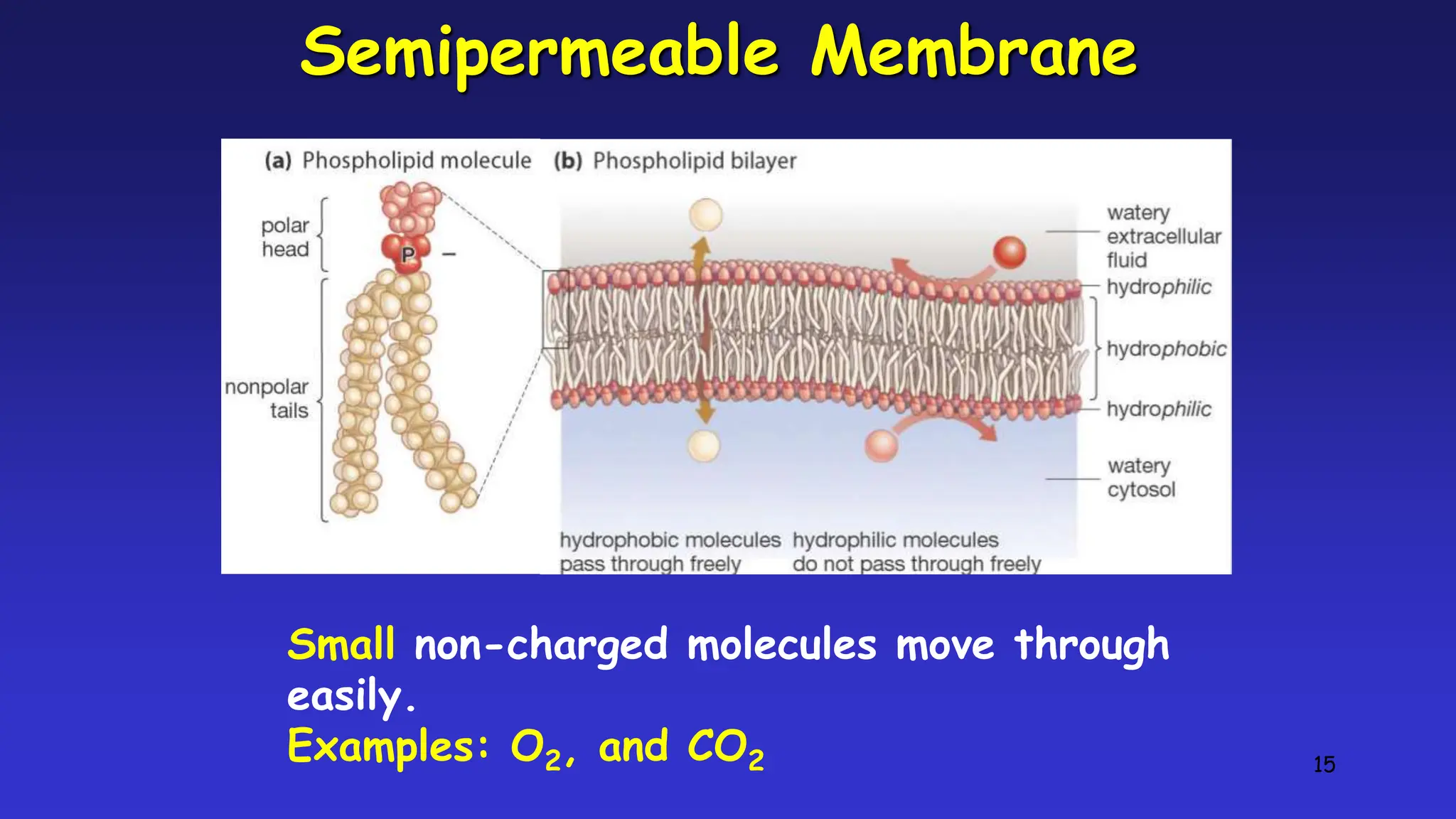
Hydrophobic
molecules pass
easily; hydrophillic
DO NOT
The cell membrane is
made of 2 layers of
phospholipids called the
lipid bilayer
14
Solubility
• Materials that are
soluble in lipids can
pass through the
cell membrane
easily
15
Small non-charged molecules move through
easily.
Examples: O2, and CO2
Semipermeable Membrane
16
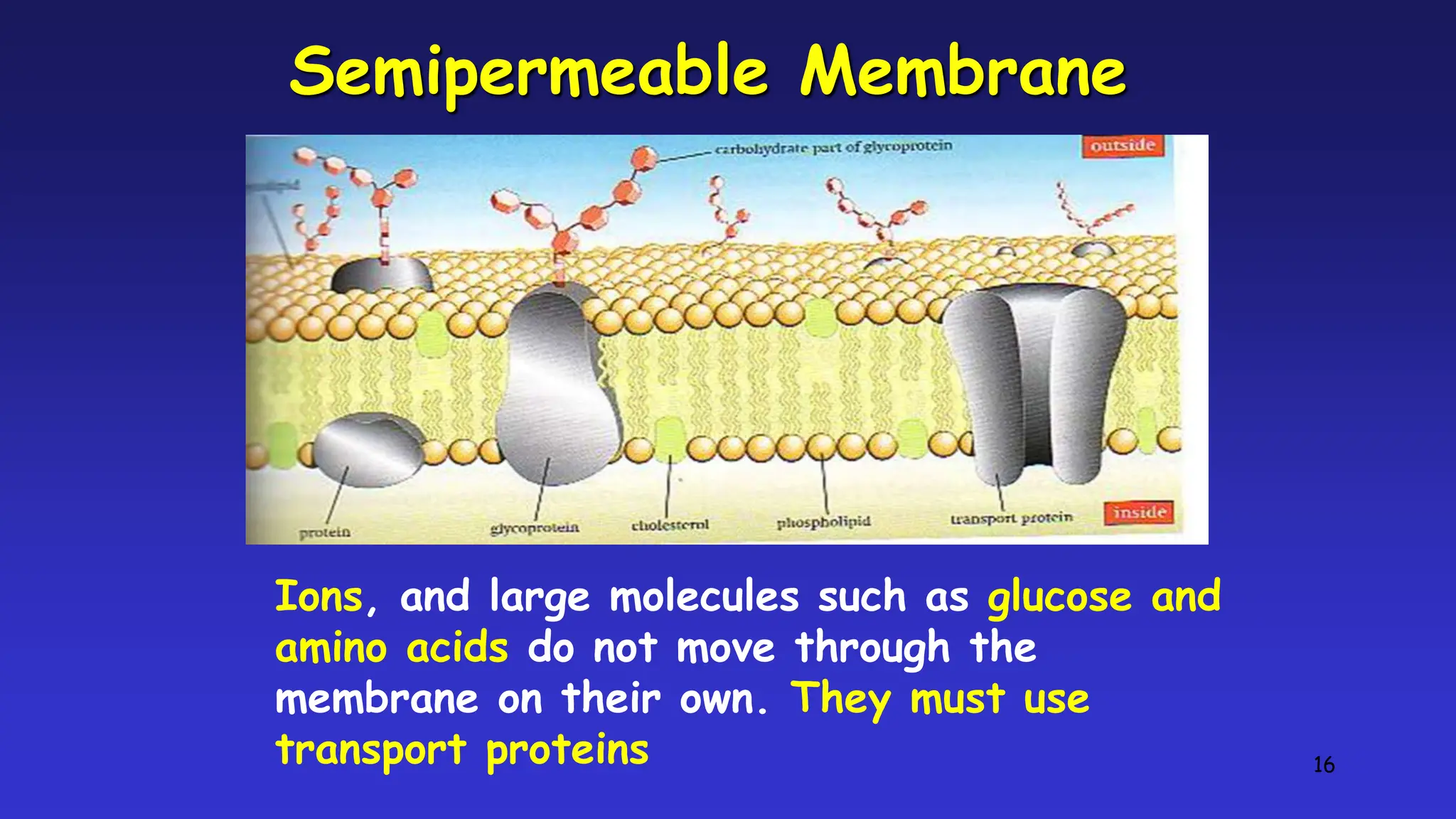
Ions, and large molecules such as glucose and
amino acids do not move through the
membrane on their own. They must use
transport proteins
Semipermeable Membrane
17
Types of Transport
Across Cell
Membranes
18
• Requires NO
energy
• Molecules
move from
area of HIGH
to LOW
concentration
Simple Diffusion
19
DIFFUSION
Diffusion is a
PASSIVE process
which means no
energy is used to
make the molecules
move.
20
Diffusion of Liquids
21
Diffusion through a
Membrane
Cell membrane
Solute moves DOWN concentration gradient (HIGH to
LOW)
22
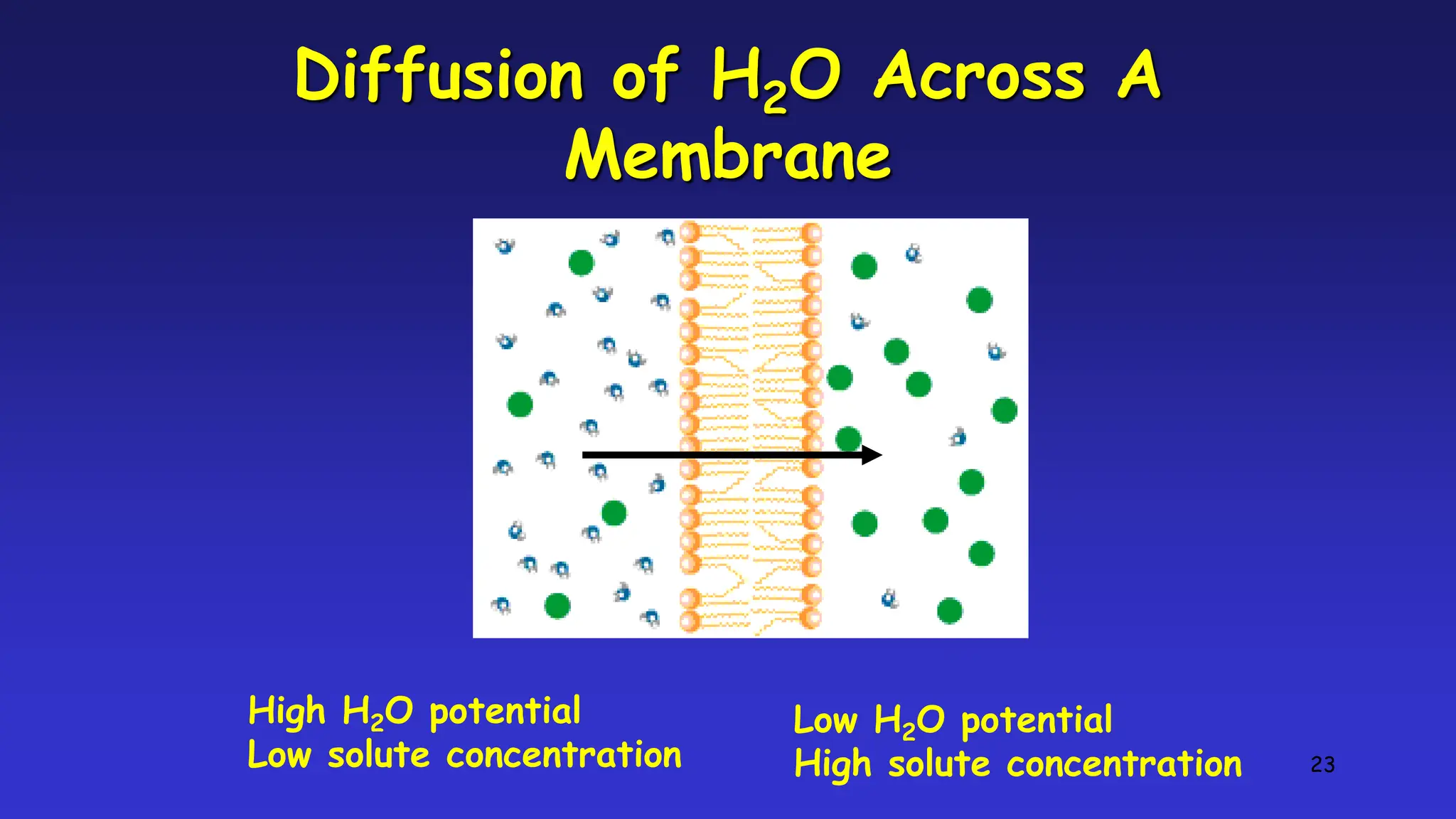
Osmosis
• Diffusion of
water across a
membrane
• Moves from
HIGH
Concentration to
a LOW
concentration
Diffusion across a membrane
Semipermeable
membrane
23
Diffusion of H2O Across A
Membrane
High H2O potential
Low solute concentration
Low H2O potential
High solute concentration
24
Cell in Isotonic Solution
CELL
10% NaCL
90% H2O
10% NaCL
90% H2O
What is the direction of water movement?
The cell is at _______________.
equilibrium
ENVIRONMENT
NO NET
MOVEMENT
25
Cell in Hypotonic Solution
CELL
10% NaCL
90% H2O
20% NaCL
80% H2O
What is the direction of water movement?
26
Cell in Hypertonic Solution
CELL
15% NaCL
85% H2O
5% NaCL
95% H2O
What is the direction of water movement?
ENVIRONMENT
27
Cells in Solutions
28
Isotonic Solution
NO NET
MOVEMENT OF
H2O (equal amounts
entering & leaving)
Hypotonic
Solution
CYTOLYSIS
Hypertonic
Solution
PLASMOLYSIS
29
Cytolysis & Plasmolysis
Cytolysis Plasmolysis
30
Three Forms of Transport Across the Membrane
31
Passive Transport
Simple Diffusion
 Doesn’t require energy
 Moves high to low
concentration
 Example: Oxygen
diffusing in or carbon
dioxide diffusing out.
32
Passive Transport
Facilitated diffusion
Doesn’t require energy
Uses transport
proteins to move high to
low concentration
Examples: Glucose or
amino acids moving from
blood into a cell.
33
Proteins Are Critical to
Membrane Function
34
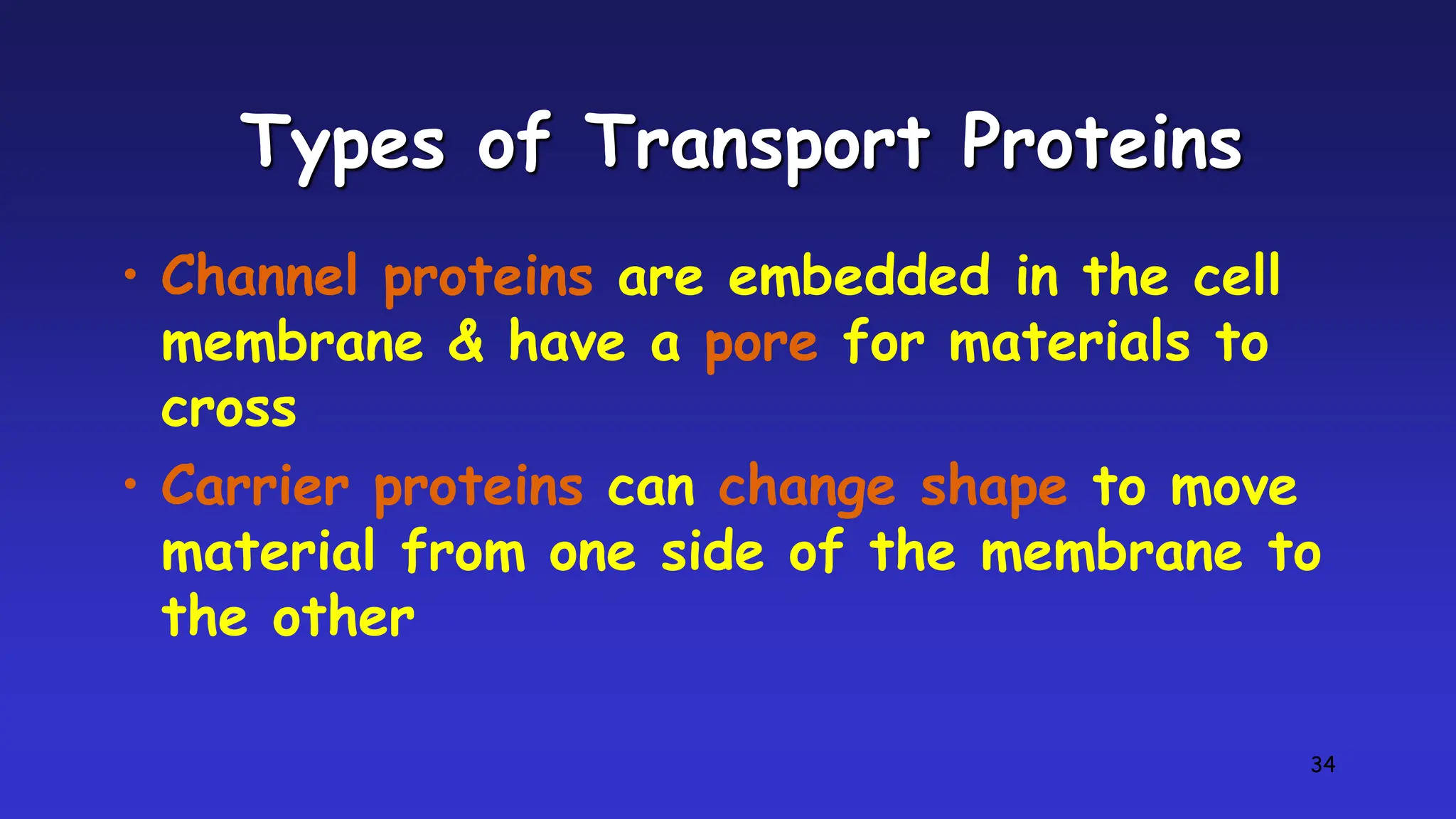
Types of Transport Proteins
• Channel proteins are embedded in the cell
membrane & have a pore for materials to
cross
• Carrier proteins can change shape to move
material from one side of the membrane to
the other
35
Facilitated Diffusion
Molecules will randomly move through
the pores in Channel Proteins.
36
Facilitated Diffusion
• Some Carrier
proteins do not
extend through
the membrane.
• They bond and
drag molecules
through the lipid
bilayer and
release them on
the opposite side.
37
Carrier Proteins
• Other carrier
proteins change
shape to move
materials across
the cell membrane
38
Active Transport
Requires energy or
ATP
Moves materials from
LOW to HIGH
concentration
AGAINST
concentration gradient
39
Active transport
Sodium-Potassium
Pump
Examples: Pumping
Na+ (sodium ions)
out and K+
(potassium ions) in
against strong
concentration
gradients.
Called Na+-K+ Pump
40
Sodium-Potassium Pump
3 Na+ pumped in for every 2 K+ pumped
out; creates a membrane potential
41
Moving the “Big Stuff”
Molecules are moved out of the cell by vesicles
that fuse with the plasma membrane.
Exocytosis
- moving
things
out.
42
Pinocytosis
Most common form of endocytosis.
Takes in dissolved molecules as a vesicle.
43
Pinocytosis
• Cell forms an
invagination
• Materials dissolve in
water to be brought
into cell
• Called “Cell Drinking”
44
Receptor-Mediated Endocytosis
Some integral proteins have receptors
on their surface to recognize & take in
hormones, cholesterol, etc.
45
Receptor-Mediated Endocytosis
46
Endocytosis – Phagocytosis
Used to engulf large particles such as
food, bacteria, etc. into vesicles
Called “Cell Eating”
47
Endocytosis – Phagocytosis
48
Exocytosis
The opposite of endocytosis is exocytosis. Large
molecules that are manufactured in the cell are
released through the cell membrane.
Inside Cell Cell environment
difference
Prokaryotic vs eukaryotic cell
PM
49
50
The End
Thank You

Plasma Membrane or Cell Membrane (Outer Layer in Animal Cells)

Editor's Notes