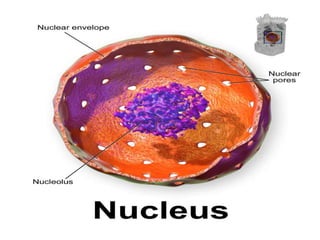
NUCLEUS
By,
K.ThangaMallika,
I M.Sc., Microbiology
INTRODUCTION
• The nucleus was the first organelle to be
discovered.
• It was first observed by ANTON VAN
LEEUWENHOEK (1632 - 1723).
• In more detail in 1831 by Scottish Botanist
ROBERT BROWN was observed and named it
as “aerola” or “nucleus”.
OCCURENCE
• OCCURRENCE - Found in all eukaryotic cells of
plants and animals.
• EXCEPTIONS - Mature sieve tubes and
erythrocytes.
• Prokaryotes (Bacteria) lack true nucleus.
• POSITION - Usually at the centre but it can
change its position according to the metabolic
state.
• NUMBER - Mononucleate , Binucleate and
Polynucleate cells.
• SHAPE AND SIZE : Its shape is related with the
shape of the cell. It may be spherical or
ellipsoidal.
• Its size is related with number of the
chromosomes. Eg: small in haploid cell and large
in diploid cell.
• Its size also depends upon the volume of the
cell, amount of DNA, proteins and metabolic
phase of the cell.
ULTRA STRUCTURE
• Larger organelle of the cell.
• Approximately 6 micrometer in diameter.
• Occupies about 10% of total volume of cell.
DIFFERENT PARTS:
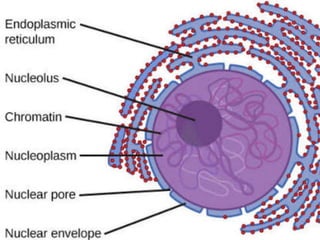
1. Nuclear Envelope
2. Nuclear lamina
3. Nucleoplasm
4. Chromatin fibres
5. Nucleolus
1. NUCLEAR ENVELOPE :
• Nuclear membrane, outer most covering of
nucleus.
• It acts as a barrier to prevent macro molecules
from diffusing freely between nucleoplasm and
cytoplasm.
• It contains 2 cellular membranes:
1.Inner membrane 2.Outer membrane .
• They are arranged parallel to one another .
• The space between 2 membranes – perinuclear
space.
• The outer membrane is continuous with the
membrane of golgi body, mitochondria,
Endoplasmic Reticulum, also studded with
ribosomes.
• Nuclear membrane is not continuous but broken
at regular intervals, these broker areas are known
as Nuclear Pores.
• Inner nuclear membrane : 5 to 10 mm thick. It
contains Proteins. It acts as a main dwelling for
many inner nuclear membrane pores.
• Outer nuclear membrane : perinuclear space
occupies 10 to 500 mm diameter. It continues
with Endoplasmic reticulum, studded with
ribosomes .
• It also contains fibres, lipid droplets, crystalline
deposits.
a. NUCLEAR PORES:
• Nuclear membrane is not continuous but broke
at regular intervals, these broken areas are
known as Nuclear pores.
• They can vary in number and it depends on
species and types of the cell. Eg: Mammalian cell
has 3000 to 4000 pores.
• The pores are circular structure and it consists
of Annuli.
2. NUCLEAR LAMINA:
• Mostly composed of lamina proteins, which
synthesized in the cytoplasm and later
transported into nucleus.
• Lamin: Fibrous protein providing structural
function and for the cell nucleus.
• The lamin may be involved in the functional
organization of the nucleus.
• They may play a role in assembly and
disassembly before and after mitosis.
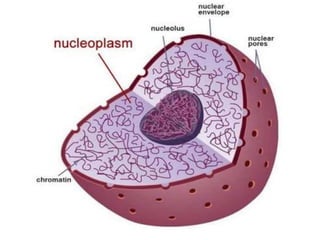
3. NUCLEOPLASM:
• The space between nuclear envelope and
nucleolus is filled by a transparent, semi solid
granular substance is known as nucleoplasm.
• It is composed of nucleo protien and contains
inorganic and organic substances.
• It is similar to cytosol.
4. CHROMATIN FIBRES :
• Chromatin is a mass of DNA and proteins that
condense to form chromosomes during cell
division.
• Chromatin is an essential part of genetic
makeup of eukaryotic cells, by controlling
replication, cell function and storing genetic
information.
• The basic structure for chromatin if the
NUCLEOPLASM.
5. NUCLEOLUS:
• It is composed of the main products of the
rRNA genes, as well as their proteins and
enzymes.
• It is a large spherical and acidophilic dense
granule.
• Size depends on the synthetic activities of
the cell.
• Malfunction can leads to several human
diseases.
FUNCTIONS
• The nucleus contains most of the cell nucleus in
the form of chromatin. The chromatin then
organize into chromosomes during cell division.
The chromosome contains a set number of genes
and it controls every single trait.
• It controls all the activities inside the cell such as
cell growth, metabolism, protein synthesis.
• It has instructions for making proteins and other
molecules.
THANK YOU

Nucleus

  • 1.
  • 2.
    INTRODUCTION • The nucleuswas the first organelle to be discovered. • It was first observed by ANTON VAN LEEUWENHOEK (1632 - 1723). • In more detail in 1831 by Scottish Botanist ROBERT BROWN was observed and named it as “aerola” or “nucleus”.
  • 3.
    OCCURENCE • OCCURRENCE -Found in all eukaryotic cells of plants and animals. • EXCEPTIONS - Mature sieve tubes and erythrocytes. • Prokaryotes (Bacteria) lack true nucleus. • POSITION - Usually at the centre but it can change its position according to the metabolic state. • NUMBER - Mononucleate , Binucleate and Polynucleate cells.
  • 4.
    • SHAPE ANDSIZE : Its shape is related with the shape of the cell. It may be spherical or ellipsoidal. • Its size is related with number of the chromosomes. Eg: small in haploid cell and large in diploid cell. • Its size also depends upon the volume of the cell, amount of DNA, proteins and metabolic phase of the cell.
  • 6.
    ULTRA STRUCTURE • Largerorganelle of the cell. • Approximately 6 micrometer in diameter. • Occupies about 10% of total volume of cell. DIFFERENT PARTS: 1. Nuclear Envelope 2. Nuclear lamina 3. Nucleoplasm 4. Chromatin fibres 5. Nucleolus
  • 8.
    1. NUCLEAR ENVELOPE: • Nuclear membrane, outer most covering of nucleus. • It acts as a barrier to prevent macro molecules from diffusing freely between nucleoplasm and cytoplasm. • It contains 2 cellular membranes: 1.Inner membrane 2.Outer membrane .
  • 9.
    • They arearranged parallel to one another . • The space between 2 membranes – perinuclear space. • The outer membrane is continuous with the membrane of golgi body, mitochondria, Endoplasmic Reticulum, also studded with ribosomes. • Nuclear membrane is not continuous but broken at regular intervals, these broker areas are known as Nuclear Pores.
  • 10.
    • Inner nuclearmembrane : 5 to 10 mm thick. It contains Proteins. It acts as a main dwelling for many inner nuclear membrane pores. • Outer nuclear membrane : perinuclear space occupies 10 to 500 mm diameter. It continues with Endoplasmic reticulum, studded with ribosomes . • It also contains fibres, lipid droplets, crystalline deposits.
  • 11.
    a. NUCLEAR PORES: •Nuclear membrane is not continuous but broke at regular intervals, these broken areas are known as Nuclear pores. • They can vary in number and it depends on species and types of the cell. Eg: Mammalian cell has 3000 to 4000 pores. • The pores are circular structure and it consists of Annuli.
  • 12.
    2. NUCLEAR LAMINA: •Mostly composed of lamina proteins, which synthesized in the cytoplasm and later transported into nucleus. • Lamin: Fibrous protein providing structural function and for the cell nucleus. • The lamin may be involved in the functional organization of the nucleus. • They may play a role in assembly and disassembly before and after mitosis.
  • 14.
    3. NUCLEOPLASM: • Thespace between nuclear envelope and nucleolus is filled by a transparent, semi solid granular substance is known as nucleoplasm. • It is composed of nucleo protien and contains inorganic and organic substances. • It is similar to cytosol.
  • 15.
    4. CHROMATIN FIBRES: • Chromatin is a mass of DNA and proteins that condense to form chromosomes during cell division. • Chromatin is an essential part of genetic makeup of eukaryotic cells, by controlling replication, cell function and storing genetic information. • The basic structure for chromatin if the NUCLEOPLASM.
  • 17.
    5. NUCLEOLUS: • Itis composed of the main products of the rRNA genes, as well as their proteins and enzymes. • It is a large spherical and acidophilic dense granule. • Size depends on the synthetic activities of the cell. • Malfunction can leads to several human diseases.
  • 18.
    FUNCTIONS • The nucleuscontains most of the cell nucleus in the form of chromatin. The chromatin then organize into chromosomes during cell division. The chromosome contains a set number of genes and it controls every single trait. • It controls all the activities inside the cell such as cell growth, metabolism, protein synthesis. • It has instructions for making proteins and other molecules.
  • 19.