PLANT CELL WALL
Dr. Saji Mariam George
Associate Professor (Retired)
Assumption College Autonomous
Changanacherry
PLANT CELL WALL
• Outer boundary of plant cell
• Non- living structure seen outside the plasma
membrane
• Secreted by the cytoplasm
• Varies in thickness in different cells – 0.1 to 10
µm
Cell wall - Chemical composition
• Varies in different cells.
• Mostly composed of cellulose
Also contain
 Hemicellulose
 Pectin
 Lignin
 Suberin
 Waxes
 Mineral deposits in the form of Ca and Mg
carbonates
 Silicates etc.
CELLULOSE
• Long, unbranched chain of glucose molecules
linked by Beta 1,4 glycosidic bonds.
• About 6000 glucose units in a cellulose chain.
• 100 cellulose chain form a bundle called
micelle – cellulose chains in a micelle are cross
linked by hydrogen bonds.
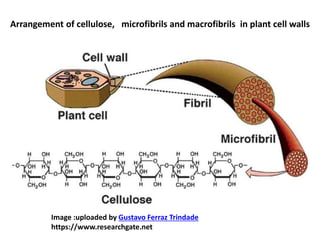
• 20 micelle form a larger bundle – microfibril.
• 250 microfibrils form a still large bundle -
macrofibril .
• Fibrils have high tensile strength.
• They associate with a gel like matrix containing
pectin, hemicellulose and lignin to form the cell
wall.
• In primary wall , microfibrils are arranged at
random.
• In the secondary wall, they are closely packed
and are arranged parallel to one another.
• These are oriented in different directions in the
different layers of the cell wall.
Arrangement of cellulose, microfibrils and macrofibrils in plant cell walls
Image :uploaded by Gustavo Ferraz Trindade
https://www.researchgate.net
HEMICELLULOSE : Composed of glucose, xylose,
mannose and glucuronic acid .
PECTIN : Contain galactose, arabinose and
galacturonic acid and are soluble in water.
LIGNIN : Found only in mature cell walls – made
up of an insoluble aromatic polymer resulting
from the polymerization of phenolic alcohols.
SUBERIN : A fat like material deposited in the
secondary wall of cork cell (Suberisation) -
makes the cell wall impermeable to water
and checks the loss of water by evaporation.
CUTIN : A fat like substance deposited on the
exposed surface of cell as a distinct layer
called cuticle – makes the exposed surface of
the cell wall relatively impermeable to water
and check evapouration (Cutinisation ).
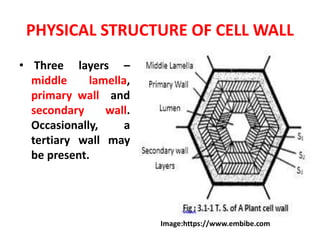
PHYSICAL STRUCTURE OF CELL WALL
• Three layers –
middle lamella,
primary wall and
secondary wall.
Occasionally, a
tertiary wall may
be present.
Image:https://www.embibe.com
1. Middle lamella:
• Development of the cell wall starts with the
formation of middle lamella by the cell plate
after cell division.
• Middle lamella is the first formed cell wall
composed of Calcium and Magnesium
pectate. It is a viscous and jelly like
substance and acts like a cementing material
between the primary walls of adjacent cells.
2. Primary wall :
• Formed during early stages of growth and
development
• Found in all plant cells
• 1 to 3 µm thick
• Composed mostly of loosely interwoven
fibrils of cellulose, hemicellulose and pectic
substances.
• Thin, elastic and undergoes extension with
the growth of the cell.
3. Secondary wall :
• Laid down on the primary wall when its growth
is over.
• 5 to 10 µm thick
• Has three layers- outer layer (S1), middle layer
(S2) and the inner layer (S3).
• Consists of many layers of closely packed
microfibrils of cellulose, hemicellulose and in
many cases, lignin. – lignification imparts
strength and rigidity to the cell wall.
• Suberin and waxes are also present.
• Addition of secondary wall brings about
thickening of the cell wall – occurs particularly in
cells that form the harder woody parts of plants.
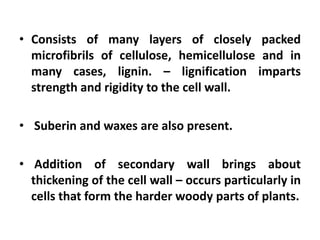
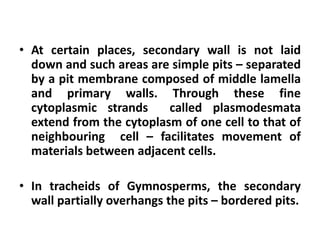
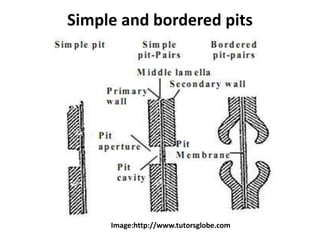
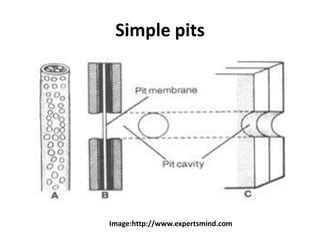
• At certain places, secondary wall is not laid
down and such areas are simple pits – separated
by a pit membrane composed of middle lamella
and primary walls. Through these fine
cytoplasmic strands called plasmodesmata
extend from the cytoplasm of one cell to that of
neighbouring cell – facilitates movement of
materials between adjacent cells.
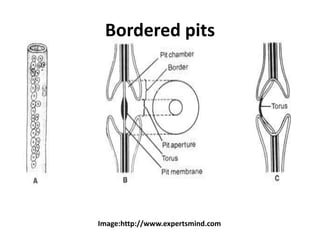
• In tracheids of Gymnosperms, the secondary
wall partially overhangs the pits – bordered pits.
Simple and bordered pits
Image:http://www.tutorsglobe.com
Simple pits
Image:http://www.expertsmind.com
Bordered pits
Image:http://www.expertsmind.com
Tertiary wall :
• In some cells, a tertiary wall is formed on
the inner surface of the secondary wall –
found in the xylem tracheids of
Gymnosperms.
• Thin
• Composed mainly of a polysaccharide known
as xylan and cellulose.
• The cell wall is hydrated
• Water content of the wall accounts for about 90 %
to 95 % of the fresh weight.
Functions of Cell wall :
1. Gives protection and mechanical support to the
plant cell.
2. Provides definite shape to plant cell.
3. It is permeable and allows materials to pass in
and out of the cell.
4. It helps in the maintenance of balance of
intracellular osmotic pressure with that of its
surroundings.
THANK YOU

PLANT CELL WALL SMG

  • 1.
    PLANT CELL WALL Dr.Saji Mariam George Associate Professor (Retired) Assumption College Autonomous Changanacherry
  • 2.
    PLANT CELL WALL •Outer boundary of plant cell • Non- living structure seen outside the plasma membrane • Secreted by the cytoplasm • Varies in thickness in different cells – 0.1 to 10 µm
  • 3.
    Cell wall -Chemical composition • Varies in different cells. • Mostly composed of cellulose Also contain  Hemicellulose  Pectin  Lignin  Suberin  Waxes  Mineral deposits in the form of Ca and Mg carbonates  Silicates etc.
  • 4.
    CELLULOSE • Long, unbranchedchain of glucose molecules linked by Beta 1,4 glycosidic bonds. • About 6000 glucose units in a cellulose chain. • 100 cellulose chain form a bundle called micelle – cellulose chains in a micelle are cross linked by hydrogen bonds. • 20 micelle form a larger bundle – microfibril.
  • 5.
    • 250 microfibrilsform a still large bundle - macrofibril . • Fibrils have high tensile strength. • They associate with a gel like matrix containing pectin, hemicellulose and lignin to form the cell wall. • In primary wall , microfibrils are arranged at random. • In the secondary wall, they are closely packed and are arranged parallel to one another. • These are oriented in different directions in the different layers of the cell wall.
  • 6.
    Arrangement of cellulose,microfibrils and macrofibrils in plant cell walls Image :uploaded by Gustavo Ferraz Trindade https://www.researchgate.net
  • 7.
    HEMICELLULOSE : Composedof glucose, xylose, mannose and glucuronic acid . PECTIN : Contain galactose, arabinose and galacturonic acid and are soluble in water. LIGNIN : Found only in mature cell walls – made up of an insoluble aromatic polymer resulting from the polymerization of phenolic alcohols.
  • 8.
    SUBERIN : Afat like material deposited in the secondary wall of cork cell (Suberisation) - makes the cell wall impermeable to water and checks the loss of water by evaporation. CUTIN : A fat like substance deposited on the exposed surface of cell as a distinct layer called cuticle – makes the exposed surface of the cell wall relatively impermeable to water and check evapouration (Cutinisation ).
  • 9.
    PHYSICAL STRUCTURE OFCELL WALL • Three layers – middle lamella, primary wall and secondary wall. Occasionally, a tertiary wall may be present. Image:https://www.embibe.com
  • 10.
    1. Middle lamella: •Development of the cell wall starts with the formation of middle lamella by the cell plate after cell division. • Middle lamella is the first formed cell wall composed of Calcium and Magnesium pectate. It is a viscous and jelly like substance and acts like a cementing material between the primary walls of adjacent cells.
  • 11.
    2. Primary wall: • Formed during early stages of growth and development • Found in all plant cells • 1 to 3 µm thick • Composed mostly of loosely interwoven fibrils of cellulose, hemicellulose and pectic substances. • Thin, elastic and undergoes extension with the growth of the cell.
  • 12.
    3. Secondary wall: • Laid down on the primary wall when its growth is over. • 5 to 10 µm thick • Has three layers- outer layer (S1), middle layer (S2) and the inner layer (S3).
  • 13.
    • Consists ofmany layers of closely packed microfibrils of cellulose, hemicellulose and in many cases, lignin. – lignification imparts strength and rigidity to the cell wall. • Suberin and waxes are also present. • Addition of secondary wall brings about thickening of the cell wall – occurs particularly in cells that form the harder woody parts of plants.
  • 14.
    • At certainplaces, secondary wall is not laid down and such areas are simple pits – separated by a pit membrane composed of middle lamella and primary walls. Through these fine cytoplasmic strands called plasmodesmata extend from the cytoplasm of one cell to that of neighbouring cell – facilitates movement of materials between adjacent cells. • In tracheids of Gymnosperms, the secondary wall partially overhangs the pits – bordered pits.
  • 15.
    Simple and borderedpits Image:http://www.tutorsglobe.com
  • 16.
  • 17.
  • 18.
    Tertiary wall : •In some cells, a tertiary wall is formed on the inner surface of the secondary wall – found in the xylem tracheids of Gymnosperms. • Thin • Composed mainly of a polysaccharide known as xylan and cellulose.
  • 19.
    • The cellwall is hydrated • Water content of the wall accounts for about 90 % to 95 % of the fresh weight. Functions of Cell wall : 1. Gives protection and mechanical support to the plant cell. 2. Provides definite shape to plant cell. 3. It is permeable and allows materials to pass in and out of the cell. 4. It helps in the maintenance of balance of intracellular osmotic pressure with that of its surroundings.
  • 20.