NODAL ANATOMY
NODALANATOMY
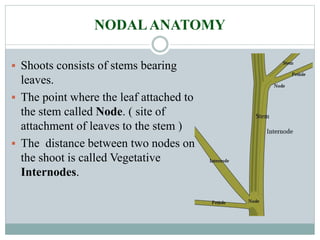
 Shoots consists of stems bearing
leaves.
 The point where the leaf attached to
the stem called Node. ( site of
attachment of leaves to the stem )
 The distance between two nodes on
the shoot is called Vegetative
Internodes.
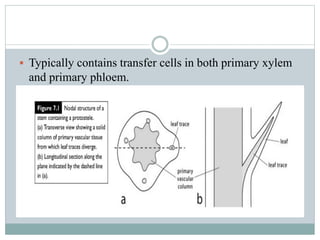
LEAF TRACES
 Leaves must have access to a source of water and
essential minerals.
 This transport of substances takes place in primary
vascular connections between the stem vascular system
and the base of leaves called Leaf traces.
 Leaf traces are composed of protoxylem, metaxylem,
protophloem and metaphloem.
 Typically contains transfer cells in both primary xylem
and primary phloem.
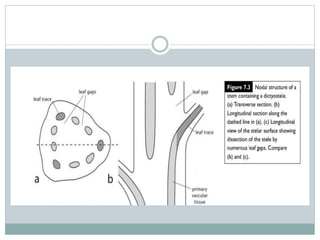
LEAF GAP
 The continuity of the cylinder of primary vascular tissue
is broken immediately above the position of outward
divergence of leaf trace, leaving a discontinuity is called
Leaf Gap.
 Since, these leaf gaps doesn’t affect vascular system.
 Lateral connectivity between tissues on top and bottom of
the leaf gap is formed, since vascular system connectivity
is breaked due to leaf gaps.
PHYLLOTAXY
PHYLLOTAXY
 “Phyllotaxis” or “Phyllotaxy” is the arrangement of
leaves on a stem.
 The word phyllotaxy is derived from ancient Greek word.
( Phyllo means leaf and taxis means arrangements )
 Phyllotaxy in mature plants is directly related to the
position & size of leaf primordia produced on apical
meristems of varying size and shape.
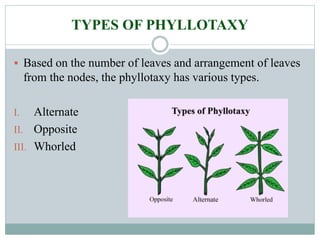
TYPES OF PHYLLOTAXY
 Based on the number of leaves and arrangement of leaves
from the nodes, the phyllotaxy has various types.
I. Alternate
II. Opposite
III. Whorled
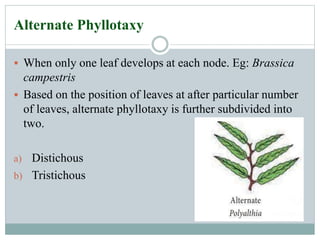
Alternate Phyllotaxy
 When only one leaf develops at each node. Eg: Brassica
campestris
 Based on the position of leaves at after particular number
of leaves, alternate phyllotaxy is further subdivided into
two.
a) Distichous
b) Tristichous
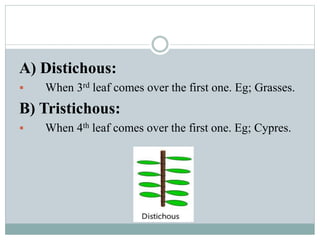
A) Distichous:
 When 3rd leaf comes over the first one. Eg; Grasses.
B) Tristichous:
 When 4th leaf comes over the first one. Eg; Cypres.
Opposite Phyllotaxy
 When a pair of leaves are present just opposite to each
other at each node, eg; Calotropis.
 There are two types in opposite phyllotaxy.
A. Opposite Deccusate
B. Opposite Superposed
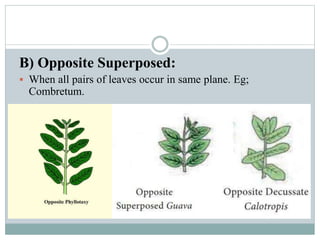
A) Oppposite Decussate:
 When two successive pairs of leaves occur at right angle
to each other, eg; Psidium gujava.
B) Opposite Superposed:
 When all pairs of leaves occur in same plane. Eg;
Combretum.
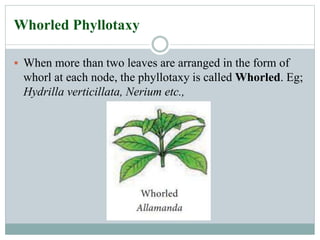
Whorled Phyllotaxy
 When more than two leaves are arranged in the form of
whorl at each node, the phyllotaxy is called Whorled. Eg;
Hydrilla verticillata, Nerium etc.,
Nodal anatomy, Leaf development & Phyllotaxy

Nodal anatomy, Leaf development & Phyllotaxy

  • 2.
  • 3.
    NODALANATOMY  Shoots consistsof stems bearing leaves.  The point where the leaf attached to the stem called Node. ( site of attachment of leaves to the stem )  The distance between two nodes on the shoot is called Vegetative Internodes.
  • 4.
    LEAF TRACES  Leavesmust have access to a source of water and essential minerals.  This transport of substances takes place in primary vascular connections between the stem vascular system and the base of leaves called Leaf traces.  Leaf traces are composed of protoxylem, metaxylem, protophloem and metaphloem.
  • 5.
     Typically containstransfer cells in both primary xylem and primary phloem.
  • 6.
    LEAF GAP  Thecontinuity of the cylinder of primary vascular tissue is broken immediately above the position of outward divergence of leaf trace, leaving a discontinuity is called Leaf Gap.  Since, these leaf gaps doesn’t affect vascular system.  Lateral connectivity between tissues on top and bottom of the leaf gap is formed, since vascular system connectivity is breaked due to leaf gaps.
  • 8.
  • 9.
    PHYLLOTAXY  “Phyllotaxis” or“Phyllotaxy” is the arrangement of leaves on a stem.  The word phyllotaxy is derived from ancient Greek word. ( Phyllo means leaf and taxis means arrangements )  Phyllotaxy in mature plants is directly related to the position & size of leaf primordia produced on apical meristems of varying size and shape.
  • 10.
    TYPES OF PHYLLOTAXY Based on the number of leaves and arrangement of leaves from the nodes, the phyllotaxy has various types. I. Alternate II. Opposite III. Whorled
  • 11.
    Alternate Phyllotaxy  Whenonly one leaf develops at each node. Eg: Brassica campestris  Based on the position of leaves at after particular number of leaves, alternate phyllotaxy is further subdivided into two. a) Distichous b) Tristichous
  • 12.
    A) Distichous:  When3rd leaf comes over the first one. Eg; Grasses. B) Tristichous:  When 4th leaf comes over the first one. Eg; Cypres.
  • 13.
    Opposite Phyllotaxy  Whena pair of leaves are present just opposite to each other at each node, eg; Calotropis.  There are two types in opposite phyllotaxy. A. Opposite Deccusate B. Opposite Superposed A) Oppposite Decussate:  When two successive pairs of leaves occur at right angle to each other, eg; Psidium gujava.
  • 14.
    B) Opposite Superposed: When all pairs of leaves occur in same plane. Eg; Combretum.
  • 15.
    Whorled Phyllotaxy  Whenmore than two leaves are arranged in the form of whorl at each node, the phyllotaxy is called Whorled. Eg; Hydrilla verticillata, Nerium etc.,