PLANT CELL WALL
DR. L. JOELRI MICHAEL RAJ
ASSISTANT PROFESSOR
DEPT. OF BOTANY
ST. XAVIER’S COLLEGE (AUTONOMOUS)
PALAYAMKOTTAI
Dr. L. Joelri Michael Raj SXC
WHAT IS CELL WALL?
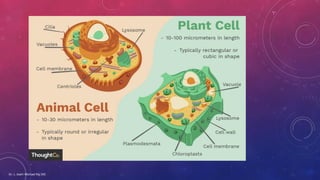
• It is the outer rigid protective supportive and semi transparent
covering of plant cells, fungi and some protists. Cell wall was first
seen in cork cells by Hooke in 1665.
• Its thickness varies in different types of cells from 0.1 µm to 10 µm.
• Cell wall is a non-living extracellular secretion or matrix of the cell
which is closely appressed to it. It is, however, metabolically active
and is capable of growth.
Dr. L. Joelri Michael Raj SXC
FUNCTIONS OF CELL WALL:
(i) Protects the protoplasm against mechanical injury,
(ii) Protects the cell from attack of pathogens,
(iii) Provides rigidity and shape to the cell,
(iv) Counteracts osmotic pressure.
(v) Gives strength to the land plants to withstand gravitational forces,
(vi) By its growth the wall helps in cell expansion,
(vii) Pits present in the wall help produce a protoplasmic continuum or
simplest amongst cells,
Dr. L. Joelri Michael Raj SXC
FUNCTIONS OF CELL WALL:
(viii) Walls prevent bursting of plant cells by inhibiting excessive
endosmosis.
(ix) Wall has some enzymatic activity connected with metabolism,
(x) In many cases, wall takes part in offence and defense,
(xi) Cutin and suberin of the cell wall reduce the loss of water through
transpiration,
(xii) Walls of sieve tubes, tracheids and vessels are specialised for long
distance transport,
(xiii) Some seeds store food in the form of hemicellulose in cell wall.
Dr. L. Joelri Michael Raj SXC
CHEMICAL COMPOSITION OF CELL
WALL:
1. Matrix
• Water— 60%. Hemicellulose— 5- 15% Pectic Substances-2-8%.
Lipids-0.5-3.0%. Proteins— 1-2%
2. Micro fibrils:
• Cellulose/fungus cellulose— 10-15%.
3. Other Ingredients:
• Lignin, cutin, suberin, silica (silicon dioxide), minerals (e.g., iron,
calcium, carbonate), waxes, tannins, resins, gum— variable.
Dr. L. Joelri Michael Raj SXC
STRUCTURE OF CELL WALL
• A cell wall can have upto three parts— middle lamella, primary wall
and secondary wall.
Middle Lamella:
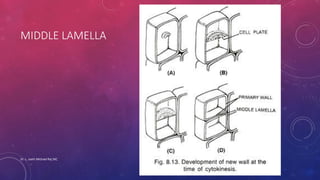
• It is a thin, amorphous and cementing layer between two adjacent
cells. Middle lamella is the first layer which is deposited at the time
of cytokinesis. It is just like brick work of the common wall between
two adjacent rooms.
• Middle lamella is absent on the outer side of surface cells. It is made
up of calcium and magnesium pectates. The softening of ripe fruits is
caused by partial solubilisation of pectic compounds to produce
jelly-like consistency.
Dr. L. Joelri Michael Raj SXC
MIDDLE LAMELLA
Dr. L. Joelri Michael Raj SXC
PRIMARY WALL
• It is the first formed wall of the cell which is produced inner to the
middle lamella. The primary wall is commonly thin (0.1-3.0 µm) and
capable of extension.
• It grows by intussusceptions or addition of materials within the
existing wall. Some cells possess only primary wall, e.g., leaf cells,
fruit cells, of cortex and pith.
Dr. L. Joelri Michael Raj SXC
PRIMARY WALL
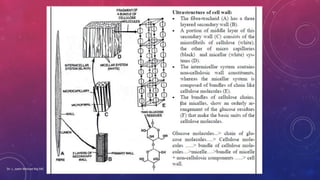
• Primary wall consists of a number of micro fibrils embedded in the
amorphous gel like matrix or ground substance. In the majority of
plants, the micro fibrils are formed of cellulose.
• They are synthesized at plasma membrane by particle rosettes
(terminal complexes) having cellulose synthetize enzyme.
Dr. L. Joelri Michael Raj SXC
PRIMARY WALL
• Micro fibrils are oriented variously according to the shape and
thickening of the wall. Usually they are arranged in a loose network
due to incomplete cross-linking.
• The matrix of the wall consists of water, pectin, hemicelluloses and
glycoproteins. Pectin is the filler substance of the matrix. Proteins
are structural and enzymatic.
• Protein expansin (Me Queen-Mason et al, 1992) is involved in
loosening and expansion of cell wall through incorporation of more
cellulose. Hemicellulose binds micro fibrils with matrix.
Dr. L. Joelri Michael Raj SXC
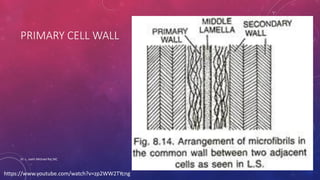
PRIMARY CELL WALL
https://www.youtube.com/watch?v=zp2WW2TYcng
Dr. L. Joelri Michael Raj SXC
SECONDARY WALL:
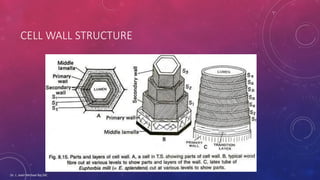
• It is produced in some mature cells when the latter have stopped
growth, e.g., tracheids, vessel elements, fibres, collenchyma’s.
• Secondary wall is laid inner to the primary wall by accretion or
deposition of materials over the surface of existing structure.
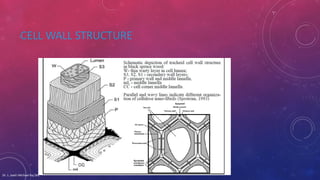
• It is thick (3—10 µm) and made up of at least three layers, sometimes
more (e.g., latex tube of Euphorbia milli). They are named as S1, S2,
S3, Sx, etc.
Dr. L. Joelri Michael Raj SXC
SECONDARY WALL:
• The innermost layer of the secondary wall is sometimes distinct both
chemically as well as in staining properties due to the presence of
xylans. It is then called tertiary wall, e.g., tension wood in
gymnosperms.
• Secondary wall may be absent, irregularly deposited or formed
uniformly in the cells.
• This results in differentiation of cells— parenchyma, collenchyma,
sclerenchyma, tracheids and vessels.
Dr. L. Joelri Michael Raj SXC
CELL WALL STRUCTURE
Dr. L. Joelri Michael Raj SXC
CELL WALL STRUCTURE
Dr. L. Joelri Michael Raj SXC
SECONDARY WALL
• The composition of secondary wall is basically similar to the primary
wall in having cellulose micro-fibrils embedded in a matrix of pectin
and hemicelluloses.
• Cellulose micro-fibrils of the secondary wall lie close, parallel and at
an angle to the longitudinal axis of the cell.
• Their orientation is different in the different layers of the secondary
wall. A number of different materials may be deposited in the wall.
Dr. L. Joelri Michael Raj SXC
DIFFERENT MATERIALS DEPOSITED IN THE
SCONDARY CELL WALL
The important ones are:
(a) Lignin:
It reduces the water content of the wall matrix and increases its
hardness. However, water permeability is not affected. The
characteristic of lignification’s (and cutinisation) has evolved with the
evolution of land plants,
(b) Suberin:
The wall of cork and endodermal cells contains a special fatty
substance called suberin. Suberin makes the walls impermeable,
Dr. L. Joelri Michael Raj SXC
DIFFERENT MATERIALS DEPOSITED IN THE
SCONDARY CELL WALL
(c) Cutin:
The epidermal cells possess another fatty substance called cutin. Cutin
is also laid as a distinct layer on the outside of the epidermal cell walls.
It is known as cuticle. Cutin reduces the rate of epidermal or surface
transpiration. Other substances which can be deposited in the cell wall
are silica (e.g., grasses), minerals, waxes, tannins, resins, gums, etc.
Dr. L. Joelri Michael Raj SXC
PLASMODESMATA
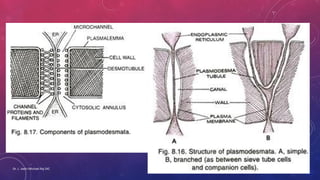
• Plasmodesmata (singular- plasmodesma) are cytoplasmic bridges
between adjacent plant cells which develop in the minute pores of
their walls. They form a protoplasmic continuum called symplast.
• Cell wall and intercellular spaces form a non-living component of
the plant body called apoplasm.
• A plasmoderma is 40—50 nm in diameter. It may be simple or
branched
Dr. L. Joelri Michael Raj SXC
PLASMODESMATA
• Plasmodesma is lined by plasma membrane. It encloses tubular
extension of endoplasmic reticulum called desmotubule.
• The space between desmotubule and plasma membrane contains 8-
10 microchannels.
• Plasmodesmata form channels for controlled passage of small sized
particles between adjacent cells as well as transfer of some specific
signals.
Dr. L. Joelri Michael Raj SXC
DIFFERENCE BETWEEN THE PRIMARY AND
SECONDARY CELL WALL
Dr. L. Joelri Michael Raj SXC
PITS
• Pits are un-thickened areas in the secondary walls of plant cells.
They, therefore, appear as depressions. Pits generally occur in pairs
on the wall of two adjacent cells. A pit has a cavity or pit chamber
and a pit membrane.
• The pit membrane consists of primary wall and middle lamella. Pits
are of two types, simple and bordered.
Dr. L. Joelri Michael Raj SXC
PITS
• Simple pit has uniform width of the pit chamber.
• In bordered pit, the pit chamber is flask-shaped because the
secondary wall overarches its mouth.
• Pit membrane is permeable. It may have minute sub-microscopic
pores. Therefore, pits help in rapid translocation between two
adjacent cells.
Dr. L. Joelri Michael Raj SXC
PITS
Dr. L. Joelri Michael Raj SXC
DIFFERENCE BETWEEN CELLULOSE AND AMYLOSE
Dr. L. Joelri Michael Raj SXC
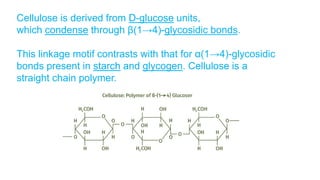
Cellulose is derived from D-glucose units,
which condense through β(1→4)-glycosidic bonds.
This linkage motif contrasts with that for α(1→4)-glycosidic
bonds present in starch and glycogen. Cellulose is a
straight chain polymer.
Dr. L. Joelri Michael Raj SXC
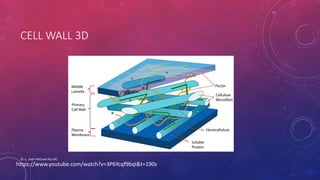
CELL WALL 3D
https://www.youtube.com/watch?v=3P6Ycqf9bqI&t=190s
Dr. L. Joelri Michael Raj SXC

PLANT CELL WALL_STRUCTURE AND COMPOSITION

  • 1.
    PLANT CELL WALL DR.L. JOELRI MICHAEL RAJ ASSISTANT PROFESSOR DEPT. OF BOTANY ST. XAVIER’S COLLEGE (AUTONOMOUS) PALAYAMKOTTAI Dr. L. Joelri Michael Raj SXC
  • 2.
    WHAT IS CELLWALL? • It is the outer rigid protective supportive and semi transparent covering of plant cells, fungi and some protists. Cell wall was first seen in cork cells by Hooke in 1665. • Its thickness varies in different types of cells from 0.1 µm to 10 µm. • Cell wall is a non-living extracellular secretion or matrix of the cell which is closely appressed to it. It is, however, metabolically active and is capable of growth. Dr. L. Joelri Michael Raj SXC
  • 3.
    Dr. L. JoelriMichael Raj SXC
  • 4.
    FUNCTIONS OF CELLWALL: (i) Protects the protoplasm against mechanical injury, (ii) Protects the cell from attack of pathogens, (iii) Provides rigidity and shape to the cell, (iv) Counteracts osmotic pressure. (v) Gives strength to the land plants to withstand gravitational forces, (vi) By its growth the wall helps in cell expansion, (vii) Pits present in the wall help produce a protoplasmic continuum or simplest amongst cells, Dr. L. Joelri Michael Raj SXC
  • 5.
    FUNCTIONS OF CELLWALL: (viii) Walls prevent bursting of plant cells by inhibiting excessive endosmosis. (ix) Wall has some enzymatic activity connected with metabolism, (x) In many cases, wall takes part in offence and defense, (xi) Cutin and suberin of the cell wall reduce the loss of water through transpiration, (xii) Walls of sieve tubes, tracheids and vessels are specialised for long distance transport, (xiii) Some seeds store food in the form of hemicellulose in cell wall. Dr. L. Joelri Michael Raj SXC
  • 6.
    CHEMICAL COMPOSITION OFCELL WALL: 1. Matrix • Water— 60%. Hemicellulose— 5- 15% Pectic Substances-2-8%. Lipids-0.5-3.0%. Proteins— 1-2% 2. Micro fibrils: • Cellulose/fungus cellulose— 10-15%. 3. Other Ingredients: • Lignin, cutin, suberin, silica (silicon dioxide), minerals (e.g., iron, calcium, carbonate), waxes, tannins, resins, gum— variable. Dr. L. Joelri Michael Raj SXC
  • 7.
    STRUCTURE OF CELLWALL • A cell wall can have upto three parts— middle lamella, primary wall and secondary wall. Middle Lamella: • It is a thin, amorphous and cementing layer between two adjacent cells. Middle lamella is the first layer which is deposited at the time of cytokinesis. It is just like brick work of the common wall between two adjacent rooms. • Middle lamella is absent on the outer side of surface cells. It is made up of calcium and magnesium pectates. The softening of ripe fruits is caused by partial solubilisation of pectic compounds to produce jelly-like consistency. Dr. L. Joelri Michael Raj SXC
  • 8.
    MIDDLE LAMELLA Dr. L.Joelri Michael Raj SXC
  • 9.
    PRIMARY WALL • Itis the first formed wall of the cell which is produced inner to the middle lamella. The primary wall is commonly thin (0.1-3.0 µm) and capable of extension. • It grows by intussusceptions or addition of materials within the existing wall. Some cells possess only primary wall, e.g., leaf cells, fruit cells, of cortex and pith. Dr. L. Joelri Michael Raj SXC
  • 10.
    Dr. L. JoelriMichael Raj SXC
  • 11.
    PRIMARY WALL • Primarywall consists of a number of micro fibrils embedded in the amorphous gel like matrix or ground substance. In the majority of plants, the micro fibrils are formed of cellulose. • They are synthesized at plasma membrane by particle rosettes (terminal complexes) having cellulose synthetize enzyme. Dr. L. Joelri Michael Raj SXC
  • 12.
    PRIMARY WALL • Microfibrils are oriented variously according to the shape and thickening of the wall. Usually they are arranged in a loose network due to incomplete cross-linking. • The matrix of the wall consists of water, pectin, hemicelluloses and glycoproteins. Pectin is the filler substance of the matrix. Proteins are structural and enzymatic. • Protein expansin (Me Queen-Mason et al, 1992) is involved in loosening and expansion of cell wall through incorporation of more cellulose. Hemicellulose binds micro fibrils with matrix. Dr. L. Joelri Michael Raj SXC
  • 13.
  • 14.
    SECONDARY WALL: • Itis produced in some mature cells when the latter have stopped growth, e.g., tracheids, vessel elements, fibres, collenchyma’s. • Secondary wall is laid inner to the primary wall by accretion or deposition of materials over the surface of existing structure. • It is thick (3—10 µm) and made up of at least three layers, sometimes more (e.g., latex tube of Euphorbia milli). They are named as S1, S2, S3, Sx, etc. Dr. L. Joelri Michael Raj SXC
  • 15.
    SECONDARY WALL: • Theinnermost layer of the secondary wall is sometimes distinct both chemically as well as in staining properties due to the presence of xylans. It is then called tertiary wall, e.g., tension wood in gymnosperms. • Secondary wall may be absent, irregularly deposited or formed uniformly in the cells. • This results in differentiation of cells— parenchyma, collenchyma, sclerenchyma, tracheids and vessels. Dr. L. Joelri Michael Raj SXC
  • 16.
    CELL WALL STRUCTURE Dr.L. Joelri Michael Raj SXC
  • 17.
    CELL WALL STRUCTURE Dr.L. Joelri Michael Raj SXC
  • 18.
    SECONDARY WALL • Thecomposition of secondary wall is basically similar to the primary wall in having cellulose micro-fibrils embedded in a matrix of pectin and hemicelluloses. • Cellulose micro-fibrils of the secondary wall lie close, parallel and at an angle to the longitudinal axis of the cell. • Their orientation is different in the different layers of the secondary wall. A number of different materials may be deposited in the wall. Dr. L. Joelri Michael Raj SXC
  • 19.
    DIFFERENT MATERIALS DEPOSITEDIN THE SCONDARY CELL WALL The important ones are: (a) Lignin: It reduces the water content of the wall matrix and increases its hardness. However, water permeability is not affected. The characteristic of lignification’s (and cutinisation) has evolved with the evolution of land plants, (b) Suberin: The wall of cork and endodermal cells contains a special fatty substance called suberin. Suberin makes the walls impermeable, Dr. L. Joelri Michael Raj SXC
  • 20.
    DIFFERENT MATERIALS DEPOSITEDIN THE SCONDARY CELL WALL (c) Cutin: The epidermal cells possess another fatty substance called cutin. Cutin is also laid as a distinct layer on the outside of the epidermal cell walls. It is known as cuticle. Cutin reduces the rate of epidermal or surface transpiration. Other substances which can be deposited in the cell wall are silica (e.g., grasses), minerals, waxes, tannins, resins, gums, etc. Dr. L. Joelri Michael Raj SXC
  • 21.
    PLASMODESMATA • Plasmodesmata (singular-plasmodesma) are cytoplasmic bridges between adjacent plant cells which develop in the minute pores of their walls. They form a protoplasmic continuum called symplast. • Cell wall and intercellular spaces form a non-living component of the plant body called apoplasm. • A plasmoderma is 40—50 nm in diameter. It may be simple or branched Dr. L. Joelri Michael Raj SXC
  • 22.
    PLASMODESMATA • Plasmodesma islined by plasma membrane. It encloses tubular extension of endoplasmic reticulum called desmotubule. • The space between desmotubule and plasma membrane contains 8- 10 microchannels. • Plasmodesmata form channels for controlled passage of small sized particles between adjacent cells as well as transfer of some specific signals. Dr. L. Joelri Michael Raj SXC
  • 23.
    Dr. L. JoelriMichael Raj SXC
  • 24.
    DIFFERENCE BETWEEN THEPRIMARY AND SECONDARY CELL WALL Dr. L. Joelri Michael Raj SXC
  • 25.
    PITS • Pits areun-thickened areas in the secondary walls of plant cells. They, therefore, appear as depressions. Pits generally occur in pairs on the wall of two adjacent cells. A pit has a cavity or pit chamber and a pit membrane. • The pit membrane consists of primary wall and middle lamella. Pits are of two types, simple and bordered. Dr. L. Joelri Michael Raj SXC
  • 26.
    PITS • Simple pithas uniform width of the pit chamber. • In bordered pit, the pit chamber is flask-shaped because the secondary wall overarches its mouth. • Pit membrane is permeable. It may have minute sub-microscopic pores. Therefore, pits help in rapid translocation between two adjacent cells. Dr. L. Joelri Michael Raj SXC
  • 27.
    PITS Dr. L. JoelriMichael Raj SXC
  • 28.
    Dr. L. JoelriMichael Raj SXC
  • 29.
    DIFFERENCE BETWEEN CELLULOSEAND AMYLOSE Dr. L. Joelri Michael Raj SXC
  • 30.
    Cellulose is derivedfrom D-glucose units, which condense through β(1→4)-glycosidic bonds. This linkage motif contrasts with that for α(1→4)-glycosidic bonds present in starch and glycogen. Cellulose is a straight chain polymer. Dr. L. Joelri Michael Raj SXC
  • 31.
  • 32.
    Dr. L. JoelriMichael Raj SXC