Cell Wall
and
It’s Function
A cell wall is a non-living, tough, flexible and
sometimes fairly rigid layer that surrounds the cell.
It is located outside the cell membrane and
provides these cells with structural support and
protection, and also acts as a filtering mechanism.
The presence of a cell wall distinguishes plant cells
from animal cells.
Functions of Cell wall:
 Prevents enlargement of the plant cell.
 Play important roles in the absorption, transport and
secretion of substances in plants.
 Provide the plant cell a definite shape and size to give
strength and rigidity to the cell.
 Provides protection from physical injury.
 Together with vacuole, provides skeletal support.
Components of the Cell Wall
The cell wall is chiefly composed of insoluble polysaccharides.
The most common constituent is cellulose. Certain
other polysaccharides like pectin, hemicellulose, lignin
and xylan may also be present.
Cellulose is made of repeating molecules of glucose attached
end to end in a b(1-4) linkage.
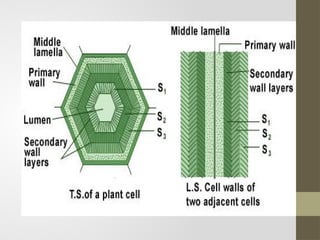
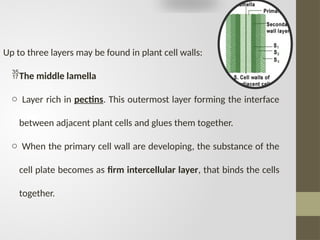
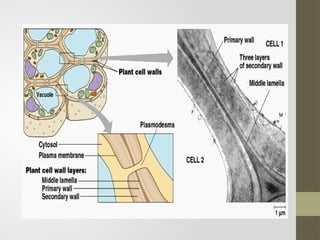
Up to three layers may be found in plant cell walls:
The middle lamella
o Layer rich in pectins. This outermost layer forming the interface
between adjacent plant cells and glues them together.
o When the primary cell wall are developing, the substance of the
cell plate becomes as firm intercellular layer, that binds the cells
together.
The primary cell wall
o Generally a thin, flexible and extensible layer formed while
the cell is growing.
o In the primary cell wall pectic substances accompany the
cellulose and hemicellulose in early stages.
o The primary wall usually consists of a single layer. As cell
enlargement begins, this membrane may become unevenly
thickened. Here primary pit field or primordial pit may be
formed.
o The young cell wall remains plastic and adaptable to
changing volume. With the attainment of the final cell size,
the primary cell wall takes on mature structure.
Plasmodesmata: protoplasmic connections between two
adjacent cells, separated by the cell wall.
The secondary cell wall
o A thick layer formed inside the primary cell wall after the cell is
fully grown. It is not found in all cell types.
o The secondary cell wall is made up of one to many layers, most
frequently three.
o It is incapable of increase in area.
o Secondary wall is mainly compose of cellulose or both the
cellulose and hemicellulose .
o In some cells (such as xylem), the secondary cell wall contains
lignin, which strengthens and waterproofs the wall.
o Cutin, suberin, tannin, oils and inorganic salts may also be found
here.
These long and thin cellulose molecules are united into a
"Micro fibril". These micro fibrils are arranged in a very
regular, ordered arrangement and because of this they
exhibit almost "crystalline" properties.
The micro fibrils form fine threads which may coil
around one another like a cable. Each "cable" is called
a "Macrofibril".

Cell-wall-properties-and-its functions.pptx

  • 1.
  • 2.
    A cell wallis a non-living, tough, flexible and sometimes fairly rigid layer that surrounds the cell. It is located outside the cell membrane and provides these cells with structural support and protection, and also acts as a filtering mechanism. The presence of a cell wall distinguishes plant cells from animal cells.
  • 3.
    Functions of Cellwall:  Prevents enlargement of the plant cell.  Play important roles in the absorption, transport and secretion of substances in plants.  Provide the plant cell a definite shape and size to give strength and rigidity to the cell.  Provides protection from physical injury.  Together with vacuole, provides skeletal support.
  • 4.
    Components of theCell Wall The cell wall is chiefly composed of insoluble polysaccharides. The most common constituent is cellulose. Certain other polysaccharides like pectin, hemicellulose, lignin and xylan may also be present. Cellulose is made of repeating molecules of glucose attached end to end in a b(1-4) linkage.
  • 6.
    Up to threelayers may be found in plant cell walls: The middle lamella o Layer rich in pectins. This outermost layer forming the interface between adjacent plant cells and glues them together. o When the primary cell wall are developing, the substance of the cell plate becomes as firm intercellular layer, that binds the cells together.
  • 7.
    The primary cellwall o Generally a thin, flexible and extensible layer formed while the cell is growing. o In the primary cell wall pectic substances accompany the cellulose and hemicellulose in early stages. o The primary wall usually consists of a single layer. As cell enlargement begins, this membrane may become unevenly thickened. Here primary pit field or primordial pit may be formed.
  • 8.
    o The youngcell wall remains plastic and adaptable to changing volume. With the attainment of the final cell size, the primary cell wall takes on mature structure. Plasmodesmata: protoplasmic connections between two adjacent cells, separated by the cell wall.
  • 9.
    The secondary cellwall o A thick layer formed inside the primary cell wall after the cell is fully grown. It is not found in all cell types. o The secondary cell wall is made up of one to many layers, most frequently three. o It is incapable of increase in area. o Secondary wall is mainly compose of cellulose or both the cellulose and hemicellulose . o In some cells (such as xylem), the secondary cell wall contains lignin, which strengthens and waterproofs the wall. o Cutin, suberin, tannin, oils and inorganic salts may also be found here.
  • 11.
    These long andthin cellulose molecules are united into a "Micro fibril". These micro fibrils are arranged in a very regular, ordered arrangement and because of this they exhibit almost "crystalline" properties. The micro fibrils form fine threads which may coil around one another like a cable. Each "cable" is called a "Macrofibril".