Cell Wall
Structure & Function
Ganesh Kumar
Asst.Professor-Botany
MBC Govt.Girls College Barmer
What is cell wall
The cell wall is the tough, usually flexible but sometimes fairly rigid layer that
surrounds some types of cells. It is located outside the cell membrane and
provides these cells with structural support and protection,and also acts as a
filtering mechanism.
● A major function of the cell wall is to act as a pressure well, preventing over
expansion when water enters the cell. They are found in plants, bacteria,
fungi, algae and some archea. Animals and protozoa do not have cell walls.
Cell wall: Layers
There are three strata may be found in plant cell wall:
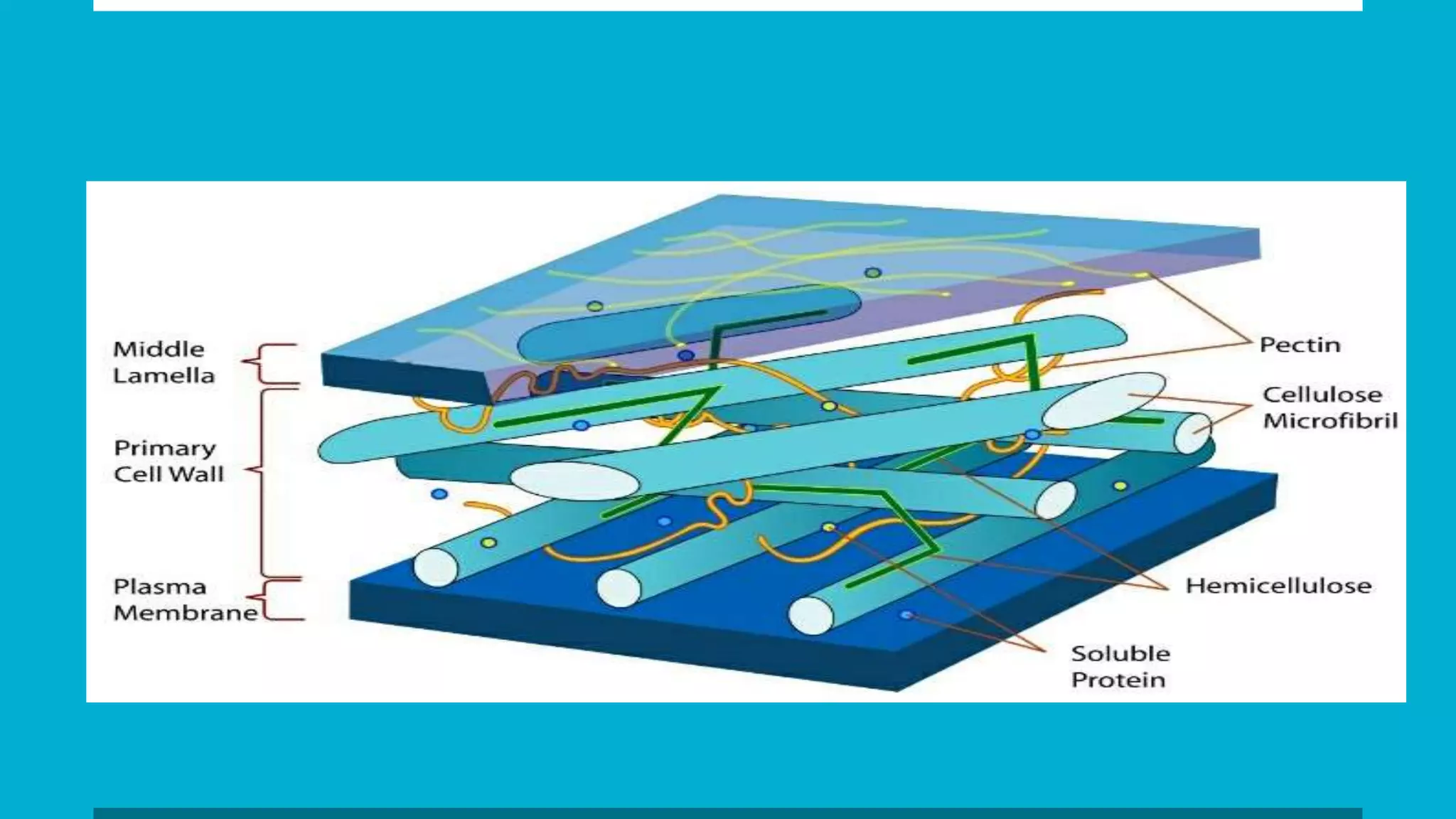
● The middle lamella, a layer rich in pectins. This outermost layer forming the
interface between adjacent plant cells and glues them together.
● The primary cell wall, generally thin, flexible and extensible layer formed while
the cell is growing.
● The secondary cell wall, a thick layer formed inside the primary cell wall after
the cell wall is fully grown. It is not found in all cell types. In some cells such
as xylem, the secondary cell wall contains lignin, which strengthens and
waterproofs the wall.
Composition
● In the primary cell wall, the major carbohydrates are cellulose, hemicellulose and
pectin. Cellulose microfibrills are linked via hemicellulosic teathers to form the
cellulose-hemicellulose network embedded in the pectin matrix.
● The outer part of the primary cell wall usually impregnated with cutin and wax,
forming a permeability barrier known as the plant cuticle.
● The major polymers that make up wood include: cellulose (35-50%), xylan (20-
35%) a type of hemicellulose and lignin (10-25%) a complex phenolic polymer
that penetrates the spaces in cell wall between cellulose, hemicellulose and
pectin components, drivi out water and strengthening the wall.
● Structural proteins (1-5%) also found in most plant cell walls as HRGP, AGP,
GRPs and PRPs.
Formation of cell wall
● The cells are held together and share the gelatinous membrane called the
middle lamella, which contains magnesium and calcium pectates. It formed
from the cell plate during cytokinesis, and the primary cell wall is then
deposited inside the middle lamella.
● Primary cell wall defined as composed of cellulose microfibrills alligned at all
angles. Microfibrills are held together by H2 bonds to provide a high tensile
strength.
● In some cells, after a maximum growth achieved, a secondary cell wall is
constructed between the plant cell and primary cell wall. Cells with secondary
cell wall is rigid. Cell communication occures through pits.
Functions:
● Act as exoskeleton of cell
● Mechanical strength
● Security
● Storage deposits
● Cell communication
● Protection
Thanks

Plant cell wall.pptx

  • 1.
    Cell Wall Structure &Function Ganesh Kumar Asst.Professor-Botany MBC Govt.Girls College Barmer
  • 2.
    What is cellwall The cell wall is the tough, usually flexible but sometimes fairly rigid layer that surrounds some types of cells. It is located outside the cell membrane and provides these cells with structural support and protection,and also acts as a filtering mechanism. ● A major function of the cell wall is to act as a pressure well, preventing over expansion when water enters the cell. They are found in plants, bacteria, fungi, algae and some archea. Animals and protozoa do not have cell walls.
  • 3.
    Cell wall: Layers Thereare three strata may be found in plant cell wall: ● The middle lamella, a layer rich in pectins. This outermost layer forming the interface between adjacent plant cells and glues them together. ● The primary cell wall, generally thin, flexible and extensible layer formed while the cell is growing. ● The secondary cell wall, a thick layer formed inside the primary cell wall after the cell wall is fully grown. It is not found in all cell types. In some cells such as xylem, the secondary cell wall contains lignin, which strengthens and waterproofs the wall.
  • 5.
    Composition ● In theprimary cell wall, the major carbohydrates are cellulose, hemicellulose and pectin. Cellulose microfibrills are linked via hemicellulosic teathers to form the cellulose-hemicellulose network embedded in the pectin matrix. ● The outer part of the primary cell wall usually impregnated with cutin and wax, forming a permeability barrier known as the plant cuticle. ● The major polymers that make up wood include: cellulose (35-50%), xylan (20- 35%) a type of hemicellulose and lignin (10-25%) a complex phenolic polymer that penetrates the spaces in cell wall between cellulose, hemicellulose and pectin components, drivi out water and strengthening the wall. ● Structural proteins (1-5%) also found in most plant cell walls as HRGP, AGP, GRPs and PRPs.
  • 6.
    Formation of cellwall ● The cells are held together and share the gelatinous membrane called the middle lamella, which contains magnesium and calcium pectates. It formed from the cell plate during cytokinesis, and the primary cell wall is then deposited inside the middle lamella. ● Primary cell wall defined as composed of cellulose microfibrills alligned at all angles. Microfibrills are held together by H2 bonds to provide a high tensile strength. ● In some cells, after a maximum growth achieved, a secondary cell wall is constructed between the plant cell and primary cell wall. Cells with secondary cell wall is rigid. Cell communication occures through pits.
  • 7.
    Functions: ● Act asexoskeleton of cell ● Mechanical strength ● Security ● Storage deposits ● Cell communication ● Protection
  • 8.