Introduction to Genetics – Mendelism
Dr Saji Mariam George
Associate Professor (Retired)
Assumption College Autonomous
Changanacherry
Introduction to Genetics – Mendelism
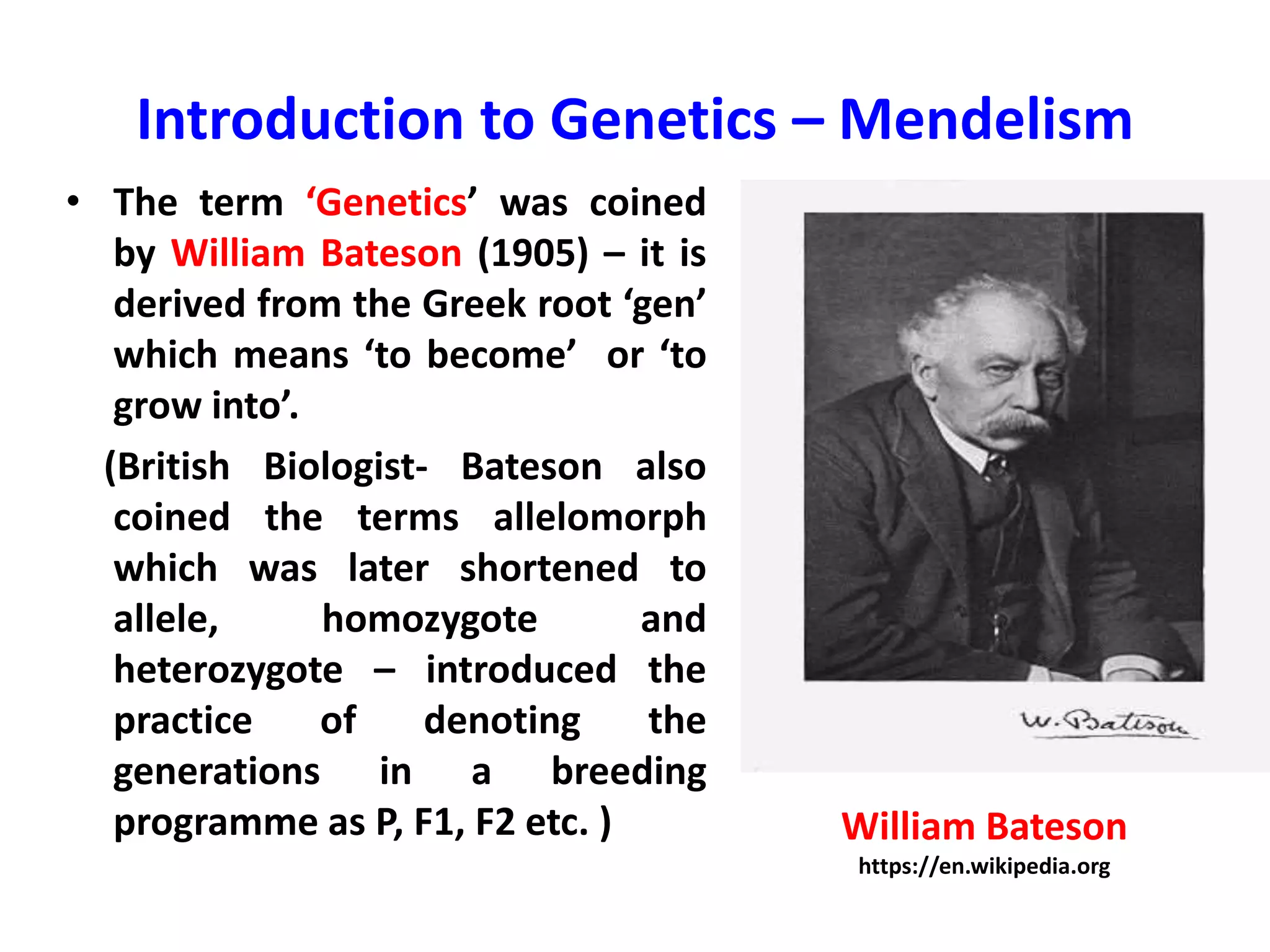
• The term ‘Genetics’ was coined
by William Bateson (1905) – it is
derived from the Greek root ‘gen’
which means ‘to become’ or ‘to
grow into’.
(British Biologist- Bateson also
coined the terms allelomorph
which was later shortened to
allele, homozygote and
heterozygote – introduced the
practice of denoting the
generations in a breeding
programme as P, F1, F2 etc. ) William Bateson
https://en.wikipedia.org
Genetics
• A branch of Biology which deals with the study of
mechanism of inheritance by which characters pass from
parents to offspring.
• The transmission of characters, resemblances as well as
variations, from one generation to the next is called heredity
(Latin heriditas = heirship). The offspring have a tendency to
resemble their parents and also among themselves. This also
is often referred to as heredity. However, the likeness never
amounts to complete identity.
• The differences shown by the individuals of a species and
also by the offspring of the same parents are referred to as
variations.
• So, Genetics can be defined as the branch of Biology that
deals with the study of heredity and variation.
• The variations are due to differences in the elements
responsible for heredity, the genes, which undergo changes
known as mutations. These variations are known as
heritable variations and are transmitted from one
generation to the other.
• It has also been noted that two individuals with the same
genetic constitution as the identical twins may become
different in external appearance when they come into
contact with different conditions of food, temperature, light,
humidity etc. Such differences among organisms of similar
heredity are known as environmental variations or
modifications. These variations are not transmitted from
one generation to the other and are called non-heritable
variations.
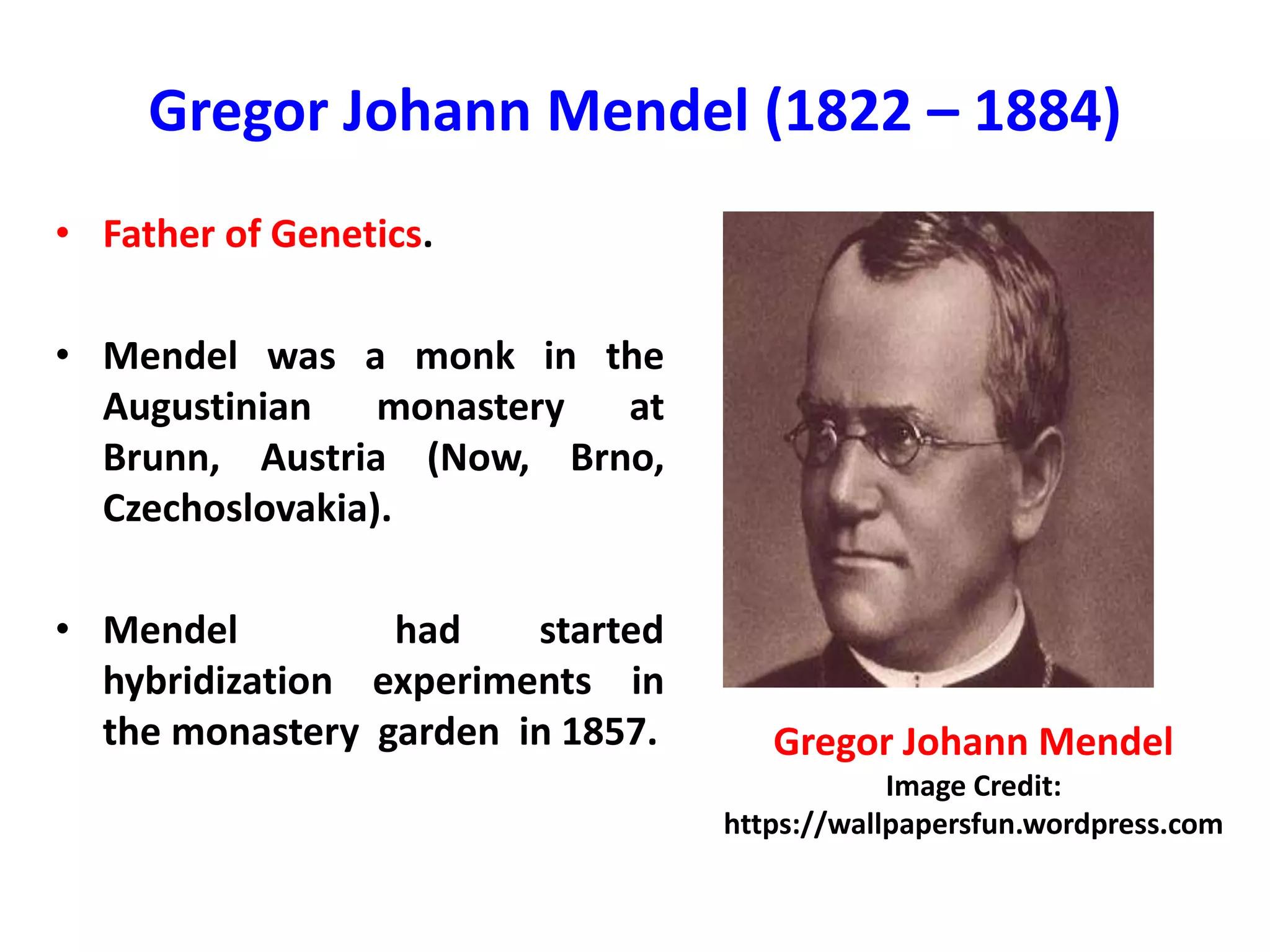
Gregor Johann Mendel (1822 – 1884)
• Father of Genetics.
• Mendel was a monk in the
Augustinian monastery at
Brunn, Austria (Now, Brno,
Czechoslovakia).
• Mendel had started
hybridization experiments in
the monastery garden in 1857. Gregor Johann Mendel
Image Credit:
https://wallpapersfun.wordpress.com
• After eight years of hybridization experiments, Mendel
formulated certain principles. His findings were presented
at two meetings of the Natural History Society of Brunn in
1865. Mendel’s paper appeared in the Annual Proceedings
of the society in 1866. Mendel’s findings were much ahead
of his time and no one at that time recognized the
significance and lay neglected for a period of 34 years.
( Mendel’s paper : Mendel, Gregor. 1866. Versuche über
Plflanzenhybriden. Verhandlungen des naturforschenden
Vereines in Brünn, Bd. IV für das Jahr 1865, Abhandlungen,
3–47. Mendel’s paper was first translated into English by
William Bateson in 1901 - EXPERIMENTS IN PLANT
HYBRIDIZATION ).
• Later Mendel continued his
experiments with other plants
and bees and also turned to
meteorological observations.
• Mendel became the Abbot of
the monastery in 1868 and
concentrated more on its
administration. He died in
1884.
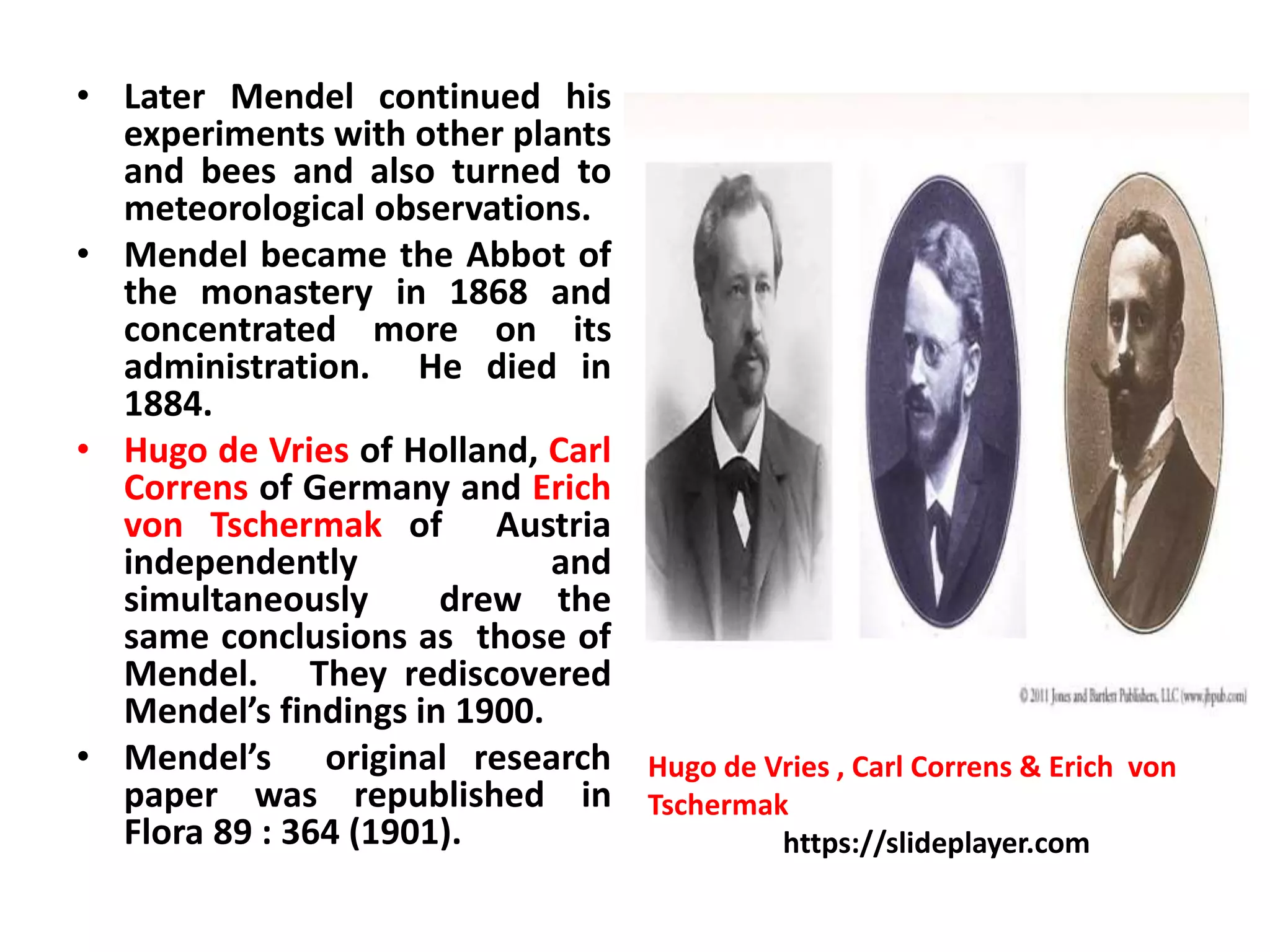
• Hugo de Vries of Holland, Carl
Correns of Germany and Erich
von Tschermak of Austria
independently and
simultaneously drew the
same conclusions as those of
Mendel. They rediscovered
Mendel’s findings in 1900.
• Mendel’s original research
paper was republished in
Flora 89 : 364 (1901).
Hugo de Vries , Carl Correns & Erich von
Tschermak
https://slideplayer.com
Terminology and Symbols in Genetics
• Genome - The DNA content of the cells- a
single complete set of chromosomes.
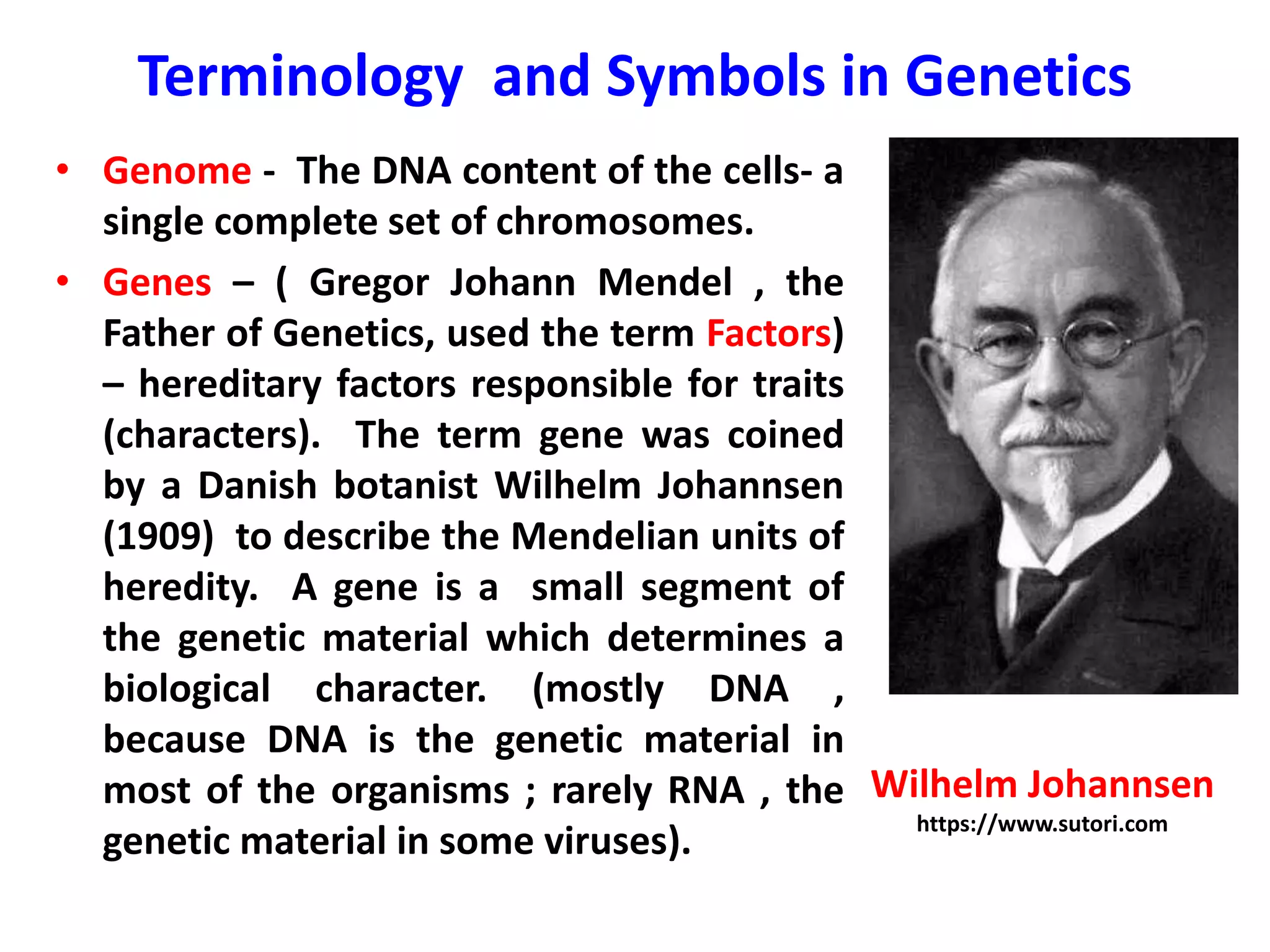
• Genes – ( Gregor Johann Mendel , the
Father of Genetics, used the term Factors)
– hereditary factors responsible for traits
(characters). The term gene was coined
by a Danish botanist Wilhelm Johannsen
(1909) to describe the Mendelian units of
heredity. A gene is a small segment of
the genetic material which determines a
biological character. (mostly DNA ,
because DNA is the genetic material in
most of the organisms ; rarely RNA , the
genetic material in some viruses).
Wilhelm Johannsen
https://www.sutori.com
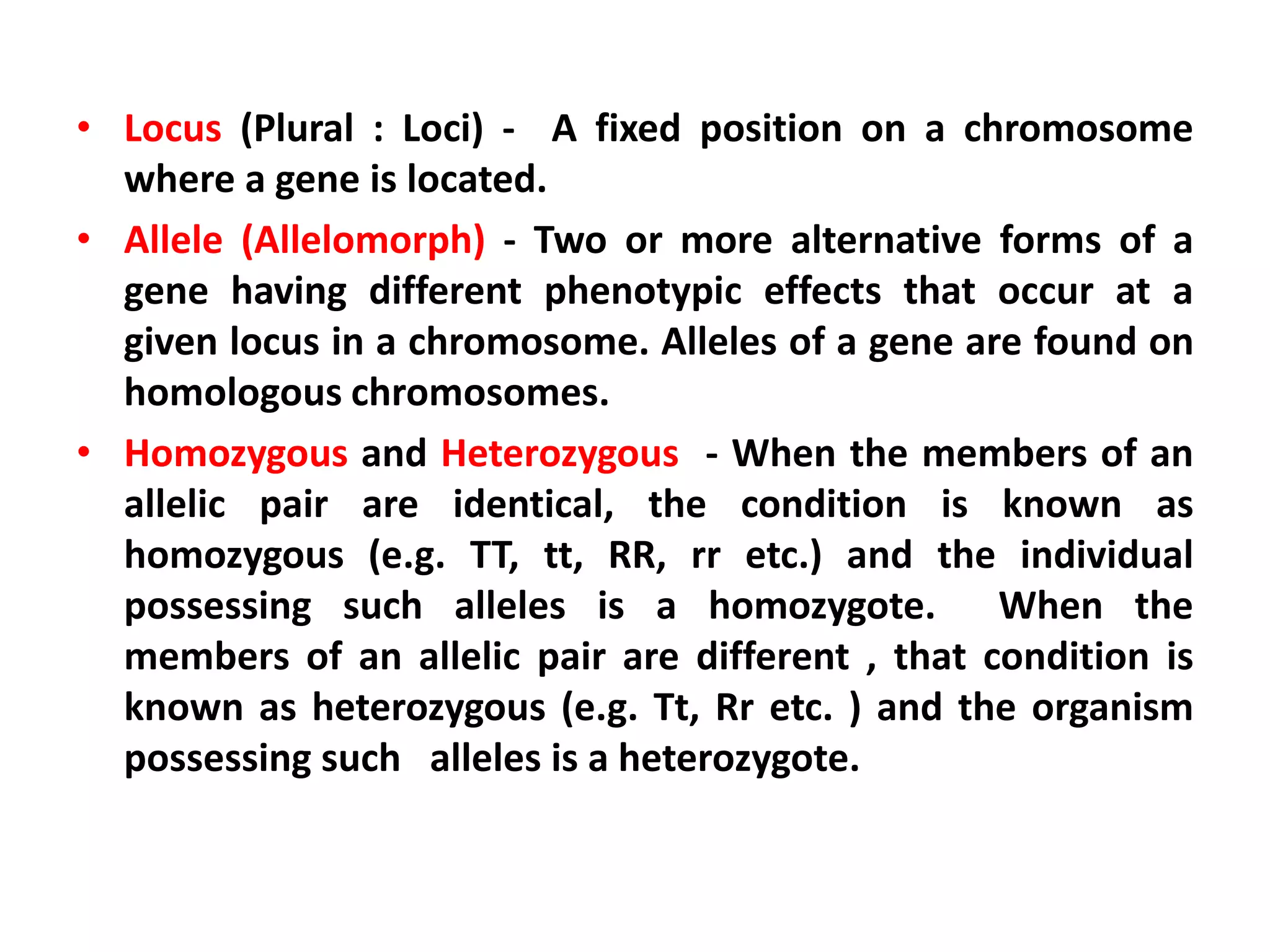
• Locus (Plural : Loci) - A fixed position on a chromosome
where a gene is located.
• Allele (Allelomorph) - Two or more alternative forms of a
gene having different phenotypic effects that occur at a
given locus in a chromosome. Alleles of a gene are found on
homologous chromosomes.
• Homozygous and Heterozygous - When the members of an
allelic pair are identical, the condition is known as
homozygous (e.g. TT, tt, RR, rr etc.) and the individual
possessing such alleles is a homozygote. When the
members of an allelic pair are different , that condition is
known as heterozygous (e.g. Tt, Rr etc. ) and the organism
possessing such alleles is a heterozygote.
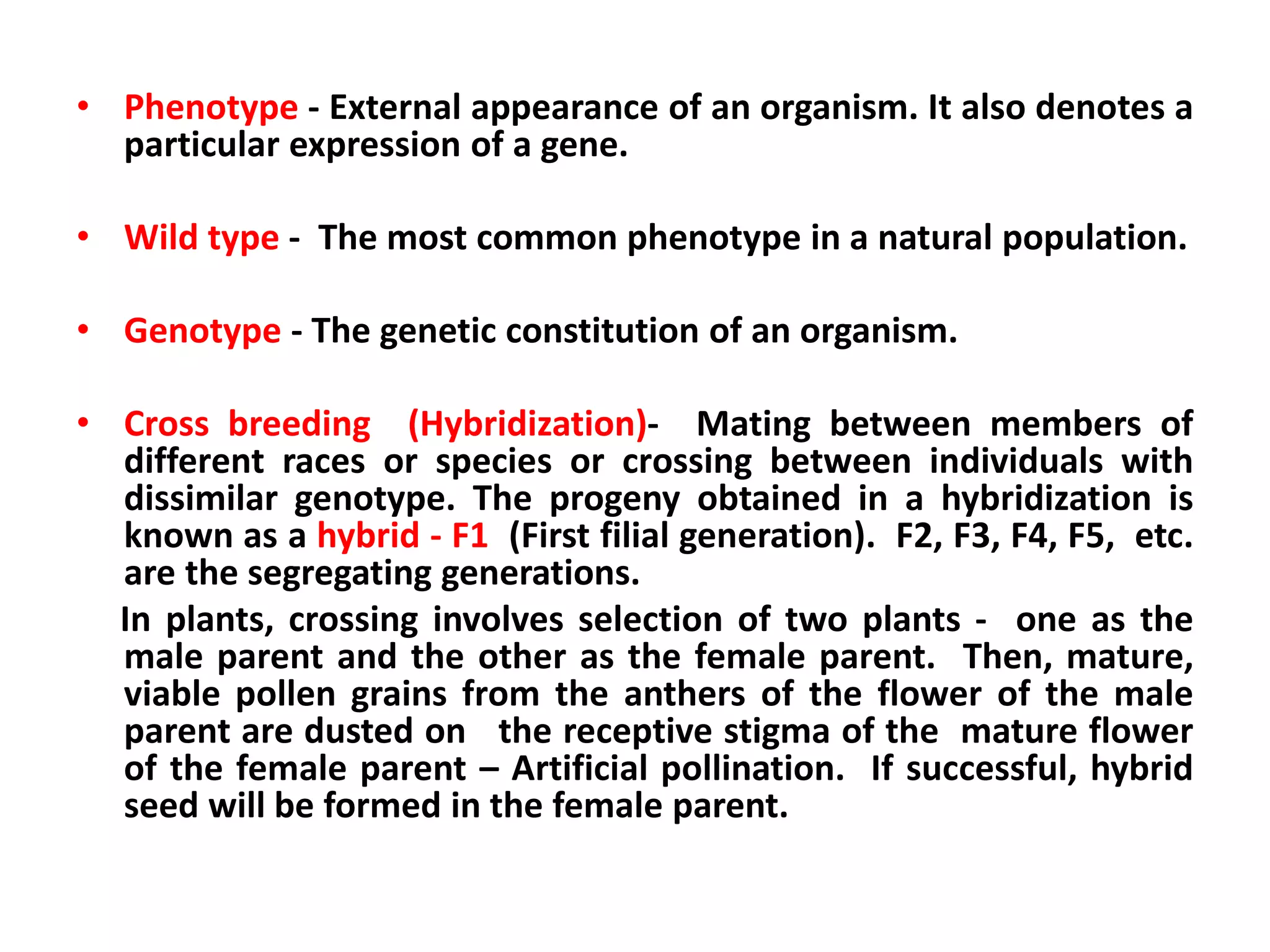
• Phenotype - External appearance of an organism. It also denotes a
particular expression of a gene.
• Wild type - The most common phenotype in a natural population.
• Genotype - The genetic constitution of an organism.
• Cross breeding (Hybridization)- Mating between members of
different races or species or crossing between individuals with
dissimilar genotype. The progeny obtained in a hybridization is
known as a hybrid - F1 (First filial generation). F2, F3, F4, F5, etc.
are the segregating generations.
In plants, crossing involves selection of two plants - one as the
male parent and the other as the female parent. Then, mature,
viable pollen grains from the anthers of the flower of the male
parent are dusted on the receptive stigma of the mature flower
of the female parent – Artificial pollination. If successful, hybrid
seed will be formed in the female parent.
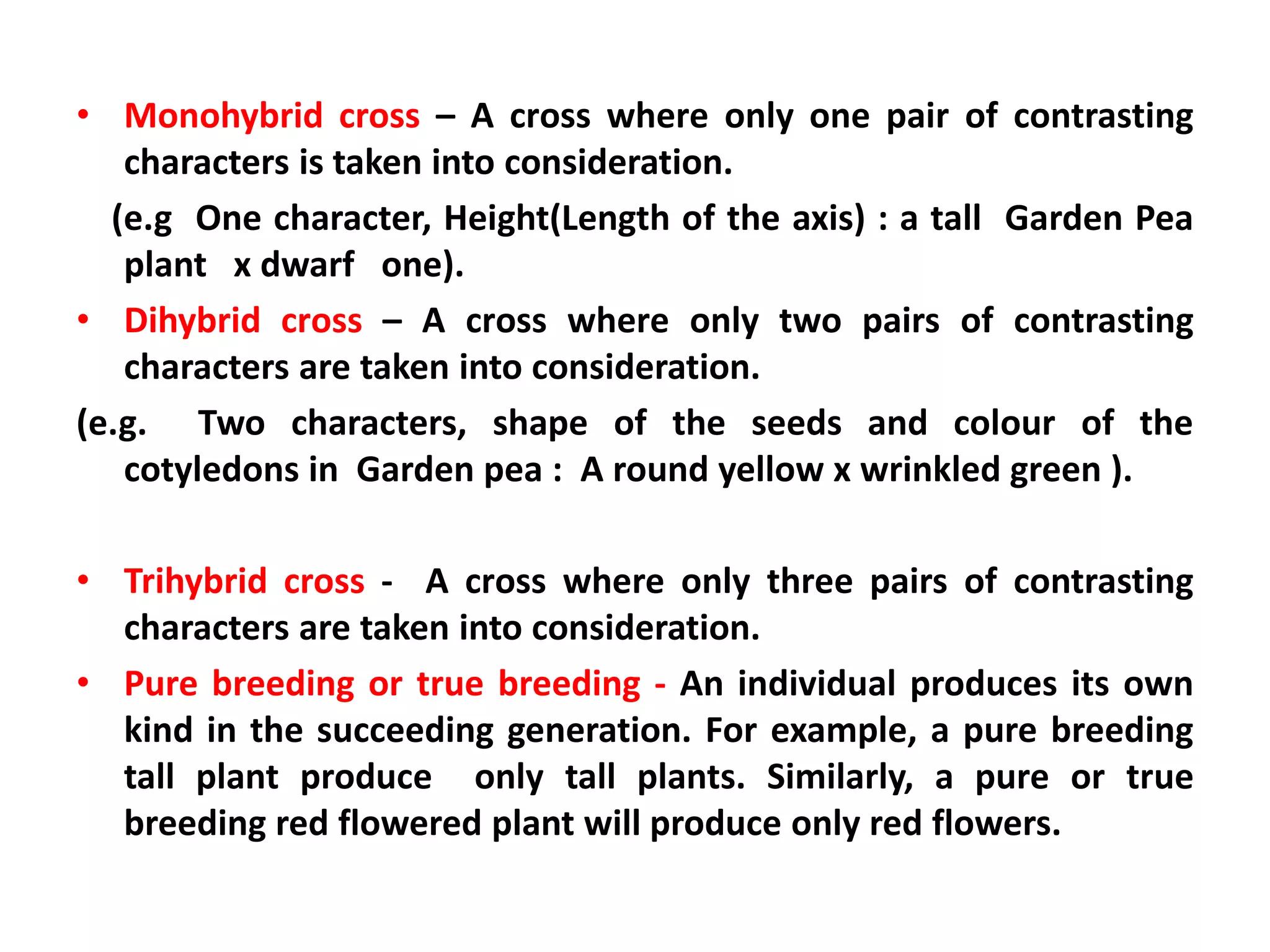
• Monohybrid cross – A cross where only one pair of contrasting
characters is taken into consideration.
(e.g One character, Height(Length of the axis) : a tall Garden Pea
plant x dwarf one).
• Dihybrid cross – A cross where only two pairs of contrasting
characters are taken into consideration.
(e.g. Two characters, shape of the seeds and colour of the
cotyledons in Garden pea : A round yellow x wrinkled green ).
• Trihybrid cross - A cross where only three pairs of contrasting
characters are taken into consideration.
• Pure breeding or true breeding - An individual produces its own
kind in the succeeding generation. For example, a pure breeding
tall plant produce only tall plants. Similarly, a pure or true
breeding red flowered plant will produce only red flowers.
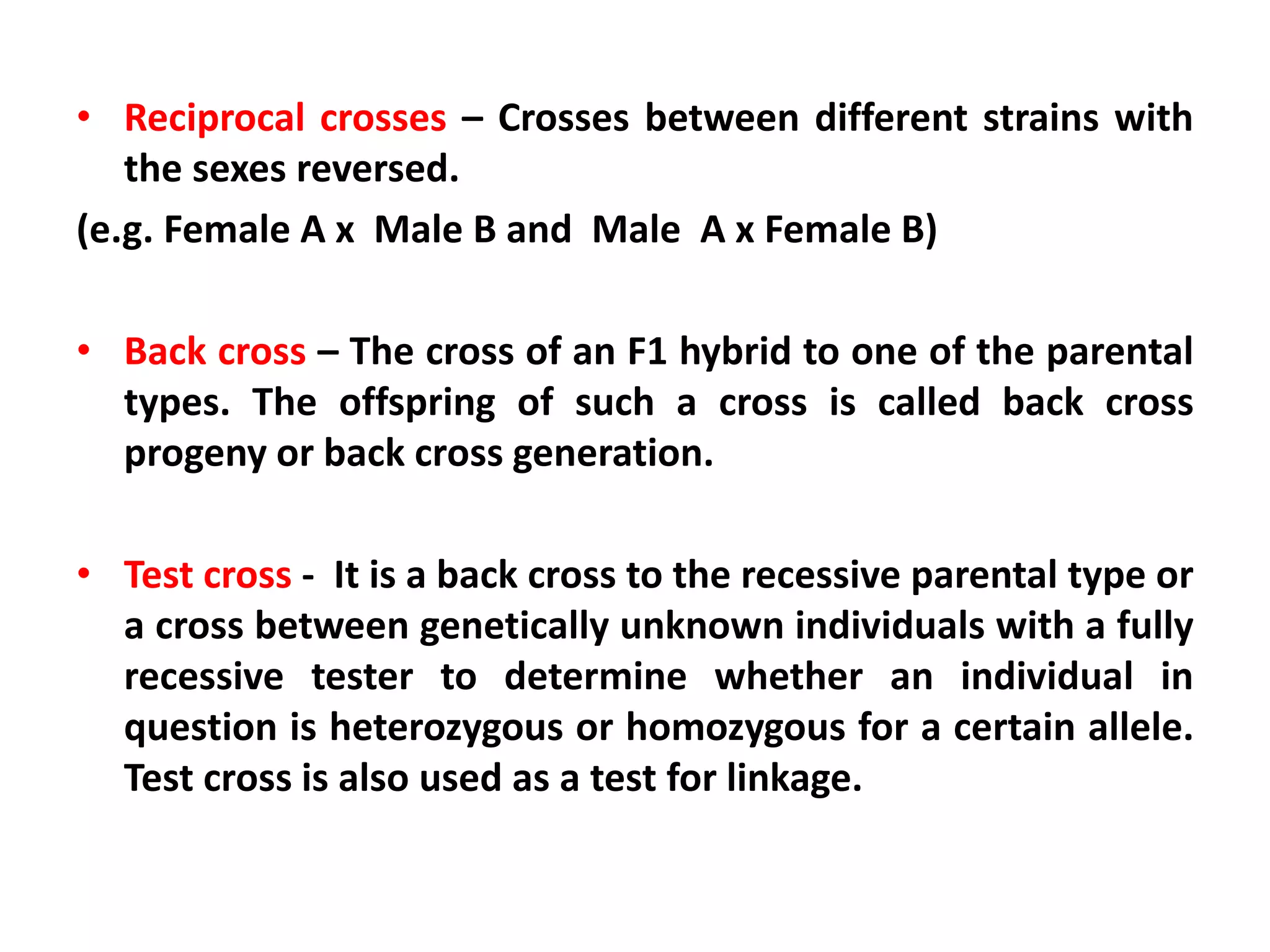
• Reciprocal crosses – Crosses between different strains with
the sexes reversed.
(e.g. Female A x Male B and Male A x Female B)
• Back cross – The cross of an F1 hybrid to one of the parental
types. The offspring of such a cross is called back cross
progeny or back cross generation.
• Test cross - It is a back cross to the recessive parental type or
a cross between genetically unknown individuals with a fully
recessive tester to determine whether an individual in
question is heterozygous or homozygous for a certain allele.
Test cross is also used as a test for linkage.
• Genetic Symbols - English alphabets are commonly used to represent
gene.
• Generally, a capital letter is used to represent the dominant allele
and the lower case , the recessive allele.
e.g. Let ‘T’ represent the dominant allele for tallness in Pea plant and ‘t’
for the recessive allele for dwarfness .
(Some geneticists prefer to use the capital letter of the word
describing the recessive trait to represent the allele for the dominant
trait. For example , ‘D’ for the allele for tall and ‘d’ for the allele for
dwarf) .
• Another method is to use ‘+’ sign for the wild type allele and the
mutant allele by a capital or a small letter depending upon whether
the mutant allele is dominant or recessive (by Drosophila
geneticists).
• In the case of multiple alleles that control ABO blood group system in
humans, the gene responsible for the production of A and B
antigens is denoted by the letter I ( I - stands for isoagglutinogen,
another term for antigen). It has three alleles- IA, IB and i. IA allele
specifies the production of the A antigen , the IB allele specifies the
production of B antigen and the i allele does not specify an antigen.
Mendel’s Experiments
• Mendel was not the first person to conduct hybridization
experiments.
• But, his predecessors had failed to trace the mechanism of
inheritance.
• Mendel was familiar with the works of his predecessors.
• His success mainly depends upon the wise choice of the
experimental material and his method of study.
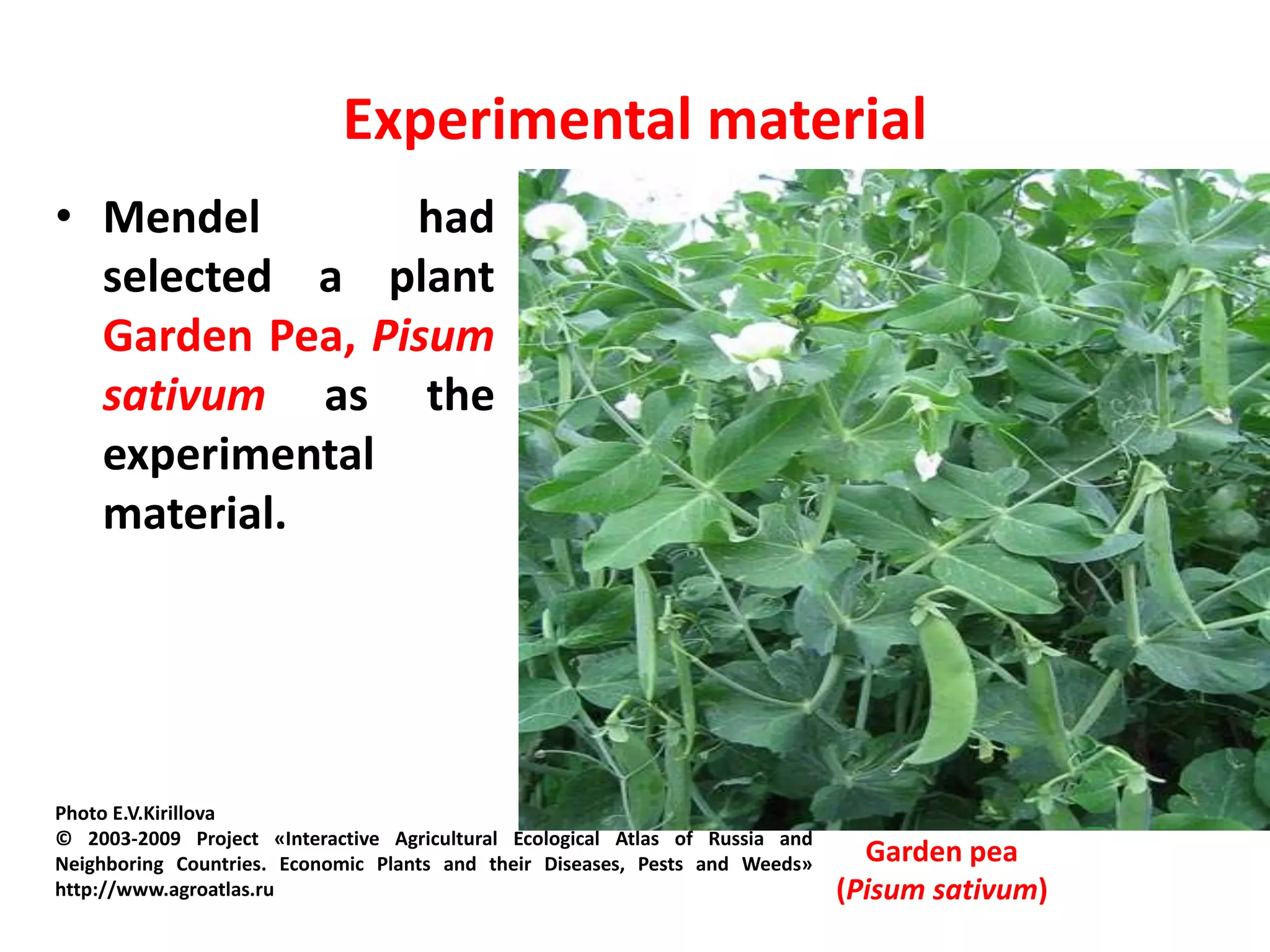
Experimental material
• Mendel had
selected a plant
Garden Pea, Pisum
sativum as the
experimental
material.
Garden pea
(Pisum sativum)
Photo E.V.Kirillova
© 2003-2009 Project «Interactive Agricultural Ecological Atlas of Russia and
Neighboring Countries. Economic Plants and their Diseases, Pests and Weeds»
http://www.agroatlas.ru
Advantages of Garden pea as the experimental material :
• Garden pea has constant differentiating characteristics – has
easily recognizable differences in
a) length and color of the stem
b) size and form of the leaves
c) position, color and size of the flowers
d) length of the petiole
e) color, form and size of the pods
f) form and size of the seeds
g) color of the seed coats and cotyledons.
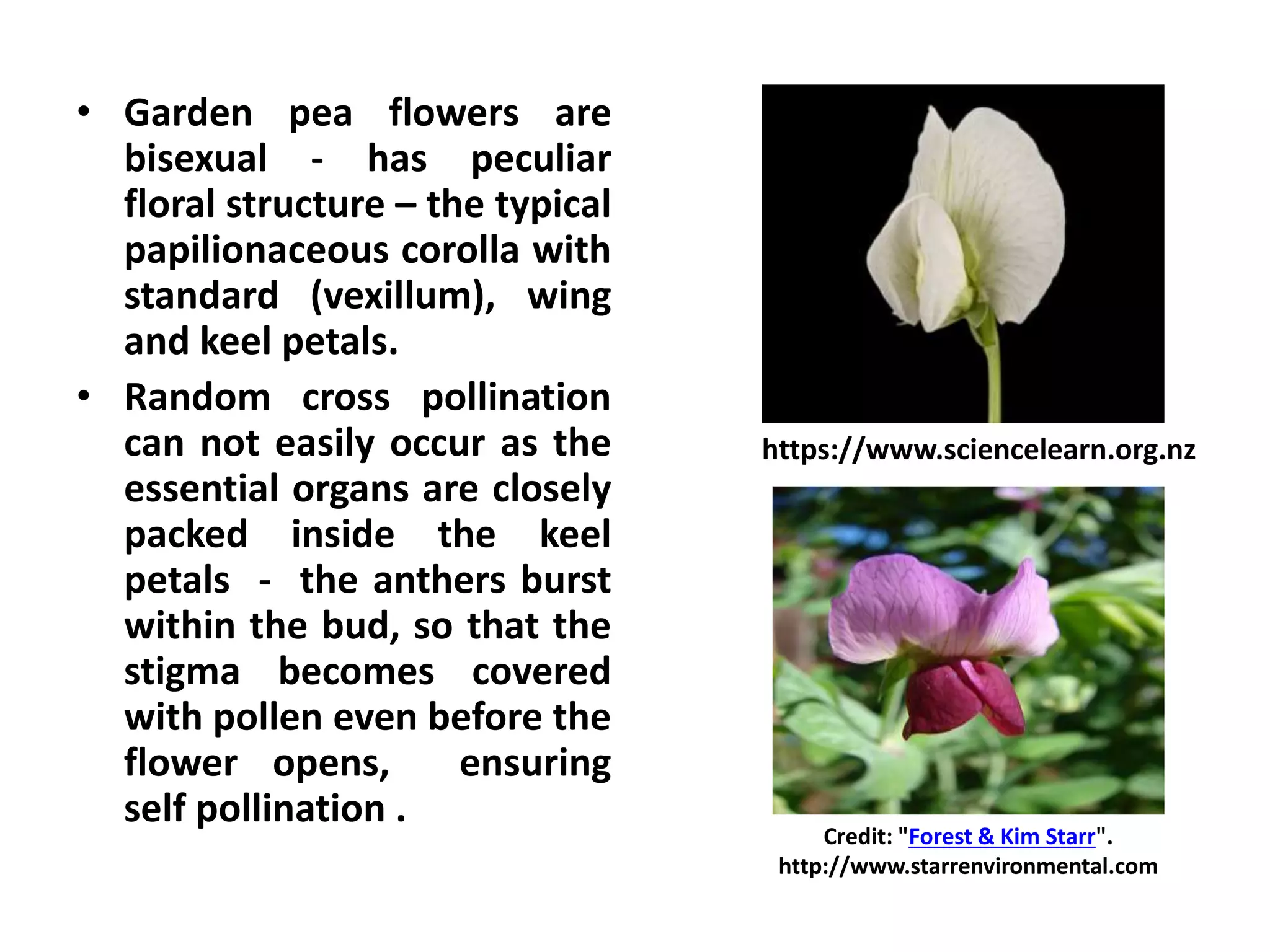
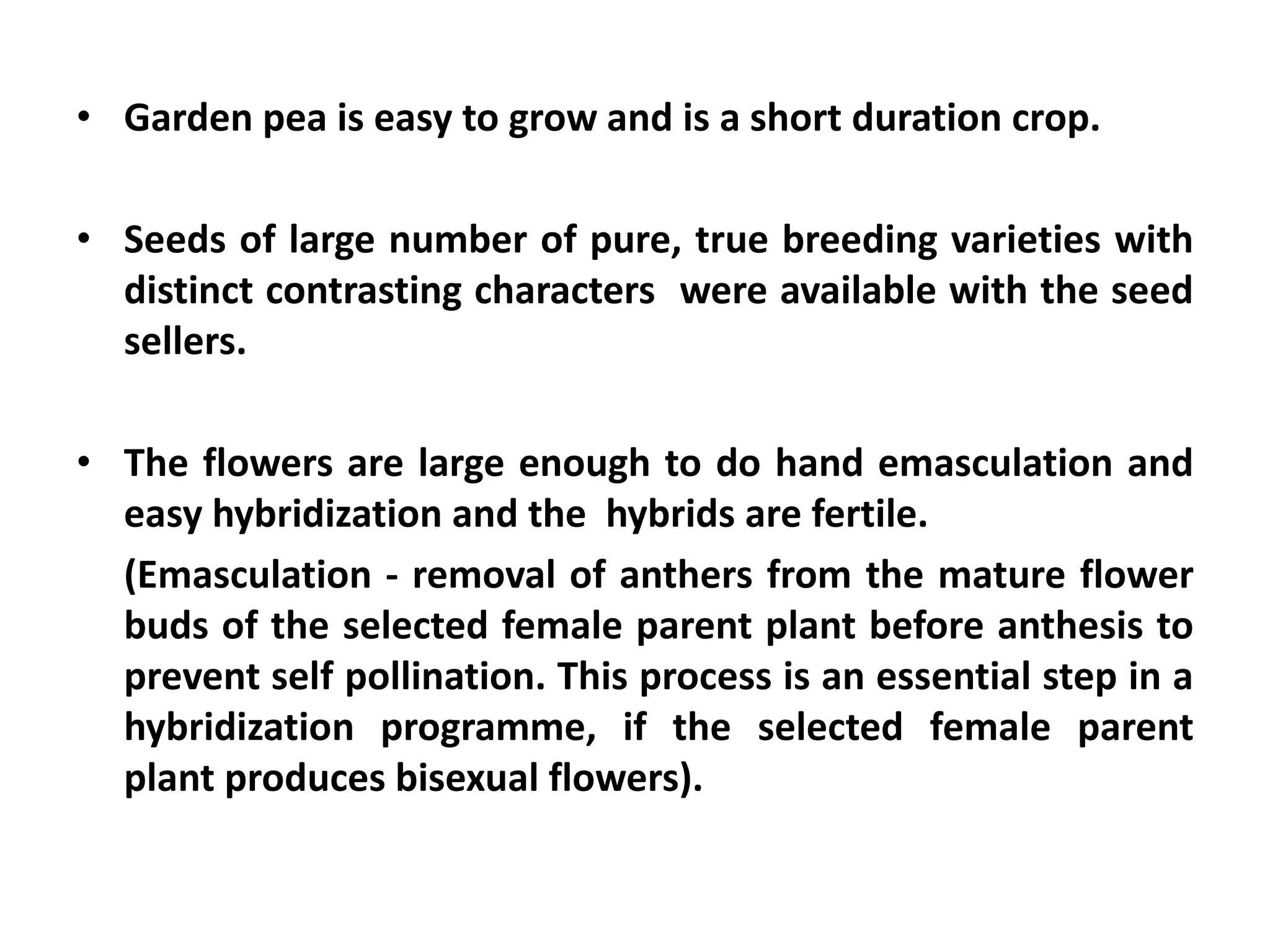
• Garden pea flowers are
bisexual - has peculiar
floral structure – the typical
papilionaceous corolla with
standard (vexillum), wing
and keel petals.
• Random cross pollination
can not easily occur as the
essential organs are closely
packed inside the keel
petals - the anthers burst
within the bud, so that the
stigma becomes covered
with pollen even before the
flower opens, ensuring
self pollination .
https://www.sciencelearn.org.nz
Credit: "Forest & Kim Starr".
http://www.starrenvironmental.com
• Garden pea is easy to grow and is a short duration crop.
• Seeds of large number of pure, true breeding varieties with
distinct contrasting characters were available with the seed
sellers.
• The flowers are large enough to do hand emasculation and
easy hybridization and the hybrids are fertile.
(Emasculation - removal of anthers from the mature flower
buds of the selected female parent plant before anthesis to
prevent self pollination. This process is an essential step in a
hybridization programme, if the selected female parent
plant produces bisexual flowers).
Mendel’s method of study
• The approach of Mendel was simple, logical, scientific,
mathematical and analytical.
• In garden peas, a number of differentiating characters were
available. Mendel collected seeds of pure breeding varieties
of Garden pea (Pisum sativum) from the seed sellers and
grown them in monastery garden. (collected seeds of 34
distinct varieties from seeds men – 22 of these were
selected and cultivated during the whole period of Mendel’s
experiments) .
• Mendel selected seven pairs of differentiating characters for
his study such as
1. Differences in the length of the stem (height) - (long axis of
6 to 7 ft(Tall ) vs. short one of ¾ ft. to 1½ ft (Dwarf)
2. Flower colour (Violet vs. White)
3. Position of the flowers (Axial vs. Terminal)
4. Color of the unripe pods (Green vs. Yellow)
5. Form of the ripe pods (Inflated vs. Constricted)
6. Form of the ripe seeds (Round vs. Wrinkled)
7. Colour of cotyledons (Yellow vs. Green)
• Most vigorous plants were selected for hybridization.
• Mendel’s predecessors made observations on plants and
animals as a whole and studied all the variations at a time.
Mendel, however, concentrated on a single character at a
time. For example, flower colour, vine height etc. Mendel
crossed two Garden pea plants differing in a pair of
contrasting characters (Monohybrid cross). (e.g. a tall
Garden pea plant x a dwarf one) and observed the
appearance of the hybrid or F1 generation (First filial
generation).
• In all the experiments, reciprocal crosses were also carried
out.
• Mendel then allowed the F1 plants to undergo self
fertilization and raised the second generation, F2. He
analyzed the results quantitatively. In the F2, he counted
the number of progeny possessing each of the contrasting
traits in which the parents differed.
• Mendel followed this method for all the seven characters
chosen for the study .
• When the behaviour of each single trait was established,
Mendel studied two traits together (Dihybrid cross).
• Mendel kept pedigree records. Thus he knew the exact
ancestry of each plant and the characteristics of its parents
and offspring.
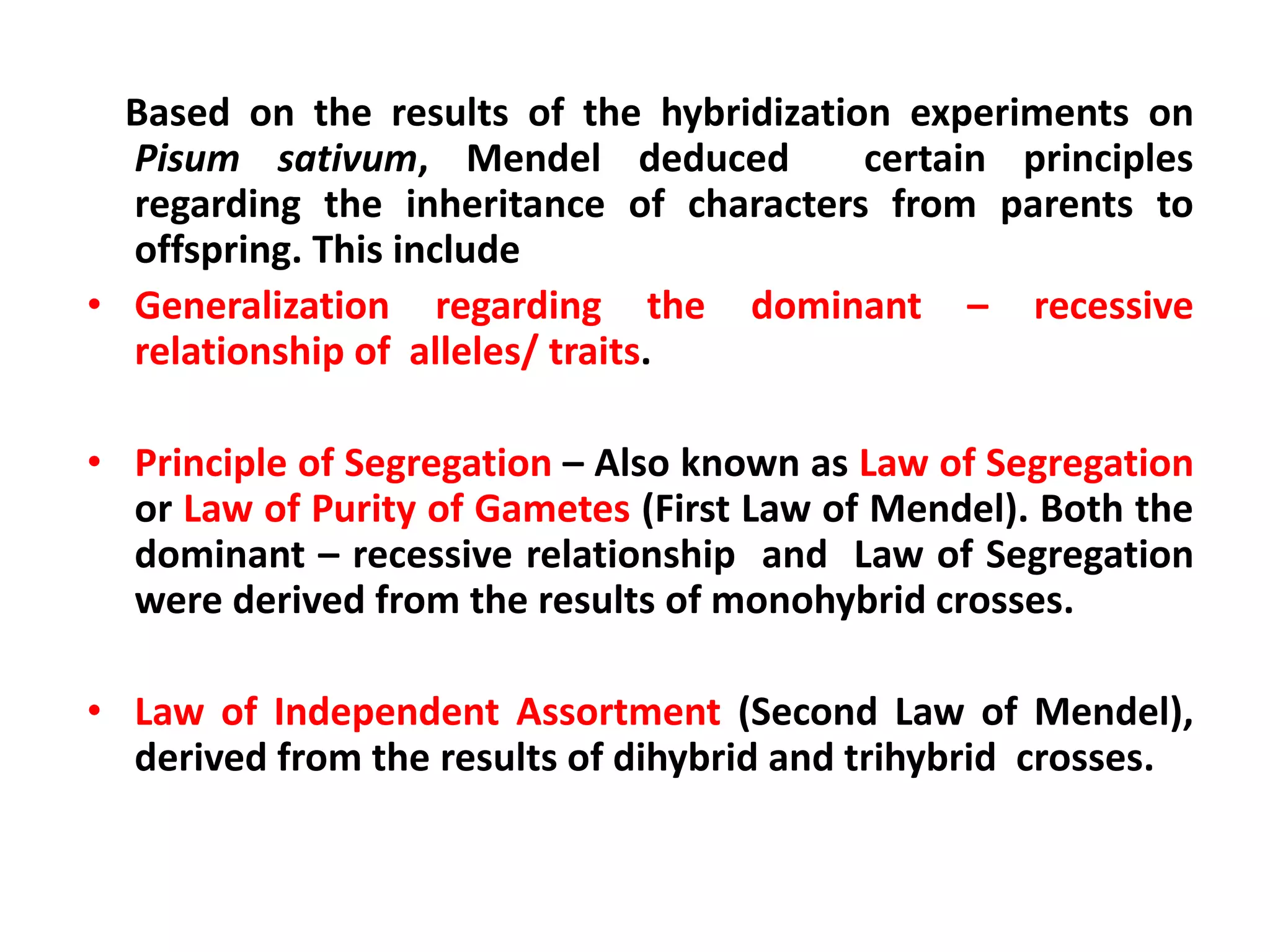
Based on the results of the hybridization experiments on
Pisum sativum, Mendel deduced certain principles
regarding the inheritance of characters from parents to
offspring. This include
• Generalization regarding the dominant – recessive
relationship of alleles/ traits.
• Principle of Segregation – Also known as Law of Segregation
or Law of Purity of Gametes (First Law of Mendel). Both the
dominant – recessive relationship and Law of Segregation
were derived from the results of monohybrid crosses.
• Law of Independent Assortment (Second Law of Mendel),
derived from the results of dihybrid and trihybrid crosses.
Monohybrid cross
• A cross (hybridization) where only one pair of contrasting
characters are taken into consideration.
• Mendel had carried out monohybrid crosses in the selected
seven pairs of contrasting characters in Garden pea (Pisum
sativum).
• Mendel crossed a pure or true breeding tall (length of the
stem - long axis of 6 to 7 ft) Garden pea with a dwarf one
(short one of ¾ ft. to 1½ ft ).
• Let T stands for the allele for tallness and t for the allele for
dwarfness. Each individual receives an allele for a trait from
both the parents. So the genotype of the pure or true
breeding tall plant can be represented as TT and that of
the dwarf plant as tt.
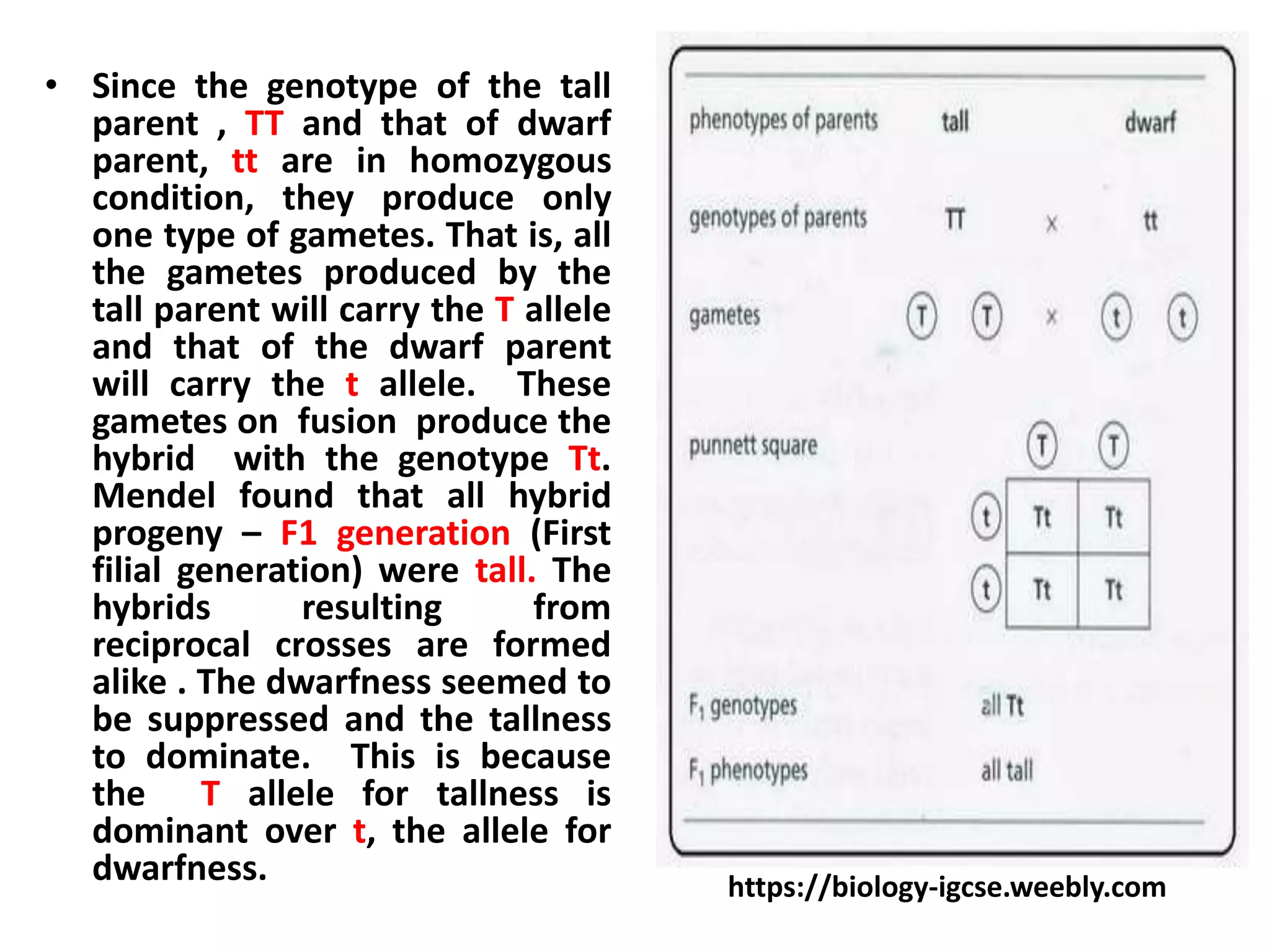
• Since the genotype of the tall
parent , TT and that of dwarf
parent, tt are in homozygous
condition, they produce only
one type of gametes. That is, all
the gametes produced by the
tall parent will carry the T allele
and that of the dwarf parent
will carry the t allele. These
gametes on fusion produce the
hybrid with the genotype Tt.
Mendel found that all hybrid
progeny – F1 generation (First
filial generation) were tall. The
hybrids resulting from
reciprocal crosses are formed
alike . The dwarfness seemed to
be suppressed and the tallness
to dominate. This is because
the T allele for tallness is
dominant over t, the allele for
dwarfness. https://biology-igcse.weebly.com
• Mendel then allowed the F1 plants to undergo self
fertilization and raised the second generation or F2.
• Mendel found that in contrast to the uniformity of the trait
under consideration in F1 hybrids (Tt - all tall) , the F2 plants
produced by the selfing of F1 plants, differed ( TT, Tt -both
tall and tt - dwarf).
• The trait or the character which was hidden or suppressed
in the F1 generation , the dwarfness reappeared in ¼ of the
progeny. Thus, F2 progeny consisted of two types of plants,
one group exhibiting the dominant phenotype and the
other, the recessive.
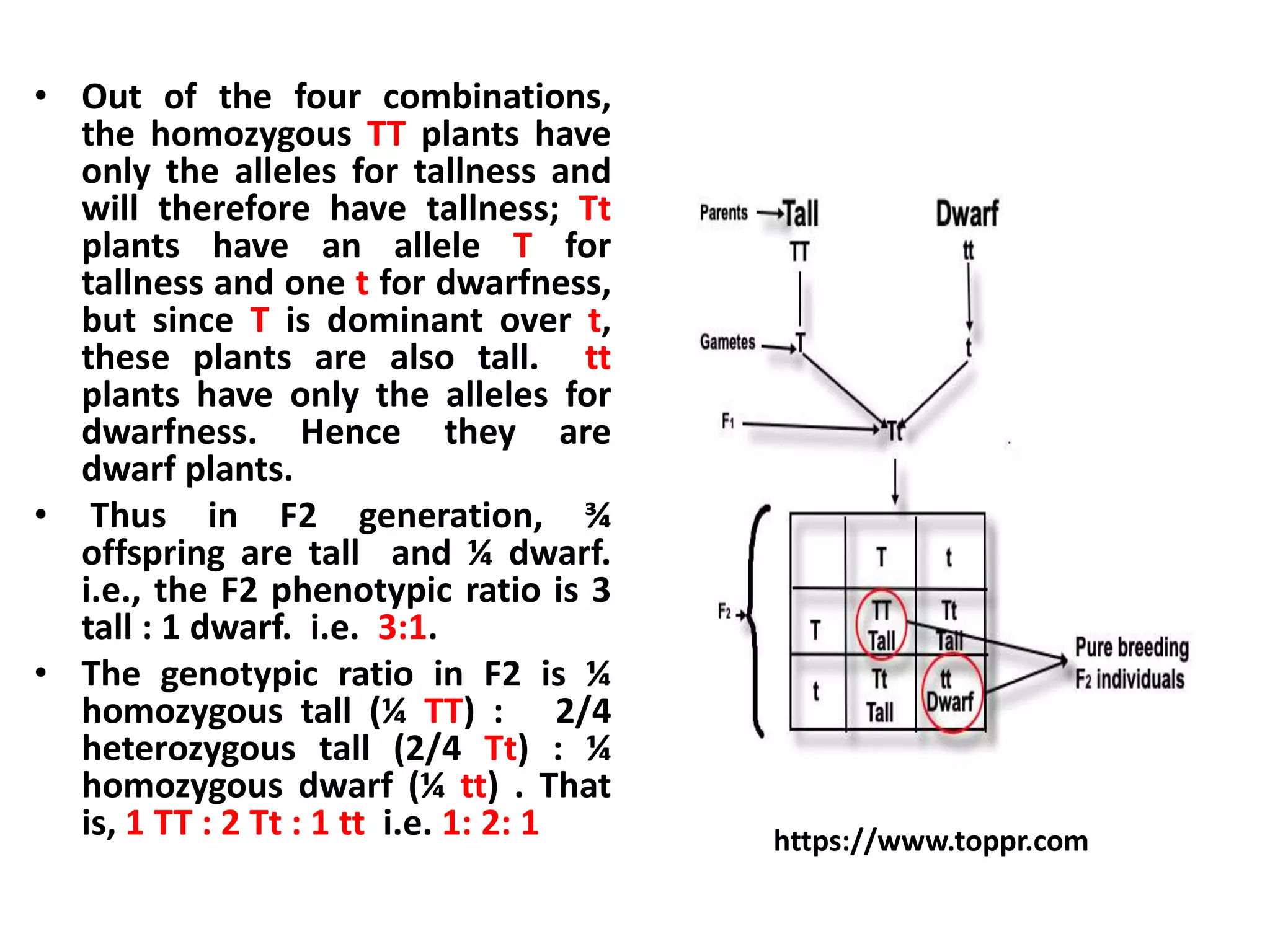
• Out of the four combinations,
the homozygous TT plants have
only the alleles for tallness and
will therefore have tallness; Tt
plants have an allele T for
tallness and one t for dwarfness,
but since T is dominant over t,
these plants are also tall. tt
plants have only the alleles for
dwarfness. Hence they are
dwarf plants.
• Thus in F2 generation, ¾
offspring are tall and ¼ dwarf.
i.e., the F2 phenotypic ratio is 3
tall : 1 dwarf. i.e. 3:1.
• The genotypic ratio in F2 is ¼
homozygous tall (¼ TT) : 2/4
heterozygous tall (2/4 Tt) : ¼
homozygous dwarf (¼ tt) . That
is, 1 TT : 2 Tt : 1 tt i.e. 1: 2: 1 https://www.toppr.com
• All the seven characters in Garden pea studied by Mendel
behaved in a similar way, one of each pair of contrasting
characters appear in the F1 generation while the other get
suppressed or hidden or masked.
• Thus tall vine habit was found to be dominant over dwarf,
violet flower colour over white, round seed over wrinkled,
yellow colour of the cotyledons over the green , inflated
form of pod over the constricted, the green colour of the
unripe pod over yellow and the axillary position of the
flowers over the terminal.
• Mendel also counted the number of progeny in the F2
generation possessing each of the contrasting characters in
which the parent plants differed.
• He found that ¾ of the F2 generation resembled the
dominant grandparent and ¼ resembled the recessive
grandparent in all crosses.
• Thus, Mendel found a 3:1 F2 phenotypic ratio (3 dominant
phenotype : 1 recessive phenotype ) in all monohybrid
crosses involving seven pairs of contrasting characters.
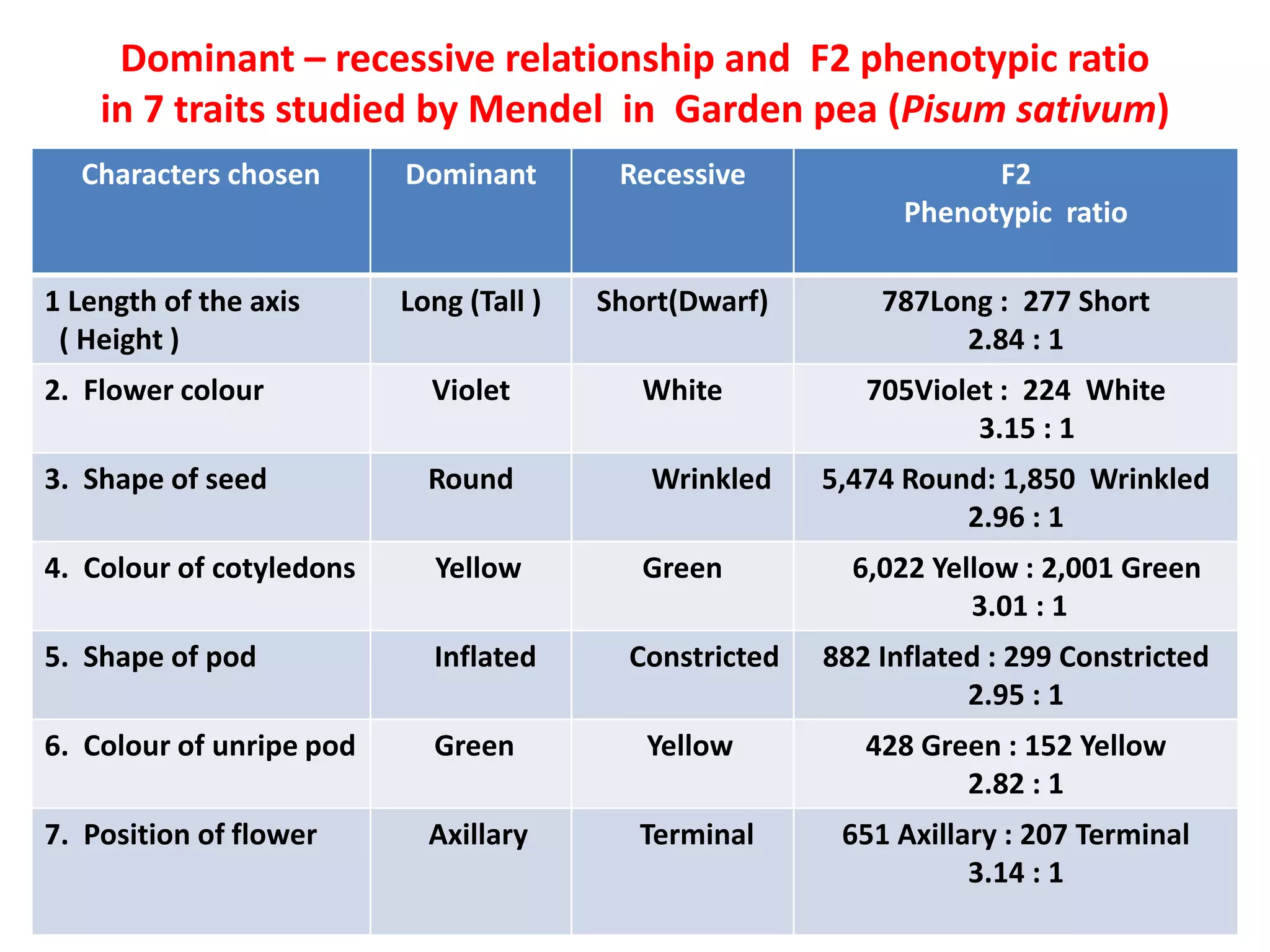
Dominant – recessive relationship and F2 phenotypic ratio
in 7 traits studied by Mendel in Garden pea (Pisum sativum)
Characters chosen Dominant Recessive F2
Phenotypic ratio
1 Length of the axis
( Height )
Long (Tall ) Short(Dwarf) 787Long : 277 Short
2.84 : 1
2. Flower colour Violet White 705Violet : 224 White
3.15 : 1
3. Shape of seed Round Wrinkled 5,474 Round: 1,850 Wrinkled
2.96 : 1
4. Colour of cotyledons Yellow Green 6,022 Yellow : 2,001 Green
3.01 : 1
5. Shape of pod Inflated Constricted 882 Inflated : 299 Constricted
2.95 : 1
6. Colour of unripe pod Green Yellow 428 Green : 152 Yellow
2.82 : 1
7. Position of flower Axillary Terminal 651 Axillary : 207 Terminal
3.14 : 1
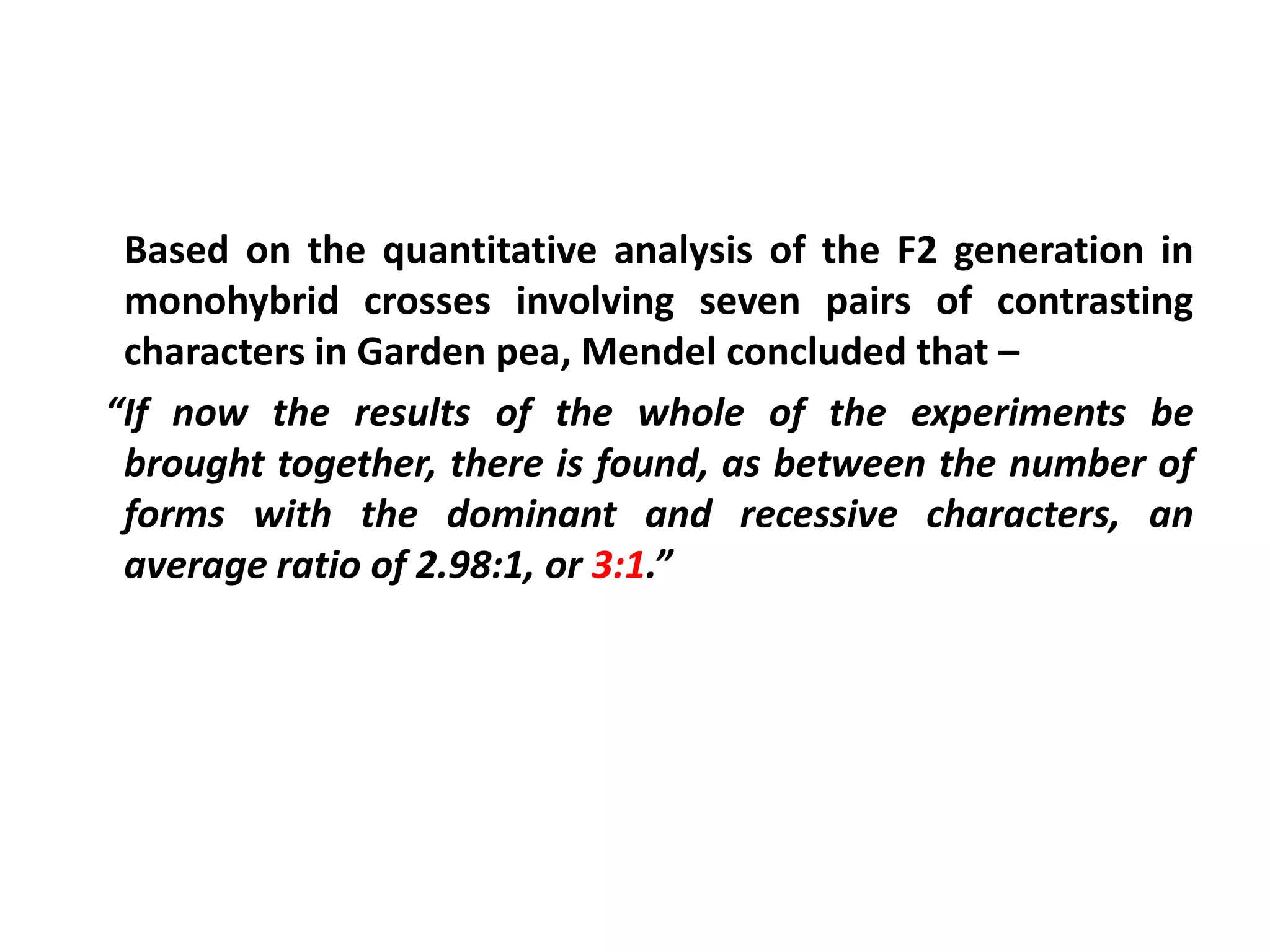
Based on the quantitative analysis of the F2 generation in
monohybrid crosses involving seven pairs of contrasting
characters in Garden pea, Mendel concluded that –
“If now the results of the whole of the experiments be
brought together, there is found, as between the number of
forms with the dominant and recessive characters, an
average ratio of 2.98:1, or 3:1.”
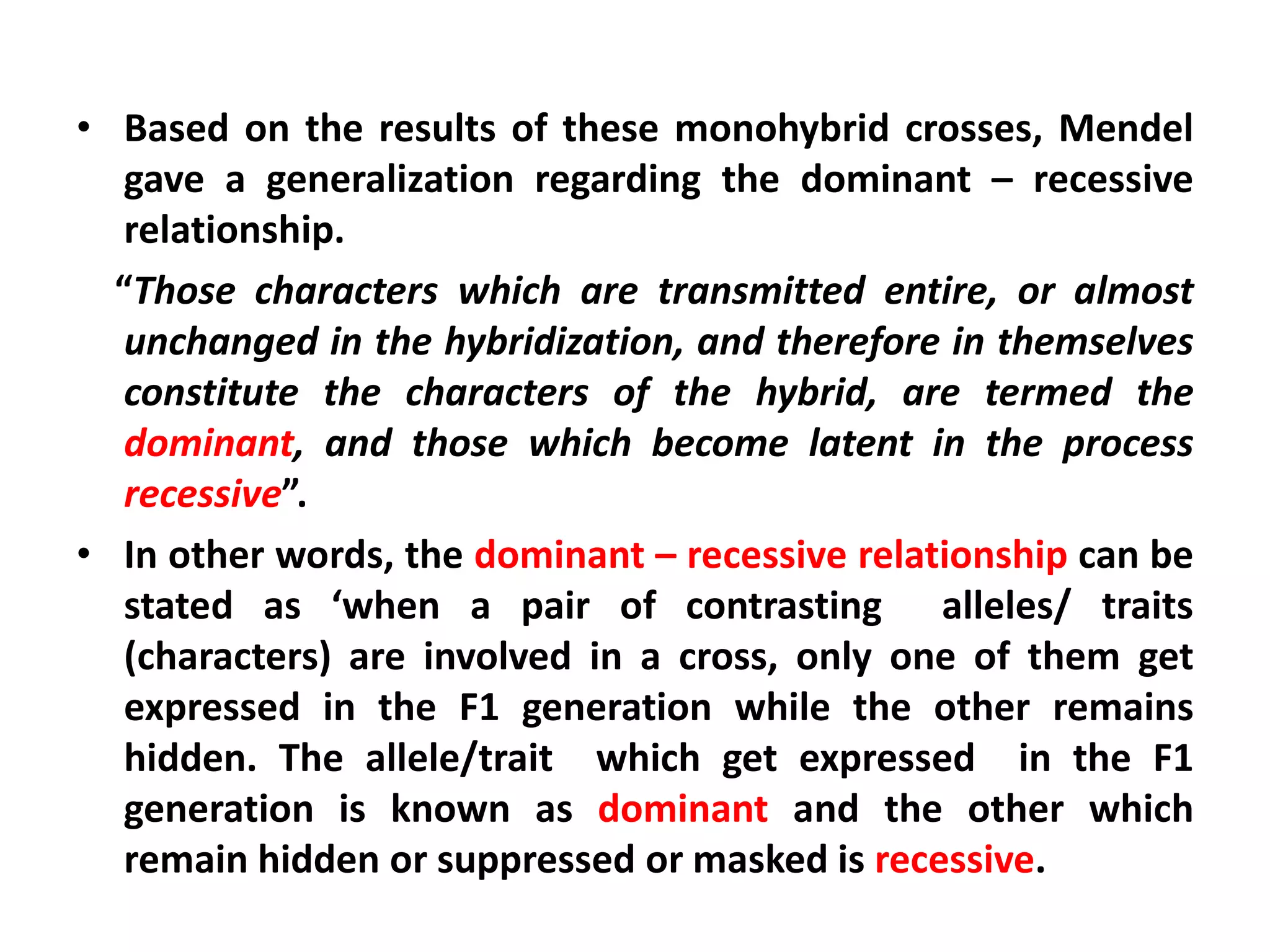
• Based on the results of these monohybrid crosses, Mendel
gave a generalization regarding the dominant – recessive
relationship.
“Those characters which are transmitted entire, or almost
unchanged in the hybridization, and therefore in themselves
constitute the characters of the hybrid, are termed the
dominant, and those which become latent in the process
recessive”.
• In other words, the dominant – recessive relationship can be
stated as ‘when a pair of contrasting alleles/ traits
(characters) are involved in a cross, only one of them get
expressed in the F1 generation while the other remains
hidden. The allele/trait which get expressed in the F1
generation is known as dominant and the other which
remain hidden or suppressed or masked is recessive.
• Mendel also proposed that each pair of contrasting characters are
determined by a pair of ‘factors’ that are transmitted from the
parents to the offspring through the gametes.
( The factors are now called gene - the alternative forms of the
same gene having different phenotypic effects are called alleles ).
• Mendel further analyzed the reappearance of the dwarf plant
with the genotype tt (recessive trait) in the F2 generation. In the
F1 heterozygote with the genotype Tt, these two alleles, T and t
do not fuse or blend , but segregate during the formation of
gametes so that half of the gametes will carry T allele and the
other half t allele. Random fusion of these gametes will result in
four combinations – there is no preferences or avoidance of
union of gametes that contain like or unlike alleles and this
resulted in the reappearance of the dwarf plant with the
genotype tt in F2.
• Mendel observed similar results in all cases of F2 generation of
other monohybrid crosses. Based on this analysis, Mendel
proposed the Principle of Segregation.
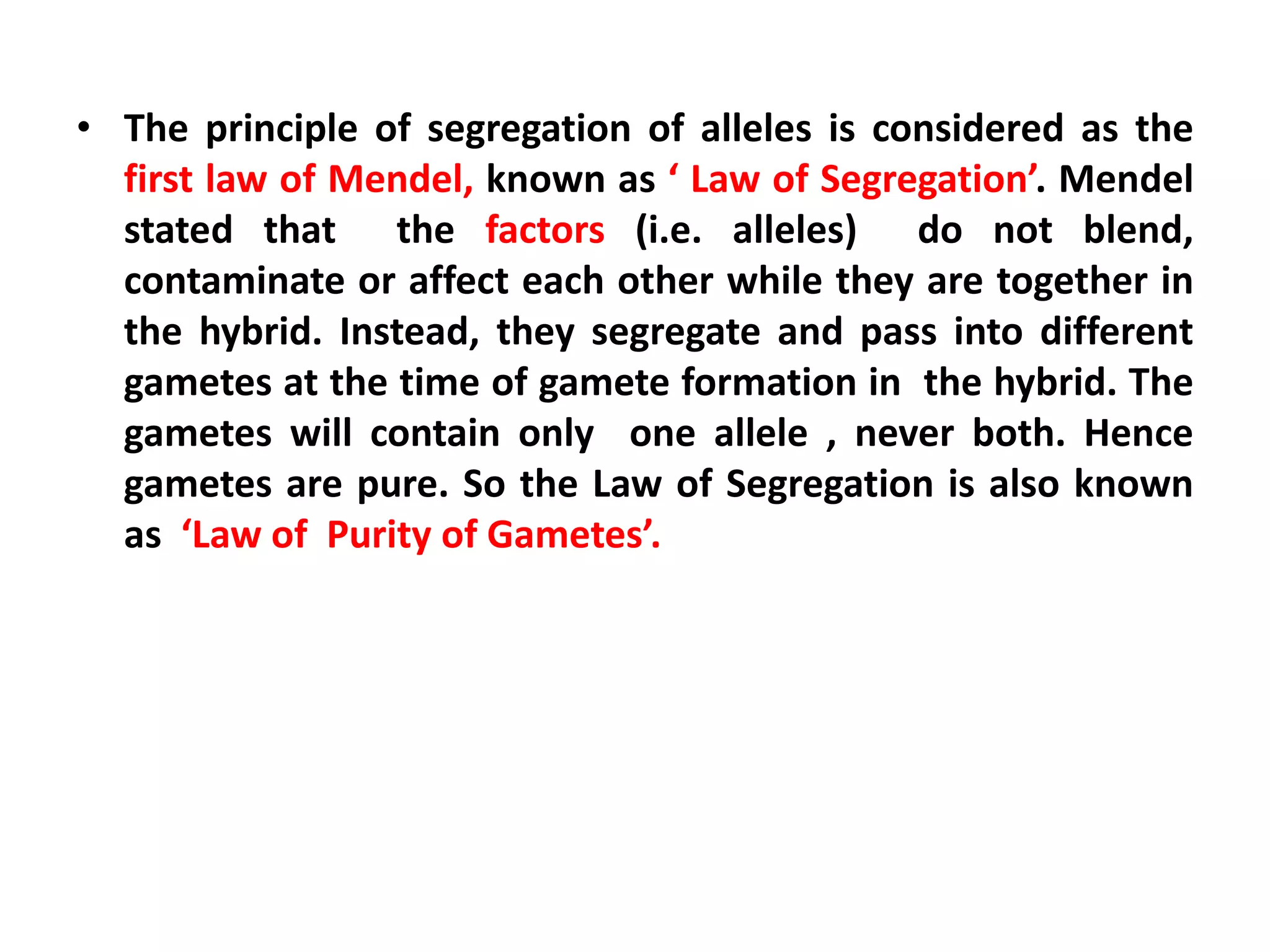
• The principle of segregation of alleles is considered as the
first law of Mendel, known as ‘ Law of Segregation’. Mendel
stated that the factors (i.e. alleles) do not blend,
contaminate or affect each other while they are together in
the hybrid. Instead, they segregate and pass into different
gametes at the time of gamete formation in the hybrid. The
gametes will contain only one allele , never both. Hence
gametes are pure. So the Law of Segregation is also known
as ‘Law of Purity of Gametes’.
Dihybrid cross
• After studying the inheritance of each single trait, Mendel
studied two traits together. Such a cross where two pairs of
contrasting characters are taken into consideration is called a
dihybrid cross.
• Mendel studied the inheritance of seed shape and the
colour of the cotyledons together.
• From monohybrid crosses, it was established that , in
Garden pea plants , round form of seed is dominant over
wrinkled and yellow cotyledon colour is dominant over
green.
• Let the gene for round seed is represented by ‘R’ and its allele for
wrinkled seed by ‘r’ and the gene for yellow cotyledon colour by
‘Y’ and its allele for green cotyledon by ‘y’. Then the genotype of
a pure breeding round yellow plant will be RRYY and that of the
wrinkled green plant will be rryy.
• Mendel crossed a pure breeding round yellow plant (RRYY)with a
wrinkled green (rryy) one. As expected he obtained round yellow
(RrYy) plants in the F1.
• Each member of a pair of alleles may combine randomly with any
of another pair during the formation of gametes. Thus the allele R
may be associated with the allele Y as well as y in equal frequency
, giving rise to RY and ry gametes respectively. Similarly , the allele
r may be associated with the allele Y as well as y in equal
frequency giving rise to RY and ry gametes respectively . Thus four
types of gametes- RY, Ry, rY and ry are produced in equal
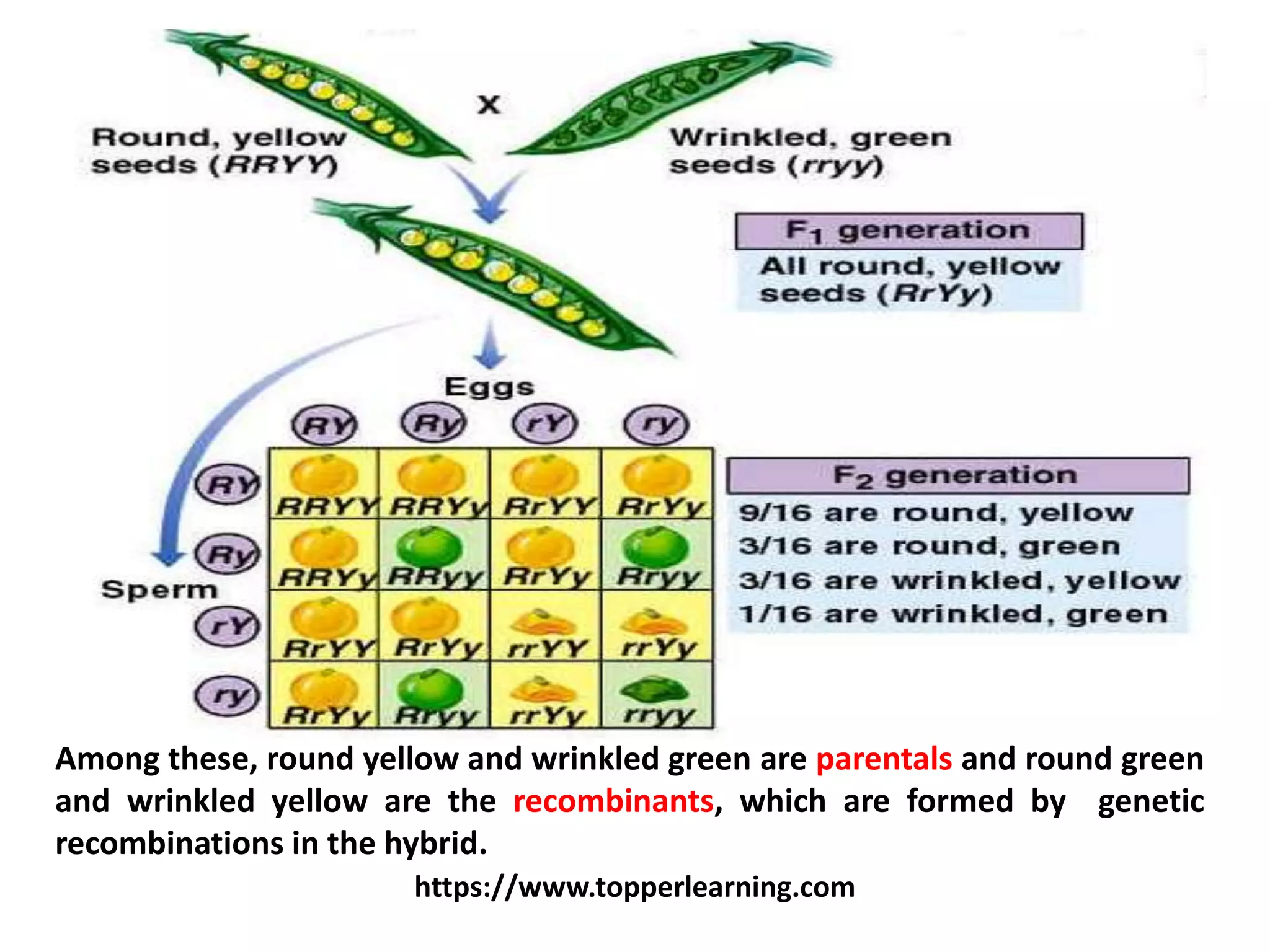
proportions. So, when the F1 plants are self fertilized or two F1
plants were crossed ( F1 x F1 , RrYy x RrYy) , there are 16 possible
combinations in the F2 generation.
https://www.topperlearning.com
Among these, round yellow and wrinkled green are parentals and round green
and wrinkled yellow are the recombinants, which are formed by genetic
recombinations in the hybrid.
• When the F1 plants were self fertilized or two F1 plants were
crossed ( F1 x F1 , RrYy x RrYy) , Mendel got 556 seeds in the F2
of which 315 were round yellow, 108 round green, 101 wrinkled
yellow and 32 wrinkled green, approximately in a ratio 9 round
yellow : 3 round green : 3 wrinkled yellow : 1 wrinkled green.
• Mendel recognized this as the result of two monohybrid
crosses, each expected to result in a 3:1 ratio, operating
together. The product of two monohybrid F2 phenotypic
ratios (3:1) . (3:1) is equal to the dihybrid F2 phenotypic ratio
9:3:3:1
• The F2 genotypic ratio was found to be 1 : 2 : 1: 2 : 4 : 2 : 1 : 2: 1
• Mendel had also carried out trihybrid crosses where three pairs
of contrasting characters were taken into consideration .
• From the analysis of the results of dihybrid and trihybrid
crosses, Mendel came to the conclusion that “ the relation
of each pair of different characters in hybrid union is
independent of the other differences in the two original
parental stocks.” In other words, when the parents differ
from each other in two or more pairs of contrasting alleles or
characters , then the assortment of one pair of alleles of a
character is independent of the assortment of alleles of
other characters. This principle is known as the Law of
Independent Assortment (Second law of Mendel). That is,
each pair of contrasting characters behave independently of
the other pair.
• Mendel was lucky in that the genes that control the various
characters chosen by him for the study were located in
different chromosomes. Otherwise, there would not have
been any independent assortment of genes.
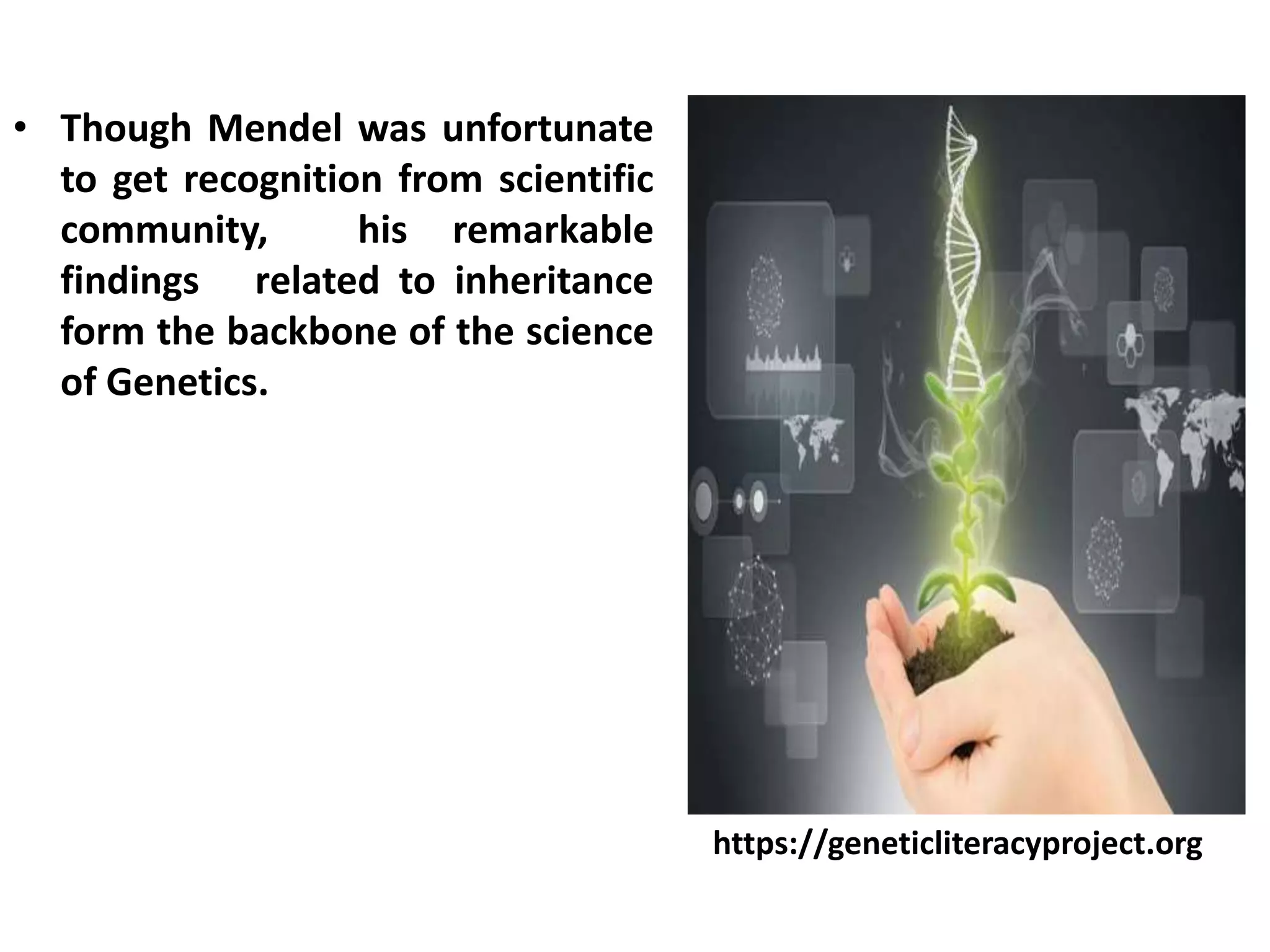
• Though Mendel was unfortunate
to get recognition from scientific
community, his remarkable
findings related to inheritance
form the backbone of the science
of Genetics.
https://geneticliteracyproject.org
Thank You

Introduction to Genetics - Mendelism SMG

  • 1.
    Introduction to Genetics– Mendelism Dr Saji Mariam George Associate Professor (Retired) Assumption College Autonomous Changanacherry
  • 2.
    Introduction to Genetics– Mendelism • The term ‘Genetics’ was coined by William Bateson (1905) – it is derived from the Greek root ‘gen’ which means ‘to become’ or ‘to grow into’. (British Biologist- Bateson also coined the terms allelomorph which was later shortened to allele, homozygote and heterozygote – introduced the practice of denoting the generations in a breeding programme as P, F1, F2 etc. ) William Bateson https://en.wikipedia.org
  • 3.
    Genetics • A branchof Biology which deals with the study of mechanism of inheritance by which characters pass from parents to offspring. • The transmission of characters, resemblances as well as variations, from one generation to the next is called heredity (Latin heriditas = heirship). The offspring have a tendency to resemble their parents and also among themselves. This also is often referred to as heredity. However, the likeness never amounts to complete identity. • The differences shown by the individuals of a species and also by the offspring of the same parents are referred to as variations. • So, Genetics can be defined as the branch of Biology that deals with the study of heredity and variation.
  • 4.
    • The variationsare due to differences in the elements responsible for heredity, the genes, which undergo changes known as mutations. These variations are known as heritable variations and are transmitted from one generation to the other. • It has also been noted that two individuals with the same genetic constitution as the identical twins may become different in external appearance when they come into contact with different conditions of food, temperature, light, humidity etc. Such differences among organisms of similar heredity are known as environmental variations or modifications. These variations are not transmitted from one generation to the other and are called non-heritable variations.
  • 5.
    Gregor Johann Mendel(1822 – 1884) • Father of Genetics. • Mendel was a monk in the Augustinian monastery at Brunn, Austria (Now, Brno, Czechoslovakia). • Mendel had started hybridization experiments in the monastery garden in 1857. Gregor Johann Mendel Image Credit: https://wallpapersfun.wordpress.com
  • 6.
    • After eightyears of hybridization experiments, Mendel formulated certain principles. His findings were presented at two meetings of the Natural History Society of Brunn in 1865. Mendel’s paper appeared in the Annual Proceedings of the society in 1866. Mendel’s findings were much ahead of his time and no one at that time recognized the significance and lay neglected for a period of 34 years. ( Mendel’s paper : Mendel, Gregor. 1866. Versuche über Plflanzenhybriden. Verhandlungen des naturforschenden Vereines in Brünn, Bd. IV für das Jahr 1865, Abhandlungen, 3–47. Mendel’s paper was first translated into English by William Bateson in 1901 - EXPERIMENTS IN PLANT HYBRIDIZATION ).
  • 7.
    • Later Mendelcontinued his experiments with other plants and bees and also turned to meteorological observations. • Mendel became the Abbot of the monastery in 1868 and concentrated more on its administration. He died in 1884. • Hugo de Vries of Holland, Carl Correns of Germany and Erich von Tschermak of Austria independently and simultaneously drew the same conclusions as those of Mendel. They rediscovered Mendel’s findings in 1900. • Mendel’s original research paper was republished in Flora 89 : 364 (1901). Hugo de Vries , Carl Correns & Erich von Tschermak https://slideplayer.com
  • 8.
    Terminology and Symbolsin Genetics • Genome - The DNA content of the cells- a single complete set of chromosomes. • Genes – ( Gregor Johann Mendel , the Father of Genetics, used the term Factors) – hereditary factors responsible for traits (characters). The term gene was coined by a Danish botanist Wilhelm Johannsen (1909) to describe the Mendelian units of heredity. A gene is a small segment of the genetic material which determines a biological character. (mostly DNA , because DNA is the genetic material in most of the organisms ; rarely RNA , the genetic material in some viruses). Wilhelm Johannsen https://www.sutori.com
  • 9.
    • Locus (Plural: Loci) - A fixed position on a chromosome where a gene is located. • Allele (Allelomorph) - Two or more alternative forms of a gene having different phenotypic effects that occur at a given locus in a chromosome. Alleles of a gene are found on homologous chromosomes. • Homozygous and Heterozygous - When the members of an allelic pair are identical, the condition is known as homozygous (e.g. TT, tt, RR, rr etc.) and the individual possessing such alleles is a homozygote. When the members of an allelic pair are different , that condition is known as heterozygous (e.g. Tt, Rr etc. ) and the organism possessing such alleles is a heterozygote.
  • 10.
    • Phenotype -External appearance of an organism. It also denotes a particular expression of a gene. • Wild type - The most common phenotype in a natural population. • Genotype - The genetic constitution of an organism. • Cross breeding (Hybridization)- Mating between members of different races or species or crossing between individuals with dissimilar genotype. The progeny obtained in a hybridization is known as a hybrid - F1 (First filial generation). F2, F3, F4, F5, etc. are the segregating generations. In plants, crossing involves selection of two plants - one as the male parent and the other as the female parent. Then, mature, viable pollen grains from the anthers of the flower of the male parent are dusted on the receptive stigma of the mature flower of the female parent – Artificial pollination. If successful, hybrid seed will be formed in the female parent.
  • 11.
    • Monohybrid cross– A cross where only one pair of contrasting characters is taken into consideration. (e.g One character, Height(Length of the axis) : a tall Garden Pea plant x dwarf one). • Dihybrid cross – A cross where only two pairs of contrasting characters are taken into consideration. (e.g. Two characters, shape of the seeds and colour of the cotyledons in Garden pea : A round yellow x wrinkled green ). • Trihybrid cross - A cross where only three pairs of contrasting characters are taken into consideration. • Pure breeding or true breeding - An individual produces its own kind in the succeeding generation. For example, a pure breeding tall plant produce only tall plants. Similarly, a pure or true breeding red flowered plant will produce only red flowers.
  • 12.
    • Reciprocal crosses– Crosses between different strains with the sexes reversed. (e.g. Female A x Male B and Male A x Female B) • Back cross – The cross of an F1 hybrid to one of the parental types. The offspring of such a cross is called back cross progeny or back cross generation. • Test cross - It is a back cross to the recessive parental type or a cross between genetically unknown individuals with a fully recessive tester to determine whether an individual in question is heterozygous or homozygous for a certain allele. Test cross is also used as a test for linkage.
  • 13.
    • Genetic Symbols- English alphabets are commonly used to represent gene. • Generally, a capital letter is used to represent the dominant allele and the lower case , the recessive allele. e.g. Let ‘T’ represent the dominant allele for tallness in Pea plant and ‘t’ for the recessive allele for dwarfness . (Some geneticists prefer to use the capital letter of the word describing the recessive trait to represent the allele for the dominant trait. For example , ‘D’ for the allele for tall and ‘d’ for the allele for dwarf) . • Another method is to use ‘+’ sign for the wild type allele and the mutant allele by a capital or a small letter depending upon whether the mutant allele is dominant or recessive (by Drosophila geneticists). • In the case of multiple alleles that control ABO blood group system in humans, the gene responsible for the production of A and B antigens is denoted by the letter I ( I - stands for isoagglutinogen, another term for antigen). It has three alleles- IA, IB and i. IA allele specifies the production of the A antigen , the IB allele specifies the production of B antigen and the i allele does not specify an antigen.
  • 14.
    Mendel’s Experiments • Mendelwas not the first person to conduct hybridization experiments. • But, his predecessors had failed to trace the mechanism of inheritance. • Mendel was familiar with the works of his predecessors. • His success mainly depends upon the wise choice of the experimental material and his method of study.
  • 15.
    Experimental material • Mendelhad selected a plant Garden Pea, Pisum sativum as the experimental material. Garden pea (Pisum sativum) Photo E.V.Kirillova © 2003-2009 Project «Interactive Agricultural Ecological Atlas of Russia and Neighboring Countries. Economic Plants and their Diseases, Pests and Weeds» http://www.agroatlas.ru
  • 16.
    Advantages of Gardenpea as the experimental material : • Garden pea has constant differentiating characteristics – has easily recognizable differences in a) length and color of the stem b) size and form of the leaves c) position, color and size of the flowers d) length of the petiole e) color, form and size of the pods f) form and size of the seeds g) color of the seed coats and cotyledons.
  • 17.
    • Garden peaflowers are bisexual - has peculiar floral structure – the typical papilionaceous corolla with standard (vexillum), wing and keel petals. • Random cross pollination can not easily occur as the essential organs are closely packed inside the keel petals - the anthers burst within the bud, so that the stigma becomes covered with pollen even before the flower opens, ensuring self pollination . https://www.sciencelearn.org.nz Credit: "Forest & Kim Starr". http://www.starrenvironmental.com
  • 18.
    • Garden peais easy to grow and is a short duration crop. • Seeds of large number of pure, true breeding varieties with distinct contrasting characters were available with the seed sellers. • The flowers are large enough to do hand emasculation and easy hybridization and the hybrids are fertile. (Emasculation - removal of anthers from the mature flower buds of the selected female parent plant before anthesis to prevent self pollination. This process is an essential step in a hybridization programme, if the selected female parent plant produces bisexual flowers).
  • 19.
    Mendel’s method ofstudy • The approach of Mendel was simple, logical, scientific, mathematical and analytical. • In garden peas, a number of differentiating characters were available. Mendel collected seeds of pure breeding varieties of Garden pea (Pisum sativum) from the seed sellers and grown them in monastery garden. (collected seeds of 34 distinct varieties from seeds men – 22 of these were selected and cultivated during the whole period of Mendel’s experiments) .
  • 20.
    • Mendel selectedseven pairs of differentiating characters for his study such as 1. Differences in the length of the stem (height) - (long axis of 6 to 7 ft(Tall ) vs. short one of ¾ ft. to 1½ ft (Dwarf) 2. Flower colour (Violet vs. White) 3. Position of the flowers (Axial vs. Terminal) 4. Color of the unripe pods (Green vs. Yellow) 5. Form of the ripe pods (Inflated vs. Constricted) 6. Form of the ripe seeds (Round vs. Wrinkled) 7. Colour of cotyledons (Yellow vs. Green)
  • 21.
    • Most vigorousplants were selected for hybridization. • Mendel’s predecessors made observations on plants and animals as a whole and studied all the variations at a time. Mendel, however, concentrated on a single character at a time. For example, flower colour, vine height etc. Mendel crossed two Garden pea plants differing in a pair of contrasting characters (Monohybrid cross). (e.g. a tall Garden pea plant x a dwarf one) and observed the appearance of the hybrid or F1 generation (First filial generation). • In all the experiments, reciprocal crosses were also carried out.
  • 22.
    • Mendel thenallowed the F1 plants to undergo self fertilization and raised the second generation, F2. He analyzed the results quantitatively. In the F2, he counted the number of progeny possessing each of the contrasting traits in which the parents differed. • Mendel followed this method for all the seven characters chosen for the study . • When the behaviour of each single trait was established, Mendel studied two traits together (Dihybrid cross). • Mendel kept pedigree records. Thus he knew the exact ancestry of each plant and the characteristics of its parents and offspring.
  • 23.
    Based on theresults of the hybridization experiments on Pisum sativum, Mendel deduced certain principles regarding the inheritance of characters from parents to offspring. This include • Generalization regarding the dominant – recessive relationship of alleles/ traits. • Principle of Segregation – Also known as Law of Segregation or Law of Purity of Gametes (First Law of Mendel). Both the dominant – recessive relationship and Law of Segregation were derived from the results of monohybrid crosses. • Law of Independent Assortment (Second Law of Mendel), derived from the results of dihybrid and trihybrid crosses.
  • 24.
    Monohybrid cross • Across (hybridization) where only one pair of contrasting characters are taken into consideration. • Mendel had carried out monohybrid crosses in the selected seven pairs of contrasting characters in Garden pea (Pisum sativum). • Mendel crossed a pure or true breeding tall (length of the stem - long axis of 6 to 7 ft) Garden pea with a dwarf one (short one of ¾ ft. to 1½ ft ). • Let T stands for the allele for tallness and t for the allele for dwarfness. Each individual receives an allele for a trait from both the parents. So the genotype of the pure or true breeding tall plant can be represented as TT and that of the dwarf plant as tt.
  • 25.
    • Since thegenotype of the tall parent , TT and that of dwarf parent, tt are in homozygous condition, they produce only one type of gametes. That is, all the gametes produced by the tall parent will carry the T allele and that of the dwarf parent will carry the t allele. These gametes on fusion produce the hybrid with the genotype Tt. Mendel found that all hybrid progeny – F1 generation (First filial generation) were tall. The hybrids resulting from reciprocal crosses are formed alike . The dwarfness seemed to be suppressed and the tallness to dominate. This is because the T allele for tallness is dominant over t, the allele for dwarfness. https://biology-igcse.weebly.com
  • 26.
    • Mendel thenallowed the F1 plants to undergo self fertilization and raised the second generation or F2. • Mendel found that in contrast to the uniformity of the trait under consideration in F1 hybrids (Tt - all tall) , the F2 plants produced by the selfing of F1 plants, differed ( TT, Tt -both tall and tt - dwarf). • The trait or the character which was hidden or suppressed in the F1 generation , the dwarfness reappeared in ¼ of the progeny. Thus, F2 progeny consisted of two types of plants, one group exhibiting the dominant phenotype and the other, the recessive.
  • 27.
    • Out ofthe four combinations, the homozygous TT plants have only the alleles for tallness and will therefore have tallness; Tt plants have an allele T for tallness and one t for dwarfness, but since T is dominant over t, these plants are also tall. tt plants have only the alleles for dwarfness. Hence they are dwarf plants. • Thus in F2 generation, ¾ offspring are tall and ¼ dwarf. i.e., the F2 phenotypic ratio is 3 tall : 1 dwarf. i.e. 3:1. • The genotypic ratio in F2 is ¼ homozygous tall (¼ TT) : 2/4 heterozygous tall (2/4 Tt) : ¼ homozygous dwarf (¼ tt) . That is, 1 TT : 2 Tt : 1 tt i.e. 1: 2: 1 https://www.toppr.com
  • 28.
    • All theseven characters in Garden pea studied by Mendel behaved in a similar way, one of each pair of contrasting characters appear in the F1 generation while the other get suppressed or hidden or masked. • Thus tall vine habit was found to be dominant over dwarf, violet flower colour over white, round seed over wrinkled, yellow colour of the cotyledons over the green , inflated form of pod over the constricted, the green colour of the unripe pod over yellow and the axillary position of the flowers over the terminal.
  • 29.
    • Mendel alsocounted the number of progeny in the F2 generation possessing each of the contrasting characters in which the parent plants differed. • He found that ¾ of the F2 generation resembled the dominant grandparent and ¼ resembled the recessive grandparent in all crosses. • Thus, Mendel found a 3:1 F2 phenotypic ratio (3 dominant phenotype : 1 recessive phenotype ) in all monohybrid crosses involving seven pairs of contrasting characters.
  • 30.
    Dominant – recessiverelationship and F2 phenotypic ratio in 7 traits studied by Mendel in Garden pea (Pisum sativum) Characters chosen Dominant Recessive F2 Phenotypic ratio 1 Length of the axis ( Height ) Long (Tall ) Short(Dwarf) 787Long : 277 Short 2.84 : 1 2. Flower colour Violet White 705Violet : 224 White 3.15 : 1 3. Shape of seed Round Wrinkled 5,474 Round: 1,850 Wrinkled 2.96 : 1 4. Colour of cotyledons Yellow Green 6,022 Yellow : 2,001 Green 3.01 : 1 5. Shape of pod Inflated Constricted 882 Inflated : 299 Constricted 2.95 : 1 6. Colour of unripe pod Green Yellow 428 Green : 152 Yellow 2.82 : 1 7. Position of flower Axillary Terminal 651 Axillary : 207 Terminal 3.14 : 1
  • 31.
    Based on thequantitative analysis of the F2 generation in monohybrid crosses involving seven pairs of contrasting characters in Garden pea, Mendel concluded that – “If now the results of the whole of the experiments be brought together, there is found, as between the number of forms with the dominant and recessive characters, an average ratio of 2.98:1, or 3:1.”
  • 32.
    • Based onthe results of these monohybrid crosses, Mendel gave a generalization regarding the dominant – recessive relationship. “Those characters which are transmitted entire, or almost unchanged in the hybridization, and therefore in themselves constitute the characters of the hybrid, are termed the dominant, and those which become latent in the process recessive”. • In other words, the dominant – recessive relationship can be stated as ‘when a pair of contrasting alleles/ traits (characters) are involved in a cross, only one of them get expressed in the F1 generation while the other remains hidden. The allele/trait which get expressed in the F1 generation is known as dominant and the other which remain hidden or suppressed or masked is recessive.
  • 33.
    • Mendel alsoproposed that each pair of contrasting characters are determined by a pair of ‘factors’ that are transmitted from the parents to the offspring through the gametes. ( The factors are now called gene - the alternative forms of the same gene having different phenotypic effects are called alleles ). • Mendel further analyzed the reappearance of the dwarf plant with the genotype tt (recessive trait) in the F2 generation. In the F1 heterozygote with the genotype Tt, these two alleles, T and t do not fuse or blend , but segregate during the formation of gametes so that half of the gametes will carry T allele and the other half t allele. Random fusion of these gametes will result in four combinations – there is no preferences or avoidance of union of gametes that contain like or unlike alleles and this resulted in the reappearance of the dwarf plant with the genotype tt in F2. • Mendel observed similar results in all cases of F2 generation of other monohybrid crosses. Based on this analysis, Mendel proposed the Principle of Segregation.
  • 34.
    • The principleof segregation of alleles is considered as the first law of Mendel, known as ‘ Law of Segregation’. Mendel stated that the factors (i.e. alleles) do not blend, contaminate or affect each other while they are together in the hybrid. Instead, they segregate and pass into different gametes at the time of gamete formation in the hybrid. The gametes will contain only one allele , never both. Hence gametes are pure. So the Law of Segregation is also known as ‘Law of Purity of Gametes’.
  • 35.
    Dihybrid cross • Afterstudying the inheritance of each single trait, Mendel studied two traits together. Such a cross where two pairs of contrasting characters are taken into consideration is called a dihybrid cross. • Mendel studied the inheritance of seed shape and the colour of the cotyledons together. • From monohybrid crosses, it was established that , in Garden pea plants , round form of seed is dominant over wrinkled and yellow cotyledon colour is dominant over green.
  • 36.
    • Let thegene for round seed is represented by ‘R’ and its allele for wrinkled seed by ‘r’ and the gene for yellow cotyledon colour by ‘Y’ and its allele for green cotyledon by ‘y’. Then the genotype of a pure breeding round yellow plant will be RRYY and that of the wrinkled green plant will be rryy. • Mendel crossed a pure breeding round yellow plant (RRYY)with a wrinkled green (rryy) one. As expected he obtained round yellow (RrYy) plants in the F1. • Each member of a pair of alleles may combine randomly with any of another pair during the formation of gametes. Thus the allele R may be associated with the allele Y as well as y in equal frequency , giving rise to RY and ry gametes respectively. Similarly , the allele r may be associated with the allele Y as well as y in equal frequency giving rise to RY and ry gametes respectively . Thus four types of gametes- RY, Ry, rY and ry are produced in equal proportions. So, when the F1 plants are self fertilized or two F1 plants were crossed ( F1 x F1 , RrYy x RrYy) , there are 16 possible combinations in the F2 generation.
  • 37.
    https://www.topperlearning.com Among these, roundyellow and wrinkled green are parentals and round green and wrinkled yellow are the recombinants, which are formed by genetic recombinations in the hybrid.
  • 38.
    • When theF1 plants were self fertilized or two F1 plants were crossed ( F1 x F1 , RrYy x RrYy) , Mendel got 556 seeds in the F2 of which 315 were round yellow, 108 round green, 101 wrinkled yellow and 32 wrinkled green, approximately in a ratio 9 round yellow : 3 round green : 3 wrinkled yellow : 1 wrinkled green. • Mendel recognized this as the result of two monohybrid crosses, each expected to result in a 3:1 ratio, operating together. The product of two monohybrid F2 phenotypic ratios (3:1) . (3:1) is equal to the dihybrid F2 phenotypic ratio 9:3:3:1 • The F2 genotypic ratio was found to be 1 : 2 : 1: 2 : 4 : 2 : 1 : 2: 1 • Mendel had also carried out trihybrid crosses where three pairs of contrasting characters were taken into consideration .
  • 39.
    • From theanalysis of the results of dihybrid and trihybrid crosses, Mendel came to the conclusion that “ the relation of each pair of different characters in hybrid union is independent of the other differences in the two original parental stocks.” In other words, when the parents differ from each other in two or more pairs of contrasting alleles or characters , then the assortment of one pair of alleles of a character is independent of the assortment of alleles of other characters. This principle is known as the Law of Independent Assortment (Second law of Mendel). That is, each pair of contrasting characters behave independently of the other pair. • Mendel was lucky in that the genes that control the various characters chosen by him for the study were located in different chromosomes. Otherwise, there would not have been any independent assortment of genes.
  • 40.
    • Though Mendelwas unfortunate to get recognition from scientific community, his remarkable findings related to inheritance form the backbone of the science of Genetics. https://geneticliteracyproject.org
  • 41.