Dr. Saji Mariam George
Associate Professor (Retired)
Assumption College Autonomous
Changanacherry
CHROMOSOMES
CHROMOSOMES
( Chromo = colour ; Soma = body)
‱ The term chromosome – coined by Waldeyer
(1888).
‱ At the time of cell division, chromatin
become condensed into chromosomes.
‱ Chromosome number – constant for a
species.
.
CHROMOSOME MORPHOLOGY
‱ Studied during Metaphase and Anaphase -
periods of maximum condensation -
chromosomes become thick and filamentous.
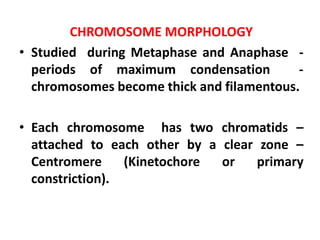
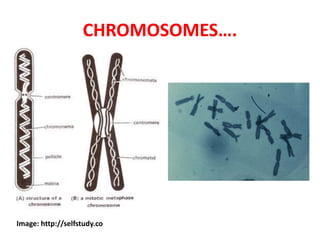
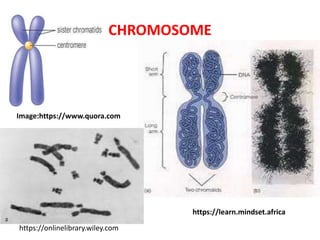
‱ Each chromosome has two chromatids –
attached to each other by a clear zone –
Centromere (Kinetochore or primary
constriction).
‱ Each chromatid – a single linear DNA
molecule with its associated proteins known
as chromonema (Plural- Chromonemata).
‱ Chromonemata of thin chromosomes of
mitotic and meiotic prophase have
alternating thick and thin regions
‱ The thick, bead-like structures –
Chromomeres – accumulation of chromatin
material – tightly folded regions of DNA
correspond to the units of genetic function in
the chromosome.
‱ The thin region in between the chromomeres
– interchromomeres.
CHROMOSOMES
.
Image: http://selfstudy.co
CENTROMERE
(KINETOCHORE OR PRIMARY CONSTRICTION)
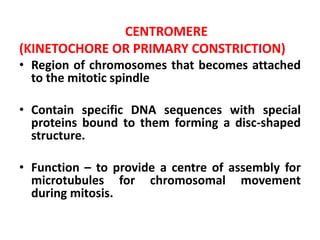
‱ Region of chromosomes that becomes attached
to the mitotic spindle
‱ Contain specific DNA sequences with special
proteins bound to them forming a disc-shaped
structure.
‱ Function – to provide a centre of assembly for
microtubules for chromosomal movement
during mitosis.
CHROMOSOME
Image:https://www.quora.com
https://learn.mindset.africa
https://onlinelibrary.wiley.com
‱ Monocentric - one centromere - most of the
chromosomes.
‱ Diffuse centromere (Holocentric
chromosomes) – microtubules attached along
the length of the chromosomes.
‱ E.g. In species of Juncaceae and Cyperaceae.
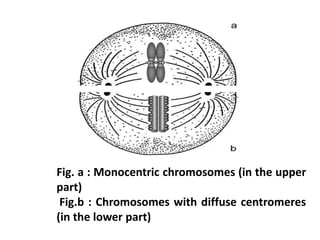
Fig. a : Monocentric chromosomes (in the upper
part)
Fig.b : Chromosomes with diffuse centromeres
(in the lower part)
Acentric and Dicentric chromosomes
‱ In some chromosomal abnormalities,
chromosomes breaks and fuse with
other ones, producing acentric
(chromosomes without centromere) or
Dicentric chromosomes (with two
centromeres).
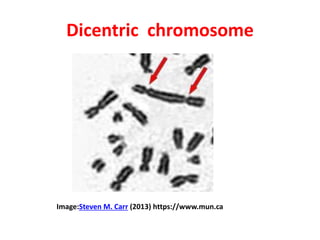
Dicentric chromosome
Image:Steven M. Carr (2013) https://www.mun.ca
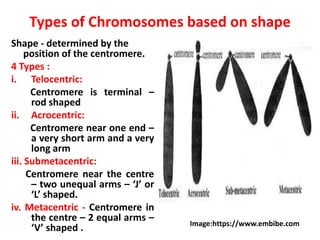
Types of Chromosomes based on shape
Shape - determined by the
position of the centromere.
4 Types :
i. Telocentric:
Centromere is terminal –
rod shaped
ii. Acrocentric:
Centromere near one end –
a very short arm and a very
long arm
iii. Submetacentric:
Centromere near the centre
– two unequal arms – ‘J’ or
‘L’ shaped.
iv. Metacentric - Centromere in
the centre – 2 equal arms –
‘V’ shaped . Image:https://www.embibe.com
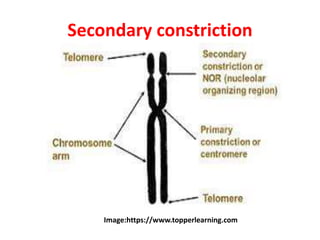
Secondary constriction
‱ Some chromosomes may have a secondary
constriction at any part of the chromosomes.
‱ Certain secondary chromosomes play a vital role
in the formation of the nucleolus – Nucleolar
organizers or Nucleolar Organizing Regions
(NOR) Nucleoli form around the chromosomal
regions that contain 5.8 S, 18 S and 28 S rRNA
genes. They contain the genes for the pre-RNA.
Secondary constriction
Image:https://www.topperlearning.com
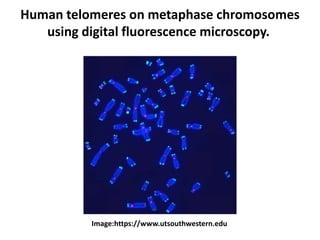
TELOMERE
‱ Extreme tip of the chromosome.
‱ It protects the end of the chromosome from
deterioration and prevents other chromosomal
segments to be fused with it.
‱ A region of repetitive nucleotide sequences at each
end of a chromosome .
‱ In most organisms, these repeats are maintained by
the enzyme, telomerase.
‱ Telomeres assure the physical integrity of
chromosome ends.
Human telomeres on metaphase chromosomes
using digital fluorescence microscopy.
Image:https://www.utsouthwestern.edu
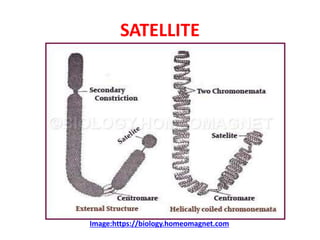
SATELLITES
‱ Present in some chromosomes.
‱ A round body separated from the rest of the
chromosomes by a delicate chromatin filament ,
which may be long or short.
‱ Chromosome with satellite - SAT chromosomes.
‱ For a particular chromosome, the size and shape
of the satellite and the filament are constant.
SATELLITE
Image:https://biology.homeomagnet.com
KARYOTYPE
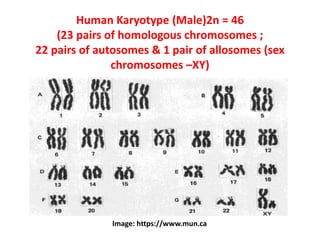
‱ It is the characteristic chromosome set of a
species.
‱ This include the characters by which a set of the
chromosomes of a species is identified such as
the number of chromosomes, relative size,
position of the centromere, length of arms,
secondary constriction, satellite etc.
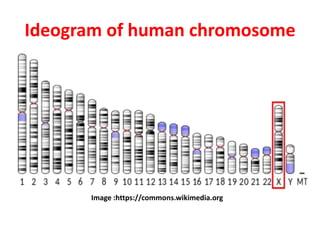
‱ Diagrammatic representation of the karyotype is
known as ideogram.
Human Karyotype (Male)2n = 46
(23 pairs of homologous chromosomes ;
22 pairs of autosomes & 1 pair of allosomes (sex
chromosomes –XY)
Image: https://www.mun.ca
Ideogram of human chromosome
Image :https://commons.wikimedia.org
Chemical composition/ Chemical organization
of Nucleosome / Nucleoproteins
Chromatin - a viscous , gelatinous substance that
contains DNA, RNA, basic proteins – Histones and
non- histone (more acidic) proteins.
‱ Histones and DNA are present in a 1:1 ratio.
‱ The content of RNA and non – histone proteins is
variable in different chromatin.
‱ The non- histone proteins are heterogeneous – vary in
different tissues - include RNA and DNA polymerases
and other regulatory proteins.
i) DNA
‱ The most important chemical component of
chromatin – measured in picogram.
‱ Each species has a characteristic content of
DNA which is constant in all individuals of that
species – C- value.
‱ Nuclei contain a constant amount of DNA – all
the cells in a diploid organism contain the
same DNA content , 2C.
‱ Since gametes are haploid, they
have half the DNA content, 1C.
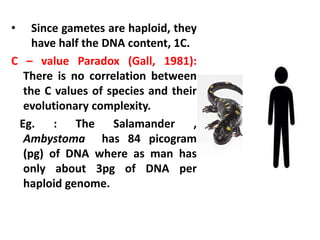
C – value Paradox (Gall, 1981):
There is no correlation between
the C values of species and their
evolutionary complexity.
Eg. : The Salamander ,
Ambystoma has 84 picogram
(pg) of DNA where as man has
only about 3pg of DNA per
haploid genome.
ii) Histones
‱ Small proteins having high content (10 to 20 %)
of basic amino acids Arginine and Lysine.
‱ Bind tightly to DNA
‱ Five histones –H2A, H2B, H3, H4. – very similar
in different species and are present twice every
200 base pairs of DNA.
‱ The fifth histone, H1 is present only once per
200 base pairs of DNA and varies between
species and within tissues of the same species.
‱ Histones play an important role in
maintaining the structure and functional
integrity of chromatin. They also protect DNA
from the action of nucleases.
iii) Non- histone proteins
‱ Include all the enzymes and factors that are
involved in DNA replication, transcription and
in the regulation of transcription.
e.g. DNA polymerase
THANK YOU

CHROMOSOMES SMG

  • 1.
    Dr. Saji MariamGeorge Associate Professor (Retired) Assumption College Autonomous Changanacherry CHROMOSOMES
  • 2.
    CHROMOSOMES ( Chromo =colour ; Soma = body) ‱ The term chromosome – coined by Waldeyer (1888). ‱ At the time of cell division, chromatin become condensed into chromosomes. ‱ Chromosome number – constant for a species. .
  • 3.
    CHROMOSOME MORPHOLOGY ‱ Studiedduring Metaphase and Anaphase - periods of maximum condensation - chromosomes become thick and filamentous. ‱ Each chromosome has two chromatids – attached to each other by a clear zone – Centromere (Kinetochore or primary constriction).
  • 4.
    ‱ Each chromatid– a single linear DNA molecule with its associated proteins known as chromonema (Plural- Chromonemata). ‱ Chromonemata of thin chromosomes of mitotic and meiotic prophase have alternating thick and thin regions
  • 5.
    ‱ The thick,bead-like structures – Chromomeres – accumulation of chromatin material – tightly folded regions of DNA correspond to the units of genetic function in the chromosome. ‱ The thin region in between the chromomeres – interchromomeres.
  • 6.
  • 7.
    CENTROMERE (KINETOCHORE OR PRIMARYCONSTRICTION) ‱ Region of chromosomes that becomes attached to the mitotic spindle ‱ Contain specific DNA sequences with special proteins bound to them forming a disc-shaped structure. ‱ Function – to provide a centre of assembly for microtubules for chromosomal movement during mitosis.
  • 8.
  • 9.
    ‱ Monocentric -one centromere - most of the chromosomes. ‱ Diffuse centromere (Holocentric chromosomes) – microtubules attached along the length of the chromosomes. ‱ E.g. In species of Juncaceae and Cyperaceae.
  • 10.
    Fig. a :Monocentric chromosomes (in the upper part) Fig.b : Chromosomes with diffuse centromeres (in the lower part)
  • 11.
    Acentric and Dicentricchromosomes ‱ In some chromosomal abnormalities, chromosomes breaks and fuse with other ones, producing acentric (chromosomes without centromere) or Dicentric chromosomes (with two centromeres).
  • 12.
    Dicentric chromosome Image:Steven M.Carr (2013) https://www.mun.ca
  • 13.
    Types of Chromosomesbased on shape Shape - determined by the position of the centromere. 4 Types : i. Telocentric: Centromere is terminal – rod shaped ii. Acrocentric: Centromere near one end – a very short arm and a very long arm iii. Submetacentric: Centromere near the centre – two unequal arms – ‘J’ or ‘L’ shaped. iv. Metacentric - Centromere in the centre – 2 equal arms – ‘V’ shaped . Image:https://www.embibe.com
  • 14.
    Secondary constriction ‱ Somechromosomes may have a secondary constriction at any part of the chromosomes. ‱ Certain secondary chromosomes play a vital role in the formation of the nucleolus – Nucleolar organizers or Nucleolar Organizing Regions (NOR) Nucleoli form around the chromosomal regions that contain 5.8 S, 18 S and 28 S rRNA genes. They contain the genes for the pre-RNA.
  • 15.
  • 16.
    TELOMERE ‱ Extreme tipof the chromosome. ‱ It protects the end of the chromosome from deterioration and prevents other chromosomal segments to be fused with it. ‱ A region of repetitive nucleotide sequences at each end of a chromosome . ‱ In most organisms, these repeats are maintained by the enzyme, telomerase. ‱ Telomeres assure the physical integrity of chromosome ends.
  • 17.
    Human telomeres onmetaphase chromosomes using digital fluorescence microscopy. Image:https://www.utsouthwestern.edu
  • 18.
    SATELLITES ‱ Present insome chromosomes. ‱ A round body separated from the rest of the chromosomes by a delicate chromatin filament , which may be long or short. ‱ Chromosome with satellite - SAT chromosomes. ‱ For a particular chromosome, the size and shape of the satellite and the filament are constant.
  • 19.
  • 20.
    KARYOTYPE ‱ It isthe characteristic chromosome set of a species. ‱ This include the characters by which a set of the chromosomes of a species is identified such as the number of chromosomes, relative size, position of the centromere, length of arms, secondary constriction, satellite etc. ‱ Diagrammatic representation of the karyotype is known as ideogram.
  • 21.
    Human Karyotype (Male)2n= 46 (23 pairs of homologous chromosomes ; 22 pairs of autosomes & 1 pair of allosomes (sex chromosomes –XY) Image: https://www.mun.ca
  • 22.
    Ideogram of humanchromosome Image :https://commons.wikimedia.org
  • 23.
    Chemical composition/ Chemicalorganization of Nucleosome / Nucleoproteins Chromatin - a viscous , gelatinous substance that contains DNA, RNA, basic proteins – Histones and non- histone (more acidic) proteins. ‱ Histones and DNA are present in a 1:1 ratio. ‱ The content of RNA and non – histone proteins is variable in different chromatin. ‱ The non- histone proteins are heterogeneous – vary in different tissues - include RNA and DNA polymerases and other regulatory proteins.
  • 24.
    i) DNA ‱ Themost important chemical component of chromatin – measured in picogram. ‱ Each species has a characteristic content of DNA which is constant in all individuals of that species – C- value. ‱ Nuclei contain a constant amount of DNA – all the cells in a diploid organism contain the same DNA content , 2C.
  • 25.
    ‱ Since gametesare haploid, they have half the DNA content, 1C. C – value Paradox (Gall, 1981): There is no correlation between the C values of species and their evolutionary complexity. Eg. : The Salamander , Ambystoma has 84 picogram (pg) of DNA where as man has only about 3pg of DNA per haploid genome.
  • 26.
    ii) Histones ‱ Smallproteins having high content (10 to 20 %) of basic amino acids Arginine and Lysine. ‱ Bind tightly to DNA ‱ Five histones –H2A, H2B, H3, H4. – very similar in different species and are present twice every 200 base pairs of DNA. ‱ The fifth histone, H1 is present only once per 200 base pairs of DNA and varies between species and within tissues of the same species.
  • 27.
    ‱ Histones playan important role in maintaining the structure and functional integrity of chromatin. They also protect DNA from the action of nucleases. iii) Non- histone proteins ‱ Include all the enzymes and factors that are involved in DNA replication, transcription and in the regulation of transcription. e.g. DNA polymerase
  • 28.

Editor's Notes

  • #7 Chromosomes in the cell of Allium cepa
  • #21 Karyotype of a Human male.