MULTIPLE ALLELES
Dr Saji Mariam George
Associate Professor (Retired)
Assumption College Autonomous
Changanacherry
MULTIPLE ALLELES
• Most of the genes exist in two alternative forms having
different phenotypic effects called alleles (allelomorphs)
which occupy the same locus in the homologous
chromosomes.
• Usually, a gene is represented by a most common allele
called the wild type and an alternate allele , the mutant.
However, there are several genes that exist in more than two
alternative forms called multiple alleles, which control
alternative forms of the same character and they occupy the
same locus in a pair of homologous chromosomes.
• Multiple alleles controlling a particular trait may be present
in a population of individuals, but only two alleles are
present in a diploid individual.
Examples :1. ABO blood group system in man
2. Self sterility in Nicotiana (Tobacco) .
1. ABO blood group system in man
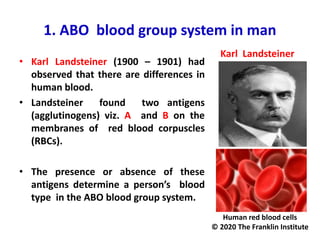
• Karl Landsteiner (1900 – 1901) had
observed that there are differences in
human blood.
• Landsteiner found two antigens
(agglutinogens) viz. A and B on the
membranes of red blood corpuscles
(RBCs).
• The presence or absence of these
antigens determine a person’s blood
type in the ABO blood group system.
Karl Landsteiner
Human red blood cells
© 2020 The Franklin Institute
ABO blood group system in man
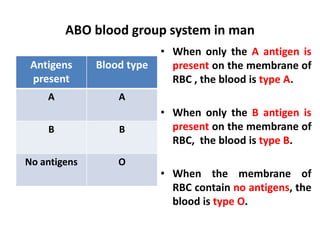
Antigens
present
Blood type
A A
B B
No antigens O
• When only the A antigen is
present on the membrane of
RBC , the blood is type A.
• When only the B antigen is
present on the membrane of
RBC, the blood is type B.
• When the membrane of
RBC contain no antigens, the
blood is type O.
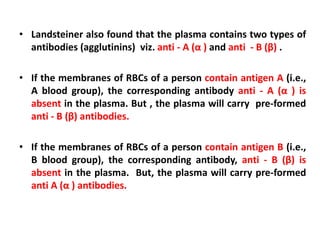
• Landsteiner also found that the plasma contains two types of
antibodies (agglutinins) viz. anti - A (α ) and anti - B (β) .
• If the membranes of RBCs of a person contain antigen A (i.e.,
A blood group), the corresponding antibody anti - A (α ) is
absent in the plasma. But , the plasma will carry pre-formed
anti - B (β) antibodies.
• If the membranes of RBCs of a person contain antigen B (i.e.,
B blood group), the corresponding antibody, anti - B (β) is
absent in the plasma. But, the plasma will carry pre-formed
anti A (α ) antibodies.
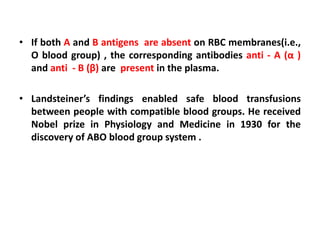
• If both A and B antigens are absent on RBC membranes(i.e.,
O blood group) , the corresponding antibodies anti - A (α )
and anti - B (β) are present in the plasma.
• Landsteiner’s findings enabled safe blood transfusions
between people with compatible blood groups. He received
Nobel prize in Physiology and Medicine in 1930 for the
discovery of ABO blood group system .
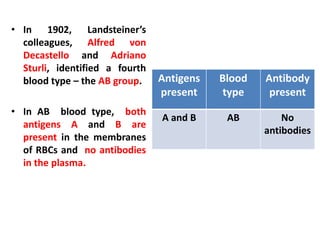
• In 1902, Landsteiner’s
colleagues, Alfred von
Decastello and Adriano
Sturli, identified a fourth
blood type – the AB group.
• In AB blood type, both
antigens A and B are
present in the membranes
of RBCs and no antibodies
in the plasma.
Antigens
present
Blood
type
Antibody
present
A and B AB No
antibodies
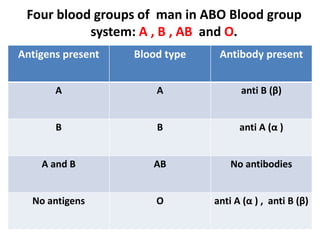
Four blood groups of man in ABO Blood group
system: A , B , AB and O.
Antigens present Blood type Antibody present
A A anti B (β)
B B anti A (α )
A and B AB No antibodies
No antigens O anti A (α ) , anti B (β)
Inheritance of multiple alleles that control
the ABO blood group system in man.
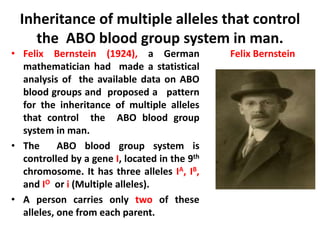
• Felix Bernstein (1924), a German
mathematician had made a statistical
analysis of the available data on ABO
blood groups and proposed a pattern
for the inheritance of multiple alleles
that control the ABO blood group
system in man.
• The ABO blood group system is
controlled by a gene I, located in the 9th
chromosome. It has three alleles IA, IB,
and IO or i (Multiple alleles).
• A person carries only two of these
alleles, one from each parent.
Felix Bernstein
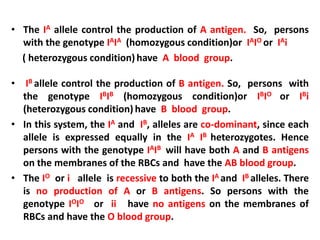
• The IA allele control the production of A antigen. So, persons
with the genotype IAIA (homozygous condition)or IAIO or IAi
( heterozygous condition)have A blood group.
• IB allele control the production of B antigen. So, persons with
the genotype IBIB (homozygous condition)or IBIO or IBi
(heterozygous condition) have B blood group.
• In this system, the IA and IB, alleles are co-dominant, since each
allele is expressed equally in the IA IB heterozygotes. Hence
persons with the genotype IAIB will have both A and B antigens
on the membranes of the RBCs and have the AB blood group.
• The IO or i allele is recessive to both the IA and IB alleles. There
is no production of A or B antigens. So persons with the
genotype IOIO or ii have no antigens on the membranes of
RBCs and have the O blood group.
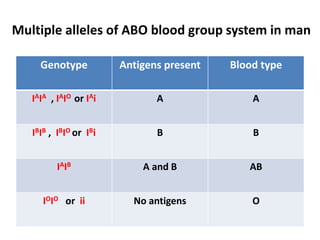
Multiple alleles of ABO blood group system in man
Genotype Antigens present Blood type
IAIA , IAIO or IAi A A
IBIB , IBIO or IBi B B
IAIB A and B AB
IOIO or ii No antigens O
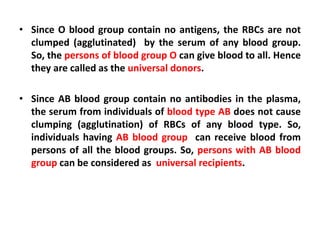
• Since O blood group contain no antigens, the RBCs are not
clumped (agglutinated) by the serum of any blood group.
So, the persons of blood group O can give blood to all. Hence
they are called as the universal donors.
• Since AB blood group contain no antibodies in the plasma,
the serum from individuals of blood type AB does not cause
clumping (agglutination) of RBCs of any blood type. So,
individuals having AB blood group can receive blood from
persons of all the blood groups. So, persons with AB blood
group can be considered as universal recipients.
2. Self sterility in Nicotiana (Tobacco)
• In plants with bisexual flowers, both male and female
reproductive units are formed in the same flower. In many
such plants self pollination takes place and seeds are
formed.
• But in certain other plants, self pollination will not take
place. In some of these plants, this may be due to self
sterility or self incompatibility , which is the inability of the
pollen grains from the same plant to effect fertilization. That
means, self sterility or self incompatibility ensures cross
pollination or out crossing.
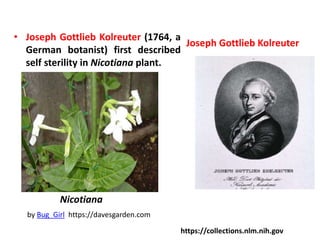
• Joseph Gottlieb Kolreuter (1764, a
German botanist) first described
self sterility in Nicotiana plant.
https://collections.nlm.nih.gov
Joseph Gottlieb Kolreuter
by Bug_Girl https://davesgarden.com
Nicotiana
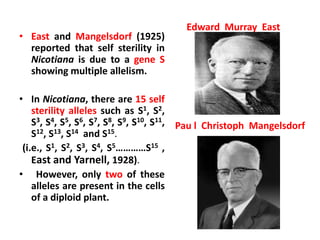
• East and Mangelsdorf (1925)
reported that self sterility in
Nicotiana is due to a gene S
showing multiple allelism.
• In Nicotiana, there are 15 self
sterility alleles such as S1, S2,
S3, S4, S5, S6, S7, S8, S9, S10, S11,
S12, S13, S14 and S15.
(i.e., S1, S2, S3, S4, S5…………S15 ,
East and Yarnell, 1928).
• However, only two of these
alleles are present in the cells
of a diploid plant.
Edward Murray East
Pau l Christoph Mangelsdorf
• There is a gene controlled reaction between the diploid tissue
of the female sporophyte and the haploid gametophytic tissue
of the pollen tube. In this reaction, each allele acts separately.
• The alleles that determine self sterility produce their effect by
controlling the rate of pollen tube growth. That is, an allele in
the female parent’s tissue prevents the growth of pollen
grains that carry the same allele. The products of the S- alleles
expressed in female tissues of Nicotiana are ribonucleases,
the S-RNases. The arrest of growth of pollen tubes in styles in
incompatible crosses may be due to the entry of the S-RNase
into the pollen tube and degradation of pollen tube RNA. In
incompatible crosses, the pollen tubes grow slowly so that
before the gametes reach the ovule, the flowers will be
withered.
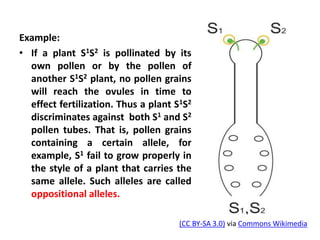
Example:
• If a plant S1S2 is pollinated by its
own pollen or by the pollen of
another S1S2 plant, no pollen grains
will reach the ovules in time to
effect fertilization. Thus a plant S1S2
discriminates against both S1 and S2
pollen tubes. That is, pollen grains
containing a certain allele, for
example, S1 fail to grow properly in
the style of a plant that carries the
same allele. Such alleles are called
oppositional alleles.
(CC BY-SA 3.0) via Commons Wikimedia
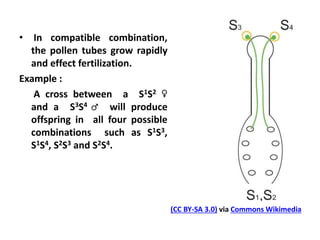
• In compatible combination,
the pollen tubes grow rapidly
and effect fertilization.
Example :
A cross between a S1S2 ♀
and a S3S4 ♂ will produce
offspring in all four possible
combinations such as S1S3,
S1S4, S2S3 and S2S4.
(CC BY-SA 3.0) via Commons Wikimedia
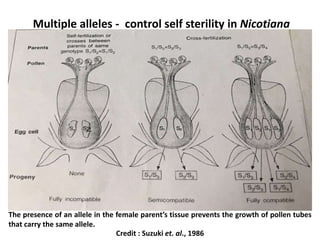
Multiple alleles - control self sterility in Nicotiana
Credit : Suzuki et. al., 1986
The presence of an allele in the female parent’s tissue prevents the growth of pollen tubes
that carry the same allele.
THANK YOU

MULTIPLE ALLELES SMG

  • 1.
    MULTIPLE ALLELES Dr SajiMariam George Associate Professor (Retired) Assumption College Autonomous Changanacherry
  • 2.
    MULTIPLE ALLELES • Mostof the genes exist in two alternative forms having different phenotypic effects called alleles (allelomorphs) which occupy the same locus in the homologous chromosomes. • Usually, a gene is represented by a most common allele called the wild type and an alternate allele , the mutant. However, there are several genes that exist in more than two alternative forms called multiple alleles, which control alternative forms of the same character and they occupy the same locus in a pair of homologous chromosomes. • Multiple alleles controlling a particular trait may be present in a population of individuals, but only two alleles are present in a diploid individual. Examples :1. ABO blood group system in man 2. Self sterility in Nicotiana (Tobacco) .
  • 3.
    1. ABO bloodgroup system in man • Karl Landsteiner (1900 – 1901) had observed that there are differences in human blood. • Landsteiner found two antigens (agglutinogens) viz. A and B on the membranes of red blood corpuscles (RBCs). • The presence or absence of these antigens determine a person’s blood type in the ABO blood group system. Karl Landsteiner Human red blood cells © 2020 The Franklin Institute
  • 4.
    ABO blood groupsystem in man Antigens present Blood type A A B B No antigens O • When only the A antigen is present on the membrane of RBC , the blood is type A. • When only the B antigen is present on the membrane of RBC, the blood is type B. • When the membrane of RBC contain no antigens, the blood is type O.
  • 5.
    • Landsteiner alsofound that the plasma contains two types of antibodies (agglutinins) viz. anti - A (α ) and anti - B (β) . • If the membranes of RBCs of a person contain antigen A (i.e., A blood group), the corresponding antibody anti - A (α ) is absent in the plasma. But , the plasma will carry pre-formed anti - B (β) antibodies. • If the membranes of RBCs of a person contain antigen B (i.e., B blood group), the corresponding antibody, anti - B (β) is absent in the plasma. But, the plasma will carry pre-formed anti A (α ) antibodies.
  • 6.
    • If bothA and B antigens are absent on RBC membranes(i.e., O blood group) , the corresponding antibodies anti - A (α ) and anti - B (β) are present in the plasma. • Landsteiner’s findings enabled safe blood transfusions between people with compatible blood groups. He received Nobel prize in Physiology and Medicine in 1930 for the discovery of ABO blood group system .
  • 7.
    • In 1902,Landsteiner’s colleagues, Alfred von Decastello and Adriano Sturli, identified a fourth blood type – the AB group. • In AB blood type, both antigens A and B are present in the membranes of RBCs and no antibodies in the plasma. Antigens present Blood type Antibody present A and B AB No antibodies
  • 8.
    Four blood groupsof man in ABO Blood group system: A , B , AB and O. Antigens present Blood type Antibody present A A anti B (β) B B anti A (α ) A and B AB No antibodies No antigens O anti A (α ) , anti B (β)
  • 9.
    Inheritance of multiplealleles that control the ABO blood group system in man. • Felix Bernstein (1924), a German mathematician had made a statistical analysis of the available data on ABO blood groups and proposed a pattern for the inheritance of multiple alleles that control the ABO blood group system in man. • The ABO blood group system is controlled by a gene I, located in the 9th chromosome. It has three alleles IA, IB, and IO or i (Multiple alleles). • A person carries only two of these alleles, one from each parent. Felix Bernstein
  • 10.
    • The IAallele control the production of A antigen. So, persons with the genotype IAIA (homozygous condition)or IAIO or IAi ( heterozygous condition)have A blood group. • IB allele control the production of B antigen. So, persons with the genotype IBIB (homozygous condition)or IBIO or IBi (heterozygous condition) have B blood group. • In this system, the IA and IB, alleles are co-dominant, since each allele is expressed equally in the IA IB heterozygotes. Hence persons with the genotype IAIB will have both A and B antigens on the membranes of the RBCs and have the AB blood group. • The IO or i allele is recessive to both the IA and IB alleles. There is no production of A or B antigens. So persons with the genotype IOIO or ii have no antigens on the membranes of RBCs and have the O blood group.
  • 11.
    Multiple alleles ofABO blood group system in man Genotype Antigens present Blood type IAIA , IAIO or IAi A A IBIB , IBIO or IBi B B IAIB A and B AB IOIO or ii No antigens O
  • 12.
    • Since Oblood group contain no antigens, the RBCs are not clumped (agglutinated) by the serum of any blood group. So, the persons of blood group O can give blood to all. Hence they are called as the universal donors. • Since AB blood group contain no antibodies in the plasma, the serum from individuals of blood type AB does not cause clumping (agglutination) of RBCs of any blood type. So, individuals having AB blood group can receive blood from persons of all the blood groups. So, persons with AB blood group can be considered as universal recipients.
  • 13.
    2. Self sterilityin Nicotiana (Tobacco) • In plants with bisexual flowers, both male and female reproductive units are formed in the same flower. In many such plants self pollination takes place and seeds are formed. • But in certain other plants, self pollination will not take place. In some of these plants, this may be due to self sterility or self incompatibility , which is the inability of the pollen grains from the same plant to effect fertilization. That means, self sterility or self incompatibility ensures cross pollination or out crossing.
  • 14.
    • Joseph GottliebKolreuter (1764, a German botanist) first described self sterility in Nicotiana plant. https://collections.nlm.nih.gov Joseph Gottlieb Kolreuter by Bug_Girl https://davesgarden.com Nicotiana
  • 15.
    • East andMangelsdorf (1925) reported that self sterility in Nicotiana is due to a gene S showing multiple allelism. • In Nicotiana, there are 15 self sterility alleles such as S1, S2, S3, S4, S5, S6, S7, S8, S9, S10, S11, S12, S13, S14 and S15. (i.e., S1, S2, S3, S4, S5…………S15 , East and Yarnell, 1928). • However, only two of these alleles are present in the cells of a diploid plant. Edward Murray East Pau l Christoph Mangelsdorf
  • 16.
    • There isa gene controlled reaction between the diploid tissue of the female sporophyte and the haploid gametophytic tissue of the pollen tube. In this reaction, each allele acts separately. • The alleles that determine self sterility produce their effect by controlling the rate of pollen tube growth. That is, an allele in the female parent’s tissue prevents the growth of pollen grains that carry the same allele. The products of the S- alleles expressed in female tissues of Nicotiana are ribonucleases, the S-RNases. The arrest of growth of pollen tubes in styles in incompatible crosses may be due to the entry of the S-RNase into the pollen tube and degradation of pollen tube RNA. In incompatible crosses, the pollen tubes grow slowly so that before the gametes reach the ovule, the flowers will be withered.
  • 17.
    Example: • If aplant S1S2 is pollinated by its own pollen or by the pollen of another S1S2 plant, no pollen grains will reach the ovules in time to effect fertilization. Thus a plant S1S2 discriminates against both S1 and S2 pollen tubes. That is, pollen grains containing a certain allele, for example, S1 fail to grow properly in the style of a plant that carries the same allele. Such alleles are called oppositional alleles. (CC BY-SA 3.0) via Commons Wikimedia
  • 18.
    • In compatiblecombination, the pollen tubes grow rapidly and effect fertilization. Example : A cross between a S1S2 ♀ and a S3S4 ♂ will produce offspring in all four possible combinations such as S1S3, S1S4, S2S3 and S2S4. (CC BY-SA 3.0) via Commons Wikimedia
  • 19.
    Multiple alleles -control self sterility in Nicotiana Credit : Suzuki et. al., 1986 The presence of an allele in the female parent’s tissue prevents the growth of pollen tubes that carry the same allele.
  • 20.