Welcome to
Cytodifferentiation of tracheary elements
&sieve elements
By N.Sannigrahi, Associate Professor,
Department of Botany, Nistarini College,
Purulia, 723101(W.B) India
CONTENTS
Meaning of Cytodifferentiation
Need of Cytodifferentiation
Primary steps
Protocol of Cytodifferentiastion
Trachery elements & Sieve elements
Cytodifferentiation of Trachery elements
Difference between the elements
Conclusion
Cytodifferentiation
• Cytology deals with cell & differentiation is the
further modification of the newly borne cells to
undergo specialization to perform desired
function with shape. So, during the growth and
the maturation of the callus tissue or free cells in
suspension culture, few dedifferentiated cells
undergo cytoquiesence and cytosenesence and
these twin phenomenon are mainly associated
with the differentiation of vascular tissues in
general and tracheary elements & sieve tubes in
particular. This whole developmental process is
called Cytodifferenciation.
What are??????
• TRACHEARY ELEMENTS
• Tracheary elements(TEs) –cells in the xylem being highly
specialized for transporting water and solutes of the plant. TEs
undergoes a very well-defined process of differentiation that
involves specification, enlargement, patterned cell wall
deposition, programmed cell death( apoptosis) and the cell
wall removal.Tracheids found in xylem of all vascular plants
but vessel elements only in angiosperms
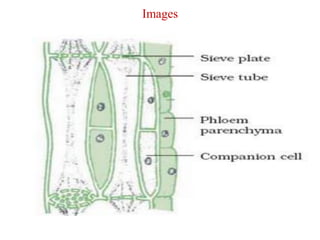
• SIEVE ELEMENTS:
• Especially in phloem, a highly organized tissue that transports
organic compounds during photosynthesis. It looses most of
the cellular components such as nucleus, cytoskeleton,
ribosome, tonoplast and contain structural phloem specific
proteins-P proteins along with mitochondria, ER, sieve
elements plastids
Contd.------
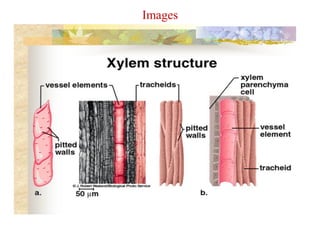
• Tracheary elements are water conducting tissues
called as xylem and sieve elements are food
conducting tissues called phloem. Tracheary elements
, both tracheids and vessels, are highly specialized
cells. These cells are devoid of protoplast when
mature. These non-living cells are elongated with
lignified walls. The main difference between
tracheids and vessel is that vessels have perforation at
the end plates which make them a tube like long
structure while tracheids do not have end plates. So,
the perforation of the end walls make the difference
between the two along with their position & function.
Images
Images
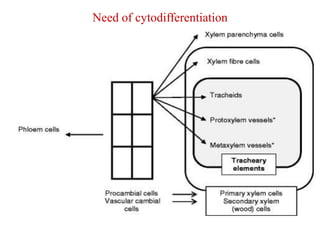
Need of cytodifferentiation
Steps for Cytodifferentiation
• Cells after division do not experience the same fate like
new born babies do not undergo same destination. It
depends on the intrinsic as well as extrinsic signals
mediated from elsewhere. Amongst a group of cells
within free suspension culture, a few cells become
morpho-genetically competent for cytodifferentiation
which can not be identified at the early stage in
advance. It occurs either spontaneously or under the
stimulus of specific nutritional or hormonal exposure.
So, it is not conditioned by a single regular event.
• Primary steps are reflected by a series of histological &
biochemical changes in the cell-the test tube individual.
It can be differentiated into three steps-
Contd.----------
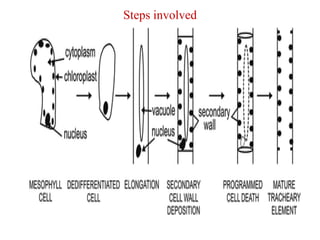
• Due to repeated mitotic growth, a few cells become
more elongate with thick wall and the calli are friable.
By further increase the subculture member, callus
tissue shows maximum xylogenesis with tracheary
elements having a continuous spiral deposition of
secondary wall materials. Actually, the initiation of
xylogenesis takes place from mitotically blocked and
elongated cells. A chain of intracellular degradative
changes are associated with
cytodifferentiation.Autodestruction of cellular
organelles such as Chloroplast, ER, dictyosomes,
ribosome and mitochondria leading to loss of entire
protoplasmic mass are the main degradative changes.
HOW?
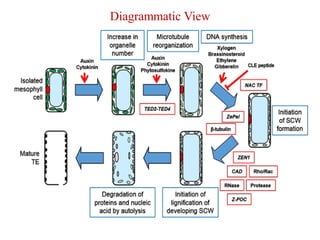
• The separation of the cell membrane bounding organelles,
the 1st step of cytoquiesence leads to cytosenesence .The
auto- phagic activity within the cell in turn is closely
linked with certain hydrolytic enzymes. The common one
is acid phosphatage commonly present in the cell and has
been detected in association with cell wall, dictyosome ,
plastids and the lysosomal systems associated with cell
degradation. The synthesis of the acid phosphatage is
indicative of autolysis of the protoplastid during
cytoquiesence and cytosenesence. So, the transformation
of the living cell into dead, empty tracheid during cellular
differentiation and the biosynthesis of the acid
phosphatase enzymes are functionally related to the
autolysis of the cell contents and lignin biosynthesis for
the spiral deposition of secondary wall materials for the
developing trachery elements.
Steps involved
Diagrammatic View
Factors of Differentiation
• FACTORS;
• Trachery elements differentiation and secondary cell
wall formation have been studied in cell cultures of
coniferous gymnosperms. Several factors that
influence the trachery element differentiation arte-
• The sucrose concentration of the media-the conc. of
sucrose,
• Temperature-the fluctuation of temperature,
• Light-quality & quantity of life,
• The type and the concentration of the phytohormones,
• Other intrinsic factors to expedite process.
CONCLUSION
• Thus, Cytodifferentiation mainly emphasises on
vascular differentiation , tracheary element
differentiation etc.The plants cells in general and
zygote in particular is totipotent in nature having the
capability of giving rise to all type of cells and tissues
in due course in order to have the stability of the
plants. But to perform the specific function, a degree
of specialization is required getting the molecular
signal from the cells corresponding to the different
extrinsic & intrinsic factors. Not only the tracheary
elements & sieve elements, this concept is highly
applicable in the domain of the developmental
biology.
THANKS A LOT FOR YOUR ATTENTION

Cytodifferentiation

  • 1.
    Welcome to Cytodifferentiation oftracheary elements &sieve elements By N.Sannigrahi, Associate Professor, Department of Botany, Nistarini College, Purulia, 723101(W.B) India CONTENTS Meaning of Cytodifferentiation Need of Cytodifferentiation Primary steps Protocol of Cytodifferentiastion Trachery elements & Sieve elements Cytodifferentiation of Trachery elements Difference between the elements Conclusion
  • 2.
    Cytodifferentiation • Cytology dealswith cell & differentiation is the further modification of the newly borne cells to undergo specialization to perform desired function with shape. So, during the growth and the maturation of the callus tissue or free cells in suspension culture, few dedifferentiated cells undergo cytoquiesence and cytosenesence and these twin phenomenon are mainly associated with the differentiation of vascular tissues in general and tracheary elements & sieve tubes in particular. This whole developmental process is called Cytodifferenciation.
  • 3.
    What are?????? • TRACHEARYELEMENTS • Tracheary elements(TEs) –cells in the xylem being highly specialized for transporting water and solutes of the plant. TEs undergoes a very well-defined process of differentiation that involves specification, enlargement, patterned cell wall deposition, programmed cell death( apoptosis) and the cell wall removal.Tracheids found in xylem of all vascular plants but vessel elements only in angiosperms • SIEVE ELEMENTS: • Especially in phloem, a highly organized tissue that transports organic compounds during photosynthesis. It looses most of the cellular components such as nucleus, cytoskeleton, ribosome, tonoplast and contain structural phloem specific proteins-P proteins along with mitochondria, ER, sieve elements plastids
  • 4.
    Contd.------ • Tracheary elementsare water conducting tissues called as xylem and sieve elements are food conducting tissues called phloem. Tracheary elements , both tracheids and vessels, are highly specialized cells. These cells are devoid of protoplast when mature. These non-living cells are elongated with lignified walls. The main difference between tracheids and vessel is that vessels have perforation at the end plates which make them a tube like long structure while tracheids do not have end plates. So, the perforation of the end walls make the difference between the two along with their position & function.
  • 5.
  • 6.
  • 7.
  • 8.
    Steps for Cytodifferentiation •Cells after division do not experience the same fate like new born babies do not undergo same destination. It depends on the intrinsic as well as extrinsic signals mediated from elsewhere. Amongst a group of cells within free suspension culture, a few cells become morpho-genetically competent for cytodifferentiation which can not be identified at the early stage in advance. It occurs either spontaneously or under the stimulus of specific nutritional or hormonal exposure. So, it is not conditioned by a single regular event. • Primary steps are reflected by a series of histological & biochemical changes in the cell-the test tube individual. It can be differentiated into three steps-
  • 9.
    Contd.---------- • Due torepeated mitotic growth, a few cells become more elongate with thick wall and the calli are friable. By further increase the subculture member, callus tissue shows maximum xylogenesis with tracheary elements having a continuous spiral deposition of secondary wall materials. Actually, the initiation of xylogenesis takes place from mitotically blocked and elongated cells. A chain of intracellular degradative changes are associated with cytodifferentiation.Autodestruction of cellular organelles such as Chloroplast, ER, dictyosomes, ribosome and mitochondria leading to loss of entire protoplasmic mass are the main degradative changes.
  • 10.
    HOW? • The separationof the cell membrane bounding organelles, the 1st step of cytoquiesence leads to cytosenesence .The auto- phagic activity within the cell in turn is closely linked with certain hydrolytic enzymes. The common one is acid phosphatage commonly present in the cell and has been detected in association with cell wall, dictyosome , plastids and the lysosomal systems associated with cell degradation. The synthesis of the acid phosphatage is indicative of autolysis of the protoplastid during cytoquiesence and cytosenesence. So, the transformation of the living cell into dead, empty tracheid during cellular differentiation and the biosynthesis of the acid phosphatase enzymes are functionally related to the autolysis of the cell contents and lignin biosynthesis for the spiral deposition of secondary wall materials for the developing trachery elements.
  • 11.
  • 12.
  • 13.
    Factors of Differentiation •FACTORS; • Trachery elements differentiation and secondary cell wall formation have been studied in cell cultures of coniferous gymnosperms. Several factors that influence the trachery element differentiation arte- • The sucrose concentration of the media-the conc. of sucrose, • Temperature-the fluctuation of temperature, • Light-quality & quantity of life, • The type and the concentration of the phytohormones, • Other intrinsic factors to expedite process.
  • 14.
    CONCLUSION • Thus, Cytodifferentiationmainly emphasises on vascular differentiation , tracheary element differentiation etc.The plants cells in general and zygote in particular is totipotent in nature having the capability of giving rise to all type of cells and tissues in due course in order to have the stability of the plants. But to perform the specific function, a degree of specialization is required getting the molecular signal from the cells corresponding to the different extrinsic & intrinsic factors. Not only the tracheary elements & sieve elements, this concept is highly applicable in the domain of the developmental biology.
  • 15.
    THANKS A LOTFOR YOUR ATTENTION