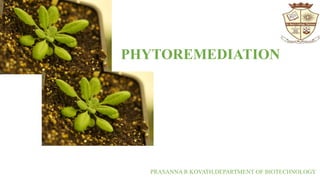
PHYTOREMEDIATION
PRASANNA R KOVATH,DEPARTMENT OF BIOTECHNOLOGY
• Phytoremediation is a bioremediation process that uses various types of
plants to remove, transfer, stabilize, and/or destroy contaminants in the
soil and groundwater.
• phyto = plant • remedium = restoring balance
• Phytoremediation consists of mitigating pollutant concentrations in
contaminated soils, water, or air, with plants able to contain, degrade, or
eliminate metals, pesticides, solvents,explosives, crude oil and its
derivatives, and various other contaminants from the media that contain
them.
How Does Phytoremediation Work?
• Plant roots take contaminants from the ground into the "body" of the
plant.
• The plant root zone is referred to as the rhizosphere, this is where the
action occurs.
• This soil supports large populations of diverse microorganisms.
• This is due to chemicals exuded by plant roots which provide carbon
and energy for microbial growth.
• This combination of plants and microorganisms appears to increase
the biodegradation of compounds.
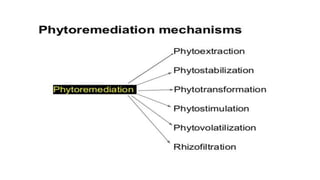
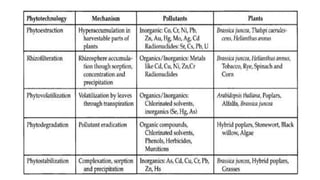
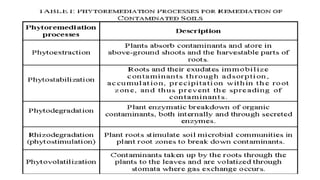
There are several different types of phytoremediation mechanisms.
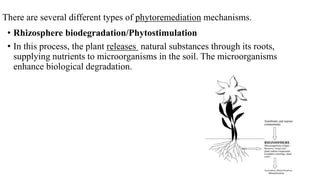
• Rhizosphere biodegradation/Phytostimulation
• In this process, the plant releases natural substances through its roots,
supplying nutrients to microorganisms in the soil. The microorganisms
enhance biological degradation.
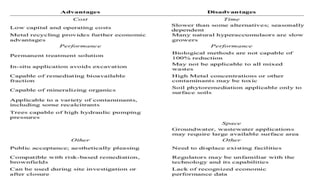
Advantages
 in situ practice resulting in no disturbance
 No removal of contaminated materials
 Complete mineralisation of the contaminant can occur
 Low installation and maintenance cost
Disadvantages
 Development of extensive root zone required- takes time
 Root depth limited due to physical structure of soil
 Organic matter from plant may be used as a C source instead of
contaminant –decrease amount of contaminant biodegradation
• Phyto-stabilization
• In this process, chemical compounds produced by the plant
immobilize contaminants, rather than degrade them.
• Refers to the immobilization of contaminants in the soil through:
Absorption and accumulation by roots
Precipitation within the roots.
● Eventually, the mobility of the contaminant is reduced, migration to
groundwater is prevented and thus bioavailability of metal into food
chain is reduced.
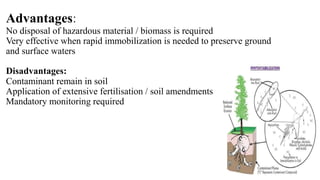
Advantages:
No disposal of hazardous material / biomass is required
Very effective when rapid immobilization is needed to preserve ground
and surface waters
Disadvantages:
Contaminant remain in soil
Application of extensive fertilisation / soil amendments
Mandatory monitoring required
Phyto-accumulation (also called phyto-extraction)
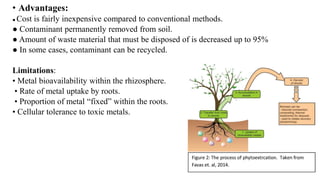
 In this process, plant roots sorb the contaminants along with other nutrients and water.
 The contaminant mass is not destroyed but ends up in the plant shoots and leaves. This
method is used primarily for wastes containing metals.
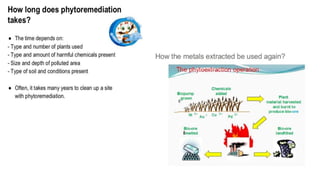
 At one demonstration site, water-soluble metals are taken up by plant species selected for
their ability to take up large quantities of lead (Pb).
 The metals are stored in the plantÍs aerial shoots, which are harvested and either smelted
for potential metal recycling/recovery or are disposed of as a hazardous waste.
 As a general rule, readily bioavailable metals for plant uptake include cadmium, nickel,
zinc, arsenic, selenium, and copper.
 Moderately bioavailable metals are cobalt, manganese, and iron. Lead, chromium, and
uranium are not very bioavailable.
 Lead can be made much more bioavailable by the addition of chelating agents to soils.
Similarly, the availability of uranium and radio-cesium 137 can be enhanced using citric
acid and ammonium nitrate, respectively.
• Advantages:
● Cost is fairly inexpensive compared to conventional methods.
● Contaminant permanently removed from soil.
● Amount of waste material that must be disposed of is decreased up to 95%
● In some cases, contaminant can be recycled.
Limitations:
• Metal bioavailability within the rhizosphere.
• Rate of metal uptake by roots.
• Proportion of metal “fixed” within the roots.
• Cellular tolerance to toxic metals.
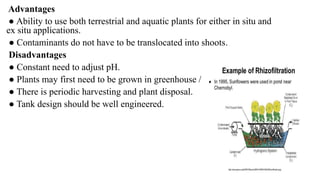
Hydroponic Systems for Treating Water Streams (Rhizofiltration)
• Rhizofiltration is similar to phyto-accumulation, but the plants used
for cleanup are raised in greenhouses with their roots in water.
• This system can be used for ex-situ groundwater treatment. That is,
groundwater is pumped to the surface to irrigate these plants. Typically
hydroponic systems utilize an artificial soil medium, such as sand
mixed with perlite or vermiculite.
• As the roots become saturated with contaminants, they are harvested
and disposed of
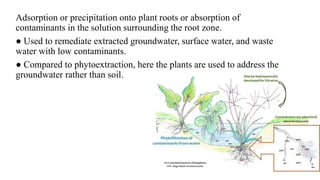
Adsorption or precipitation onto plant roots or absorption of
contaminants in the solution surrounding the root zone.
● Used to remediate extracted groundwater, surface water, and waste
water with low contaminants.
● Compared to phytoextraction, here the plants are used to address the
groundwater rather than soil.
Advantages
● Ability to use both terrestrial and aquatic plants for either in situ and
ex situ applications.
● Contaminants do not have to be translocated into shoots.
Disadvantages
● Constant need to adjust pH.
● Plants may first need to be grown in greenhouse / nursery.
● There is periodic harvesting and plant disposal.
● Tank design should be well engineered.
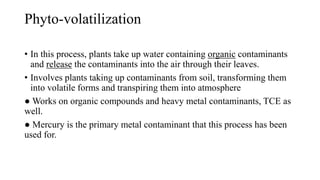
Phyto-volatilization
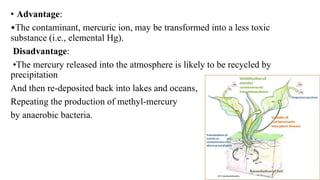
• In this process, plants take up water containing organic contaminants
and release the contaminants into the air through their leaves.
• Involves plants taking up contaminants from soil, transforming them
into volatile forms and transpiring them into atmosphere
● Works on organic compounds and heavy metal contaminants, TCE as
well.
● Mercury is the primary metal contaminant that this process has been
used for.
• Advantage:
•The contaminant, mercuric ion, may be transformed into a less toxic
substance (i.e., elemental Hg).
Disadvantage:
•The mercury released into the atmosphere is likely to be recycled by
precipitation
And then re-deposited back into lakes and oceans,
Repeating the production of methyl-mercury
by anaerobic bacteria.
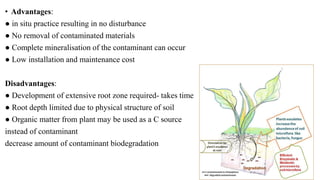
Phyto-degradationPhytostimulation (Rhizodegradation)
• In this process, plants actually metabolize and destroy contaminants
within plant tissues.
• Breakdown of contaminants within the plant root zone, or rhizosphere.
● Carried out by bacteria or other microorganisms flourishing in the
rhizosphere.
● Microbes in rhizosphere transform contaminant to non toxic product.
● Works well in the removal of petroleum hydrocarbons
• Advantages:
● in situ practice resulting in no disturbance
● No removal of contaminated materials
● Complete mineralisation of the contaminant can occur
● Low installation and maintenance cost
Disadvantages:
● Development of extensive root zone required- takes time
● Root depth limited due to physical structure of soil
● Organic matter from plant may be used as a C source
instead of contaminant
decrease amount of contaminant biodegradation
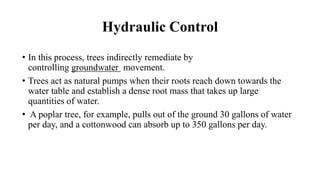
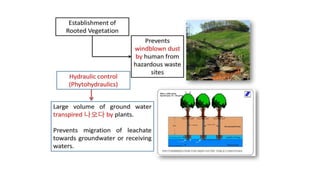
Hydraulic Control
• In this process, trees indirectly remediate by
controlling groundwater movement.
• Trees act as natural pumps when their roots reach down towards the
water table and establish a dense root mass that takes up large
quantities of water.
• A poplar tree, for example, pulls out of the ground 30 gallons of water
per day, and a cottonwood can absorb up to 350 gallons per day.
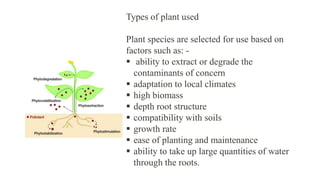
Types of plant used
Plant species are selected for use based on
factors such as: -
 ability to extract or degrade the
contaminants of concern
 adaptation to local climates
 high biomass
 depth root structure
 compatibility with soils
 growth rate
 ease of planting and maintenance
 ability to take up large quantities of water
through the roots.
Phytoremediation
Phytoremediation
Phytoremediation
Phytoremediation

Phytoremediation

  • 1.
  • 2.
    • Phytoremediation isa bioremediation process that uses various types of plants to remove, transfer, stabilize, and/or destroy contaminants in the soil and groundwater. • phyto = plant • remedium = restoring balance • Phytoremediation consists of mitigating pollutant concentrations in contaminated soils, water, or air, with plants able to contain, degrade, or eliminate metals, pesticides, solvents,explosives, crude oil and its derivatives, and various other contaminants from the media that contain them.
  • 3.
    How Does PhytoremediationWork? • Plant roots take contaminants from the ground into the "body" of the plant. • The plant root zone is referred to as the rhizosphere, this is where the action occurs. • This soil supports large populations of diverse microorganisms. • This is due to chemicals exuded by plant roots which provide carbon and energy for microbial growth. • This combination of plants and microorganisms appears to increase the biodegradation of compounds.
  • 5.
    There are severaldifferent types of phytoremediation mechanisms. • Rhizosphere biodegradation/Phytostimulation • In this process, the plant releases natural substances through its roots, supplying nutrients to microorganisms in the soil. The microorganisms enhance biological degradation.
  • 6.
    Advantages  in situpractice resulting in no disturbance  No removal of contaminated materials  Complete mineralisation of the contaminant can occur  Low installation and maintenance cost Disadvantages  Development of extensive root zone required- takes time  Root depth limited due to physical structure of soil  Organic matter from plant may be used as a C source instead of contaminant –decrease amount of contaminant biodegradation
  • 7.
    • Phyto-stabilization • Inthis process, chemical compounds produced by the plant immobilize contaminants, rather than degrade them. • Refers to the immobilization of contaminants in the soil through: Absorption and accumulation by roots Precipitation within the roots. ● Eventually, the mobility of the contaminant is reduced, migration to groundwater is prevented and thus bioavailability of metal into food chain is reduced.
  • 8.
    Advantages: No disposal ofhazardous material / biomass is required Very effective when rapid immobilization is needed to preserve ground and surface waters Disadvantages: Contaminant remain in soil Application of extensive fertilisation / soil amendments Mandatory monitoring required
  • 9.
    Phyto-accumulation (also calledphyto-extraction)  In this process, plant roots sorb the contaminants along with other nutrients and water.  The contaminant mass is not destroyed but ends up in the plant shoots and leaves. This method is used primarily for wastes containing metals.  At one demonstration site, water-soluble metals are taken up by plant species selected for their ability to take up large quantities of lead (Pb).  The metals are stored in the plantÍs aerial shoots, which are harvested and either smelted for potential metal recycling/recovery or are disposed of as a hazardous waste.  As a general rule, readily bioavailable metals for plant uptake include cadmium, nickel, zinc, arsenic, selenium, and copper.  Moderately bioavailable metals are cobalt, manganese, and iron. Lead, chromium, and uranium are not very bioavailable.  Lead can be made much more bioavailable by the addition of chelating agents to soils. Similarly, the availability of uranium and radio-cesium 137 can be enhanced using citric acid and ammonium nitrate, respectively.
  • 10.
    • Advantages: ● Costis fairly inexpensive compared to conventional methods. ● Contaminant permanently removed from soil. ● Amount of waste material that must be disposed of is decreased up to 95% ● In some cases, contaminant can be recycled. Limitations: • Metal bioavailability within the rhizosphere. • Rate of metal uptake by roots. • Proportion of metal “fixed” within the roots. • Cellular tolerance to toxic metals.
  • 11.
    Hydroponic Systems forTreating Water Streams (Rhizofiltration) • Rhizofiltration is similar to phyto-accumulation, but the plants used for cleanup are raised in greenhouses with their roots in water. • This system can be used for ex-situ groundwater treatment. That is, groundwater is pumped to the surface to irrigate these plants. Typically hydroponic systems utilize an artificial soil medium, such as sand mixed with perlite or vermiculite. • As the roots become saturated with contaminants, they are harvested and disposed of
  • 12.
    Adsorption or precipitationonto plant roots or absorption of contaminants in the solution surrounding the root zone. ● Used to remediate extracted groundwater, surface water, and waste water with low contaminants. ● Compared to phytoextraction, here the plants are used to address the groundwater rather than soil.
  • 13.
    Advantages ● Ability touse both terrestrial and aquatic plants for either in situ and ex situ applications. ● Contaminants do not have to be translocated into shoots. Disadvantages ● Constant need to adjust pH. ● Plants may first need to be grown in greenhouse / nursery. ● There is periodic harvesting and plant disposal. ● Tank design should be well engineered.
  • 14.
    Phyto-volatilization • In thisprocess, plants take up water containing organic contaminants and release the contaminants into the air through their leaves. • Involves plants taking up contaminants from soil, transforming them into volatile forms and transpiring them into atmosphere ● Works on organic compounds and heavy metal contaminants, TCE as well. ● Mercury is the primary metal contaminant that this process has been used for.
  • 15.
    • Advantage: •The contaminant,mercuric ion, may be transformed into a less toxic substance (i.e., elemental Hg). Disadvantage: •The mercury released into the atmosphere is likely to be recycled by precipitation And then re-deposited back into lakes and oceans, Repeating the production of methyl-mercury by anaerobic bacteria.
  • 16.
    Phyto-degradationPhytostimulation (Rhizodegradation) • Inthis process, plants actually metabolize and destroy contaminants within plant tissues. • Breakdown of contaminants within the plant root zone, or rhizosphere. ● Carried out by bacteria or other microorganisms flourishing in the rhizosphere. ● Microbes in rhizosphere transform contaminant to non toxic product. ● Works well in the removal of petroleum hydrocarbons
  • 17.
    • Advantages: ● insitu practice resulting in no disturbance ● No removal of contaminated materials ● Complete mineralisation of the contaminant can occur ● Low installation and maintenance cost Disadvantages: ● Development of extensive root zone required- takes time ● Root depth limited due to physical structure of soil ● Organic matter from plant may be used as a C source instead of contaminant decrease amount of contaminant biodegradation
  • 18.
    Hydraulic Control • Inthis process, trees indirectly remediate by controlling groundwater movement. • Trees act as natural pumps when their roots reach down towards the water table and establish a dense root mass that takes up large quantities of water. • A poplar tree, for example, pulls out of the ground 30 gallons of water per day, and a cottonwood can absorb up to 350 gallons per day.
  • 20.
    Types of plantused Plant species are selected for use based on factors such as: -  ability to extract or degrade the contaminants of concern  adaptation to local climates  high biomass  depth root structure  compatibility with soils  growth rate  ease of planting and maintenance  ability to take up large quantities of water through the roots.