Department of Microbiology
(Ch. Charan Singh University Campus, Meerut)
Presented By: Manisha Sirohi
M.Sc. (Microbiology)
2nd Semester.
CONTENTS
What is bioremediation?
Bioremediation: A three corner process.
Types of bioremediation techniques.
In situ bioremediation
Ex situ bioremediation
Micro-organisms use in bioremediation.
Factors affecting bioremediation.
References
What is bioremediation?
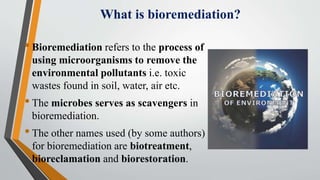
•Bioremediation refers to the process of
using microorganisms to remove the
environmental pollutants i.e. toxic
wastes found in soil, water, air etc.
•The microbes serves as scavengers in
bioremediation.
•The other names used (by some authors)
for bioremediation are biotreatment,
bioreclamation and biorestoration.
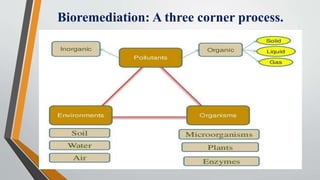
Bioremediation: A three corner process.
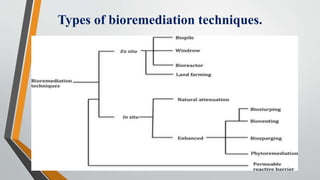
Types of bioremediation techniques.
In situ bioremediation:
•It involves a direct approach for the microbial
degradation of xenobiotics at the sites of pollution
(soil, ground water).
•In situ bioremediation has been successfully applied
for clean-up of oil spillages, beaches etc.
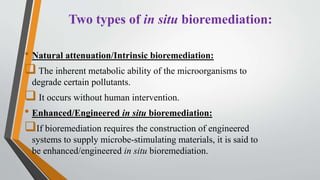
Two types of in situ bioremediation:
• Natural attenuation/Intrinsic bioremediation:
 The inherent metabolic ability of the microorganisms to
degrade certain pollutants.
 It occurs without human intervention.
• Enhanced/Engineered in situ bioremediation:
If bioremediation requires the construction of engineered
systems to supply microbe-stimulating materials, it is said to
be enhanced/engineered in situ bioremediation.
4 Types of enhanced/engineered in situ bioremediation:
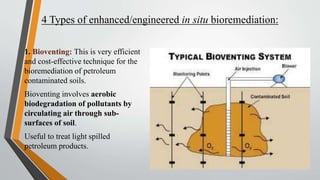
1. Bioventing: This is very efficient
and cost-effective technique for the
bioremediation of petroleum
contaminated soils.
Bioventing involves aerobic
biodegradation of pollutants by
circulating air through sub-
surfaces of soil.
Useful to treat light spilled
petroleum products.
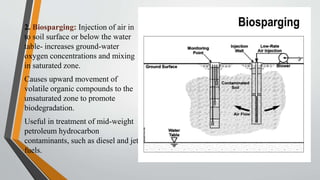
2. Biosparging: Injection of air in
to soil surface or below the water
table- increases ground-water
oxygen concentrations and mixing
in saturated zone.
Causes upward movement of
volatile organic compounds to the
unsaturated zone to promote
biodegradation.
Useful in treatment of mid-weight
petroleum hydrocarbon
contaminants, such as diesel and jet
fuels.
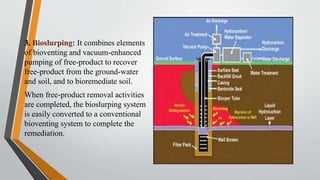
3. Bioslurping: It combines elements
of bioventing and vacuum-enhanced
pumping of free-product to recover
free-product from the ground-water
and soil, and to bioremediate soil.
When free-product removal activities
are completed, the bioslurping system
is easily converted to a conventional
bioventing system to complete the
remediation.
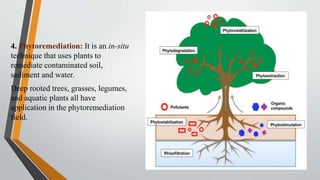
4. Phytoremediation: It is an in-situ
technique that uses plants to
remediate contaminated soil,
sediment and water.
Deep rooted trees, grasses, legumes,
and aquatic plants all have
application in the phytoremediation
field.
Ex situ bioremediation:
•Waste or toxic pollutants can be collected from the
polluted sites and bioremediation can be carried
out at a designated place or site.
•4 types of ex situ bioremediation:
•Land farming, windrow, biopiles and bioreactors.
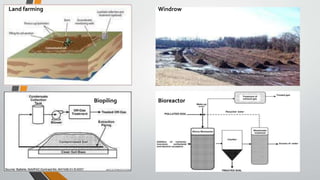
• Land farming: Contaminated soil is excavated and spread over
land. Soil is periodically tilled to improve aeration.
Remediation due to indigenous microorganisms, as well as
chemical and physical processes. It can reduce monitoring and
maintainence costs.
• Windrow: Windrows rely on periodic turning of piled polluted
soil to enhance bioremediation by icreasing degradation
activities of indigenous and/or transient hydrocarbonoclastic
bacteria present in polluted soil.
• Biopiling: It is the combination of landfarming and
composting. It controls the physical losses of contaminants.
• Bioreactors: Soil and water pumped up from a contaminated
plume and processed through an engineered containment
system. Degradation in a bioreactor is generally greater than in
situ because the contained environment is more controlable and
predictable.
Land farming Windrow
Biopiling Bioreactor
Micro-organisms use in bioremediation.
Bacteria:
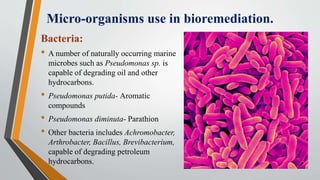
• A number of naturally occurring marine
microbes such as Pseudomonas sp. is
capable of degrading oil and other
hydrocarbons.
• Pseudomonas putida- Aromatic
compounds
• Pseudomonas diminuta- Parathion
• Other bacteria includes Achromobacter,
Arthrobacter, Bacillus, Brevibacterium,
capable of degrading petroleum
hydrocarbons.
Factors affecting
bioremediation:
Nutrient availability
Moisture content
pH
Temperature
Contaminant availability
References
• Satyanarayana U. Biotechnology. BOOKS AND ALLIED (P) Ltd.
• Sharma P.D. Environmental Microbiology. RASTOGI PUBLICATIONS.
• Gupta P.K. Biotechnology and Genomics. RASTOGI PUBLICATIONS.
• Dubey R.C. ATextbook of Biotechnology. S Chand And Company Ltd.
• Dubey R.C. ATextbook of Microbiology. S Chand And Company Ltd.
• Willey/Sherwood/Woolverton. Prescott’s Microbiology. McGRAW-HILL
INTERNATIONAL EDITION.
• www.sciencedirect.com/bioremediation.
Wish you all a very
Happy Holi 

Bioremediation

  • 1.
    Department of Microbiology (Ch.Charan Singh University Campus, Meerut) Presented By: Manisha Sirohi M.Sc. (Microbiology) 2nd Semester.
  • 2.
    CONTENTS What is bioremediation? Bioremediation:A three corner process. Types of bioremediation techniques. In situ bioremediation Ex situ bioremediation Micro-organisms use in bioremediation. Factors affecting bioremediation. References
  • 3.
    What is bioremediation? •Bioremediationrefers to the process of using microorganisms to remove the environmental pollutants i.e. toxic wastes found in soil, water, air etc. •The microbes serves as scavengers in bioremediation. •The other names used (by some authors) for bioremediation are biotreatment, bioreclamation and biorestoration.
  • 4.
    Bioremediation: A threecorner process.
  • 5.
  • 6.
    In situ bioremediation: •Itinvolves a direct approach for the microbial degradation of xenobiotics at the sites of pollution (soil, ground water). •In situ bioremediation has been successfully applied for clean-up of oil spillages, beaches etc.
  • 7.
    Two types ofin situ bioremediation: • Natural attenuation/Intrinsic bioremediation:  The inherent metabolic ability of the microorganisms to degrade certain pollutants.  It occurs without human intervention. • Enhanced/Engineered in situ bioremediation: If bioremediation requires the construction of engineered systems to supply microbe-stimulating materials, it is said to be enhanced/engineered in situ bioremediation.
  • 8.
    4 Types ofenhanced/engineered in situ bioremediation: 1. Bioventing: This is very efficient and cost-effective technique for the bioremediation of petroleum contaminated soils. Bioventing involves aerobic biodegradation of pollutants by circulating air through sub- surfaces of soil. Useful to treat light spilled petroleum products.
  • 9.
    2. Biosparging: Injectionof air in to soil surface or below the water table- increases ground-water oxygen concentrations and mixing in saturated zone. Causes upward movement of volatile organic compounds to the unsaturated zone to promote biodegradation. Useful in treatment of mid-weight petroleum hydrocarbon contaminants, such as diesel and jet fuels.
  • 10.
    3. Bioslurping: Itcombines elements of bioventing and vacuum-enhanced pumping of free-product to recover free-product from the ground-water and soil, and to bioremediate soil. When free-product removal activities are completed, the bioslurping system is easily converted to a conventional bioventing system to complete the remediation.
  • 11.
    4. Phytoremediation: Itis an in-situ technique that uses plants to remediate contaminated soil, sediment and water. Deep rooted trees, grasses, legumes, and aquatic plants all have application in the phytoremediation field.
  • 12.
    Ex situ bioremediation: •Wasteor toxic pollutants can be collected from the polluted sites and bioremediation can be carried out at a designated place or site. •4 types of ex situ bioremediation: •Land farming, windrow, biopiles and bioreactors.
  • 13.
    • Land farming:Contaminated soil is excavated and spread over land. Soil is periodically tilled to improve aeration. Remediation due to indigenous microorganisms, as well as chemical and physical processes. It can reduce monitoring and maintainence costs. • Windrow: Windrows rely on periodic turning of piled polluted soil to enhance bioremediation by icreasing degradation activities of indigenous and/or transient hydrocarbonoclastic bacteria present in polluted soil. • Biopiling: It is the combination of landfarming and composting. It controls the physical losses of contaminants. • Bioreactors: Soil and water pumped up from a contaminated plume and processed through an engineered containment system. Degradation in a bioreactor is generally greater than in situ because the contained environment is more controlable and predictable.
  • 14.
  • 15.
    Micro-organisms use inbioremediation. Bacteria: • A number of naturally occurring marine microbes such as Pseudomonas sp. is capable of degrading oil and other hydrocarbons. • Pseudomonas putida- Aromatic compounds • Pseudomonas diminuta- Parathion • Other bacteria includes Achromobacter, Arthrobacter, Bacillus, Brevibacterium, capable of degrading petroleum hydrocarbons.
  • 16.
    Factors affecting bioremediation: Nutrient availability Moisturecontent pH Temperature Contaminant availability
  • 17.
    References • Satyanarayana U.Biotechnology. BOOKS AND ALLIED (P) Ltd. • Sharma P.D. Environmental Microbiology. RASTOGI PUBLICATIONS. • Gupta P.K. Biotechnology and Genomics. RASTOGI PUBLICATIONS. • Dubey R.C. ATextbook of Biotechnology. S Chand And Company Ltd. • Dubey R.C. ATextbook of Microbiology. S Chand And Company Ltd. • Willey/Sherwood/Woolverton. Prescott’s Microbiology. McGRAW-HILL INTERNATIONAL EDITION. • www.sciencedirect.com/bioremediation.
  • 18.
    Wish you alla very Happy Holi 