PRASANNA R KOVATH,DEPARTMENT OF BIOTECHNOLOGY
• Biogas is a type of biofuel that is naturally produced from the
decomposition of organic waste.
• When organic matter, such as food scraps and animal waste, break
down in an anaerobic environment (an environment absent of oxygen)
they release a blend of gases, primarily methane and carbon dioxide.
• Because this decomposition happens in an anaerobic environment, the
process of producing biogas is also known as anaerobic digestion.
• Biogas is known as an environmentally-friendly energy source because it
alleviates two major environmental problems simultaneously.
• The global waste epidemic that releases dangerous levels of methane gas
every day.
• The reliance on fossil fuel energy to meet global energy demand.
• Due to the high content of methane in biogas (typically 50-75%) biogas
is flammable, and therefore produces a deep blue flame, and can be used
as an energy source.
• Biogas generation recovers waste materials that would otherwise pollute
landfills; prevents the use of toxic chemicals in sewage treatment plants,
and saves money, energy, and material by treating waste on-site.
• Biogas is one of the most widely used alternative sources for
the production of renewable energy.
• In India, it is also known as "Gobar Gas".
• It is the result of the decomposition in the absence of oxygen (a process
called anaerobic digestion) of various organic substances, by a large
amount of bacteria.
• Biogas has a high calorific value and can be converted into electricity
and heat. The fermentation remains is called digestate, which is a
completely odourless liquid material with high agronomic value, with
improved features compared to the starting material.
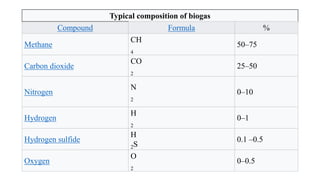
Typical composition of biogas
Compound Formula %
Methane
CH
4
50–75
Carbon dioxide
CO
2
25–50
Nitrogen
N
2
0–10
Hydrogen
H
2
0–1
Hydrogen sulfide
H
2S
0.1 –0.5
Oxygen
O
2
0–0.5
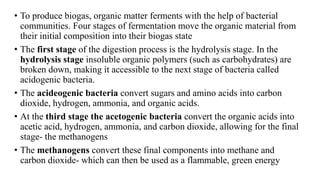
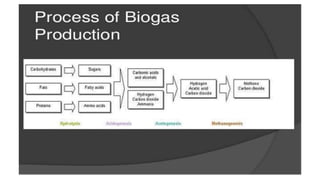
• To produce biogas, organic matter ferments with the help of bacterial
communities. Four stages of fermentation move the organic material from
their initial composition into their biogas state
• The first stage of the digestion process is the hydrolysis stage. In the
hydrolysis stage insoluble organic polymers (such as carbohydrates) are
broken down, making it accessible to the next stage of bacteria called
acidogenic bacteria.
• The acideogenic bacteria convert sugars and amino acids into carbon
dioxide, hydrogen, ammonia, and organic acids.
• At the third stage the acetogenic bacteria convert the organic acids into
acetic acid, hydrogen, ammonia, and carbon dioxide, allowing for the final
stage- the methanogens
• The methanogens convert these final components into methane and
carbon dioxide- which can then be used as a flammable, green energy
RAW MATERIALS
• Industrial and food processing waste:these arise from sugar, potato,
vegetable and fruit processing, brewery and distillery wastes, and
whey from cheese production.
• Animal excreta and agricultural wastes:these are solid wastes rich
on cellulose and lignocelluloses.
• Agricultural biomass like straw, bagasse, etc. show poor digestibility
and often high C : N ratio.
• Domestic and municipal wastes:these are in the form of solid wastes
and sewage respectively
CONSTRUCTION
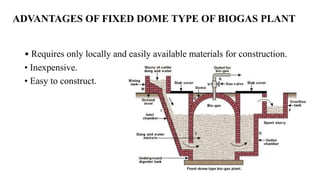
• The biogas plant is a brick and cement structure having the following
five sections:
• Mixing tank present above the ground level.
• Inlet tank: The mixing tank opens underground into a sloping inlet
chamber.
• Digester: The inlet chamber opens from below into the digester which
is a huge tank with a dome like ceiling. The ceiling of the digester has
an outlet with a valve for the supply of biogas.
• Outlet tank: The digester opens from below into an outlet chamber.
• Overflow tank: The outlet chamber opens from the top into a small
over flow tank.
FIXED DOME TYPE BIOGAS PLANT
• The various forms of biomass are mixed with an equal quantity of water
in the mixing tank. This forms the slurry.
• The slurry is fed into the digester through the inlet chamber.
• When the digester is partially filled with the slurry, the introduction of
slurry is stopped and the plant is left unused for about two months.During
these two months, anaerobic bacteria present in the slurry decomposes or
ferments the biomass in the presence of water.
• As a result of anaerobic fermentation, biogas is formed, which starts
collecting in the dome of the digester.
• As more and more biogas starts collecting, the pressure exerted by the
biogas forces the spent slurry into the outlet chamber.
• From the outlet chamber, the spent slurry overflows into the overflow
tank.
• The spent slurry is manually removed from the overflow tank and used as
manure for plants.
• The gas valve connected to a system of pipelines is opened when a
supply of biogas is required.
• To obtain a continuous supply of biogas, a functioning plant can be fed
continuously with the prepared slurry
ADVANTAGES OF FIXED DOME TYPE OF BIOGAS PLANT
• Requires only locally and easily available materials for construction.
• Inexpensive.
• Easy to construct.
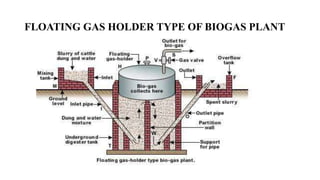
FLOATING GAS HOLDER TYPE OF BIOGAS PLANT
WORKING
• Slurry (mixture of equal quantities of biomass and water) is prepared
in the mixing tank.
• The prepared slurry is fed into the inlet chamber of the digester
through the inlet pipe.
• The plant is left unused for about two months and introduction of more
slurry is stopped.
• During this period, anaerobic fermentation of biomass takes place in
the presence of water and produces biogas in the digester.
• Biogas being lighter rises up and starts collecting in the gas holder.
The gas holder now starts moving up.
• The gas holder cannot rise up beyond a certain level. As more and
more gas starts collecting, more pressure begins to be exerted on the
slurry.
• The spent slurry is now forced into the outlet chamber from the top of
the inlet chamber.
• When the outlet chamber gets filled with the spent slurry, the excess is
forced out through the outlet pipe into the overflow tank. This is later
used as manure for plants.
• The gas valve of the gas outlet is opened to get a supply of biogas.
• Once the production of biogas begins, a continuous supply of gas can
be ensured by regular removal of spent slurry and introduction of fresh
slurry.
• Disadvantages of floating gas holder type biogas plant
• Expensive
• Steel drum may rust
• Requires regular maintenance
• Batch type: Filled once,sealed, Emptied when raw materials stop
producing gas.
• Continuous type: Fed with a definite quantity of wastes at regular
intervals,Gas production continuous & regular
FACTORS AFFECTING METHANE FORMATION
• pH
• 6-8 Acidic medium lowers methane formation.
• Temperature
Fluctuation ↓ methane formation – inhibit growth of methanogens.• 30-40oC.
Nitrogen concentration
↑ N2 - ↓ growth of bacteria - ↓ CH4
C:N ratio
Micro organisms in a biogas plant needs both N nitrogen and C carbon.
• Research has shown that the methanogenic bacteria work best with a C/N ratio
30:1
Creation of anaerobic conditions
• CH4 production take place in strictly anaerobic condition.
• Digesters – airtight, burried under soil.
• Advantages
• Cheaper and simpler technology than other biofuels.
• Recovery of the product is spontaneous
• Aseptic conditions are not needed for operation.
• Any biodegradable matter can be used as substrate.
• Anaerobic digestion inactivates pathogens and parasites.
• Disadvantages
• The product value is rather low.
• The process is not very attractive economically on large industrial
scale.
• The biogas yields are lower due to the dilute nature of substrates used.
• Biogas contains some gases as impurities, which are corrosive to the
metal of engine.
Biogas

Biogas

  • 1.
  • 2.
    • Biogas isa type of biofuel that is naturally produced from the decomposition of organic waste. • When organic matter, such as food scraps and animal waste, break down in an anaerobic environment (an environment absent of oxygen) they release a blend of gases, primarily methane and carbon dioxide. • Because this decomposition happens in an anaerobic environment, the process of producing biogas is also known as anaerobic digestion.
  • 3.
    • Biogas isknown as an environmentally-friendly energy source because it alleviates two major environmental problems simultaneously. • The global waste epidemic that releases dangerous levels of methane gas every day. • The reliance on fossil fuel energy to meet global energy demand. • Due to the high content of methane in biogas (typically 50-75%) biogas is flammable, and therefore produces a deep blue flame, and can be used as an energy source.
  • 4.
    • Biogas generationrecovers waste materials that would otherwise pollute landfills; prevents the use of toxic chemicals in sewage treatment plants, and saves money, energy, and material by treating waste on-site. • Biogas is one of the most widely used alternative sources for the production of renewable energy. • In India, it is also known as "Gobar Gas". • It is the result of the decomposition in the absence of oxygen (a process called anaerobic digestion) of various organic substances, by a large amount of bacteria. • Biogas has a high calorific value and can be converted into electricity and heat. The fermentation remains is called digestate, which is a completely odourless liquid material with high agronomic value, with improved features compared to the starting material.
  • 5.
    Typical composition ofbiogas Compound Formula % Methane CH 4 50–75 Carbon dioxide CO 2 25–50 Nitrogen N 2 0–10 Hydrogen H 2 0–1 Hydrogen sulfide H 2S 0.1 –0.5 Oxygen O 2 0–0.5
  • 6.
    • To producebiogas, organic matter ferments with the help of bacterial communities. Four stages of fermentation move the organic material from their initial composition into their biogas state • The first stage of the digestion process is the hydrolysis stage. In the hydrolysis stage insoluble organic polymers (such as carbohydrates) are broken down, making it accessible to the next stage of bacteria called acidogenic bacteria. • The acideogenic bacteria convert sugars and amino acids into carbon dioxide, hydrogen, ammonia, and organic acids. • At the third stage the acetogenic bacteria convert the organic acids into acetic acid, hydrogen, ammonia, and carbon dioxide, allowing for the final stage- the methanogens • The methanogens convert these final components into methane and carbon dioxide- which can then be used as a flammable, green energy
  • 8.
    RAW MATERIALS • Industrialand food processing waste:these arise from sugar, potato, vegetable and fruit processing, brewery and distillery wastes, and whey from cheese production. • Animal excreta and agricultural wastes:these are solid wastes rich on cellulose and lignocelluloses. • Agricultural biomass like straw, bagasse, etc. show poor digestibility and often high C : N ratio. • Domestic and municipal wastes:these are in the form of solid wastes and sewage respectively
  • 9.
    CONSTRUCTION • The biogasplant is a brick and cement structure having the following five sections: • Mixing tank present above the ground level. • Inlet tank: The mixing tank opens underground into a sloping inlet chamber. • Digester: The inlet chamber opens from below into the digester which is a huge tank with a dome like ceiling. The ceiling of the digester has an outlet with a valve for the supply of biogas. • Outlet tank: The digester opens from below into an outlet chamber. • Overflow tank: The outlet chamber opens from the top into a small over flow tank.
  • 10.
    FIXED DOME TYPEBIOGAS PLANT • The various forms of biomass are mixed with an equal quantity of water in the mixing tank. This forms the slurry. • The slurry is fed into the digester through the inlet chamber. • When the digester is partially filled with the slurry, the introduction of slurry is stopped and the plant is left unused for about two months.During these two months, anaerobic bacteria present in the slurry decomposes or ferments the biomass in the presence of water. • As a result of anaerobic fermentation, biogas is formed, which starts collecting in the dome of the digester.
  • 11.
    • As moreand more biogas starts collecting, the pressure exerted by the biogas forces the spent slurry into the outlet chamber. • From the outlet chamber, the spent slurry overflows into the overflow tank. • The spent slurry is manually removed from the overflow tank and used as manure for plants. • The gas valve connected to a system of pipelines is opened when a supply of biogas is required. • To obtain a continuous supply of biogas, a functioning plant can be fed continuously with the prepared slurry
  • 12.
    ADVANTAGES OF FIXEDDOME TYPE OF BIOGAS PLANT • Requires only locally and easily available materials for construction. • Inexpensive. • Easy to construct.
  • 13.
    FLOATING GAS HOLDERTYPE OF BIOGAS PLANT
  • 14.
    WORKING • Slurry (mixtureof equal quantities of biomass and water) is prepared in the mixing tank. • The prepared slurry is fed into the inlet chamber of the digester through the inlet pipe. • The plant is left unused for about two months and introduction of more slurry is stopped. • During this period, anaerobic fermentation of biomass takes place in the presence of water and produces biogas in the digester. • Biogas being lighter rises up and starts collecting in the gas holder. The gas holder now starts moving up.
  • 15.
    • The gasholder cannot rise up beyond a certain level. As more and more gas starts collecting, more pressure begins to be exerted on the slurry. • The spent slurry is now forced into the outlet chamber from the top of the inlet chamber. • When the outlet chamber gets filled with the spent slurry, the excess is forced out through the outlet pipe into the overflow tank. This is later used as manure for plants. • The gas valve of the gas outlet is opened to get a supply of biogas. • Once the production of biogas begins, a continuous supply of gas can be ensured by regular removal of spent slurry and introduction of fresh slurry.
  • 16.
    • Disadvantages offloating gas holder type biogas plant • Expensive • Steel drum may rust • Requires regular maintenance • Batch type: Filled once,sealed, Emptied when raw materials stop producing gas. • Continuous type: Fed with a definite quantity of wastes at regular intervals,Gas production continuous & regular
  • 17.
    FACTORS AFFECTING METHANEFORMATION • pH • 6-8 Acidic medium lowers methane formation. • Temperature Fluctuation ↓ methane formation – inhibit growth of methanogens.• 30-40oC. Nitrogen concentration ↑ N2 - ↓ growth of bacteria - ↓ CH4 C:N ratio Micro organisms in a biogas plant needs both N nitrogen and C carbon. • Research has shown that the methanogenic bacteria work best with a C/N ratio 30:1 Creation of anaerobic conditions • CH4 production take place in strictly anaerobic condition. • Digesters – airtight, burried under soil.
  • 18.
    • Advantages • Cheaperand simpler technology than other biofuels. • Recovery of the product is spontaneous • Aseptic conditions are not needed for operation. • Any biodegradable matter can be used as substrate. • Anaerobic digestion inactivates pathogens and parasites. • Disadvantages • The product value is rather low. • The process is not very attractive economically on large industrial scale. • The biogas yields are lower due to the dilute nature of substrates used. • Biogas contains some gases as impurities, which are corrosive to the metal of engine.