PHYTOREMEDIATION
Submitted to : Dr. Abudul Ghani
Submitted by : Mujahid Hussain (12)
Subject : Advance Plant
Ecology
Classs : M.Phil Botany
1/24/201
7
Mujahid Hussain (12) M.Phil Botany, Department of Botany, Unversity of Sargodha,
Sargodha, Pakistan
1
What is Phytoremediation?
 Phytoremediation from Ancient Greek 
 (phyto), meaning "plant", 
 and Latin Remedium, meaning "restoring 
balance" 
1/24/201
7
Mujahid Hussain (12) M.Phil Botany, Department of Botany, Unversity of Sargodha,
Sargodha, Pakistan
2
 The process of removing contamination from soil
or water using potential plants.
1/24/201
7
Mujahid Hussain (12) M.Phil Botany, Department of Botany, Unversity of Sargodha,
Sargodha, Pakistan
3
 Technology that use plants to clean
up contaminated sites including
contaminated water or soil
1/24/201
7
Mujahid Hussain (12) M.Phil Botany, Department of Botany, Unversity of Sargodha,
Sargodha, Pakistan
4
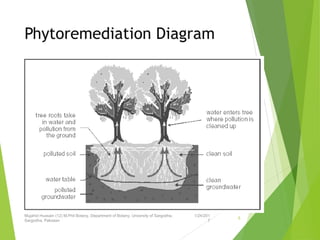
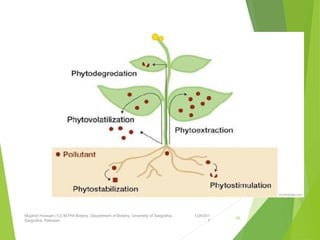
Phytoremediation Diagram
1/24/201
7
Mujahid Hussain (12) M.Phil Botany, Department of Botany, Unversity of Sargodha,
Sargodha, Pakistan
5
History
 Basically Phytoremediation technique was first
introduced in 1983 but the concept was actually
implemented since last 300 years
1/24/201
7
Mujahid Hussain (12) M.Phil Botany, Department of Botany, Unversity of Sargodha,
Sargodha, Pakistan
6
Applications
Phytoremediation may be 
applied to 
contaminated soil and 
contaminated water
1/24/201
7
Mujahid Hussain (12) M.Phil Botany, Department of Botany, Unversity of Sargodha,
Sargodha, Pakistan
7
Phytoremediation can be performed
following different methods:
1. PHYTOEXTRACTION
2. PHYTOSTABILIZATION
3. PHYTOVOLATILIZATION
4. PHYTOTRANSFORMATION
5. PHYTOSTIMULATION
6. RHIZOFILTERATION
1/24/201
7
Mujahid Hussain (12) M.Phil Botany, Department of Botany, Unversity of Sargodha,
Sargodha, Pakistan
8
Process dependence
 These processes totally rely on the ability of plants to
take up, accumulate or metabolize to less toxic
substances.
1/24/201
7
Mujahid Hussain (12) M.Phil Botany, Department of Botany, Unversity of Sargodha,
Sargodha, Pakistan
9
 The plant potential to uptake, accumulate and
degradation of contaminants vary from plant to plant.
1/24/201
7
Mujahid Hussain (12) M.Phil Botany, Department of Botany, Unversity of Sargodha,
Sargodha, Pakistan
10
Selection of plants
 The plants which are used in phytoremediation are
generally selected on the basis their growth rate and
biomass, their ability to accumulate and tolerate
contaminants, the depth of their root zone, and their
potential to transpire ground water
1/24/201
7
Mujahid Hussain (12) M.Phil Botany, Department of Botany, Unversity of Sargodha,
Sargodha, Pakistan
11
 The plants used in phytoremediation should be able to
degrade, accumulate or volatilize the contaminants,
and grow rapidly in wide range of different conditions
1/24/201
7
Mujahid Hussain (12) M.Phil Botany, Department of Botany, Unversity of Sargodha,
Sargodha, Pakistan
12
Advantages
 This technology has many advantages, beneficial in that
way because it is inexpensive, natural, conserves soil
resources and has no secondary contaminations and
enhances the soil quality and productivity
1/24/201
7
Mujahid Hussain (12) M.Phil Botany, Department of Botany, Unversity of Sargodha,
Sargodha, Pakistan
13
Other methods
 Ion exchange
 chemical precipitation
 reverse osmosis
1/24/201
7
Mujahid Hussain (12) M.Phil Botany, Department of Botany, Unversity of Sargodha,
Sargodha, Pakistan
14
Other methods
 These are the most helpful methods that have being
using to remove lead and cadmium (metal) and other
contaminations from wastewater.
 But these methods are very expensive and also they
produce a large amount of sludge requiring special
disposal, also decrease the fertility of soil leading to
infertile soil
1/24/201
7
Mujahid Hussain (12) M.Phil Botany, Department of Botany, Unversity of Sargodha,
Sargodha, Pakistan
15
PHYTOEXTRACTION
Phytoextraction:
Uptake and concentration of
pollutants from the
environment into the plant
biomass.
1/24/201
7
Mujahid Hussain (12) M.Phil Botany, Department of Botany, Unversity of Sargodha,
Sargodha, Pakistan
16
Phytoextraction
 Work well on metals (heavy metals) such as lead,
cadmium, copper, nikel
1/24/201
7
Mujahid Hussain (12) M.Phil Botany, Department of Botany, Unversity of Sargodha,
Sargodha, Pakistan
17
source
 source of these metals are industrial waste, mining
operation, smelting, combustion sources and solid
waste incinerators are the primary sources.
 Other sources include paint, batteries, metal plating,
automobiles exhausts, lead piping and fertilizers
pesticides
1/24/201
7
Mujahid Hussain (12) M.Phil Botany, Department of Botany, Unversity of Sargodha,
Sargodha, Pakistan
18
Phytoextraction
 for example lead and cadmium is soluble in water and
the excessive amount of lead and cadmium in water
cause many physiological and biochemical stress
symptoms in plants
1/24/201
7
Mujahid Hussain (12) M.Phil Botany, Department of Botany, Unversity of Sargodha,
Sargodha, Pakistan
19
Phytoextraction
 symptoms include such as growth reduction, disturbed
mineral nutrition, water imbalance.
 Like any other metal When they enter into the cell they
produce an oxidative stress in plant and lead to cell
damage
1/24/201
7
Mujahid Hussain (12) M.Phil Botany, Department of Botany, Unversity of Sargodha,
Sargodha, Pakistan
20
Phytoextraction
 Heavy metals also have serious effects on human health
cause many problems to human like are carcinogenic
increase the risk of cancer including liver cancer, skin
cancer, pulmonary damage
1/24/201
7
Mujahid Hussain (12) M.Phil Botany, Department of Botany, Unversity of Sargodha,
Sargodha, Pakistan
21
Phytoextraction
 lungs cancer, bladder, kidney, colon, nasal, paranasal
sinuses itai-itai disease, skeletal damage, also effect
metabolism, mental and intelligence problems,
Anaemia, pink disease, Neurasthenia, Diarrhea, high
blood pressure, nervous system disorders, vomiting,
fever, Multi-organ effect and also cause lead to death
1/24/201
7
Mujahid Hussain (12) M.Phil Botany, Department of Botany, Unversity of Sargodha,
Sargodha, Pakistan
22
Phytoextraction
 Plants used for treatment are as follows
 Water lettuce
 Sunflower
 Indian mustard
 Mostly these plants are used for treatment
1/24/201
7
Mujahid Hussain (12) M.Phil Botany, Department of Botany, Unversity of Sargodha,
Sargodha, Pakistan
23
 But also some other plant as well used
 Pteris vittata,
 Triticum aestivum,
 Brassica campestris,
 Brassica juncea
 Brassica Rapa
 Brassica napus, Salix sp., Populus sp.,
 Sanvitalia procumbens
 Sorghum Sudanese
1/24/201
7
Mujahid Hussain (12) M.Phil Botany, Department of Botany, Unversity of Sargodha,
Sargodha, Pakistan
24
Specificity
 For Arsenic, lead using the Sunflower (Helianthus
annuus) 
 or the Chinese Brake fern (Pteris vittata) a
hyperaccumulator. Chinese Brake fern stores arsenic,
lead in its leaves.
 Salt-tolerant
(moderately halophytic) barley and/or sugar beets are
commonly used for the extraction of sodium
chloride (common salt) to reclaim fields that were
previously flooded by sea water.
1/24/201
7
Mujahid Hussain (12) M.Phil Botany, Department of Botany, Unversity of Sargodha,
Sargodha, Pakistan
25
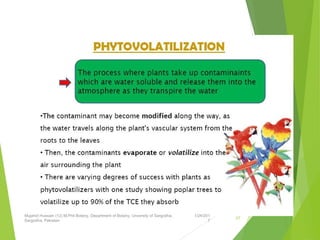
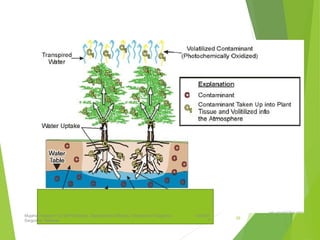
PHYTOVOLATILIZATION
Phytovolatilization:
Removal of substances
from soil or water with
release into the air.
1/24/201
7
Mujahid Hussain (12) M.Phil Botany, Department of Botany, Unversity of Sargodha,
Sargodha, Pakistan
26
1/24/201
7
Mujahid Hussain (12) M.Phil Botany, Department of Botany, Unversity of Sargodha,
Sargodha, Pakistan
27
Plants used
 Liriodendron tulipifera
 Arabidopsis thaliana
 Stanleya pinnata
 Astragalus bisulucatus
1/24/201
7
Mujahid Hussain (12) M.Phil Botany, Department of Botany, Unversity of Sargodha,
Sargodha, Pakistan
28
1/24/201
7
Mujahid Hussain (12) M.Phil Botany, Department of Botany, Unversity of Sargodha,
Sargodha, Pakistan
29
Phytostimulation
Phytostimulation  — 
 This process is also known as rhizosphere degradation.
 Enhancement of soil microbial activity for the degradation of 
contaminants, typically by organisms that associate with roots. 
1/24/201
7
Mujahid Hussain (12) M.Phil Botany, Department of Botany, Unversity of Sargodha,
Sargodha, Pakistan
30
Phytostimulation
 Organisms involve may be bacteria or mycorrhizal fungi
1/24/201
7
Mujahid Hussain (12) M.Phil Botany, Department of Botany, Unversity of Sargodha,
Sargodha, Pakistan
31
RHIZOFILTRATION
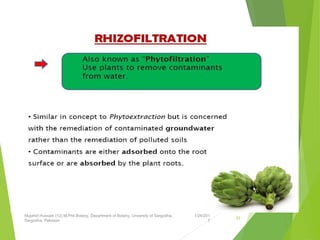
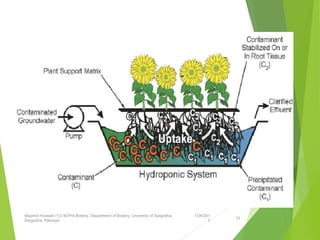
Rhizofiltration: Filtering
water through a mass of
roots to remove toxic
substances or excess
nutrients.
1/24/201
7
Mujahid Hussain (12) M.Phil Botany, Department of Botany, Unversity of Sargodha,
Sargodha, Pakistan
32
1/24/201
7
Mujahid Hussain (12) M.Phil Botany, Department of Botany, Unversity of Sargodha,
Sargodha, Pakistan
33
1/24/201
7
Mujahid Hussain (12) M.Phil Botany, Department of Botany, Unversity of Sargodha,
Sargodha, Pakistan
34
Plants used
 Helianthus Annus
 Euchronia crassipes
 chloridemia sp.
 cladophore
1/24/201
7
Mujahid Hussain (12) M.Phil Botany, Department of Botany, Unversity of Sargodha,
Sargodha, Pakistan
35
PHYTOSTABILIZATION
Reduction of mobility of
contaminants in
environment
1/24/201
7
Mujahid Hussain (12) M.Phil Botany, Department of Botany, Unversity of Sargodha,
Sargodha, Pakistan
36
PHYTOSTABILIZATION
 Stabilize the contaminants
 Prevent mechanical transportation of chemicals
 Trees transpire large quantities of water (even some
more than 15gal/day)
 So pumping action prevents contaminants from
migration into the water table
1/24/201
7
Mujahid Hussain (12) M.Phil Botany, Department of Botany, Unversity of Sargodha,
Sargodha, Pakistan
37
How stabilization occur
 Phytostabilization focuses on the long term stabilization
 For example, the plant's presence can reduce wind
erosion;
 or the plant's roots can prevent water erosion,
 In this way immobilize the pollutants by adsorption or
accumulation, and provide a zone around the roots
where the pollutant can precipitate and stabilize.
1/24/201
7
Mujahid Hussain (12) M.Phil Botany, Department of Botany, Unversity of Sargodha,
Sargodha, Pakistan
38
 Unlike phytoextraction, phytostabilization focuses
mainly on sequestering (attached) pollutants in soil near
the roots but not in plant tissues. Pollutants become
less bioavailable, and livestock, wildlife, and human
exposure is reduced. 
1/24/201
7
Mujahid Hussain (12) M.Phil Botany, Department of Botany, Unversity of Sargodha,
Sargodha, Pakistan
39
Plant used
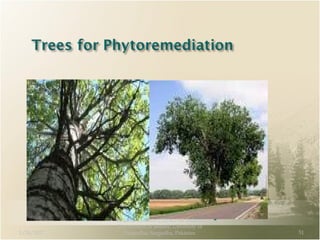
 Mostly tree species are used
1/24/201
7
Mujahid Hussain (12) M.Phil Botany, Department of Botany, Unversity of Sargodha,
Sargodha, Pakistan
40
Phytotransformation
Chemical modification of
the environmental
substances (contaminants)
takes place by plant.
1/24/201
7
Mujahid Hussain (12) M.Phil Botany, Department of Botany, Unversity of Sargodha,
Sargodha, Pakistan
41
Phytotransformation
 In the case of organic pollutants, such
as pesticides, explosives, solvents, industrial chemicals, and
other toxic substances are taken up by plants and transformed
into less toxic or non-toxic form when plant metabolize them.
1/24/201
7
Mujahid Hussain (12) M.Phil Botany, Department of Botany, Unversity of Sargodha,
Sargodha, Pakistan
42
Phytotransformation
 certain plants are used, such as Cannas, convert these
substances (contaminants) into non-toxic substances by their
metabolism.
 In other cases, microorganisms living in association with plant
roots may metabolize these substances in soil or water.
1/24/201
7
Mujahid Hussain (12) M.Phil Botany, Department of Botany, Unversity of Sargodha,
Sargodha, Pakistan
43
 These complex compounds cannot be broken down to basic
molecules (water, carbon-dioxide, etc.) by plants
 hence, the term phytotransformation represents a change in
chemical structure (less toxic) without complete breakdown of
the compound.
1/24/201
7
Mujahid Hussain (12) M.Phil Botany, Department of Botany, Unversity of Sargodha,
Sargodha, Pakistan
44
Phase I metabolism
 "Green Liver" is used to describe phytotransformation,
 as plants behave analogously to the human liver when
dealing with these xenobiotic compounds (foreign
compound/pollutant).
 After uptake of the xenobiotics, plant enzymes increase
the polarity of the xenobiotics by adding functional
groups such as hydroxyl groups (-OH).
1/24/201
7
Mujahid Hussain (12) M.Phil Botany, Department of Botany, Unversity of Sargodha,
Sargodha, Pakistan
45
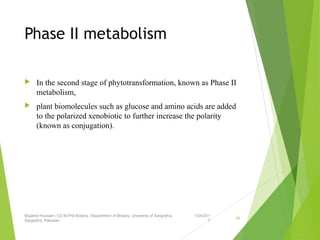
Phase II metabolism
 In the second stage of phytotransformation, known as Phase II
metabolism,
 plant biomolecules such as glucose and amino acids are added
to the polarized xenobiotic to further increase the polarity
(known as conjugation).
1/24/201
7
Mujahid Hussain (12) M.Phil Botany, Department of Botany, Unversity of Sargodha,
Sargodha, Pakistan
46
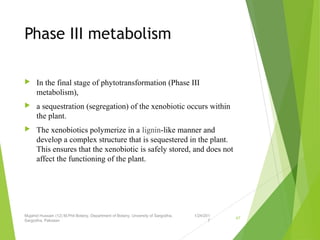
Phase III metabolism
 In the final stage of phytotransformation (Phase III
metabolism),
 a sequestration (segregation) of the xenobiotic occurs within
the plant.
 The xenobiotics polymerize in a lignin-like manner and
develop a complex structure that is sequestered in the plant.
This ensures that the xenobiotic is safely stored, and does not
affect the functioning of the plant.
1/24/201
7
Mujahid Hussain (12) M.Phil Botany, Department of Botany, Unversity of Sargodha,
Sargodha, Pakistan
47
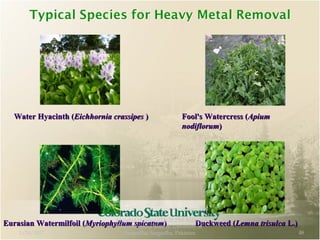
Eurasian Watermilfoil (Eurasian Watermilfoil (Myriophyllum spicatumMyriophyllum spicatum))
Water Hyacinth (Water Hyacinth (Eichhornia crassipesEichhornia crassipes ))
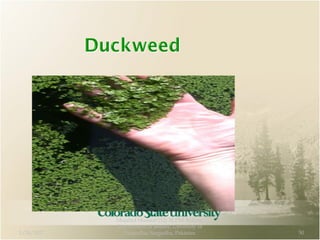
Duckweed (Duckweed (Lemna trisulcaLemna trisulca L.)L.)
Fool's Watercress (Fool's Watercress (ApiumApium
nodiflorumnodiflorum))
1/24/2017
Mujahid Hussain (12) M.Phil Botany,
Department of Botany, Unversity of
Sargodha, Sargodha, Pakistan 48
1/24/2017
Mujahid Hussain (12) M.Phil Botany,
Department of Botany, Unversity of
Sargodha, Sargodha, Pakistan 49
1/24/2017
Mujahid Hussain (12) M.Phil Botany,
Department of Botany, Unversity of
Sargodha, Sargodha, Pakistan 50
1/24/2017
Mujahid Hussain (12) M.Phil Botany,
Department of Botany, Unversity of
Sargodha, Sargodha, Pakistan 51
Plant ClassificationPlant Classification
1/24/201
7
Mujahid Hussain (12) M.Phil Botany, Department of Botany, Unversity of Sargodha,
Sargodha, Pakistan
52
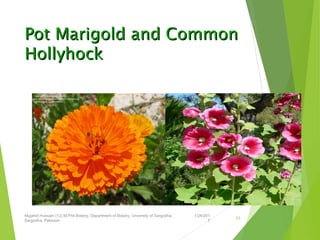
Pot Marigold and CommonPot Marigold and Common
HollyhockHollyhock
1/24/201
7
Mujahid Hussain (12) M.Phil Botany, Department of Botany, Unversity of Sargodha,
Sargodha, Pakistan
53
Features of OrnamentalFeatures of Ornamental
PhytoremediationPhytoremediation
Beauty
Cleaning

1/24/201
7
Mujahid Hussain (12) M.Phil Botany, Department of Botany, Unversity of Sargodha,
Sargodha, Pakistan
54
1/24/201
7
Mujahid Hussain (12) M.Phil Botany, Department of Botany, Unversity of Sargodha,
Sargodha, Pakistan
55
Advantages
 Natural.
 Lo cost
 Environmentally friendly
 Increase soil fertility
 Increase productivity
 Increase growth and yield
1/24/201
7
Mujahid Hussain (12) M.Phil Botany, Department of Botany, Unversity of Sargodha,
Sargodha, Pakistan
56
Disadvantages
 May take several years to remediate
 Consumption of contaminated plant tissue is also a
concern (may enter into food chain
 Possible effect on the food chain.
1/24/201
7
Mujahid Hussain (12) M.Phil Botany, Department of Botany, Unversity of Sargodha,
Sargodha, Pakistan
57
Conclusion
 So overall we have to understand their (mean
contaminants especially heavy metals) toxic effects on
living lives, on all living organisms (including animals,
humans and plants as well).
 Pakistan is an agricultural country and much of its
economy based on agriculture
 By using potential plants, curing this problem we can
increase yield and production in agriculture
 So in this way we can happy our farmers by overall
increasing yield production and also in this way we can
improve our economy and income
 And overall overcome economic losses
 1/24/201
7
Mujahid Hussain (12) M.Phil Botany, Department of Botany, Unversity of Sargodha,
Sargodha, Pakistan
58
Thank you 
1/24/201
7
Mujahid Hussain (12) M.Phil Botany, Department of Botany, Unversity of Sargodha,
Sargodha, Pakistan
59

phytoremidation

  • 1.
    PHYTOREMEDIATION Submitted to :Dr. Abudul Ghani Submitted by : Mujahid Hussain (12) Subject : Advance Plant Ecology Classs : M.Phil Botany 1/24/201 7 Mujahid Hussain (12) M.Phil Botany, Department of Botany, Unversity of Sargodha, Sargodha, Pakistan 1
  • 2.
    What is Phytoremediation? Phytoremediation from Ancient Greek   (phyto), meaning "plant",   and Latin Remedium, meaning "restoring  balance"  1/24/201 7 Mujahid Hussain (12) M.Phil Botany, Department of Botany, Unversity of Sargodha, Sargodha, Pakistan 2
  • 3.
     The processof removing contamination from soil or water using potential plants. 1/24/201 7 Mujahid Hussain (12) M.Phil Botany, Department of Botany, Unversity of Sargodha, Sargodha, Pakistan 3
  • 4.
     Technology thatuse plants to clean up contaminated sites including contaminated water or soil 1/24/201 7 Mujahid Hussain (12) M.Phil Botany, Department of Botany, Unversity of Sargodha, Sargodha, Pakistan 4
  • 5.
    Phytoremediation Diagram 1/24/201 7 Mujahid Hussain(12) M.Phil Botany, Department of Botany, Unversity of Sargodha, Sargodha, Pakistan 5
  • 6.
    History  Basically Phytoremediationtechnique was first introduced in 1983 but the concept was actually implemented since last 300 years 1/24/201 7 Mujahid Hussain (12) M.Phil Botany, Department of Botany, Unversity of Sargodha, Sargodha, Pakistan 6
  • 7.
  • 8.
    Phytoremediation can beperformed following different methods: 1. PHYTOEXTRACTION 2. PHYTOSTABILIZATION 3. PHYTOVOLATILIZATION 4. PHYTOTRANSFORMATION 5. PHYTOSTIMULATION 6. RHIZOFILTERATION 1/24/201 7 Mujahid Hussain (12) M.Phil Botany, Department of Botany, Unversity of Sargodha, Sargodha, Pakistan 8
  • 9.
    Process dependence  Theseprocesses totally rely on the ability of plants to take up, accumulate or metabolize to less toxic substances. 1/24/201 7 Mujahid Hussain (12) M.Phil Botany, Department of Botany, Unversity of Sargodha, Sargodha, Pakistan 9
  • 10.
     The plantpotential to uptake, accumulate and degradation of contaminants vary from plant to plant. 1/24/201 7 Mujahid Hussain (12) M.Phil Botany, Department of Botany, Unversity of Sargodha, Sargodha, Pakistan 10
  • 11.
    Selection of plants The plants which are used in phytoremediation are generally selected on the basis their growth rate and biomass, their ability to accumulate and tolerate contaminants, the depth of their root zone, and their potential to transpire ground water 1/24/201 7 Mujahid Hussain (12) M.Phil Botany, Department of Botany, Unversity of Sargodha, Sargodha, Pakistan 11
  • 12.
     The plantsused in phytoremediation should be able to degrade, accumulate or volatilize the contaminants, and grow rapidly in wide range of different conditions 1/24/201 7 Mujahid Hussain (12) M.Phil Botany, Department of Botany, Unversity of Sargodha, Sargodha, Pakistan 12
  • 13.
    Advantages  This technologyhas many advantages, beneficial in that way because it is inexpensive, natural, conserves soil resources and has no secondary contaminations and enhances the soil quality and productivity 1/24/201 7 Mujahid Hussain (12) M.Phil Botany, Department of Botany, Unversity of Sargodha, Sargodha, Pakistan 13
  • 14.
    Other methods  Ionexchange  chemical precipitation  reverse osmosis 1/24/201 7 Mujahid Hussain (12) M.Phil Botany, Department of Botany, Unversity of Sargodha, Sargodha, Pakistan 14
  • 15.
    Other methods  Theseare the most helpful methods that have being using to remove lead and cadmium (metal) and other contaminations from wastewater.  But these methods are very expensive and also they produce a large amount of sludge requiring special disposal, also decrease the fertility of soil leading to infertile soil 1/24/201 7 Mujahid Hussain (12) M.Phil Botany, Department of Botany, Unversity of Sargodha, Sargodha, Pakistan 15
  • 16.
    PHYTOEXTRACTION Phytoextraction: Uptake and concentrationof pollutants from the environment into the plant biomass. 1/24/201 7 Mujahid Hussain (12) M.Phil Botany, Department of Botany, Unversity of Sargodha, Sargodha, Pakistan 16
  • 17.
    Phytoextraction  Work wellon metals (heavy metals) such as lead, cadmium, copper, nikel 1/24/201 7 Mujahid Hussain (12) M.Phil Botany, Department of Botany, Unversity of Sargodha, Sargodha, Pakistan 17
  • 18.
    source  source ofthese metals are industrial waste, mining operation, smelting, combustion sources and solid waste incinerators are the primary sources.  Other sources include paint, batteries, metal plating, automobiles exhausts, lead piping and fertilizers pesticides 1/24/201 7 Mujahid Hussain (12) M.Phil Botany, Department of Botany, Unversity of Sargodha, Sargodha, Pakistan 18
  • 19.
    Phytoextraction  for examplelead and cadmium is soluble in water and the excessive amount of lead and cadmium in water cause many physiological and biochemical stress symptoms in plants 1/24/201 7 Mujahid Hussain (12) M.Phil Botany, Department of Botany, Unversity of Sargodha, Sargodha, Pakistan 19
  • 20.
    Phytoextraction  symptoms includesuch as growth reduction, disturbed mineral nutrition, water imbalance.  Like any other metal When they enter into the cell they produce an oxidative stress in plant and lead to cell damage 1/24/201 7 Mujahid Hussain (12) M.Phil Botany, Department of Botany, Unversity of Sargodha, Sargodha, Pakistan 20
  • 21.
    Phytoextraction  Heavy metalsalso have serious effects on human health cause many problems to human like are carcinogenic increase the risk of cancer including liver cancer, skin cancer, pulmonary damage 1/24/201 7 Mujahid Hussain (12) M.Phil Botany, Department of Botany, Unversity of Sargodha, Sargodha, Pakistan 21
  • 22.
    Phytoextraction  lungs cancer,bladder, kidney, colon, nasal, paranasal sinuses itai-itai disease, skeletal damage, also effect metabolism, mental and intelligence problems, Anaemia, pink disease, Neurasthenia, Diarrhea, high blood pressure, nervous system disorders, vomiting, fever, Multi-organ effect and also cause lead to death 1/24/201 7 Mujahid Hussain (12) M.Phil Botany, Department of Botany, Unversity of Sargodha, Sargodha, Pakistan 22
  • 23.
    Phytoextraction  Plants usedfor treatment are as follows  Water lettuce  Sunflower  Indian mustard  Mostly these plants are used for treatment 1/24/201 7 Mujahid Hussain (12) M.Phil Botany, Department of Botany, Unversity of Sargodha, Sargodha, Pakistan 23
  • 24.
     But alsosome other plant as well used  Pteris vittata,  Triticum aestivum,  Brassica campestris,  Brassica juncea  Brassica Rapa  Brassica napus, Salix sp., Populus sp.,  Sanvitalia procumbens  Sorghum Sudanese 1/24/201 7 Mujahid Hussain (12) M.Phil Botany, Department of Botany, Unversity of Sargodha, Sargodha, Pakistan 24
  • 25.
    Specificity  For Arsenic,lead using the Sunflower (Helianthus annuus)   or the Chinese Brake fern (Pteris vittata) a hyperaccumulator. Chinese Brake fern stores arsenic, lead in its leaves.  Salt-tolerant (moderately halophytic) barley and/or sugar beets are commonly used for the extraction of sodium chloride (common salt) to reclaim fields that were previously flooded by sea water. 1/24/201 7 Mujahid Hussain (12) M.Phil Botany, Department of Botany, Unversity of Sargodha, Sargodha, Pakistan 25
  • 26.
    PHYTOVOLATILIZATION Phytovolatilization: Removal of substances fromsoil or water with release into the air. 1/24/201 7 Mujahid Hussain (12) M.Phil Botany, Department of Botany, Unversity of Sargodha, Sargodha, Pakistan 26
  • 27.
    1/24/201 7 Mujahid Hussain (12)M.Phil Botany, Department of Botany, Unversity of Sargodha, Sargodha, Pakistan 27
  • 28.
    Plants used  Liriodendrontulipifera  Arabidopsis thaliana  Stanleya pinnata  Astragalus bisulucatus 1/24/201 7 Mujahid Hussain (12) M.Phil Botany, Department of Botany, Unversity of Sargodha, Sargodha, Pakistan 28
  • 29.
    1/24/201 7 Mujahid Hussain (12)M.Phil Botany, Department of Botany, Unversity of Sargodha, Sargodha, Pakistan 29
  • 30.
    Phytostimulation Phytostimulation  —   This process is also known as rhizospheredegradation.  Enhancement of soil microbial activity for the degradation of  contaminants, typically by organisms that associate with roots.  1/24/201 7 Mujahid Hussain (12) M.Phil Botany, Department of Botany, Unversity of Sargodha, Sargodha, Pakistan 30
  • 31.
    Phytostimulation  Organisms involvemay be bacteria or mycorrhizal fungi 1/24/201 7 Mujahid Hussain (12) M.Phil Botany, Department of Botany, Unversity of Sargodha, Sargodha, Pakistan 31
  • 32.
    RHIZOFILTRATION Rhizofiltration: Filtering water througha mass of roots to remove toxic substances or excess nutrients. 1/24/201 7 Mujahid Hussain (12) M.Phil Botany, Department of Botany, Unversity of Sargodha, Sargodha, Pakistan 32
  • 33.
    1/24/201 7 Mujahid Hussain (12)M.Phil Botany, Department of Botany, Unversity of Sargodha, Sargodha, Pakistan 33
  • 34.
    1/24/201 7 Mujahid Hussain (12)M.Phil Botany, Department of Botany, Unversity of Sargodha, Sargodha, Pakistan 34
  • 35.
    Plants used  HelianthusAnnus  Euchronia crassipes  chloridemia sp.  cladophore 1/24/201 7 Mujahid Hussain (12) M.Phil Botany, Department of Botany, Unversity of Sargodha, Sargodha, Pakistan 35
  • 36.
    PHYTOSTABILIZATION Reduction of mobilityof contaminants in environment 1/24/201 7 Mujahid Hussain (12) M.Phil Botany, Department of Botany, Unversity of Sargodha, Sargodha, Pakistan 36
  • 37.
    PHYTOSTABILIZATION  Stabilize thecontaminants  Prevent mechanical transportation of chemicals  Trees transpire large quantities of water (even some more than 15gal/day)  So pumping action prevents contaminants from migration into the water table 1/24/201 7 Mujahid Hussain (12) M.Phil Botany, Department of Botany, Unversity of Sargodha, Sargodha, Pakistan 37
  • 38.
    How stabilization occur Phytostabilization focuses on the long term stabilization  For example, the plant's presence can reduce wind erosion;  or the plant's roots can prevent water erosion,  In this way immobilize the pollutants by adsorption or accumulation, and provide a zone around the roots where the pollutant can precipitate and stabilize. 1/24/201 7 Mujahid Hussain (12) M.Phil Botany, Department of Botany, Unversity of Sargodha, Sargodha, Pakistan 38
  • 39.
     Unlike phytoextraction,phytostabilization focuses mainly on sequestering (attached) pollutants in soil near the roots but not in plant tissues. Pollutants become less bioavailable, and livestock, wildlife, and human exposure is reduced.  1/24/201 7 Mujahid Hussain (12) M.Phil Botany, Department of Botany, Unversity of Sargodha, Sargodha, Pakistan 39
  • 40.
    Plant used  Mostlytree species are used 1/24/201 7 Mujahid Hussain (12) M.Phil Botany, Department of Botany, Unversity of Sargodha, Sargodha, Pakistan 40
  • 41.
    Phytotransformation Chemical modification of theenvironmental substances (contaminants) takes place by plant. 1/24/201 7 Mujahid Hussain (12) M.Phil Botany, Department of Botany, Unversity of Sargodha, Sargodha, Pakistan 41
  • 42.
    Phytotransformation  In thecase of organic pollutants, such as pesticides, explosives, solvents, industrial chemicals, and other toxic substances are taken up by plants and transformed into less toxic or non-toxic form when plant metabolize them. 1/24/201 7 Mujahid Hussain (12) M.Phil Botany, Department of Botany, Unversity of Sargodha, Sargodha, Pakistan 42
  • 43.
    Phytotransformation  certain plantsare used, such as Cannas, convert these substances (contaminants) into non-toxic substances by their metabolism.  In other cases, microorganisms living in association with plant roots may metabolize these substances in soil or water. 1/24/201 7 Mujahid Hussain (12) M.Phil Botany, Department of Botany, Unversity of Sargodha, Sargodha, Pakistan 43
  • 44.
     These complexcompounds cannot be broken down to basic molecules (water, carbon-dioxide, etc.) by plants  hence, the term phytotransformation represents a change in chemical structure (less toxic) without complete breakdown of the compound. 1/24/201 7 Mujahid Hussain (12) M.Phil Botany, Department of Botany, Unversity of Sargodha, Sargodha, Pakistan 44
  • 45.
    Phase I metabolism "Green Liver" is used to describe phytotransformation,  as plants behave analogously to the human liver when dealing with these xenobiotic compounds (foreign compound/pollutant).  After uptake of the xenobiotics, plant enzymes increase the polarity of the xenobiotics by adding functional groups such as hydroxyl groups (-OH). 1/24/201 7 Mujahid Hussain (12) M.Phil Botany, Department of Botany, Unversity of Sargodha, Sargodha, Pakistan 45
  • 46.
    Phase II metabolism In the second stage of phytotransformation, known as Phase II metabolism,  plant biomolecules such as glucose and amino acids are added to the polarized xenobiotic to further increase the polarity (known as conjugation). 1/24/201 7 Mujahid Hussain (12) M.Phil Botany, Department of Botany, Unversity of Sargodha, Sargodha, Pakistan 46
  • 47.
    Phase III metabolism In the final stage of phytotransformation (Phase III metabolism),  a sequestration (segregation) of the xenobiotic occurs within the plant.  The xenobiotics polymerize in a lignin-like manner and develop a complex structure that is sequestered in the plant. This ensures that the xenobiotic is safely stored, and does not affect the functioning of the plant. 1/24/201 7 Mujahid Hussain (12) M.Phil Botany, Department of Botany, Unversity of Sargodha, Sargodha, Pakistan 47
  • 48.
    Eurasian Watermilfoil (EurasianWatermilfoil (Myriophyllum spicatumMyriophyllum spicatum)) Water Hyacinth (Water Hyacinth (Eichhornia crassipesEichhornia crassipes )) Duckweed (Duckweed (Lemna trisulcaLemna trisulca L.)L.) Fool's Watercress (Fool's Watercress (ApiumApium nodiflorumnodiflorum)) 1/24/2017 Mujahid Hussain (12) M.Phil Botany, Department of Botany, Unversity of Sargodha, Sargodha, Pakistan 48
  • 49.
    1/24/2017 Mujahid Hussain (12)M.Phil Botany, Department of Botany, Unversity of Sargodha, Sargodha, Pakistan 49
  • 50.
    1/24/2017 Mujahid Hussain (12)M.Phil Botany, Department of Botany, Unversity of Sargodha, Sargodha, Pakistan 50
  • 51.
    1/24/2017 Mujahid Hussain (12)M.Phil Botany, Department of Botany, Unversity of Sargodha, Sargodha, Pakistan 51
  • 52.
    Plant ClassificationPlant Classification 1/24/201 7 MujahidHussain (12) M.Phil Botany, Department of Botany, Unversity of Sargodha, Sargodha, Pakistan 52
  • 53.
    Pot Marigold andCommonPot Marigold and Common HollyhockHollyhock 1/24/201 7 Mujahid Hussain (12) M.Phil Botany, Department of Botany, Unversity of Sargodha, Sargodha, Pakistan 53
  • 54.
    Features of OrnamentalFeaturesof Ornamental PhytoremediationPhytoremediation Beauty Cleaning  1/24/201 7 Mujahid Hussain (12) M.Phil Botany, Department of Botany, Unversity of Sargodha, Sargodha, Pakistan 54
  • 55.
    1/24/201 7 Mujahid Hussain (12)M.Phil Botany, Department of Botany, Unversity of Sargodha, Sargodha, Pakistan 55
  • 56.
    Advantages  Natural.  Locost  Environmentally friendly  Increase soil fertility  Increase productivity  Increase growth and yield 1/24/201 7 Mujahid Hussain (12) M.Phil Botany, Department of Botany, Unversity of Sargodha, Sargodha, Pakistan 56
  • 57.
    Disadvantages  May takeseveral years to remediate  Consumption of contaminated plant tissue is also a concern (may enter into food chain  Possible effect on the food chain. 1/24/201 7 Mujahid Hussain (12) M.Phil Botany, Department of Botany, Unversity of Sargodha, Sargodha, Pakistan 57
  • 58.
    Conclusion  So overallwe have to understand their (mean contaminants especially heavy metals) toxic effects on living lives, on all living organisms (including animals, humans and plants as well).  Pakistan is an agricultural country and much of its economy based on agriculture  By using potential plants, curing this problem we can increase yield and production in agriculture  So in this way we can happy our farmers by overall increasing yield production and also in this way we can improve our economy and income  And overall overcome economic losses  1/24/201 7 Mujahid Hussain (12) M.Phil Botany, Department of Botany, Unversity of Sargodha, Sargodha, Pakistan 58
  • 59.
    Thank you  1/24/201 7 MujahidHussain (12) M.Phil Botany, Department of Botany, Unversity of Sargodha, Sargodha, Pakistan 59