Bioremediation
&
Phytoremediation
Memoona Rafique
Bioremediation can be broken down to
Bio, as in biological material
and
Remediation, as in the correction of
something.
BIOREMEDIATION
• Technology that uses living organism to remove pollutants.
• Bioremediation is an innovative and promising technology
available for removal of heavy metals and recovery of the
heavy metals in polluted water and lands.
• Bioremediation can occur on its own (natural
bioremediation) or can be spurred on via the addition of
fertilizers to increase the bioavailability within the medium
(bio stimulation).
TYPES OF BIOREMEDIATION
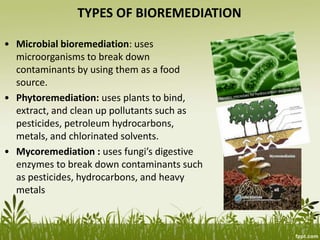
• Microbial bioremediation: uses
microorganisms to break down
contaminants by using them as a food
source.
• Phytoremediation: uses plants to bind,
extract, and clean up pollutants such as
pesticides, petroleum hydrocarbons,
metals, and chlorinated solvents.
• Mycoremediation : uses fungi’s digestive
enzymes to break down contaminants such
as pesticides, hydrocarbons, and heavy
metals
BIOREMEDIATION STRATEGIES
• In-Situ Bioremediation:
In situ bioremediation is the application of biological
treatment to the clean-up of hazardous chemicals present in
the subsurface.
• Ex-situ bioremediation:
The treatment of contaminates soil or water once it has been
excavated or pumped out of the location at which it was
found.
BIOREMEDIATION STRATEGIES
In-Situ Bioremediation:
• Phytoremediation
• Biosparging
• Bioventing
• Bio augmentation
• Bio piling
Ex-Situ Bioremediation
• Composting
• Bioreactors
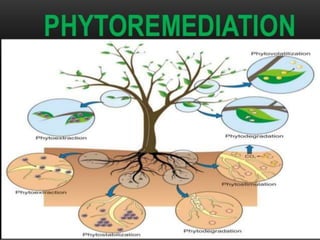
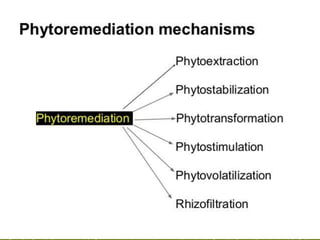
PHYTOREMEDIATION
Phytoremediation can be broken down as:
Phyto: Plants
and
Remedium: Restoring balance
PHYTOREMEDIATION
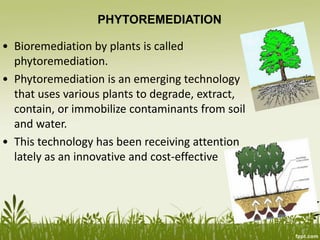
• Bioremediation by plants is called
phytoremediation.
• Phytoremediation is an emerging technology
that uses various plants to degrade, extract,
contain, or immobilize contaminants from soil
and water.
• This technology has been receiving attention
lately as an innovative and cost-effective
Why we need Phytoremediation:
• With the growth of industry, there has been a considerable
increase in the discharge of industrial waste to the
environment, chiefly soil and water.
• The indiscriminate release of heavy metals into the soil and
waters is a major health concern worldwide
• Several techniques exist to remove heavy metals, But most
of these techniques become ineffective when the
concentrations of heavy metals are less than 100 mg/L.
• Use of plants for remediation purposes is thus a possible
solution for heavy metal pollution since it includes
sustainable remediation technologies.
LIMITATIONS OF PHYTOREMEDIATION:
• Bioremediation is limited to those compounds that are
biodegradable. Not all compounds are susceptible to rapid
and complete degradation.
• Research is needed to develop and engineer
bioremediation technologies that are appropriate for sites
with complex mixtures of contaminants that are not evenly
dispersed in the environment.
• Bioremediation often takes longer than other treatment
options, such as excavation and removal of soil or
incineration.
TYPES OF VEGETATION USED:
Some of the plants used in phytoremediation are:
• Alfalfa
• Hybrid poplar trees
• Blue-green Algae
• Arrowroot
• Sudan grass
• Rye Grass
• Duck Weed
• Bermuda Grass
• Yellow or White Water Lilies
ADVANTAGES OF PHYTOREMEDIATION:
The major advantages of phytoremediation are:
• The cost of the phytoremediation is lower (up to 1000
times cheaper than other methods) than that of traditional
processes both in-situ and ex- situ.
• The plants can be easily monitored.
• The possibility of the recovery and re-use of valuable
products.
• Complete break down of pollutants in to non toxic
compounds is possible
DISADVANTANGES OF PHOTOREMEDIATION
• Phytoremediation is only limited to the sites with lower
contaminants concentration.
• Phytoremediation is slower than conventional method.
• This method is restricted to sites with contamination as
deep as the roots of the plants.
• It does not work through the winter.(seasonally effective)
• The air could be contaminated by the burning of leaves or
limbs of plants containing dangerous chemicals.
Phytoextraction
“Phytoextraction is a sub process of phytoremediation in
which plants remove dangerous elements or compounds
from soil or water, most usually heavy metals, metals that
have a high density and may be toxic to organisms even at
relatively low concentrations.”
16
Methods Of Phytoextraction
I. Natural hyper-accumulation, where plants naturally take
up the contaminants in soil unassisted.
II.Induced or assisted hyper-accumulation, where a
conditioning fluid containing a chelator or another agent is
added to soil to increase metal solubility or mobilization so
that the plants can absorb them more easily.
17
THE PROCESS
• In order for a plant to extract a heavy metal from water or
soil, five things need to happen.
• The metal needs to be dissolved in something the plant
roots can absorb
• The plant roots need to absorbs the heavy metal
• The plant needs to chelate the metal in order to both
protect itself and make the metal more mobile(this can
also happen before the metal is absorbed)
18
Cont..
• Chelation is a process by which a metal is surrounded
and chemically bonded to an organic compound
• The plant moves the chelated metal to a place to
safely store it.
• Finally, the plant must adapt to any damages the
metals cause during transportation and storage
19
Examples
• Arsenic, using the sunflower or the Chinese Brake fern
• Caesium-137and strontium-90 were removed from a pond
using sunflowers after the Chernobyl accident
• Mercury, selenium and organic pollutants such as
polychlorinated biphenyls (PCBs) have been removed from
soils by transgenic plants containing genes for bacterial
enzymes
20
ADVANTAGES
• Environmental friendly
• Clean up the soil without causing any harm to the soil
quality
• Less expensive than any other clean up process
• Amount of waste material that must be disposed off is
decreased up to 95%
• In some cases contaminant can be recycled
DISADVANTAGES
As this process is controlled by plants, it takes more time
than anthropogenic soil clean-up methods.
21
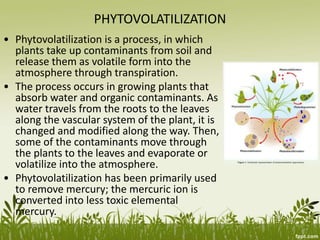
PHYTOVOLATILIZATION
• Phytovolatilization is a process, in which
plants take up contaminants from soil and
release them as volatile form into the
atmosphere through transpiration.
• The process occurs in growing plants that
absorb water and organic contaminants. As
water travels from the roots to the leaves
along the vascular system of the plant, it is
changed and modified along the way. Then,
some of the contaminants move through
the plants to the leaves and evaporate or
volatilize into the atmosphere.
• Phytovolatilization has been primarily used
to remove mercury; the mercuric ion is
converted into less toxic elemental
mercury.
Direct phytovolatilization
• Direct phytovolatilization is the more intuitive and better-
studied form, resulting from plant uptake and translocation
of contaminants
• It leads to volatilization of the compound from the
stem/trunk and leaves. Historically, this process is simply
called “phytovolatilization”.
• The direct phytovolatilization pathway often differs from
transpiration
INDIRECT PHYTOVOLATILIZATION
• Indirect phytovolatilization is the increase in volatile
contaminant flux from the subsurface resulting from plant
root activities. These processes cause profound changes in
subsurface chemical fate and transport. The activities of
plant roots can increase the flux of volatile contaminants
from the subsurface through the following mechanisms:
• Lowering the water table
• Increased soil permeability
• Chemical transport via hydraulic redistribution
DISADVANTAGE
• Use is limited by the fact that it does not remove the
pollutant completely,only it is transferred from one
segment (soil) to another (atmosphere) from where
it can be redeposited.
PHYTOSTABILIZATION
• involves the reduction of the
mobility of heavy metals in soil.
• can be enhanced by using soil
amendments that immobilize metals
combined with plant species.
• Phytostabilization is mostly used for
the remeditation of soil, sediment
and water.
Phytostabilization targets areas:
• large bare surfaces caused by mining operations or by
aerial depositions of metals from metal smelters.
• Plants for phytostabilization should be:
• tolerant to metals or tolerant to specific growing conditions
for a given site
• not accumulate contaminants in above-ground parts which
could be consumed by humans or animals
• have shallow roots to stabilize soil and take up soil water
• be easy to care for once established
Role of plants in phytostabilization:
• protect the contaminated soil from wind and water erosion
• alter the chemical form of the contaminants by changing
the soil environments.
• accumulate and precipitate heavy metals in the roots or
adsorb metals to the roots
• micro-organisms living in the rhizosphere of plants may
have an important role in these processes
PHYTOTRANSFORMATION
• Also referred to as phytodegradation, is the breakdown of
organic contaminants by plants via:
(1) metabolic processes within the plant
(2) the effect of compounds, such as enzymes, produced
by plants.
• Phytotransformation is dependent on direct uptake of
contaminants from the media and accumulation in the
vegetation.
Applicability
• Phytotransformation can be employed to remediate sites
contaminated with organic compounds.
• This technology also can be used to remove contaminants
from petrochemical sites and storage areas, fuel spills,
landfill leachates, and agricultural chemicals.
• In some applications, phytotransformation may be used in
concert with other remediation technologies or as a
polishing treatment.
Advantages VS Disadvantages
• Advantages:
 Both economically and environmentally friendly.
• Disadvantage:
 Requires more than one growing season to be efficient.
 Soil must be less than 3ft in depth and groundwater within
10ft of the surface.
 Contaminants may still enter the food chain through
animals or insects that eat plant material.
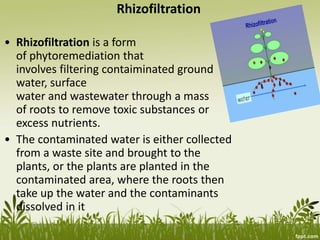
Rhizofiltration
• Rhizofiltration is a form
of phytoremediation that
involves filtering contaiminated ground
water, surface
water and wastewater through a mass
of roots to remove toxic substances or
excess nutrients.
• The contaminated water is either collected
from a waste site and brought to the
plants, or the plants are planted in the
contaminated area, where the roots then
take up the water and the contaminants
dissolved in it
Process of Rhizofiltration
• This process is very similar to phytoextraction in that it
removes contaminants by trapping them into harvestable
plant biomass
• Plants that have stable root systems are put in contact with
the contamination to get acclumated to the toxins.
• They absorb contaminants through their root systems and
store them in root biomass or transport them up into the
stems or leaves.
• The plants continue to absorb contaminants until they are
harvested.
• The plants are then replaced to continue the growth until
satisfactory levels of contaminant are achieved.
Application
• Rhizofiltration may be applicable to the treatment of
surface water and groundwater, industrial and residential
effluents, downwashes from power lines,acid mine
drainage, agricultural runoffs and diluted sludges.
• Plants suitable for rhizofiltration applications can efficiently
remove toxic metals from a solution using rapid-growth
root systems.
• Various terrestrial plant species have been found to
effectively remove toxic metals such as Cu2+, Cd2+, Ni2+,
Pb2+, and Zn2+ from aqueous solutions.
Plants used for rhizofiltration
Some of the most common plant species to remove toxins
from water via rhizofiltration
• Sunflower
• Indian Mustard
• Tobacco
• Rye
• Spinach
• Corn
• Parrot's Feather
• Cattail
Phytostimulation
• Also referred to as enhanced rhizosphere biodegradation,
and is the breakdown of organic contaminants in the soil
via enhanced microbial activity in the plant root zone.
• Another aspect of phytostimulation is the cultivation of
new microorganisms in the soil. Because of the distinct
rhizosphere habitat that is produced by living plants,
microorganisms may be inoculated on plant seed to
introduce specific organisms to the growing rhizosphere.
Importance of phytostimulation
• The rhizosphere provides a specific niche for soil
microorganisms to live. This niche is continuously
expanding as roots grow and penetrate new soil
zones.
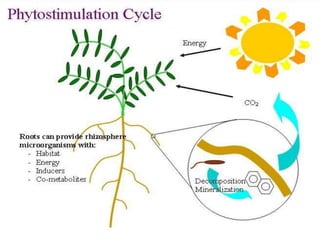
• Root exudates provide many benefits for
microorganism growth and activity. Root released
compounds have many roles in phytostimulation
because they often mimic man-made pollutants. The
rhizosphere serves as a unique soil habitat, full of
organic compounds that may serve as energy sources
for microorganisms.
References:
• http://rydberg.biology.colostate.edu/Phytoremediation/20
08%20websites/Alford%20Phytostimulation%20Webpage/
phytostimulation.htm
• https://www.wordnik.coM
• https://www.tandfonline.com
• http://pubs.sciepub.com
• http://www.hawaii.edu
REFRENCES:
• http://www.geoengineer.org/education/web-based-class-
projects/geoenvironmental-remediation-
technologies/bioremediation?showall=&start=7
• http://www.geoengineer.org/education/web-based-class-
projects/geoenvironmental-remediation-
technologies/bioremediation?showall=&start=6
• http://www.agrotechnomarket.com/2011/10/advantage-
and-disadvantages-of.html
• https://www.aftermath.com/content/types-of-
bioremediation
• http://rydberg.biology.colostate.edu/Phytoremediation/20
08%20websites/Alford%20Phytostimulation%20Webpage/
phytostimulation.htm

Bioremediation

  • 1.
  • 2.
    Bioremediation can bebroken down to Bio, as in biological material and Remediation, as in the correction of something.
  • 3.
    BIOREMEDIATION • Technology thatuses living organism to remove pollutants. • Bioremediation is an innovative and promising technology available for removal of heavy metals and recovery of the heavy metals in polluted water and lands. • Bioremediation can occur on its own (natural bioremediation) or can be spurred on via the addition of fertilizers to increase the bioavailability within the medium (bio stimulation).
  • 4.
    TYPES OF BIOREMEDIATION •Microbial bioremediation: uses microorganisms to break down contaminants by using them as a food source. • Phytoremediation: uses plants to bind, extract, and clean up pollutants such as pesticides, petroleum hydrocarbons, metals, and chlorinated solvents. • Mycoremediation : uses fungi’s digestive enzymes to break down contaminants such as pesticides, hydrocarbons, and heavy metals
  • 5.
    BIOREMEDIATION STRATEGIES • In-SituBioremediation: In situ bioremediation is the application of biological treatment to the clean-up of hazardous chemicals present in the subsurface. • Ex-situ bioremediation: The treatment of contaminates soil or water once it has been excavated or pumped out of the location at which it was found.
  • 6.
    BIOREMEDIATION STRATEGIES In-Situ Bioremediation: •Phytoremediation • Biosparging • Bioventing • Bio augmentation • Bio piling Ex-Situ Bioremediation • Composting • Bioreactors
  • 8.
    PHYTOREMEDIATION Phytoremediation can bebroken down as: Phyto: Plants and Remedium: Restoring balance
  • 9.
    PHYTOREMEDIATION • Bioremediation byplants is called phytoremediation. • Phytoremediation is an emerging technology that uses various plants to degrade, extract, contain, or immobilize contaminants from soil and water. • This technology has been receiving attention lately as an innovative and cost-effective
  • 10.
    Why we needPhytoremediation: • With the growth of industry, there has been a considerable increase in the discharge of industrial waste to the environment, chiefly soil and water. • The indiscriminate release of heavy metals into the soil and waters is a major health concern worldwide • Several techniques exist to remove heavy metals, But most of these techniques become ineffective when the concentrations of heavy metals are less than 100 mg/L. • Use of plants for remediation purposes is thus a possible solution for heavy metal pollution since it includes sustainable remediation technologies.
  • 11.
    LIMITATIONS OF PHYTOREMEDIATION: •Bioremediation is limited to those compounds that are biodegradable. Not all compounds are susceptible to rapid and complete degradation. • Research is needed to develop and engineer bioremediation technologies that are appropriate for sites with complex mixtures of contaminants that are not evenly dispersed in the environment. • Bioremediation often takes longer than other treatment options, such as excavation and removal of soil or incineration.
  • 12.
    TYPES OF VEGETATIONUSED: Some of the plants used in phytoremediation are: • Alfalfa • Hybrid poplar trees • Blue-green Algae • Arrowroot • Sudan grass • Rye Grass • Duck Weed • Bermuda Grass • Yellow or White Water Lilies
  • 13.
    ADVANTAGES OF PHYTOREMEDIATION: Themajor advantages of phytoremediation are: • The cost of the phytoremediation is lower (up to 1000 times cheaper than other methods) than that of traditional processes both in-situ and ex- situ. • The plants can be easily monitored. • The possibility of the recovery and re-use of valuable products. • Complete break down of pollutants in to non toxic compounds is possible
  • 14.
    DISADVANTANGES OF PHOTOREMEDIATION •Phytoremediation is only limited to the sites with lower contaminants concentration. • Phytoremediation is slower than conventional method. • This method is restricted to sites with contamination as deep as the roots of the plants. • It does not work through the winter.(seasonally effective) • The air could be contaminated by the burning of leaves or limbs of plants containing dangerous chemicals.
  • 16.
    Phytoextraction “Phytoextraction is asub process of phytoremediation in which plants remove dangerous elements or compounds from soil or water, most usually heavy metals, metals that have a high density and may be toxic to organisms even at relatively low concentrations.” 16
  • 17.
    Methods Of Phytoextraction I.Natural hyper-accumulation, where plants naturally take up the contaminants in soil unassisted. II.Induced or assisted hyper-accumulation, where a conditioning fluid containing a chelator or another agent is added to soil to increase metal solubility or mobilization so that the plants can absorb them more easily. 17
  • 18.
    THE PROCESS • Inorder for a plant to extract a heavy metal from water or soil, five things need to happen. • The metal needs to be dissolved in something the plant roots can absorb • The plant roots need to absorbs the heavy metal • The plant needs to chelate the metal in order to both protect itself and make the metal more mobile(this can also happen before the metal is absorbed) 18
  • 19.
    Cont.. • Chelation isa process by which a metal is surrounded and chemically bonded to an organic compound • The plant moves the chelated metal to a place to safely store it. • Finally, the plant must adapt to any damages the metals cause during transportation and storage 19
  • 20.
    Examples • Arsenic, usingthe sunflower or the Chinese Brake fern • Caesium-137and strontium-90 were removed from a pond using sunflowers after the Chernobyl accident • Mercury, selenium and organic pollutants such as polychlorinated biphenyls (PCBs) have been removed from soils by transgenic plants containing genes for bacterial enzymes 20
  • 21.
    ADVANTAGES • Environmental friendly •Clean up the soil without causing any harm to the soil quality • Less expensive than any other clean up process • Amount of waste material that must be disposed off is decreased up to 95% • In some cases contaminant can be recycled DISADVANTAGES As this process is controlled by plants, it takes more time than anthropogenic soil clean-up methods. 21
  • 22.
    PHYTOVOLATILIZATION • Phytovolatilization isa process, in which plants take up contaminants from soil and release them as volatile form into the atmosphere through transpiration. • The process occurs in growing plants that absorb water and organic contaminants. As water travels from the roots to the leaves along the vascular system of the plant, it is changed and modified along the way. Then, some of the contaminants move through the plants to the leaves and evaporate or volatilize into the atmosphere. • Phytovolatilization has been primarily used to remove mercury; the mercuric ion is converted into less toxic elemental mercury.
  • 23.
    Direct phytovolatilization • Directphytovolatilization is the more intuitive and better- studied form, resulting from plant uptake and translocation of contaminants • It leads to volatilization of the compound from the stem/trunk and leaves. Historically, this process is simply called “phytovolatilization”. • The direct phytovolatilization pathway often differs from transpiration
  • 24.
    INDIRECT PHYTOVOLATILIZATION • Indirectphytovolatilization is the increase in volatile contaminant flux from the subsurface resulting from plant root activities. These processes cause profound changes in subsurface chemical fate and transport. The activities of plant roots can increase the flux of volatile contaminants from the subsurface through the following mechanisms: • Lowering the water table • Increased soil permeability • Chemical transport via hydraulic redistribution
  • 25.
    DISADVANTAGE • Use islimited by the fact that it does not remove the pollutant completely,only it is transferred from one segment (soil) to another (atmosphere) from where it can be redeposited.
  • 26.
    PHYTOSTABILIZATION • involves thereduction of the mobility of heavy metals in soil. • can be enhanced by using soil amendments that immobilize metals combined with plant species. • Phytostabilization is mostly used for the remeditation of soil, sediment and water.
  • 27.
    Phytostabilization targets areas: •large bare surfaces caused by mining operations or by aerial depositions of metals from metal smelters. • Plants for phytostabilization should be: • tolerant to metals or tolerant to specific growing conditions for a given site • not accumulate contaminants in above-ground parts which could be consumed by humans or animals • have shallow roots to stabilize soil and take up soil water • be easy to care for once established
  • 28.
    Role of plantsin phytostabilization: • protect the contaminated soil from wind and water erosion • alter the chemical form of the contaminants by changing the soil environments. • accumulate and precipitate heavy metals in the roots or adsorb metals to the roots • micro-organisms living in the rhizosphere of plants may have an important role in these processes
  • 29.
    PHYTOTRANSFORMATION • Also referredto as phytodegradation, is the breakdown of organic contaminants by plants via: (1) metabolic processes within the plant (2) the effect of compounds, such as enzymes, produced by plants. • Phytotransformation is dependent on direct uptake of contaminants from the media and accumulation in the vegetation.
  • 30.
    Applicability • Phytotransformation canbe employed to remediate sites contaminated with organic compounds. • This technology also can be used to remove contaminants from petrochemical sites and storage areas, fuel spills, landfill leachates, and agricultural chemicals. • In some applications, phytotransformation may be used in concert with other remediation technologies or as a polishing treatment.
  • 31.
    Advantages VS Disadvantages •Advantages:  Both economically and environmentally friendly. • Disadvantage:  Requires more than one growing season to be efficient.  Soil must be less than 3ft in depth and groundwater within 10ft of the surface.  Contaminants may still enter the food chain through animals or insects that eat plant material.
  • 32.
    Rhizofiltration • Rhizofiltration isa form of phytoremediation that involves filtering contaiminated ground water, surface water and wastewater through a mass of roots to remove toxic substances or excess nutrients. • The contaminated water is either collected from a waste site and brought to the plants, or the plants are planted in the contaminated area, where the roots then take up the water and the contaminants dissolved in it
  • 33.
    Process of Rhizofiltration •This process is very similar to phytoextraction in that it removes contaminants by trapping them into harvestable plant biomass • Plants that have stable root systems are put in contact with the contamination to get acclumated to the toxins. • They absorb contaminants through their root systems and store them in root biomass or transport them up into the stems or leaves. • The plants continue to absorb contaminants until they are harvested. • The plants are then replaced to continue the growth until satisfactory levels of contaminant are achieved.
  • 34.
    Application • Rhizofiltration maybe applicable to the treatment of surface water and groundwater, industrial and residential effluents, downwashes from power lines,acid mine drainage, agricultural runoffs and diluted sludges. • Plants suitable for rhizofiltration applications can efficiently remove toxic metals from a solution using rapid-growth root systems. • Various terrestrial plant species have been found to effectively remove toxic metals such as Cu2+, Cd2+, Ni2+, Pb2+, and Zn2+ from aqueous solutions.
  • 35.
    Plants used forrhizofiltration Some of the most common plant species to remove toxins from water via rhizofiltration • Sunflower • Indian Mustard • Tobacco • Rye • Spinach • Corn • Parrot's Feather • Cattail
  • 36.
    Phytostimulation • Also referredto as enhanced rhizosphere biodegradation, and is the breakdown of organic contaminants in the soil via enhanced microbial activity in the plant root zone. • Another aspect of phytostimulation is the cultivation of new microorganisms in the soil. Because of the distinct rhizosphere habitat that is produced by living plants, microorganisms may be inoculated on plant seed to introduce specific organisms to the growing rhizosphere.
  • 38.
    Importance of phytostimulation •The rhizosphere provides a specific niche for soil microorganisms to live. This niche is continuously expanding as roots grow and penetrate new soil zones. • Root exudates provide many benefits for microorganism growth and activity. Root released compounds have many roles in phytostimulation because they often mimic man-made pollutants. The rhizosphere serves as a unique soil habitat, full of organic compounds that may serve as energy sources for microorganisms.
  • 39.
  • 40.
    REFRENCES: • http://www.geoengineer.org/education/web-based-class- projects/geoenvironmental-remediation- technologies/bioremediation?showall=&start=7 • http://www.geoengineer.org/education/web-based-class- projects/geoenvironmental-remediation- technologies/bioremediation?showall=&start=6 •http://www.agrotechnomarket.com/2011/10/advantage- and-disadvantages-of.html • https://www.aftermath.com/content/types-of- bioremediation • http://rydberg.biology.colostate.edu/Phytoremediation/20 08%20websites/Alford%20Phytostimulation%20Webpage/ phytostimulation.htm

Editor's Notes

  • #39 Exudates:a mass of cells and fluid that has seeped out of blood vessels or an organ, especially in inflammation