MICROBIAL
INSECTICIDES
Presented by
B.R.Iniyalakshimi
Dept. of Soil Science and Agricultural Chemistry
TNAU
Introduction
• Microbes & microbial products used as
insecticides.
• Less harmfull, fewer environmental effects.
• Microbial insecticides are biological
preparations that are often delivered in ways
similar to conventional chemical insecticides.
MICROBES
 Bacteria
 Fungi
 Virus
 Protozoa
 Rickettsiae – not used.
BACTERIA
 About 90 species of bacteria pathogenic to insect
pests.
 Bacillus thuringiensis – first discovered in 1902-
japanese bacteriologists, Ishiwata from infected silk
worms stands out prominent.
 Bacillus thuringiensis
 Bacillus popillae
 Bacillus sphaericus
 Coccobacillus acridorum
 Serratia marcescens
BACILLUS THURINGIENSIS
 B. thuringiensis (‘Bt’) is a spore forming gram positive
crystalliferous soil bacterium.
 Produces a toxin or crystal protein (Bt toxin or Cry) that
kills certain insects
 Commercially produced worldwide using fermentation
technology.
 The commercial Bt products are produced as dust,
wettable powder and emulsifiable concentrates.
 The toxin genes have also been genetically engineered
into several crop plants.
 The Bt toxin or Cry is produced when the bacteria
sporulates and is present in the parasporal crystal
 Several different strains and subspecies of B.
thuringiensis exist and produce different toxins that kill
specific insects
 Used as alternative to DDT and organophosphates since
the 1920s
 Bt toxin is used as specific insecticides under trade
names such as Dipel and Thuricide
TARGET INSECTS FOR BT TOXIN
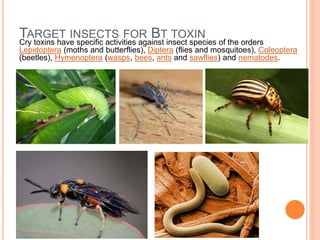
Cry toxins have specific activities against insect species of the orders
Lepidoptera (moths and butterflies), Diptera (flies and mosquitoes), Coleoptera
(beetles), Hymenoptera (wasps, bees, ants and sawflies) and nematodes.
SOME PROPERTIES OF THE INSECTICIDAL TOXINS
FROM VARIOUS STRAINS OF B. THURINGIENSIS
Strain/subsp. Protein size Target Insects Cry #
berliner 130-140 kDa Lepidoptera CryI
kurstaki KTP, HD1 130-140 kDa Lepidoptera CryI
entomocidus 6.01 130-140 kDa Lepidoptera CryI
aizawai 7.29 130-140 kDa Lepidoptera CryI
aizawai IC 1 135 kDa Lepidoptera, Diptera CryII
kurstaki HD-1 71 kDa Lepidoptera, Diptera CryII
tenebrionis (sd) 66-73 kDa Coleoptera CryIII
morrisoni PG14 125-145 kDa Diptera CryIV
israelensis 68 kDa Diptera CryIV
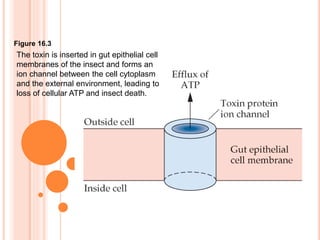
Figure 16.3
The toxin is inserted in gut epithelial cell
membranes of the insect and forms an
ion channel between the cell cytoplasm
and the external environment, leading to
loss of cellular ATP and insect death.
MODE OF ACTION
 Was initially believed to kill larvae by septicaemia
 It is now well established that delta-endotoxin alone is
responsible for the death of most susceptible
lepidopterous larvae.
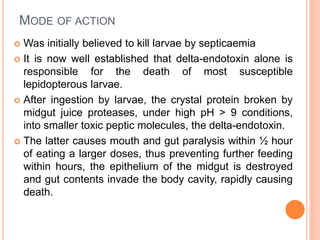
 After ingestion by larvae, the crystal protein broken by
midgut juice proteases, under high pH > 9 conditions,
into smaller toxic peptic molecules, the delta-endotoxin.
 The latter causes mouth and gut paralysis within ½ hour
of eating a larger doses, thus preventing further feeding
within hours, the epithelium of the midgut is destroyed
and gut contents invade the body cavity, rapidly causing
death.
ORGANISM TRADE NAME TARGET PEST
Bacillus popilliae - Japanese beetle
B. Thuringiensis
var.kurstaki
Dipel, Biobit,
Thuricide, Condor.
Moths
B. Thuringiensis
var.kurstaki plus beta-
exotoxin
Javelin Armyworm & other
moths
B. Thuringiensis var.
aizawi
Agree Wax moth
B. Thuringiensis
var.tenebrionis
Novodor Colorado potato
beetle
B. Thuringiensis
var.israelensis
VectoBac Mosquitoes, black flies
B. Thuringiensis
var.galleriae
Spicturin Larvae and moths and
forest insects
FUNGI
 More than 750 species known to infect insects.
 Mostly causing disease to insects.
 Some attack insects through cuticle.
 Spore attached to cuticle- germinates & penetrates
into body wall.
 Spreads – colonize the hemocoel & sometimes
produce toxins.
 Toxins – rapid death or death delayed until nutrients
depleted or organs destroyed.
VERTICILLIUM LECANII
 It is known as 'white – halo' fungus because of the
white mycelial growth on the edges of infected
scale insects.
 It can be multiplied on medium based on locally
available grains and tubers.
 It is formulated as wettable powder.
 It is effective against coffee green bug and certain
other homopterans.
o Deuteromycotina fungus, naturally occurring in soil throughout
the world.
o Mass produced on locally available grains and other solid
substrates.
o Formulated as wettable powder, water dispersible granule, and oil
based emulsifiable suspension.
o Useful against Coffee berry borer, Diamond backmoth, Thrips,
Grasshoppers, White flies, Aphid, Codling moth etc.
o Birds: Oral LD50: (5 days) quail >2,000 mg/kg daily (by gavage).
Beauveria bassiana
Metarrhizium anisopliae
Metarrhizium anisopliae is a widely distributed soil inhabiting
fungus.
The spore of M. anisopliae can be formulated as dust and
sprayable formulation.
It is used to control termites, mosquitoes, leaf hopper,
beetles etc.
Nomuraea rileyi
Nomuraea rileyi is of cosmopolitan occurrence and
pathogenic to a number of economically important
lepidopterous pests.
It is formulated as wettable powder.
The fungus could be multiplied on polished rice grains
and crushed sorghum.
ORGANISM TRADE NAME TARGET PEST
Beauveria
bassiana
Dispel®,
Naturalis®,
Mycotrol®,
BotaniGard®.
Helicoperva,
spodoptera,
borers,
hairy caterpillars,
mites, scales, etc
Metarhizium
anisopliae
Taenure® Thrips and beetle
larvae
Tick-Ex® Grubs and ticks
Paecilomyces
fumosoroseus
PFR-97® Whiteflies, aphids
and thrips.
Other genera- Nomuraea, Entomophthora and
Zoophthora. – affects insects.
Metarhizium anisopliae
VIRUS
Insect
virus
Baculo
virus
NPV
GV
CPV OCV
BACULOVIRUSES
 Baculoviruses are rod-shaped, double stranded DNA viruses
that can infect and kill a large number of different invertebrate
organisms
 Immature (larval) forms of moth species are the most common
hosts, but these viruses have also been found infecting sawflies,
mosquitoes, and shrimp.
 Baculoviruses have limited host ranges and generally do not
allow for insect resistance to develop
 Slow killing of target insects occurs
 In order to speed killing (enhance effectiveness), several genes
can be expressed in the baculovirus including diuretic hormone,
juvenile hormone esterase, Bt toxin, scorpion toxin, mite toxin,
wasp toxin, and a neurotoxin.
BACULOVIRUS
 Larvae infected with GV and NPV usually die within
5-12 days after infection.
 These viruses are produced on the host insects and
are formulated both as liquid and dust formulation.
family: Baculoviridae
Nuclear Polyhedrosis Virus
(NPV),
Granulosis virus (GV) and
Oryctes Granulosis virus.
NPV
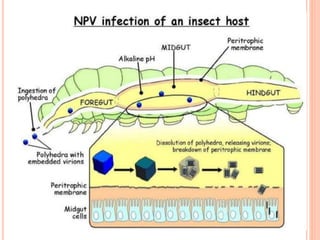
 NPV viruses develop in the host cell nucleus where one
or several virus rods occur singly or in groups encased in
a envelope.
 The envelops are occuled in many-sided crystals called
polyhedra.
 After ingesting the polyhedra, larvae show no outward
symptoms for 4 days to 3 weeks.
 At this time, the larval skin darkens & larvae climb to the
highest point on their host plant, where they die.
 Dead, blackened larvae may be found hanging from
the tops of plants.
 The integuments of these dead larvae rupture, and
millions of polyhedra are released into the
environment.
 Such diseases collectively – caterpillar wilt.
 Seven virus registered with EPA.
 NPV microbials – celery looper, gypsy moth,
douglas fir tussock moth, corn earworm & beetle
army worm.
 Two GV microbials – codling moth & Indian meal
moth.
 NPV -250 – 500 ml/ ha 2 - 3 time at 10 days
Interval
 Being obligate, virus has
to be produced only in
live insects.
 Thus, for the production
of HaNPV, either rear H.
armigera on large scale
or collect the larvae from
field and use them for
HaNPV production.
 Collect the 250 larvae (6-
7 day old) of H. armigera
from field.
Production of HaNPV
 Larvae are singly placed in
plastic tubes containing food
contaminated with NPV.
 After 7-8 days collect larvae
showing the symptoms of
NPV infection before they
liquefied, in air tight
container.
 Keep this container for 8-10
days to decompose the
larvae, so that polyhedra
released from infected tissue.
 Homogenize the decomposed suspension of diseased larvae
using a homogenizer.
 Dilute the homogenized content with small amount of water
and filter through two layers of muslin cloth.
 Little water is sprinkled 2-3 times over the remnants to
extract residual polyhedra.
 For crude preparation the filtrate is diluted with water
to make solution of 250 ml.
 This is known as 250 LE (LE-larval equivalent) HaNPV
 HaNPV in stoppered bottle, and store in cool and
dry place.
Cont……
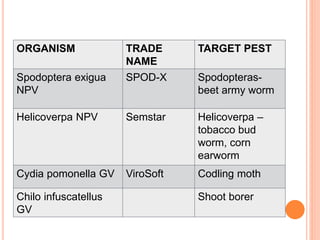
ORGANISM TRADE
NAME
TARGET PEST
Spodoptera exigua
NPV
SPOD-X Spodopteras-
beet army worm
Helicoverpa NPV Semstar Helicoverpa –
tobacco bud
worm, corn
earworm
Cydia pomonella GV ViroSoft Codling moth
Chilo infuscatellus
GV
Shoot borer
PROTOZOA
 Single-celled animals.
 Some of them parasitize and kill insects.
 Formulated as baits.
 When bait ingested- protozoa spores – active- grow
and replicate in the insect’s digestive system- kills.
 Effective – insects in immature stage.
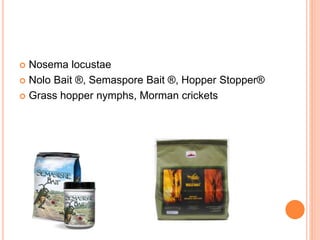
 Nosema locustae
 Nolo Bait ®, Semaspore Bait ®, Hopper Stopper®
 Grass hopper nymphs, Morman crickets
Microbial insecticides

Microbial insecticides

  • 1.
    MICROBIAL INSECTICIDES Presented by B.R.Iniyalakshimi Dept. ofSoil Science and Agricultural Chemistry TNAU
  • 2.
    Introduction • Microbes &microbial products used as insecticides. • Less harmfull, fewer environmental effects. • Microbial insecticides are biological preparations that are often delivered in ways similar to conventional chemical insecticides.
  • 3.
    MICROBES  Bacteria  Fungi Virus  Protozoa  Rickettsiae – not used.
  • 4.
    BACTERIA  About 90species of bacteria pathogenic to insect pests.  Bacillus thuringiensis – first discovered in 1902- japanese bacteriologists, Ishiwata from infected silk worms stands out prominent.  Bacillus thuringiensis  Bacillus popillae  Bacillus sphaericus  Coccobacillus acridorum  Serratia marcescens
  • 5.
    BACILLUS THURINGIENSIS  B.thuringiensis (‘Bt’) is a spore forming gram positive crystalliferous soil bacterium.  Produces a toxin or crystal protein (Bt toxin or Cry) that kills certain insects  Commercially produced worldwide using fermentation technology.  The commercial Bt products are produced as dust, wettable powder and emulsifiable concentrates.  The toxin genes have also been genetically engineered into several crop plants.
  • 6.
     The Bttoxin or Cry is produced when the bacteria sporulates and is present in the parasporal crystal  Several different strains and subspecies of B. thuringiensis exist and produce different toxins that kill specific insects  Used as alternative to DDT and organophosphates since the 1920s  Bt toxin is used as specific insecticides under trade names such as Dipel and Thuricide
  • 7.
    TARGET INSECTS FORBT TOXIN Cry toxins have specific activities against insect species of the orders Lepidoptera (moths and butterflies), Diptera (flies and mosquitoes), Coleoptera (beetles), Hymenoptera (wasps, bees, ants and sawflies) and nematodes.
  • 8.
    SOME PROPERTIES OFTHE INSECTICIDAL TOXINS FROM VARIOUS STRAINS OF B. THURINGIENSIS Strain/subsp. Protein size Target Insects Cry # berliner 130-140 kDa Lepidoptera CryI kurstaki KTP, HD1 130-140 kDa Lepidoptera CryI entomocidus 6.01 130-140 kDa Lepidoptera CryI aizawai 7.29 130-140 kDa Lepidoptera CryI aizawai IC 1 135 kDa Lepidoptera, Diptera CryII kurstaki HD-1 71 kDa Lepidoptera, Diptera CryII tenebrionis (sd) 66-73 kDa Coleoptera CryIII morrisoni PG14 125-145 kDa Diptera CryIV israelensis 68 kDa Diptera CryIV
  • 9.
    Figure 16.3 The toxinis inserted in gut epithelial cell membranes of the insect and forms an ion channel between the cell cytoplasm and the external environment, leading to loss of cellular ATP and insect death.
  • 10.
    MODE OF ACTION Was initially believed to kill larvae by septicaemia  It is now well established that delta-endotoxin alone is responsible for the death of most susceptible lepidopterous larvae.  After ingestion by larvae, the crystal protein broken by midgut juice proteases, under high pH > 9 conditions, into smaller toxic peptic molecules, the delta-endotoxin.  The latter causes mouth and gut paralysis within ½ hour of eating a larger doses, thus preventing further feeding within hours, the epithelium of the midgut is destroyed and gut contents invade the body cavity, rapidly causing death.
  • 11.
    ORGANISM TRADE NAMETARGET PEST Bacillus popilliae - Japanese beetle B. Thuringiensis var.kurstaki Dipel, Biobit, Thuricide, Condor. Moths B. Thuringiensis var.kurstaki plus beta- exotoxin Javelin Armyworm & other moths B. Thuringiensis var. aizawi Agree Wax moth B. Thuringiensis var.tenebrionis Novodor Colorado potato beetle B. Thuringiensis var.israelensis VectoBac Mosquitoes, black flies B. Thuringiensis var.galleriae Spicturin Larvae and moths and forest insects
  • 12.
    FUNGI  More than750 species known to infect insects.  Mostly causing disease to insects.  Some attack insects through cuticle.  Spore attached to cuticle- germinates & penetrates into body wall.  Spreads – colonize the hemocoel & sometimes produce toxins.  Toxins – rapid death or death delayed until nutrients depleted or organs destroyed.
  • 13.
    VERTICILLIUM LECANII  Itis known as 'white – halo' fungus because of the white mycelial growth on the edges of infected scale insects.  It can be multiplied on medium based on locally available grains and tubers.  It is formulated as wettable powder.  It is effective against coffee green bug and certain other homopterans.
  • 14.
    o Deuteromycotina fungus,naturally occurring in soil throughout the world. o Mass produced on locally available grains and other solid substrates. o Formulated as wettable powder, water dispersible granule, and oil based emulsifiable suspension. o Useful against Coffee berry borer, Diamond backmoth, Thrips, Grasshoppers, White flies, Aphid, Codling moth etc. o Birds: Oral LD50: (5 days) quail >2,000 mg/kg daily (by gavage). Beauveria bassiana
  • 15.
    Metarrhizium anisopliae Metarrhizium anisopliaeis a widely distributed soil inhabiting fungus. The spore of M. anisopliae can be formulated as dust and sprayable formulation. It is used to control termites, mosquitoes, leaf hopper, beetles etc.
  • 16.
    Nomuraea rileyi Nomuraea rileyiis of cosmopolitan occurrence and pathogenic to a number of economically important lepidopterous pests. It is formulated as wettable powder. The fungus could be multiplied on polished rice grains and crushed sorghum.
  • 18.
    ORGANISM TRADE NAMETARGET PEST Beauveria bassiana Dispel®, Naturalis®, Mycotrol®, BotaniGard®. Helicoperva, spodoptera, borers, hairy caterpillars, mites, scales, etc Metarhizium anisopliae Taenure® Thrips and beetle larvae Tick-Ex® Grubs and ticks Paecilomyces fumosoroseus PFR-97® Whiteflies, aphids and thrips. Other genera- Nomuraea, Entomophthora and Zoophthora. – affects insects.
  • 19.
  • 21.
  • 22.
    BACULOVIRUSES  Baculoviruses arerod-shaped, double stranded DNA viruses that can infect and kill a large number of different invertebrate organisms  Immature (larval) forms of moth species are the most common hosts, but these viruses have also been found infecting sawflies, mosquitoes, and shrimp.  Baculoviruses have limited host ranges and generally do not allow for insect resistance to develop  Slow killing of target insects occurs  In order to speed killing (enhance effectiveness), several genes can be expressed in the baculovirus including diuretic hormone, juvenile hormone esterase, Bt toxin, scorpion toxin, mite toxin, wasp toxin, and a neurotoxin.
  • 23.
    BACULOVIRUS  Larvae infectedwith GV and NPV usually die within 5-12 days after infection.  These viruses are produced on the host insects and are formulated both as liquid and dust formulation.
  • 24.
    family: Baculoviridae Nuclear PolyhedrosisVirus (NPV), Granulosis virus (GV) and Oryctes Granulosis virus.
  • 25.
    NPV  NPV virusesdevelop in the host cell nucleus where one or several virus rods occur singly or in groups encased in a envelope.  The envelops are occuled in many-sided crystals called polyhedra.  After ingesting the polyhedra, larvae show no outward symptoms for 4 days to 3 weeks.  At this time, the larval skin darkens & larvae climb to the highest point on their host plant, where they die.
  • 27.
     Dead, blackenedlarvae may be found hanging from the tops of plants.  The integuments of these dead larvae rupture, and millions of polyhedra are released into the environment.  Such diseases collectively – caterpillar wilt.
  • 30.
     Seven virusregistered with EPA.  NPV microbials – celery looper, gypsy moth, douglas fir tussock moth, corn earworm & beetle army worm.  Two GV microbials – codling moth & Indian meal moth.  NPV -250 – 500 ml/ ha 2 - 3 time at 10 days Interval
  • 31.
     Being obligate,virus has to be produced only in live insects.  Thus, for the production of HaNPV, either rear H. armigera on large scale or collect the larvae from field and use them for HaNPV production.  Collect the 250 larvae (6- 7 day old) of H. armigera from field. Production of HaNPV
  • 32.
     Larvae aresingly placed in plastic tubes containing food contaminated with NPV.  After 7-8 days collect larvae showing the symptoms of NPV infection before they liquefied, in air tight container.  Keep this container for 8-10 days to decompose the larvae, so that polyhedra released from infected tissue.
  • 33.
     Homogenize thedecomposed suspension of diseased larvae using a homogenizer.  Dilute the homogenized content with small amount of water and filter through two layers of muslin cloth.  Little water is sprinkled 2-3 times over the remnants to extract residual polyhedra.  For crude preparation the filtrate is diluted with water to make solution of 250 ml.  This is known as 250 LE (LE-larval equivalent) HaNPV  HaNPV in stoppered bottle, and store in cool and dry place. Cont……
  • 37.
    ORGANISM TRADE NAME TARGET PEST Spodopteraexigua NPV SPOD-X Spodopteras- beet army worm Helicoverpa NPV Semstar Helicoverpa – tobacco bud worm, corn earworm Cydia pomonella GV ViroSoft Codling moth Chilo infuscatellus GV Shoot borer
  • 40.
    PROTOZOA  Single-celled animals. Some of them parasitize and kill insects.  Formulated as baits.  When bait ingested- protozoa spores – active- grow and replicate in the insect’s digestive system- kills.  Effective – insects in immature stage.
  • 41.
     Nosema locustae Nolo Bait ®, Semaspore Bait ®, Hopper Stopper®  Grass hopper nymphs, Morman crickets