METHANOGENESIS
Prasanna R Kovath,Department of Biotechnology
Methanogenesis is a form of anaerobic respiration that
uses carbon as a electron acceptor and results in the
production of methane.
Methanogenesis, or biomethanation, is a form of
anaerobic respiration that uses carbon as the terminal
electron acceptor, resulting in the production of
methane.
The carbon is sourced from a small number of low
molecular weight organic compounds, such as carbon
dioxide, acetic acid, formic acid (formate), methanol,
methylamines, dimethyl sulfide, and methanethiol.
It is the process of production of methane/biofuel from
anaerobic digestion of organic matter by the action of
methanogenic bacteria on them
METHANE
Methane, colourless, odourless gas that occurs abundantly in
nature and as a product of certain human activities. Methane is
the simplest member of the paraffin series of hydrocarbons and is
among the most potent of thegreen house gas.
Its chemical formula is CH4
Wetlands are the major natural source of methane
Other important natural sources of methane include termites (as a
result of digestive processes), volcanoes, vents in the ocean floor,
and methane hydrate deposits that occur along continental
margins and beneath
Methane also is the chief constituent of natural gas
human activities that are associated with methane production
include biomass burning, livestock farming, and waste
management (where bacteria produce methane as they
decompose sludge in waste-treatment facilities and decaying
matter in landfills)..
●
The entire anaerobic fermentation process can
be divided in to 3 steps
●
Hydrolysis
●
Acidification
●
Methane formation
HYDROLYSIS
●
Hydrolysis causes decomposition of mostly water
insoluble bioplymers(carbohydrates,proteins,fats)
to water soluble
monomers(aminoacids,monosaccharides,glycerin,fat
ty acid)by extracellular enzymes and are thus made
accessible for further degradation.
ACIDIFICATION
●
In this process,the intermediate of 1st reaction
are converted into acetic acid,Hydrogen,Carbon
dioxide,aminoacids and alcohols by different
groups of bacteria
●
Some of these intermediate products can be
directly used by methanogenic
●
But most of the organic acids and alcohol are
decomposed into acetic acid,hydrogen and
carbon dioxide during acidogenesis.
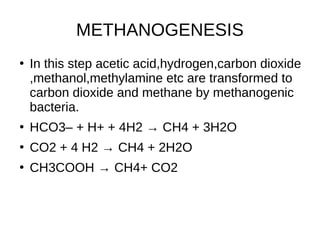
METHANOGENESIS
●
In this step acetic acid,hydrogen,carbon dioxide
,methanol,methylamine etc are transformed to
carbon dioxide and methane by methanogenic
bacteria.
●
HCO3– + H+ + 4H2 → CH4 + 3H2O
●
CO2 + 4 H2 → CH4 + 2H2O
●
CH3COOH → CH4+ CO2
●
The metabolic pathway of methanogens can be
divided into three categories:
●
CO2 reducing pathway
●
methyl trophic pathway
●
aceticlastic pathways.
●
Hydrogenotrophic methanogens oxidize H2,
formate or a few simple alcohols and reduce CO2
to CH4. Most described methanogens are
hydrogenotrophic.
●
They are the predominant source of
methanogenesis in deep marine sediments, termite
hindguts, human and animal gastrointestinal tracts,
which altogether contribute a third of biologically
generated methane emissions
●
Aceticlastic methanogens split acetate to form
CH4 and CO2.
●
They are found in habitats where
hydrogenotrophic methanogens reduce H2
levels low enough to create the conditions
needed for high levels of acetate formation.
●
Aceticlastic methanogens are the dominant
methane producers in anaerobic digesters, rice
fields and wetlands
●
Methylotrophic methanogens are common in
marine and hypersaline, sulfate-rich sediments
where they utilize methylated compounds such
as trimethylamine, dimethyl sulfate, and
methanol
●
their contribution to global methane emissions
is probably small.
●
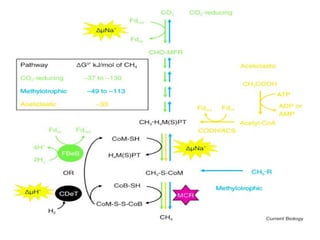
All methanogenic pathways contain three common steps:
the transfer of the methyl group to coenzyme M (CoM-SH),
the reduction of methyl-coenzyme M with coenzyme B
(CoB-SH), and the recycling of the heterodisulfide CoM-S-S-
CoB. , CO2-reducing pathway; , aceticlastic pathway; ,
methylotrophic pathway; Abbreviations: MFR,
methanofuran; H4MPT, tetrahydromethanopterin; H4SPT,
tetrahydrosarcinapterin; ΔG0’, standard free energy change; G0’, standard free energy change;
CH3-R, methyl-containing compounds such as methanol,
methanethiol, dimethylsulfide, monomethylamine,
dimethylamine, trimethylamine, and tetramethylammonium;
Fdred, reduced form of ferredoxin; Fdox, oxidized form of
ferredoxin; ΔG0’, standard free energy change; μNa+, electrochemical sodium ion potential; Na+, electrochemical sodium ion potential;
ΔG0’, standard free energy change; μNa+, electrochemical sodium ion potential; H+, electrochemical proton potential; FBeB, flavin-based
electron bifurcation; CDeT, cytochrome-dependent electron
transfer; MCR, methyl-coenzyme M reductase; CODH/ACS,
carbon monoxide dehydrogenase/acetyl-CoA
synthase/decarbonlyase complex.
●
Microbes capable of producing methane are called
methanogens.
●
They have been identified only from the domain
Archaea – a group that is phylogenetically distinct
from eukaryotes and bacteria – though many live in
close association with anaerobic bacteria.
●
The production of methane is an important and
widespread form of microbial metabolism, and in most
environments, it is the final step in the decomposition
of biomass.
MICROBES IN METHANE
PRODUCTION
●
Fermentative bacteria
●
High molecular weight compounds decomposed to
low molecular weight by the enzymes secreted.
●
Eg:clostridium sp and Eubacterium sps
●
Acid forming bacteria
●
Transform the hydrolysis product into
hydrogen,carbon dioxide,alcohols,organic acids
resultind in a low pH
●
Acetogenic Microorganisms
●
They decompose alcohols and long chain fatty acids
to acetic acid ,hydrogen and carbon dioxide.
●
They grow only at a very low hydrogen partial
pressure because they live in close symbiosis with
methanogeneicand sulphidogenic bacteria which
use hydrogen as an energy source.
●
Eg:Syntrophobacter.wolini,Syntrophomonas wolfei

Methanogenesis

  • 1.
  • 2.
    Methanogenesis is aform of anaerobic respiration that uses carbon as a electron acceptor and results in the production of methane. Methanogenesis, or biomethanation, is a form of anaerobic respiration that uses carbon as the terminal electron acceptor, resulting in the production of methane. The carbon is sourced from a small number of low molecular weight organic compounds, such as carbon dioxide, acetic acid, formic acid (formate), methanol, methylamines, dimethyl sulfide, and methanethiol. It is the process of production of methane/biofuel from anaerobic digestion of organic matter by the action of methanogenic bacteria on them
  • 3.
    METHANE Methane, colourless, odourlessgas that occurs abundantly in nature and as a product of certain human activities. Methane is the simplest member of the paraffin series of hydrocarbons and is among the most potent of thegreen house gas. Its chemical formula is CH4 Wetlands are the major natural source of methane Other important natural sources of methane include termites (as a result of digestive processes), volcanoes, vents in the ocean floor, and methane hydrate deposits that occur along continental margins and beneath Methane also is the chief constituent of natural gas human activities that are associated with methane production include biomass burning, livestock farming, and waste management (where bacteria produce methane as they decompose sludge in waste-treatment facilities and decaying matter in landfills)..
  • 4.
    ● The entire anaerobicfermentation process can be divided in to 3 steps ● Hydrolysis ● Acidification ● Methane formation
  • 5.
    HYDROLYSIS ● Hydrolysis causes decompositionof mostly water insoluble bioplymers(carbohydrates,proteins,fats) to water soluble monomers(aminoacids,monosaccharides,glycerin,fat ty acid)by extracellular enzymes and are thus made accessible for further degradation.
  • 6.
    ACIDIFICATION ● In this process,theintermediate of 1st reaction are converted into acetic acid,Hydrogen,Carbon dioxide,aminoacids and alcohols by different groups of bacteria ● Some of these intermediate products can be directly used by methanogenic ● But most of the organic acids and alcohol are decomposed into acetic acid,hydrogen and carbon dioxide during acidogenesis.
  • 7.
    METHANOGENESIS ● In this stepacetic acid,hydrogen,carbon dioxide ,methanol,methylamine etc are transformed to carbon dioxide and methane by methanogenic bacteria. ● HCO3– + H+ + 4H2 → CH4 + 3H2O ● CO2 + 4 H2 → CH4 + 2H2O ● CH3COOH → CH4+ CO2
  • 8.
    ● The metabolic pathwayof methanogens can be divided into three categories: ● CO2 reducing pathway ● methyl trophic pathway ● aceticlastic pathways.
  • 9.
    ● Hydrogenotrophic methanogens oxidizeH2, formate or a few simple alcohols and reduce CO2 to CH4. Most described methanogens are hydrogenotrophic. ● They are the predominant source of methanogenesis in deep marine sediments, termite hindguts, human and animal gastrointestinal tracts, which altogether contribute a third of biologically generated methane emissions
  • 10.
    ● Aceticlastic methanogens splitacetate to form CH4 and CO2. ● They are found in habitats where hydrogenotrophic methanogens reduce H2 levels low enough to create the conditions needed for high levels of acetate formation. ● Aceticlastic methanogens are the dominant methane producers in anaerobic digesters, rice fields and wetlands
  • 11.
    ● Methylotrophic methanogens arecommon in marine and hypersaline, sulfate-rich sediments where they utilize methylated compounds such as trimethylamine, dimethyl sulfate, and methanol ● their contribution to global methane emissions is probably small.
  • 13.
    ● All methanogenic pathwayscontain three common steps: the transfer of the methyl group to coenzyme M (CoM-SH), the reduction of methyl-coenzyme M with coenzyme B (CoB-SH), and the recycling of the heterodisulfide CoM-S-S- CoB. , CO2-reducing pathway; , aceticlastic pathway; , methylotrophic pathway; Abbreviations: MFR, methanofuran; H4MPT, tetrahydromethanopterin; H4SPT, tetrahydrosarcinapterin; ΔG0’, standard free energy change; G0’, standard free energy change; CH3-R, methyl-containing compounds such as methanol, methanethiol, dimethylsulfide, monomethylamine, dimethylamine, trimethylamine, and tetramethylammonium; Fdred, reduced form of ferredoxin; Fdox, oxidized form of ferredoxin; ΔG0’, standard free energy change; μNa+, electrochemical sodium ion potential; Na+, electrochemical sodium ion potential; ΔG0’, standard free energy change; μNa+, electrochemical sodium ion potential; H+, electrochemical proton potential; FBeB, flavin-based electron bifurcation; CDeT, cytochrome-dependent electron transfer; MCR, methyl-coenzyme M reductase; CODH/ACS, carbon monoxide dehydrogenase/acetyl-CoA synthase/decarbonlyase complex.
  • 15.
    ● Microbes capable ofproducing methane are called methanogens. ● They have been identified only from the domain Archaea – a group that is phylogenetically distinct from eukaryotes and bacteria – though many live in close association with anaerobic bacteria. ● The production of methane is an important and widespread form of microbial metabolism, and in most environments, it is the final step in the decomposition of biomass.
  • 16.
    MICROBES IN METHANE PRODUCTION ● Fermentativebacteria ● High molecular weight compounds decomposed to low molecular weight by the enzymes secreted. ● Eg:clostridium sp and Eubacterium sps ● Acid forming bacteria ● Transform the hydrolysis product into hydrogen,carbon dioxide,alcohols,organic acids resultind in a low pH
  • 17.
    ● Acetogenic Microorganisms ● They decomposealcohols and long chain fatty acids to acetic acid ,hydrogen and carbon dioxide. ● They grow only at a very low hydrogen partial pressure because they live in close symbiosis with methanogeneicand sulphidogenic bacteria which use hydrogen as an energy source. ● Eg:Syntrophobacter.wolini,Syntrophomonas wolfei