COMPOSTING
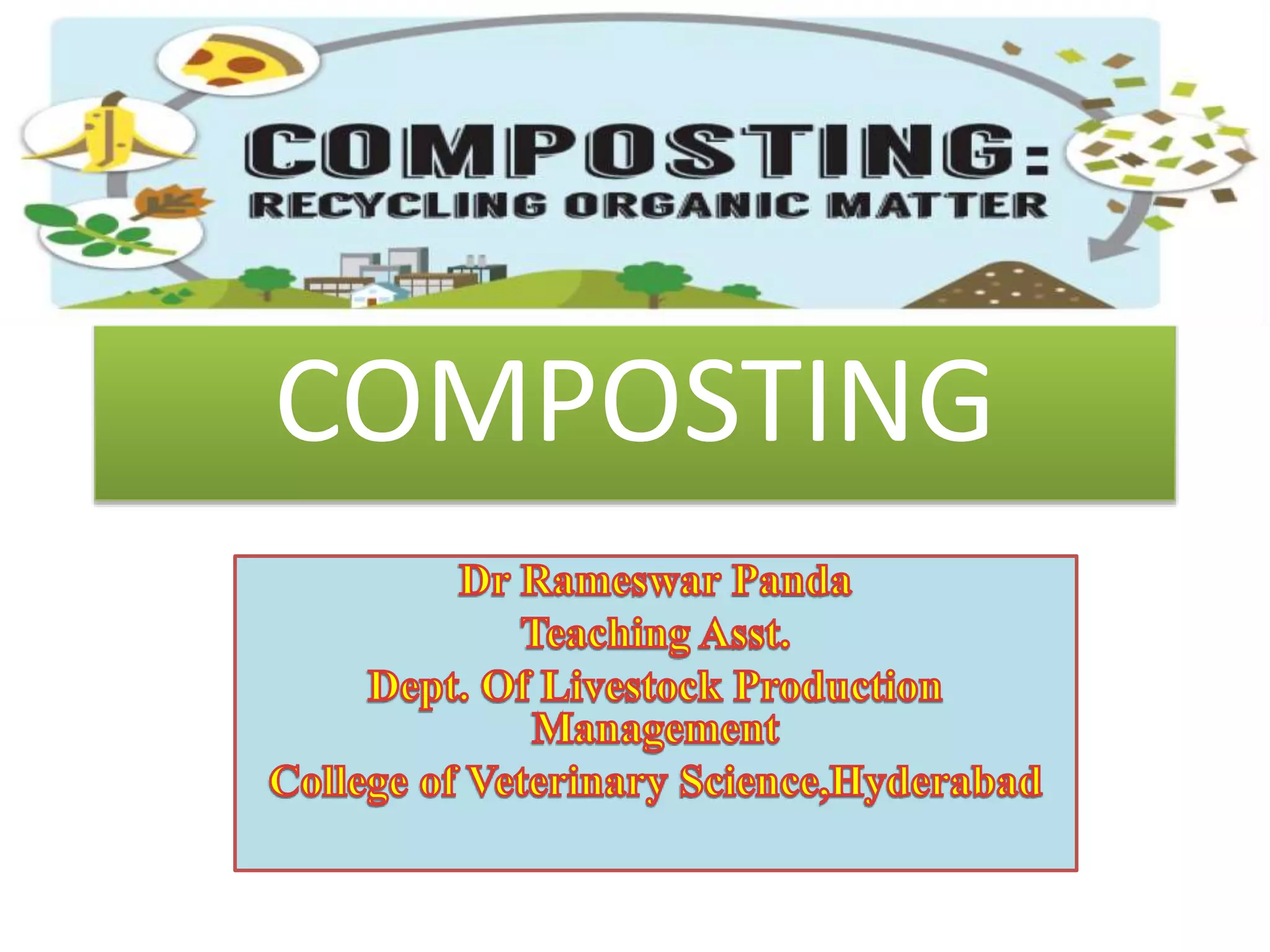
What is Composting
 Composting is nothing but the process of
decomposition of organic contents of the
waste material.
Waste material may be one which is not
having an economic value or another that is
remained after extracting the utility value of
imperishable objects.
 objective of composting is lying on the
utility of the compost.
The compost after formation is used as a
fertilizer in agricultural field.
The most important consideration of using
the compost in field is its organic value i.e
the now obtained fertilizer is devoid of
chemicals which is healthy than the
conventional fertilizers that are available in
the market.
2 factors are essential for composting
1. Temperature
2. Areation or oxygenation
 First, an area should be selected for the
purpose of composting which should be
located in outskirt of habitation or more
particularly to the near of agricultural field for
convenience.
 The waste materials should be gathered to
undergo composting phenomenon.
 The waste materials should contain more
organic content.
 The phenomenon occurs during the process is
oxidation i.e it will oxygen for undergoing
chemical equations.
Since oxidation happens, factually heat, water
and Carbon dioxide will be released.
A higher temperature range of 45-65 C is
maintained so that microbial action happens
that include the population of bacteria, fungi
and actinomycetes.
• This rich temperature establishment is due to
the heat generation by thermophilic bacteria
and should be maintained for 3 days strictly.
• Since organic matter is more concerned factor,
cow dung/manure/slurry are mostly preferred
for this purpose.
• Apart from these, other waste materials
having less organic can be used by mixing with
above materials.
• Hatchery waste with broiler litter has been
adjudged as an effective compost means for
reducing salmonella and E.coli populations in
the manure.
Different composting methods
Windrow composting
• In windrow method, the composting materials
are put on the ground in a straight alignment.
• The height of the windrow may be of 2-3
meter.
• Since there is the concept of oxidation in this
event, aeration is necessary on periodical
basis.
• After making windrows, aeration is performed
by bottom blowing creating negative pressure
so that the stacked foul air will be removed
and fresh air will be returned.
• 2 types of blowing air to oxygenate happens.
1. Bottom blowing aeration, creates positive
pressure.
2. Bottom suction aeration, creating negative
pressure.
BIN COMPOSTING
 2 types of bins
1. Continuous vertical bins (most popular)
2. Horizontal bins
 The most used method for dead animal
composting is Bin method.
Use of microalgae in composting
• For this algal pond is built which provide
aeration.
• The contents of the pond are mixed at the rate
of 20cm per second by paddlers.
Moisture % Nitrogen
(kg/tonn)
Phosphorous
(Kg/tonn)
Pottasium
(Kg/tonn)
Fresh manure 75 13 4.5 3.6
Loose manure 64 11 6.0 7.3
Broiler manure 19 32 11 13.6
Broiler litter 14.5 13.0 10.5
animal L biogas/kg of
volatile solid
L biogas/day Methane % Heat
value(kcal/day)
Dairy cow
(500kg)
330 1200 70 6850
Fattening
pig(50kg)
630 180 65 900
Laying hen
(2kg)
450 11 70 62
THANK YOU

Composting

  • 1.
  • 3.
    What is Composting Composting is nothing but the process of decomposition of organic contents of the waste material. Waste material may be one which is not having an economic value or another that is remained after extracting the utility value of imperishable objects.
  • 5.
     objective ofcomposting is lying on the utility of the compost. The compost after formation is used as a fertilizer in agricultural field. The most important consideration of using the compost in field is its organic value i.e the now obtained fertilizer is devoid of chemicals which is healthy than the conventional fertilizers that are available in the market.
  • 6.
    2 factors areessential for composting 1. Temperature 2. Areation or oxygenation  First, an area should be selected for the purpose of composting which should be located in outskirt of habitation or more particularly to the near of agricultural field for convenience.  The waste materials should be gathered to undergo composting phenomenon.
  • 7.
     The wastematerials should contain more organic content.  The phenomenon occurs during the process is oxidation i.e it will oxygen for undergoing chemical equations. Since oxidation happens, factually heat, water and Carbon dioxide will be released. A higher temperature range of 45-65 C is maintained so that microbial action happens that include the population of bacteria, fungi and actinomycetes.
  • 8.
    • This richtemperature establishment is due to the heat generation by thermophilic bacteria and should be maintained for 3 days strictly. • Since organic matter is more concerned factor, cow dung/manure/slurry are mostly preferred for this purpose. • Apart from these, other waste materials having less organic can be used by mixing with above materials.
  • 9.
    • Hatchery wastewith broiler litter has been adjudged as an effective compost means for reducing salmonella and E.coli populations in the manure.
  • 10.
  • 11.
    • In windrowmethod, the composting materials are put on the ground in a straight alignment. • The height of the windrow may be of 2-3 meter. • Since there is the concept of oxidation in this event, aeration is necessary on periodical basis. • After making windrows, aeration is performed by bottom blowing creating negative pressure so that the stacked foul air will be removed and fresh air will be returned.
  • 12.
    • 2 typesof blowing air to oxygenate happens. 1. Bottom blowing aeration, creates positive pressure. 2. Bottom suction aeration, creating negative pressure.
  • 15.
  • 16.
     2 typesof bins 1. Continuous vertical bins (most popular) 2. Horizontal bins  The most used method for dead animal composting is Bin method.
  • 17.
    Use of microalgaein composting • For this algal pond is built which provide aeration. • The contents of the pond are mixed at the rate of 20cm per second by paddlers.
  • 18.
    Moisture % Nitrogen (kg/tonn) Phosphorous (Kg/tonn) Pottasium (Kg/tonn) Freshmanure 75 13 4.5 3.6 Loose manure 64 11 6.0 7.3 Broiler manure 19 32 11 13.6 Broiler litter 14.5 13.0 10.5
  • 19.
    animal L biogas/kgof volatile solid L biogas/day Methane % Heat value(kcal/day) Dairy cow (500kg) 330 1200 70 6850 Fattening pig(50kg) 630 180 65 900 Laying hen (2kg) 450 11 70 62
  • 20.