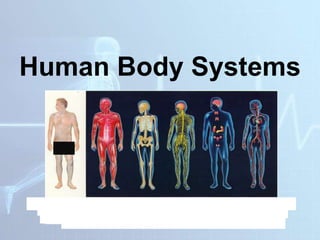
Human Body Systems
Regulation and
Homeostasis in the
Human Body:
Overview
How do Humans and other complex mammals
maintain homeostasis? They must carry out
all needed life functions in a coordinated way.
What does our species need to accomplish?
Growth Repair of injuries
Get energy Get building materials
Get rid of waste
Keep away disease
Respond to changing environment
Reproduce
Eleven Body Systems work together to
maintain homeostasis and carry out
these tasks:
1. Nervous System 2. Endocrine System
3. Lymphatic System 4. Circulatory System
5. Respiratory System 6. Digestive System
7. Excretory System 8. Skeletal System
9. Muscular System 10. Integumentary
System
11. Reproductive System
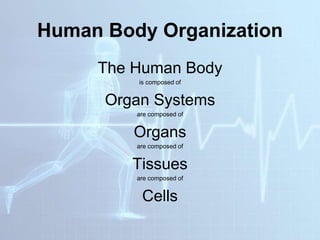
Human Body Organization
The Human Body
is composed of
Organ Systems
are composed of
Organs
are composed of
Tissues
are composed of
Cells
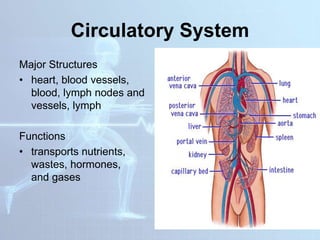
Circulatory System
Major Structures
• heart, blood vessels,
blood, lymph nodes and
vessels, lymph
Functions
• transports nutrients,
wastes, hormones,
and gases
Interesting Facts…
• The heart is a muscle about the size of a fist.
• Each blood cell takes around 20 seconds to make its
deliveries and travel back to the heart.
• The heart works by contracting and relaxing.
• The heart has flapping valves that allow blood to flow in one
direction. The flaps create a “lub-dup” sound.
• A heart attack is caused by a blood vessel blocked by a clot.
• The average person has about 5 liters of blood.
• The body can replace blood within a few weeks after loss.
• Platelets in the blood help it to clot, or stick together, to
make scabs.
• The four blood types are A, B, AB, and O.
Interesting Facts…
• Food takes 3 days to complete its journey through the
digestive system.
• An adult digestive system is about 30 feet long.
• An average person takes in about 4.4 pounds of food and
drink every day, consuming over 110,000 pounds in a
lifetime.
• Gravity and bands of muscles help food travel down the
esophagus to the stomach, making it possible to eat lying
down or even upside down.
• The stomach is lined with a slimy mucus and releases an
acid called gastric juice to help dissolve food.
• Stomach noises are caused by food and air sloshing around.
• Water makes up about 70% of the body.
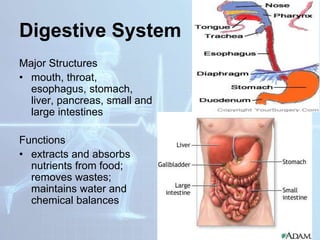
Digestive System
Major Structures
• mouth, throat,
esophagus, stomach,
liver, pancreas, small and
large intestines
Functions
• extracts and absorbs
nutrients from food;
removes wastes;
maintains water and
chemical balances
The nutrients your body needs are water,
carbohydrates, fats, proteins, vitamins
and minerals.
WATER – Most of the bodies reactions take place
in water. Humans need an average of 1 liter of
water a day. Dehydration causes many problems
throughout the body.
CARBOHYDRATES – Sugars and starches are used by
the body to provide the simple sugars needed for
Respiration (energy)
FATS- Deposits of fats protect body organs,
insulate the body and store energy, make up cell
membranes and coat the nervous system cells
PROTEINS – Supply the raw materials for
growth and repair in the form of enzymes
VITAMINS – Organic molecules that work
with enzymes to control body processes.
MINERALS – Inorganic nutrients that are
needed in small amounts. Calcium is
needed to build bones, Iron is needed for
red blood cells.
The Process of Digestion: The path of food
Each organ of the digestive system helps convert
foods into simpler molecules that can be
absorbed and used by the cells of the body.
Teeth – Cut, Crush and tear food
Salivary glands – Moisten food to make it easier to
chew and pass through the system, enzymes break
down starches
Esophagus – Tube from mouth to stomach connected
by Pharynx. Works by contraction of the smooth
muscles known as peristalsis.
Stomach – Muscular sac that churns and mixes food
with acid
Section 38-2
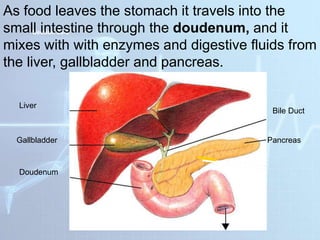
As food leaves the stomach it travels into the
small intestine through the doudenum, and it
mixes with with enzymes and digestive fluids from
the liver, gallbladder and pancreas.
Liver
Gallbladder
Doudenum
Bile Duct
Pancreas
.
Chemicals from the pancreas breakdown
carbohydrates, proteins, lipids and nucleic
acids. In addition chemicals from the
pancreas produce substances which
neutralize stomach acid.
If the acid travels too far without
being neutralized it will change the
shape of enzymes and cause
problems in the body.
The Liver makes bile which acts like a
detergent to break down fat. The gall
bladder is a storage area for the bile
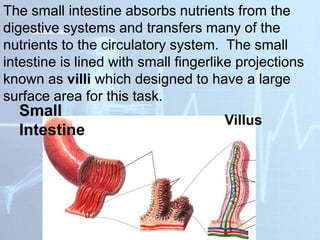
Small
Intestine
Villus
Section 38-2
The small intestine absorbs nutrients from the
digestive systems and transfers many of the
nutrients to the circulatory system. The small
intestine is lined with small fingerlike projections
known as villi which designed to have a large
surface area for this task.
Large intestine (Colon)
Food that enters the large intestine is nutrient-
free. Usable nutrients have been absorbed
leaving water and undigestible substances. The
large intestine removes water from the waste.
Once water is eliminated the solid waste passes
out of the body through the rectum.
The appendix is located just below the entry
to the large intestine. In many animals it
helps digest difficult materials such as
cellulose. In humans the appendix is not
used for any purpose in digestion. When
it gets infected it is removed.
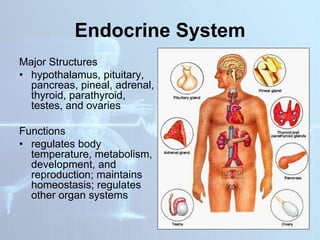
Endocrine System
Major Structures
• hypothalamus, pituitary,
pancreas, pineal, adrenal,
thyroid, parathyroid,
testes, and ovaries
Functions
• regulates body
temperature, metabolism,
development, and
reproduction; maintains
homeostasis; regulates
other organ systems
Interesting Facts…
• Endocrine glands release hormones, chemicals that act as
signals telling different parts of the body what to do.
• The body makes over 20 hormones, each with a different
job to do.
• The blood carries hormones around the body until reaching
the target organ, the body part needing it.
• Hormones can affect the way a person feels.
• As a person ages, the body makes less of some hormones.
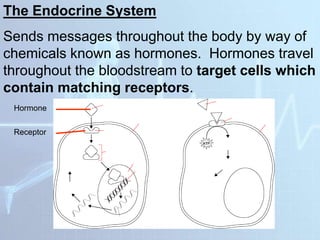
The Endocrine System
Sends messages throughout the body by way of
chemicals known as hormones. Hormones travel
throughout the bloodstream to target cells which
contain matching receptors.
Hormone
Receptor
If a cell does not have a specific receptor
the hormone will not affect the cell.
Responses to hormones take longer and last
longer than nervous system messages.
Hormones can take minutes, hours or
days to influence cells.
Examples of functions
controlled by hormones:
Growth, Metabolism, Sleep,
Reaction to stress,
Reproduction.
The Endocrine System works through a
FEEDBACK system. Glands of the Endocrine
system determine the level of a hormone in the
blood and then changes the rate of hormone
production or sends out the opposite hormone to
counteract excess amounts of hormone.
Examples of Feedback mechanisms:
Control of insulin/sugar levels in blood
Hypothalamus can measure water level in
blood and sends out hormones that tell the
kidneys to conserve water.
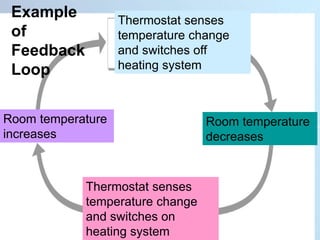
Room temperature
increases
Thermostat senses
temperature change
and switches on
heating system
Thermostat senses
temperature change
and switches off
heating system
Room temperature
decreases
Section 35-1
Example
of
Feedback
Loop
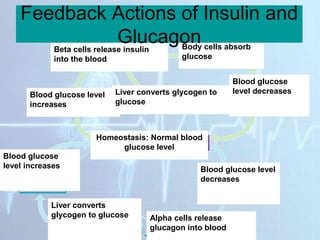
Beta cells release insulin
into the blood
Body cells absorb
glucose
Blood glucose
level decreases
Homeostasis: Normal blood
glucose level
Blood glucose level
decreases
Alpha cells release
glucagon into blood
Liver converts
glycogen to glucose
Blood glucose
level increases
Blood glucose level
increases
Liver converts glycogen to
glucose
Feedback Actions of Insulin and
Glucagon
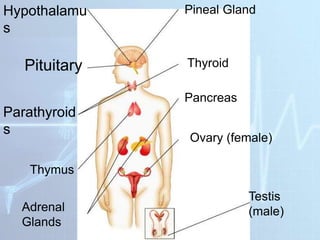
Hypothalamu
s
Pituitary
Parathyroid
s
Thymus
Adrenal
Glands
Pineal Gland
Thyroid
Pancreas
Ovary (female)
Testis
(male)
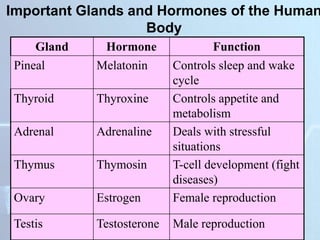
Important Glands and Hormones of the Human
Body
Gland Hormone Function
Pineal Melatonin Controls sleep and wake
cycle
Thyroid Thyroxine Controls appetite and
metabolism
Adrenal Adrenaline Deals with stressful
situations
Thymus Thymosin T-cell development (fight
diseases)
Ovary Estrogen Female reproduction
Testis Testosterone Male reproduction
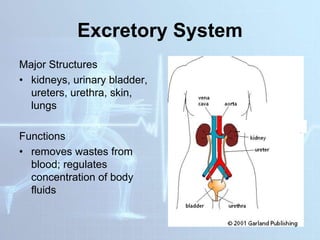
Excretory System
Major Structures
• kidneys, urinary bladder,
ureters, urethra, skin,
lungs
Functions
• removes wastes from
blood; regulates
concentration of body
fluids
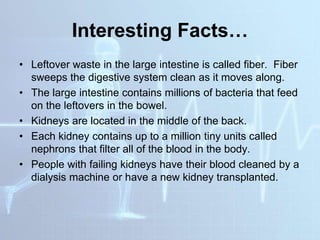
Interesting Facts…
• Leftover waste in the large intestine is called fiber. Fiber
sweeps the digestive system clean as it moves along.
• The large intestine contains millions of bacteria that feed
on the leftovers in the bowel.
• Kidneys are located in the middle of the back.
• Each kidney contains up to a million tiny units called
nephrons that filter all of the blood in the body.
• People with failing kidneys have their blood cleaned by a
dialysis machine or have a new kidney transplanted.
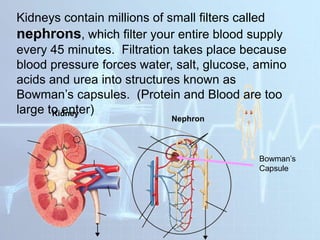
Kidney
Nephron
Section 38-3
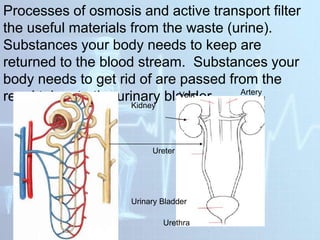
Kidneys contain millions of small filters called
nephrons, which filter your entire blood supply
every 45 minutes. Filtration takes place because
blood pressure forces water, salt, glucose, amino
acids and urea into structures known as
Bowman’s capsules. (Protein and Blood are too
large to enter)
Bowman’s
Capsule
Processes of osmosis and active transport filter
the useful materials from the waste (urine).
Substances your body needs to keep are
returned to the blood stream. Substances your
body needs to get rid of are passed from the
renal tubes to the urinary bladder.
Kidney
Urinary Bladder
Ureter
Urethra
Vein Artery
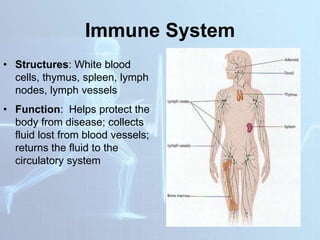
Immune System
• Structures: White blood
cells, thymus, spleen, lymph
nodes, lymph vessels
• Function: Helps protect the
body from disease; collects
fluid lost from blood vessels;
returns the fluid to the
circulatory system
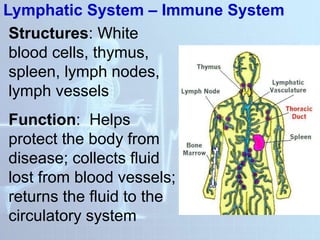
Lymphatic System – Immune System
Structures: White
blood cells, thymus,
spleen, lymph nodes,
lymph vessels
Function: Helps
protect the body from
disease; collects fluid
lost from blood vessels;
returns the fluid to the
circulatory system
Interesting Facts…
• The immune system is constantly on guard to keep
germs, bugs, and poisons out the body.
• The skin is the immune system’s first line of defense.
• There are germ-killing chemicals in saliva, tears, ear
wax, and mucus.
• White blood cells destroy germs that enter through cuts.
• Sticky yellow pus is made of bodies of white blood cells
that die in the battle against germs.
• An allergy is the immune system making a mistake.
• Some white blood cells make antibodies which can
protect against bacteria, viruses, and poisons.
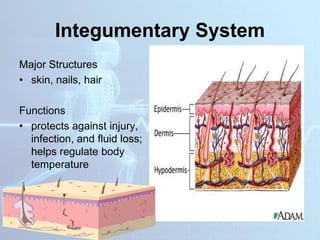
Integumentary System
Major Structures
• skin, nails, hair
Functions
• protects against injury,
infection, and fluid loss;
helps regulate body
temperature
Interesting Facts…
• Skin cells are made of a tough protein called keratin.
• About 40 million dead skin cells are lost each day.
• The average adult skin spread out would take up about 2.2
square yards and would weigh around 15 pounds.
• The skin is waterproof. It keeps water out so the body is
not a sponge and holds in moisture so it does not dry out.
• Skin expands to fit the body.
• Skin forms bumps when cold and releases sweat when hot.
• The skin repairs itself forming scabs and scars.
• Skin absorbs sunlight to make vitamin D. Too much sun
can lead to sunburn and can even cause skin cancer.
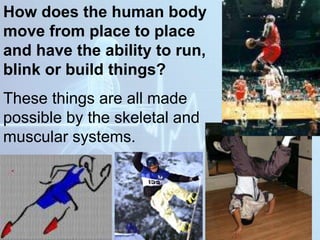
How does the human body
move from place to place
and have the ability to run,
blink or build things?
These things are all made
possible by the skeletal and
muscular systems.
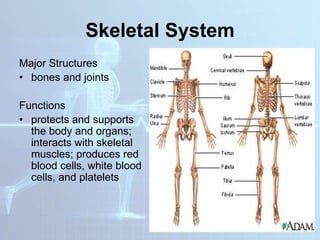
Skeletal System
Major Structures
• bones and joints
Functions
• protects and supports
the body and organs;
interacts with skeletal
muscles; produces red
blood cells, white blood
cells, and platelets
Interesting Facts…
• A baby is born with 270 bones while an adult body has
206 bones.
• The hands and feet contain half of the bones in the
human body.
• Bones are made of the hard mineral calcium, living cells,
blood vessels and nerves.
• Bones are made of several layers – periosteum,
compact bone, and spongy bone.
• A joint is where two bones meet.
• Joints can be cartilagenous (spine), ball-and-socket
(shoulders and hips), pivot (neck), gliding (wrists), and
hinged (fingers, elbows, and knees).
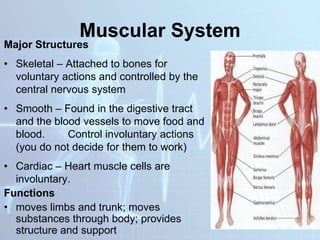
Muscular System
Major Structures
• Skeletal – Attached to bones for
voluntary actions and controlled by the
central nervous system
• Smooth – Found in the digestive tract
and the blood vessels to move food and
blood. Control involuntary actions
(you do not decide for them to work)
• Cardiac – Heart muscle cells are
involuntary.
Functions
• moves limbs and trunk; moves
substances through body; provides
structure and support
Interesting Facts…
• There are nearly 600 skeletal muscles that make up
nearly half of the total body weight in the human.
• Muscles can only pull – they cannot push.
• Energy is stored in the muscles in a chemical called ATP.
• Lactic acid is released when the muscles are overworked
and lack O2, making the muscles hurt or ache.
• Muscles are attached to bones by tendons.
• The biggest muscles in the body are the gluteus maximus
muscles (buttocks), but the muscle that can exert the
most force is the masseter (jaw muscle).
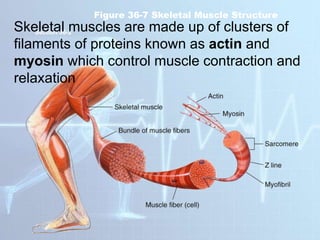
Figure 36-7 Skeletal Muscle Structure
Section 36-2
Skeletal muscles are made up of clusters of
filaments of proteins known as actin and
myosin which control muscle contraction and
relaxation
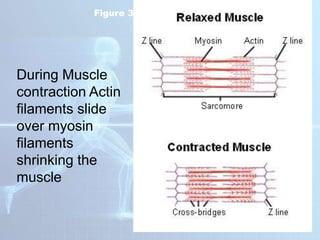
Figure 36-8 Muscle Contraction
During Muscle
contraction Actin
filaments slide
over myosin
filaments
shrinking the
muscle
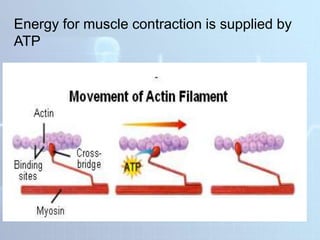
Energy for muscle contraction is supplied by
ATP
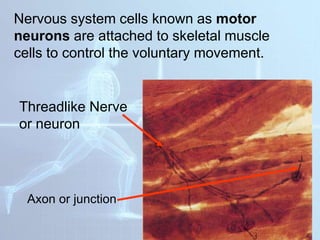
Nervous system cells known as motor
neurons are attached to skeletal muscle
cells to control the voluntary movement.
Threadlike Nerve
or neuron
Axon or junction
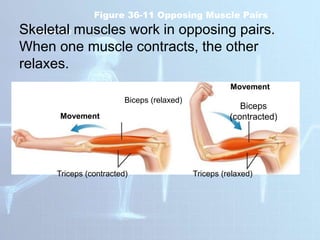
Movement
Movement
Biceps (relaxed)
Triceps (contracted)
Biceps
(contracted)
Triceps (relaxed)
Figure 36-11 Opposing Muscle Pairs
Section 36-2
Skeletal muscles work in opposing pairs.
When one muscle contracts, the other
relaxes.
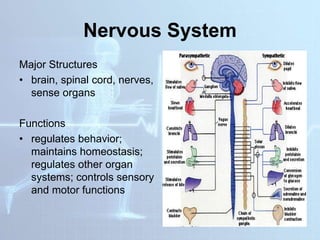
Nervous System
Major Structures
• brain, spinal cord, nerves,
sense organs
Functions
• regulates behavior;
maintains homeostasis;
regulates other organ
systems; controls sensory
and motor functions
Interesting Facts…
• The left half of the brain controls the right half of the
body and vice-versa.
• The human brain is more powerful and complicated than
the world’s biggest computer. It can store millions of
memories and do billions of calculations every day.
• The human body has over 100 billion neurons in all.
• The brain can receive over 100,000 signals per second.
• Messages whiz through the nerves at up to 270 mph.
• Neurons reaching from the spinal cord to the toes are
the longest cells in the human body, measuring up to 4
feet in length.
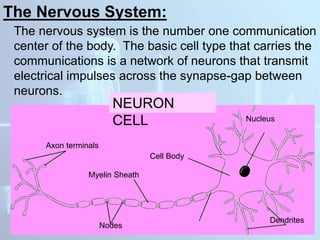
The Nervous System:
The nervous system is the number one communication
center of the body. The basic cell type that carries the
communications is a network of neurons that transmit
electrical impulses across the synapse-gap between
neurons.
Axon terminals
Nodes
Myelin Sheath
Cell Body
Nucleus
Dendrites
NEURON
CELL
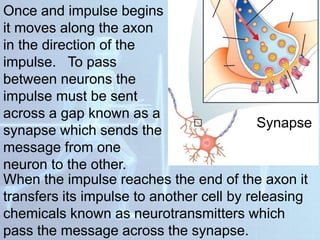
Once and impulse begins
it moves along the axon
in the direction of the
impulse. To pass
between neurons the
impulse must be sent
across a gap known as a
synapse which sends the
message from one
neuron to the other.
When the impulse reaches the end of the axon it
transfers its impulse to another cell by releasing
chemicals known as neurotransmitters which
pass the message across the synapse.
Synapse
The nervous system is divided into two
divisions:
• The Central Nervous System (CNS)–
Responsible for relaying messages,
processing and analyzing information.
• The Peripheral Nervous System –
Receives information from the environment
and relays commands from the CNS to the
organs and glands
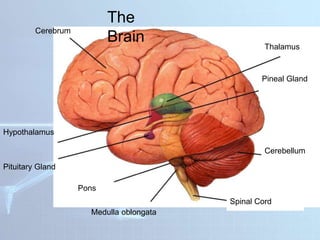
Cerebrum
Thalamus
Hypothalamus
Pituitary Gland
Pineal Gland
Cerebellum
Spinal Cord
Pons
Medulla oblongata
The
Brain
The brain is the main switching area of the central
nervous system.
Cerebrum – Responsible for voluntary activities of the
body (Intelligence, learning and judgement)
Cerebellum – Coordinates muscle movement
Brain Stem – Consists of the pons and the medulla
oblongata. Pass message between brain and body
Thalamus – Connects messages from the sense organs
to the Cerebrum
Hypothalamus - Control center for hunger, thirst, anger
and body temperature.
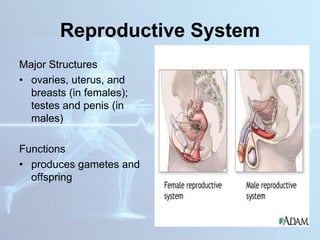
Reproductive System
Major Structures
• ovaries, uterus, and
breasts (in females);
testes and penis (in
males)
Functions
• produces gametes and
offspring
Interesting Facts…
• A person grows over 5 million times bigger changing
from a single cell to a newborn human being.
• Humans grow for about 20 years, changing from a child
to an adult.
• Male reproductive cells are called sperm, and female
reproductive cells are called eggs.
• Sperm and eggs have only 23 chromosomes each.
• When joined together, sperm and egg make a whole cell
called a fertilized egg which can grow into a baby.
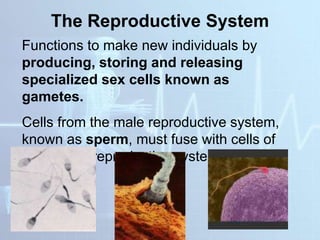
The Reproductive System
Functions to make new individuals by
producing, storing and releasing
specialized sex cells known as
gametes.
Cells from the male reproductive system,
known as sperm, must fuse with cells of
the female reproductive system, known as
eggs.
Reproduction in both males and females is
regulated by hormones.
•In males - Testosterone is produced by the
testes. It is required for sperm production
and development of male physical
characteristics.
•In females - Estrogen and progesterone are
female hormones produced by the ovaries.
Estrogen is required for the development of
eggs and female physical characteristics.
Progesterone prepare the uterus for the
arrival of a developing embryo.
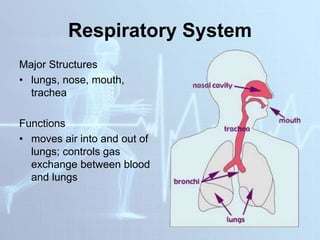
Respiratory System
Major Structures
• lungs, nose, mouth,
trachea
Functions
• moves air into and out of
lungs; controls gas
exchange between blood
and lungs
Interesting Facts…
• The lungs fill up most of the chest cavity.
• The left lung is slightly smaller than the right lung,
because it must allow enough space for the heart.
• Inside each lung is a network of thousands of tunnels
called the bronchial tree which branch into bronchioles
containing six million tiny bags (air sacs) called alveoli.
• The lungs take millions of O2 molecules out of the air
and put them into the blood to be delivered to the cells.
• Simultaneously, the lungs also take waste gases out of
the blood.
• A smoker’s lungs are dark gray and full of dirt and tar.
Section 37-3
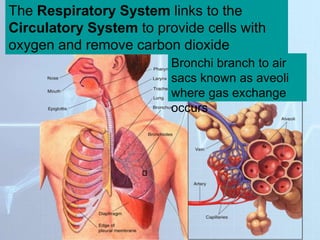
Figure 37-13 The Respiratory System
Bronchi branch to air
sacs known as aveoli
where gas exchange
occurs
The Respiratory System links to the
Circulatory System to provide cells with
oxygen and remove carbon dioxide
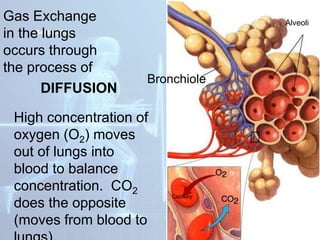
Alveoli
Bronchiole
Capillary
Section 37-3
Gas Exchange
in the lungs
occurs through
the process of
DIFFUSION
High concentration of
oxygen (O2) moves
out of lungs into
blood to balance
concentration. CO2
does the opposite
(moves from blood to
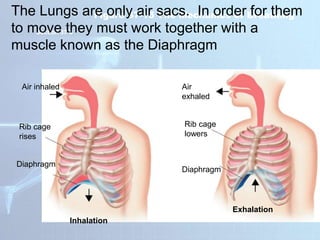
Air inhaled
Diaphragm
Rib cage
rises
Air
exhaled
Diaphragm
Rib cage
lowers
Inhalation
Exhalation
Section 37-3
Figure 37-15 The Mechanics of Breathing
The Lungs are only air sacs. In order for them
to move they must work together with a
muscle known as the Diaphragm
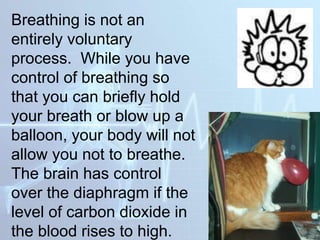
Breathing is not an
entirely voluntary
process. While you have
control of breathing so
that you can briefly hold
your breath or blow up a
balloon, your body will not
allow you not to breathe.
The brain has control
over the diaphragm if the
level of carbon dioxide in
the blood rises to high.

2014 The Human Body Systems ppt.ppt

  • 1.
  • 2.
    Regulation and Homeostasis inthe Human Body: Overview
  • 3.
    How do Humansand other complex mammals maintain homeostasis? They must carry out all needed life functions in a coordinated way. What does our species need to accomplish? Growth Repair of injuries Get energy Get building materials Get rid of waste Keep away disease Respond to changing environment Reproduce
  • 4.
    Eleven Body Systemswork together to maintain homeostasis and carry out these tasks: 1. Nervous System 2. Endocrine System 3. Lymphatic System 4. Circulatory System 5. Respiratory System 6. Digestive System 7. Excretory System 8. Skeletal System 9. Muscular System 10. Integumentary System 11. Reproductive System
  • 5.
    Human Body Organization TheHuman Body is composed of Organ Systems are composed of Organs are composed of Tissues are composed of Cells
  • 6.
    Circulatory System Major Structures •heart, blood vessels, blood, lymph nodes and vessels, lymph Functions • transports nutrients, wastes, hormones, and gases
  • 7.
    Interesting Facts… • Theheart is a muscle about the size of a fist. • Each blood cell takes around 20 seconds to make its deliveries and travel back to the heart. • The heart works by contracting and relaxing. • The heart has flapping valves that allow blood to flow in one direction. The flaps create a “lub-dup” sound. • A heart attack is caused by a blood vessel blocked by a clot. • The average person has about 5 liters of blood. • The body can replace blood within a few weeks after loss. • Platelets in the blood help it to clot, or stick together, to make scabs. • The four blood types are A, B, AB, and O.
  • 8.
    Interesting Facts… • Foodtakes 3 days to complete its journey through the digestive system. • An adult digestive system is about 30 feet long. • An average person takes in about 4.4 pounds of food and drink every day, consuming over 110,000 pounds in a lifetime. • Gravity and bands of muscles help food travel down the esophagus to the stomach, making it possible to eat lying down or even upside down. • The stomach is lined with a slimy mucus and releases an acid called gastric juice to help dissolve food. • Stomach noises are caused by food and air sloshing around. • Water makes up about 70% of the body.
  • 9.
    Digestive System Major Structures •mouth, throat, esophagus, stomach, liver, pancreas, small and large intestines Functions • extracts and absorbs nutrients from food; removes wastes; maintains water and chemical balances
  • 10.
    The nutrients yourbody needs are water, carbohydrates, fats, proteins, vitamins and minerals. WATER – Most of the bodies reactions take place in water. Humans need an average of 1 liter of water a day. Dehydration causes many problems throughout the body. CARBOHYDRATES – Sugars and starches are used by the body to provide the simple sugars needed for Respiration (energy)
  • 11.
    FATS- Deposits offats protect body organs, insulate the body and store energy, make up cell membranes and coat the nervous system cells PROTEINS – Supply the raw materials for growth and repair in the form of enzymes VITAMINS – Organic molecules that work with enzymes to control body processes. MINERALS – Inorganic nutrients that are needed in small amounts. Calcium is needed to build bones, Iron is needed for red blood cells.
  • 12.
    The Process ofDigestion: The path of food Each organ of the digestive system helps convert foods into simpler molecules that can be absorbed and used by the cells of the body. Teeth – Cut, Crush and tear food Salivary glands – Moisten food to make it easier to chew and pass through the system, enzymes break down starches Esophagus – Tube from mouth to stomach connected by Pharynx. Works by contraction of the smooth muscles known as peristalsis. Stomach – Muscular sac that churns and mixes food with acid
  • 13.
    Section 38-2 As foodleaves the stomach it travels into the small intestine through the doudenum, and it mixes with with enzymes and digestive fluids from the liver, gallbladder and pancreas. Liver Gallbladder Doudenum Bile Duct Pancreas
  • 14.
    . Chemicals from thepancreas breakdown carbohydrates, proteins, lipids and nucleic acids. In addition chemicals from the pancreas produce substances which neutralize stomach acid. If the acid travels too far without being neutralized it will change the shape of enzymes and cause problems in the body. The Liver makes bile which acts like a detergent to break down fat. The gall bladder is a storage area for the bile
  • 15.
    Small Intestine Villus Section 38-2 The smallintestine absorbs nutrients from the digestive systems and transfers many of the nutrients to the circulatory system. The small intestine is lined with small fingerlike projections known as villi which designed to have a large surface area for this task.
  • 16.
    Large intestine (Colon) Foodthat enters the large intestine is nutrient- free. Usable nutrients have been absorbed leaving water and undigestible substances. The large intestine removes water from the waste. Once water is eliminated the solid waste passes out of the body through the rectum. The appendix is located just below the entry to the large intestine. In many animals it helps digest difficult materials such as cellulose. In humans the appendix is not used for any purpose in digestion. When it gets infected it is removed.
  • 17.
    Endocrine System Major Structures •hypothalamus, pituitary, pancreas, pineal, adrenal, thyroid, parathyroid, testes, and ovaries Functions • regulates body temperature, metabolism, development, and reproduction; maintains homeostasis; regulates other organ systems
  • 18.
    Interesting Facts… • Endocrineglands release hormones, chemicals that act as signals telling different parts of the body what to do. • The body makes over 20 hormones, each with a different job to do. • The blood carries hormones around the body until reaching the target organ, the body part needing it. • Hormones can affect the way a person feels. • As a person ages, the body makes less of some hormones.
  • 19.
    The Endocrine System Sendsmessages throughout the body by way of chemicals known as hormones. Hormones travel throughout the bloodstream to target cells which contain matching receptors. Hormone Receptor
  • 20.
    If a celldoes not have a specific receptor the hormone will not affect the cell. Responses to hormones take longer and last longer than nervous system messages. Hormones can take minutes, hours or days to influence cells. Examples of functions controlled by hormones: Growth, Metabolism, Sleep, Reaction to stress, Reproduction.
  • 21.
    The Endocrine Systemworks through a FEEDBACK system. Glands of the Endocrine system determine the level of a hormone in the blood and then changes the rate of hormone production or sends out the opposite hormone to counteract excess amounts of hormone. Examples of Feedback mechanisms: Control of insulin/sugar levels in blood Hypothalamus can measure water level in blood and sends out hormones that tell the kidneys to conserve water.
  • 22.
    Room temperature increases Thermostat senses temperaturechange and switches on heating system Thermostat senses temperature change and switches off heating system Room temperature decreases Section 35-1 Example of Feedback Loop
  • 23.
    Beta cells releaseinsulin into the blood Body cells absorb glucose Blood glucose level decreases Homeostasis: Normal blood glucose level Blood glucose level decreases Alpha cells release glucagon into blood Liver converts glycogen to glucose Blood glucose level increases Blood glucose level increases Liver converts glycogen to glucose Feedback Actions of Insulin and Glucagon
  • 24.
  • 25.
    Important Glands andHormones of the Human Body Gland Hormone Function Pineal Melatonin Controls sleep and wake cycle Thyroid Thyroxine Controls appetite and metabolism Adrenal Adrenaline Deals with stressful situations Thymus Thymosin T-cell development (fight diseases) Ovary Estrogen Female reproduction Testis Testosterone Male reproduction
  • 26.
    Excretory System Major Structures •kidneys, urinary bladder, ureters, urethra, skin, lungs Functions • removes wastes from blood; regulates concentration of body fluids
  • 27.
    Interesting Facts… • Leftoverwaste in the large intestine is called fiber. Fiber sweeps the digestive system clean as it moves along. • The large intestine contains millions of bacteria that feed on the leftovers in the bowel. • Kidneys are located in the middle of the back. • Each kidney contains up to a million tiny units called nephrons that filter all of the blood in the body. • People with failing kidneys have their blood cleaned by a dialysis machine or have a new kidney transplanted.
  • 28.
    Kidney Nephron Section 38-3 Kidneys containmillions of small filters called nephrons, which filter your entire blood supply every 45 minutes. Filtration takes place because blood pressure forces water, salt, glucose, amino acids and urea into structures known as Bowman’s capsules. (Protein and Blood are too large to enter) Bowman’s Capsule
  • 29.
    Processes of osmosisand active transport filter the useful materials from the waste (urine). Substances your body needs to keep are returned to the blood stream. Substances your body needs to get rid of are passed from the renal tubes to the urinary bladder. Kidney Urinary Bladder Ureter Urethra Vein Artery
  • 30.
    Immune System • Structures:White blood cells, thymus, spleen, lymph nodes, lymph vessels • Function: Helps protect the body from disease; collects fluid lost from blood vessels; returns the fluid to the circulatory system
  • 31.
    Lymphatic System –Immune System Structures: White blood cells, thymus, spleen, lymph nodes, lymph vessels Function: Helps protect the body from disease; collects fluid lost from blood vessels; returns the fluid to the circulatory system
  • 32.
    Interesting Facts… • Theimmune system is constantly on guard to keep germs, bugs, and poisons out the body. • The skin is the immune system’s first line of defense. • There are germ-killing chemicals in saliva, tears, ear wax, and mucus. • White blood cells destroy germs that enter through cuts. • Sticky yellow pus is made of bodies of white blood cells that die in the battle against germs. • An allergy is the immune system making a mistake. • Some white blood cells make antibodies which can protect against bacteria, viruses, and poisons.
  • 33.
    Integumentary System Major Structures •skin, nails, hair Functions • protects against injury, infection, and fluid loss; helps regulate body temperature
  • 34.
    Interesting Facts… • Skincells are made of a tough protein called keratin. • About 40 million dead skin cells are lost each day. • The average adult skin spread out would take up about 2.2 square yards and would weigh around 15 pounds. • The skin is waterproof. It keeps water out so the body is not a sponge and holds in moisture so it does not dry out. • Skin expands to fit the body. • Skin forms bumps when cold and releases sweat when hot. • The skin repairs itself forming scabs and scars. • Skin absorbs sunlight to make vitamin D. Too much sun can lead to sunburn and can even cause skin cancer.
  • 35.
    How does thehuman body move from place to place and have the ability to run, blink or build things? These things are all made possible by the skeletal and muscular systems.
  • 36.
    Skeletal System Major Structures •bones and joints Functions • protects and supports the body and organs; interacts with skeletal muscles; produces red blood cells, white blood cells, and platelets
  • 37.
    Interesting Facts… • Ababy is born with 270 bones while an adult body has 206 bones. • The hands and feet contain half of the bones in the human body. • Bones are made of the hard mineral calcium, living cells, blood vessels and nerves. • Bones are made of several layers – periosteum, compact bone, and spongy bone. • A joint is where two bones meet. • Joints can be cartilagenous (spine), ball-and-socket (shoulders and hips), pivot (neck), gliding (wrists), and hinged (fingers, elbows, and knees).
  • 38.
    Muscular System Major Structures •Skeletal – Attached to bones for voluntary actions and controlled by the central nervous system • Smooth – Found in the digestive tract and the blood vessels to move food and blood. Control involuntary actions (you do not decide for them to work) • Cardiac – Heart muscle cells are involuntary. Functions • moves limbs and trunk; moves substances through body; provides structure and support
  • 39.
    Interesting Facts… • Thereare nearly 600 skeletal muscles that make up nearly half of the total body weight in the human. • Muscles can only pull – they cannot push. • Energy is stored in the muscles in a chemical called ATP. • Lactic acid is released when the muscles are overworked and lack O2, making the muscles hurt or ache. • Muscles are attached to bones by tendons. • The biggest muscles in the body are the gluteus maximus muscles (buttocks), but the muscle that can exert the most force is the masseter (jaw muscle).
  • 40.
    Figure 36-7 SkeletalMuscle Structure Section 36-2 Skeletal muscles are made up of clusters of filaments of proteins known as actin and myosin which control muscle contraction and relaxation
  • 41.
    Figure 36-8 MuscleContraction During Muscle contraction Actin filaments slide over myosin filaments shrinking the muscle
  • 42.
    Energy for musclecontraction is supplied by ATP
  • 43.
    Nervous system cellsknown as motor neurons are attached to skeletal muscle cells to control the voluntary movement. Threadlike Nerve or neuron Axon or junction
  • 44.
    Movement Movement Biceps (relaxed) Triceps (contracted) Biceps (contracted) Triceps(relaxed) Figure 36-11 Opposing Muscle Pairs Section 36-2 Skeletal muscles work in opposing pairs. When one muscle contracts, the other relaxes.
  • 45.
    Nervous System Major Structures •brain, spinal cord, nerves, sense organs Functions • regulates behavior; maintains homeostasis; regulates other organ systems; controls sensory and motor functions
  • 46.
    Interesting Facts… • Theleft half of the brain controls the right half of the body and vice-versa. • The human brain is more powerful and complicated than the world’s biggest computer. It can store millions of memories and do billions of calculations every day. • The human body has over 100 billion neurons in all. • The brain can receive over 100,000 signals per second. • Messages whiz through the nerves at up to 270 mph. • Neurons reaching from the spinal cord to the toes are the longest cells in the human body, measuring up to 4 feet in length.
  • 47.
    The Nervous System: Thenervous system is the number one communication center of the body. The basic cell type that carries the communications is a network of neurons that transmit electrical impulses across the synapse-gap between neurons. Axon terminals Nodes Myelin Sheath Cell Body Nucleus Dendrites NEURON CELL
  • 48.
    Once and impulsebegins it moves along the axon in the direction of the impulse. To pass between neurons the impulse must be sent across a gap known as a synapse which sends the message from one neuron to the other. When the impulse reaches the end of the axon it transfers its impulse to another cell by releasing chemicals known as neurotransmitters which pass the message across the synapse. Synapse
  • 49.
    The nervous systemis divided into two divisions: • The Central Nervous System (CNS)– Responsible for relaying messages, processing and analyzing information. • The Peripheral Nervous System – Receives information from the environment and relays commands from the CNS to the organs and glands
  • 50.
  • 51.
    The brain isthe main switching area of the central nervous system. Cerebrum – Responsible for voluntary activities of the body (Intelligence, learning and judgement) Cerebellum – Coordinates muscle movement Brain Stem – Consists of the pons and the medulla oblongata. Pass message between brain and body Thalamus – Connects messages from the sense organs to the Cerebrum Hypothalamus - Control center for hunger, thirst, anger and body temperature.
  • 52.
    Reproductive System Major Structures •ovaries, uterus, and breasts (in females); testes and penis (in males) Functions • produces gametes and offspring
  • 53.
    Interesting Facts… • Aperson grows over 5 million times bigger changing from a single cell to a newborn human being. • Humans grow for about 20 years, changing from a child to an adult. • Male reproductive cells are called sperm, and female reproductive cells are called eggs. • Sperm and eggs have only 23 chromosomes each. • When joined together, sperm and egg make a whole cell called a fertilized egg which can grow into a baby.
  • 54.
    The Reproductive System Functionsto make new individuals by producing, storing and releasing specialized sex cells known as gametes. Cells from the male reproductive system, known as sperm, must fuse with cells of the female reproductive system, known as eggs.
  • 55.
    Reproduction in bothmales and females is regulated by hormones. •In males - Testosterone is produced by the testes. It is required for sperm production and development of male physical characteristics. •In females - Estrogen and progesterone are female hormones produced by the ovaries. Estrogen is required for the development of eggs and female physical characteristics. Progesterone prepare the uterus for the arrival of a developing embryo.
  • 56.
    Respiratory System Major Structures •lungs, nose, mouth, trachea Functions • moves air into and out of lungs; controls gas exchange between blood and lungs
  • 57.
    Interesting Facts… • Thelungs fill up most of the chest cavity. • The left lung is slightly smaller than the right lung, because it must allow enough space for the heart. • Inside each lung is a network of thousands of tunnels called the bronchial tree which branch into bronchioles containing six million tiny bags (air sacs) called alveoli. • The lungs take millions of O2 molecules out of the air and put them into the blood to be delivered to the cells. • Simultaneously, the lungs also take waste gases out of the blood. • A smoker’s lungs are dark gray and full of dirt and tar.
  • 58.
    Section 37-3 Figure 37-13The Respiratory System Bronchi branch to air sacs known as aveoli where gas exchange occurs The Respiratory System links to the Circulatory System to provide cells with oxygen and remove carbon dioxide
  • 59.
    Alveoli Bronchiole Capillary Section 37-3 Gas Exchange inthe lungs occurs through the process of DIFFUSION High concentration of oxygen (O2) moves out of lungs into blood to balance concentration. CO2 does the opposite (moves from blood to
  • 60.
    Air inhaled Diaphragm Rib cage rises Air exhaled Diaphragm Ribcage lowers Inhalation Exhalation Section 37-3 Figure 37-15 The Mechanics of Breathing The Lungs are only air sacs. In order for them to move they must work together with a muscle known as the Diaphragm
  • 61.
    Breathing is notan entirely voluntary process. While you have control of breathing so that you can briefly hold your breath or blow up a balloon, your body will not allow you not to breathe. The brain has control over the diaphragm if the level of carbon dioxide in the blood rises to high.