Section 3:
Measurement
Standard Measurement System
• Minimizes confusion among scientists all over the world
• Allows scientists to compare data and communicate with
each other about the results
• Metric System — developed in France in the 1790s
• a.k.a. International System of Units (SI)
Chapter 1 Introduction to Physical Science
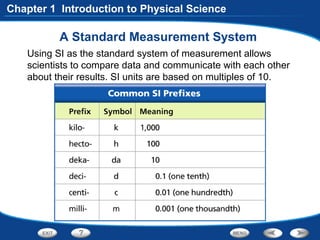
A Standard Measurement System
Using SI as the standard system of measurement allows
scientists to compare data and communicate with each other
about their results. SI units are based on multiples of 10.
Chapter 1 Introduction to Physical Science
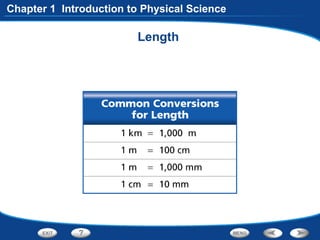
Metric Length
The basic unit of length in SI is the meter (m).
•Very small objects can be down to the nanometer (nm)
•Very large objects in kilometers (km)
•Common tool: metric ruler
Chapter 1 Introduction to Physical Science
Length
Chapter 1 Introduction to Physical Science
Weight
a measure of the force of gravity on an object
SI unit for weight is the Newton (N)
weight is based on the pull of gravity on your mass
weight depends on location
Chapter 1 Introduction to Physical Science
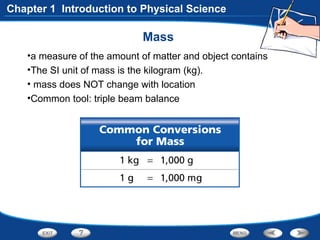
Mass
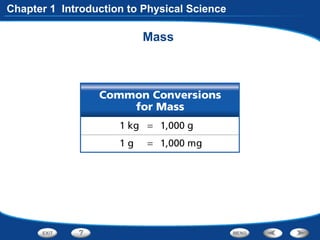
•a measure of the amount of matter and object contains
•The SI unit of mass is the kilogram (kg).
• mass does NOT change with location
•Common tool: triple beam balance
Chapter 1 Introduction to Physical Science
Mass
Chapter 1 Introduction to Physical Science
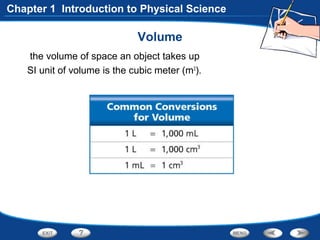
Volume
the volume of space an object takes up
SI unit of volume is the cubic meter (m3
).
Chapter 1 Introduction to Physical Science
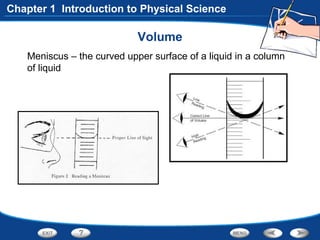
Volume
Meniscus – the curved upper surface of a liquid in a column
of liquid
Chapter 1 Introduction to Physical Science
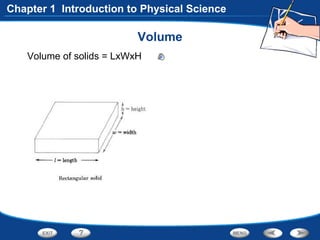
Volume
Volume of solids = LxWxH
Chapter 1 Introduction to Physical Science
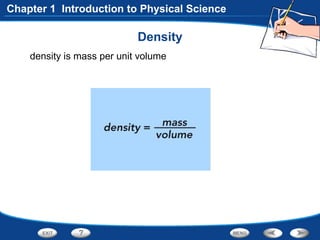
Density
density is mass per unit volume
Chapter 1 Introduction to Physical Science
Density
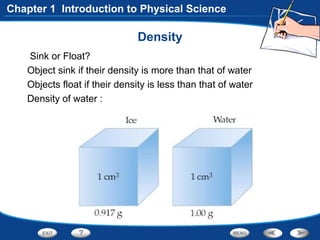
Sink or Float?
Object sink if their density is more than that of water
Objects float if their density is less than that of water
Density of water :
Chapter 1 Introduction to Physical Science
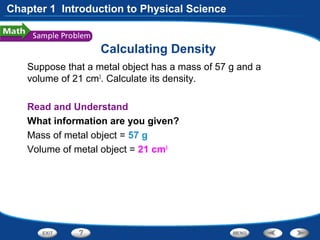
Calculating Density
Suppose that a metal object has a mass of 57 g and a
volume of 21 cm3
. Calculate its density.
Read and Understand
What information are you given?
Mass of metal object = 57 g
Volume of metal object = 21 cm3
Chapter 1 Introduction to Physical Science
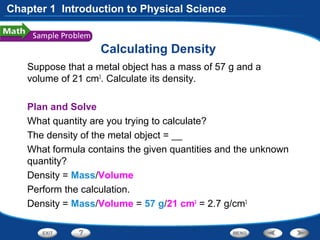
Calculating Density
Suppose that a metal object has a mass of 57 g and a
volume of 21 cm3
. Calculate its density.
Plan and Solve
What quantity are you trying to calculate?
The density of the metal object = __
What formula contains the given quantities and the unknown
quantity?
Density = Mass/Volume
Perform the calculation.
Density = Mass/Volume = 57 g/21 cm3
= 2.7 g/cm3
Chapter 1 Introduction to Physical Science
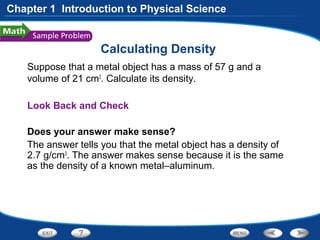
Calculating Density
Suppose that a metal object has a mass of 57 g and a
volume of 21 cm3
. Calculate its density.
Look Back and Check
Does your answer make sense?
The answer tells you that the metal object has a density of
2.7 g/cm3
. The answer makes sense because it is the same
as the density of a known metal–aluminum.
Chapter 1 Introduction to Physical Science
Calculating Density
Practice Problem
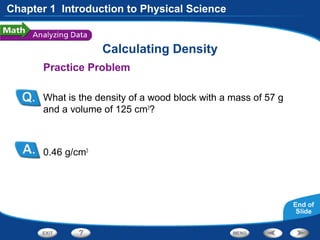
What is the density of a wood block with a mass of 57 g
and a volume of 125 cm3
?
0.46 g/cm3
Chapter 1 Introduction to Physical Science
Calculating Density
Practice Problem
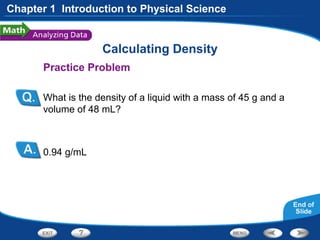
What is the density of a liquid with a mass of 45 g and a
volume of 48 mL?
0.94 g/mL
Chapter 1 Introduction to Physical Science
Density
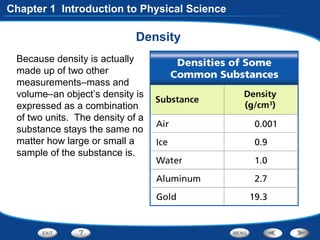
Because density is actually
made up of two other
measurements–mass and
volume–an object’s density is
expressed as a combination
of two units. The density of a
substance stays the same no
matter how large or small a
sample of the substance is.
Chapter 1 Introduction to Physical Science
Time
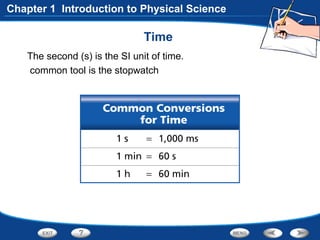
The second (s) is the SI unit of time.
common tool is the stopwatch
Chapter 1 Introduction to Physical Science
Temperature
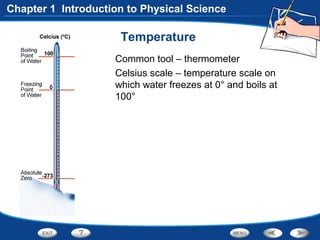
Common tool – thermometer
Celsius scale – temperature scale on
which water freezes at 0° and boils at
100°
Chapter 1 Introduction to Physical Science
Temperature
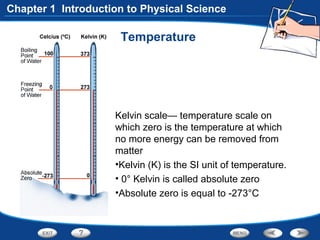
Kelvin scale— temperature scale on
which zero is the temperature at which
no more energy can be removed from
matter
•Kelvin (K) is the SI unit of temperature.
• 0° Kelvin is called absolute zero
•Absolute zero is equal to -273°C
Chapter 1 Introduction to Physical Science

Physical Science Chapter 1.3 Measurements

  • 1.
    Section 3: Measurement Standard MeasurementSystem • Minimizes confusion among scientists all over the world • Allows scientists to compare data and communicate with each other about the results • Metric System — developed in France in the 1790s • a.k.a. International System of Units (SI) Chapter 1 Introduction to Physical Science
  • 2.
    A Standard MeasurementSystem Using SI as the standard system of measurement allows scientists to compare data and communicate with each other about their results. SI units are based on multiples of 10. Chapter 1 Introduction to Physical Science
  • 3.
    Metric Length The basicunit of length in SI is the meter (m). •Very small objects can be down to the nanometer (nm) •Very large objects in kilometers (km) •Common tool: metric ruler Chapter 1 Introduction to Physical Science
  • 4.
    Length Chapter 1 Introductionto Physical Science
  • 5.
    Weight a measure ofthe force of gravity on an object SI unit for weight is the Newton (N) weight is based on the pull of gravity on your mass weight depends on location Chapter 1 Introduction to Physical Science
  • 6.
    Mass •a measure ofthe amount of matter and object contains •The SI unit of mass is the kilogram (kg). • mass does NOT change with location •Common tool: triple beam balance Chapter 1 Introduction to Physical Science
  • 7.
    Mass Chapter 1 Introductionto Physical Science
  • 8.
    Volume the volume ofspace an object takes up SI unit of volume is the cubic meter (m3 ). Chapter 1 Introduction to Physical Science
  • 9.
    Volume Meniscus – thecurved upper surface of a liquid in a column of liquid Chapter 1 Introduction to Physical Science
  • 10.
    Volume Volume of solids= LxWxH Chapter 1 Introduction to Physical Science
  • 11.
    Density density is massper unit volume Chapter 1 Introduction to Physical Science
  • 12.
    Density Sink or Float? Objectsink if their density is more than that of water Objects float if their density is less than that of water Density of water : Chapter 1 Introduction to Physical Science
  • 13.
    Calculating Density Suppose thata metal object has a mass of 57 g and a volume of 21 cm3 . Calculate its density. Read and Understand What information are you given? Mass of metal object = 57 g Volume of metal object = 21 cm3 Chapter 1 Introduction to Physical Science
  • 14.
    Calculating Density Suppose thata metal object has a mass of 57 g and a volume of 21 cm3 . Calculate its density. Plan and Solve What quantity are you trying to calculate? The density of the metal object = __ What formula contains the given quantities and the unknown quantity? Density = Mass/Volume Perform the calculation. Density = Mass/Volume = 57 g/21 cm3 = 2.7 g/cm3 Chapter 1 Introduction to Physical Science
  • 15.
    Calculating Density Suppose thata metal object has a mass of 57 g and a volume of 21 cm3 . Calculate its density. Look Back and Check Does your answer make sense? The answer tells you that the metal object has a density of 2.7 g/cm3 . The answer makes sense because it is the same as the density of a known metal–aluminum. Chapter 1 Introduction to Physical Science
  • 16.
    Calculating Density Practice Problem Whatis the density of a wood block with a mass of 57 g and a volume of 125 cm3 ? 0.46 g/cm3 Chapter 1 Introduction to Physical Science
  • 17.
    Calculating Density Practice Problem Whatis the density of a liquid with a mass of 45 g and a volume of 48 mL? 0.94 g/mL Chapter 1 Introduction to Physical Science
  • 18.
    Density Because density isactually made up of two other measurements–mass and volume–an object’s density is expressed as a combination of two units. The density of a substance stays the same no matter how large or small a sample of the substance is. Chapter 1 Introduction to Physical Science
  • 19.
    Time The second (s)is the SI unit of time. common tool is the stopwatch Chapter 1 Introduction to Physical Science
  • 20.
    Temperature Common tool –thermometer Celsius scale – temperature scale on which water freezes at 0° and boils at 100° Chapter 1 Introduction to Physical Science
  • 21.
    Temperature Kelvin scale— temperaturescale on which zero is the temperature at which no more energy can be removed from matter •Kelvin (K) is the SI unit of temperature. • 0° Kelvin is called absolute zero •Absolute zero is equal to -273°C Chapter 1 Introduction to Physical Science