By:- Dr. Anju Jha
MBBS, MD, PGDMCH
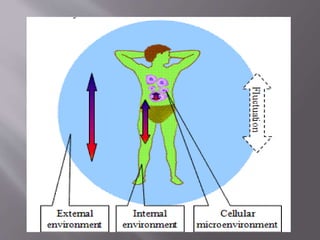
 Human body is composed of collection of
trillions of cells.
 These cells function in a finely tuned pattern to
continue the life process.
 If body is considered as a system, the inside of
the body is stated as ‘milieu intérieur’ or the
internal environment.
 milieu interrieur” stressed by Claude Bernard in
1857.
 Claude Bernard – father of experimental medicine.
 Supported by extensive work of Walter B Cannon
in 1935.
 Cannon used the word homeostasis to describe the
constancy of milieu interieur.
 This internal environment refers everything
within the body where cells live and work.
 For the proper functioning of cells, and hence
tissues, organs, systems, a specific optimum
condition (Physical and chemical) must be
maintained.
 Homeostasis is the maintenance of constancy of
the internal environment.
 Homeostatic functions of our body depend on
the functioning of control systems.
 For each variable of our body there is a control
system.
 To control: to change something in desired
manner.
 Control system: a system with a goal.
 Variables: the things that have to be controlled to
achieve the goal are called variables.
 Regulatory control: special type of control meant
for maintaining the constancy of a variable at any
predetermined level/ range.
 Homeostasis refers to regulation of the internal
environment.
 The tendency towards a relatively stable
equilibrium between interdependent elements,
especially as maintained by physiological
processes.
 The human cell enjoys a steady supply of
I. O2 at 100mmHg partial pressure,
II. Glucose at a concentration of 100mg/dl,
III. Metabolites should be washed away from its
vicinity immediately,
IV. It basks in the cozy comfort of 37oC.
 A well known example of a homeostatic failure
is shown in type 1 diabetes mellitus.
 The body water homeostat can be
compromised by the inability to secrete
ADH in response to even the normal daily
water losses via the exhaled air, the feces,
and insensible sweating.
 On receiving a zero blood ADH signal, the
kidneys produce huge unchanging volumes of
very dilute urine, causing dehydration and
death if not treated.
Control systems in our body:-
 Controls of cardiac out put.
 Regulation of blood pressure.
 Regulation of blood glucose.
 Regulation of body temperature.
 Control of breathing.
 Regulation or control of posture.
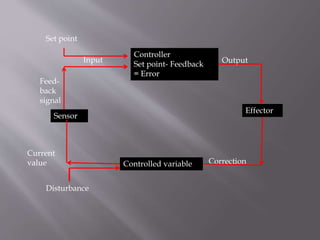
The control system consists of –
 Sensor,
 Central comparator or Integrator,
 Set point,
 Effector.
The set point is the physiological optimum value
of a parameter, which is predefined and preset.
 The sensor continuously monitors the value of
a variable parameter. The real time value is
send to the central comparator as an input.
 If the comparator detects a difference between
the set point and the input value, it is
considered as an error.
 The effector comes into the play for correction
of the error.
 Thus, the control system keeps each variable
parameter closest possible to the set point
(physiological range).
 The physiological system is made up of
innumerable control systems.
 Few of the control systems even collectively
can form another control system.
 When the control systems fail to correct the
error, the homeostatic system fails.
 The control systems work in such a manner the
orderliness is maintained.
 The control systems work in such a manner
that the constancy of the system is maintained.
 The target of the homeostasis is not the
absolute constancy, rather, to achieve a level of
steady state, where the net difference is zero or
nullified.
Disturbance
Controlled variable
Sensor
Controller
Set point- Feedback
= Error
Input
Effector
Current
value
Feed-
back
signal
Set point
Output
Correction
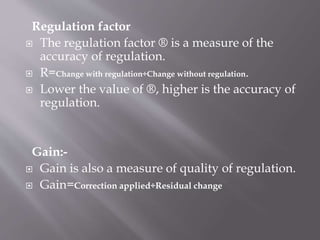
Regulation factor
 The regulation factor ® is a measure of the
accuracy of regulation.
 R=Change with regulation÷Change without regulation.
 Lower the value of ®, higher is the accuracy of
regulation.
Gain:-
 Gain is also a measure of quality of regulation.
 Gain=Correction applied÷Residual change
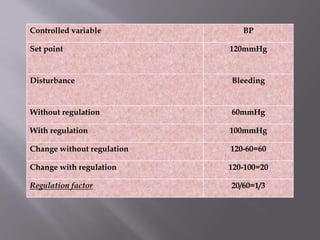
Controlled variable BP
Set point 120mmHg
Disturbance Bleeding
Without regulation 60mmHg
With regulation 100mmHg
Change without regulation 120-60=60
Change with regulation 120-100=20
Regulation factor 20/60=1/3
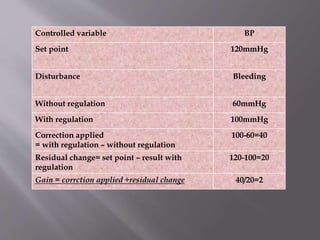
Controlled variable BP
Set point 120mmHg
Disturbance Bleeding
Without regulation 60mmHg
With regulation 100mmHg
Correction applied
= with regulation – without regulation
100-60=40
Residual change= set point – result with
regulation
120-100=20
Gain = corrction applied ÷residual change 40/20=2
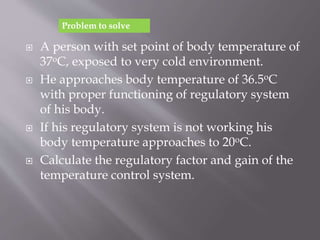
 A person with set point of body temperature of
37oC, exposed to very cold environment.
 He approaches body temperature of 36.5oC
with proper functioning of regulatory system
of his body.
 If his regulatory system is not working his
body temperature approaches to 20oC.
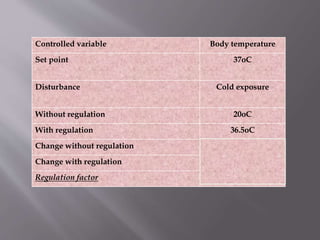
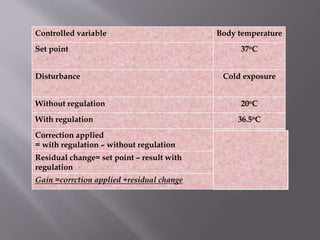
 Calculate the regulatory factor and gain of the
temperature control system.
Problem to solve
Controlled variable Body temperature
Set point 37oC
Disturbance Cold exposure
Without regulation 20oC
With regulation 36.5oC
Change without regulation 37-20=17oC
Change with regulation 37-36.5=0.5oC
Regulation factor 0.5/17=1/34
Controlled variable Body temperature
Set point 37oC
Disturbance Cold exposure
Without regulation 20oC
With regulation 36.5oC
Correction applied
= with regulation – without regulation
36.5-20
=16.5oC
Residual change= set point – result with
regulation
37-36.5
=0.5oC
Gain =corrction applied ÷residual change 16.5/0.5=33
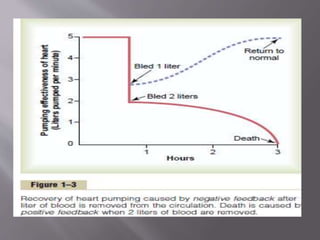
 if some factor becomes excessive
or deficient, a control system initiates negative
feedback, which consists of a series of changes that
return the factor toward a certain mean value,
thus maintaining homeostasis.
 Positive feedback is better known as a “vicious
cycle.”
 A mild degree of positive feedback can be
overcome by the negative feedback control
mechanisms of the body, and the vicious cycle
fails to develop.
Positive Feedback Can Sometimes Be Useful.
Eg.:- blood clotting, Childbirth, generation of
nerve signals.
 Closed loop (guided )control.
 Open loop (parametric, anticipatory) control.
 Combined control.
Static versus dynamic sensors:-
 A static sensor is ideal for detecting very small,
slow changes in the variables.
 Dynamic sensor is suited for detecting rapid
fluctuations in variable.
 If receptors with dynamic sensitivity are
absent, regulation will fail whenever there are
rapid fluctuations in variable.
 In the absence of receptors with static
sensitivity, a large change in a variable can go
undetected if change occurs extremely slowly.
 It is therefore advantageous to adjust the static
and dynamic sensitivity of receptors
depending on how variables tends to change.
 Chemical composition of body fluids- sensed
by chemo-receptors which do not show
dynamic sensitivity.
 Mechanoreceptors mostly sense dynamic
changes. But in muscle spindles both sensors
are functioning.
 Many biological control systems are more
complex than relatively simple systems.
 Some features of complex control systems are:
a. Servomechanism.
b. Variable gain,
c. Anticipatory control.
d. coupling
 Servomechanism- if the set point changes from
time to time, the system is called
servomechanism.
eg.- Resting muscle length of a given skeletal
muscle in different position of limb.
 Variable gain- the gain may change
continuously with response.
eg.-Stretch reflex have a variable gain.
 Anticipatory Control- if some variables which
have to be regulated very accurately are
controlled by anticipating the disturbance.
Thermoregulation is one example.
 Coupling- sometimes two control systems are
coupled when simultaneous changes in
effectors of both are likely to be physiologically
useful.
eg.- In hypoxia along with hyperventilation
blood pressure also rises.
Feedback correction time:-
The total time taken by afferent sensory
information to reach the control center and the
time taken by the efferent corrective measures
to take effect constitute the feedback correction
time.
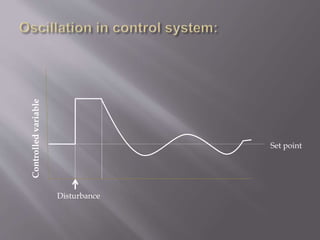
Disturbance
Set point
Controlledvariable
 In positive feedback systems, the effector of a
process bolsters the stimulus, which increases
the production of the product.
 Positive feedback systems essentially cause a
growing cascade reaction in which each new
product further amplifies the very process that
created it, ensuring a whole lot more product.
 In negative feedback systems, the effector of a
process reduces the effect of the stimulus
which, in turn, decreases the production of the
product.
 In physiology, feed-forward control is
exemplified by the normal anticipatory
regulation of heartbeat in advance of actual
physical exertion.
 A homeostatic control system relies mainly on
feedback (especially negative), in addition to
the feedforward elements of the system.
 What is feed forward control?
 If we have homeostatic mechanisms for
regulating blood pressure, why do some
people get hypertension?
 Can a single effector work in both direction:
stepping up or stepping down, a function?
 Are there any examples of oscillatory control in
normal physiology?
Principles of regulation: control system.

Principles of regulation: control system.

  • 1.
    By:- Dr. AnjuJha MBBS, MD, PGDMCH
  • 2.
     Human bodyis composed of collection of trillions of cells.  These cells function in a finely tuned pattern to continue the life process.  If body is considered as a system, the inside of the body is stated as ‘milieu intérieur’ or the internal environment.
  • 3.
     milieu interrieur”stressed by Claude Bernard in 1857.  Claude Bernard – father of experimental medicine.  Supported by extensive work of Walter B Cannon in 1935.  Cannon used the word homeostasis to describe the constancy of milieu interieur.
  • 4.
     This internalenvironment refers everything within the body where cells live and work.  For the proper functioning of cells, and hence tissues, organs, systems, a specific optimum condition (Physical and chemical) must be maintained.  Homeostasis is the maintenance of constancy of the internal environment.
  • 5.
     Homeostatic functionsof our body depend on the functioning of control systems.  For each variable of our body there is a control system.
  • 7.
     To control:to change something in desired manner.  Control system: a system with a goal.  Variables: the things that have to be controlled to achieve the goal are called variables.  Regulatory control: special type of control meant for maintaining the constancy of a variable at any predetermined level/ range.
  • 8.
     Homeostasis refersto regulation of the internal environment.  The tendency towards a relatively stable equilibrium between interdependent elements, especially as maintained by physiological processes.  The human cell enjoys a steady supply of I. O2 at 100mmHg partial pressure, II. Glucose at a concentration of 100mg/dl, III. Metabolites should be washed away from its vicinity immediately, IV. It basks in the cozy comfort of 37oC.
  • 9.
     A wellknown example of a homeostatic failure is shown in type 1 diabetes mellitus.  The body water homeostat can be compromised by the inability to secrete ADH in response to even the normal daily water losses via the exhaled air, the feces, and insensible sweating.  On receiving a zero blood ADH signal, the kidneys produce huge unchanging volumes of very dilute urine, causing dehydration and death if not treated.
  • 10.
    Control systems inour body:-  Controls of cardiac out put.  Regulation of blood pressure.  Regulation of blood glucose.  Regulation of body temperature.  Control of breathing.  Regulation or control of posture.
  • 11.
    The control systemconsists of –  Sensor,  Central comparator or Integrator,  Set point,  Effector. The set point is the physiological optimum value of a parameter, which is predefined and preset.
  • 13.
     The sensorcontinuously monitors the value of a variable parameter. The real time value is send to the central comparator as an input.  If the comparator detects a difference between the set point and the input value, it is considered as an error.
  • 14.
     The effectorcomes into the play for correction of the error.  Thus, the control system keeps each variable parameter closest possible to the set point (physiological range).
  • 15.
     The physiologicalsystem is made up of innumerable control systems.  Few of the control systems even collectively can form another control system.
  • 16.
     When thecontrol systems fail to correct the error, the homeostatic system fails.  The control systems work in such a manner the orderliness is maintained.
  • 17.
     The controlsystems work in such a manner that the constancy of the system is maintained.  The target of the homeostasis is not the absolute constancy, rather, to achieve a level of steady state, where the net difference is zero or nullified.
  • 18.
    Disturbance Controlled variable Sensor Controller Set point-Feedback = Error Input Effector Current value Feed- back signal Set point Output Correction
  • 19.
    Regulation factor  Theregulation factor ® is a measure of the accuracy of regulation.  R=Change with regulation÷Change without regulation.  Lower the value of ®, higher is the accuracy of regulation. Gain:-  Gain is also a measure of quality of regulation.  Gain=Correction applied÷Residual change
  • 20.
    Controlled variable BP Setpoint 120mmHg Disturbance Bleeding Without regulation 60mmHg With regulation 100mmHg Change without regulation 120-60=60 Change with regulation 120-100=20 Regulation factor 20/60=1/3
  • 21.
    Controlled variable BP Setpoint 120mmHg Disturbance Bleeding Without regulation 60mmHg With regulation 100mmHg Correction applied = with regulation – without regulation 100-60=40 Residual change= set point – result with regulation 120-100=20 Gain = corrction applied ÷residual change 40/20=2
  • 22.
     A personwith set point of body temperature of 37oC, exposed to very cold environment.  He approaches body temperature of 36.5oC with proper functioning of regulatory system of his body.  If his regulatory system is not working his body temperature approaches to 20oC.  Calculate the regulatory factor and gain of the temperature control system. Problem to solve
  • 23.
    Controlled variable Bodytemperature Set point 37oC Disturbance Cold exposure Without regulation 20oC With regulation 36.5oC Change without regulation 37-20=17oC Change with regulation 37-36.5=0.5oC Regulation factor 0.5/17=1/34
  • 24.
    Controlled variable Bodytemperature Set point 37oC Disturbance Cold exposure Without regulation 20oC With regulation 36.5oC Correction applied = with regulation – without regulation 36.5-20 =16.5oC Residual change= set point – result with regulation 37-36.5 =0.5oC Gain =corrction applied ÷residual change 16.5/0.5=33
  • 25.
     if somefactor becomes excessive or deficient, a control system initiates negative feedback, which consists of a series of changes that return the factor toward a certain mean value, thus maintaining homeostasis.
  • 26.
     Positive feedbackis better known as a “vicious cycle.”  A mild degree of positive feedback can be overcome by the negative feedback control mechanisms of the body, and the vicious cycle fails to develop. Positive Feedback Can Sometimes Be Useful. Eg.:- blood clotting, Childbirth, generation of nerve signals.
  • 28.
     Closed loop(guided )control.  Open loop (parametric, anticipatory) control.  Combined control.
  • 29.
    Static versus dynamicsensors:-  A static sensor is ideal for detecting very small, slow changes in the variables.  Dynamic sensor is suited for detecting rapid fluctuations in variable.
  • 30.
     If receptorswith dynamic sensitivity are absent, regulation will fail whenever there are rapid fluctuations in variable.  In the absence of receptors with static sensitivity, a large change in a variable can go undetected if change occurs extremely slowly.
  • 31.
     It istherefore advantageous to adjust the static and dynamic sensitivity of receptors depending on how variables tends to change.  Chemical composition of body fluids- sensed by chemo-receptors which do not show dynamic sensitivity.  Mechanoreceptors mostly sense dynamic changes. But in muscle spindles both sensors are functioning.
  • 32.
     Many biologicalcontrol systems are more complex than relatively simple systems.  Some features of complex control systems are: a. Servomechanism. b. Variable gain, c. Anticipatory control. d. coupling
  • 33.
     Servomechanism- ifthe set point changes from time to time, the system is called servomechanism. eg.- Resting muscle length of a given skeletal muscle in different position of limb.  Variable gain- the gain may change continuously with response. eg.-Stretch reflex have a variable gain.
  • 34.
     Anticipatory Control-if some variables which have to be regulated very accurately are controlled by anticipating the disturbance. Thermoregulation is one example.  Coupling- sometimes two control systems are coupled when simultaneous changes in effectors of both are likely to be physiologically useful. eg.- In hypoxia along with hyperventilation blood pressure also rises.
  • 35.
    Feedback correction time:- Thetotal time taken by afferent sensory information to reach the control center and the time taken by the efferent corrective measures to take effect constitute the feedback correction time.
  • 36.
  • 37.
     In positivefeedback systems, the effector of a process bolsters the stimulus, which increases the production of the product.  Positive feedback systems essentially cause a growing cascade reaction in which each new product further amplifies the very process that created it, ensuring a whole lot more product.
  • 38.
     In negativefeedback systems, the effector of a process reduces the effect of the stimulus which, in turn, decreases the production of the product.
  • 39.
     In physiology,feed-forward control is exemplified by the normal anticipatory regulation of heartbeat in advance of actual physical exertion.  A homeostatic control system relies mainly on feedback (especially negative), in addition to the feedforward elements of the system.
  • 40.
     What isfeed forward control?  If we have homeostatic mechanisms for regulating blood pressure, why do some people get hypertension?  Can a single effector work in both direction: stepping up or stepping down, a function?  Are there any examples of oscillatory control in normal physiology?