Chapter 1 What is Life Science?
Section 2:
The Study of Life
Life Science: the study of living things
a.k.a.: biology — the study of life
Chapter 1 What is Life Science?
Organism
a living thing
May be an animal, a plant, a fungus or a microbe
Chapter 1 What is Life Science?
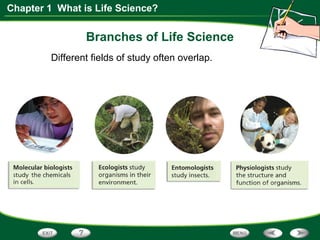
Branches of Life Science
Different fields of study often overlap.
Chapter 1 What is Life Science?
Big Ideas in Life Science
1. Organisms are diverse, yet share similar characteristics
all organisms are made of cells (building blocks of life)
• Multicellular versus unicellular
• All organisms require energy
• All organisms grow and develop (process of change that
causes an organism to become more complex during its
lifetime)
Chapter 1 What is Life Science?
Big Ideas in Life Science
2. Groups of organisms change over time
• evolution: gradual process of change that occurs in
groups of organisms
• Evolution occurs over many, many generations
Chapter 1 What is Life Science?
Big Ideas in Life Science
3. the structure and function of organisms are
complementary
• the structure of an organism allows it to function
• Structure: way that an organism is put together as a
whole
• function: process that enables an organism to survive
• Complementary: when structure and function work
together to meet the needs of the organism
Chapter 1 What is Life Science?
Big Ideas in Life Science
4. Organisms operate on the same physical principles as
the rest of our natural world

Life Science Chapter 1, Section 2 The Study of Life

  • 1.
    Chapter 1 Whatis Life Science? Section 2: The Study of Life Life Science: the study of living things a.k.a.: biology — the study of life
  • 2.
    Chapter 1 Whatis Life Science? Organism a living thing May be an animal, a plant, a fungus or a microbe
  • 3.
    Chapter 1 Whatis Life Science? Branches of Life Science Different fields of study often overlap.
  • 4.
    Chapter 1 Whatis Life Science? Big Ideas in Life Science 1. Organisms are diverse, yet share similar characteristics all organisms are made of cells (building blocks of life) • Multicellular versus unicellular • All organisms require energy • All organisms grow and develop (process of change that causes an organism to become more complex during its lifetime)
  • 5.
    Chapter 1 Whatis Life Science? Big Ideas in Life Science 2. Groups of organisms change over time • evolution: gradual process of change that occurs in groups of organisms • Evolution occurs over many, many generations
  • 6.
    Chapter 1 Whatis Life Science? Big Ideas in Life Science 3. the structure and function of organisms are complementary • the structure of an organism allows it to function • Structure: way that an organism is put together as a whole • function: process that enables an organism to survive • Complementary: when structure and function work together to meet the needs of the organism
  • 7.
    Chapter 1 Whatis Life Science? Big Ideas in Life Science 4. Organisms operate on the same physical principles as the rest of our natural world