Chapter 1 What is Life Science?
Section 3:
Scientific Inquiry
scientific inquiry: the diverse ways in which
scientists investigate the natural world and
propose explanations based on the evidence
they gather
Chapter 1 What is Life Science?
The Process of
Scientific Inquiry
1. Pose a Question
• Ask a question based on experiences from
observations and inferences.
• Scientific inquiry can’t answer questions about
personal taste or judgments.
Chapter 1 What is Life Science?
The Process of
Scientific Inquiry
2. Develop a Hypothesis
• hypothesis: a possible explanation for a set of
observations or answer to a scientific question
• Hypothesis must be testable, which means a
scientist must be able to carry out investigations and
gather evidence that will either support or disprove a
hypothesis
• Many trials trial may need to be run to prove a
hypothesis right or wrong
Chapter 1 What is Life Science?
The Process of
Scientific Inquiry
3. Design an Experiment
• Define the Variable
• Variable: factor that can change in an experiment
• All variables must be the same except one to make
the experiment credible
• Controlled experiment: an experiment in which only
one variable is changed anytime
Chapter 1 What is Life Science?
The Process of
Scientific Inquiry
3. Design an Experiment (continued)
• manipulated variable: the variable that is changed,
a.k.a.: independent variable
• Responding variable: the variable that is affected by
the manipulated variable, a.k.a. dependent variable
Chapter 1 What is Life Science?
The Process of
Scientific Inquiry
3. Design an Experiment (continued)
• Control: part of the experiment to which you can
compare the results of other tests
• The control group has no manipulated variables
• Operational definition: a statement that describes
how to measure a variable or define a term
Chapter 1 What is Life Science?
The Process of
Scientific Inquiry
4. Collecting and Interpreting Data
• data: the facts, figures and other evidence gathered
through observations
• Can be in the form of a table, a graph or a list
Chapter 1 What is Life Science?
The Process of
Scientific Inquiry
5. Draw Conclusions
• conclusion is a summary of what you have learned
from the experiment
• You must support or disprove your hypothesis with
evidence
• this is the answer to “why?”
Chapter 1 What is Life Science?
The Process of
Scientific Inquiry
6. Communication
• Communicating: sharing of ideas and experimental
findings with others through writing
• Lab reports or published results
Chapter 1 What is Life Science?
Collecting and Interpreting Data
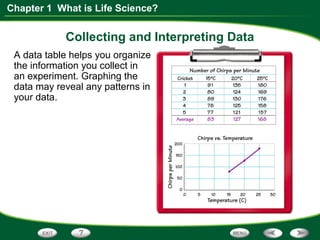
A data table helps you organize
the information you collect in
an experiment. Graphing the
data may reveal any patterns in
your data.
Chapter 1 What is Life Science?
The Nature of Inquiry
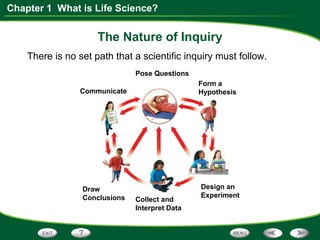
There is no set path that a scientific inquiry must follow.
Pose Questions
Communicate
Draw
Conclusions
Form a
Hypothesis
Design an
Experiment
Collect and
Interpret Data

Life Science Chapter 1, Section 3 Scientific Inquiry

  • 1.
    Chapter 1 Whatis Life Science? Section 3: Scientific Inquiry scientific inquiry: the diverse ways in which scientists investigate the natural world and propose explanations based on the evidence they gather
  • 2.
    Chapter 1 Whatis Life Science? The Process of Scientific Inquiry 1. Pose a Question • Ask a question based on experiences from observations and inferences. • Scientific inquiry can’t answer questions about personal taste or judgments.
  • 3.
    Chapter 1 Whatis Life Science? The Process of Scientific Inquiry 2. Develop a Hypothesis • hypothesis: a possible explanation for a set of observations or answer to a scientific question • Hypothesis must be testable, which means a scientist must be able to carry out investigations and gather evidence that will either support or disprove a hypothesis • Many trials trial may need to be run to prove a hypothesis right or wrong
  • 4.
    Chapter 1 Whatis Life Science? The Process of Scientific Inquiry 3. Design an Experiment • Define the Variable • Variable: factor that can change in an experiment • All variables must be the same except one to make the experiment credible • Controlled experiment: an experiment in which only one variable is changed anytime
  • 5.
    Chapter 1 Whatis Life Science? The Process of Scientific Inquiry 3. Design an Experiment (continued) • manipulated variable: the variable that is changed, a.k.a.: independent variable • Responding variable: the variable that is affected by the manipulated variable, a.k.a. dependent variable
  • 6.
    Chapter 1 Whatis Life Science? The Process of Scientific Inquiry 3. Design an Experiment (continued) • Control: part of the experiment to which you can compare the results of other tests • The control group has no manipulated variables • Operational definition: a statement that describes how to measure a variable or define a term
  • 7.
    Chapter 1 Whatis Life Science? The Process of Scientific Inquiry 4. Collecting and Interpreting Data • data: the facts, figures and other evidence gathered through observations • Can be in the form of a table, a graph or a list
  • 8.
    Chapter 1 Whatis Life Science? The Process of Scientific Inquiry 5. Draw Conclusions • conclusion is a summary of what you have learned from the experiment • You must support or disprove your hypothesis with evidence • this is the answer to “why?”
  • 9.
    Chapter 1 Whatis Life Science? The Process of Scientific Inquiry 6. Communication • Communicating: sharing of ideas and experimental findings with others through writing • Lab reports or published results
  • 10.
    Chapter 1 Whatis Life Science? Collecting and Interpreting Data A data table helps you organize the information you collect in an experiment. Graphing the data may reveal any patterns in your data.
  • 11.
    Chapter 1 Whatis Life Science? The Nature of Inquiry There is no set path that a scientific inquiry must follow. Pose Questions Communicate Draw Conclusions Form a Hypothesis Design an Experiment Collect and Interpret Data