PHYLUM COELENTERATA
(Cnidaria)
• Cnidarians are invariably aquatic organisms,
mostly dwelling in seas, but some species also
inhabit in brackish and fresh waters.
• Features:
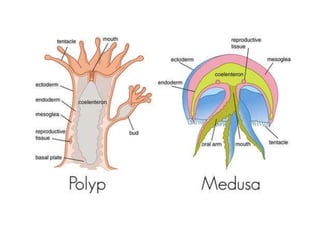
• The body wall composed of two layers of cells,
the ectoderm and endoderm, and between
these a layer secreted by them (mesogloea).
• Within the body wall a single cavity, having a single
opening for ingestion and egestion, and often
complicated by canals.
2. Digestion is both intracellular and extracellular
3. The nervous system is as the network of cells.
4. Nematocysts are present in this group.
5. Both sexual and asexual reproduction takes place.
• Special cnidarian larvae – planula.
6. Life cycle includes polype and medusoid forms;
some polyps can form colonies.
• This phylum includes about 9.000 species.
Class Hydrozoa
• General Structure
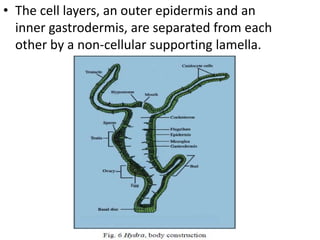
• The body of a hydra consists of a simple two-
layered tube, the trunk, normally attached at one
end, the base, and surmounted at the other by a
circle of tentacles, varying in number.
• The tentacles enclose a conical region, the
hypostome, which bears at its apex the mouth.
• The body wall surrounds a digestive cavity or
coelenteron, which extends into the tentacles.
• The cell layers, an outer epidermis and an
inner gastrodermis, are separated from each
other by a non-cellular supporting lamella.
Metabolism.
• The small animals serving as food for the hydra,
after being paralyzed and held fast by the
nematocysts, are brought to the mouth by the
tentacles and are ingested by engulfing
movements of the hypostome.
• The mouth is capable of a surprising degree of
distension to accommodate large objects of food.
• Soon after its ingestion the food is shifted by
peristaltic contractions of the body to a position
in the distal half of the coelenteron, where the
early stages of digestion occur.
• The process of digestion in the hydra is twofold.
• Enzymes released from the gland cells bring
about the disintegration of the softer parts of
the food mass, liquefying it and hastening its
breakdown into particles.
• The soluble products of this extracellular phase
of digestion are absorbed directly by the
gastrodermal cells.
• Finely divided particulate matter is ingested by
pseudopodia formed by the large gastrodermal
cells and comes to lie in food vacuoles within
their cytoplasm.
• the intracellular phase of digestion occurs, which
is presumably entirely comparable with the
process as it occurs in an amoeba.
• The indigestible residues are cast off by the
gastrodermal cells and, together with the
resistant parts of the food mass in the
coelenteron, are expelled through the mouth by a
series of violent contractions of the body.
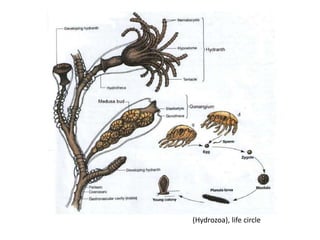
(Hydrozoa), life circle
Reproduction and Development.
• At certain seasons of the year, particularly in
autumn, hydras reproduce by syngamy, the
union of gametes.
• The testes are usually located on the distal half
of the trunk, the ovaries near the middle.
• Testes may appear first and ovaries later on the
same animal, or both may be present together.
• Animals in which the same individual possesses
both ovaries and testes are said to be
hermaphroditic or monoecious.
• These gonads appear as swollen protuberances
from the epidermis in the characteristic regions.
• Within them, ova or spermatozoa a rise from
interstitial cells.
• Fully matured spermatozoa may be seen moving
actively within the testis; they are discharged by
the periodic opening of the apex of the testis.
• The spermatozoon then swims about until it
dies, or until it comes into contact with an ovum
which has been exposed by the rupture of its
epidermal covering.
• The zygote formed by the union of these two
gametes undergoes cleavage and secretes about
it self a shell-like cyst, or theca.
• With in the theca, development proceeds until
an outer layer of cells, the ectoderm, and an
inner solid mass, the endoderm, have been
formed.
• The embryo within its theca then becomes
detached from the parent and drops to the
bottom.
• Tentacles eventually develop; the embryo breaks
from its cyst, becomes attached, develops a
coelenteron, forms a mouth, and so becomes a
miniature hydra.
• Zygotes developing in late autumn pass the
winter with in the protective cyst.
• Hydras frequently produce new individuals by
budding, a process referred to as asexual
reproduction.
Class Scyphomedusae
• Cnidaria with medusoid stage as the main stage
in the life cycle.
• Most of the jellyfishes called hydromedusae are
small.
• The amount of solid or living material in such
individuals would be small, however, because
jellyfishes are composed chiefly of water.
• In scyphomedusans specialized organs of
equilibration, termed statocysts, are located at
intervals around the margin of the bell, these
sense organs are important in the free-swimming
locomotion of jelly fishes, and similar though
simpler statocysts occur also in hydromedusae
• In typical cases the life cycle of scyphomedusa
consists of the following sequence:
• a planula larva develops from a zygote; this larva
produces an attached polyp generation, the
scyphistoma, from which free swimming medusae
arise in succession by transverse budding or
strobilization.
• The young medusae released from the strobila are
saucer like individuals called ephyrae; they grow
and transform into adult, sexually reproducing
jellyfishes.
• Asexual reproduction of the polypoid generation,
by budding to produce additional polyps, has also
been reported.
Class Anthozoa
• Cnidaria with only polyp stage represented in
their life cycle, The Anthozoa are represented
by the sea anemone, As in anthozoans
generally, the sea anemone is provided with a
somewhat flattened oral disk surrounded by
tentacles.
• The epidermis turns in at the mouth and
hangs downward into the coelenteron to form
a tubular pharynx or stomodaeum.
• The pharynx is attached to the lateral body wall
by a series of radiating partitions or septa, which
thus divide the upper part of the coelenteron
into radial compartments, continuous with the
undivided cavity below.
• The biradial symmetry characteristic of many
Anthozoa is produced by the presence of one or
more heavily ciliated grooves or gutters, called
siphonoglyphs, traversing the pharynx
longitudinally from its outer to its inner edge.
• These grooves presumably function to provide
active currents of fresh, aerated water to the
inner parts of the animal, and to flush away
wastes.
• Other representative anthozoans are the true
corals.
• The coral individual resembles a small sea
anemone lying in a limy, cup-like skeleton
secreted by its epidermal cells.
• The stony mass of a coral head or reef, covered
completely by the living substance of its polyps
Class Ctenophora
• The Ctenophora, commonly known as sea
walnuts or comb jellies, are animals with biradial
symmetry, epidermal and gastrodermal layers
like those of coelenterates, definite muscular
elements and a mesenchymal middle layer
(collenchyme) that are both derived from
mesoderm.
• Ctenophores are all small marine animals
which float and swim near the surface,
• Few species creeping existence upon the
bottom.
• Their food consists of whatever small animals
they may capture with the aid of the tentacles
which some ctenophores possess, or with the
parts related to the mouth.
• Abundant mucous secretions of the epidermis
aid in trapping small animals which are then
driven toward the mouth by ciliary currents
• The gastrovascular cavity is divided into pharynx,
stomach, and branching diverticula which ramify
extensively throughout the body.
• A small anus is present at the aboral end.
• The structure of a ctenophore is rather
complicated for an animal whose basic
organization is so simple.
• The eight rows of combs, responsible for the
name Ctenophora are a unique feature of the
phylum.
• Locomotion is effected by the beating of the
combs, which has been much studied as an
example of ciliary action controlled by a nervous
system

PHYLUM COELENTERATA (Cnidaria).pptx

  • 1.
  • 2.
    • Cnidarians areinvariably aquatic organisms, mostly dwelling in seas, but some species also inhabit in brackish and fresh waters. • Features: • The body wall composed of two layers of cells, the ectoderm and endoderm, and between these a layer secreted by them (mesogloea).
  • 3.
    • Within thebody wall a single cavity, having a single opening for ingestion and egestion, and often complicated by canals. 2. Digestion is both intracellular and extracellular 3. The nervous system is as the network of cells. 4. Nematocysts are present in this group. 5. Both sexual and asexual reproduction takes place. • Special cnidarian larvae – planula. 6. Life cycle includes polype and medusoid forms; some polyps can form colonies. • This phylum includes about 9.000 species.
  • 5.
    Class Hydrozoa • GeneralStructure • The body of a hydra consists of a simple two- layered tube, the trunk, normally attached at one end, the base, and surmounted at the other by a circle of tentacles, varying in number. • The tentacles enclose a conical region, the hypostome, which bears at its apex the mouth. • The body wall surrounds a digestive cavity or coelenteron, which extends into the tentacles.
  • 6.
    • The celllayers, an outer epidermis and an inner gastrodermis, are separated from each other by a non-cellular supporting lamella.
  • 7.
    Metabolism. • The smallanimals serving as food for the hydra, after being paralyzed and held fast by the nematocysts, are brought to the mouth by the tentacles and are ingested by engulfing movements of the hypostome. • The mouth is capable of a surprising degree of distension to accommodate large objects of food. • Soon after its ingestion the food is shifted by peristaltic contractions of the body to a position in the distal half of the coelenteron, where the early stages of digestion occur.
  • 8.
    • The processof digestion in the hydra is twofold. • Enzymes released from the gland cells bring about the disintegration of the softer parts of the food mass, liquefying it and hastening its breakdown into particles. • The soluble products of this extracellular phase of digestion are absorbed directly by the gastrodermal cells. • Finely divided particulate matter is ingested by pseudopodia formed by the large gastrodermal cells and comes to lie in food vacuoles within their cytoplasm.
  • 9.
    • the intracellularphase of digestion occurs, which is presumably entirely comparable with the process as it occurs in an amoeba. • The indigestible residues are cast off by the gastrodermal cells and, together with the resistant parts of the food mass in the coelenteron, are expelled through the mouth by a series of violent contractions of the body.
  • 10.
  • 11.
    Reproduction and Development. •At certain seasons of the year, particularly in autumn, hydras reproduce by syngamy, the union of gametes. • The testes are usually located on the distal half of the trunk, the ovaries near the middle. • Testes may appear first and ovaries later on the same animal, or both may be present together. • Animals in which the same individual possesses both ovaries and testes are said to be hermaphroditic or monoecious.
  • 12.
    • These gonadsappear as swollen protuberances from the epidermis in the characteristic regions. • Within them, ova or spermatozoa a rise from interstitial cells. • Fully matured spermatozoa may be seen moving actively within the testis; they are discharged by the periodic opening of the apex of the testis. • The spermatozoon then swims about until it dies, or until it comes into contact with an ovum which has been exposed by the rupture of its epidermal covering.
  • 13.
    • The zygoteformed by the union of these two gametes undergoes cleavage and secretes about it self a shell-like cyst, or theca. • With in the theca, development proceeds until an outer layer of cells, the ectoderm, and an inner solid mass, the endoderm, have been formed. • The embryo within its theca then becomes detached from the parent and drops to the bottom.
  • 14.
    • Tentacles eventuallydevelop; the embryo breaks from its cyst, becomes attached, develops a coelenteron, forms a mouth, and so becomes a miniature hydra. • Zygotes developing in late autumn pass the winter with in the protective cyst. • Hydras frequently produce new individuals by budding, a process referred to as asexual reproduction.
  • 15.
    Class Scyphomedusae • Cnidariawith medusoid stage as the main stage in the life cycle. • Most of the jellyfishes called hydromedusae are small. • The amount of solid or living material in such individuals would be small, however, because jellyfishes are composed chiefly of water.
  • 16.
    • In scyphomedusansspecialized organs of equilibration, termed statocysts, are located at intervals around the margin of the bell, these sense organs are important in the free-swimming locomotion of jelly fishes, and similar though simpler statocysts occur also in hydromedusae
  • 17.
    • In typicalcases the life cycle of scyphomedusa consists of the following sequence: • a planula larva develops from a zygote; this larva produces an attached polyp generation, the scyphistoma, from which free swimming medusae arise in succession by transverse budding or strobilization. • The young medusae released from the strobila are saucer like individuals called ephyrae; they grow and transform into adult, sexually reproducing jellyfishes. • Asexual reproduction of the polypoid generation, by budding to produce additional polyps, has also been reported.
  • 18.
    Class Anthozoa • Cnidariawith only polyp stage represented in their life cycle, The Anthozoa are represented by the sea anemone, As in anthozoans generally, the sea anemone is provided with a somewhat flattened oral disk surrounded by tentacles. • The epidermis turns in at the mouth and hangs downward into the coelenteron to form a tubular pharynx or stomodaeum.
  • 19.
    • The pharynxis attached to the lateral body wall by a series of radiating partitions or septa, which thus divide the upper part of the coelenteron into radial compartments, continuous with the undivided cavity below. • The biradial symmetry characteristic of many Anthozoa is produced by the presence of one or more heavily ciliated grooves or gutters, called siphonoglyphs, traversing the pharynx longitudinally from its outer to its inner edge.
  • 20.
    • These groovespresumably function to provide active currents of fresh, aerated water to the inner parts of the animal, and to flush away wastes. • Other representative anthozoans are the true corals. • The coral individual resembles a small sea anemone lying in a limy, cup-like skeleton secreted by its epidermal cells. • The stony mass of a coral head or reef, covered completely by the living substance of its polyps
  • 21.
    Class Ctenophora • TheCtenophora, commonly known as sea walnuts or comb jellies, are animals with biradial symmetry, epidermal and gastrodermal layers like those of coelenterates, definite muscular elements and a mesenchymal middle layer (collenchyme) that are both derived from mesoderm.
  • 22.
    • Ctenophores areall small marine animals which float and swim near the surface, • Few species creeping existence upon the bottom. • Their food consists of whatever small animals they may capture with the aid of the tentacles which some ctenophores possess, or with the parts related to the mouth. • Abundant mucous secretions of the epidermis aid in trapping small animals which are then driven toward the mouth by ciliary currents
  • 23.
    • The gastrovascularcavity is divided into pharynx, stomach, and branching diverticula which ramify extensively throughout the body. • A small anus is present at the aboral end. • The structure of a ctenophore is rather complicated for an animal whose basic organization is so simple. • The eight rows of combs, responsible for the name Ctenophora are a unique feature of the phylum. • Locomotion is effected by the beating of the combs, which has been much studied as an example of ciliary action controlled by a nervous system