Phylum Cnidaria & Ctenophora (ny-dar’ e-a) & (te-nof’ o-ra) The RADIATE Metazoa
Cnidaria   (cnidos=nettle like) 9000+ species Primary  radial  or  biradial   symmetry 700 million+ year fossil record 2 Germ layers  ectoderm  ( epidermis ),  endoderm  ( gastrodermis ), &  mesoglea Gastrovascular  cavity (extracellular digestion) Coelenerata (hollow gut) Nerve net (no CNS) Locomotion via  epitheliomuscular  cells  Polymorphism   (one species, multiple forms) Nematocysts  (unique to Cnideria)
Cnideria contd. Usually shallow marine habitats Some on the open ocean or at depth Many have bioluminescence. Symbiosis :  commensals  (anemonies),  mutuals  (zooanthellae) More on polymorphism Polyps Medusae
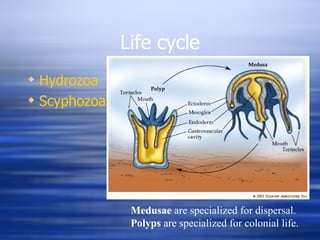
Life cycle Hydrozoa Scyphozoa Medusae  are specialized for dispersal. Polyps  are specialized for colonial life.
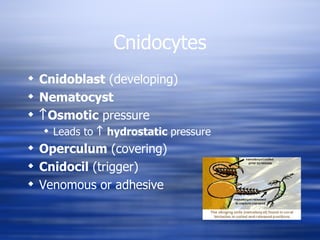
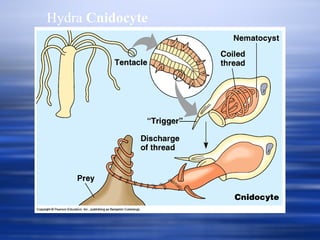
Cnidocytes Cnidoblast  (developing) Nematocyst  Osmotic  pressure Leads to    hydrostatic  pressure Operculum  (covering) Cnidocil  (trigger) Venomous or adhesive
Hydra  Cnidocyte
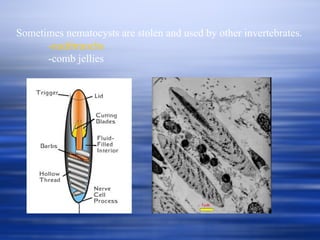
Sometimes nematocysts are stolen and used by other invertebrates. -nudibranchs -comb jellies
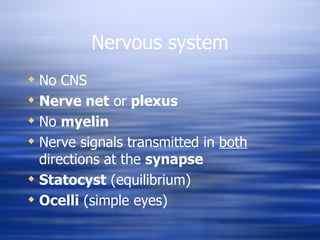
Nervous system No CNS Nerve net  or  plexus No  myelin Nerve signals transmitted in  both  directions at the  synapse Statocyst  (equilibrium) Ocelli  (simple eyes)
4 Classes of Cnidaria Hydrozoa  (e.g.. hydroids, fire corals, Portuguese man-o-war) Scyphozoa  (true jellies: e.g..  moon jellies,   other  bell-shaped jellies  )  Cubozoa  (cube jellies:e.g..  Chironex fleckeri ..or  Sea wasp ) Anthozoa  (e.g..  anemones , stony corals, & soft corals such as  sea pens )
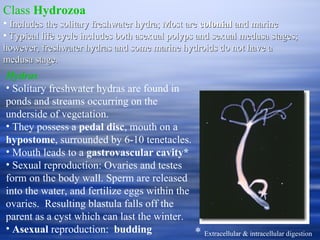
Class  Hydrozoa   Includes the solitary freshwater hydra; Most are  colonial  and marine  Typical life cycle includes both asexual polyps and sexual medusa stages; however, freshwater hydras and some marine hydroids do not have a medusa stage. Hydras Solitary freshwater hydras are found in ponds and streams occurring on the underside of vegetation. They possess a  pedal disc , mouth on a  hypostome , surrounded by 6-10 tenetacles. Mouth leads to a  gastrovascular cavity*   Sexual reproduction: Ovaries and testes form on the body wall. Sperm are released into the water, and fertilize eggs within the ovaries.  Resulting blastula falls off the parent as a cyst which can last the winter. Asexual  reproduction:  budding *  Extracellular & intracellular digestion
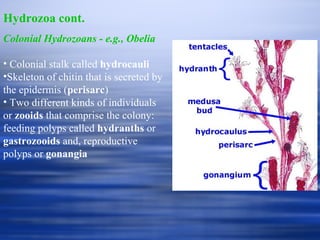
Hydrozoa cont. Colonial Hydrozoans - e.g., Obelia Colonial stalk called  hydrocauli Skeleton of chitin that is secreted by the epidermis ( perisarc ) Two different kinds of individuals or  zooids  that comprise the colony: feeding polyps called  hydranths  or  gastrozooids  and, reproductive polyps or  gonangia
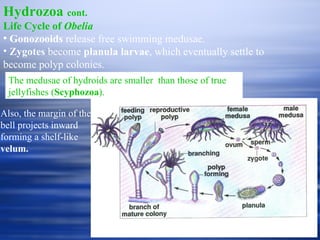
Hydrozoa  cont. Life Cycle of  Obelia Gonozooids  release free swimming medusae. Zygotes  become  planula larvae , which eventually settle to become polyp colonies. Also, the margin of the bell projects inward forming a shelf-like  velum. The medusae of hydroids are smaller  than those of true jellyfishes ( Scyphozoa ).
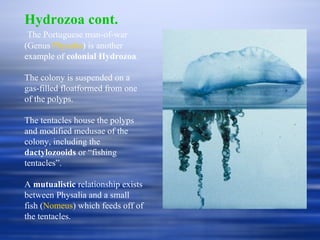
Hydrozoa cont. The Portuguese man-of-war (Genus  Physalia ) is another example of  colonial Hydrozoa . The colony is suspended on a gas-filled floatformed from one of the polyps. The tentacles house the polyps and modified medusae of the colony, including the  dactylozooids  or “fishing tentacles”. A  mutualistic  relationship exists between Physalia and a small fish ( Nomeus ) which feeds off of the tentacles.
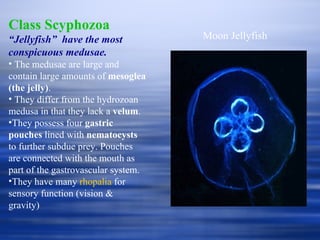
Class Scyphozoa “ Jellyfish”  have the most conspicuous medusae. The medusae are large and contain large amounts of  mesoglea (the jelly) . They differ from the hydrozoan medusa in that they lack a  velum . They possess four  gastric pouches  lined with  nematocysts  to further subdue prey. Pouches are connected with the mouth as part of the gastrovascular system. They have many  rhopalia  for sensory function (vision & gravity) Moon Jellyfish
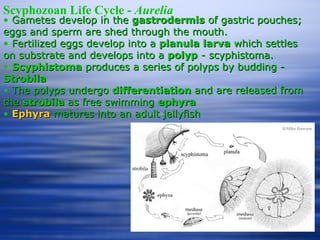
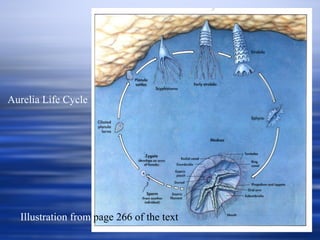
Scyphozoan Life Cycle -  Aurelia Gametes develop in the  gastrodermis  of gastric pouches; eggs and sperm are shed through the mouth. Fertilized eggs develop into a  planula larva  which settles on substrate and develops into a  polyp  - scyphistoma. Scyphistoma  produces a series of polyps by budding -  Strobila The polyps undergo  differentiation  and are released from the  strobila  as free swimming  ephyra Ephyra   matures into an adult jellyfish
Illustration from  page 266 of the text Aurelia Life Cycle
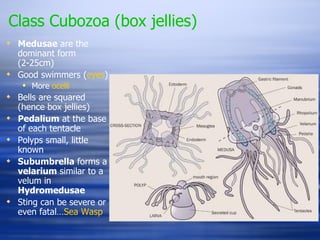
Class Cubozoa (box jellies) Medusae  are the dominant form (2-25cm) Good swimmers ( eyes ) More  ocelli   Bells are squared (hence box jellies) Pedalium  at the base of each tentacle Polyps small, little known Subumbrella  forms a  velarium  similar to a velum in  Hydromedusae Sting can be severe or even fatal… Sea Wasp
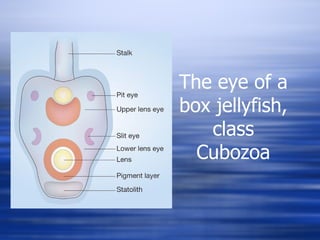
The eye of a box jellyfish, class Cubozoa
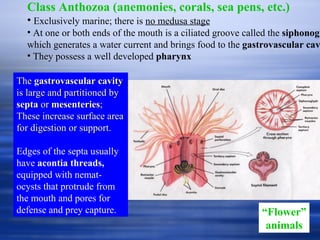
Class Anthozoa (anemonies, corals, sea pens, etc.) Exclusively marine; there is  no medusa stage At one or both ends of the mouth is a ciliated groove called the  siphonoglyph,  which generates a water current and brings food to the  gastrovascular cavity They possess a well developed  pharynx   “ Flower” animals The  gastrovascular cavity  is large and partitioned by  septa  or  mesenteries ; These increase surface area for digestion or support. Edges of the septa usually have  acontia threads,  equipped with nemat-ocysts that protrude from the mouth and pores for defense and prey capture.
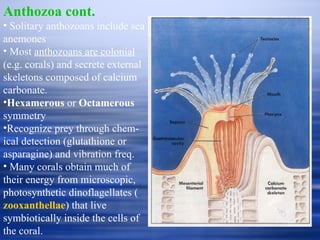
Anthozoa cont. Solitary anthozoans include sea anemones Most  anthozoans are colonial  (e.g. corals) and secrete external skeletons composed of calcium carbonate. Hexamerous  or  Octamerous  symmetry Recognize prey through chem-ical detection (glutathione or asparagine) and vibration freq. Many corals obtain much of their energy from microscopic, photosynthetic dinoflagellates ( zooxanthellae ) that live symbiotically inside the cells of the coral.
Reproduction Anemonies Monoecious  and  dioecious Protandrous  if monoecious Asexual reproduction by  Budding Longitudinal fission Pedal laceration Hard Corals  (hexacorallian) Sexual repro. Moneceous & dioecious Spawning Planula larva Asexual repro. Budding Fission Transverse Longitudinal Anthozoa   contd .
Coral Reef  types  ( more ) Fringing reef Close to land; narrow or no lagoon Barrier Parallel to shore; wide, deep lagoon Patch Located on the leeward side of a barrier reef or atoll Atoll Encircle a lagoon, but not an island Hermatypic (reef building) corals Coraline  algae Shallow water (<30m) & warmth ( +  30° Lat.) Large formations of calcium carbonate (CaCO 3 ) Tremendous diversity of life (Islands of life)
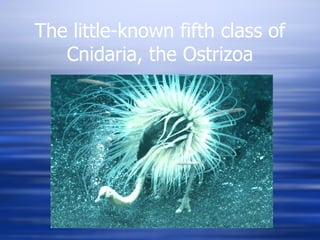
The little-known fifth class of Cnidaria, the Ostrizoa
Ctenophora ( Comb Jellies ) Colloblasts  (glue-secreting cells - prey capture) Cilliated  Comb rows  (swims mouth first) Marine, < 100 species; many deep water sp. Two tentacles which retract into sheaths No nematocysts (H. rubra steals them) Aboral  organ senses gravity (statocyst) Aboral canal  voids waste (complete gut) Epidermis, gastrodermis, and  collenchyme  which contains distinct muscle  fibers . Respiration & excretion through cell membranes Bioluminescence
Ctenophora life cycle Monoeceous Eggs and sperm released into the water Free swimming  cydippid  larva No polyp stage
The End Brought to you by… Hydrozoa & Scyphozoa

cnidera

  • 1.
    Phylum Cnidaria &Ctenophora (ny-dar’ e-a) & (te-nof’ o-ra) The RADIATE Metazoa
  • 2.
    Cnidaria (cnidos=nettle like) 9000+ species Primary radial or biradial symmetry 700 million+ year fossil record 2 Germ layers ectoderm ( epidermis ), endoderm ( gastrodermis ), & mesoglea Gastrovascular cavity (extracellular digestion) Coelenerata (hollow gut) Nerve net (no CNS) Locomotion via epitheliomuscular cells Polymorphism (one species, multiple forms) Nematocysts (unique to Cnideria)
  • 3.
    Cnideria contd. Usuallyshallow marine habitats Some on the open ocean or at depth Many have bioluminescence. Symbiosis : commensals (anemonies), mutuals (zooanthellae) More on polymorphism Polyps Medusae
  • 4.
    Life cycle HydrozoaScyphozoa Medusae are specialized for dispersal. Polyps are specialized for colonial life.
  • 5.
    Cnidocytes Cnidoblast (developing) Nematocyst  Osmotic pressure Leads to  hydrostatic pressure Operculum (covering) Cnidocil (trigger) Venomous or adhesive
  • 6.
  • 7.
    Sometimes nematocysts arestolen and used by other invertebrates. -nudibranchs -comb jellies
  • 8.
    Nervous system NoCNS Nerve net or plexus No myelin Nerve signals transmitted in both directions at the synapse Statocyst (equilibrium) Ocelli (simple eyes)
  • 9.
    4 Classes ofCnidaria Hydrozoa (e.g.. hydroids, fire corals, Portuguese man-o-war) Scyphozoa (true jellies: e.g.. moon jellies, other bell-shaped jellies ) Cubozoa (cube jellies:e.g.. Chironex fleckeri ..or Sea wasp ) Anthozoa (e.g.. anemones , stony corals, & soft corals such as sea pens )
  • 10.
    Class Hydrozoa Includes the solitary freshwater hydra; Most are colonial and marine Typical life cycle includes both asexual polyps and sexual medusa stages; however, freshwater hydras and some marine hydroids do not have a medusa stage. Hydras Solitary freshwater hydras are found in ponds and streams occurring on the underside of vegetation. They possess a pedal disc , mouth on a hypostome , surrounded by 6-10 tenetacles. Mouth leads to a gastrovascular cavity* Sexual reproduction: Ovaries and testes form on the body wall. Sperm are released into the water, and fertilize eggs within the ovaries. Resulting blastula falls off the parent as a cyst which can last the winter. Asexual reproduction: budding * Extracellular & intracellular digestion
  • 11.
    Hydrozoa cont. ColonialHydrozoans - e.g., Obelia Colonial stalk called hydrocauli Skeleton of chitin that is secreted by the epidermis ( perisarc ) Two different kinds of individuals or zooids that comprise the colony: feeding polyps called hydranths or gastrozooids and, reproductive polyps or gonangia
  • 12.
    Hydrozoa cont.Life Cycle of Obelia Gonozooids release free swimming medusae. Zygotes become planula larvae , which eventually settle to become polyp colonies. Also, the margin of the bell projects inward forming a shelf-like velum. The medusae of hydroids are smaller than those of true jellyfishes ( Scyphozoa ).
  • 13.
    Hydrozoa cont. ThePortuguese man-of-war (Genus Physalia ) is another example of colonial Hydrozoa . The colony is suspended on a gas-filled floatformed from one of the polyps. The tentacles house the polyps and modified medusae of the colony, including the dactylozooids or “fishing tentacles”. A mutualistic relationship exists between Physalia and a small fish ( Nomeus ) which feeds off of the tentacles.
  • 14.
    Class Scyphozoa “Jellyfish” have the most conspicuous medusae. The medusae are large and contain large amounts of mesoglea (the jelly) . They differ from the hydrozoan medusa in that they lack a velum . They possess four gastric pouches lined with nematocysts to further subdue prey. Pouches are connected with the mouth as part of the gastrovascular system. They have many rhopalia for sensory function (vision & gravity) Moon Jellyfish
  • 15.
    Scyphozoan Life Cycle- Aurelia Gametes develop in the gastrodermis of gastric pouches; eggs and sperm are shed through the mouth. Fertilized eggs develop into a planula larva which settles on substrate and develops into a polyp - scyphistoma. Scyphistoma produces a series of polyps by budding - Strobila The polyps undergo differentiation and are released from the strobila as free swimming ephyra Ephyra matures into an adult jellyfish
  • 16.
    Illustration from page 266 of the text Aurelia Life Cycle
  • 17.
    Class Cubozoa (boxjellies) Medusae are the dominant form (2-25cm) Good swimmers ( eyes ) More ocelli Bells are squared (hence box jellies) Pedalium at the base of each tentacle Polyps small, little known Subumbrella forms a velarium similar to a velum in Hydromedusae Sting can be severe or even fatal… Sea Wasp
  • 18.
    The eye ofa box jellyfish, class Cubozoa
  • 19.
    Class Anthozoa (anemonies,corals, sea pens, etc.) Exclusively marine; there is no medusa stage At one or both ends of the mouth is a ciliated groove called the siphonoglyph, which generates a water current and brings food to the gastrovascular cavity They possess a well developed pharynx “ Flower” animals The gastrovascular cavity is large and partitioned by septa or mesenteries ; These increase surface area for digestion or support. Edges of the septa usually have acontia threads, equipped with nemat-ocysts that protrude from the mouth and pores for defense and prey capture.
  • 20.
    Anthozoa cont. Solitaryanthozoans include sea anemones Most anthozoans are colonial (e.g. corals) and secrete external skeletons composed of calcium carbonate. Hexamerous or Octamerous symmetry Recognize prey through chem-ical detection (glutathione or asparagine) and vibration freq. Many corals obtain much of their energy from microscopic, photosynthetic dinoflagellates ( zooxanthellae ) that live symbiotically inside the cells of the coral.
  • 21.
    Reproduction Anemonies Monoecious and dioecious Protandrous if monoecious Asexual reproduction by Budding Longitudinal fission Pedal laceration Hard Corals (hexacorallian) Sexual repro. Moneceous & dioecious Spawning Planula larva Asexual repro. Budding Fission Transverse Longitudinal Anthozoa contd .
  • 22.
    Coral Reef types ( more ) Fringing reef Close to land; narrow or no lagoon Barrier Parallel to shore; wide, deep lagoon Patch Located on the leeward side of a barrier reef or atoll Atoll Encircle a lagoon, but not an island Hermatypic (reef building) corals Coraline algae Shallow water (<30m) & warmth ( + 30° Lat.) Large formations of calcium carbonate (CaCO 3 ) Tremendous diversity of life (Islands of life)
  • 23.
    The little-known fifthclass of Cnidaria, the Ostrizoa
  • 24.
    Ctenophora ( CombJellies ) Colloblasts (glue-secreting cells - prey capture) Cilliated Comb rows (swims mouth first) Marine, < 100 species; many deep water sp. Two tentacles which retract into sheaths No nematocysts (H. rubra steals them) Aboral organ senses gravity (statocyst) Aboral canal voids waste (complete gut) Epidermis, gastrodermis, and collenchyme which contains distinct muscle fibers . Respiration & excretion through cell membranes Bioluminescence
  • 25.
    Ctenophora life cycleMonoeceous Eggs and sperm released into the water Free swimming cydippid larva No polyp stage
  • 26.
    The End Broughtto you by… Hydrozoa & Scyphozoa