FACTORS AFFECTING
EGG PRODUCTION
IN LAYERS
During the production cycle many factors influence egg
production, therefore, the cycle must be managed effectively and
efficiently in order to provide maximum output and profitability.
• ENVIRONMENTAL FACTORS AFFECTING EGG
PRODUCTION
• Environment may be visualized at the surroundings in which a
bird is placed or conditions to which it is subjected.
• The expression of the potentialities of an animal including the
Avians ,is the sum of the responses of the animal Or bird to their
genetic makeup and their interaction with the environment in
which they are placed
The components of environment
• 1. climate
• 2. nutrition
• 3.shelter/housing
• 4.level of health
• 5.management
All the above factors combining affect the egg production
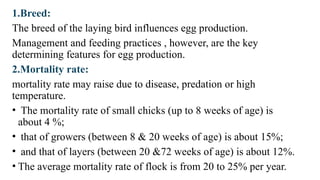
1.Breed:
The breed of the laying bird influences egg production.
Management and feeding practices , however, are the key
determining features for egg production.
2.Mortality rate:
mortality rate may raise due to disease, predation or high
temperature.
• The mortality rate of small chicks (up to 8 weeks of age) is
about 4 %;
• that of growers (between 8 & 20 weeks of age) is about 15%;
• and that of layers (between 20 &72 weeks of age) is about 12%.
• The average mortality rate of flock is from 20 to 25% per year.
3. Age:
birds typically begin production eggs in their 20 or 21 week and continue for
slightly over a year.
This is best laying period and eggs tend to increase in size until the end of
the egg production cycle.
Chick factors
• Layers are usually kept for 52 weeks. After this period, they undergo a stage
called moulting where they lose their feathers and stop producing eggs. Egg
production will start again in the second laying period after moulting, but
the eggs will be bigger, shells thinner and production lower.
• Older birds produce eggs with thin shells.
• Indigenous chickens do not lay as many eggs when compared to
commercial layers.
4. Body weight:
•in general, optimum body weight during the laying period
should be around 1.5 kg , although this varies according to
breed.
• Underweight as well as overweight birds lay eggs at a lower
rate.
• Proper management and the correct amount of feed are
necessary in order to achieve optimum body weight.
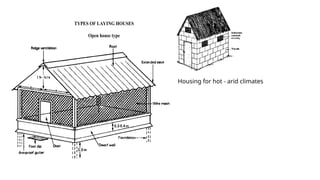
5.Laying house:
the laying house should be built according to local climatic
conditions and farmer’s finances.
A good house protects laying birds from theft, predation, direct
sunlight, rain, excessive wind, heat and cold, as well as sudden
changes in temperature and excessive dust.
if the climate is hot and humid, for example, the use of an open
house construction will enable ventilation. the inside of house
should be arranged so that it requires minimum labor and time to
care for the birds.
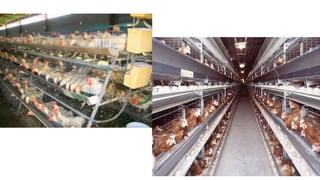
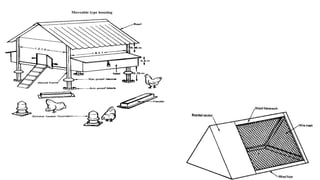
TYPES OF LAYING HOUSES
Open house type
Housing for hot - arid climates
Moveable type housing
6.Lighting schedule:
• Egg production is stimulated by daylight; therefore, as the days grow
longer production increases.
• In open houses , found commonly in the tropics, artificial lighting
may be used to increase the laying period. When darkness falls
artificial lighting can be introduced for 2 to 3 hours, which may
increase egg production by 20 to 30 %.
• In closed house , where layers are not exposed to natural light, the
length of the artificial day should be increased either in one step, or in
a number of steps until the artificial day reaches 16 to 17 hours, which
will ensure constant and maximized egg production
• Effective day light should never decrease during the laying
period.
• When the lights are off, chickens do not eat and this results in
low egg production. Lights should be checked regularly and
cleaned so that they do not get dimmer.
• Bulbs should be changed when necessary
• Exposure to light for less than the minimum time required
results in a drop in egg production.
• When chickens are exposed to too much light, they reach
sexual maturity at an early stage and they lay very small eggs.
feed-range hens will produce more meat and eggs with
supplemental feed, but only if they are improved breeds or
crossbreeds. The selection of local hens is done on the basis of
resistance and other criteria rather than feed utilization for
production.
Fresh and clean water should always be provided, as a layer
can consume up tone-quarter of liter a day.
FEED-RELATED PROBLEMS
Not enough drinking water
Clean and cool water must always be available to avoid heat
stress. Lack of water results in reduced egg production.
No feed or decreased feed intake
Chickens tend to eat less when the feed is not tasty or when
they are stressed because of environmental temperatures,
especially when it gets too hot. Feed should be available at all
times.
Low calcium in the feed
• This result in few and smaller eggs, soft-shelled eggs, shell-less eggs,
cracked eggs, eggs losing colour and hens having leg problems.
• If calcium deficiency is suspected, take a feed sample to the laboratory
to check the calcium level.
• Commercial rations have calcium added. When mixing your own ration
make sure that calcium added is 3,5 %.
• If calcium deficiency is a problem, limestone grit should be given as a
top dressing at least twice a week at 5 gm /bird.
Low salt in the feed
• This results in a sharp decrease in egg production.
• Chickens will also start pecking each other and eating
feathers
• If salt deficiency is suspected, a sample of feed should be
taken to the laboratory to check the level of salt.
• Take care when mixing your own chicken ration at home.
Add the required quantity of salt, which is 0,4 %.
Culling
culling is the removal of undesirable(sick and /or
unproductive) birds, from the flock. There are two
method of culling:
. Mass culling, when the entire flock is removed and
replaced at the end of the laying cycle; and
. Selective culling, when farmer removes individual
unproductive or sick birds.
Culling enables a high level of egg production to be
maintained, prevents feed waste on unproductive
birds and may avert the spreading of diseases.
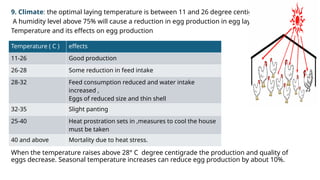
9. Climate: the optimal laying temperature is between 11 and 26 degree centigrade.
A humidity level above 75% will cause a reduction in egg production in egg laying.
Temperature and its effects on egg production
When the temperature raises above 28° C degree centigrade the production and quality of
eggs decrease. Seasonal temperature increases can reduce egg production by about 10%.
Temperature ( C ) effects
11-26 Good production
26-28 Some reduction in feed intake
28-32 Feed consumption reduced and water intake
increased ,
Eggs of reduced size and thin shell
32-35 Slight panting
25-40 Heat prostration sets in ,measures to cool the house
must be taken
40 and above Mortality due to heat stress.
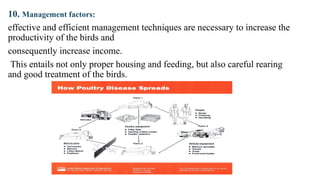
10. Management factors:
effective and efficient management techniques are necessary to increase the
productivity of the birds and
consequently increase income.
This entails not only proper housing and feeding, but also careful rearing
and good treatment of the birds.
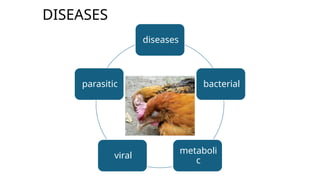
DISEASES
diseases
bacterial
metaboli
c
viral
parasitic
Factors affecting Factors   egg production.pptx

Factors affecting Factors egg production.pptx

  • 1.
  • 2.
    During the productioncycle many factors influence egg production, therefore, the cycle must be managed effectively and efficiently in order to provide maximum output and profitability. • ENVIRONMENTAL FACTORS AFFECTING EGG PRODUCTION • Environment may be visualized at the surroundings in which a bird is placed or conditions to which it is subjected. • The expression of the potentialities of an animal including the Avians ,is the sum of the responses of the animal Or bird to their genetic makeup and their interaction with the environment in which they are placed
  • 3.
    The components ofenvironment • 1. climate • 2. nutrition • 3.shelter/housing • 4.level of health • 5.management All the above factors combining affect the egg production
  • 4.
    1.Breed: The breed ofthe laying bird influences egg production. Management and feeding practices , however, are the key determining features for egg production. 2.Mortality rate: mortality rate may raise due to disease, predation or high temperature. • The mortality rate of small chicks (up to 8 weeks of age) is about 4 %; • that of growers (between 8 & 20 weeks of age) is about 15%; • and that of layers (between 20 &72 weeks of age) is about 12%. • The average mortality rate of flock is from 20 to 25% per year.
  • 5.
    3. Age: birds typicallybegin production eggs in their 20 or 21 week and continue for slightly over a year. This is best laying period and eggs tend to increase in size until the end of the egg production cycle. Chick factors • Layers are usually kept for 52 weeks. After this period, they undergo a stage called moulting where they lose their feathers and stop producing eggs. Egg production will start again in the second laying period after moulting, but the eggs will be bigger, shells thinner and production lower. • Older birds produce eggs with thin shells. • Indigenous chickens do not lay as many eggs when compared to commercial layers.
  • 6.
    4. Body weight: •ingeneral, optimum body weight during the laying period should be around 1.5 kg , although this varies according to breed. • Underweight as well as overweight birds lay eggs at a lower rate. • Proper management and the correct amount of feed are necessary in order to achieve optimum body weight.
  • 7.
    5.Laying house: the layinghouse should be built according to local climatic conditions and farmer’s finances. A good house protects laying birds from theft, predation, direct sunlight, rain, excessive wind, heat and cold, as well as sudden changes in temperature and excessive dust. if the climate is hot and humid, for example, the use of an open house construction will enable ventilation. the inside of house should be arranged so that it requires minimum labor and time to care for the birds.
  • 9.
    TYPES OF LAYINGHOUSES Open house type Housing for hot - arid climates
  • 10.
  • 11.
    6.Lighting schedule: • Eggproduction is stimulated by daylight; therefore, as the days grow longer production increases. • In open houses , found commonly in the tropics, artificial lighting may be used to increase the laying period. When darkness falls artificial lighting can be introduced for 2 to 3 hours, which may increase egg production by 20 to 30 %. • In closed house , where layers are not exposed to natural light, the length of the artificial day should be increased either in one step, or in a number of steps until the artificial day reaches 16 to 17 hours, which will ensure constant and maximized egg production
  • 12.
    • Effective daylight should never decrease during the laying period. • When the lights are off, chickens do not eat and this results in low egg production. Lights should be checked regularly and cleaned so that they do not get dimmer. • Bulbs should be changed when necessary • Exposure to light for less than the minimum time required results in a drop in egg production. • When chickens are exposed to too much light, they reach sexual maturity at an early stage and they lay very small eggs.
  • 13.
    feed-range hens willproduce more meat and eggs with supplemental feed, but only if they are improved breeds or crossbreeds. The selection of local hens is done on the basis of resistance and other criteria rather than feed utilization for production. Fresh and clean water should always be provided, as a layer can consume up tone-quarter of liter a day.
  • 14.
    FEED-RELATED PROBLEMS Not enoughdrinking water Clean and cool water must always be available to avoid heat stress. Lack of water results in reduced egg production. No feed or decreased feed intake Chickens tend to eat less when the feed is not tasty or when they are stressed because of environmental temperatures, especially when it gets too hot. Feed should be available at all times.
  • 15.
    Low calcium inthe feed • This result in few and smaller eggs, soft-shelled eggs, shell-less eggs, cracked eggs, eggs losing colour and hens having leg problems. • If calcium deficiency is suspected, take a feed sample to the laboratory to check the calcium level. • Commercial rations have calcium added. When mixing your own ration make sure that calcium added is 3,5 %. • If calcium deficiency is a problem, limestone grit should be given as a top dressing at least twice a week at 5 gm /bird.
  • 16.
    Low salt inthe feed • This results in a sharp decrease in egg production. • Chickens will also start pecking each other and eating feathers • If salt deficiency is suspected, a sample of feed should be taken to the laboratory to check the level of salt. • Take care when mixing your own chicken ration at home. Add the required quantity of salt, which is 0,4 %.
  • 17.
    Culling culling is theremoval of undesirable(sick and /or unproductive) birds, from the flock. There are two method of culling: . Mass culling, when the entire flock is removed and replaced at the end of the laying cycle; and . Selective culling, when farmer removes individual unproductive or sick birds. Culling enables a high level of egg production to be maintained, prevents feed waste on unproductive birds and may avert the spreading of diseases.
  • 18.
    9. Climate: theoptimal laying temperature is between 11 and 26 degree centigrade. A humidity level above 75% will cause a reduction in egg production in egg laying. Temperature and its effects on egg production When the temperature raises above 28° C degree centigrade the production and quality of eggs decrease. Seasonal temperature increases can reduce egg production by about 10%. Temperature ( C ) effects 11-26 Good production 26-28 Some reduction in feed intake 28-32 Feed consumption reduced and water intake increased , Eggs of reduced size and thin shell 32-35 Slight panting 25-40 Heat prostration sets in ,measures to cool the house must be taken 40 and above Mortality due to heat stress.
  • 19.
    10. Management factors: effectiveand efficient management techniques are necessary to increase the productivity of the birds and consequently increase income. This entails not only proper housing and feeding, but also careful rearing and good treatment of the birds.
  • 20.