Phylum
          CNIDARIA


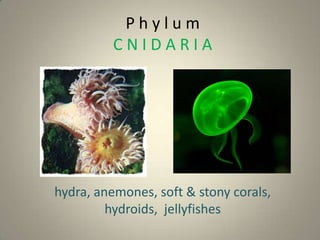
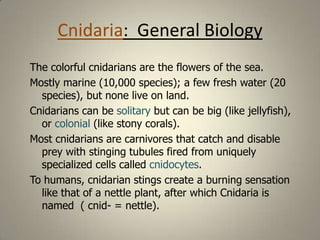
hydra, anemones, soft & stony corals,
         hydroids, jellyfishes
Cnidaria: General Biology
The colorful cnidarians are the flowers of the sea.
Mostly marine (10,000 species); a few fresh water (20
  species), but none live on land.
Cnidarians can be solitary but can be big (like jellyfish),
  or colonial (like stony corals).
Most cnidarians are carnivores that catch and disable
  prey with stinging tubules fired from uniquely
  specialized cells called cnidocytes.
To humans, cnidarian stings create a burning sensation
  like that of a nettle plant, after which Cnidaria is
  named ( cnid- = nettle).
Form and Symmetry of
              Solitary Individuals
• General
    In basic form, the saccate cnidarian body
 resembles a gastrula, which consists of a gut like
 cavity enclosed by a solid body wall.

    The cavity, called coelenteron, opens the exterior
 via a mouth surrounded by one or more whorls of
 tentacles. Sensory organs, when present, are
 distributed at or near the bases of the tentacles.
•     The cnidarian body exhibits radial symmetry around
    one axis, the oral-aboral axis, that extends from mouth
    to base. The oral end of the body, which bears the
    mouth, is at one end of the axis, and opposite it is the
    aboral end.

        Radial symmetry may be useful when an abundant but
    diffuse resource plankton, light- or danger has an equal
    probability of arriving from any or all directions. This
    applies to most cnidarians because they do not stalk
    their food, but instead feed opportunistically on prey as
    it inadvertently swims or drifts into contact with them.
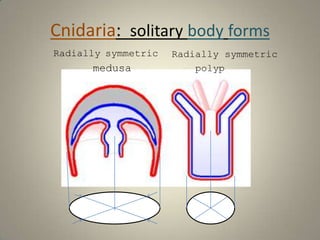
2 body forms: Polyp & Medusa
Cnidaria: 2 body forms
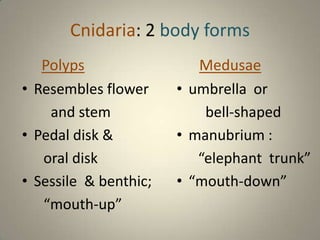
   Polyps                 Medusae
• Resembles flower     • umbrella or
    and stem               bell-shaped
• Pedal disk &         • manubrium :
   oral disk              “elephant trunk”
• Sessile & benthic;   • “mouth-down”
   “mouth-up”
Cnidaria: solitary body forms
Radially symmetric   Radially symmetric
      medusa             polyp
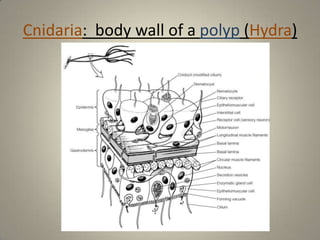
Tissues and Body Compartments
    The cnidarian body wall is composed of
three tissue layers: an outer epithelium,
the epidermis; an inner epithelium, the
gastrodermis, which lines the gut-like
coelenteron and joins the epidermis at the
mouth; and between these two epithelia,
a gelatinous extracellular matrix called
mesoglea.
Cnidaria: body wall of a polyp (Hydra)
A stolonate colony, like a strawberry runner,
consists of a prostate colon, single or branched in a
two-dimensional network, that attaches to the
surface of the substrantum and bears upright,
unbranched zooids. The stolon is a tubular body wall
outgrowth that includes the coelenteron, from which
zooids bud at intervals along its length.

 Colonies of several taxa consist of zooids that arise
from the surface of a continous sheet of tissue called
a stolonal mat or coenosarc that unites the zooids
and attaches the colony to the substantrum.
The colonies described so far are more than
less simple, consisting of zooids borne either
directly on stolons like bulbs on a string of
Christmas lights or individually on a
coenosarc. More complex colonies arise not
only by the budding of zooids from stolons or
coenosarc, but also from other zooids. With a
few exceptions, zooidal budding produces an
upright, plantlike, fruticose colony that may
be grassy, bushy, shrubby, or feathery in
appearance.
Cnidaria: fruticose (shrubby) colony


 A fruticose colony     A fruticose colony can
resulting from          also grow from an
                        axial polyp (stem-like),
fixed-length budding.   which buds a succession
                        of lateral zooids.
Skeleton
• The startling variety of cnidarian skeletons,
  especially evident in polyps, exceeds even that of
  sponges. Exoskeletons may be the thin cuticles of
  chitinous periderm, as found in many small-bodied
  solitaty polyps and colonies, but not Hydra or most
  anemones, which are naked. The polyps of stony
  corals secrete a hard calcareous exoskeleton that in
  some reef species can, over many generations,
  reach a diameter of 1m or more and weigh several
  tons.
Medusa: locomotion by swimming
                     (jet propulsion )
Muscular and Movement
• The principal muscle of medusae is the halo-
  shaped, circular coronal muscle on the subumbrelar
  surface. The cross-strained coronal muscle is
  antagonized by the elastic mesoglea.

•    Cnidarian muscles are primarily epidermal and
    gastrodermal epitheliomuscular cells, but in
    anthozoans and scyphozoans, some of these cells
    have abandoned the epithelia, entered the
    mesoglea, and transformed into myocytes, or “true”
    muscle cells.
Hydra: locomotion by
          crawling or somersaulting


Hydras and some sea anemones can detach and shift locations by creeping
on their bases, by inchworm-like crawling, by somersaulting, or by floating.
Cnidaria: nervous system
Nerve net of a polyp   Nervous system of medusa
• The cnidarian nervous system, like that of all
  eumetazoans, consists of superficial sensory neurons
  that monitor the environment, motorneurons that
  activate effectors such as muscles or cnidocytes, and
  interneurons that join the sensory receptors to the
  motorneurons.

• In Cnidaria, interconnected neurons form a pair of
  complex, two-dimensional nerve nets.

• Diffuse conduction is a characteristic of nerve nets.
A ganglion is a concentration of neurons
that serves as a brainlike integration center.
As such, it receives sensory input, integrates
that information with other inputs, and
generates motor output.
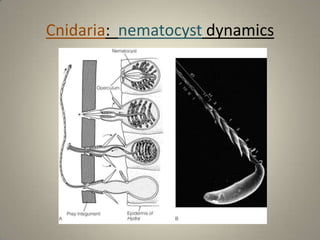
Cnidaria: nematocyst dynamics
Cnidocytes And Cnidae
• A unique and defining feature of cnidarians is the
  cnidocyte: a combined sensory-effector cell that
  plays a central role in prey capture and defense. Each
  cnidocyte houses a cnida, a fluid-filled membranous
  capsule containing a long tubular invagination of the
  capsule wall.

• Three general types of cnidae- nematocytes,
  spirocytes, and ptychocytes.
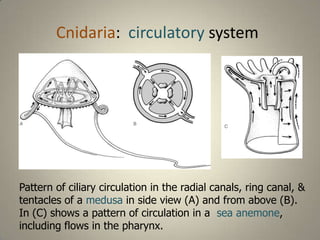
Cnidaria: circulatory system


Pattern of ciliary circulation in the radial canals, ring canal, &
tentacles of a medusa in side view (A) and from above (B).
In (C) shows a pattern of circulation in a sea anemone,
including flows in the pharynx.
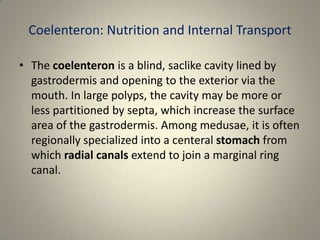
Coelenteron: Nutrition and Internal Transport

• The coelenteron is a blind, saclike cavity lined by
  gastrodermis and opening to the exterior via the
  mouth. In large polyps, the cavity may be more or
  less partitioned by septa, which increase the surface
  area of the gastrodermis. Among medusae, it is often
  regionally specialized into a centeral stomach from
  which radial canals extend to join a marginal ring
  canal.
Regeneration and Clonal Production

• Cnidarians have an impressive ability to heal and
  regenerate missing parts after injury. In Hydra, for
  example, loss of the oral end is followed by regrowth
  and differentiation of a new mouth and tentacles.
  Living specimens of the common anemone Aiptasia
  pallida can be dissected, pinned open for
  observation, and then returned to an aquarium,
  where they will heal after a few days. Medusae also
  heal and regenerate missing parts after damage, as
  do planula larvae.
Cnidaria: clonal reproduction
Sexual Reproduction and Life Cycles
• Cnidarian adults are generally gonochoric, but
  certain taxa such as stony corals, have many
  hermaphroditic species. Germ cells originate in the
  endoderm and generally grow and differentiate in
  the gastrodermis, except in some hydrozoans, in
  which they migrate into the epidermis.

• Further development leads to a planktonic larva
  known as a planula. It’s epidermis is monociliated
  and its gastrocdermis is often yolky.
Cnidaria: sexual reproduction
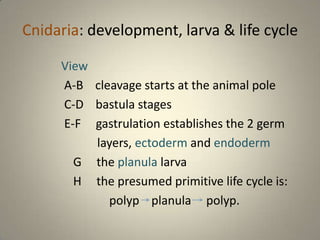
Cnidaria: development, larva & life cycle

     View
     A-B cleavage starts at the animal pole
     C-D bastula stages
     E-F gastrulation establishes the 2 germ
          layers, ectoderm and endoderm
       G the planula larva
       H the presumed primitive life cycle is:
            polyp planula polyp.
Anthozoa: anatomy
cutaway view of a sea anemone
Polyp Form

• The body consists of a tubular column
  surmounted by a wide plateau, the oral disc. The
  oval or slitlike mouth is in the center of the oral
  disc and a whorl of tentacles occurs at its margin.

• In solitary individuals, the base of the column is
  often expanded into a pedal disc that adheres to
  the substratum. The mouth leads into a tubular
  but laterally compressed pharynx that descends
  below the oral disc and opens into the
  coelenteron via an internal opening.
• Because of the pharyngeal compression, the mouth
  and internal pharynx opening are elongated slits. The
  two opposite corners of the mouth exted inward
  along the length of the pharynx as ciliated grooves
  called siphonoglyphs.
Anthozoa: anatomy
cross section of body at level of pharynx

Cnidaria gen features -2012

  • 1.
    Phylum CNIDARIA hydra, anemones, soft & stony corals, hydroids, jellyfishes
  • 2.
    Cnidaria: General Biology Thecolorful cnidarians are the flowers of the sea. Mostly marine (10,000 species); a few fresh water (20 species), but none live on land. Cnidarians can be solitary but can be big (like jellyfish), or colonial (like stony corals). Most cnidarians are carnivores that catch and disable prey with stinging tubules fired from uniquely specialized cells called cnidocytes. To humans, cnidarian stings create a burning sensation like that of a nettle plant, after which Cnidaria is named ( cnid- = nettle).
  • 3.
    Form and Symmetryof Solitary Individuals • General In basic form, the saccate cnidarian body resembles a gastrula, which consists of a gut like cavity enclosed by a solid body wall. The cavity, called coelenteron, opens the exterior via a mouth surrounded by one or more whorls of tentacles. Sensory organs, when present, are distributed at or near the bases of the tentacles.
  • 4.
    The cnidarian body exhibits radial symmetry around one axis, the oral-aboral axis, that extends from mouth to base. The oral end of the body, which bears the mouth, is at one end of the axis, and opposite it is the aboral end. Radial symmetry may be useful when an abundant but diffuse resource plankton, light- or danger has an equal probability of arriving from any or all directions. This applies to most cnidarians because they do not stalk their food, but instead feed opportunistically on prey as it inadvertently swims or drifts into contact with them.
  • 5.
    2 body forms:Polyp & Medusa
  • 6.
    Cnidaria: 2 bodyforms Polyps Medusae • Resembles flower • umbrella or and stem bell-shaped • Pedal disk & • manubrium : oral disk “elephant trunk” • Sessile & benthic; • “mouth-down” “mouth-up”
  • 7.
    Cnidaria: solitary bodyforms Radially symmetric Radially symmetric medusa polyp
  • 8.
    Tissues and BodyCompartments The cnidarian body wall is composed of three tissue layers: an outer epithelium, the epidermis; an inner epithelium, the gastrodermis, which lines the gut-like coelenteron and joins the epidermis at the mouth; and between these two epithelia, a gelatinous extracellular matrix called mesoglea.
  • 9.
    Cnidaria: body wallof a polyp (Hydra)
  • 10.
    A stolonate colony,like a strawberry runner, consists of a prostate colon, single or branched in a two-dimensional network, that attaches to the surface of the substrantum and bears upright, unbranched zooids. The stolon is a tubular body wall outgrowth that includes the coelenteron, from which zooids bud at intervals along its length. Colonies of several taxa consist of zooids that arise from the surface of a continous sheet of tissue called a stolonal mat or coenosarc that unites the zooids and attaches the colony to the substantrum.
  • 11.
    The colonies describedso far are more than less simple, consisting of zooids borne either directly on stolons like bulbs on a string of Christmas lights or individually on a coenosarc. More complex colonies arise not only by the budding of zooids from stolons or coenosarc, but also from other zooids. With a few exceptions, zooidal budding produces an upright, plantlike, fruticose colony that may be grassy, bushy, shrubby, or feathery in appearance.
  • 12.
    Cnidaria: fruticose (shrubby)colony A fruticose colony A fruticose colony can resulting from also grow from an axial polyp (stem-like), fixed-length budding. which buds a succession of lateral zooids.
  • 13.
    Skeleton • The startlingvariety of cnidarian skeletons, especially evident in polyps, exceeds even that of sponges. Exoskeletons may be the thin cuticles of chitinous periderm, as found in many small-bodied solitaty polyps and colonies, but not Hydra or most anemones, which are naked. The polyps of stony corals secrete a hard calcareous exoskeleton that in some reef species can, over many generations, reach a diameter of 1m or more and weigh several tons.
  • 14.
    Medusa: locomotion byswimming (jet propulsion )
  • 15.
    Muscular and Movement •The principal muscle of medusae is the halo- shaped, circular coronal muscle on the subumbrelar surface. The cross-strained coronal muscle is antagonized by the elastic mesoglea. • Cnidarian muscles are primarily epidermal and gastrodermal epitheliomuscular cells, but in anthozoans and scyphozoans, some of these cells have abandoned the epithelia, entered the mesoglea, and transformed into myocytes, or “true” muscle cells.
  • 16.
    Hydra: locomotion by crawling or somersaulting Hydras and some sea anemones can detach and shift locations by creeping on their bases, by inchworm-like crawling, by somersaulting, or by floating.
  • 17.
    Cnidaria: nervous system Nervenet of a polyp Nervous system of medusa
  • 18.
    • The cnidariannervous system, like that of all eumetazoans, consists of superficial sensory neurons that monitor the environment, motorneurons that activate effectors such as muscles or cnidocytes, and interneurons that join the sensory receptors to the motorneurons. • In Cnidaria, interconnected neurons form a pair of complex, two-dimensional nerve nets. • Diffuse conduction is a characteristic of nerve nets.
  • 19.
    A ganglion isa concentration of neurons that serves as a brainlike integration center. As such, it receives sensory input, integrates that information with other inputs, and generates motor output.
  • 20.
  • 21.
    Cnidocytes And Cnidae •A unique and defining feature of cnidarians is the cnidocyte: a combined sensory-effector cell that plays a central role in prey capture and defense. Each cnidocyte houses a cnida, a fluid-filled membranous capsule containing a long tubular invagination of the capsule wall. • Three general types of cnidae- nematocytes, spirocytes, and ptychocytes.
  • 22.
    Cnidaria: circulatory system Patternof ciliary circulation in the radial canals, ring canal, & tentacles of a medusa in side view (A) and from above (B). In (C) shows a pattern of circulation in a sea anemone, including flows in the pharynx.
  • 23.
    Coelenteron: Nutrition andInternal Transport • The coelenteron is a blind, saclike cavity lined by gastrodermis and opening to the exterior via the mouth. In large polyps, the cavity may be more or less partitioned by septa, which increase the surface area of the gastrodermis. Among medusae, it is often regionally specialized into a centeral stomach from which radial canals extend to join a marginal ring canal.
  • 24.
    Regeneration and ClonalProduction • Cnidarians have an impressive ability to heal and regenerate missing parts after injury. In Hydra, for example, loss of the oral end is followed by regrowth and differentiation of a new mouth and tentacles. Living specimens of the common anemone Aiptasia pallida can be dissected, pinned open for observation, and then returned to an aquarium, where they will heal after a few days. Medusae also heal and regenerate missing parts after damage, as do planula larvae.
  • 25.
  • 26.
    Sexual Reproduction andLife Cycles • Cnidarian adults are generally gonochoric, but certain taxa such as stony corals, have many hermaphroditic species. Germ cells originate in the endoderm and generally grow and differentiate in the gastrodermis, except in some hydrozoans, in which they migrate into the epidermis. • Further development leads to a planktonic larva known as a planula. It’s epidermis is monociliated and its gastrocdermis is often yolky.
  • 27.
  • 28.
    Cnidaria: development, larva& life cycle View A-B cleavage starts at the animal pole C-D bastula stages E-F gastrulation establishes the 2 germ layers, ectoderm and endoderm G the planula larva H the presumed primitive life cycle is: polyp planula polyp.
  • 29.
  • 30.
    Polyp Form • Thebody consists of a tubular column surmounted by a wide plateau, the oral disc. The oval or slitlike mouth is in the center of the oral disc and a whorl of tentacles occurs at its margin. • In solitary individuals, the base of the column is often expanded into a pedal disc that adheres to the substratum. The mouth leads into a tubular but laterally compressed pharynx that descends below the oral disc and opens into the coelenteron via an internal opening.
  • 31.
    • Because ofthe pharyngeal compression, the mouth and internal pharynx opening are elongated slits. The two opposite corners of the mouth exted inward along the length of the pharynx as ciliated grooves called siphonoglyphs.
  • 32.
    Anthozoa: anatomy cross sectionof body at level of pharynx