The Nervous System
Overview of the Nervous System and
Sensory Organs in Birds
Introduction
• The nervous system and the important sensory
organs play a key role in the day-to-day
functioning of an animal.
• The nervous system integrates and controls the
various functions of the body, while the
sensory organs detect the various stimuli in the
bird’s environment that it reacts to.
• Functions are actively (voluntarily) or
automatically (involuntarily) controlled:
• Voluntary control occurs where the animal, in
its response to some activity or stimulus, has a
choice in what actions (if any) it may take. It
chooses to respond in one way or another, such
as to move a particular part(s) of its anatomy.
• The nerves that make up this voluntary part of
the nervous system are called voluntary, or
somatic, nerves.
• Involuntary control exists where the animal has no
choice and the response to an activity or event
occurs without the animal having any conscious
control. Examples of the functioning of this part of
the nervous system are the regulation of heart beat
and circulation, digestion, and respiration.
• It is obvious that the animal cannot afford to have
to remember to keep its heart beating, its digestive
system functioning or even just to breath.
• The part of the nervous system that regulates such
important functions is called the autonomic, or
involuntary, nervous system.
The Brain
• The brain is located in the head and is well
protected by the bones of the cranium.
• The brain consists of a number of parts, which
in turn consist of various special cells that have
the ability to detect, recognise, remember and
direct.
• Thus the brain is the control centre for the
many functions and activities of the many
systems, organs and tissues that make up the
bird’s body
• The parts and major regions that make up the
avian brain are as follows:
• The forebrain which consists mainly of the
cerebral hemispheres and the olfactory lobes.
The hypothalamus and pituitary gland are
located on the lower side of the forebrain.
• The midbrain which mainly consists of the
optic lobes.
• The hindbrain which consists mainly of the
cerebellum and the medulla oblongata
• The olfactory lobes of the forebrain are the
receptor areas for the olfactory nerves and are
the centre for smell, while the optic lobes are
the receptor areas for the optic nerve and are
the centre for sight. The optic lobes of poultry
are very large when compared with those of
other species in relation to total brain size. This
indicates that sight plays a major role in the
normal behaviour of fowls.
• The very small gland called the pituitary gland,
or hypophysis, is associated with
the hypothalamus.
• This gland is of major importance as an
endocrine gland, so much so that it is often
called the “master” gland.
• Many of its secretions regulate the operation of
many other glands as well as the functions of
the systems, organs and tissues of the bird.
Spinal cord
• The spinal cord, as the name suggests, is a cord of
nerve tissue that extends from the medulla
oblongata of the brain along almost the full
extremity of the vertebral column through the
canal provided for that purpose.
• The spinal cord and the brain constitute the
Central Nervous System (often referred to as the
CNS). Like the brain, the spinal cord is well
protected, firstly by its spinal fluid and the sheath
that encloses it, all of which is fully enclosed
within the bones of the vertebral column.
• The various nerves that provide for the control of the
various systems, organs and tissues of the body leave
the spinal cord through appropriate openings
located in the joints between the different vertebrae.
• If the spinal cord should be broken, the connection
between the brain and the parts that it controls will
be broken and hence control of the effected parts
will be lost.
• For example, a break of the spinal cord in the lower
back will result in the loss of control (paralysis) of the
legs and other functions that take place below the
break.
Nerves
• The nerve cell or neuron consists of a cell body
with one or more elongated projections extending
from it. The cell body contains the nucleus.
• The projections are part of the cytoplasm and are
called axons if they are long and singular, or
dendrites if they are short and branched.
• Nerve endings or receptors at one end carry the
sensors that respond to the stimuli, while on the
opposite side, the stimulus is transferred ultimately
to the brain. The nerve endings are the means by
which stimuli are perceived or control exercised.
• The remainder of the nerve cell acts as a message carrier
to the brain .
• These messages are in the form of very weak electrical
currents.
• There are a number of different types of nerve endings on
nerve cells depending on the task they have to carry out,
such as smell, hear, see or perceive touch.
• The bird may then react to these stimuli and the response
is directed via the nerves of a particular system, organ or
tissue.
• Those that send messages to the muscles to respond are
often called “motor nerves” or “motor neurons”.
• The types of nerve endings associated with touch include
those specifically for pain, touch, cold, heat and pressure.
The Sensory Organs
• The sensory organs receive various stimuli from
the bird’s environment.
• Depending on the mode of action of the stimuli,
special endings on the nerves will perceive that
stimulus. The sensory organs include:
• Eye(s) – for sight
• Ear(s) – for hearing and balance
• Olfactory organ – for smell
• Taste buds – for taste
• Skin – for touching
Eyes
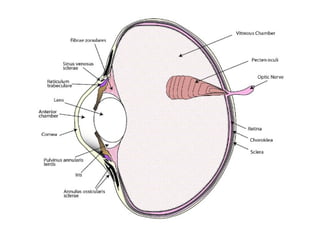
• The eye of the fowl is fairly large in relation to
the size of the bird.
• There is one eye on each side of the face and
only a 26° angle directly to the bird’s front has
binocular vision (Binocular vision occurs when
both eyes see an object.
• This is an important aid to distance perception).
• There are two main eyelids and a third very thin
membrane called the nictitating membrane,
which is located in the front corner of each eye.
• While the eye is open, this membranous “eyelid”
is only partially visible. It is capable of covering
the eyeball with a very fast movement to provide
protection to that organ.
• The fowl’s eye is very similar to the mammalian
eye, except that fowls have a higher threshold of
light intensity at which they see than do some
other birds and mammals.
• This makes them active during the day
(diurnal) rather than at night (nocturnal). At night
in nature, or in a free ranging situation, chickens
seek the protection of trees to sleep.
Ear
• The ears of the fowl are located on each side of the face
behind the eye. While the ear is very similar to that of
mammals, there are some differences. The fowl’s ear
does not have a pinna, ear flap or lobe and the three
bones of the mammalian middle ear have been
replaced by a single structure of bone and cartilage.
• The fowl ear consists of three main segments:
1. The outer ear
2. The middle ear separated from the outer by the
tympanic membrane (ear drum)
3. The inner ear which consists of the cochlea and the
three semicircular ducts
• The outer ear consists of the ear canal. Unlike the
mammalian ear there is no pinna to direct the
sound waves into the ear canal but it is covered
by a tuft of feathers to protect it from dust and
other potentially harmful materials.
• The middle ear is separated from the outer ear
by the tympanic membrane which is stretched
across the inner end of the ear canal.
• A rod of cartilage replaces the three bones of the
mammalian ear connecting the tympanic
membrane to the inner ear.
• The inner ear consists of the cochlea in which
special nerve endings are located that receive the
sound waves for transmission to the area of the
brain associated with hearing. Also located in the
inner ear are the semicircular ducts that are
associated with the maintenance of balance.
• A special duct connects the middle ear with the
roof of the mouth with the ducts from each ear
joining before entering the mouth. The function
of this duct is to regulate the air pressure in the
middle ear to that of the outer ear (the
environment) to prevent air pressure injury to the
tympanic membrane.
• The fowl hears by sound waves that enter the
outer ear canal and apply pressure in waves on
the tympanic membrane.
• The wave-like nature of sound causes the
tympanic membrane to vibrate.
• This vibration is transmitted by the columella to
the cochlea where special nerve endings
receive it and transmit it by the auditory nerve
to the brain where it is recognised as sound.
Olfactory organ
• This is the organ of smell.
• In fowls, it is not very highly developed and it
is believed that smell is of secondary
importance to the other senses in the location
and choice of food.
• The loss of a chicken’s ability to smell does not
seem to influence either its selection of food
or other behaviour.
Taste buds
• The taste buds in the fowl are located at the base of
the tongue and on the floor of the mouth. They
contain nerve endings from the glossopharyngeal
nerve.
• Small quantities of the chemicals of taste are
recognised by the taste buds and this information is
transferred to the appropriate receptors of the brain.
• Fowls have shown that the taste of materials in the
dry state is weaker than when in the liquid state and
they are more likely to refuse something on the basis
of taste when it is in the water than when it is in
their food
• This has important application when using
strong tasting medications to treat disease.
• An important feature is the sensitivity of the
fowl to the temperature of its drinking water.
• They are likely to reject water with a
temperature above approximately 33o
C and in
any case, the provision of cool water in hot
weather is an important strategy to help reduce
the effects of heat stress.
• They will drink water that has a very low
temperature even just above freezing point.

Nervous_System.pptx poultry physiology..

  • 1.
    The Nervous System Overviewof the Nervous System and Sensory Organs in Birds
  • 2.
    Introduction • The nervoussystem and the important sensory organs play a key role in the day-to-day functioning of an animal. • The nervous system integrates and controls the various functions of the body, while the sensory organs detect the various stimuli in the bird’s environment that it reacts to. • Functions are actively (voluntarily) or automatically (involuntarily) controlled:
  • 3.
    • Voluntary controloccurs where the animal, in its response to some activity or stimulus, has a choice in what actions (if any) it may take. It chooses to respond in one way or another, such as to move a particular part(s) of its anatomy. • The nerves that make up this voluntary part of the nervous system are called voluntary, or somatic, nerves.
  • 4.
    • Involuntary controlexists where the animal has no choice and the response to an activity or event occurs without the animal having any conscious control. Examples of the functioning of this part of the nervous system are the regulation of heart beat and circulation, digestion, and respiration. • It is obvious that the animal cannot afford to have to remember to keep its heart beating, its digestive system functioning or even just to breath. • The part of the nervous system that regulates such important functions is called the autonomic, or involuntary, nervous system.
  • 5.
    The Brain • Thebrain is located in the head and is well protected by the bones of the cranium. • The brain consists of a number of parts, which in turn consist of various special cells that have the ability to detect, recognise, remember and direct. • Thus the brain is the control centre for the many functions and activities of the many systems, organs and tissues that make up the bird’s body
  • 6.
    • The partsand major regions that make up the avian brain are as follows: • The forebrain which consists mainly of the cerebral hemispheres and the olfactory lobes. The hypothalamus and pituitary gland are located on the lower side of the forebrain. • The midbrain which mainly consists of the optic lobes. • The hindbrain which consists mainly of the cerebellum and the medulla oblongata
  • 7.
    • The olfactorylobes of the forebrain are the receptor areas for the olfactory nerves and are the centre for smell, while the optic lobes are the receptor areas for the optic nerve and are the centre for sight. The optic lobes of poultry are very large when compared with those of other species in relation to total brain size. This indicates that sight plays a major role in the normal behaviour of fowls.
  • 8.
    • The verysmall gland called the pituitary gland, or hypophysis, is associated with the hypothalamus. • This gland is of major importance as an endocrine gland, so much so that it is often called the “master” gland. • Many of its secretions regulate the operation of many other glands as well as the functions of the systems, organs and tissues of the bird.
  • 9.
    Spinal cord • Thespinal cord, as the name suggests, is a cord of nerve tissue that extends from the medulla oblongata of the brain along almost the full extremity of the vertebral column through the canal provided for that purpose. • The spinal cord and the brain constitute the Central Nervous System (often referred to as the CNS). Like the brain, the spinal cord is well protected, firstly by its spinal fluid and the sheath that encloses it, all of which is fully enclosed within the bones of the vertebral column.
  • 10.
    • The variousnerves that provide for the control of the various systems, organs and tissues of the body leave the spinal cord through appropriate openings located in the joints between the different vertebrae. • If the spinal cord should be broken, the connection between the brain and the parts that it controls will be broken and hence control of the effected parts will be lost. • For example, a break of the spinal cord in the lower back will result in the loss of control (paralysis) of the legs and other functions that take place below the break.
  • 11.
    Nerves • The nervecell or neuron consists of a cell body with one or more elongated projections extending from it. The cell body contains the nucleus. • The projections are part of the cytoplasm and are called axons if they are long and singular, or dendrites if they are short and branched. • Nerve endings or receptors at one end carry the sensors that respond to the stimuli, while on the opposite side, the stimulus is transferred ultimately to the brain. The nerve endings are the means by which stimuli are perceived or control exercised.
  • 12.
    • The remainderof the nerve cell acts as a message carrier to the brain . • These messages are in the form of very weak electrical currents. • There are a number of different types of nerve endings on nerve cells depending on the task they have to carry out, such as smell, hear, see or perceive touch. • The bird may then react to these stimuli and the response is directed via the nerves of a particular system, organ or tissue. • Those that send messages to the muscles to respond are often called “motor nerves” or “motor neurons”. • The types of nerve endings associated with touch include those specifically for pain, touch, cold, heat and pressure.
  • 13.
    The Sensory Organs •The sensory organs receive various stimuli from the bird’s environment. • Depending on the mode of action of the stimuli, special endings on the nerves will perceive that stimulus. The sensory organs include: • Eye(s) – for sight • Ear(s) – for hearing and balance • Olfactory organ – for smell • Taste buds – for taste • Skin – for touching
  • 14.
    Eyes • The eyeof the fowl is fairly large in relation to the size of the bird. • There is one eye on each side of the face and only a 26° angle directly to the bird’s front has binocular vision (Binocular vision occurs when both eyes see an object. • This is an important aid to distance perception). • There are two main eyelids and a third very thin membrane called the nictitating membrane, which is located in the front corner of each eye.
  • 15.
    • While theeye is open, this membranous “eyelid” is only partially visible. It is capable of covering the eyeball with a very fast movement to provide protection to that organ. • The fowl’s eye is very similar to the mammalian eye, except that fowls have a higher threshold of light intensity at which they see than do some other birds and mammals. • This makes them active during the day (diurnal) rather than at night (nocturnal). At night in nature, or in a free ranging situation, chickens seek the protection of trees to sleep.
  • 17.
    Ear • The earsof the fowl are located on each side of the face behind the eye. While the ear is very similar to that of mammals, there are some differences. The fowl’s ear does not have a pinna, ear flap or lobe and the three bones of the mammalian middle ear have been replaced by a single structure of bone and cartilage. • The fowl ear consists of three main segments: 1. The outer ear 2. The middle ear separated from the outer by the tympanic membrane (ear drum) 3. The inner ear which consists of the cochlea and the three semicircular ducts
  • 18.
    • The outerear consists of the ear canal. Unlike the mammalian ear there is no pinna to direct the sound waves into the ear canal but it is covered by a tuft of feathers to protect it from dust and other potentially harmful materials. • The middle ear is separated from the outer ear by the tympanic membrane which is stretched across the inner end of the ear canal. • A rod of cartilage replaces the three bones of the mammalian ear connecting the tympanic membrane to the inner ear.
  • 19.
    • The innerear consists of the cochlea in which special nerve endings are located that receive the sound waves for transmission to the area of the brain associated with hearing. Also located in the inner ear are the semicircular ducts that are associated with the maintenance of balance. • A special duct connects the middle ear with the roof of the mouth with the ducts from each ear joining before entering the mouth. The function of this duct is to regulate the air pressure in the middle ear to that of the outer ear (the environment) to prevent air pressure injury to the tympanic membrane.
  • 20.
    • The fowlhears by sound waves that enter the outer ear canal and apply pressure in waves on the tympanic membrane. • The wave-like nature of sound causes the tympanic membrane to vibrate. • This vibration is transmitted by the columella to the cochlea where special nerve endings receive it and transmit it by the auditory nerve to the brain where it is recognised as sound.
  • 21.
    Olfactory organ • Thisis the organ of smell. • In fowls, it is not very highly developed and it is believed that smell is of secondary importance to the other senses in the location and choice of food. • The loss of a chicken’s ability to smell does not seem to influence either its selection of food or other behaviour.
  • 22.
    Taste buds • Thetaste buds in the fowl are located at the base of the tongue and on the floor of the mouth. They contain nerve endings from the glossopharyngeal nerve. • Small quantities of the chemicals of taste are recognised by the taste buds and this information is transferred to the appropriate receptors of the brain. • Fowls have shown that the taste of materials in the dry state is weaker than when in the liquid state and they are more likely to refuse something on the basis of taste when it is in the water than when it is in their food
  • 23.
    • This hasimportant application when using strong tasting medications to treat disease. • An important feature is the sensitivity of the fowl to the temperature of its drinking water. • They are likely to reject water with a temperature above approximately 33o C and in any case, the provision of cool water in hot weather is an important strategy to help reduce the effects of heat stress. • They will drink water that has a very low temperature even just above freezing point.