ELECTRONICS CLUB
           IIT JODHPUR


  Digital electronics
Content...
1) Breadboard
2) Resistors and Capacitor
3) Digital
4) Clock Pulse
5) Logic Gates
6) 555 timer
7) Decade counter
8) Decoder
9) 7 segment LED display
10) Digital clock workshop
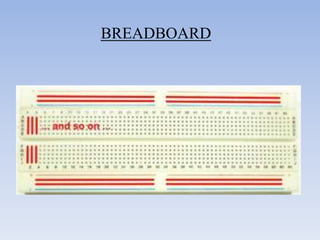
BREADBOARD
WHY BREADBOARD..??

• Bread + Board

•Strip of metal (copper usually) runs underneath the board
connecting the holes to one another.

•   Used to connect a circuit to reduce use of wires.
•   Easy to modify the circuit in case of errors.
•   No soldering required
•   Since it is not permanent, can be reused.
•   Not used for professional purposes
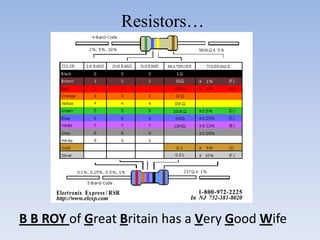
Resistors…


B B ROY of Great Britain has a Very Good Wife
Types of Resistors
FIXED RESISTORS:
1) Carbon Composition Resistor
2) Precesion wire wound
3) NIST Standards
4) Power wire wound resistor
5) Fuse resistors
6) Carbon film resistors
7) Metal Film resistors
8) Foil Resistors
9) Filament resistors
10) Power Film resistors

VARIABLE RESISTORS
1) Rheostat
2) Potentiometer
3) Preset
Capacitance..
• Capacitance   is the measure of capacitor to STORE
CHARGE.

•Units of capacitance Farads, pF, uF

• Q= C*V

• Charging and Discharging
• Also used for coupling
• Allows AC to pass through and blocks DC.
TYPES OF CAPACITOR
1) Electrolytic capacitor
2) Non- Electrolytic capacitor
3) Variable Capacitance (varicap)

Other types capacitor
 Ceramic Capacitor
 Mica Capacitor
 Mylar Capacitor
 Dielectric Capacitor
 Film Capacitor
 Radial Lead type capacitor
 Axial Lead type capacitor
 Tantalum Electrolytic Capacitor
LETS BEGIN THE MAIN
    SECTION…!!
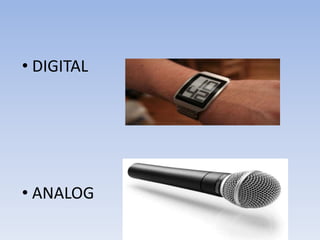
• DIGITAL


• ANALOG
DIGITAL ELECTRONICS
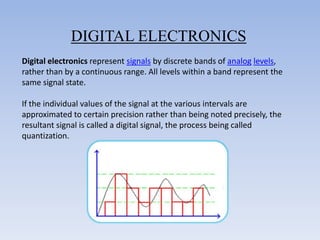
Digital electronics represent signals by discrete bands of analog levels,
rather than by a continuous range. All levels within a band represent the
same signal state.

If the individual values of the signal at the various intervals are
approximated to certain precision rather than being noted precisely, the
resultant signal is called a digital signal, the process being called
quantization.
DIGITAL ELECTRONICS

• Consists of only two states.
• Low state refers to 0 V.
• High state refers to 5 V.
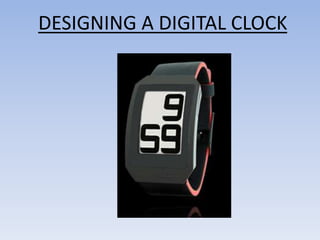
DESIGNING A DIGITAL CLOCK
APPLICATIONS
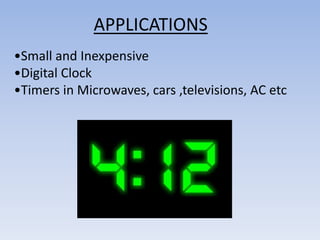
•Small and Inexpensive
•Digital Clock
•Timers in Microwaves, cars ,televisions, AC etc
What do we need?
•A display

•Something that counts – Counter

•Speed controlling of counter
HOW DO WE COUNT..???
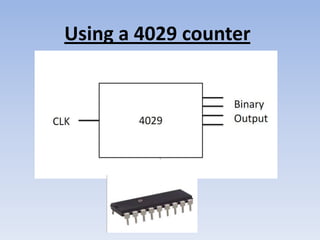
Using a 4029 counter
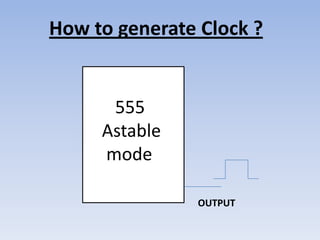
How to generate Clock ?


      555
     Astable
     mode

               OUTPUT
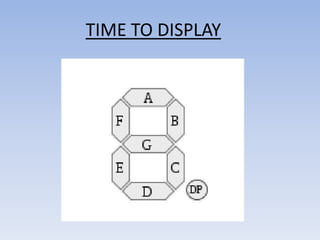
TIME TO DISPLAY
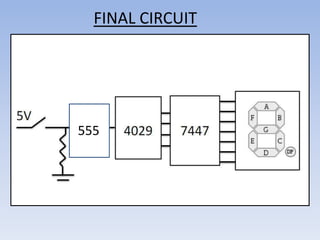
FINAL CIRCUIT


555
CLOCK
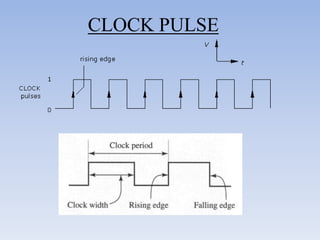
• In digital electronics, system clock is the basic timing
unit.

•System clock is a device which generates a periodic
train of clock pulses.

•The basic time interval during which logic operation
must be performed is called clock cycle time.

  clock cycle time = 1 period of clock waveform
CLOCK PULSE
INTEGRATED CIRCUITS (IC)
• Integrated circuit originally referred to a
miniaturized electronic circuit consisting of semiconductor
devices, as well as passive components bonded to a
substrate or circuit board.

• In short, a package of complex circuit to perform a task.

• The circuit in the IC may be even more tiny but it is
enclosed in bigger box for ease of handling.

• It can be considered to be a black box doing you work..!! :P
GATES
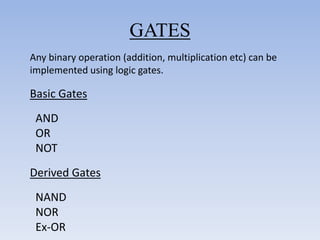
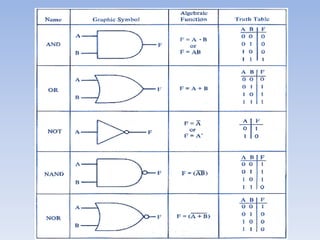
Any binary operation (addition, multiplication etc) can be
implemented using logic gates.

Basic Gates
 AND
 OR
 NOT
Derived Gates
 NAND
 NOR
 Ex-OR
VOLTAGE REGULATOR

• It produces fixed DC output voltage from variable DC.

•A device which converts pulsating DC to fixed DC at output.

• Mainly two types
   - Fixed
   - Variable
FIXED
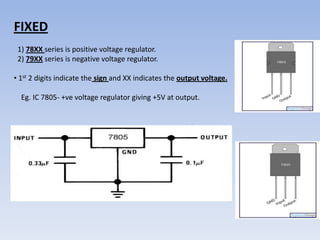
 1) 78XX series is positive voltage regulator.
 2) 79XX series is negative voltage regulator.

• 1st 2 digits indicate the sign and XX indicates the output voltage.

  Eg. IC 7805- +ve voltage regulator giving +5V at output.
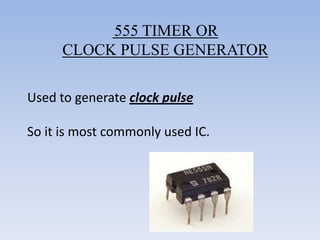
555 TIMER OR
     CLOCK PULSE GENERATOR

Used to generate clock pulse

So it is most commonly used IC.
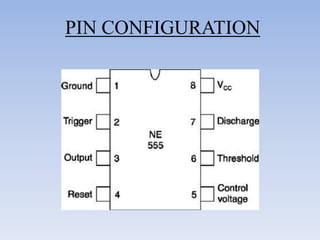
PIN CONFIGURATION
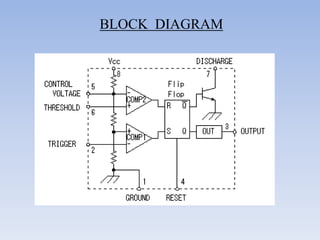
BLOCK DIAGRAM
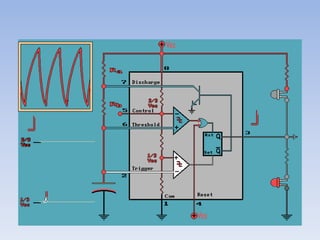
• Name 555 due to 3 5kohm resistor potential divider
circuit.

• Consists of 2 OPAMP used as comparator, 1 flip flop
and a discharge transistor.

•Comparator used to compare the voltage at input and
give output accordingly.

• Flip flop is bistable multivibrator (both states are
stable).
• Non-inverting terminal of Comp1 is at +Vcc/3 .
• When trigger input voltage (pin 2- inverting terminal) voltage is
slightly less than +Vcc/3  resets flip flop (R=1)  Q=0 
transistor cut off  Capacitor charges

• Inverting terminal of Comp2 is at +2Vcc/3.
• When threshold voltage (pin 6- non inverting terminal) voltage
slightly more than +2Vcc/3  sets flip flop (S=1)  Q= 1 
transistor saturates  Capacitor discharges.

• Pin 1  Ground
• Pin 8  +Vcc
• Pin 4  Reset (if gnd, prevents device from working)
• Pin 3  Output
APPLICATIONS
• Monostable Multivibrator
• Astable Multivibrator
• Voltage controlled divider
• Pulse position modulator (PPM)
• Pulse amplitude modulator (PAM)
• Frequency shift keying (FSK)
• Ramp generator
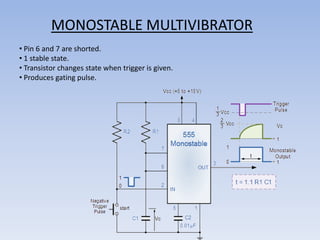
MONOSTABLE MULTIVIBRATOR
• Pin 6 and 7 are shorted.
• 1 stable state.
• Transistor changes state when trigger is given.
• Produces gating pulse.
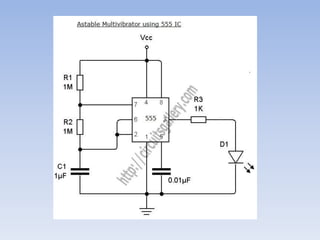
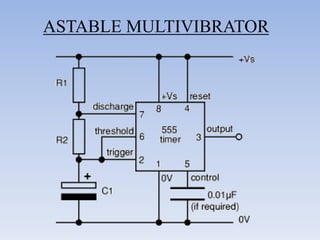
ASTABLE MULTIVIBRATOR
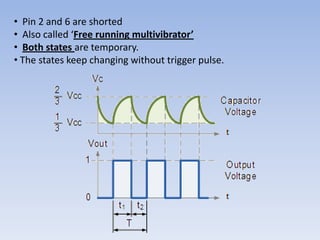
• Pin 2 and 6 are shorted
• Also called ‘Free running multivibrator’
• Both states are temporary.
• The states keep changing without trigger pulse.
• A duty cycle is the time that an entity spends in an active state as a fraction of the
total time under consideration.

  Duty cycle = (W/T)* 100
              = (R1+R2)/ (R1+2R2) *100
              = 0.693 (R1+ 2R2)*C

  Frequency,                   f=       1.44__
                                    [(R1+2R2)*C]

 T – time period
 W – Width
 R1, R2 – Resistances in ohms
 C – Capacitance in farads
 f – Frequency in hertz

The time period can be split into two parts: T = Tm + Ts
Mark time (output high): Tm = 0.7 (R1 + R2) C1
Space time (output low): Ts = 0.7 R2 C1
LETZ
  BEGIN
     FIRST
        STEP….!!

GENERATE CLOCK PULSE..!!
COUNTER
• It is a special kind of register, designed to count the number of clock
pulses arriving at its input.

Applications:
1) To count number of clock pulses.
2) To measure frequency.
3) For frequency division.
4) Measurement of time.
5) To generate a pulse of known width.
6) To generate timing pulses for horizontal and vertical generator in TV.
7) For direct counting of objects moving at a high speed.
8) In digital voltmeter etc.
MODULUS OF A COUNTER:
• The modulus of a counter is the total number of states through
which the counter can progress.
• The natural count is given by 2^n, where n is the number of flip
flops used.


TYPES OF COUNTER:
1) Ripple or asynchronous counter
2) Synchronous counter
3) Combination counter
DECADE COUNTER
• It has a modified count.

•By using 4 negative edge triggered J-K flip flops,
Mod- 16 counter can be constructed.

• By using feedback, 6 states are skipped making it
Mod-10 counter.
Up- Down Counter- IC 4029
• Synchronous counter so its output changes precisely
together with change in clock pulse.
• The count occurs as clock input becomes high (positive
edge triggered).
• Up/Down determines the direction of counting:

High  Up  4 bit binary 0 to 15
Low  Down  decade 0 to 9

• Preset and Carry in terminal is low for normal
operation.
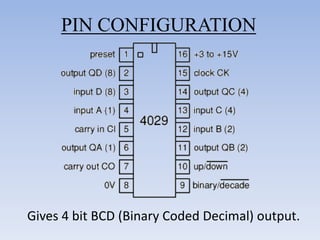
PIN CONFIGURATION


Gives 4 bit BCD (Binary Coded Decimal) output.
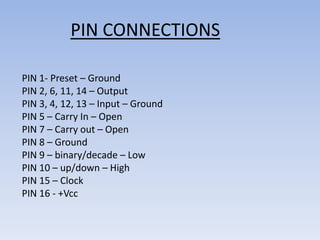
PIN CONNECTIONS

PIN 1- Preset – Ground
PIN 2, 6, 11, 14 – Output
PIN 3, 4, 12, 13 – Input – Ground
PIN 5 – Carry In – Open
PIN 7 – Carry out – Open
PIN 8 – Ground
PIN 9 – binary/decade – Low
PIN 10 – up/down – High
PIN 15 – Clock
PIN 16 - +Vcc
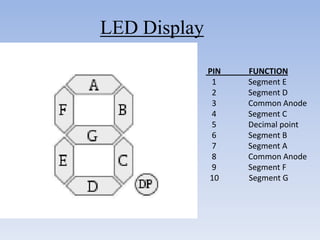
LED Display

              PIN   FUNCTION
               1    Segment E
               2    Segment D
               3    Common Anode
               4    Segment C
               5    Decimal point
               6    Segment B
               7    Segment A
               8    Common Anode
               9    Segment F
              10    Segment G
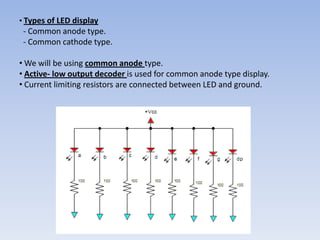
• Types of LED display
 - Common anode type.
 - Common cathode type.

• We will be using common anode type.
• Active- low output decoder is used for common anode type display.
• Current limiting resistors are connected between LED and ground.
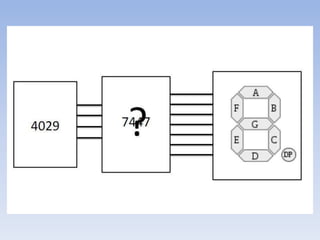
NOW WE CAN COUNT THE CLOCK
PULSE…

     BUT IN BCD CODE…

        WE NEED IN 7 Segment…

       WHAT NOW…???
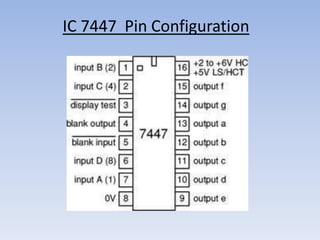
IC 7447 Pin Configuration
IC 7447
• IC 7447 is used to convert BCD to 7- segment code.
• It has 4 input lines and 7 output lines to drive 7 segment
display.
• The output terminals are connected to respective segment
(a through g) of the display.
• It is active- low output decoder.

• LT (Lamp Test) : Used to check the segments of LED display.
                   Connect LT to logic 0 to check.
                   Usually it is connected to logic 1.
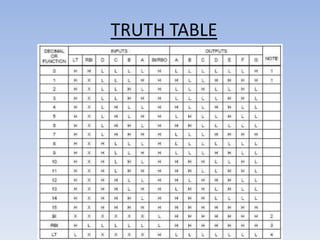
TRUTH TABLE
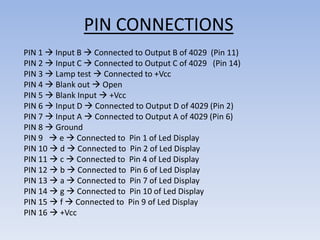
PIN CONNECTIONS
PIN 1  Input B  Connected to Output B of 4029 (Pin 11)
PIN 2  Input C  Connected to Output C of 4029 (Pin 14)
PIN 3  Lamp test  Connected to +Vcc
PIN 4  Blank out  Open
PIN 5  Blank Input  +Vcc
PIN 6  Input D  Connected to Output D of 4029 (Pin 2)
PIN 7  Input A  Connected to Output A of 4029 (Pin 6)
PIN 8  Ground
PIN 9  e  Connected to Pin 1 of Led Display
PIN 10  d  Connected to Pin 2 of Led Display
PIN 11  c  Connected to Pin 4 of Led Display
PIN 12  b  Connected to Pin 6 of Led Display
PIN 13  a  Connected to Pin 7 of Led Display
PIN 14  g  Connected to Pin 10 of Led Display
PIN 15  f  Connected to Pin 9 of Led Display
PIN 16  +Vcc
LETS COMPLETE THE
DIGITAL CLOCK…
          
THANK YOU…!!!

Digital clock workshop

  • 1.
    ELECTRONICS CLUB IIT JODHPUR Digital electronics
  • 2.
    Content... 1) Breadboard 2) Resistorsand Capacitor 3) Digital 4) Clock Pulse 5) Logic Gates 6) 555 timer 7) Decade counter 8) Decoder 9) 7 segment LED display 10) Digital clock workshop
  • 3.
  • 4.
    WHY BREADBOARD..?? • Bread+ Board •Strip of metal (copper usually) runs underneath the board connecting the holes to one another. • Used to connect a circuit to reduce use of wires. • Easy to modify the circuit in case of errors. • No soldering required • Since it is not permanent, can be reused. • Not used for professional purposes
  • 5.
    Resistors… B B ROYof Great Britain has a Very Good Wife
  • 6.
    Types of Resistors FIXEDRESISTORS: 1) Carbon Composition Resistor 2) Precesion wire wound 3) NIST Standards 4) Power wire wound resistor 5) Fuse resistors 6) Carbon film resistors 7) Metal Film resistors 8) Foil Resistors 9) Filament resistors 10) Power Film resistors VARIABLE RESISTORS 1) Rheostat 2) Potentiometer 3) Preset
  • 7.
    Capacitance.. • Capacitance is the measure of capacitor to STORE CHARGE. •Units of capacitance Farads, pF, uF • Q= C*V • Charging and Discharging • Also used for coupling • Allows AC to pass through and blocks DC.
  • 8.
    TYPES OF CAPACITOR 1)Electrolytic capacitor 2) Non- Electrolytic capacitor 3) Variable Capacitance (varicap) Other types capacitor  Ceramic Capacitor  Mica Capacitor  Mylar Capacitor  Dielectric Capacitor  Film Capacitor  Radial Lead type capacitor  Axial Lead type capacitor  Tantalum Electrolytic Capacitor
  • 9.
    LETS BEGIN THEMAIN SECTION…!!
  • 10.
  • 11.
    DIGITAL ELECTRONICS Digital electronicsrepresent signals by discrete bands of analog levels, rather than by a continuous range. All levels within a band represent the same signal state. If the individual values of the signal at the various intervals are approximated to certain precision rather than being noted precisely, the resultant signal is called a digital signal, the process being called quantization.
  • 12.
    DIGITAL ELECTRONICS • Consistsof only two states. • Low state refers to 0 V. • High state refers to 5 V.
  • 13.
  • 14.
    APPLICATIONS •Small and Inexpensive •DigitalClock •Timers in Microwaves, cars ,televisions, AC etc
  • 15.
    What do weneed? •A display •Something that counts – Counter •Speed controlling of counter
  • 16.
    HOW DO WECOUNT..???
  • 17.
    Using a 4029counter
  • 18.
    How to generateClock ? 555 Astable mode OUTPUT
  • 19.
  • 21.
  • 22.
    CLOCK • In digitalelectronics, system clock is the basic timing unit. •System clock is a device which generates a periodic train of clock pulses. •The basic time interval during which logic operation must be performed is called clock cycle time. clock cycle time = 1 period of clock waveform
  • 23.
  • 24.
    INTEGRATED CIRCUITS (IC) •Integrated circuit originally referred to a miniaturized electronic circuit consisting of semiconductor devices, as well as passive components bonded to a substrate or circuit board. • In short, a package of complex circuit to perform a task. • The circuit in the IC may be even more tiny but it is enclosed in bigger box for ease of handling. • It can be considered to be a black box doing you work..!! :P
  • 25.
    GATES Any binary operation(addition, multiplication etc) can be implemented using logic gates. Basic Gates AND OR NOT Derived Gates NAND NOR Ex-OR
  • 27.
    VOLTAGE REGULATOR • Itproduces fixed DC output voltage from variable DC. •A device which converts pulsating DC to fixed DC at output. • Mainly two types - Fixed - Variable
  • 28.
    FIXED 1) 78XXseries is positive voltage regulator. 2) 79XX series is negative voltage regulator. • 1st 2 digits indicate the sign and XX indicates the output voltage. Eg. IC 7805- +ve voltage regulator giving +5V at output.
  • 29.
    555 TIMER OR CLOCK PULSE GENERATOR Used to generate clock pulse So it is most commonly used IC.
  • 30.
  • 31.
  • 32.
    • Name 555due to 3 5kohm resistor potential divider circuit. • Consists of 2 OPAMP used as comparator, 1 flip flop and a discharge transistor. •Comparator used to compare the voltage at input and give output accordingly. • Flip flop is bistable multivibrator (both states are stable).
  • 33.
    • Non-inverting terminalof Comp1 is at +Vcc/3 . • When trigger input voltage (pin 2- inverting terminal) voltage is slightly less than +Vcc/3  resets flip flop (R=1)  Q=0  transistor cut off  Capacitor charges • Inverting terminal of Comp2 is at +2Vcc/3. • When threshold voltage (pin 6- non inverting terminal) voltage slightly more than +2Vcc/3  sets flip flop (S=1)  Q= 1  transistor saturates  Capacitor discharges. • Pin 1  Ground • Pin 8  +Vcc • Pin 4  Reset (if gnd, prevents device from working) • Pin 3  Output
  • 34.
    APPLICATIONS • Monostable Multivibrator •Astable Multivibrator • Voltage controlled divider • Pulse position modulator (PPM) • Pulse amplitude modulator (PAM) • Frequency shift keying (FSK) • Ramp generator
  • 35.
    MONOSTABLE MULTIVIBRATOR • Pin6 and 7 are shorted. • 1 stable state. • Transistor changes state when trigger is given. • Produces gating pulse.
  • 36.
  • 37.
    • Pin 2and 6 are shorted • Also called ‘Free running multivibrator’ • Both states are temporary. • The states keep changing without trigger pulse.
  • 39.
    • A dutycycle is the time that an entity spends in an active state as a fraction of the total time under consideration. Duty cycle = (W/T)* 100 = (R1+R2)/ (R1+2R2) *100 = 0.693 (R1+ 2R2)*C Frequency, f= 1.44__ [(R1+2R2)*C] T – time period W – Width R1, R2 – Resistances in ohms C – Capacitance in farads f – Frequency in hertz The time period can be split into two parts: T = Tm + Ts Mark time (output high): Tm = 0.7 (R1 + R2) C1 Space time (output low): Ts = 0.7 R2 C1
  • 40.
    LETZ BEGIN FIRST STEP….!! GENERATE CLOCK PULSE..!!
  • 42.
    COUNTER • It isa special kind of register, designed to count the number of clock pulses arriving at its input. Applications: 1) To count number of clock pulses. 2) To measure frequency. 3) For frequency division. 4) Measurement of time. 5) To generate a pulse of known width. 6) To generate timing pulses for horizontal and vertical generator in TV. 7) For direct counting of objects moving at a high speed. 8) In digital voltmeter etc.
  • 43.
    MODULUS OF ACOUNTER: • The modulus of a counter is the total number of states through which the counter can progress. • The natural count is given by 2^n, where n is the number of flip flops used. TYPES OF COUNTER: 1) Ripple or asynchronous counter 2) Synchronous counter 3) Combination counter
  • 44.
    DECADE COUNTER • Ithas a modified count. •By using 4 negative edge triggered J-K flip flops, Mod- 16 counter can be constructed. • By using feedback, 6 states are skipped making it Mod-10 counter.
  • 45.
    Up- Down Counter-IC 4029 • Synchronous counter so its output changes precisely together with change in clock pulse. • The count occurs as clock input becomes high (positive edge triggered). • Up/Down determines the direction of counting: High  Up  4 bit binary 0 to 15 Low  Down  decade 0 to 9 • Preset and Carry in terminal is low for normal operation.
  • 46.
    PIN CONFIGURATION Gives 4bit BCD (Binary Coded Decimal) output.
  • 47.
    PIN CONNECTIONS PIN 1-Preset – Ground PIN 2, 6, 11, 14 – Output PIN 3, 4, 12, 13 – Input – Ground PIN 5 – Carry In – Open PIN 7 – Carry out – Open PIN 8 – Ground PIN 9 – binary/decade – Low PIN 10 – up/down – High PIN 15 – Clock PIN 16 - +Vcc
  • 48.
    LED Display PIN FUNCTION 1 Segment E 2 Segment D 3 Common Anode 4 Segment C 5 Decimal point 6 Segment B 7 Segment A 8 Common Anode 9 Segment F 10 Segment G
  • 49.
    • Types ofLED display - Common anode type. - Common cathode type. • We will be using common anode type. • Active- low output decoder is used for common anode type display. • Current limiting resistors are connected between LED and ground.
  • 50.
    NOW WE CANCOUNT THE CLOCK PULSE… BUT IN BCD CODE… WE NEED IN 7 Segment… WHAT NOW…???
  • 51.
    IC 7447 PinConfiguration
  • 52.
    IC 7447 • IC7447 is used to convert BCD to 7- segment code. • It has 4 input lines and 7 output lines to drive 7 segment display. • The output terminals are connected to respective segment (a through g) of the display. • It is active- low output decoder. • LT (Lamp Test) : Used to check the segments of LED display. Connect LT to logic 0 to check. Usually it is connected to logic 1.
  • 53.
  • 54.
    PIN CONNECTIONS PIN 1 Input B  Connected to Output B of 4029 (Pin 11) PIN 2  Input C  Connected to Output C of 4029 (Pin 14) PIN 3  Lamp test  Connected to +Vcc PIN 4  Blank out  Open PIN 5  Blank Input  +Vcc PIN 6  Input D  Connected to Output D of 4029 (Pin 2) PIN 7  Input A  Connected to Output A of 4029 (Pin 6) PIN 8  Ground PIN 9  e  Connected to Pin 1 of Led Display PIN 10  d  Connected to Pin 2 of Led Display PIN 11  c  Connected to Pin 4 of Led Display PIN 12  b  Connected to Pin 6 of Led Display PIN 13  a  Connected to Pin 7 of Led Display PIN 14  g  Connected to Pin 10 of Led Display PIN 15  f  Connected to Pin 9 of Led Display PIN 16  +Vcc
  • 55.
  • 56.