Chapter 4
Bipolar Junction Transistors (BJTs)
Contents
• Bipolar Junction transistors
• Construction
• Circuit diagrams
• BJT biasing circuits
• Q-point
• BJT as a switch
• BJT as an Amplifier
• Transistor is a combination of two words i.e.
transfer and resistor. It is because a transistor
is basically a resistor that amplifies electrical
impulses as they are transferred through it
from its input to output terminal.
Transistor
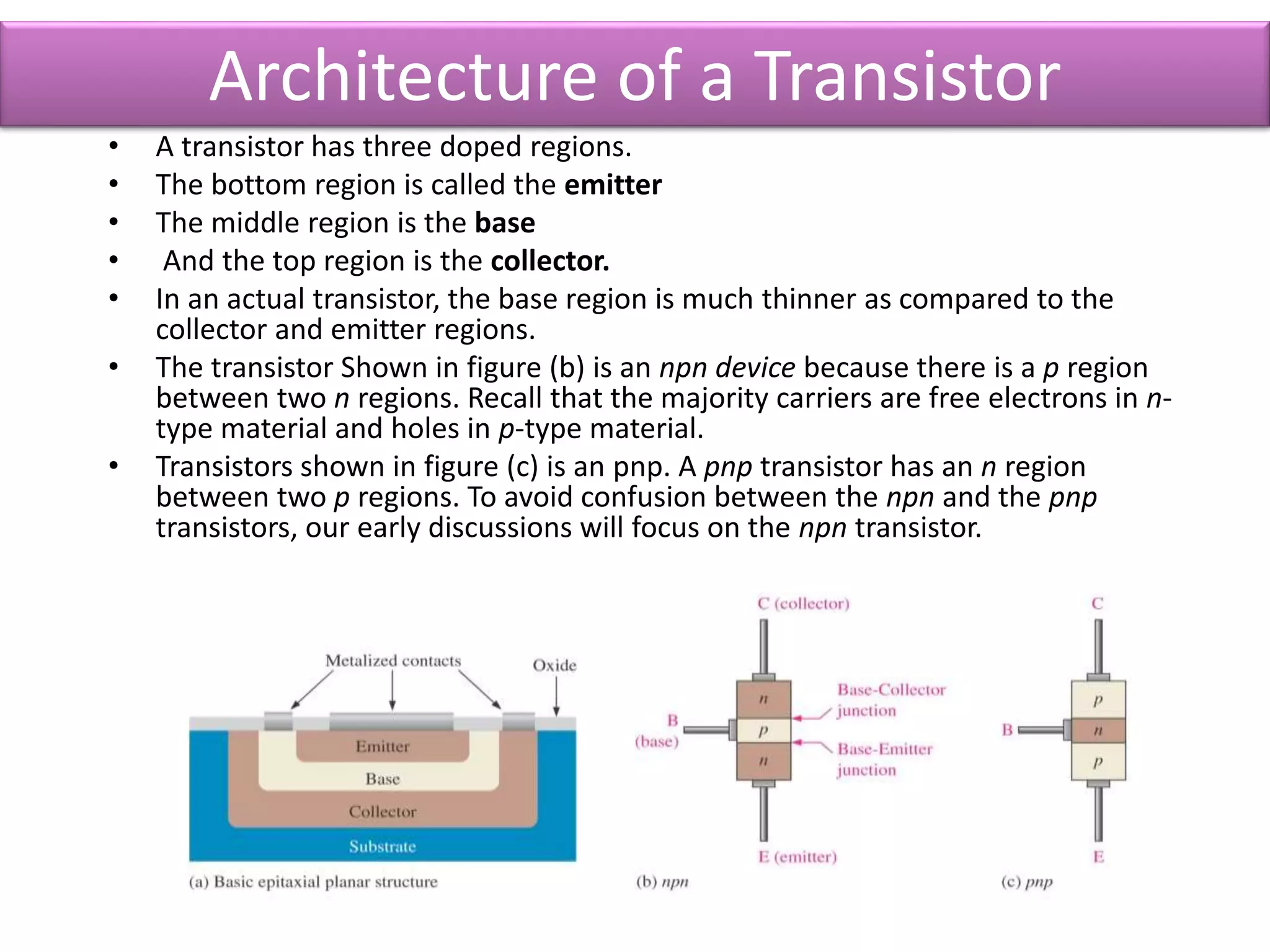
• A transistor has three doped regions.
• The bottom region is called the emitter
• The middle region is the base
• And the top region is the collector.
• In an actual transistor, the base region is much thinner as compared to the
collector and emitter regions.
• The transistor Shown in figure (b) is an npn device because there is a p region
between two n regions. Recall that the majority carriers are free electrons in n-
type material and holes in p-type material.
• Transistors shown in figure (c) is an pnp. A pnp transistor has an n region
between two p regions. To avoid confusion between the npn and the pnp
transistors, our early discussions will focus on the npn transistor.
Architecture of a Transistor
• There are two types of BJTs, the npn and pnp.
• The two junctions are termed the base-emitter junction and
the base-collector junction
• The term bipolar refers to the use of both holes and electrons
as charge carriers in the transistor structure
• In order for the transistor to operate properly, the two
junctions must have the correct dc bias voltages
– the base-emitter (BE) junction is forward biased(>=0.7V
for Si, >=0.3V for Ge)
– the base-collector (BC) junction is reverse biased
Architecture of a BJTs
• An integrated circuit (IC) consists of
transistors, resistors, diodes and capacitors
combined together in one wafer-thin chip of
silicon. This one wafer-thin chip is called a
microchip. The microchip is only a few
millimeters square with a thickness of 0.5 mm.
IC?
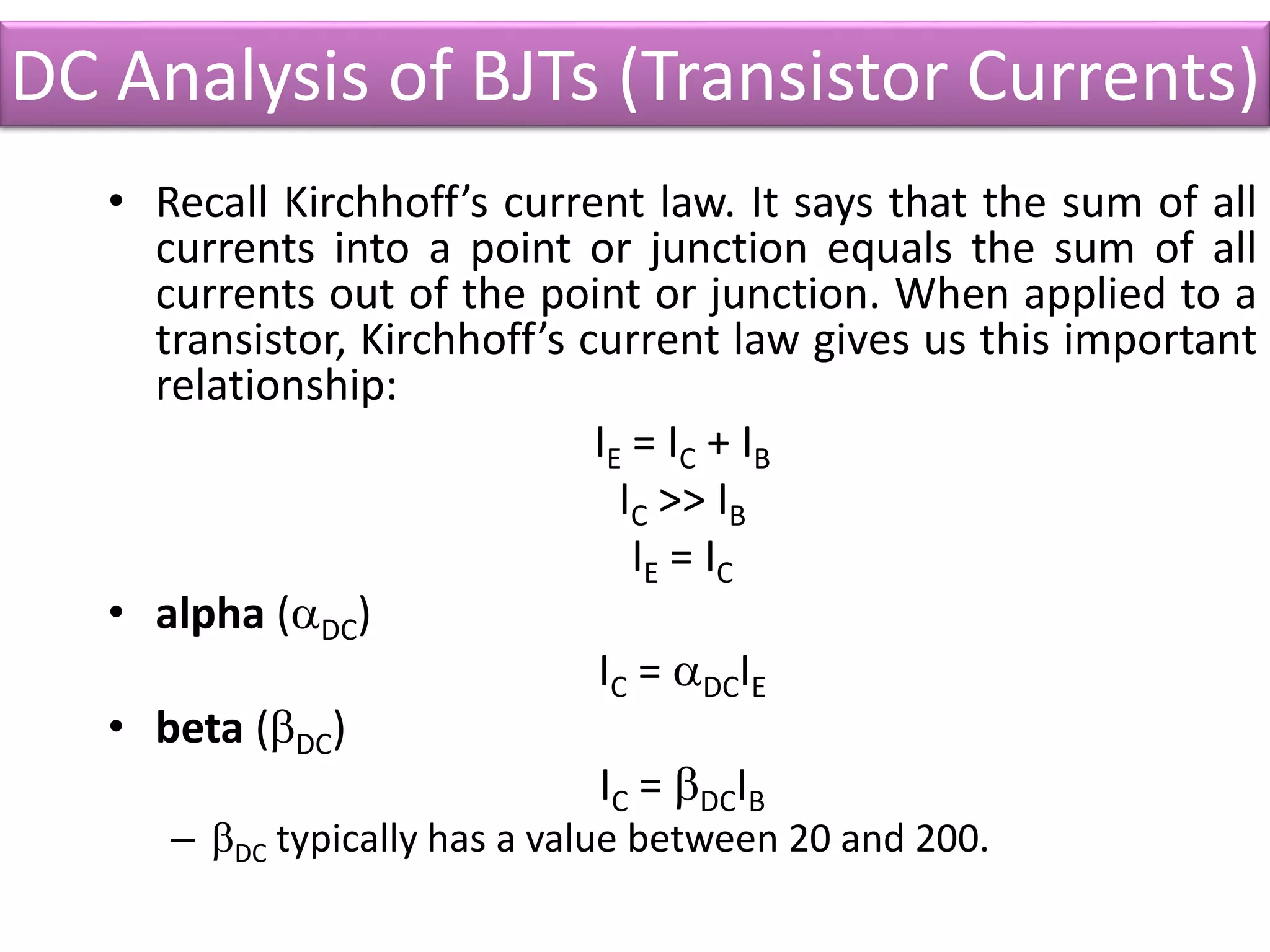
Emitter
It is the most heavily doped part of the transistor. Its
major function is to supply the majority charge carriers
to base.
Base
It is the smallest part of the transistor with 10.6mm
area and it is lightly doped.
Collector
It is physically the largest part of the transistor. Its
major function is to collect the charge carriers.
Parts of a Transistor
Diode equivalent of a Transistor
The minus signs represent free electrons.
The heavily doped emitter has the following job:
to emit or inject its free electrons into the base.
The lightly doped base also has a well-defined
purpose: to pass emitter-injected electrons on to
the collector.
The collector is so named because it collects or
gathers most of the electrons from the base.
The left source VBB of forward-biases the emitter
diode, and the right source VCC reverse-biases the
collector Diode.
VBB forward-biases the emitter diode, forcing the
free electrons in the emitter to enter the base.
The thin and lightly doped base gives almost all
these electrons enough time to diffuse into the
collector. These electrons flow through the
collector, through RC, and into the positive
terminal of the VCC voltage source.
Basic Circuit of a BJT
Symbolic Representation
• Recall Kirchhoff’s current law. It says that the sum of all
currents into a point or junction equals the sum of all
currents out of the point or junction. When applied to a
transistor, Kirchhoff’s current law gives us this important
relationship:
IE = IC + IB
IC >> IB
IE = IC
• alpha (DC)
IC = DCIE
• beta (DC)
IC = DCIB
– DC typically has a value between 20 and 200.
DC Analysis of BJTs (Transistor Currents)
Operation of BJTs
Examples
DC Analysis of a Transistor
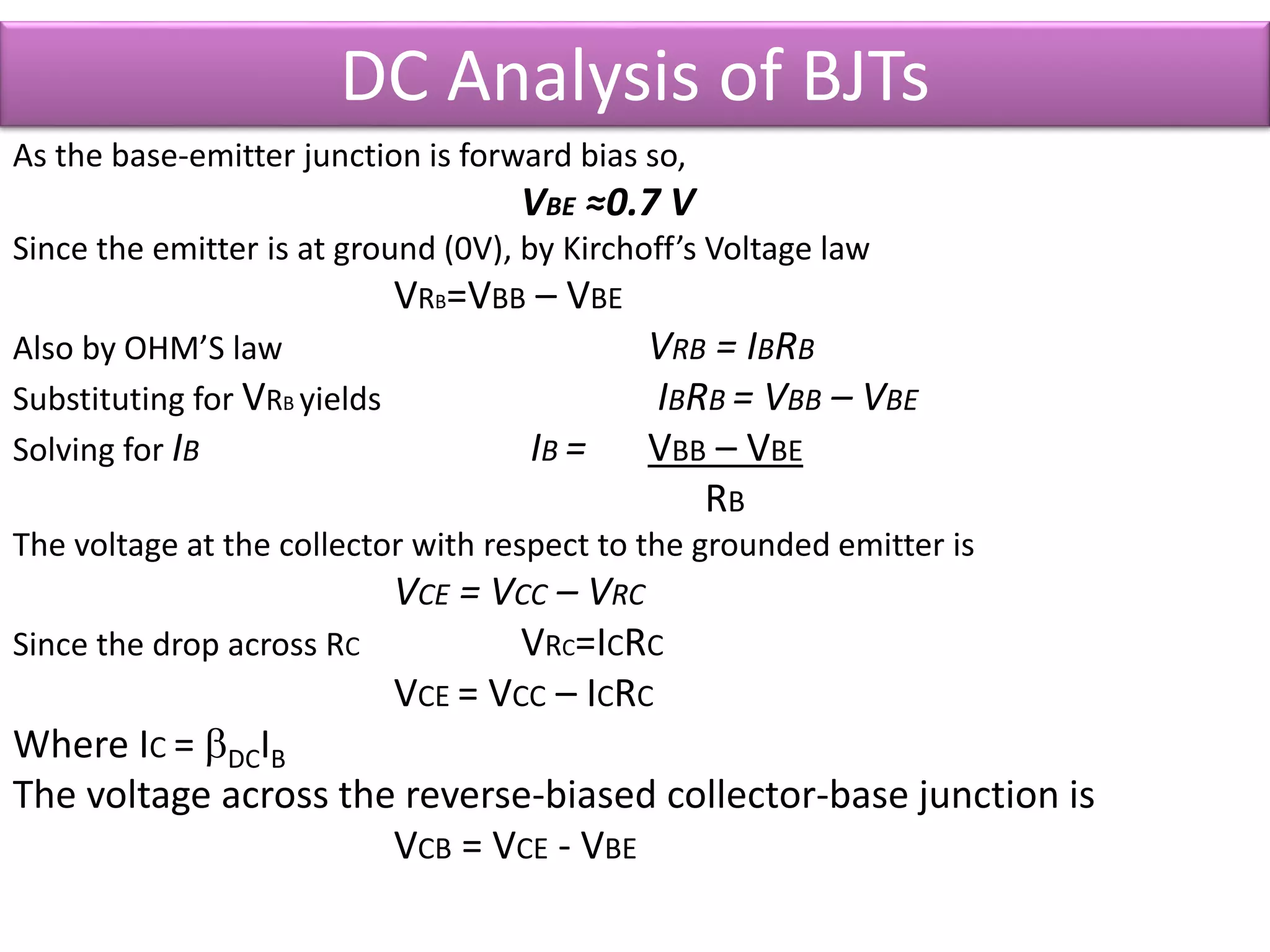
As the base-emitter junction is forward bias so,
VBE ≈0.7 V
Since the emitter is at ground (0V), by Kirchoff’s Voltage law
VRB=VBB – VBE
Also by OHM’S law VRB = IBRB
Substituting for VRB yields IBRB = VBB – VBE
Solving for IB IB = VBB – VBE
RB
The voltage at the collector with respect to the grounded emitter is
VCE = VCC – VRC
Since the drop across RC VRC=ICRC
VCE = VCC – ICRC
Where IC = DCIB
The voltage across the reverse-biased collector-base junction is
VCB = VCE - VBE
DC Analysis of BJTs
• DC voltages for the biased transistor:
• Collector voltage
VC = VCC - ICRC
• Base voltage
VB = VE + VBE
– for silicon transistors, VBE = 0.7 V
– for germanium transistors, VBE = 0.3 V
DC Analysis of BJTs
Example
• The base current, IB, is established by the base bias.
• The point at which the base current curve intersects the
dc load line is the quiescent or Q-point for the circuit.
Q-Point
• The voltage divider
biasing is widely used
• Input resistance is:
RIN  DCRE
• The base voltage is
approximately:
VB  VCCR2/(R1+R2)
DC Analysis of BJTs
• When used as an electronic switch, a transistor
normally is operated alternately in cutoff and
saturation.
– A transistor is in cutoff when the base-emitter junction is
not forward-biased. VCE is approximately equal to VCC
– When the base-emitter junction is forward-biased and
there is enough base current to produce a maximum
collector current, the transistor is saturated.
BJTs as a Switch
BJTs as a Switch
BJT Operating Regions
Operation
Region
IB or VCE
Char.
BC and BE
Junctions
Mode
Cutoff IB = Very
small
Reverse &
Reverse
Open
Switch
Saturation VCE = Small Forward &
Forward
Closed
Switch
Active
Linear
VCE =
Moderate
Reverse &
Forward
Linear
Amplifier
Break-
down
VCE =
Large
Beyond
Limits
Overload
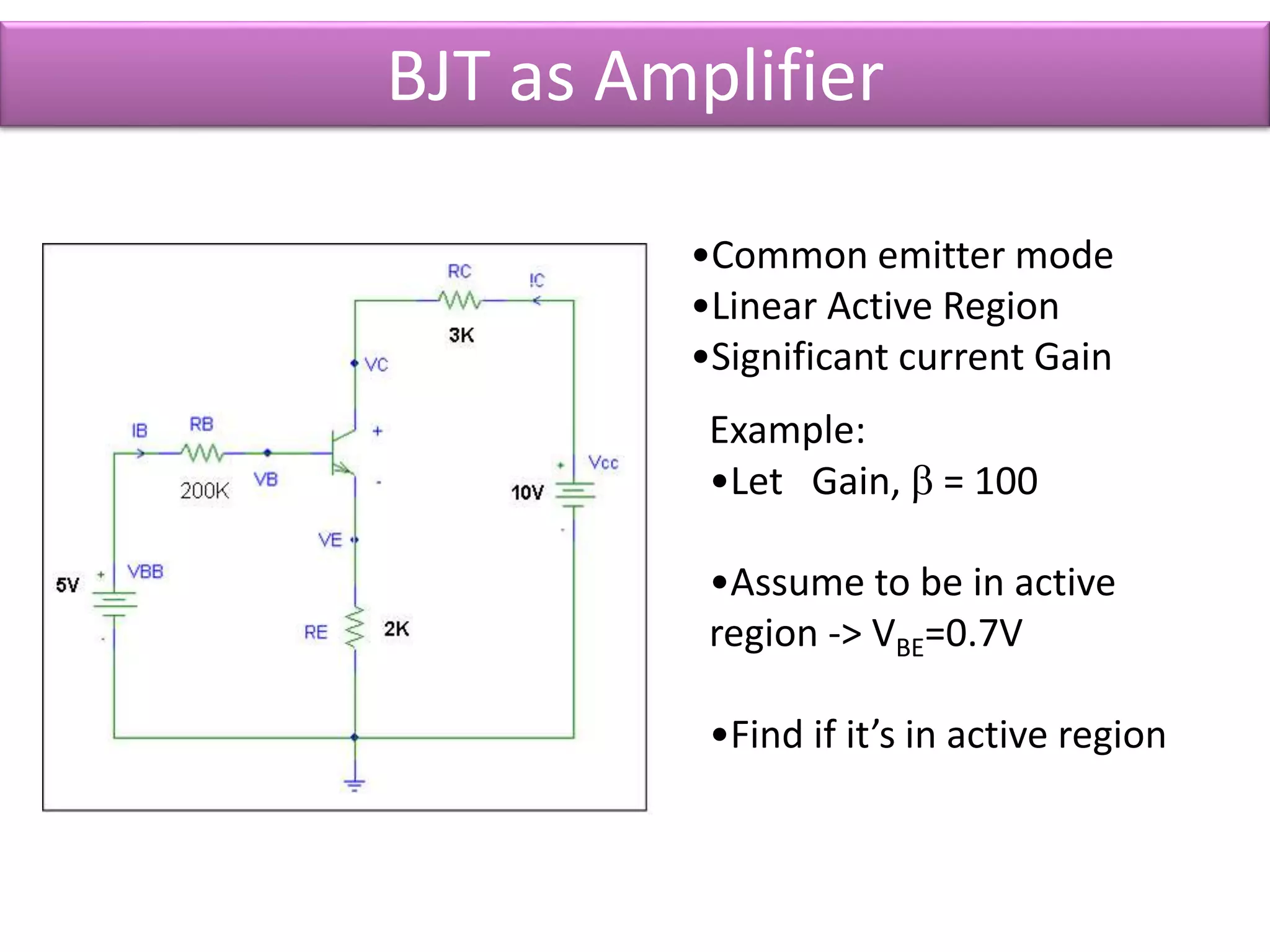
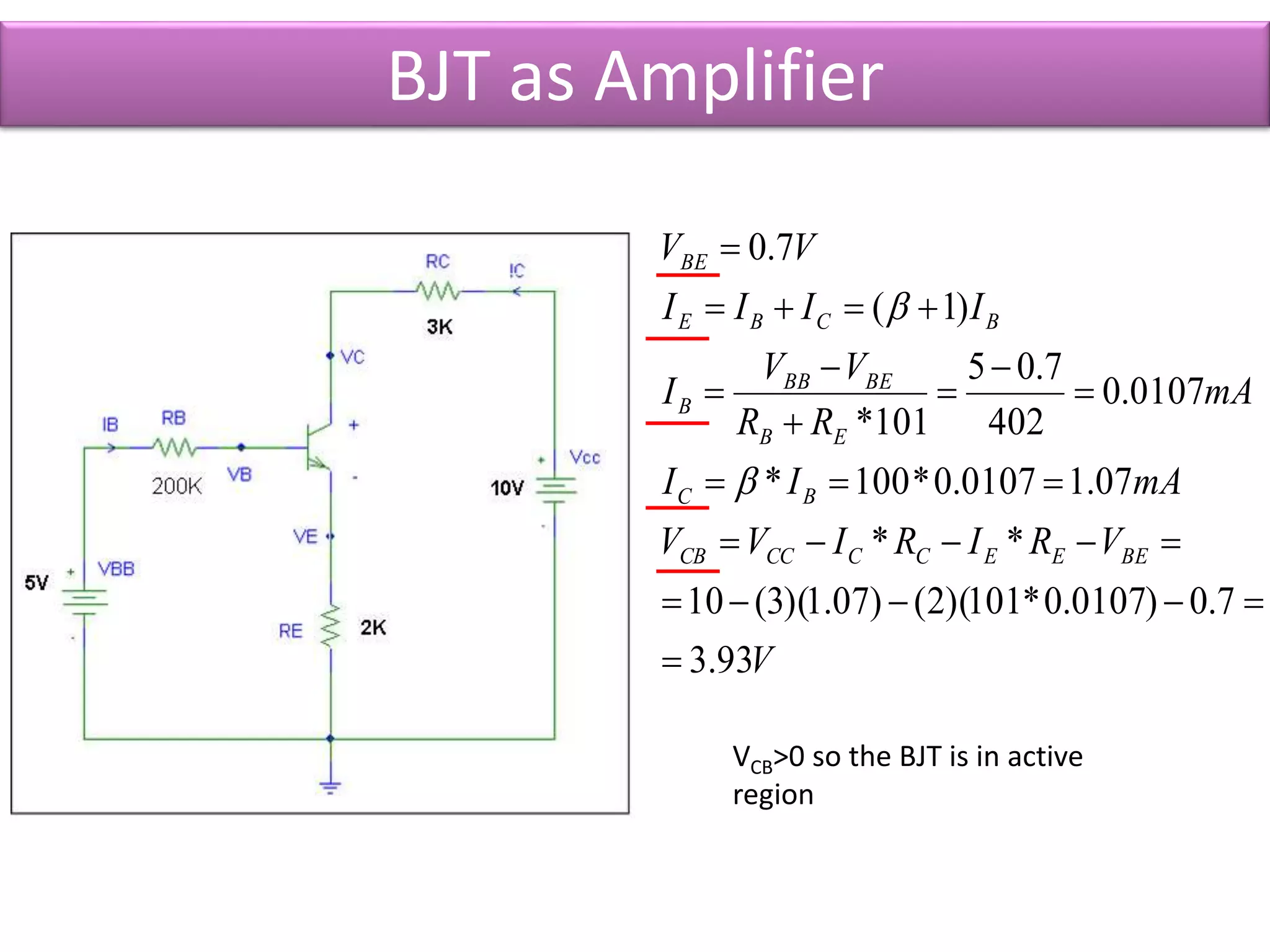
•Common emitter mode
•Linear Active Region
•Significant current Gain
Example:
•Let Gain,  = 100
•Assume to be in active
region -> VBE=0.7V
•Find if it’s in active region
BJT as Amplifier
V
VRIRIVV
mAII
mA
RR
VV
I
IIII
VV
BEEECCCCCB
BC
EB
BEBB
B
BCBE
BE
93.3
7.0)0107.0*101)(2()07.1)(3(10
**
07.10107.0*100*
0107.0
402
7.05
101*
)1(
7.0














VCB>0 so the BJT is in active
region
BJT as Amplifier

Bipolar junction Transistor

  • 1.
    Chapter 4 Bipolar JunctionTransistors (BJTs)
  • 2.
    Contents • Bipolar Junctiontransistors • Construction • Circuit diagrams • BJT biasing circuits • Q-point • BJT as a switch • BJT as an Amplifier
  • 3.
    • Transistor isa combination of two words i.e. transfer and resistor. It is because a transistor is basically a resistor that amplifies electrical impulses as they are transferred through it from its input to output terminal. Transistor
  • 4.
    • A transistorhas three doped regions. • The bottom region is called the emitter • The middle region is the base • And the top region is the collector. • In an actual transistor, the base region is much thinner as compared to the collector and emitter regions. • The transistor Shown in figure (b) is an npn device because there is a p region between two n regions. Recall that the majority carriers are free electrons in n- type material and holes in p-type material. • Transistors shown in figure (c) is an pnp. A pnp transistor has an n region between two p regions. To avoid confusion between the npn and the pnp transistors, our early discussions will focus on the npn transistor. Architecture of a Transistor
  • 5.
    • There aretwo types of BJTs, the npn and pnp. • The two junctions are termed the base-emitter junction and the base-collector junction • The term bipolar refers to the use of both holes and electrons as charge carriers in the transistor structure • In order for the transistor to operate properly, the two junctions must have the correct dc bias voltages – the base-emitter (BE) junction is forward biased(>=0.7V for Si, >=0.3V for Ge) – the base-collector (BC) junction is reverse biased Architecture of a BJTs
  • 6.
    • An integratedcircuit (IC) consists of transistors, resistors, diodes and capacitors combined together in one wafer-thin chip of silicon. This one wafer-thin chip is called a microchip. The microchip is only a few millimeters square with a thickness of 0.5 mm. IC?
  • 7.
    Emitter It is themost heavily doped part of the transistor. Its major function is to supply the majority charge carriers to base. Base It is the smallest part of the transistor with 10.6mm area and it is lightly doped. Collector It is physically the largest part of the transistor. Its major function is to collect the charge carriers. Parts of a Transistor
  • 8.
    Diode equivalent ofa Transistor
  • 9.
    The minus signsrepresent free electrons. The heavily doped emitter has the following job: to emit or inject its free electrons into the base. The lightly doped base also has a well-defined purpose: to pass emitter-injected electrons on to the collector. The collector is so named because it collects or gathers most of the electrons from the base. The left source VBB of forward-biases the emitter diode, and the right source VCC reverse-biases the collector Diode. VBB forward-biases the emitter diode, forcing the free electrons in the emitter to enter the base. The thin and lightly doped base gives almost all these electrons enough time to diffuse into the collector. These electrons flow through the collector, through RC, and into the positive terminal of the VCC voltage source. Basic Circuit of a BJT
  • 10.
  • 11.
    • Recall Kirchhoff’scurrent law. It says that the sum of all currents into a point or junction equals the sum of all currents out of the point or junction. When applied to a transistor, Kirchhoff’s current law gives us this important relationship: IE = IC + IB IC >> IB IE = IC • alpha (DC) IC = DCIE • beta (DC) IC = DCIB – DC typically has a value between 20 and 200. DC Analysis of BJTs (Transistor Currents)
  • 12.
  • 13.
  • 14.
    DC Analysis ofa Transistor As the base-emitter junction is forward bias so, VBE ≈0.7 V Since the emitter is at ground (0V), by Kirchoff’s Voltage law VRB=VBB – VBE Also by OHM’S law VRB = IBRB Substituting for VRB yields IBRB = VBB – VBE Solving for IB IB = VBB – VBE RB The voltage at the collector with respect to the grounded emitter is VCE = VCC – VRC Since the drop across RC VRC=ICRC VCE = VCC – ICRC Where IC = DCIB The voltage across the reverse-biased collector-base junction is VCB = VCE - VBE DC Analysis of BJTs
  • 15.
    • DC voltagesfor the biased transistor: • Collector voltage VC = VCC - ICRC • Base voltage VB = VE + VBE – for silicon transistors, VBE = 0.7 V – for germanium transistors, VBE = 0.3 V DC Analysis of BJTs
  • 16.
  • 17.
    • The basecurrent, IB, is established by the base bias. • The point at which the base current curve intersects the dc load line is the quiescent or Q-point for the circuit. Q-Point
  • 18.
    • The voltagedivider biasing is widely used • Input resistance is: RIN  DCRE • The base voltage is approximately: VB  VCCR2/(R1+R2) DC Analysis of BJTs
  • 19.
    • When usedas an electronic switch, a transistor normally is operated alternately in cutoff and saturation. – A transistor is in cutoff when the base-emitter junction is not forward-biased. VCE is approximately equal to VCC – When the base-emitter junction is forward-biased and there is enough base current to produce a maximum collector current, the transistor is saturated. BJTs as a Switch
  • 20.
    BJTs as aSwitch
  • 21.
    BJT Operating Regions Operation Region IBor VCE Char. BC and BE Junctions Mode Cutoff IB = Very small Reverse & Reverse Open Switch Saturation VCE = Small Forward & Forward Closed Switch Active Linear VCE = Moderate Reverse & Forward Linear Amplifier Break- down VCE = Large Beyond Limits Overload
  • 22.
    •Common emitter mode •LinearActive Region •Significant current Gain Example: •Let Gain,  = 100 •Assume to be in active region -> VBE=0.7V •Find if it’s in active region BJT as Amplifier
  • 23.