Kristin Ackerson, Virginia Tech EE
Spring 2002
B
C
E
The Bipolar Junction Transistor_______________________________slide 3
BJT Relationships – Equations________________________________slide 4
DC  and DC  _____________________________________________slides 5
BJT Example_______________________________________________slide 6
BJT Transconductance Curve_________________________________slide 7
Modes of Operation_________________________________________slide 8
Three Types of BJT Biasing__________________________________slide 9
Common Base______________________slide 10-11
Common Emitter_____________________slide 12
Common Collector___________________slide 13
Eber-Moll Model__________________________________________slides 14-15
Small Signal BJT Equivalent Circuit__________________________slides 16
The Early Effect___________________________________________slide 17
Early Effect Example_______________________________________slide 18
Breakdown Voltage________________________________________slide 19
Sources__________________________________________________slide 20
Table of Contents
Kristin Ackerson, Virginia Tech EE
Spring 2002
The BJT – Bipolar Junction Transistor
Kristin Ackerson, Virginia Tech EE
Spring 2002
 Note: It will be very helpful to go through the Analog Electronics
Diodes Tutorial to get information on doping, n-type and p-type materials.
The Two Types of BJT Transistors:
npn pnp
n p nE
B
C p n pE
B
C
Cross Section Cross Section
B
C
E
Schematic
Symbol
B
C
E
Schematic
Symbol
• Collector doping is usually ~ 106
• Base doping is slightly higher ~ 107 – 108
• Emitter doping is much higher ~ 1015
BJT Relationships - Equations
Kristin Ackerson, Virginia Tech EE
Spring 2002
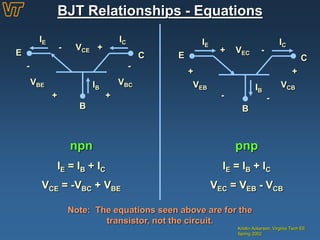
B
CE
IE IC
IB
-
+
VBE VBC
+
-
+- VCE
B
CE
IE IC
IB
-
+
VEB VCB
+
-
+ -VEC
npn
IE = IB + IC
VCE = -VBC + VBE
pnp
IE = IB + IC
VEC = VEB - VCB
Note: The equations seen above are for the
transistor, not the circuit.
DC  and DC 
Kristin Ackerson, Virginia Tech EE
Spring 2002
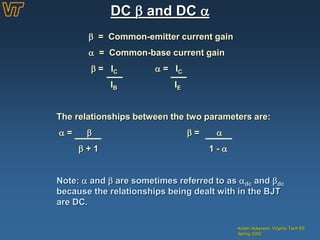
 = Common-emitter current gain
 = Common-base current gain
 = IC  = IC
IB IE
The relationships between the two parameters are:
 =   = 
 + 1 1 - 
Note:  and  are sometimes referred to as dc and dc
because the relationships being dealt with in the BJT
are DC.
BJT Example
Kristin Ackerson, Virginia Tech EE
Spring 2002
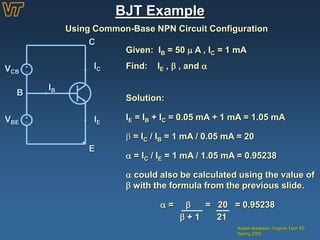
Using Common-Base NPN Circuit Configuration
+
_
+
_
Given: IB = 50  A , IC = 1 mA
Find: IE ,  , and 
Solution:
IE = IB + IC = 0.05 mA + 1 mA = 1.05 mA
 = IC / IB = 1 mA / 0.05 mA = 20
 = IC / IE = 1 mA / 1.05 mA = 0.95238
 could also be calculated using the value of
 with the formula from the previous slide.
 =  = 20 = 0.95238
 + 1 21
IC
IE
IB
VCB
VBE
E
C
B
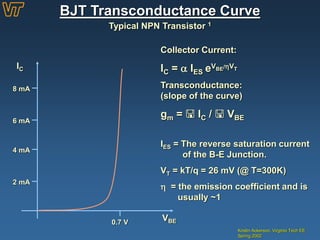
BJT Transconductance Curve
Kristin Ackerson, Virginia Tech EE
Spring 2002
Typical NPN Transistor 1
VBE
IC
2 mA
4 mA
6 mA
8 mA
0.7 V
Collector Current:
IC =  IES eVBE/VT
Transconductance:
(slope of the curve)
gm =  IC /  VBE
IES = The reverse saturation current
of the B-E Junction.
VT = kT/q = 26 mV (@ T=300K)
 = the emission coefficient and is
usually ~1
Modes of Operation
Kristin Ackerson, Virginia Tech EE
Spring 2002
• Most important mode of operation
• Central to amplifier operation
• The region where current curves are practically flat
Active:
Saturation: • Barrier potential of the junctions cancel each other out
causing a virtual short
Cutoff: • Current reduced to zero
• Ideal transistor behaves like an open switch
* Note: There is also a mode of operation
called inverse active, but it is rarely used.
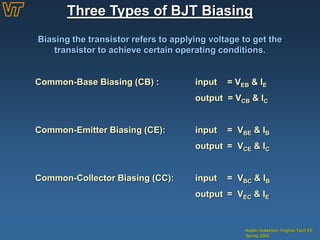
Three Types of BJT Biasing
Kristin Ackerson, Virginia Tech EE
Spring 2002
Biasing the transistor refers to applying voltage to get the
transistor to achieve certain operating conditions.
Common-Base Biasing (CB) : input = VEB & IE
output = VCB & IC
Common-Emitter Biasing (CE): input = VBE & IB
output = VCE & IC
Common-Collector Biasing (CC): input = VBC & IB
output = VEC & IE
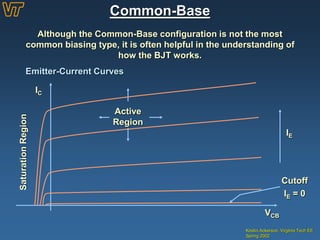
Common-Base
Kristin Ackerson, Virginia Tech EE
Spring 2002
Although the Common-Base configuration is not the most
common biasing type, it is often helpful in the understanding of
how the BJT works.
Emitter-Current Curves
SaturationRegion
IE
IC
VCB
Active
Region
Cutoff
IE = 0
Common-Base
Kristin Ackerson, Virginia Tech EE
Spring 2002
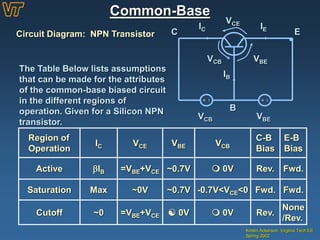
Circuit Diagram: NPN Transistor
+
_
+
_
IC IE
IB
VCB VBE
EC
B
VCE
VBEVCB
Region of
Operation
IC VCE VBE VCB
C-B
Bias
E-B
Bias
Active IB =VBE+VCE ~0.7V  0V Rev. Fwd.
Saturation Max ~0V ~0.7V -0.7V<VCE<0 Fwd. Fwd.
Cutoff ~0 =VBE+VCE  0V  0V Rev.
None
/Rev.
The Table Below lists assumptions
that can be made for the attributes
of the common-base biased circuit
in the different regions of
operation. Given for a Silicon NPN
transistor.
Common-Emitter
Kristin Ackerson, Virginia Tech EE
Spring 2002
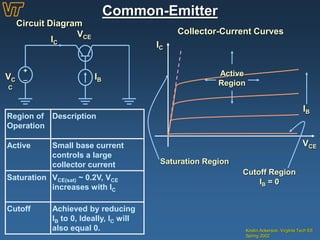
Circuit Diagram
+
_VC
C
IC
VCE
IB
Collector-Current Curves
VCE
IC
Active
Region
IB
Saturation Region
Cutoff Region
IB = 0
Region of
Operation
Description
Active Small base current
controls a large
collector current
Saturation VCE(sat) ~ 0.2V, VCE
increases with IC
Cutoff Achieved by reducing
IB to 0, Ideally, IC will
also equal 0.
Common-Collector
Kristin Ackerson, Virginia Tech EE
Spring 2002
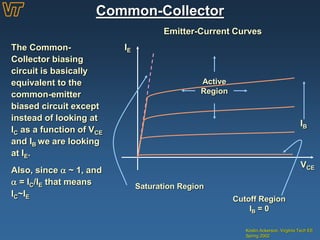
Emitter-Current Curves
VCE
IE
Active
Region
IB
Saturation Region
Cutoff Region
IB = 0
The Common-
Collector biasing
circuit is basically
equivalent to the
common-emitter
biased circuit except
instead of looking at
IC as a function of VCE
and IB we are looking
at IE.
Also, since  ~ 1, and
 = IC/IE that means
IC~IE
Eber-Moll BJT Model
Kristin Ackerson, Virginia Tech EE
Spring 2002
The Eber-Moll Model for BJTs is fairly complex, but it is
valid in all regions of BJT operation. The circuit diagram
below shows all the components of the Eber-Moll Model:
E C
B
IR
IF
IE IC
IB
RIERIC
Kristin Ackerson, Virginia Tech EE
Spring 2002
Eber-Moll BJT Model
R = Common-base current gain (in forward active mode)
F = Common-base current gain (in inverse active mode)
IES = Reverse-Saturation Current of B-E Junction
ICS = Reverse-Saturation Current of B-C Junction
IC = FIF – IR IB = IE - IC
IE = IF - RIR
IF = IES [exp(qVBE/kT) – 1] IR = IC [exp(qVBC/kT) – 1]
 If IES & ICS are not given, they can be determined using various
BJT parameters.
Kristin Ackerson, Virginia Tech EE
Spring 2002
Small Signal BJT Equivalent Circuit
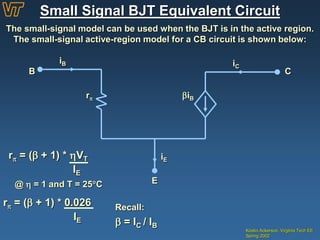
The small-signal model can be used when the BJT is in the active region.
The small-signal active-region model for a CB circuit is shown below:
iBr
iE
iC
iB
B C
E
r = ( + 1) * VT
IE
@  = 1 and T = 25C
r = ( + 1) * 0.026
IE
Recall:
 = IC / IB
The Early Effect (Early Voltage)
Kristin Ackerson, Virginia Tech EE
Spring 2002
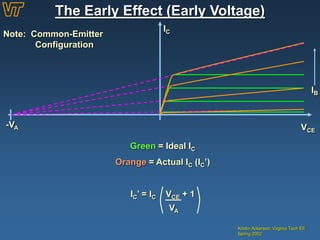
VCE
IC
Note: Common-Emitter
Configuration
-VA
IB
Green = Ideal IC
Orange = Actual IC (IC’)
IC’ = IC VCE + 1
VA
Kristin Ackerson, Virginia Tech EE
Spring 2002
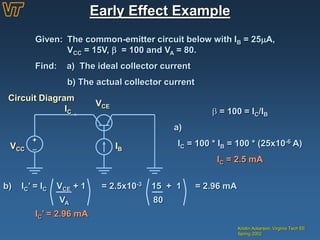
Early Effect Example
Given: The common-emitter circuit below with IB = 25A,
VCC = 15V,  = 100 and VA = 80.
Find: a) The ideal collector current
b) The actual collector current
Circuit Diagram
+
_VCC
IC
VCE
IB
 = 100 = IC/IB
a)
IC = 100 * IB = 100 * (25x10-6 A)
IC = 2.5 mA
b) IC’ = IC VCE + 1 = 2.5x10⁻³ 15 + 1 = 2.96 mA
VA 80
IC’ = 2.96 mA
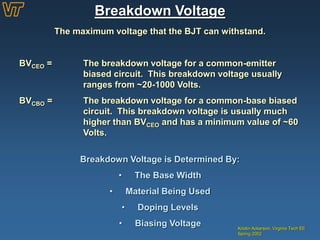
Breakdown Voltage
Kristin Ackerson, Virginia Tech EE
Spring 2002
The maximum voltage that the BJT can withstand.
BVCEO = The breakdown voltage for a common-emitter
biased circuit. This breakdown voltage usually
ranges from ~20-1000 Volts.
BVCBO = The breakdown voltage for a common-base biased
circuit. This breakdown voltage is usually much
higher than BVCEO and has a minimum value of ~60
Volts.
Breakdown Voltage is Determined By:
• The Base Width
• Material Being Used
• Doping Levels
• Biasing Voltage
Sources
Dailey, Denton. Electronic Devices and Circuits, Discrete and Integrated. Prentice Hall, New
Jersey: 2001. (pp 84-153)
1 Figure 3.7, Transconductance curve for a typical npn transistor, pg 90.
Liou, J.J. and Yuan, J.S. Semiconductor Device Physics and Simulation. Plenum Press,
New York: 1998.
Neamen, Donald. Semiconductor Physics & Devices. Basic Principles. McGraw-Hill,
Boston: 1997. (pp 351-409)
Web Sites
http://www.infoplease.com/ce6/sci/A0861609.html
Kristin Ackerson, Virginia Tech EE
Spring 2002

Bjts

  • 1.
    Kristin Ackerson, VirginiaTech EE Spring 2002 B C E
  • 2.
    The Bipolar JunctionTransistor_______________________________slide 3 BJT Relationships – Equations________________________________slide 4 DC  and DC  _____________________________________________slides 5 BJT Example_______________________________________________slide 6 BJT Transconductance Curve_________________________________slide 7 Modes of Operation_________________________________________slide 8 Three Types of BJT Biasing__________________________________slide 9 Common Base______________________slide 10-11 Common Emitter_____________________slide 12 Common Collector___________________slide 13 Eber-Moll Model__________________________________________slides 14-15 Small Signal BJT Equivalent Circuit__________________________slides 16 The Early Effect___________________________________________slide 17 Early Effect Example_______________________________________slide 18 Breakdown Voltage________________________________________slide 19 Sources__________________________________________________slide 20 Table of Contents Kristin Ackerson, Virginia Tech EE Spring 2002
  • 3.
    The BJT –Bipolar Junction Transistor Kristin Ackerson, Virginia Tech EE Spring 2002  Note: It will be very helpful to go through the Analog Electronics Diodes Tutorial to get information on doping, n-type and p-type materials. The Two Types of BJT Transistors: npn pnp n p nE B C p n pE B C Cross Section Cross Section B C E Schematic Symbol B C E Schematic Symbol • Collector doping is usually ~ 106 • Base doping is slightly higher ~ 107 – 108 • Emitter doping is much higher ~ 1015
  • 4.
    BJT Relationships -Equations Kristin Ackerson, Virginia Tech EE Spring 2002 B CE IE IC IB - + VBE VBC + - +- VCE B CE IE IC IB - + VEB VCB + - + -VEC npn IE = IB + IC VCE = -VBC + VBE pnp IE = IB + IC VEC = VEB - VCB Note: The equations seen above are for the transistor, not the circuit.
  • 5.
    DC  andDC  Kristin Ackerson, Virginia Tech EE Spring 2002  = Common-emitter current gain  = Common-base current gain  = IC  = IC IB IE The relationships between the two parameters are:  =   =   + 1 1 -  Note:  and  are sometimes referred to as dc and dc because the relationships being dealt with in the BJT are DC.
  • 6.
    BJT Example Kristin Ackerson,Virginia Tech EE Spring 2002 Using Common-Base NPN Circuit Configuration + _ + _ Given: IB = 50  A , IC = 1 mA Find: IE ,  , and  Solution: IE = IB + IC = 0.05 mA + 1 mA = 1.05 mA  = IC / IB = 1 mA / 0.05 mA = 20  = IC / IE = 1 mA / 1.05 mA = 0.95238  could also be calculated using the value of  with the formula from the previous slide.  =  = 20 = 0.95238  + 1 21 IC IE IB VCB VBE E C B
  • 7.
    BJT Transconductance Curve KristinAckerson, Virginia Tech EE Spring 2002 Typical NPN Transistor 1 VBE IC 2 mA 4 mA 6 mA 8 mA 0.7 V Collector Current: IC =  IES eVBE/VT Transconductance: (slope of the curve) gm =  IC /  VBE IES = The reverse saturation current of the B-E Junction. VT = kT/q = 26 mV (@ T=300K)  = the emission coefficient and is usually ~1
  • 8.
    Modes of Operation KristinAckerson, Virginia Tech EE Spring 2002 • Most important mode of operation • Central to amplifier operation • The region where current curves are practically flat Active: Saturation: • Barrier potential of the junctions cancel each other out causing a virtual short Cutoff: • Current reduced to zero • Ideal transistor behaves like an open switch * Note: There is also a mode of operation called inverse active, but it is rarely used.
  • 9.
    Three Types ofBJT Biasing Kristin Ackerson, Virginia Tech EE Spring 2002 Biasing the transistor refers to applying voltage to get the transistor to achieve certain operating conditions. Common-Base Biasing (CB) : input = VEB & IE output = VCB & IC Common-Emitter Biasing (CE): input = VBE & IB output = VCE & IC Common-Collector Biasing (CC): input = VBC & IB output = VEC & IE
  • 10.
    Common-Base Kristin Ackerson, VirginiaTech EE Spring 2002 Although the Common-Base configuration is not the most common biasing type, it is often helpful in the understanding of how the BJT works. Emitter-Current Curves SaturationRegion IE IC VCB Active Region Cutoff IE = 0
  • 11.
    Common-Base Kristin Ackerson, VirginiaTech EE Spring 2002 Circuit Diagram: NPN Transistor + _ + _ IC IE IB VCB VBE EC B VCE VBEVCB Region of Operation IC VCE VBE VCB C-B Bias E-B Bias Active IB =VBE+VCE ~0.7V  0V Rev. Fwd. Saturation Max ~0V ~0.7V -0.7V<VCE<0 Fwd. Fwd. Cutoff ~0 =VBE+VCE  0V  0V Rev. None /Rev. The Table Below lists assumptions that can be made for the attributes of the common-base biased circuit in the different regions of operation. Given for a Silicon NPN transistor.
  • 12.
    Common-Emitter Kristin Ackerson, VirginiaTech EE Spring 2002 Circuit Diagram + _VC C IC VCE IB Collector-Current Curves VCE IC Active Region IB Saturation Region Cutoff Region IB = 0 Region of Operation Description Active Small base current controls a large collector current Saturation VCE(sat) ~ 0.2V, VCE increases with IC Cutoff Achieved by reducing IB to 0, Ideally, IC will also equal 0.
  • 13.
    Common-Collector Kristin Ackerson, VirginiaTech EE Spring 2002 Emitter-Current Curves VCE IE Active Region IB Saturation Region Cutoff Region IB = 0 The Common- Collector biasing circuit is basically equivalent to the common-emitter biased circuit except instead of looking at IC as a function of VCE and IB we are looking at IE. Also, since  ~ 1, and  = IC/IE that means IC~IE
  • 14.
    Eber-Moll BJT Model KristinAckerson, Virginia Tech EE Spring 2002 The Eber-Moll Model for BJTs is fairly complex, but it is valid in all regions of BJT operation. The circuit diagram below shows all the components of the Eber-Moll Model: E C B IR IF IE IC IB RIERIC
  • 15.
    Kristin Ackerson, VirginiaTech EE Spring 2002 Eber-Moll BJT Model R = Common-base current gain (in forward active mode) F = Common-base current gain (in inverse active mode) IES = Reverse-Saturation Current of B-E Junction ICS = Reverse-Saturation Current of B-C Junction IC = FIF – IR IB = IE - IC IE = IF - RIR IF = IES [exp(qVBE/kT) – 1] IR = IC [exp(qVBC/kT) – 1]  If IES & ICS are not given, they can be determined using various BJT parameters.
  • 16.
    Kristin Ackerson, VirginiaTech EE Spring 2002 Small Signal BJT Equivalent Circuit The small-signal model can be used when the BJT is in the active region. The small-signal active-region model for a CB circuit is shown below: iBr iE iC iB B C E r = ( + 1) * VT IE @  = 1 and T = 25C r = ( + 1) * 0.026 IE Recall:  = IC / IB
  • 17.
    The Early Effect(Early Voltage) Kristin Ackerson, Virginia Tech EE Spring 2002 VCE IC Note: Common-Emitter Configuration -VA IB Green = Ideal IC Orange = Actual IC (IC’) IC’ = IC VCE + 1 VA
  • 18.
    Kristin Ackerson, VirginiaTech EE Spring 2002 Early Effect Example Given: The common-emitter circuit below with IB = 25A, VCC = 15V,  = 100 and VA = 80. Find: a) The ideal collector current b) The actual collector current Circuit Diagram + _VCC IC VCE IB  = 100 = IC/IB a) IC = 100 * IB = 100 * (25x10-6 A) IC = 2.5 mA b) IC’ = IC VCE + 1 = 2.5x10⁻³ 15 + 1 = 2.96 mA VA 80 IC’ = 2.96 mA
  • 19.
    Breakdown Voltage Kristin Ackerson,Virginia Tech EE Spring 2002 The maximum voltage that the BJT can withstand. BVCEO = The breakdown voltage for a common-emitter biased circuit. This breakdown voltage usually ranges from ~20-1000 Volts. BVCBO = The breakdown voltage for a common-base biased circuit. This breakdown voltage is usually much higher than BVCEO and has a minimum value of ~60 Volts. Breakdown Voltage is Determined By: • The Base Width • Material Being Used • Doping Levels • Biasing Voltage
  • 20.
    Sources Dailey, Denton. ElectronicDevices and Circuits, Discrete and Integrated. Prentice Hall, New Jersey: 2001. (pp 84-153) 1 Figure 3.7, Transconductance curve for a typical npn transistor, pg 90. Liou, J.J. and Yuan, J.S. Semiconductor Device Physics and Simulation. Plenum Press, New York: 1998. Neamen, Donald. Semiconductor Physics & Devices. Basic Principles. McGraw-Hill, Boston: 1997. (pp 351-409) Web Sites http://www.infoplease.com/ce6/sci/A0861609.html Kristin Ackerson, Virginia Tech EE Spring 2002