By: Roselle Altar
BASIC CONCEPT
LEAF AS
PHOTOSYNTHETIC SYSTEM
CHLOROPLAST
LIGHT AND CHLOROPLAST
BASIC CONCEPT
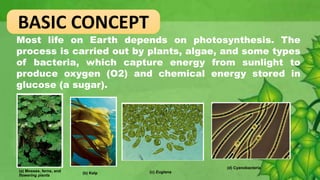
Most life on Earth depends on photosynthesis. The
process is carried out by plants, algae, and some types
of bacteria, which capture energy from sunlight to
produce oxygen (O2) and chemical energy stored in
glucose (a sugar).
(a) Mosses, ferns, and
flowering plants
(b) Kelp (c) Euglena
(d) Cyanobacteria
BASIC CONCEPT
• Herbivores then
obtain this energy
by eating plants,
and carnivores
obtain it by eating
herbivores.
• Energy can be
transformed from
one form to
another
Photosynthesis
• Photosynthesis is the process by which autotrophic
organisms use light energy to make sugar and oxygen
gas from carbon dioxide and water
Photosynthesis has 3 major events:
1. Sunlight is converted into chemical energy
2. Water (H2O) is split into oxygen (O2)
3. Carbon dioxide (CO2) is fixed into sugars (C6H12O6)
Carbon
dioxide
Water
Glucose
Oxygen
gas
PHOTOSYNTHESIS
PROCESS • During photosynthesis,
plants take in carbon
dioxide (CO2) and water
(H2O) from the air and
soil. Within the plant cell,
the water is oxidized,
meaning it loses
electrons, while the
carbon dioxide is
reduced, meaning it gains
electrons. This
transforms the water into
oxygen and the carbon
dioxide into glucose. The
plant then releases the
oxygen back into the air,
and stores energy within
the glucose molecules.
Video:https://www.youtube.com/w
atch?v=ucH2Q8wKmwQ
LEAF AS A
PHOTOSYNTHETIC SYSTEM
Video:https://www.youtu
be.com/watch?v=pwym
X2LxnQs
LEAF AS A
PHOTOSYNTHETIC SYSTEM
Oxygen — the oxygen that we breathe — is just a
waste product of what reaction?
Every split second that
sunlight hits that
leaf, photosynthesis is
initiated, bringing energy into
the ecosystem. It could be
said that this is one of the
most important - if not the
absolutely most important -
biochemical reactions. And it
all starts with the leaf.
FACTORIES FOR
PHOTOSYNTHESIS
A factory has specialized machines to
produce a product. It’s also connected to a
transportation system that supplies it with
raw materials and carries away the
finished product. In all these ways, a leaf
resembles a factory.
A leaf consists of several different kinds of
specialized tissues that work together to
make food by photosynthesis. The major tissues are
mesophyll, veins, and epidermis.
•Mesophyll -This is where
photosynthesis occurs. Mesophyll
consists mainly of parenchyma
with chloroplasts.
•Veins are made primarily
of xylem and phloem. They transport
water and minerals to the cells of
leaves and carry away dissolved
sugar.
•The epidermis of the leaf consists
of a single layer of tightly-packed
dermal cells. They secrete
waxy cuticle to
prevent evaporation of water from
the leaf.
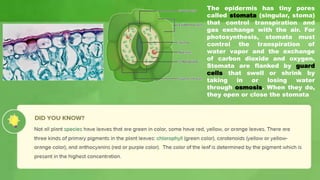
The epidermis has tiny pores
called stomata (singular, stoma)
that control transpiration and
gas exchange with the air. For
photosynthesis, stomata must
control the transpiration of
water vapor and the exchange
of carbon dioxide and oxygen.
Stomata are flanked by guard
cells that swell or shrink by
taking in or losing water
through osmosis. When they do,
they open or close the stomata
CHLOROPLAST
CHLOROPLAST
Through evolution, plant cells, certain bacteria and
some algae have acquired chloroplasts to help
carry out the photosynthetic reaction.
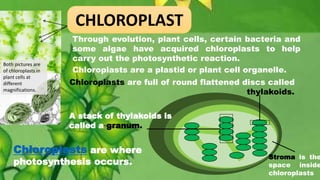
Chloroplasts are a plastid or plant cell organelle.
Both pictures are
of chloroplasts in
plant cells at
different
magnifications.
Chloroplasts are full of round flattened discs called
thylakoids.
A stack of thylakoids is
called a granum.
Stroma is the
space inside
chloroplasts
Chloroplasts are where
photosynthesis occurs.
FUNCTION
Thylakoid System: internal membrane system
consisting of flattened sac-like membrane
structures called thylakoids where light energy
is converted into chemical energy. Thylakoids
contain the light-harvesting complex, including
the electron transport chains used in
photosynthesis and pigments like chlorophyll
and carotenoids.
Chlorophyll is a green pigment and
is the most abundant.
Granum: densely layered stacks of
thylakoids (10 to 20) that are the sites
of conversion of light energy to
chemical energy.
Chlorophyll absorbs all wavelength
colors except green, which is
reflected off giving plants their
green appearance
FUNCTION OF CHLOROPLAST
Chloroplasts are essential for the survival and growth of plants and
photosynthetic protists. They are responsible to carry out photosynthesis, the
process of conversion of light energy into sugar and other organic molecules
that are used by plants or algae as food. They also produce amino acids and lipid
components that are necessary for chloroplast membrane production.
Photosynthesis has two stages:
(i) The 1st stage: the light-dependent reactions occur. Sunlight is captured
through chlorophyll and carotenoids and converted into adenosine triphosphate
(ATP, the molecular unit of currency of intracellular energy transfer) and
nicotinamide adenine dinucleotide phosphate (NADPH), which carries electrons.
(ii) The 2nd stage: the light-independent reactions, also known as the Calvin
cycle, occur. The electrons carried by NADPH convert carbon dioxide to
carbohydrate, a process known as CO2 fixation. Hence, carbohydrates and other
organic molecules can be stored and used for energy.
LIGHT AND
CHLOROPLAST
Video:
https://www.youtube.com/
watch?v=Ry4J3aQpVX4
Different wavelengths of visible light are seen
by the human eye as different colors.
Gamma
rays
X-rays UV
Infrared &
Microwaves
Radio waves
Visible light
Wavelength (nm)
Sunlight minus absorbed
wavelengths or colors equals
the apparent color of an
object.
The feathers of male
cardinals are loaded with
carotenoid pigments. These
pigments absorb some
wavelengths of light and
reflect others.
Chloroplasts absorb
light energy and
convert it to chemical
energy
Light
Reflected
light
Absorbed
light
Transmitted
light
Chloroplast
THE COLOR OF LIGHT SEEN IS THE COLOR NOT
ABSORBED
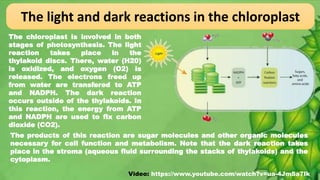
The light and dark reactions in the chloroplast
The chloroplast is involved in both
stages of photosynthesis. The light
reaction takes place in the
thylakoid discs. There, water (H20)
is oxidized, and oxygen (O2) is
released. The electrons freed up
from water are transfered to ATP
and NADPH. The dark reaction
occurs outside of the thylakoids. In
this reaction, the energy from ATP
and NADPH are used to fix carbon
dioxide (CO2).
The products of this reaction are sugar molecules and other organic molecules
necessary for cell function and metabolism. Note that the dark reaction takes
place in the stroma (aqueous fluid surrounding the stacks of thylakoids) and the
cytoplasm.
Video: https://www.youtube.com/watch?v=ua-4JmSa7Ik
THANK
YOU

Photosynthesis Topic.pptx

  • 1.
  • 2.
    BASIC CONCEPT LEAF AS PHOTOSYNTHETICSYSTEM CHLOROPLAST LIGHT AND CHLOROPLAST
  • 3.
    BASIC CONCEPT Most lifeon Earth depends on photosynthesis. The process is carried out by plants, algae, and some types of bacteria, which capture energy from sunlight to produce oxygen (O2) and chemical energy stored in glucose (a sugar). (a) Mosses, ferns, and flowering plants (b) Kelp (c) Euglena (d) Cyanobacteria
  • 4.
    BASIC CONCEPT • Herbivoresthen obtain this energy by eating plants, and carnivores obtain it by eating herbivores. • Energy can be transformed from one form to another
  • 5.
    Photosynthesis • Photosynthesis isthe process by which autotrophic organisms use light energy to make sugar and oxygen gas from carbon dioxide and water Photosynthesis has 3 major events: 1. Sunlight is converted into chemical energy 2. Water (H2O) is split into oxygen (O2) 3. Carbon dioxide (CO2) is fixed into sugars (C6H12O6) Carbon dioxide Water Glucose Oxygen gas PHOTOSYNTHESIS
  • 6.
    PROCESS • Duringphotosynthesis, plants take in carbon dioxide (CO2) and water (H2O) from the air and soil. Within the plant cell, the water is oxidized, meaning it loses electrons, while the carbon dioxide is reduced, meaning it gains electrons. This transforms the water into oxygen and the carbon dioxide into glucose. The plant then releases the oxygen back into the air, and stores energy within the glucose molecules. Video:https://www.youtube.com/w atch?v=ucH2Q8wKmwQ
  • 7.
    LEAF AS A PHOTOSYNTHETICSYSTEM Video:https://www.youtu be.com/watch?v=pwym X2LxnQs
  • 8.
    LEAF AS A PHOTOSYNTHETICSYSTEM Oxygen — the oxygen that we breathe — is just a waste product of what reaction? Every split second that sunlight hits that leaf, photosynthesis is initiated, bringing energy into the ecosystem. It could be said that this is one of the most important - if not the absolutely most important - biochemical reactions. And it all starts with the leaf.
  • 9.
    FACTORIES FOR PHOTOSYNTHESIS A factoryhas specialized machines to produce a product. It’s also connected to a transportation system that supplies it with raw materials and carries away the finished product. In all these ways, a leaf resembles a factory. A leaf consists of several different kinds of specialized tissues that work together to make food by photosynthesis. The major tissues are mesophyll, veins, and epidermis. •Mesophyll -This is where photosynthesis occurs. Mesophyll consists mainly of parenchyma with chloroplasts. •Veins are made primarily of xylem and phloem. They transport water and minerals to the cells of leaves and carry away dissolved sugar. •The epidermis of the leaf consists of a single layer of tightly-packed dermal cells. They secrete waxy cuticle to prevent evaporation of water from the leaf.
  • 10.
    The epidermis hastiny pores called stomata (singular, stoma) that control transpiration and gas exchange with the air. For photosynthesis, stomata must control the transpiration of water vapor and the exchange of carbon dioxide and oxygen. Stomata are flanked by guard cells that swell or shrink by taking in or losing water through osmosis. When they do, they open or close the stomata
  • 11.
  • 12.
    CHLOROPLAST Through evolution, plantcells, certain bacteria and some algae have acquired chloroplasts to help carry out the photosynthetic reaction. Chloroplasts are a plastid or plant cell organelle. Both pictures are of chloroplasts in plant cells at different magnifications. Chloroplasts are full of round flattened discs called thylakoids. A stack of thylakoids is called a granum. Stroma is the space inside chloroplasts Chloroplasts are where photosynthesis occurs.
  • 13.
    FUNCTION Thylakoid System: internalmembrane system consisting of flattened sac-like membrane structures called thylakoids where light energy is converted into chemical energy. Thylakoids contain the light-harvesting complex, including the electron transport chains used in photosynthesis and pigments like chlorophyll and carotenoids. Chlorophyll is a green pigment and is the most abundant. Granum: densely layered stacks of thylakoids (10 to 20) that are the sites of conversion of light energy to chemical energy. Chlorophyll absorbs all wavelength colors except green, which is reflected off giving plants their green appearance
  • 14.
    FUNCTION OF CHLOROPLAST Chloroplastsare essential for the survival and growth of plants and photosynthetic protists. They are responsible to carry out photosynthesis, the process of conversion of light energy into sugar and other organic molecules that are used by plants or algae as food. They also produce amino acids and lipid components that are necessary for chloroplast membrane production. Photosynthesis has two stages: (i) The 1st stage: the light-dependent reactions occur. Sunlight is captured through chlorophyll and carotenoids and converted into adenosine triphosphate (ATP, the molecular unit of currency of intracellular energy transfer) and nicotinamide adenine dinucleotide phosphate (NADPH), which carries electrons. (ii) The 2nd stage: the light-independent reactions, also known as the Calvin cycle, occur. The electrons carried by NADPH convert carbon dioxide to carbohydrate, a process known as CO2 fixation. Hence, carbohydrates and other organic molecules can be stored and used for energy.
  • 15.
  • 16.
    Different wavelengths ofvisible light are seen by the human eye as different colors. Gamma rays X-rays UV Infrared & Microwaves Radio waves Visible light Wavelength (nm)
  • 17.
    Sunlight minus absorbed wavelengthsor colors equals the apparent color of an object. The feathers of male cardinals are loaded with carotenoid pigments. These pigments absorb some wavelengths of light and reflect others.
  • 18.
    Chloroplasts absorb light energyand convert it to chemical energy Light Reflected light Absorbed light Transmitted light Chloroplast THE COLOR OF LIGHT SEEN IS THE COLOR NOT ABSORBED
  • 19.
    The light anddark reactions in the chloroplast The chloroplast is involved in both stages of photosynthesis. The light reaction takes place in the thylakoid discs. There, water (H20) is oxidized, and oxygen (O2) is released. The electrons freed up from water are transfered to ATP and NADPH. The dark reaction occurs outside of the thylakoids. In this reaction, the energy from ATP and NADPH are used to fix carbon dioxide (CO2). The products of this reaction are sugar molecules and other organic molecules necessary for cell function and metabolism. Note that the dark reaction takes place in the stroma (aqueous fluid surrounding the stacks of thylakoids) and the cytoplasm. Video: https://www.youtube.com/watch?v=ua-4JmSa7Ik
  • 20.