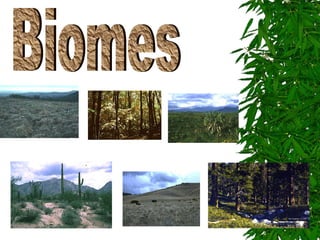
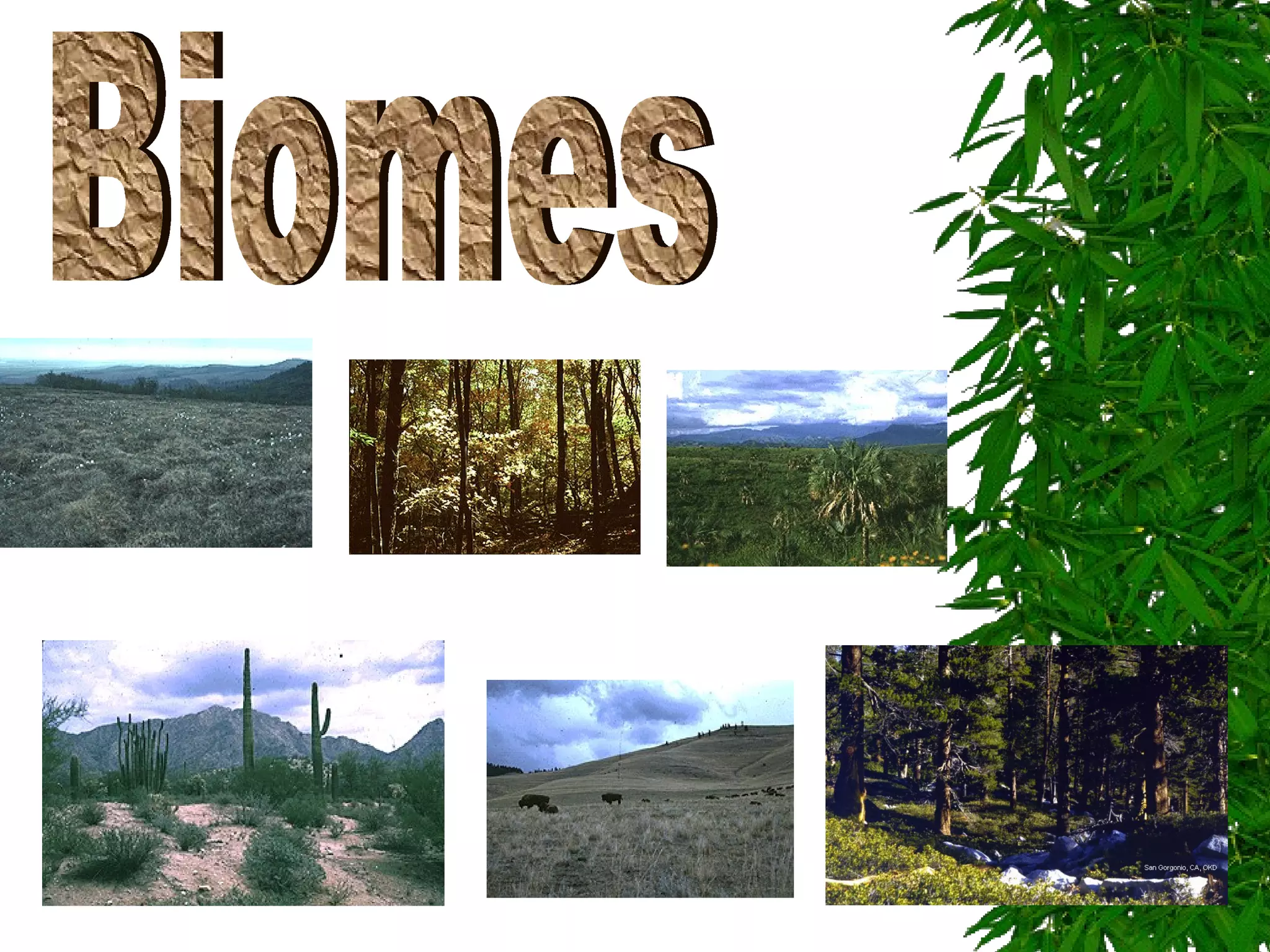
I. Biomes:
areas that have
  distinctive
 climates and
   organisms
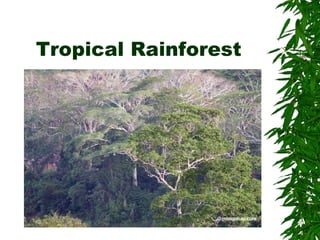
Tropical Rainforest
Tropical
     Rainforest
once,
     20% of earth;
now 7%
exist around equator, so
   strong sunlight and
   consistent climate.
Tropical
     Rainforest
humid, always warm,
never freezes, lots of
rain (100-400 in. a year
= 250-1000 cm/yr)
Tropical
    Rainforest
 Has poor soil.
So how do many
 species of plants
 thrive?
answer: rapid decay
    of plants and
 animals constantly
 returning nutrients
      to the soil
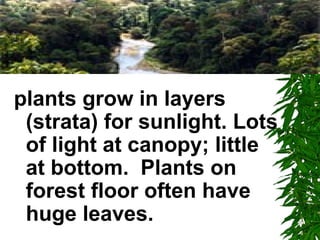
plants grow in layers
 (strata) for sunlight. Lots
 of light at canopy; little
 at bottom. Plants on
 forest floor often have
 huge leaves.
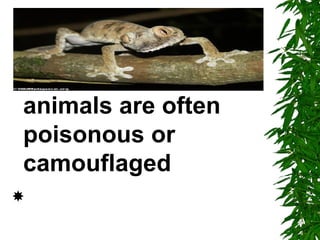
animals are often
poisonous or
camouflaged

Temperate Rain
      Forest
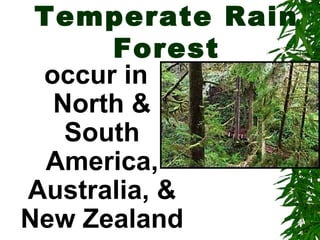
 occur in
  North &
   South
  America,
Australia, &
New Zealand
Temperate Rain
     Forest
cool & humid
Mild winters and
 summers for latitude
70 – 200 inches of rain
 per year (150 – 500
 cm)
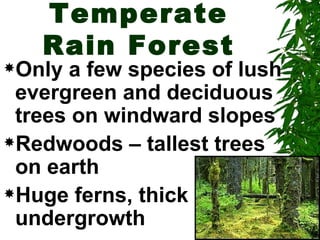
Temperate
   Rain Forest
Only a few species of lush
 evergreen and deciduous
 trees on windward slopes
Redwoods – tallest trees
 on earth
Huge ferns, thick
 undergrowth
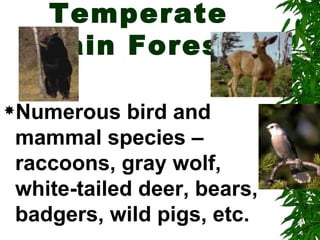
Temperate
   Rain Forest

Numerous   bird and
mammal species –
raccoons, gray wolf,
white-tailed deer, bears,
badgers, wild pigs, etc.
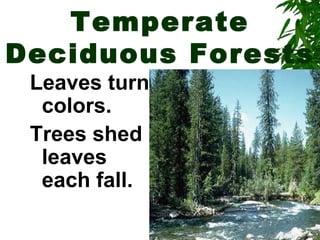
Temperate
Deciduous Forests
 Leaves turn
  colors.
 Trees shed
  leaves
  each fall.
Temperate
Deciduous Forests
exist b/t 30 degrees &
 50 degrees north
 latitude, so
 seasonal variation
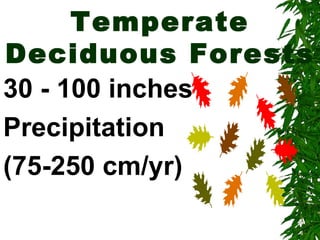
Temperate
Deciduous Forests
30 - 100 inches
Precipitation
(75-250 cm/yr)
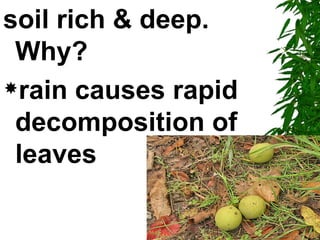
soil rich & deep.
 Why?
rain causes rapid

 decomposition of
 leaves
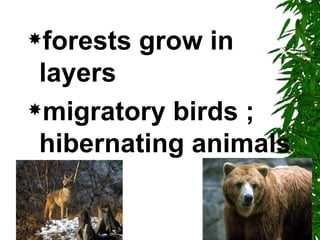
forests   grow in
 layers
migratory birds ;

 hibernating animals
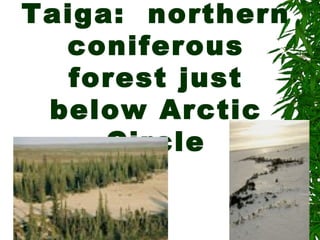
Taiga: northern
  coniferous
   forest just
 below Arctic
     Circle
Taiga
long, cold winters
precipitation = snow
constant daylight in
  summer
Taiga
conifer trees: needle-
 shaped leaves (retain
 water, acidic)
Taiga
soil forms slowly, is
 acidic; few plants on
 ground
Taiga
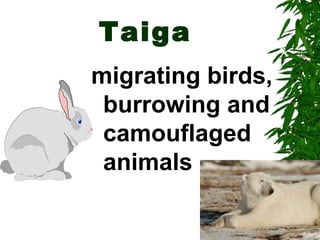
migrating birds,
 burrowing and
 camouflaged
 animals
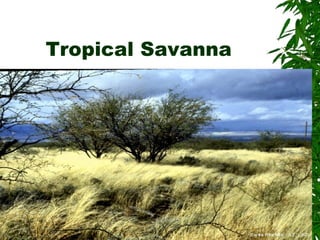
Tropical Savanna
Tropical
     Savanna
near equator

very little rain -
 less than 6 months
 of the year (4 –70
 inches)
Tropical
    Savanna
plants: long
 underground roots to
 survive fire and dry
 season, perennials;
- thorny plants so
 animals won’t eat
Tropical
      Savanna
Migratory herbivores
 follow rains-
 different herbivores
 eat plants of
 different heights.
Tropical
      Savanna
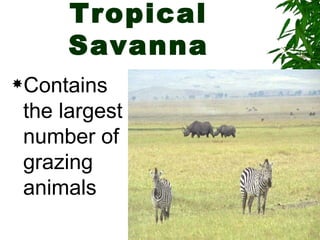
Contains

 the largest
 number of
 grazing
 animals
Tropical
    Savanna
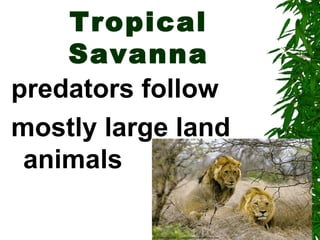
predators follow
mostly large land
 animals
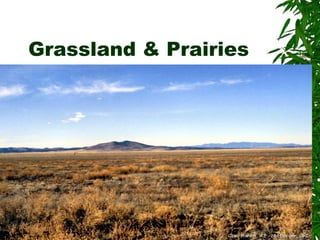
Grassland & Prairies
Temperate
    Grasslands &
      Prairies
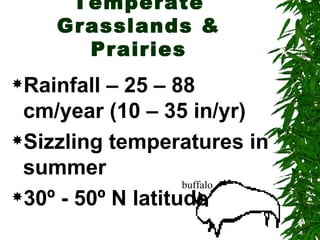
Rainfall – 25 – 88
 cm/year (10 – 35 in/yr)
Sizzling temperatures in

 summer
                   buffalo
30º - 50º N latitude
Temperate
      Grasslands &
          Prairies
 Plant Adaptations

  - Root systems of plants
  form dense mats to
  survive drought and fire
  and hold the soil in place.
  - Few trees because of the
  drought, fire and constant
  wind.
Temperate
       Grasslands &
           Prairies
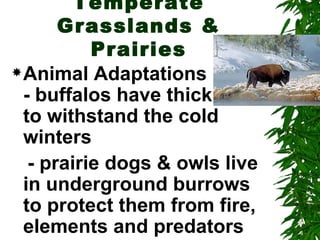
 Animal Adaptations
  - buffalos have thick coats
  to withstand the cold
  winters
   - prairie dogs & owls live
  in underground burrows
  to protect them from fire,
  elements and predators
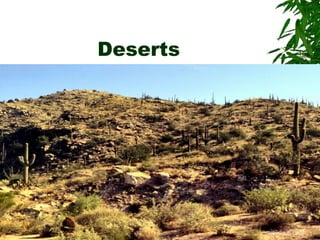
Deserts
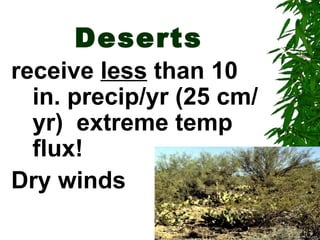
Deserts
receive less than 10
  in. precip/yr (25 cm/
  yr) extreme temp
  flux!
Dry winds
Deserts
soil rich in
 minerals, but poor
 in organic matter.
 Why?
Deserts
ans: not enough
water to aid in
decomposition.
Deserts
plants:
succulents
 :thick stems &
 leaves to store
 water -
Deserts
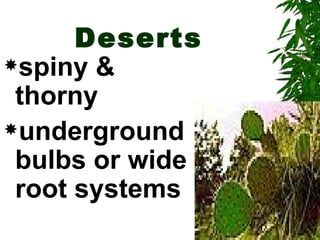
spiny &
 thorny
underground
 bulbs or wide
 root systems
Deserts
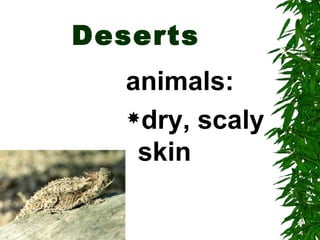
   animals:
   dry, scaly

    skin
Deserts
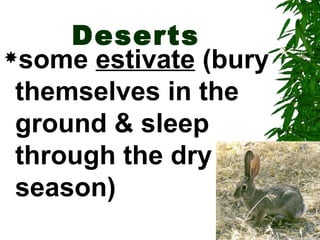
some estivate (bury

 themselves in the
 ground & sleep
 through the dry
 season)
Deserts
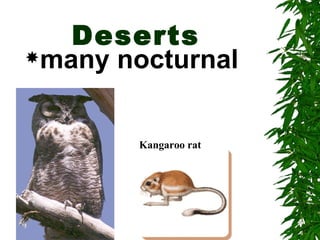
many nocturnal


        Kangaroo rat
Tundra
Tundra

North of the
Arctic Circle
Tundra
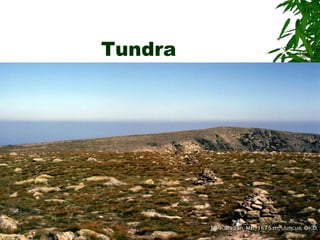
biome w/o trees,
 grasses & shrubs
 grow in permanently
 frozen soil
 (permafrost)
Tundra
7 – 40 inches of
 rain/year
Only 2 or 3 months
 above freezing
Long and cold winter
Brief cool summer
Tundra
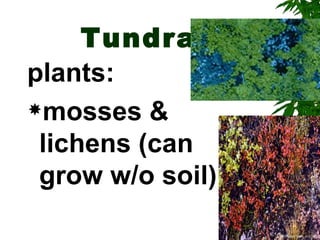
plants:
mosses &

 lichens (can
 grow w/o soil)
Tundra
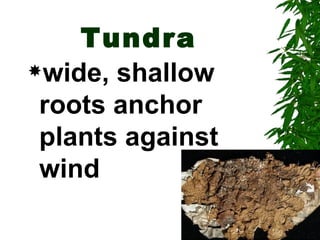
wide, shallow

 roots anchor
 plants against
 wind
Tundra
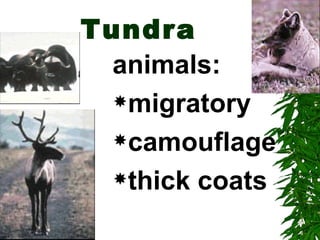
  animals:
  migratory

  camouflage

  thick coats

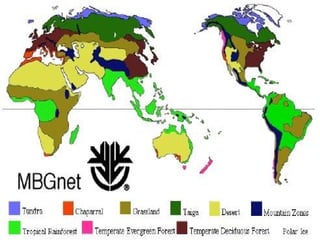
Terrestrial biomes