PHOTOSYNTHESIS

  Victoria Johnson


                     Google.image.com
What is photosynthesis?
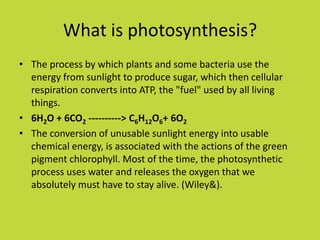
• The process by which plants and some bacteria use the
  energy from sunlight to produce sugar, which then cellular
  respiration converts into ATP, the "fuel" used by all living
  things.
• 6H2O + 6CO2 ----------> C6H12O6+ 6O2
• The conversion of unusable sunlight energy into usable
  chemical energy, is associated with the actions of the green
  pigment chlorophyll. Most of the time, the photosynthetic
  process uses water and releases the oxygen that we
  absolutely must have to stay alive. (Wiley&).
Leaves and their structure:
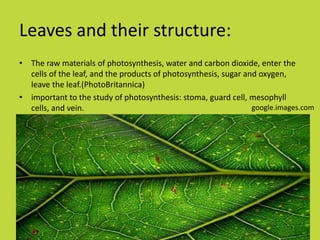
• The raw materials of photosynthesis, water and carbon dioxide, enter the
  cells of the leaf, and the products of photosynthesis, sugar and oxygen,
  leave the leaf.(PhotoBritannica)
• important to the study of photosynthesis: stoma, guard cell, mesophyll
  cells, and vein.                                               google.images.com
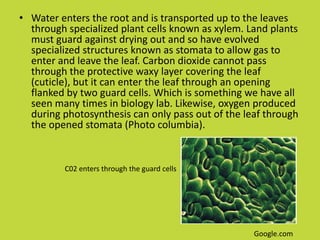
• Water enters the root and is transported up to the leaves
  through specialized plant cells known as xylem. Land plants
  must guard against drying out and so have evolved
  specialized structures known as stomata to allow gas to
  enter and leave the leaf. Carbon dioxide cannot pass
  through the protective waxy layer covering the leaf
  (cuticle), but it can enter the leaf through an opening
  flanked by two guard cells. Which is something we have all
  seen many times in biology lab. Likewise, oxygen produced
  during photosynthesis can only pass out of the leaf through
  the opened stomata (Photo columbia).


         C02 enters through the guard cells


                                                   Google.com
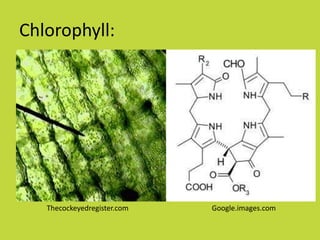
Chlorophyll:


   Thecockeyedregister.com   Google.images.com
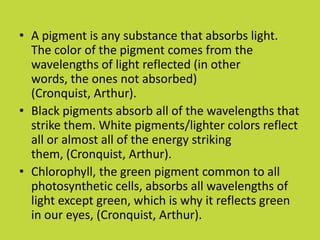
• A pigment is any substance that absorbs light.
  The color of the pigment comes from the
  wavelengths of light reflected (in other
  words, the ones not absorbed)
  (Cronquist, Arthur).
• Black pigments absorb all of the wavelengths that
  strike them. White pigments/lighter colors reflect
  all or almost all of the energy striking
  them, (Cronquist, Arthur).
• Chlorophyll, the green pigment common to all
  photosynthetic cells, absorbs all wavelengths of
  light except green, which is why it reflects green
  in our eyes, (Cronquist, Arthur).
Other pigments
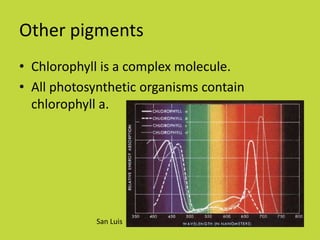
• Chlorophyll is a complex molecule.
• All photosynthetic organisms contain
  chlorophyll a.


             San Luis
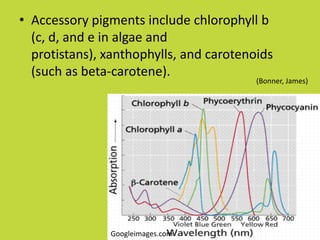
• Accessory pigments include chlorophyll b
  (c, d, and e in algae and
  protistans), xanthophylls, and carotenoids
  (such as beta-carotene).
                                         (Bonner, James)


               Googleimages.com
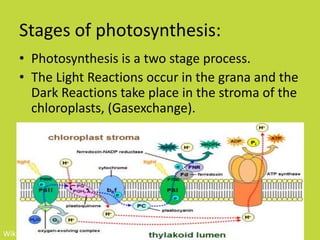
Stages of photosynthesis:
    • Photosynthesis is a two stage process.
    • The Light Reactions occur in the grana and the
      Dark Reactions take place in the stroma of the
      chloroplasts, (Gasexchange).


Wikipedia.com
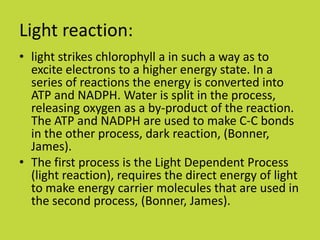
Light reaction:
• light strikes chlorophyll a in such a way as to
  excite electrons to a higher energy state. In a
  series of reactions the energy is converted into
  ATP and NADPH. Water is split in the process,
  releasing oxygen as a by-product of the reaction.
  The ATP and NADPH are used to make C-C bonds
  in the other process, dark reaction, (Bonner,
  James).
• The first process is the Light Dependent Process
  (light reaction), requires the direct energy of light
  to make energy carrier molecules that are used in
  the second process, (Bonner, James).
Dark reaction
• Dark reactions occurs when the products of
  the Light Reaction are used to form C-C
  covalent bonds of carbohydrates. The Dark
  Reactions can usually occur in the dark, if the
  energy carriers from the light process are
  present.
How does any of this happen?
• “This occurs when the electrons from water are excited by the
  light in the presence of P680, (Gasexchange).
• “ Light energy causes the removal of an electron from a
  molecule of P680. The P680 requires an electron, which is
  taken from a water molecule, breaking the water into H+ ions
  and O-2 ions. These O-2 ions combine to form the diatomic O2
  that is released” (Solarenergy).
• The electron is then "boosted" to a higher
  energy state and attached to a primary
  electron acceptor, which begins a series of
  redox reactions, passing the electron through
  a series of electron carriers


                                 Put domino picture here
• The electron is then passed again through a
  series of redox reactions, eventually being
  attached to NADP+ and H+ to form NADPH, an
  energy carrier needed in the dark reaction.
• The electron from Photosystem II replaces the
  excited electron in the P700 molecule. There is
  thus a continuous flow of electrons from
  water to NADPH… This energy is used in
  Carbon Fixation.


 (Solarenergy)
summary
•   Sunlight
•   Produce sugar
•   Two stage process-dependency
•   Sugar converts to ATP
•   ATP= “fuel” for all living things
•   Sunlight turned into chemical energy
•   chlorophyll
Benefits: Plants
• Photosynthesis is the process by which plants
  use energy from the sun (along with carbon
  dioxide and water) to create its own food.
  Without photosynthesis, plants would die.


Bettysoriginalembroideries.com
• “Photosynthesis is responsible for the
  conversion of carbon from carbon dioxide
  into organic compounds in plants. It allows
  the plant to make organic building blocks,
  new cells, starch, and proteins. Without this
  process, life as we know it would not exist on
  earth. Plants provide, directly or indirectly,
  food for all animals and all of our
  atmospheric oxygen” (San Luis).
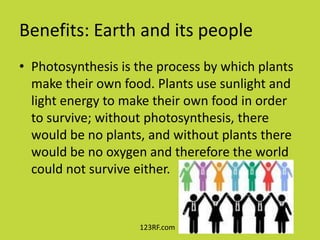
Benefits: Earth and its people
• Photosynthesis is the process by which plants
  make their own food. Plants use sunlight and
  light energy to make their own food in order
  to survive; without photosynthesis, there
  would be no plants, and without plants there
  would be no oxygen and therefore the world
  could not survive either.


                    123RF.com
WORK CITED
•   Wiley and Sons, Inc, John. "Interactive Concepts in Biochemistry - Photosynthesis." Wiley: Home.
    2002. Web. 04 Oct. 2011.
    <http://www.wiley.com/legacy/college/boyer/0470003790/animations/animations.htm>.
•   "Photosynthesis." The Columbia Encyclopedia. New York: Columbia UP, 2008. Credo Reference. 7
    Nov. 2008. Web. 7 Oct. 2011. <http://www.credoreference.com/entry/columency/photosynthesis>.
•    "Photosynthesis." Dictionary of Microbiology & Molecular Biology. Hoboken: Wiley, 2006. Credo
    Reference. 18 Mar. 2010. Web. 7 Oct. 2011.
    <http://www.credoreference.com/entry/wileymicrob/photosynthesis>.
•    "Photosynthesis." Britannica Concise Encyclopedia. Chicago: Encyclopaedia Britannica, 2009. Credo
    Reference. 3 Sept. 2010. Web. 7 Oct. 2011.
    <http://www.credoreference.com/entry/ebconcise/photosynthesis>.
•   "Gas Exchange." The Hutchinson Unabridged Encyclopedia with Atlas and Weather Guide. Abington:
    Helicon, 2010. Credo Reference. 4 Jan. 2011. Web. 7 Oct. 2011.
    <http://www.credoreference.com/entry/heliconhe/gas_exchange>.
•   Bonner, James. "Chlorophyll." Encyclopedia Americana. Grolier Online, 2011. Web. 7 Oct. 2011.
•   Cronquist, Arthur. "Leaf." Encyclopedia Americana. Grolier Online, 2011. Web. 7 Oct. 2011.
•   Bassham, James A. "Calvin, Melvin (1911–1997)." Encyclopedia Americana. Grolier Online, 2011.
    Web. 7 Oct. 2011.
•   "Solar Energy." Encyclopedia Americana. Grolier Online, 2011. Web. 7 Oct. 2011.
•   Sinnott, Edmund W. "Botany." Encyclopedia Americana. Grolier Online, 2011. Web. 7 Oct. 2011.
Pictures..
•   123RF.com
•   Betty’s original embroideries
•   Thecockeyedregister.com
•   google.images.com
•   SanLuisObispo
•   wikipedia

Biophotosynthesis

  • 1.
    PHOTOSYNTHESIS VictoriaJohnson Google.image.com
  • 2.
    What is photosynthesis? •The process by which plants and some bacteria use the energy from sunlight to produce sugar, which then cellular respiration converts into ATP, the "fuel" used by all living things. • 6H2O + 6CO2 ----------> C6H12O6+ 6O2 • The conversion of unusable sunlight energy into usable chemical energy, is associated with the actions of the green pigment chlorophyll. Most of the time, the photosynthetic process uses water and releases the oxygen that we absolutely must have to stay alive. (Wiley&).
  • 3.
    Leaves and theirstructure: • The raw materials of photosynthesis, water and carbon dioxide, enter the cells of the leaf, and the products of photosynthesis, sugar and oxygen, leave the leaf.(PhotoBritannica) • important to the study of photosynthesis: stoma, guard cell, mesophyll cells, and vein. google.images.com
  • 4.
    • Water entersthe root and is transported up to the leaves through specialized plant cells known as xylem. Land plants must guard against drying out and so have evolved specialized structures known as stomata to allow gas to enter and leave the leaf. Carbon dioxide cannot pass through the protective waxy layer covering the leaf (cuticle), but it can enter the leaf through an opening flanked by two guard cells. Which is something we have all seen many times in biology lab. Likewise, oxygen produced during photosynthesis can only pass out of the leaf through the opened stomata (Photo columbia). C02 enters through the guard cells Google.com
  • 5.
    Chlorophyll: Thecockeyedregister.com Google.images.com
  • 6.
    • A pigmentis any substance that absorbs light. The color of the pigment comes from the wavelengths of light reflected (in other words, the ones not absorbed) (Cronquist, Arthur). • Black pigments absorb all of the wavelengths that strike them. White pigments/lighter colors reflect all or almost all of the energy striking them, (Cronquist, Arthur). • Chlorophyll, the green pigment common to all photosynthetic cells, absorbs all wavelengths of light except green, which is why it reflects green in our eyes, (Cronquist, Arthur).
  • 7.
    Other pigments • Chlorophyllis a complex molecule. • All photosynthetic organisms contain chlorophyll a. San Luis
  • 8.
    • Accessory pigmentsinclude chlorophyll b (c, d, and e in algae and protistans), xanthophylls, and carotenoids (such as beta-carotene). (Bonner, James) Googleimages.com
  • 9.
    Stages of photosynthesis: • Photosynthesis is a two stage process. • The Light Reactions occur in the grana and the Dark Reactions take place in the stroma of the chloroplasts, (Gasexchange). Wikipedia.com
  • 10.
    Light reaction: • lightstrikes chlorophyll a in such a way as to excite electrons to a higher energy state. In a series of reactions the energy is converted into ATP and NADPH. Water is split in the process, releasing oxygen as a by-product of the reaction. The ATP and NADPH are used to make C-C bonds in the other process, dark reaction, (Bonner, James). • The first process is the Light Dependent Process (light reaction), requires the direct energy of light to make energy carrier molecules that are used in the second process, (Bonner, James).
  • 11.
    Dark reaction • Darkreactions occurs when the products of the Light Reaction are used to form C-C covalent bonds of carbohydrates. The Dark Reactions can usually occur in the dark, if the energy carriers from the light process are present.
  • 12.
    How does anyof this happen? • “This occurs when the electrons from water are excited by the light in the presence of P680, (Gasexchange). • “ Light energy causes the removal of an electron from a molecule of P680. The P680 requires an electron, which is taken from a water molecule, breaking the water into H+ ions and O-2 ions. These O-2 ions combine to form the diatomic O2 that is released” (Solarenergy).
  • 13.
    • The electronis then "boosted" to a higher energy state and attached to a primary electron acceptor, which begins a series of redox reactions, passing the electron through a series of electron carriers Put domino picture here
  • 14.
    • The electronis then passed again through a series of redox reactions, eventually being attached to NADP+ and H+ to form NADPH, an energy carrier needed in the dark reaction. • The electron from Photosystem II replaces the excited electron in the P700 molecule. There is thus a continuous flow of electrons from water to NADPH… This energy is used in Carbon Fixation. (Solarenergy)
  • 15.
    summary • Sunlight • Produce sugar • Two stage process-dependency • Sugar converts to ATP • ATP= “fuel” for all living things • Sunlight turned into chemical energy • chlorophyll
  • 16.
    Benefits: Plants • Photosynthesisis the process by which plants use energy from the sun (along with carbon dioxide and water) to create its own food. Without photosynthesis, plants would die. Bettysoriginalembroideries.com
  • 17.
    • “Photosynthesis isresponsible for the conversion of carbon from carbon dioxide into organic compounds in plants. It allows the plant to make organic building blocks, new cells, starch, and proteins. Without this process, life as we know it would not exist on earth. Plants provide, directly or indirectly, food for all animals and all of our atmospheric oxygen” (San Luis).
  • 18.
    Benefits: Earth andits people • Photosynthesis is the process by which plants make their own food. Plants use sunlight and light energy to make their own food in order to survive; without photosynthesis, there would be no plants, and without plants there would be no oxygen and therefore the world could not survive either. 123RF.com
  • 19.
    WORK CITED • Wiley and Sons, Inc, John. "Interactive Concepts in Biochemistry - Photosynthesis." Wiley: Home. 2002. Web. 04 Oct. 2011. <http://www.wiley.com/legacy/college/boyer/0470003790/animations/animations.htm>. • "Photosynthesis." The Columbia Encyclopedia. New York: Columbia UP, 2008. Credo Reference. 7 Nov. 2008. Web. 7 Oct. 2011. <http://www.credoreference.com/entry/columency/photosynthesis>. • "Photosynthesis." Dictionary of Microbiology & Molecular Biology. Hoboken: Wiley, 2006. Credo Reference. 18 Mar. 2010. Web. 7 Oct. 2011. <http://www.credoreference.com/entry/wileymicrob/photosynthesis>. • "Photosynthesis." Britannica Concise Encyclopedia. Chicago: Encyclopaedia Britannica, 2009. Credo Reference. 3 Sept. 2010. Web. 7 Oct. 2011. <http://www.credoreference.com/entry/ebconcise/photosynthesis>. • "Gas Exchange." The Hutchinson Unabridged Encyclopedia with Atlas and Weather Guide. Abington: Helicon, 2010. Credo Reference. 4 Jan. 2011. Web. 7 Oct. 2011. <http://www.credoreference.com/entry/heliconhe/gas_exchange>. • Bonner, James. "Chlorophyll." Encyclopedia Americana. Grolier Online, 2011. Web. 7 Oct. 2011. • Cronquist, Arthur. "Leaf." Encyclopedia Americana. Grolier Online, 2011. Web. 7 Oct. 2011. • Bassham, James A. "Calvin, Melvin (1911–1997)." Encyclopedia Americana. Grolier Online, 2011. Web. 7 Oct. 2011. • "Solar Energy." Encyclopedia Americana. Grolier Online, 2011. Web. 7 Oct. 2011. • Sinnott, Edmund W. "Botany." Encyclopedia Americana. Grolier Online, 2011. Web. 7 Oct. 2011.
  • 20.
    Pictures.. • 123RF.com • Betty’s original embroideries • Thecockeyedregister.com • google.images.com • SanLuisObispo • wikipedia