By the end of this lecture you will be able to:
1. Understand that ENERGY can be transformed from one form to another.
2. Know that energy exist in two forms; free energy - available for doing work
or as heat - a form unavailable for doing work.
3. Appreciate that the Sun provides most of the energy needed for life on
Earth.
4. Explain why photosynthesis is so important to energy and material flow for
life on earth.
5. Know why plants tend to be green in appearance.
6. Equate the organelle of photosynthesis in eukaryotes with the chloroplast.
7. Describe the organization of the chloroplast.
8. Understand that photosynthesis is a two fold process composed of the
light-dependent reactions (i.e., light reactions) and the light
independent reactions (i.e. Calvin Cycle or Dark Reactions).
9. Tell where the light reactions and the CO2 fixation reactions occur in the
chloroplast.
10. Define chlorophylls giving their basic composition and structure.
11. Draw the absorption spectrum of chlorophyll and compare it to the action
spectrum of photosynthesis.
12. Define the Reaction Centers and Antennae and describe how it operates.
13. Describe cyclic photophosphorylation of photosynthesis.
14. Describe noncyclic photophosphorylation of photosynthesis.
LEARNING OBJECTIVES
Energy can be transformed from
one form to another
FREE ENERGY
(available for work)
vs.
HEAT
(not available for work)
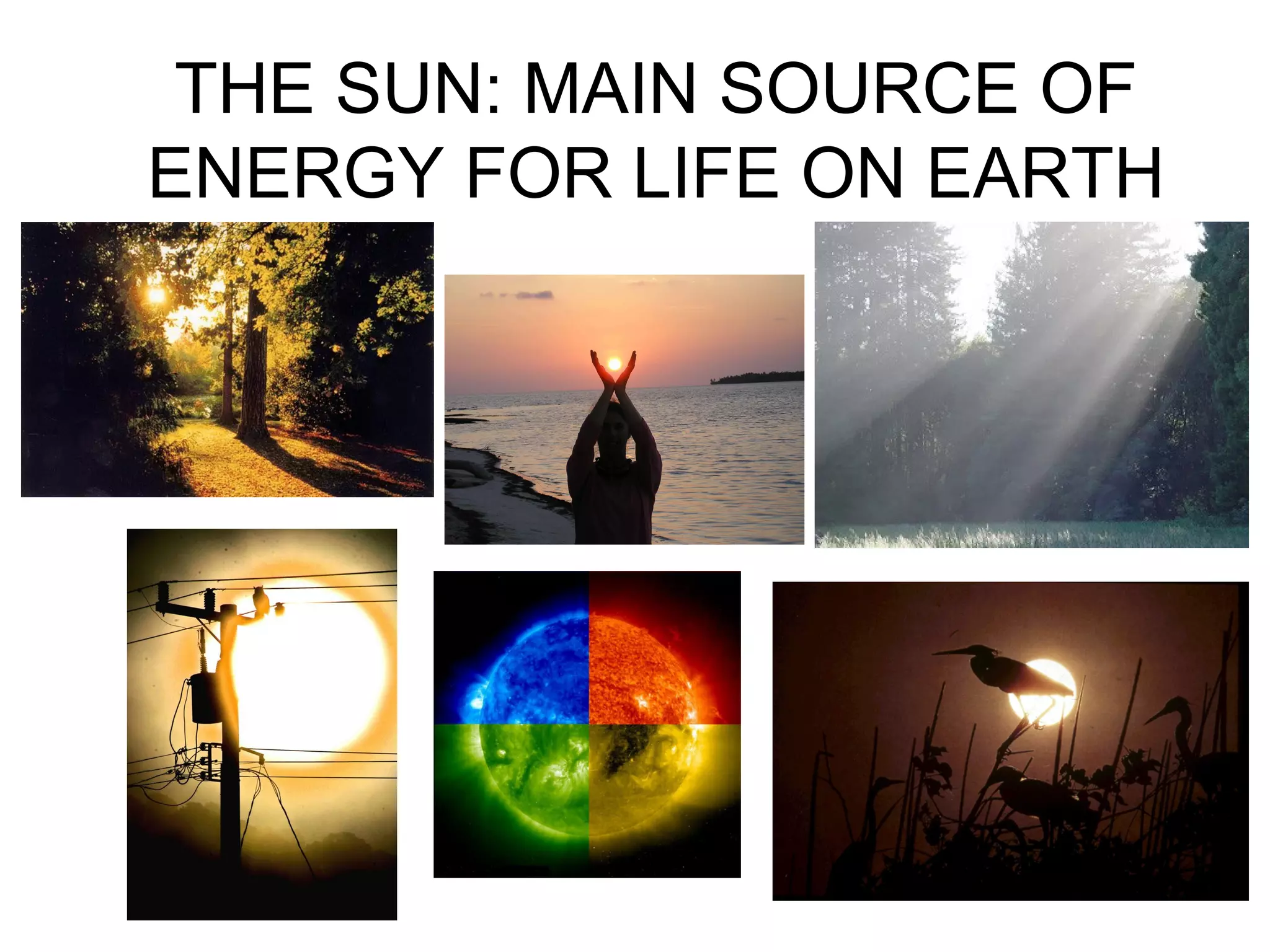
THE SUN: MAIN SOURCE OF
ENERGY FOR LIFE ON EARTH
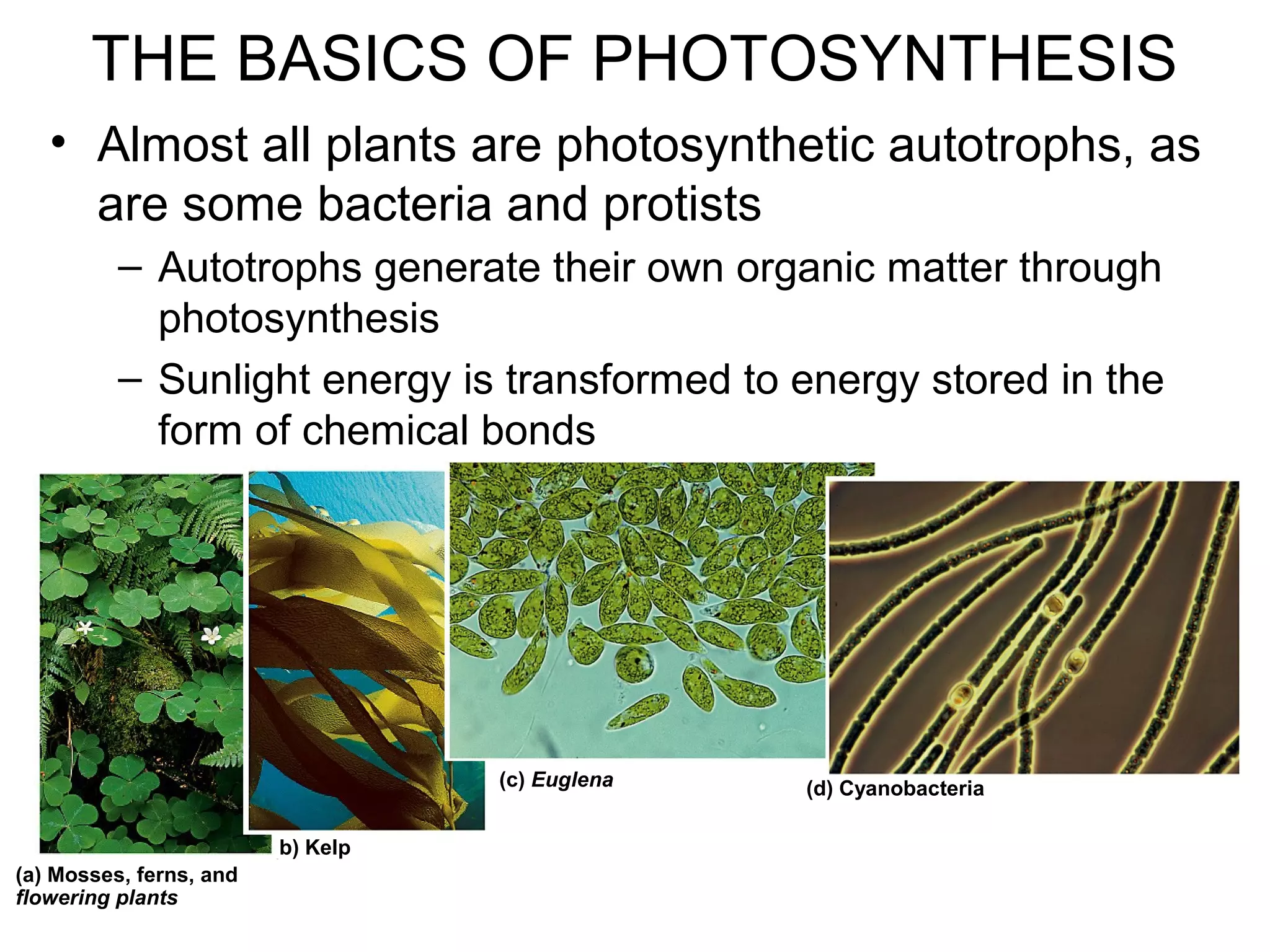
• Almost all plants are photosynthetic autotrophs, as
are some bacteria and protists
– Autotrophs generate their own organic matter through
photosynthesis
– Sunlight energy is transformed to energy stored in the
form of chemical bonds
(a) Mosses, ferns, and
flowering plants
(b) Kelp
(c) Euglena (d) Cyanobacteria
THE BASICS OF PHOTOSYNTHESIS
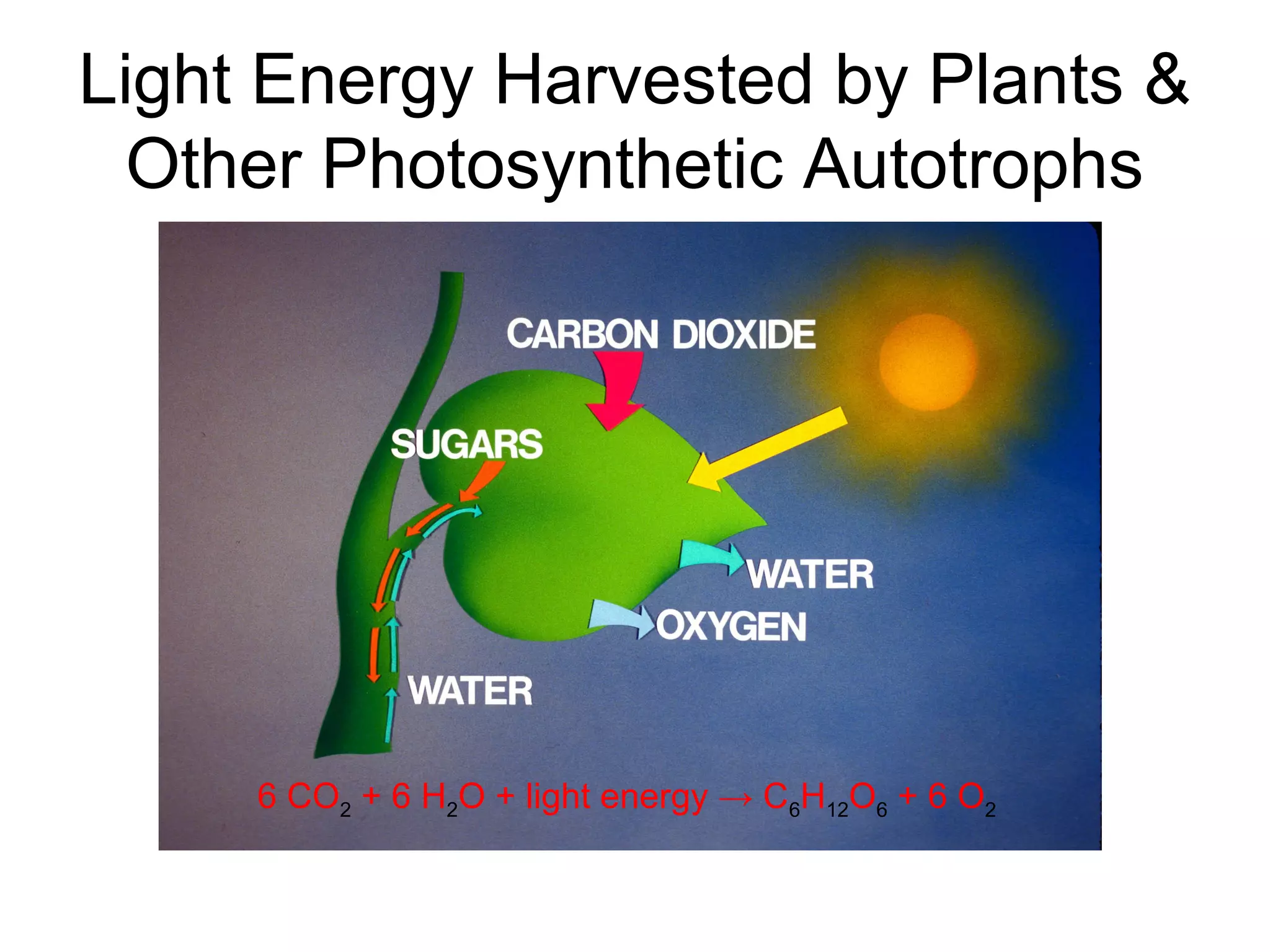
Light Energy Harvested by Plants &
Other Photosynthetic Autotrophs
6 CO2 + 6 H2O + light energy → C6H12O6 + 6 O2
Food Chain
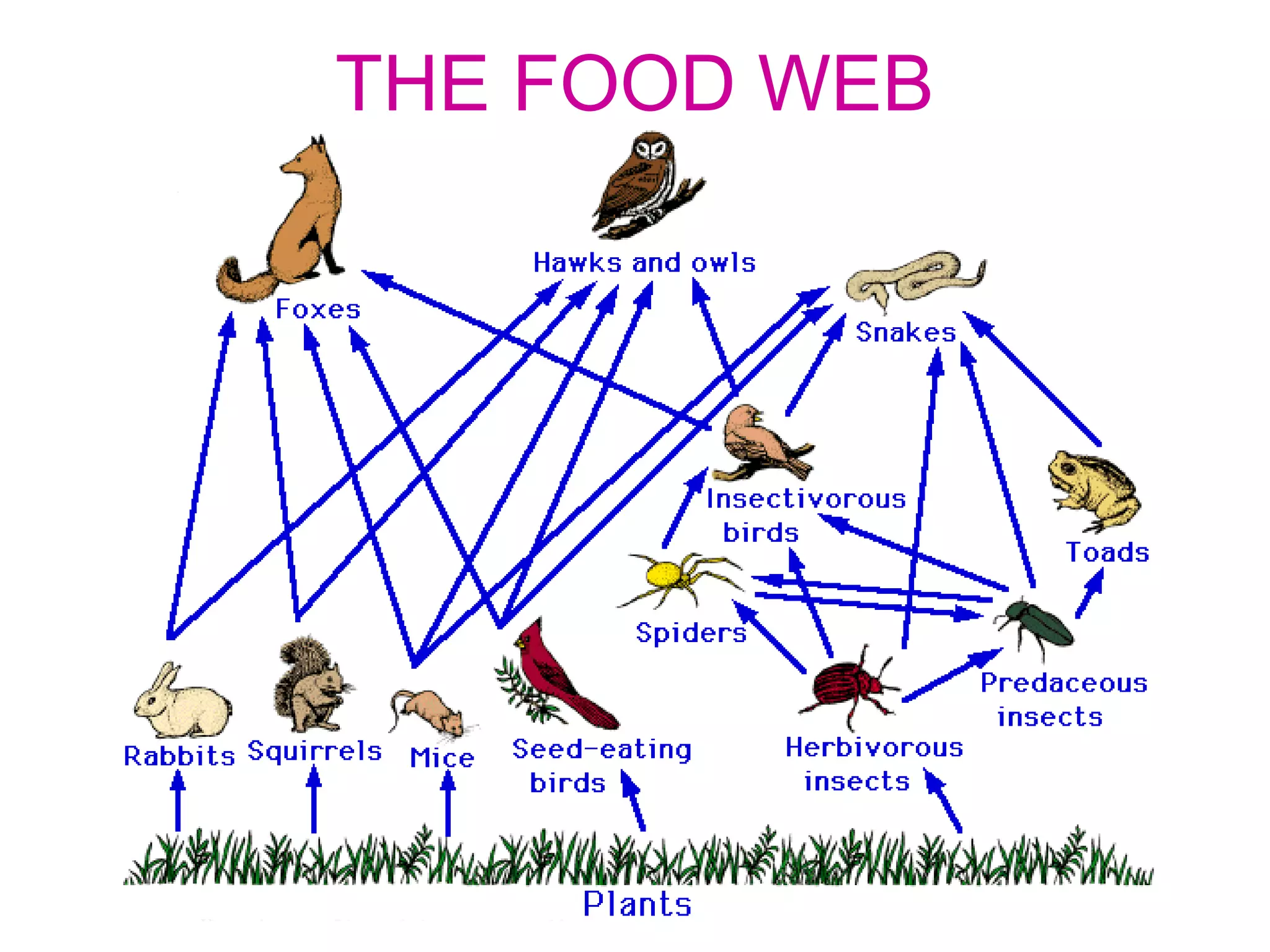
THE FOOD WEB
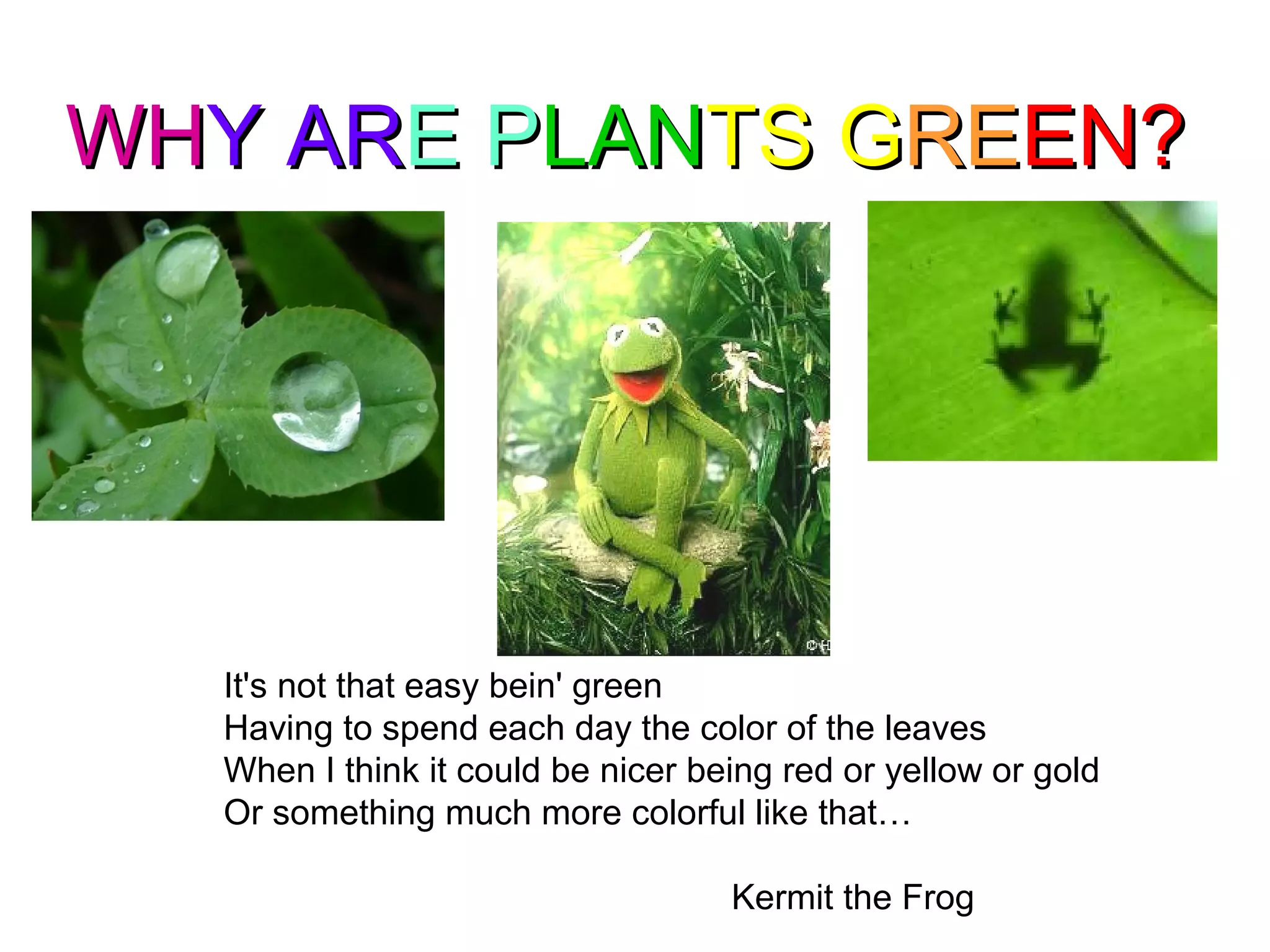
WHWHY ARY ARE PE PLANLANTS GTS GREREEN?EN?
It's not that easy bein' green
Having to spend each day the color of the leaves
When I think it could be nicer being red or yellow or gold
Or something much more colorful like that…
Kermit the Frog
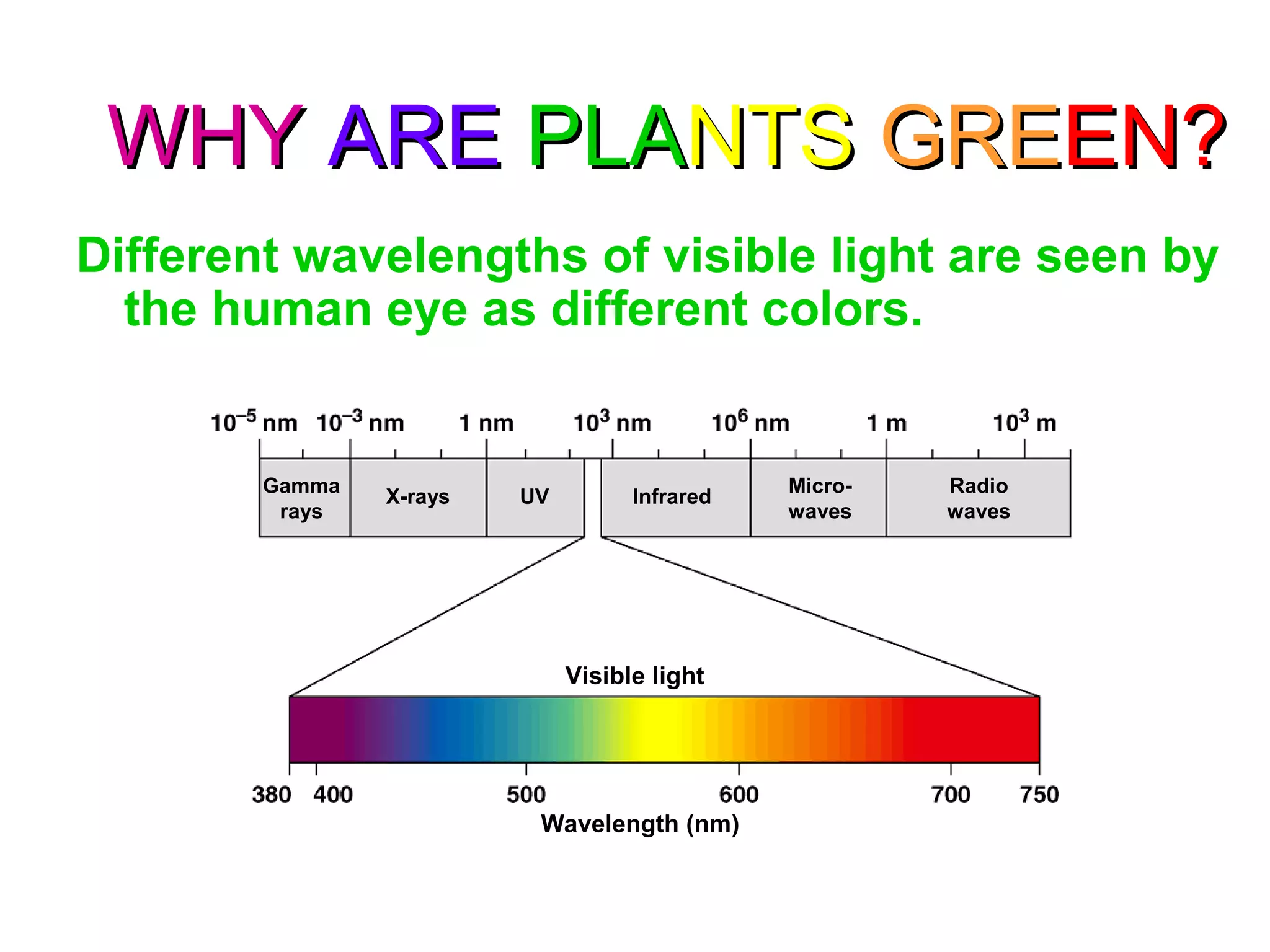
Electromagnetic Spectrum and
Visible Light
Gamma
rays X-rays UV
Infrared &
Microwaves Radio waves
Visible light
Wavelength (nm)
Different wavelengths of visible light are seen by
the human eye as different colors.
WHYWHY AREARE PLAPLANTSNTS GREGREEN?EN?
Gamma
rays
X-rays UV Infrared
Micro-
waves
Radio
waves
Visible light
Wavelength (nm)
Sunlight minus absorbedSunlight minus absorbed
wavelengths or colorswavelengths or colors
equals the apparent colorequals the apparent color
of an object.of an object.
The feathers of male cardinals
are loaded with carotenoid
pigments. These pigments
absorb some wavelengths of
light and reflect others.
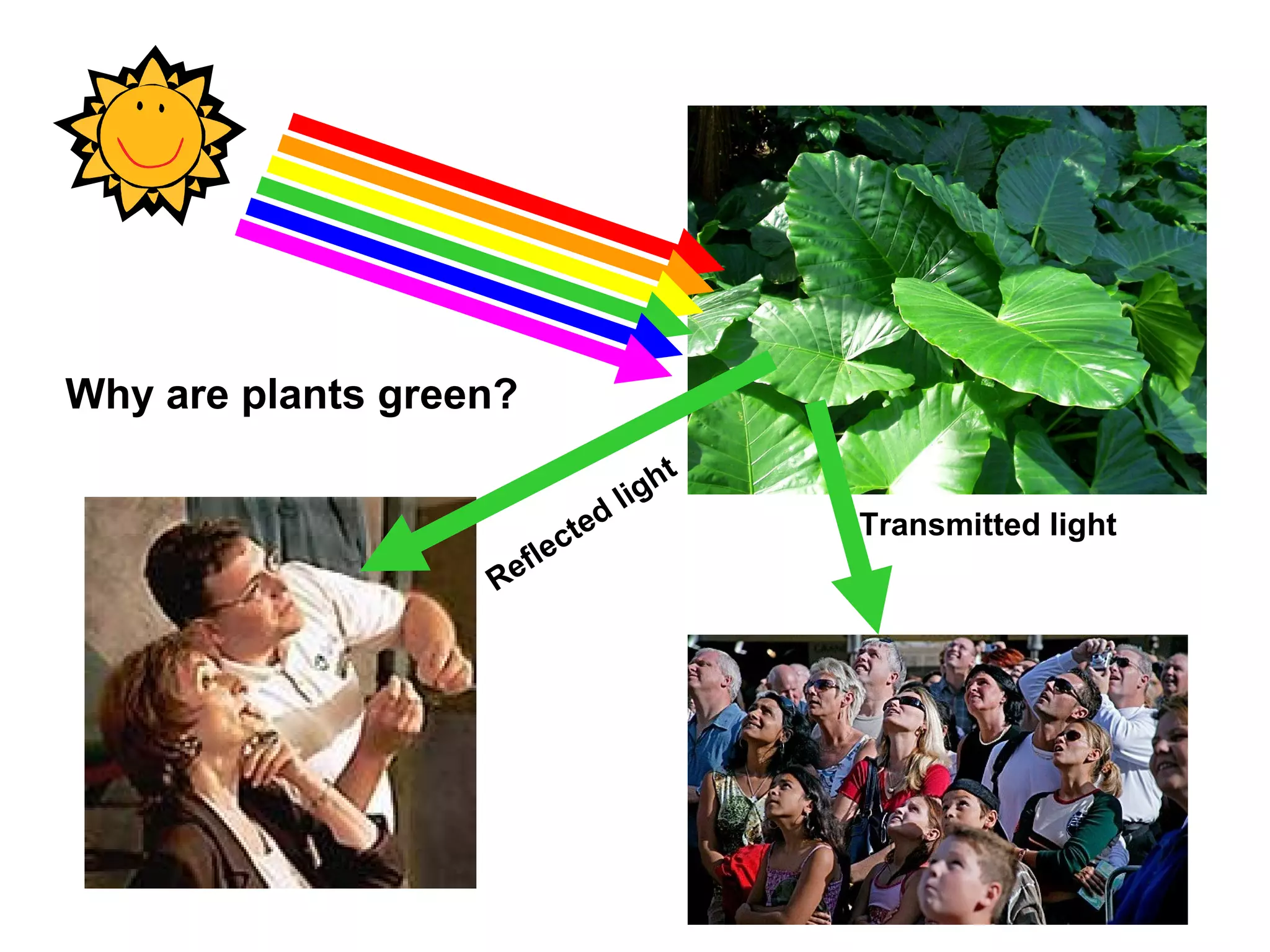
Reflected light
Why are plants green?
Reflected light
Transmitted light
WHYWHY AREARE PLAPLANTSNTS GREGREEN?EN?
Plant Cells
have Green
Chloroplasts
The thylakoid
membrane of the
chloroplast is
impregnated with
photosynthetic
pigments (i.e.,
chlorophylls,
carotenoids).
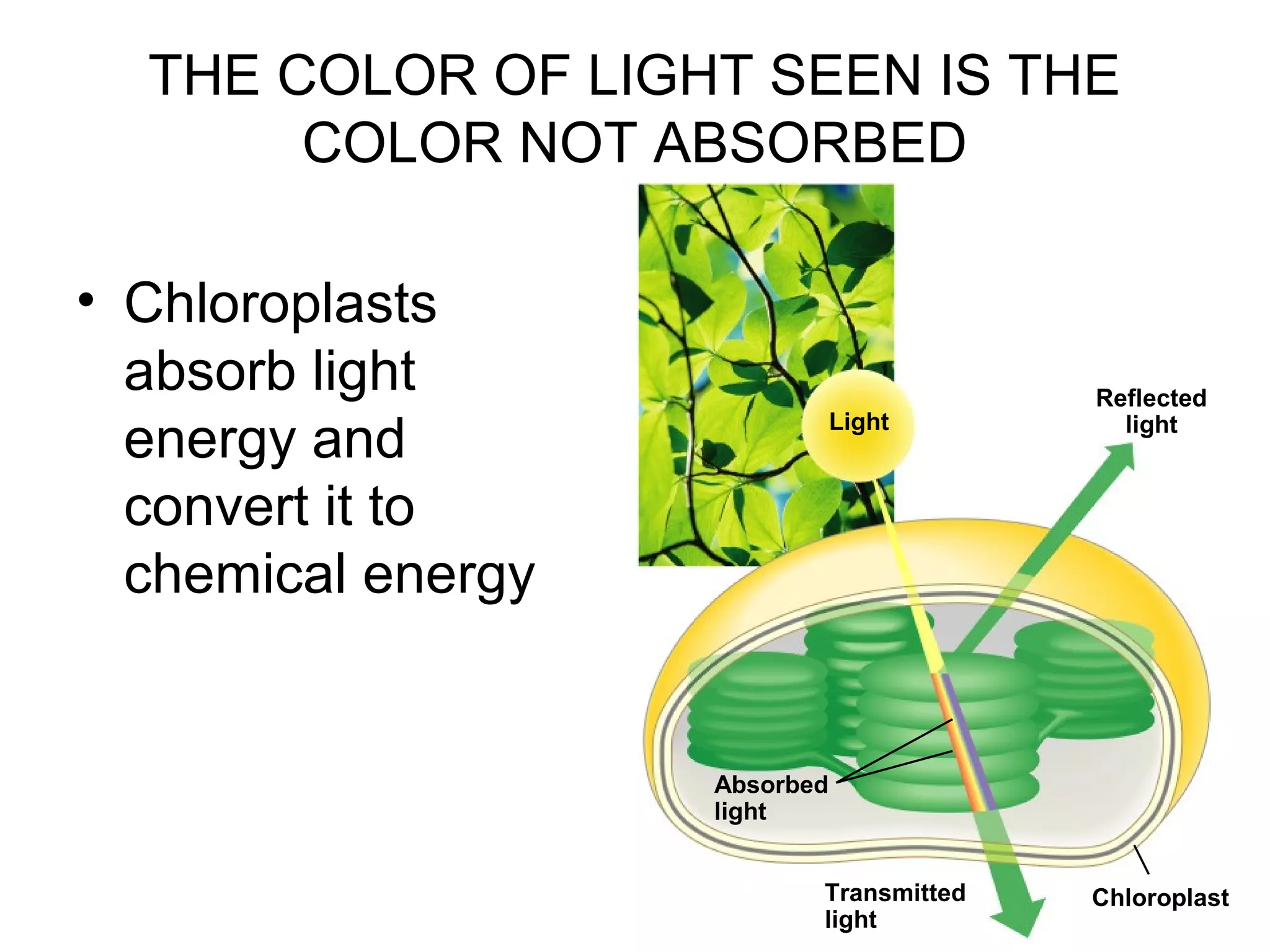
• Chloroplasts
absorb light
energy and
convert it to
chemical energy
Light
Reflected
light
Absorbed
light
Transmitted
light
Chloroplast
THE COLOR OF LIGHT SEEN IS THE
COLOR NOT ABSORBED
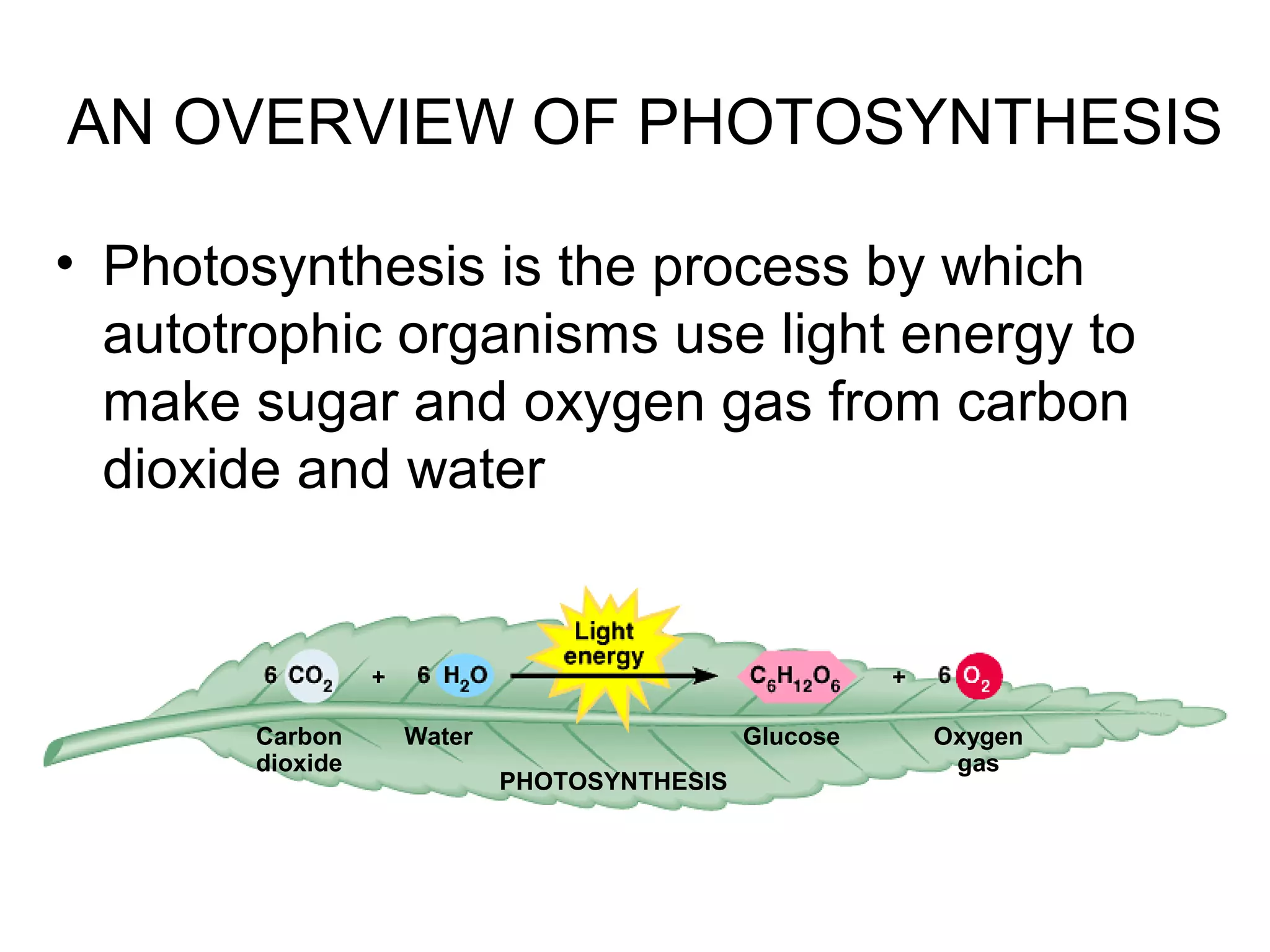
• Photosynthesis is the process by which
autotrophic organisms use light energy to
make sugar and oxygen gas from carbon
dioxide and water
AN OVERVIEW OF PHOTOSYNTHESIS
Carbon
dioxide
Water Glucose Oxygen
gas
PHOTOSYNTHESIS
• The Calvin cycle makes
sugar from carbon
dioxide
– ATP generated by the light
reactions provides the energy
for sugar synthesis
– The NADPH produced by the
light reactions provides the
electrons for the reduction of
carbon dioxide to glucose
Light
Chloroplast
Light
reactions
Calvin
cycle
NADP+
ADP
+ P
• The light reactions
convert solar
energy to chemical
energy
– Produce ATP & NADPH
AN OVERVIEW OF PHOTOSYNTHESIS
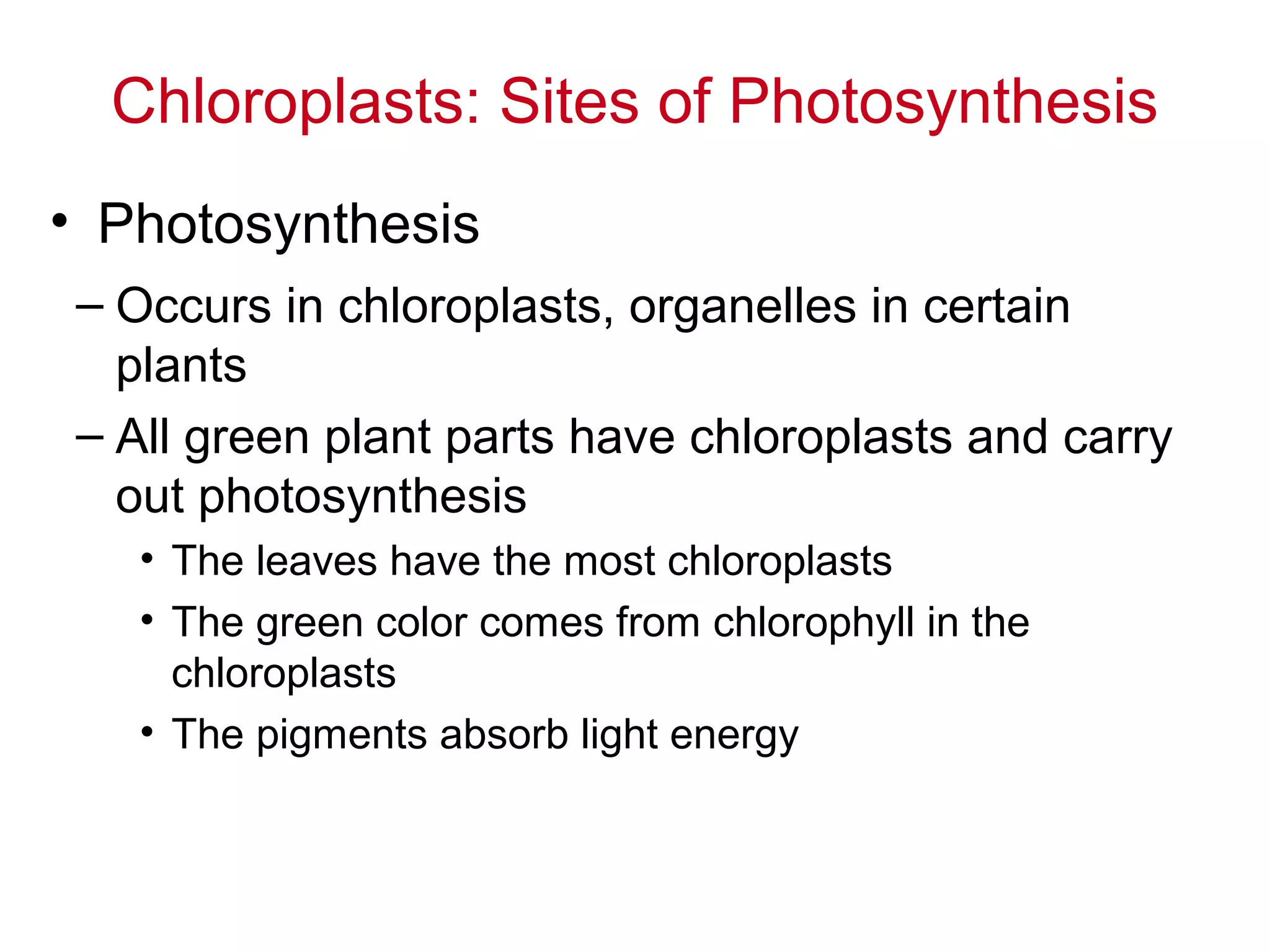
Chloroplasts: Sites of Photosynthesis
• Photosynthesis
– Occurs in chloroplasts, organelles in certain
plants
– All green plant parts have chloroplasts and carry
out photosynthesis
• The leaves have the most chloroplasts
• The green color comes from chlorophyll in the
chloroplasts
• The pigments absorb light energy
• In most plants, photosynthesis occurs
primarily in the leaves, in the chloroplasts
• A chloroplast contains:
– stroma, a fluid
– grana, stacks of thylakoids
• The thylakoids contain chlorophyll
– Chlorophyll is the green pigment that captures
light for photosynthesis
Photosynthesis occurs in chloroplasts
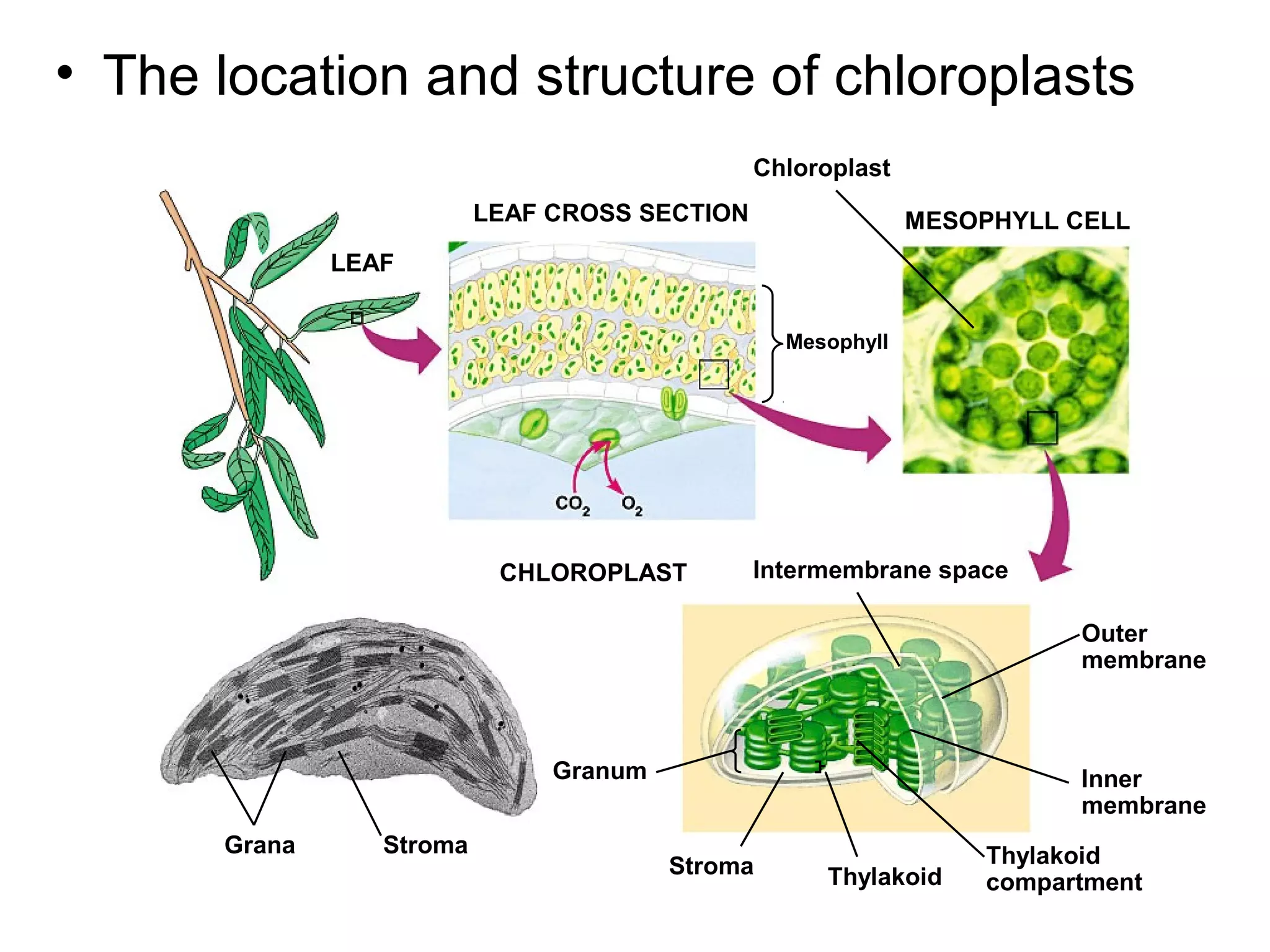
• The location and structure of chloroplasts
LEAF CROSS SECTION MESOPHYLL CELL
LEAF
Chloroplast
Mesophyll
CHLOROPLAST Intermembrane space
Outer
membrane
Inner
membrane
Thylakoid
compartmentThylakoidStroma
Granum
StromaGrana
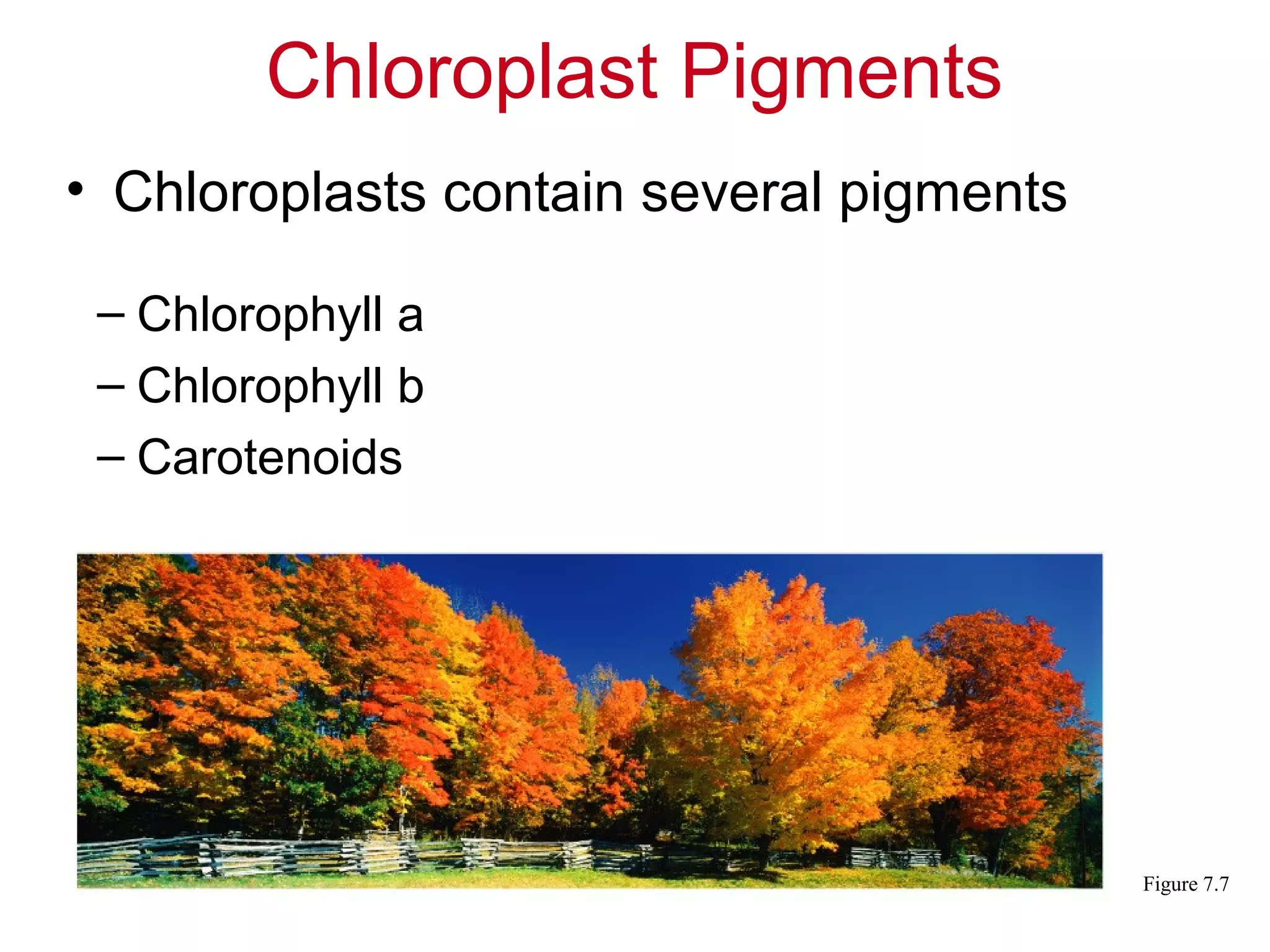
• Chloroplasts contain several pigments
Chloroplast Pigments
– Chlorophyll a
– Chlorophyll b
– Carotenoids
Figure 7.7
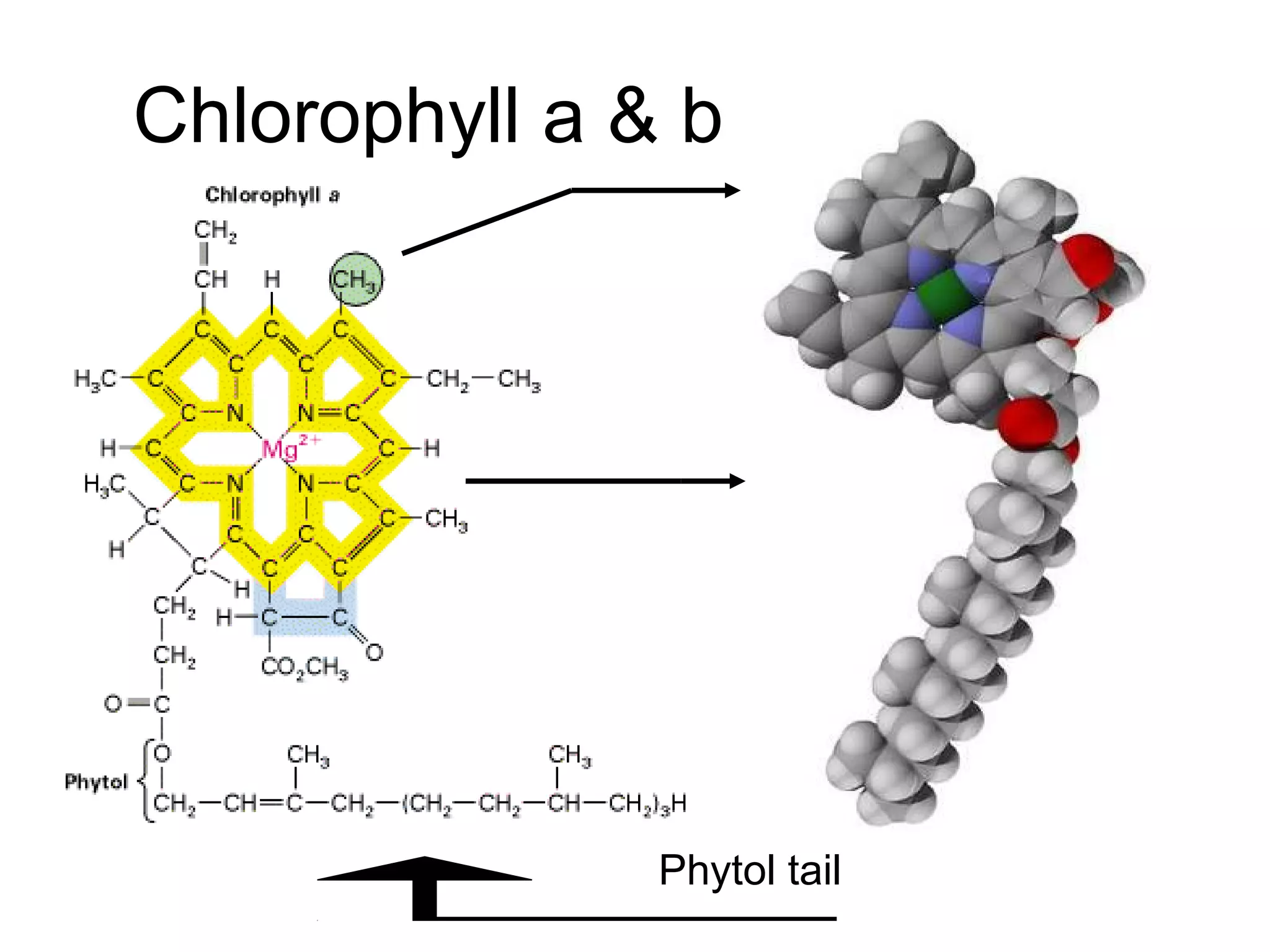
Chlorophyll a & b
•Chl a has a methyl
group
•Chl b has a carbonyl
group
Porphyrin ring
delocalized e-
Phytol tail
Different pigments absorb light
differently
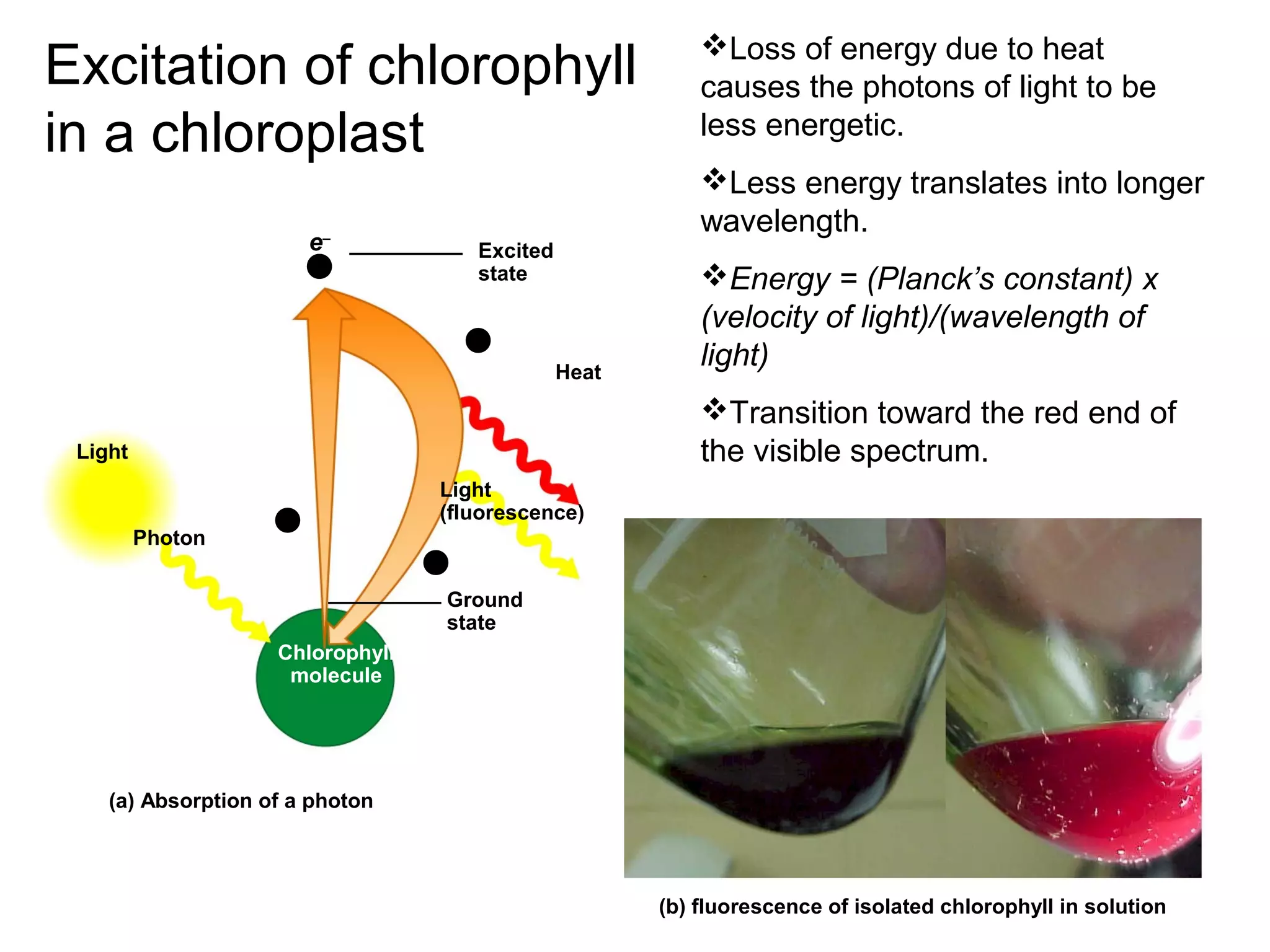
Excited
state
e−
Heat
Light
Photon
Light
(fluorescence)
Chlorophyll
molecule
Ground
state
2
(a) Absorption of a photon
(b) fluorescence of isolated chlorophyll in solution
Excitation of chlorophyll
in a chloroplast
Loss of energy due to heat
causes the photons of light to be
less energetic.
Less energy translates into longer
wavelength.
Energy = (Planck’s constant) x
(velocity of light)/(wavelength of
light)
Transition toward the red end of
the visible spectrum.
e−
Primary
electron acceptor
Photon
Reaction
center
PHOTOSYSTEM
Pigment
molecules
of antenna
Molecular Game of “Hot Potato”
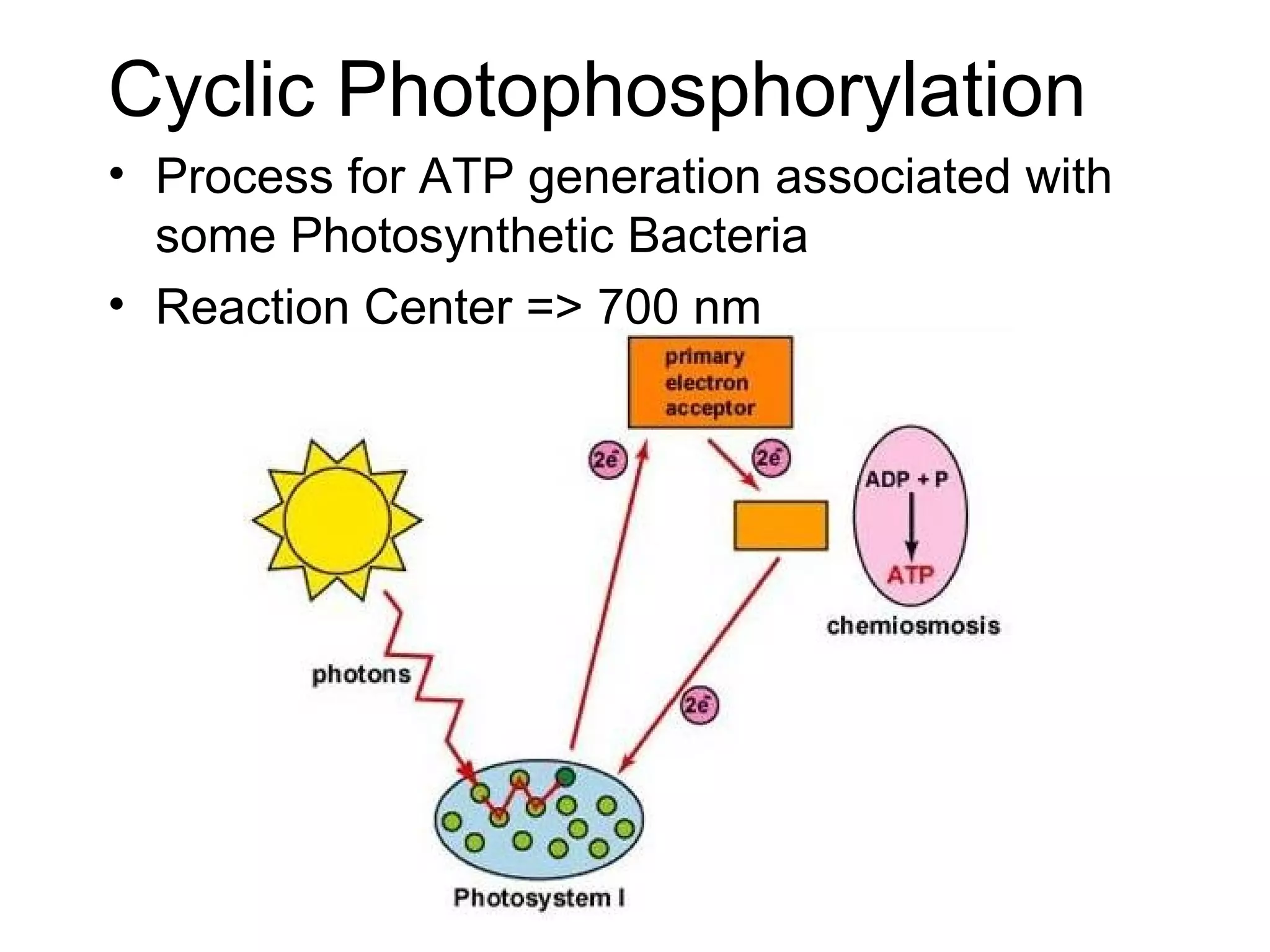
Cyclic Photophosphorylation
• Process for ATP generation associated with
some Photosynthetic Bacteria
• Reaction Center => 700 nm
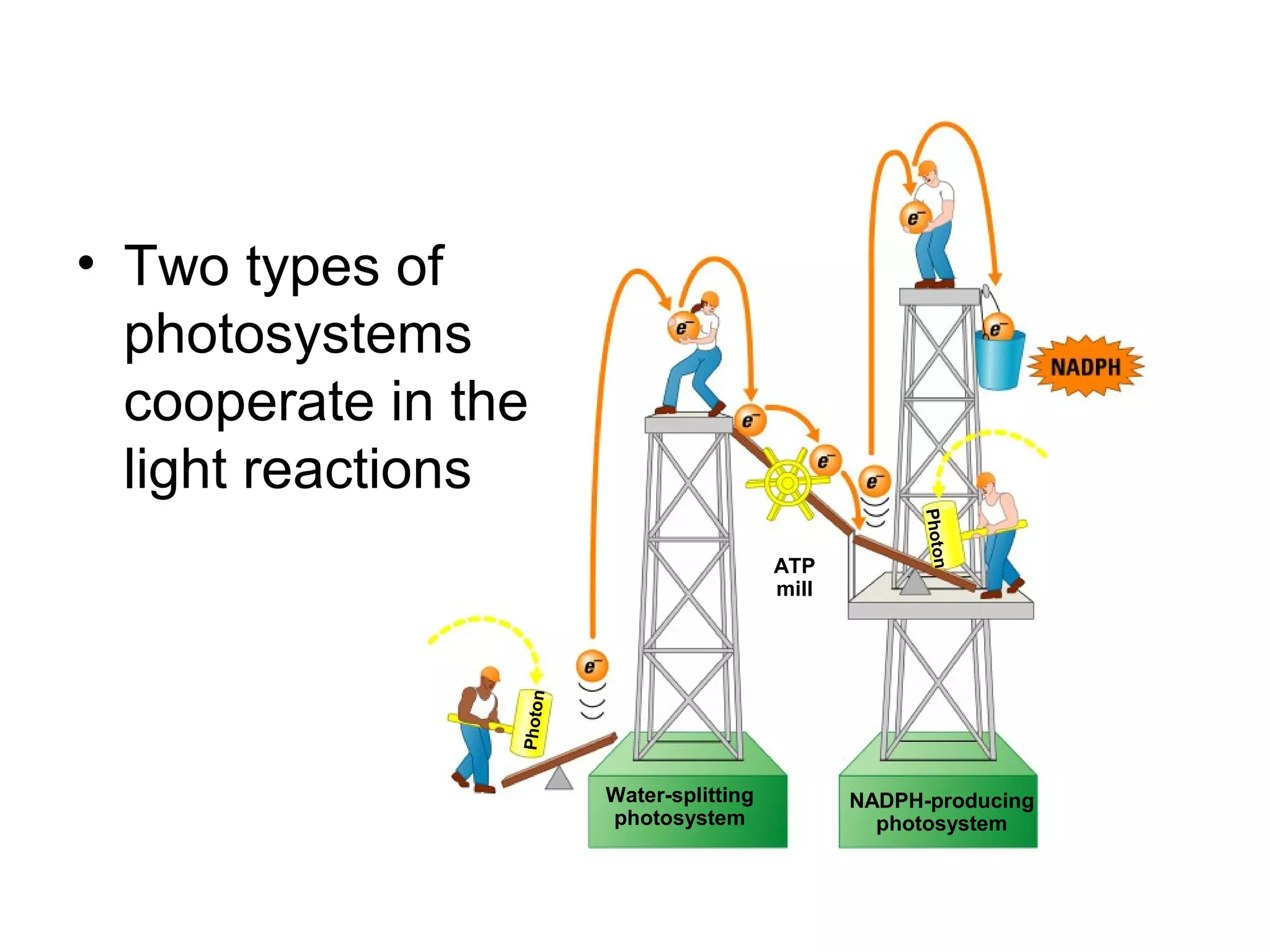
Photon
Photon
Water-splitting
photosystem
NADPH-producing
photosystem
ATP
mill
• Two types of
photosystems
cooperate in the
light reactions
Primary
electron acceptor
Primary
electron acceptor
Electron
transport chain
Electron
transport
Photons
PHOTOSYSTEM I
PHOTOSYSTEM II
Energy for
synthesis of
by chemiosmosis
Noncyclic Photophosphorylation
• Photosystem II regains electrons by splitting
water, leaving O2 gas as a by-product
• The O2 liberated by photosynthesis is made
from the oxygen in water (H+
and e-
)
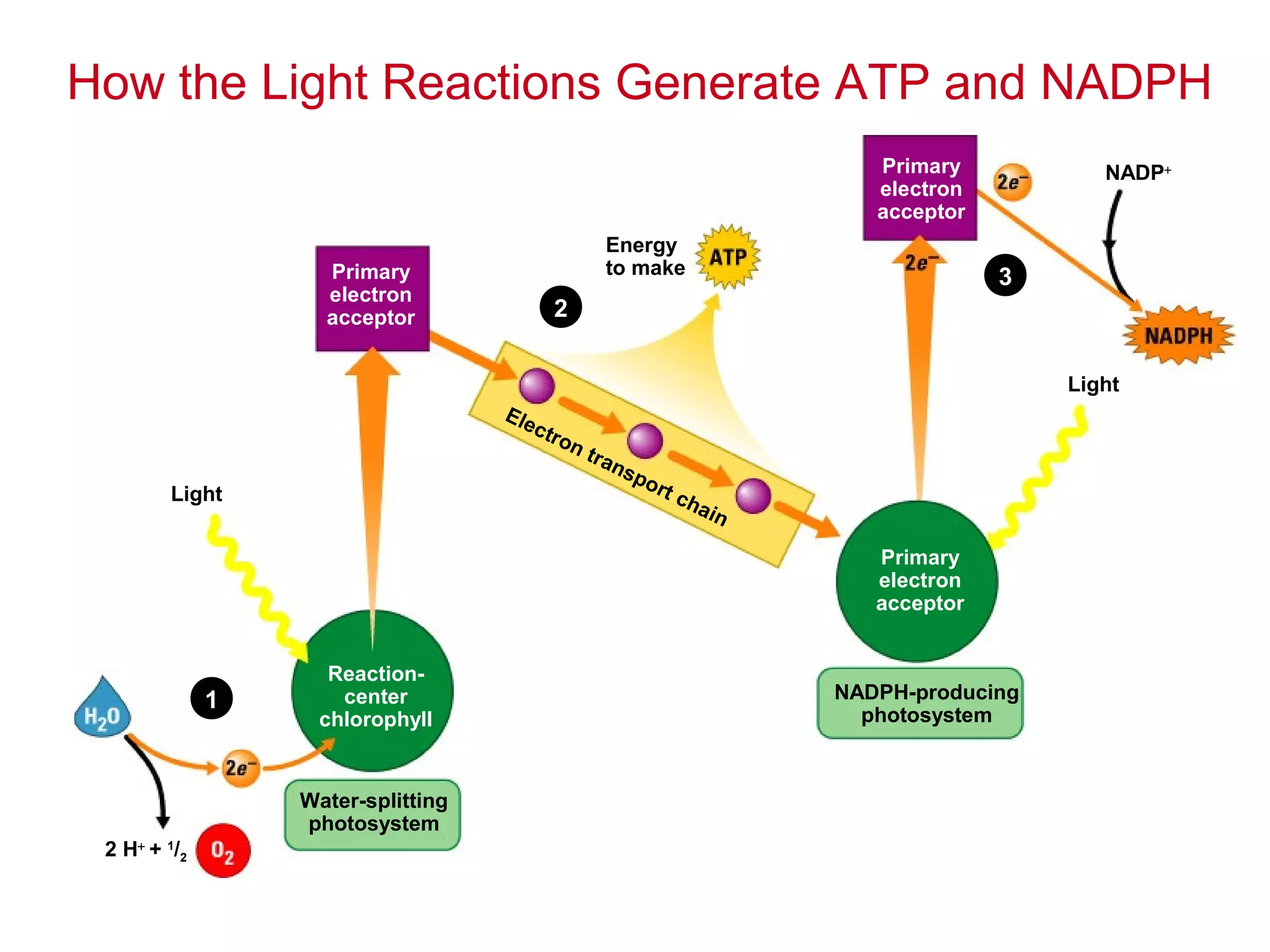
Plants produce OPlants produce O22 gas by splitting Hgas by splitting H22OO
2 H+
+ 1
/2
Water-splitting
photosystem
Reaction-
center
chlorophyll
Light
Primary
electron
acceptor
Energy
to make
Electron transport chain
Primary
electron
acceptor
Primary
electron
acceptor
NADPH-producing
photosystem
Light
NADP+
1
2
3
How the Light Reactions Generate ATP and NADPH
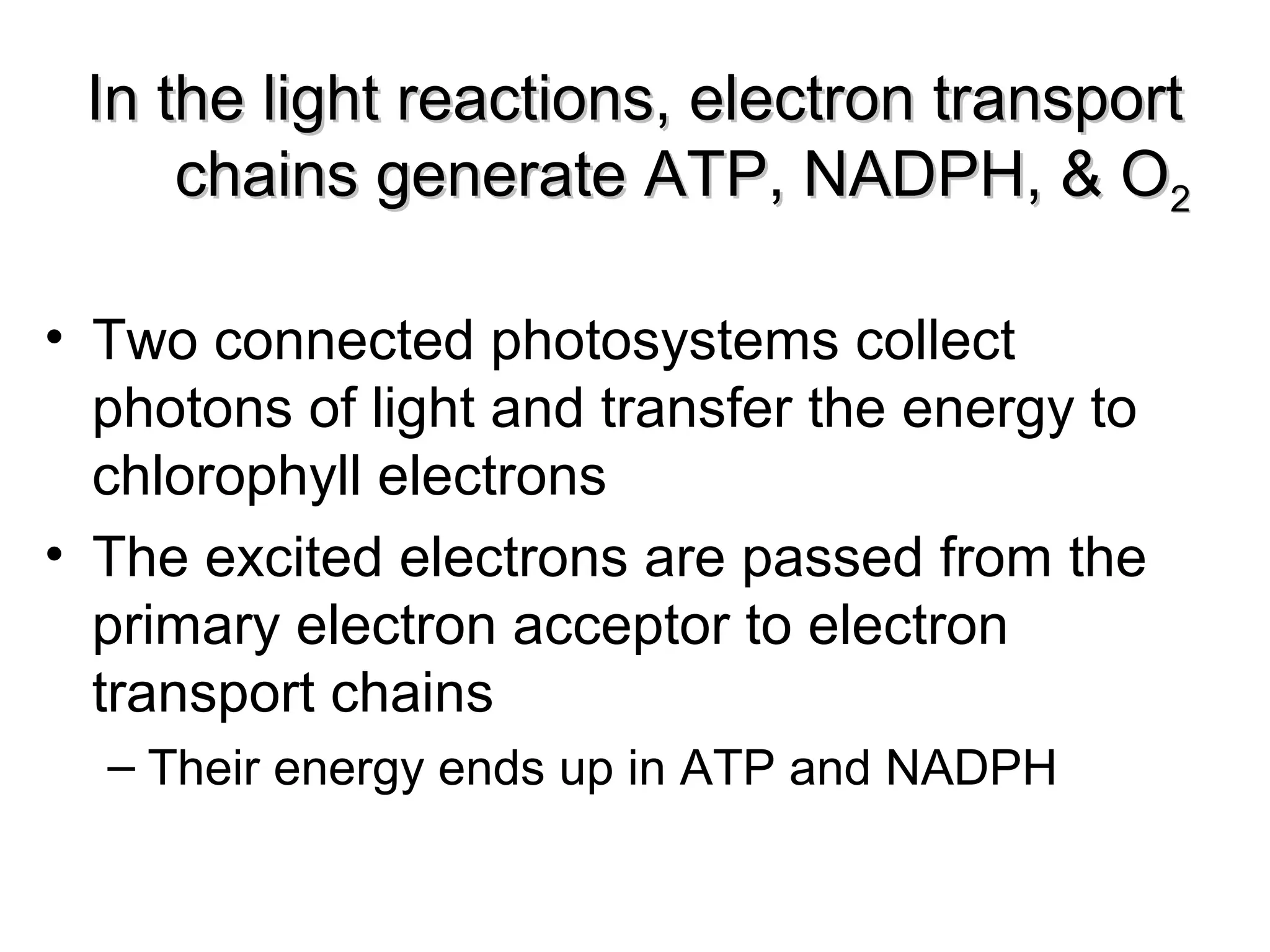
• Two connected photosystems collect
photons of light and transfer the energy to
chlorophyll electrons
• The excited electrons are passed from the
primary electron acceptor to electron
transport chains
– Their energy ends up in ATP and NADPH
In the light reactions, electron transportIn the light reactions, electron transport
chains generate ATP, NADPH, & Ochains generate ATP, NADPH, & O22
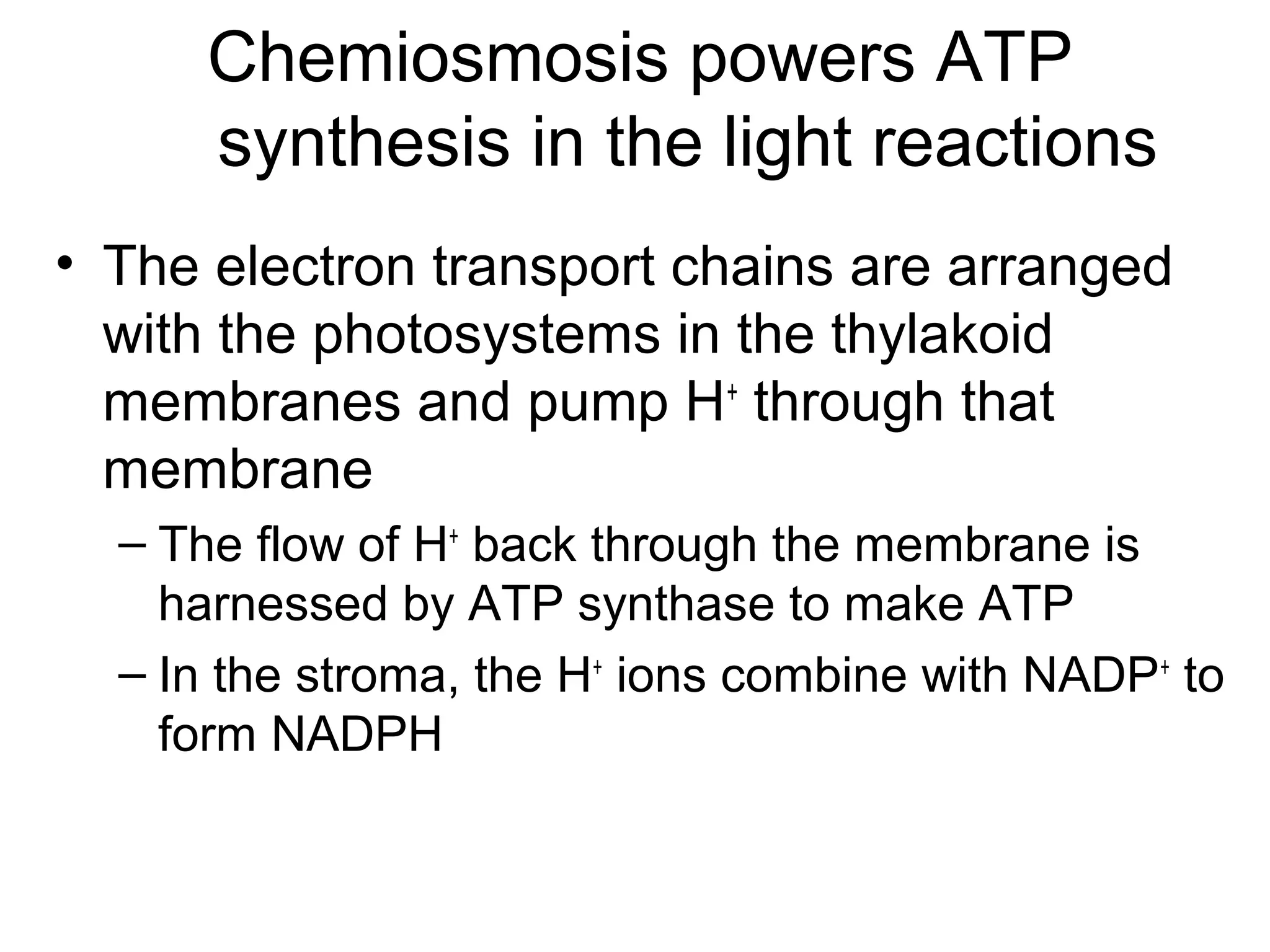
• The electron transport chains are arranged
with the photosystems in the thylakoid
membranes and pump H+
through that
membrane
– The flow of H+
back through the membrane is
harnessed by ATP synthase to make ATP
– In the stroma, the H+
ions combine with NADP+
to
form NADPH
Chemiosmosis powers ATP
synthesis in the light reactions
• The production of ATP by chemiosmosis in
photosynthesis
Thylakoid
compartment
(high H+
)
Thylakoid
membrane
Stroma
(low H+
)
Light
Antenna
molecules
Light
ELECTRON TRANSPORT
CHAIN
PHOTOSYSTEM II PHOTOSYSTEM I ATP SYNTHASE
• A Photosynthesis Road Map
Chloroplast
Light
Stack of
thylakoids ADP
+ P
NADP+
Stroma
Light
reactions
Calvin
cycle
Sugar used for
• Cellular respiration
• Cellulose
• Starch
• Other organic compounds
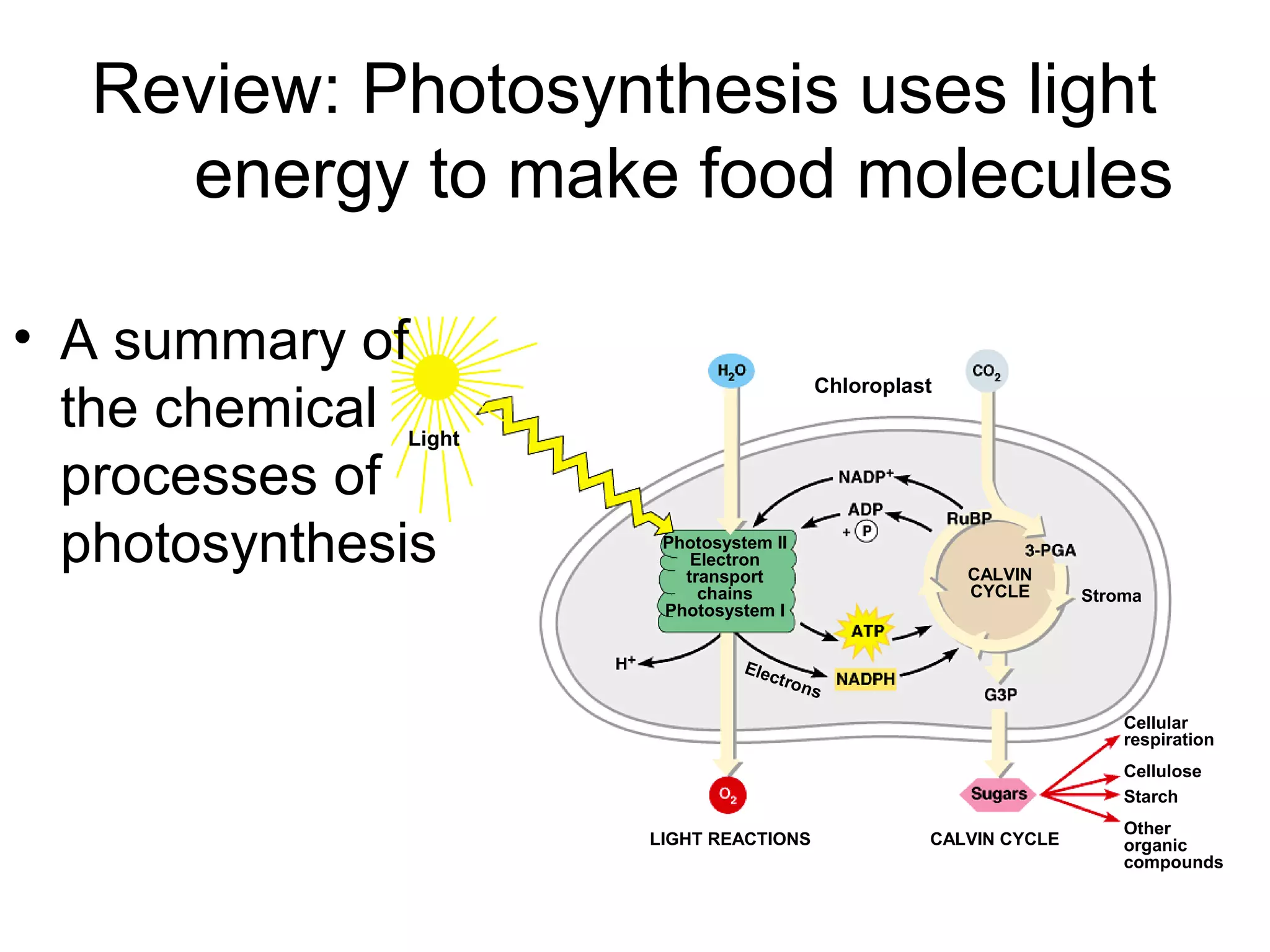
Review: Photosynthesis uses light
energy to make food molecules
Light
Chloroplast
Photosystem II
Electron
transport
chains
Photosystem I
CALVIN
CYCLE Stroma
Electrons
LIGHT REACTIONS CALVIN CYCLE
Cellular
respiration
Cellulose
Starch
Other
organic
compounds
• A summary of
the chemical
processes of
photosynthesis
It's not thatIt's not that
easy bein'easy bein'
green… but itgreen… but it
is essential foris essential for
life on earth!life on earth!

Photosynthesis PPT FOR CLASS 9,10 and 11Th students

  • 1.
    By the endof this lecture you will be able to: 1. Understand that ENERGY can be transformed from one form to another. 2. Know that energy exist in two forms; free energy - available for doing work or as heat - a form unavailable for doing work. 3. Appreciate that the Sun provides most of the energy needed for life on Earth. 4. Explain why photosynthesis is so important to energy and material flow for life on earth. 5. Know why plants tend to be green in appearance. 6. Equate the organelle of photosynthesis in eukaryotes with the chloroplast. 7. Describe the organization of the chloroplast. 8. Understand that photosynthesis is a two fold process composed of the light-dependent reactions (i.e., light reactions) and the light independent reactions (i.e. Calvin Cycle or Dark Reactions). 9. Tell where the light reactions and the CO2 fixation reactions occur in the chloroplast. 10. Define chlorophylls giving their basic composition and structure. 11. Draw the absorption spectrum of chlorophyll and compare it to the action spectrum of photosynthesis. 12. Define the Reaction Centers and Antennae and describe how it operates. 13. Describe cyclic photophosphorylation of photosynthesis. 14. Describe noncyclic photophosphorylation of photosynthesis. LEARNING OBJECTIVES
  • 2.
    Energy can betransformed from one form to another FREE ENERGY (available for work) vs. HEAT (not available for work)
  • 3.
    THE SUN: MAINSOURCE OF ENERGY FOR LIFE ON EARTH
  • 4.
    • Almost allplants are photosynthetic autotrophs, as are some bacteria and protists – Autotrophs generate their own organic matter through photosynthesis – Sunlight energy is transformed to energy stored in the form of chemical bonds (a) Mosses, ferns, and flowering plants (b) Kelp (c) Euglena (d) Cyanobacteria THE BASICS OF PHOTOSYNTHESIS
  • 5.
    Light Energy Harvestedby Plants & Other Photosynthetic Autotrophs 6 CO2 + 6 H2O + light energy → C6H12O6 + 6 O2
  • 6.
  • 7.
  • 8.
    WHWHY ARY AREPE PLANLANTS GTS GREREEN?EN? It's not that easy bein' green Having to spend each day the color of the leaves When I think it could be nicer being red or yellow or gold Or something much more colorful like that… Kermit the Frog
  • 9.
    Electromagnetic Spectrum and VisibleLight Gamma rays X-rays UV Infrared & Microwaves Radio waves Visible light Wavelength (nm)
  • 10.
    Different wavelengths ofvisible light are seen by the human eye as different colors. WHYWHY AREARE PLAPLANTSNTS GREGREEN?EN? Gamma rays X-rays UV Infrared Micro- waves Radio waves Visible light Wavelength (nm)
  • 11.
    Sunlight minus absorbedSunlightminus absorbed wavelengths or colorswavelengths or colors equals the apparent colorequals the apparent color of an object.of an object. The feathers of male cardinals are loaded with carotenoid pigments. These pigments absorb some wavelengths of light and reflect others. Reflected light
  • 12.
    Why are plantsgreen? Reflected light Transmitted light
  • 13.
    WHYWHY AREARE PLAPLANTSNTSGREGREEN?EN? Plant Cells have Green Chloroplasts The thylakoid membrane of the chloroplast is impregnated with photosynthetic pigments (i.e., chlorophylls, carotenoids).
  • 14.
    • Chloroplasts absorb light energyand convert it to chemical energy Light Reflected light Absorbed light Transmitted light Chloroplast THE COLOR OF LIGHT SEEN IS THE COLOR NOT ABSORBED
  • 15.
    • Photosynthesis isthe process by which autotrophic organisms use light energy to make sugar and oxygen gas from carbon dioxide and water AN OVERVIEW OF PHOTOSYNTHESIS Carbon dioxide Water Glucose Oxygen gas PHOTOSYNTHESIS
  • 16.
    • The Calvincycle makes sugar from carbon dioxide – ATP generated by the light reactions provides the energy for sugar synthesis – The NADPH produced by the light reactions provides the electrons for the reduction of carbon dioxide to glucose Light Chloroplast Light reactions Calvin cycle NADP+ ADP + P • The light reactions convert solar energy to chemical energy – Produce ATP & NADPH AN OVERVIEW OF PHOTOSYNTHESIS
  • 17.
    Chloroplasts: Sites ofPhotosynthesis • Photosynthesis – Occurs in chloroplasts, organelles in certain plants – All green plant parts have chloroplasts and carry out photosynthesis • The leaves have the most chloroplasts • The green color comes from chlorophyll in the chloroplasts • The pigments absorb light energy
  • 18.
    • In mostplants, photosynthesis occurs primarily in the leaves, in the chloroplasts • A chloroplast contains: – stroma, a fluid – grana, stacks of thylakoids • The thylakoids contain chlorophyll – Chlorophyll is the green pigment that captures light for photosynthesis Photosynthesis occurs in chloroplasts
  • 19.
    • The locationand structure of chloroplasts LEAF CROSS SECTION MESOPHYLL CELL LEAF Chloroplast Mesophyll CHLOROPLAST Intermembrane space Outer membrane Inner membrane Thylakoid compartmentThylakoidStroma Granum StromaGrana
  • 20.
    • Chloroplasts containseveral pigments Chloroplast Pigments – Chlorophyll a – Chlorophyll b – Carotenoids Figure 7.7
  • 21.
    Chlorophyll a &b •Chl a has a methyl group •Chl b has a carbonyl group Porphyrin ring delocalized e- Phytol tail
  • 22.
    Different pigments absorblight differently
  • 23.
    Excited state e− Heat Light Photon Light (fluorescence) Chlorophyll molecule Ground state 2 (a) Absorption ofa photon (b) fluorescence of isolated chlorophyll in solution Excitation of chlorophyll in a chloroplast Loss of energy due to heat causes the photons of light to be less energetic. Less energy translates into longer wavelength. Energy = (Planck’s constant) x (velocity of light)/(wavelength of light) Transition toward the red end of the visible spectrum. e−
  • 24.
  • 25.
    Cyclic Photophosphorylation • Processfor ATP generation associated with some Photosynthetic Bacteria • Reaction Center => 700 nm
  • 26.
  • 27.
    Primary electron acceptor Primary electron acceptor Electron transportchain Electron transport Photons PHOTOSYSTEM I PHOTOSYSTEM II Energy for synthesis of by chemiosmosis Noncyclic Photophosphorylation • Photosystem II regains electrons by splitting water, leaving O2 gas as a by-product
  • 28.
    • The O2liberated by photosynthesis is made from the oxygen in water (H+ and e- ) Plants produce OPlants produce O22 gas by splitting Hgas by splitting H22OO
  • 29.
    2 H+ + 1 /2 Water-splitting photosystem Reaction- center chlorophyll Light Primary electron acceptor Energy tomake Electron transport chain Primary electron acceptor Primary electron acceptor NADPH-producing photosystem Light NADP+ 1 2 3 How the Light Reactions Generate ATP and NADPH
  • 30.
    • Two connectedphotosystems collect photons of light and transfer the energy to chlorophyll electrons • The excited electrons are passed from the primary electron acceptor to electron transport chains – Their energy ends up in ATP and NADPH In the light reactions, electron transportIn the light reactions, electron transport chains generate ATP, NADPH, & Ochains generate ATP, NADPH, & O22
  • 31.
    • The electrontransport chains are arranged with the photosystems in the thylakoid membranes and pump H+ through that membrane – The flow of H+ back through the membrane is harnessed by ATP synthase to make ATP – In the stroma, the H+ ions combine with NADP+ to form NADPH Chemiosmosis powers ATP synthesis in the light reactions
  • 32.
    • The productionof ATP by chemiosmosis in photosynthesis Thylakoid compartment (high H+ ) Thylakoid membrane Stroma (low H+ ) Light Antenna molecules Light ELECTRON TRANSPORT CHAIN PHOTOSYSTEM II PHOTOSYSTEM I ATP SYNTHASE
  • 33.
    • A PhotosynthesisRoad Map Chloroplast Light Stack of thylakoids ADP + P NADP+ Stroma Light reactions Calvin cycle Sugar used for • Cellular respiration • Cellulose • Starch • Other organic compounds
  • 34.
    Review: Photosynthesis useslight energy to make food molecules Light Chloroplast Photosystem II Electron transport chains Photosystem I CALVIN CYCLE Stroma Electrons LIGHT REACTIONS CALVIN CYCLE Cellular respiration Cellulose Starch Other organic compounds • A summary of the chemical processes of photosynthesis
  • 35.
    It's not thatIt'snot that easy bein'easy bein' green… but itgreen… but it is essential foris essential for life on earth!life on earth!

Editor's Notes

  • #2 <number>
  • #3 <number>
  • #4 <number>
  • #5 <number>
  • #6 <number>
  • #7 <number>
  • #8 <number>
  • #9 <number>
  • #10 <number>
  • #11 <number>
  • #12 <number>
  • #13 <number>
  • #14 <number>
  • #15 <number>
  • #16 <number>
  • #17 <number>
  • #18 <number>
  • #19 <number>
  • #20 <number>
  • #21 <number>
  • #22 <number>
  • #23 <number>
  • #24 <number>
  • #25 <number>
  • #26 <number>
  • #27 <number>
  • #28 <number>
  • #29 <number>
  • #30 <number>
  • #31 <number>
  • #32 <number>
  • #33 <number>
  • #34 <number>
  • #35 <number>
  • #36 <number>