PHOTOSYNTHESIS
UNIT-I
Overview: The Process That Feeds the
Biosphere
 Photosynthesis is the process that converts solar energy into chemical
energy. Or we can say in different word,
 Photosynthesis is the process a plant uses to make food and grow.
 Directly or indirectly, photosynthesis nourishes almost the entire living
world.
 Photosynthesis occurs in plants, algae, certain other protists, and some
prokaryotes.
 These organisms feed not only themselves but also the entire living world.
 Autotrophs are the producers of the biosphere, producing organic molecules from CO2
and other inorganic molecules.
 Almost all plants are photoautotrophs, using the energy of sunlight to make organic
molecules from water and carbon dioxide
 Heterotrophs obtain their organic material from other organisms
 Heterotrophs are the consumers of the biosphere
 Almost all heterotrophs, including humans, depend on photoautotrophs for food and
oxygen
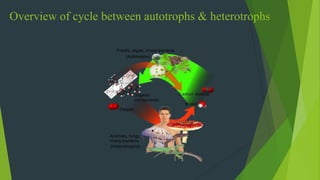
Overview of cycle between autotrophs & heterotrophs
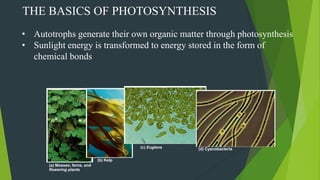
• Autotrophs generate their own organic matter through photosynthesis
• Sunlight energy is transformed to energy stored in the form of
chemical bonds
(a) Mosses, ferns, and
flowering plants
(b) Kelp
(c) Euglena (d) Cyanobacteria
THE BASICS OF PHOTOSYNTHESIS
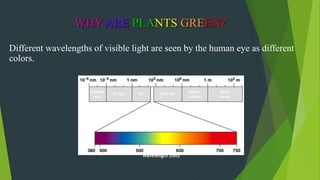
Different wavelengths of visible light are seen by the human eye as different
colors.
WHY ARE PLANTS GREEN?
Gamma
rays
X-rays UV Infrared
Micro-
waves
Radio
waves
Visible light
Wavelength (nm)
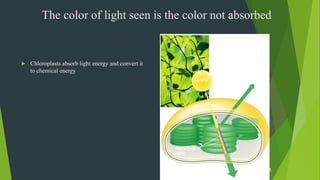
 Chloroplasts absorb light energy and convert it
to chemical energy
Light
Reflected
light
Absorbed
light
Transmitted
light
Chloroplast
The color of light seen is the color not absorbed
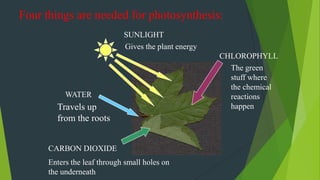
Four things are needed for photosynthesis:
Travels up
from the roots
WATER
CARBON DIOXIDE
Enters the leaf through small holes on
the underneath
SUNLIGHT
Gives the plant energy
CHLOROPHYLL
The green
stuff where
the chemical
reactions
happen
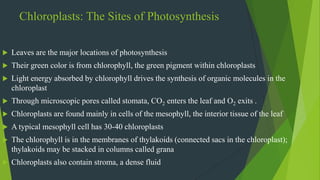
Chloroplasts: The Sites of Photosynthesis
 Leaves are the major locations of photosynthesis
 Their green color is from chlorophyll, the green pigment within chloroplasts
 Light energy absorbed by chlorophyll drives the synthesis of organic molecules in the
chloroplast
 Through microscopic pores called stomata, CO2 enters the leaf and O2 exits .
 Chloroplasts are found mainly in cells of the mesophyll, the interior tissue of the leaf
 A typical mesophyll cell has 30-40 chloroplasts
 The chlorophyll is in the membranes of thylakoids (connected sacs in the chloroplast);
thylakoids may be stacked in columns called grana
 Chloroplasts also contain stroma, a dense fluid
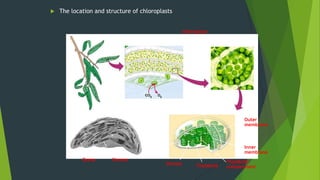
 The location and structure of chloroplasts
LEAF CROSS SECTION MESOPHYLL CELL
LEAF
Chloroplast
Mesophyll
CHLOROPLAST Intermembrane space
Outer
membrane
Inner
membrane
Thylakoid
compartmentThylakoidStroma
Granum
StromaGrana
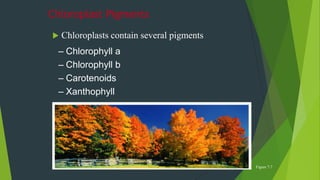
Chloroplast Pigments
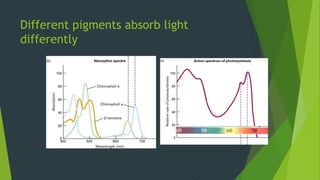
 Chloroplasts contain several pigments
– Chlorophyll a
– Chlorophyll b
– Carotenoids
– Xanthophyll
Figure 7.7
Different pigments absorb light
differently
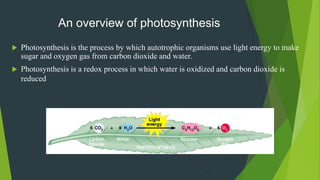
 Photosynthesis is the process by which autotrophic organisms use light energy to make
sugar and oxygen gas from carbon dioxide and water.
 Photosynthesis is a redox process in which water is oxidized and carbon dioxide is
reduced
An overview of photosynthesis
Carbon
dioxide
Water Glucose Oxygen
gas
PHOTOSYNTHESIS
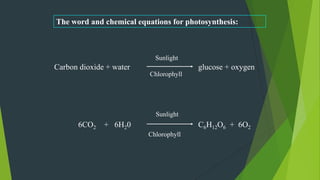
The word and chemical equations for photosynthesis:
Carbon dioxide + water glucose + oxygen
6CO2 + 6H20 C6H12O6 + 6O2
Sunlight
Chlorophyll
Sunlight
Chlorophyll
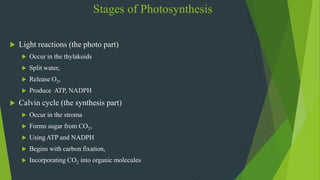
Stages of Photosynthesis
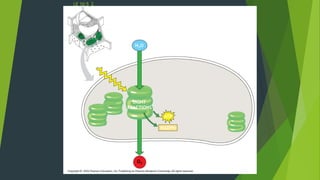
 Light reactions (the photo part)
 Occur in the thylakoids
 Split water,
 Release O2,
 Produce ATP, NADPH
 Calvin cycle (the synthesis part)
 Occur in the stroma
 Forms sugar from CO2,
 Using ATP and NADPH
 Begins with carbon fixation,
 Incorporating CO2 into organic molecules
LE 10-5_2
H2O
LIGHT
REACTIONS
Chloroplast
Light
ATP
NADPH
O2
LE 10-5_3
H2O
LIGHT
REACTIONS
Chloroplast
Light
ATP
NADPH
O2
NADP+
CO2
ADP
P+ i
CALVIN
CYCLE
[CH2O]
(sugar)
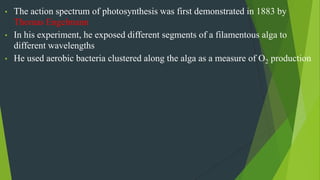
• The action spectrum of photosynthesis was first demonstrated in 1883 by
Thomas Engelmann
• In his experiment, he exposed different segments of a filamentous alga to
different wavelengths
• He used aerobic bacteria clustered along the alga as a measure of O2 production
A Photosystem: A Reaction Center Associated with Light-
Harvesting Complexes
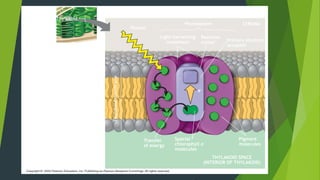
 A photosystem consists of a reaction center surrounded by light-harvesting
complexes
 The light-harvesting complexes (pigment molecules bound to proteins) funnel
the energy of photons to the reaction center.
• There are two types of photosystems in the thylakoid membrane
• Photosystem II functions first (the numbers reflect order of discovery) and is best at
absorbing a wavelength of 680 nm
• Photosystem I is best at absorbing a wavelength of 700 nm
• The two photosystems work together to use light energy to generate ATP and
NADPH
Thylakoid
Photon
Light-harvesting
complexes
Photosystem
Reaction
center
STROMA
Primary electron
acceptor
e–
Transfer
of energy
Special
chlorophyll a
molecules
Pigment
molecules
THYLAKOID SPACE
(INTERIOR OF THYLAKOID)
Thylakoidmembrane
Photophosphorylation
 Two types of Photophosphorylation
 Cyclic
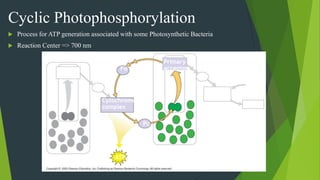
 Photosystem1 (best work at 700nm)
 produces only ATP
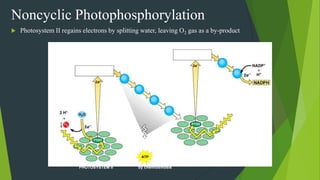
 Non-cyclic
 Photosystem2 (best work at 680nm) and photosystem1 (best work at
700nm)
 produces only ATP and NADPH
Cyclic Photophosphorylation
 Process for ATP generation associated with some Photosynthetic Bacteria
 Reaction Center => 700 nm
Cytochrome
complex
Fd
Pc
Primary
acceptor
Photosystem I
ATP
Primary
electron acceptor
Primary
electron acceptor
Photons
PHOTOSYSTEM I
PHOTOSYSTEM II
Energy for
synthesis of
by chemiosmosis
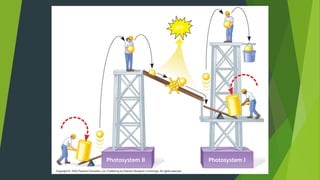
Noncyclic Photophosphorylation
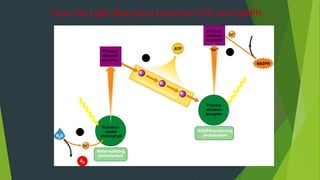
 Photosystem II regains electrons by splitting water, leaving O2 gas as a by-product
ATP
Photosystem II
e–
e–
e–
e–
Mill
makes
ATP
e–
e–
e–
Photosystem I
NADPH
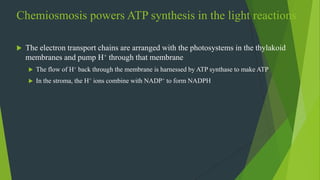
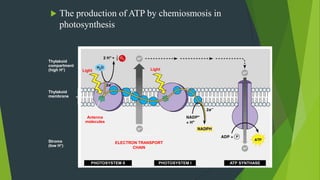
Chemiosmosis powers ATP synthesis in the light reactions
 The electron transport chains are arranged with the photosystems in the thylakoid
membranes and pump H+ through that membrane
 The flow of H+ back through the membrane is harnessed by ATP synthase to make ATP
 In the stroma, the H+ ions combine with NADP+ to form NADPH
2 H + 1/2
Water-splitting
photosystem
Reaction-
center
chlorophyll
Light
Primary
electron
acceptor
Energy
to make
Primary
electron
acceptor
Primary
electron
acceptor
NADPH-producing
photosystem
Light
NADP
1
2
3
How the Light Reactions Generate ATP and NADPH
 The production of ATP by chemiosmosis in
photosynthesis
Thylakoid
compartment
(high H+)
Thylakoid
membrane
Stroma
(low H+)
Light
Antenna
molecules
Light
ELECTRON TRANSPORT
CHAIN
PHOTOSYSTEM II PHOTOSYSTEM I ATP SYNTHASE
The Calvin cycle uses ATP and NADPH to convert CO2 to
sugar
 The Calvin cycle, like the citric acid cycle, regenerates its starting material after molecules
enter and leave the cycle
 The cycle builds sugar from smaller molecules by using ATP and the reducing power of
electrons carried by NADPH
 Carbon enters the cycle as CO2 and leaves as a sugar named glyceraldehyde-3-phospate
(G3P)
 For net synthesis of one G3P, the cycle must take place three times, fixing three molecules
of CO2
 The Calvin cycle has three phases:
 Carbon fixation (catalyzed by rubisco)
 Reduction
 Regeneration of the CO2 acceptor (RuBP)
LE 10-18_3
[CH2O] (sugar)O2
NADPH
ATP
ADP
NADP+
CO2
H2O
LIGHT
REACTIONS
CALVIN
CYCLE
Light
Input
CO2
(Entering one
at a time)
Rubisco
3 P P
Short-lived
intermediate
Phase 1: Carbon fixation
6 P
3-Phosphoglycerate
6 ATP
6 ADP
CALVIN
CYCLE
3
P P
Ribulose bisphosphate
(RuBP)
3
6 NADP+
6
6 NADPH
P i
6 P
1,3-Bisphosphoglycerate
P
6 P
Glyceraldehyde-3-phosphate
(G3P)
P1
G3P
(a sugar)
Output
Phase 2:
Reduction
Glucose and
other organic
compounds
3
3 ADP
ATP
Phase 3:
Regeneration of
the CO2 acceptor
(RuBP) P5
G3P
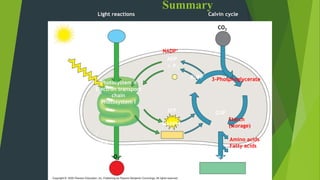
Summary
Light
CO2
H2O
Light reactions Calvin cycle
NADP+
RuBP
G3PATP
Photosystem II
Electron transport
chain
Photosystem I
O2
Chloroplast
NADPH
ADP
+ P i
3-Phosphoglycerate
Starch
(storage)
Amino acids
Fatty acids
Sucrose (export)
Summary………
Light Dependent Reactions
 Overall input
light energy, H2O.
 Overall output
ATP, NADPH, O2.
Light Independent Reactions
 Overall input
CO2, ATP, NADPH.
 Overall output
glucose.
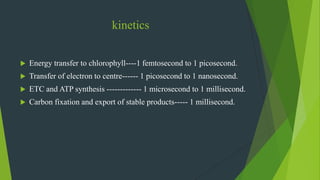
kinetics
 Energy transfer to chlorophyll----1 femtosecond to 1 picosecond.
 Transfer of electron to centre------ 1 picosecond to 1 nanosecond.
 ETC and ATP synthesis ------------- 1 microsecond to 1 millisecond.
 Carbon fixation and export of stable products----- 1 millisecond.
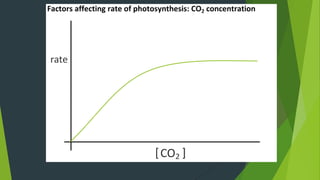
plateau
At low CO2 concentration, rate is
positively correlated with concentration
CO2 is a substrate in an
enyme-catalysed light-
dependent reaction.
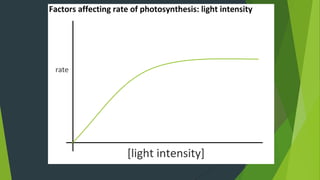
At low light intensity, rate of photosynthesis is
proportional to light intensity.
plateau
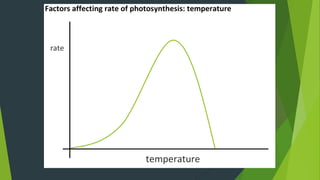
Increased temp.
gives increased
energy and
increased rate of
photosynthesis
Optimum
temperature
Above the
optimum temp.,
enzymes are
denatured and
rate drops steeply.
Which enzymes are
used in respiration?

Photosynthesis

  • 1.
  • 2.
    Overview: The ProcessThat Feeds the Biosphere  Photosynthesis is the process that converts solar energy into chemical energy. Or we can say in different word,  Photosynthesis is the process a plant uses to make food and grow.  Directly or indirectly, photosynthesis nourishes almost the entire living world.  Photosynthesis occurs in plants, algae, certain other protists, and some prokaryotes.  These organisms feed not only themselves but also the entire living world.
  • 3.
     Autotrophs arethe producers of the biosphere, producing organic molecules from CO2 and other inorganic molecules.  Almost all plants are photoautotrophs, using the energy of sunlight to make organic molecules from water and carbon dioxide  Heterotrophs obtain their organic material from other organisms  Heterotrophs are the consumers of the biosphere  Almost all heterotrophs, including humans, depend on photoautotrophs for food and oxygen
  • 4.
    Overview of cyclebetween autotrophs & heterotrophs
  • 5.
    • Autotrophs generatetheir own organic matter through photosynthesis • Sunlight energy is transformed to energy stored in the form of chemical bonds (a) Mosses, ferns, and flowering plants (b) Kelp (c) Euglena (d) Cyanobacteria THE BASICS OF PHOTOSYNTHESIS
  • 6.
    Different wavelengths ofvisible light are seen by the human eye as different colors. WHY ARE PLANTS GREEN? Gamma rays X-rays UV Infrared Micro- waves Radio waves Visible light Wavelength (nm)
  • 7.
     Chloroplasts absorblight energy and convert it to chemical energy Light Reflected light Absorbed light Transmitted light Chloroplast The color of light seen is the color not absorbed
  • 8.
    Four things areneeded for photosynthesis: Travels up from the roots WATER CARBON DIOXIDE Enters the leaf through small holes on the underneath SUNLIGHT Gives the plant energy CHLOROPHYLL The green stuff where the chemical reactions happen
  • 9.
    Chloroplasts: The Sitesof Photosynthesis  Leaves are the major locations of photosynthesis  Their green color is from chlorophyll, the green pigment within chloroplasts  Light energy absorbed by chlorophyll drives the synthesis of organic molecules in the chloroplast  Through microscopic pores called stomata, CO2 enters the leaf and O2 exits .  Chloroplasts are found mainly in cells of the mesophyll, the interior tissue of the leaf  A typical mesophyll cell has 30-40 chloroplasts  The chlorophyll is in the membranes of thylakoids (connected sacs in the chloroplast); thylakoids may be stacked in columns called grana  Chloroplasts also contain stroma, a dense fluid
  • 10.
     The locationand structure of chloroplasts LEAF CROSS SECTION MESOPHYLL CELL LEAF Chloroplast Mesophyll CHLOROPLAST Intermembrane space Outer membrane Inner membrane Thylakoid compartmentThylakoidStroma Granum StromaGrana
  • 11.
    Chloroplast Pigments  Chloroplastscontain several pigments – Chlorophyll a – Chlorophyll b – Carotenoids – Xanthophyll Figure 7.7
  • 12.
    Different pigments absorblight differently
  • 13.
     Photosynthesis isthe process by which autotrophic organisms use light energy to make sugar and oxygen gas from carbon dioxide and water.  Photosynthesis is a redox process in which water is oxidized and carbon dioxide is reduced An overview of photosynthesis Carbon dioxide Water Glucose Oxygen gas PHOTOSYNTHESIS
  • 14.
    The word andchemical equations for photosynthesis: Carbon dioxide + water glucose + oxygen 6CO2 + 6H20 C6H12O6 + 6O2 Sunlight Chlorophyll Sunlight Chlorophyll
  • 15.
    Stages of Photosynthesis Light reactions (the photo part)  Occur in the thylakoids  Split water,  Release O2,  Produce ATP, NADPH  Calvin cycle (the synthesis part)  Occur in the stroma  Forms sugar from CO2,  Using ATP and NADPH  Begins with carbon fixation,  Incorporating CO2 into organic molecules
  • 16.
  • 17.
  • 18.
    • The actionspectrum of photosynthesis was first demonstrated in 1883 by Thomas Engelmann • In his experiment, he exposed different segments of a filamentous alga to different wavelengths • He used aerobic bacteria clustered along the alga as a measure of O2 production
  • 19.
    A Photosystem: AReaction Center Associated with Light- Harvesting Complexes  A photosystem consists of a reaction center surrounded by light-harvesting complexes  The light-harvesting complexes (pigment molecules bound to proteins) funnel the energy of photons to the reaction center. • There are two types of photosystems in the thylakoid membrane • Photosystem II functions first (the numbers reflect order of discovery) and is best at absorbing a wavelength of 680 nm • Photosystem I is best at absorbing a wavelength of 700 nm • The two photosystems work together to use light energy to generate ATP and NADPH
  • 20.
  • 21.
    Photophosphorylation  Two typesof Photophosphorylation  Cyclic  Photosystem1 (best work at 700nm)  produces only ATP  Non-cyclic  Photosystem2 (best work at 680nm) and photosystem1 (best work at 700nm)  produces only ATP and NADPH
  • 22.
    Cyclic Photophosphorylation  Processfor ATP generation associated with some Photosynthetic Bacteria  Reaction Center => 700 nm Cytochrome complex Fd Pc Primary acceptor Photosystem I ATP
  • 23.
    Primary electron acceptor Primary electron acceptor Photons PHOTOSYSTEMI PHOTOSYSTEM II Energy for synthesis of by chemiosmosis Noncyclic Photophosphorylation  Photosystem II regains electrons by splitting water, leaving O2 gas as a by-product
  • 24.
  • 25.
    Chemiosmosis powers ATPsynthesis in the light reactions  The electron transport chains are arranged with the photosystems in the thylakoid membranes and pump H+ through that membrane  The flow of H+ back through the membrane is harnessed by ATP synthase to make ATP  In the stroma, the H+ ions combine with NADP+ to form NADPH
  • 26.
    2 H +1/2 Water-splitting photosystem Reaction- center chlorophyll Light Primary electron acceptor Energy to make Primary electron acceptor Primary electron acceptor NADPH-producing photosystem Light NADP 1 2 3 How the Light Reactions Generate ATP and NADPH
  • 27.
     The productionof ATP by chemiosmosis in photosynthesis Thylakoid compartment (high H+) Thylakoid membrane Stroma (low H+) Light Antenna molecules Light ELECTRON TRANSPORT CHAIN PHOTOSYSTEM II PHOTOSYSTEM I ATP SYNTHASE
  • 28.
    The Calvin cycleuses ATP and NADPH to convert CO2 to sugar  The Calvin cycle, like the citric acid cycle, regenerates its starting material after molecules enter and leave the cycle  The cycle builds sugar from smaller molecules by using ATP and the reducing power of electrons carried by NADPH  Carbon enters the cycle as CO2 and leaves as a sugar named glyceraldehyde-3-phospate (G3P)  For net synthesis of one G3P, the cycle must take place three times, fixing three molecules of CO2
  • 29.
     The Calvincycle has three phases:  Carbon fixation (catalyzed by rubisco)  Reduction  Regeneration of the CO2 acceptor (RuBP)
  • 30.
    LE 10-18_3 [CH2O] (sugar)O2 NADPH ATP ADP NADP+ CO2 H2O LIGHT REACTIONS CALVIN CYCLE Light Input CO2 (Enteringone at a time) Rubisco 3 P P Short-lived intermediate Phase 1: Carbon fixation 6 P 3-Phosphoglycerate 6 ATP 6 ADP CALVIN CYCLE 3 P P Ribulose bisphosphate (RuBP) 3 6 NADP+ 6 6 NADPH P i 6 P 1,3-Bisphosphoglycerate P 6 P Glyceraldehyde-3-phosphate (G3P) P1 G3P (a sugar) Output Phase 2: Reduction Glucose and other organic compounds 3 3 ADP ATP Phase 3: Regeneration of the CO2 acceptor (RuBP) P5 G3P
  • 31.
    Summary Light CO2 H2O Light reactions Calvincycle NADP+ RuBP G3PATP Photosystem II Electron transport chain Photosystem I O2 Chloroplast NADPH ADP + P i 3-Phosphoglycerate Starch (storage) Amino acids Fatty acids Sucrose (export)
  • 32.
    Summary……… Light Dependent Reactions Overall input light energy, H2O.  Overall output ATP, NADPH, O2. Light Independent Reactions  Overall input CO2, ATP, NADPH.  Overall output glucose.
  • 33.
    kinetics  Energy transferto chlorophyll----1 femtosecond to 1 picosecond.  Transfer of electron to centre------ 1 picosecond to 1 nanosecond.  ETC and ATP synthesis ------------- 1 microsecond to 1 millisecond.  Carbon fixation and export of stable products----- 1 millisecond.
  • 34.
    plateau At low CO2concentration, rate is positively correlated with concentration CO2 is a substrate in an enyme-catalysed light- dependent reaction.
  • 35.
    At low lightintensity, rate of photosynthesis is proportional to light intensity. plateau
  • 36.
    Increased temp. gives increased energyand increased rate of photosynthesis Optimum temperature Above the optimum temp., enzymes are denatured and rate drops steeply. Which enzymes are used in respiration?

Editor's Notes

  • #35 CO2 affects rate of photosynthesis. CO2 is the substrate in carbon fixation (Calvin cycle) – rubisco is the enzyme.
  • #36 Light intensity affects rate of photosynthesis.
  • #37 Temperature affects the rate of photosynthesis. Remember enzyme theory. Enzymes used in respiration: rubisco is the main one. ATP synthase can also be denatured.