TROPOSPHERIC POLLUTION
1.GASEOUS AIR POLLUTANTS
2.PARTICULATE POLLUTANTS
GASEOUS AIR POLLUTANTS
1.OXIDES OF SULPHUR
2.OXIDES OF NITROGEN
3.HYDROCARBONS
4.OXIDES OF CARBON
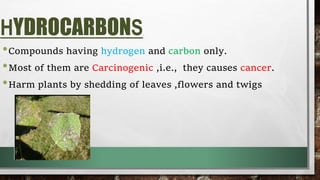
HYDROCARBONS
•Compounds having hydrogen and carbon only.
•Most of them are Carcinogenic ,i.e., they causes cancer.
•Harm plants by shedding of leaves ,flowers and twigs
OXIDES OF CARBON
•CARBON MONOXIDE
•CARBON DIOXIDE
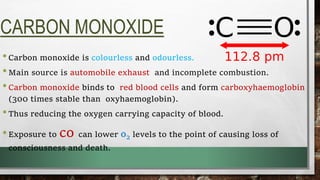
CARBON MONOXIDE
•Carbon monoxide is colourless and odourless.
•Main source is automobile exhaust and incomplete combustion.
•Carbon monoxide binds to red blood cells and form carboxyhaemoglobin
(300 times stable than oxyhaemoglobin).
•Thus reducing the oxygen carrying capacity of blood.
•Exposure to co can lower o2 levels to the point of causing loss of
consciousness and death.
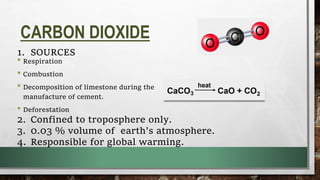
CARBON DIOXIDE
1. SOURCES
2. Confined to troposphere only.
3. 0.03 % volume of earth’s atmosphere.
4. Responsible for global warming.
• Respiration
• Combustion
• Decomposition of limestone during the
manufacture of cement.
• Deforestation
• Because of green house effect the average temperature of the earth
increases and this is known as global warming.
Causes
• Increase in the concentration of co2.
• Increase in the concentration of methane (ch4) which is emitted
when vegetation is burnt, paddy fields ,coal mines, etc..
• Increase in the concentration of Chlorofluorocarbons which is
commonly emitted from refrigerators, air conditioners and
microwave ovens.
IMPACTS OF GLOBAL WARMING
•Depletion of ozone layer
• Melting of polar ice caps
•Floods
•Increase in global temperature.
•Rising sea levels
•More frequent and intense extreme weather events
•Oceans are warming and acidifying
•
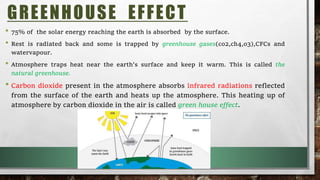
• 75% of the solar energy reaching the earth is absorbed by the surface.
• Rest is radiated back and some is trapped by greenhouse gases(co2,ch4,o3),CFCs and
watervapour.
• Atmosphere traps heat near the earth’s surface and keep it warm. This is called the
natural greenhouse.
• Carbon dioxide present in the atmosphere absorbs infrared radiations reflected
from the surface of the earth and heats up the atmosphere. This heating up of
atmosphere by carbon dioxide in the air is called green house effect.
GREENHOUSE EFFECT
HOW CAN WE REDUCE
GLOBAL
WARMING ?
ACID RAIN
•We are aware that normally rain water has a pH of 5.6 due to
presence of hydrogen ions formed by reaction of rain water with
carbon dioxide present in the atmosphere.
• H2O (l) + CO2 (g) ↔ H2CO3 (aq)
•H2CO3 (aq) ↔ H+ (aq) + HCO3 − (aq)
• when the pH of the rain water drops below 5.6, it is called
acid rain.
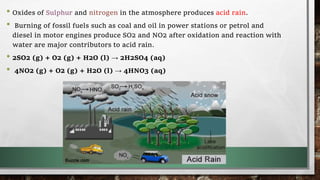
• Oxides of Sulphur and nitrogen in the atmosphere produces acid rain.
• Burning of fossil fuels such as coal and oil in power stations or petrol and
diesel in motor engines produce SO2 and NO2 after oxidation and reaction with
water are major contributors to acid rain.
• 2SO2 (g) + O2 (g) + H2O (l) → 2H2SO4 (aq)
• 4NO2 (g) + O2 (g) + H2O (l) → 4HNO3 (aq)
RESULTS OF ACID RAIN
•Acid rain is harmful for agriculture, trees and plants as it
dissolves and washes away nutrients needed for their
growth.
•It causes respiratory ailments in human beings and
animals.
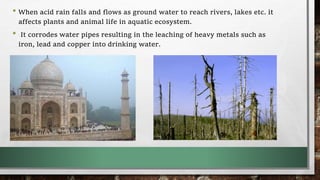
• When acid rain falls and flows as ground water to reach rivers, lakes etc. it
affects plants and animal life in aquatic ecosystem.
• It corrodes water pipes resulting in the leaching of heavy metals such as
iron, lead and copper into drinking water.
Credits:scienceclues

Environmental chemistry -class xi

  • 2.
    TROPOSPHERIC POLLUTION 1.GASEOUS AIRPOLLUTANTS 2.PARTICULATE POLLUTANTS
  • 3.
    GASEOUS AIR POLLUTANTS 1.OXIDESOF SULPHUR 2.OXIDES OF NITROGEN 3.HYDROCARBONS 4.OXIDES OF CARBON
  • 4.
    HYDROCARBONS •Compounds having hydrogenand carbon only. •Most of them are Carcinogenic ,i.e., they causes cancer. •Harm plants by shedding of leaves ,flowers and twigs
  • 5.
    OXIDES OF CARBON •CARBONMONOXIDE •CARBON DIOXIDE
  • 6.
    CARBON MONOXIDE •Carbon monoxideis colourless and odourless. •Main source is automobile exhaust and incomplete combustion. •Carbon monoxide binds to red blood cells and form carboxyhaemoglobin (300 times stable than oxyhaemoglobin). •Thus reducing the oxygen carrying capacity of blood. •Exposure to co can lower o2 levels to the point of causing loss of consciousness and death.
  • 7.
    CARBON DIOXIDE 1. SOURCES 2.Confined to troposphere only. 3. 0.03 % volume of earth’s atmosphere. 4. Responsible for global warming. • Respiration • Combustion • Decomposition of limestone during the manufacture of cement. • Deforestation
  • 9.
    • Because ofgreen house effect the average temperature of the earth increases and this is known as global warming. Causes • Increase in the concentration of co2. • Increase in the concentration of methane (ch4) which is emitted when vegetation is burnt, paddy fields ,coal mines, etc.. • Increase in the concentration of Chlorofluorocarbons which is commonly emitted from refrigerators, air conditioners and microwave ovens.
  • 10.
    IMPACTS OF GLOBALWARMING •Depletion of ozone layer • Melting of polar ice caps •Floods •Increase in global temperature. •Rising sea levels •More frequent and intense extreme weather events •Oceans are warming and acidifying •
  • 11.
    • 75% ofthe solar energy reaching the earth is absorbed by the surface. • Rest is radiated back and some is trapped by greenhouse gases(co2,ch4,o3),CFCs and watervapour. • Atmosphere traps heat near the earth’s surface and keep it warm. This is called the natural greenhouse. • Carbon dioxide present in the atmosphere absorbs infrared radiations reflected from the surface of the earth and heats up the atmosphere. This heating up of atmosphere by carbon dioxide in the air is called green house effect. GREENHOUSE EFFECT
  • 12.
    HOW CAN WEREDUCE GLOBAL WARMING ?
  • 13.
    ACID RAIN •We areaware that normally rain water has a pH of 5.6 due to presence of hydrogen ions formed by reaction of rain water with carbon dioxide present in the atmosphere. • H2O (l) + CO2 (g) ↔ H2CO3 (aq) •H2CO3 (aq) ↔ H+ (aq) + HCO3 − (aq) • when the pH of the rain water drops below 5.6, it is called acid rain.
  • 14.
    • Oxides ofSulphur and nitrogen in the atmosphere produces acid rain. • Burning of fossil fuels such as coal and oil in power stations or petrol and diesel in motor engines produce SO2 and NO2 after oxidation and reaction with water are major contributors to acid rain. • 2SO2 (g) + O2 (g) + H2O (l) → 2H2SO4 (aq) • 4NO2 (g) + O2 (g) + H2O (l) → 4HNO3 (aq)
  • 15.
    RESULTS OF ACIDRAIN •Acid rain is harmful for agriculture, trees and plants as it dissolves and washes away nutrients needed for their growth. •It causes respiratory ailments in human beings and animals.
  • 16.
    • When acidrain falls and flows as ground water to reach rivers, lakes etc. it affects plants and animal life in aquatic ecosystem. • It corrodes water pipes resulting in the leaching of heavy metals such as iron, lead and copper into drinking water.
  • 18.